All How to Build Healthcare Supply Chain Management Software
July 8, 202615 min read


Logistics in patient care is no longer a back-office function. Manual tracking, paper workflows, and disconnected databases create real risks: drug shortages, emergency purchases, excess stock, and missed savings.
Custom healthcare supply chain software helps hospitals track inventory in real time, predict shortages earlier, and keep medical items within safe stock levels. It also reduces waste, limits rogue spending, and supports compliance across regional healthcare networks.
That is why more providers are investing in healthcare supply chain management software development built around automation, visibility, and secure inventory control. Let’s take a closer look at this.
What Is Healthcare Supply Chain Management Software?
Healthcare supply chain management software coordinates the sourcing, storage, and movement of medical items from production lines to clinical rooms, which makes supply chain management software development a distinct category from retail logistics.
By linking finance, logistics, and patient registries, healthcare supply chain management software coordinates purchasing decisions across multiple hospital wards and connects clinical demand with backend business operations.
Managers get real-time visibility into products. Clinicians use the same system to track medications, surgical implants, and protective gear without pulling focus away from patient care.
Unlike standard retail logistics engines, specialized healthcare logistics software tracks Unique Device Identifiers (UDIs) and serial numbers to support recalls and guarantee product safety.
Dedicated healthcare procurement software helps purchasing departments align order volumes with preferred vendor agreements, which prevents compliance issues while cutting procurement delays. A dedicated healthcare supply chain software platform gives administrative teams a single place to manage all of this.
A well-designed platform also has to coordinate action across diverse partners: regional health networks, pharmaceutical distributors, clinical laboratories, device manufacturers. When hospitals deploy scalable hospital supply chain management software, they eliminate manual entry errors and bring multiple locations onto a single system of record.
Why Healthcare Organizations Need Better Supply Chain Software in 2026
Operating margins are dropping under Medicaid funding cuts and high inflation.
Standard procurement strategies can no longer cushion health networks from vendor shortages and rising pharmaceutical costs. Rising costs alone account for 60% of the challenges procurement leaders face today. In response, administrators are shifting toward customized medical supply chain software to improve demand forecasting.
Rising Costs and Supply Shortages
When clinical environments run low on medical products, emergency courier shipments drive up operating overhead. Dedicated hospital supply chain solutions let logistics teams analyze stock movements across every floor, and that visibility prevents overstocking and cuts waste from expired biological shipments.
Automated replenishment tools protect hospitals from sudden vendor delays. Administrators use modern healthcare supply chain software to improve demand planning and get ahead of those delays before they hit.
More Complex Pharmaceutical and Medical Device Distribution
Specialty medications, blood products, and advanced biological therapies require uninterrupted temperature tracking, so distributors have to monitor cold storage environments to prevent product degradation.
Specialized healthcare supply chain solutions let health networks monitor environmental sensors during transit. New serialization requirements add another layer: each drug package now needs verified transaction details attached.
The Shift from Manual Work to Predictive Operations
Manual checklists can't keep pace with the volatile schedules of modern surgical wards.
Advanced healthcare supply chain automation lets clinics align material flows with patient demand by analyzing historical consumption alongside upcoming clinical appointments. That reduces clinical overhead and keeps critical items ready before a surgeon asks for them.
Core Features of Healthcare Supply Chain Management Software
To protect hospital workflows from inventory gaps, clinical networks need a strong platform that covers every step of the logistics path. Building this tool requires specialized SCM software development focused on real-time data accuracy. Here are the primary functional modules required for supply tracking.
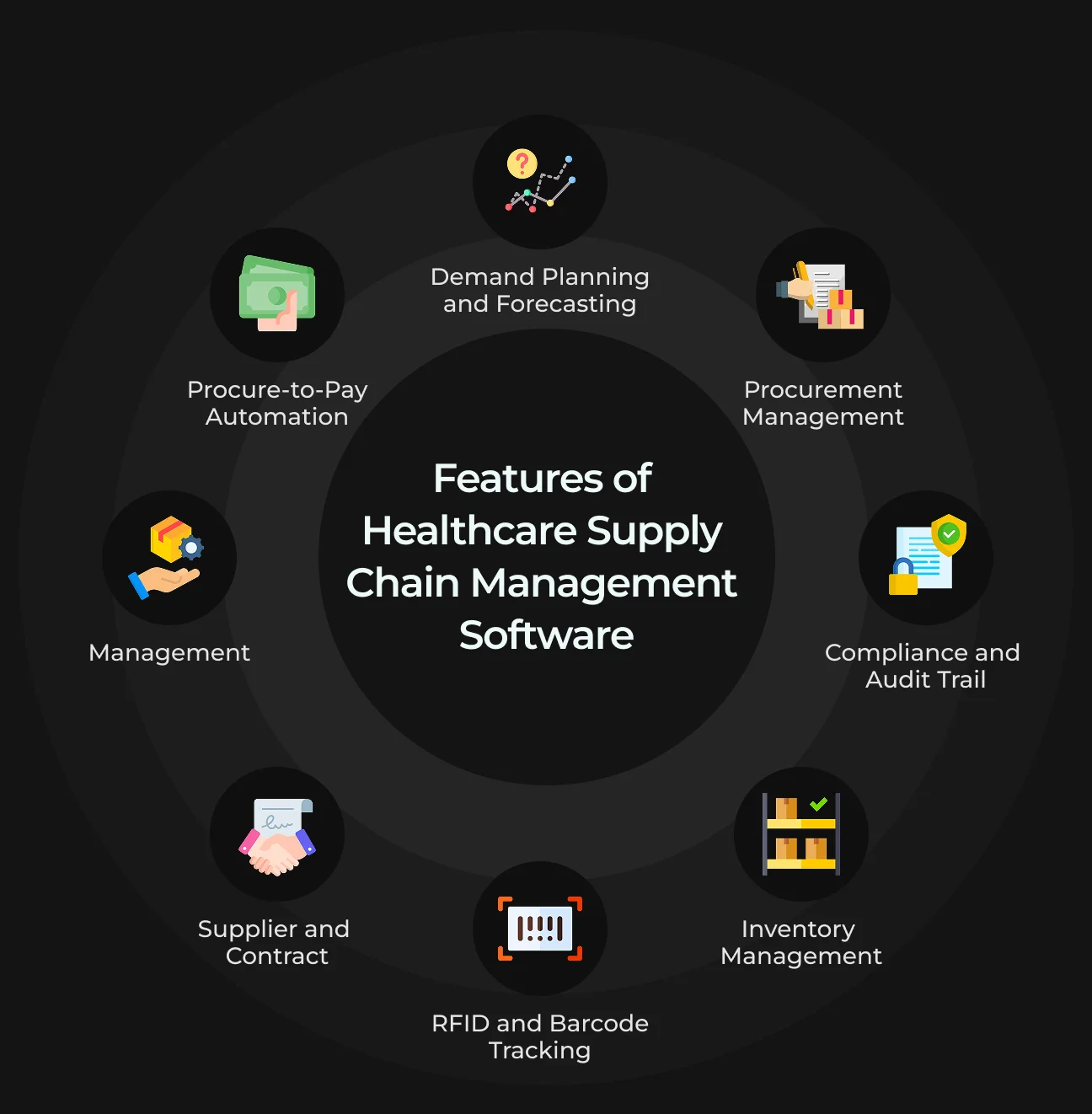
Demand Planning and Forecasting
This module predicts required product volumes by examining:
- Patient intake trends;
- Historical product consumption;
- Upcoming surgical bookings;
- Seasonal disease outbreaks and infection-rate fluctuations;
- Emergency room admission patterns;
- Supplier delivery timelines and procurement delays;
- Expiration dates of critical medical supplies;
- Department-specific usage rates across facilities;
- Regional demographic and population health data;
- Real-time inventory turnover metrics.
This predictive approach shapes modern supply chain software development targets. Linked with clinical schedulers, the system flags potential surges in surgical gloves or specialized catheters, keeping stock levels safe and reducing overall inventory carrying costs.
Procurement Management
Purchasing departments use this tool to:
- Manage purchase orders;
- Select alternative suppliers during manufacturer backorders;
- Track supplier performance and delivery reliability;
- Monitor contract pricing and compliance requirements;
- Automate approval workflows for medical procurement requests;
- Consolidate purchasing activity across multiple facilities;
- Validate inventory availability before placing new orders;
- Reduce duplicate or unauthorized purchasing;
- Generate procurement reports for audits and budgeting;
- Coordinate emergency sourcing during supply shortages.
Standardized healthcare procurement software directs purchases toward contracted, pre-approved vendor catalogs. Managing purchase orders is a primary goal in supply chain management software development, and it's what contains rogue spending and keeps purchases aligned with pre-negotiated corporate rates.
Compliance and Audit Trail
Every product receipt, location shift, and clinical dispense must be recorded on a permanent record. This tracking ensures compliance with federal drug security rules and simplifies recall operations. When agencies request product reports, the system produces clean transaction histories quickly.
Inventory Management
Real-time stock monitoring:
- Prevents double-ordering;
- Helps clinicians find supplies across different treatment rooms;
- Tracks inventory movement between departments and facilities;
- Identifies low-stock and overstock situations instantly;
- Reduces supply shortages during critical procedures;
- Improves visibility into high-value or regulated medical items;
- Supports barcode and RFID-based inventory tracking;
- Minimizes product expiration and waste;
- Accelerates replenishment workflows for nursing staff;
- Maintains accurate inventory records for compliance audits.
The system tracks items from central warehouses down to specific storage carts, using customized reorder points. When quantities drop below safety limits, the software sends alerts to prompt immediate replenishment.
Build Software That Prevents Costly Stockouts
Talk to SapientPro's engineers about custom healthcare supply chain management software built for your hospital network.

RFID and Barcode Tracking
Automatic scanning speeds up intake workflows and connects used products directly to electronic health records. By coupling hardware scanning with hospital supply chain software, staff can verify in seconds:
- Surgical implants;
- High-value drugs;
- Blood products and laboratory samples;
- Expiration dates of sterile supplies;
- Lot and batch numbers for regulated items;
- Patient-specific medication assignments;
- Medical devices requiring maintenance tracking;
- Controlled substances and narcotics;
- PPE usage across departments;
- Returned or recalled medical products.
This ensures a complete trace history and simplifies inventory audits.
Supplier and Contract Management
This repository holds:
- Vendor licensing details;
- Pricing contracts;
- Lead-time scores;
- Regulatory compliance certifications;
- Product quality and recall histories;
- Supplier delivery performance metrics;
- Insurance and liability documentation;
- Approved product catalogs;
- Service-level agreement (SLA) records;
- Alternative sourcing options for critical supplies.
It helps procurement teams evaluate supplier compliance and find backup suppliers during global disruptions, which reduces single-source dependency and protects clinical teams from unexpected shortages.
Procure-to-Pay Automation
Automating invoice matching reduces administrative overhead and minimizes invoicing errors. Enterprise teams invest in professional supply chain software development to connect purchase records with accounts payable, which speeds up vendor payments and helps health systems qualify for early-payment discounts.
Healthcare Supply Chain Management Software Architecture
Enterprise architecture must support high data volumes while maintaining strict compliance. Building these systems requires modern healthcare supply chain management software development frameworks. Here's how these systems get structured.
Cloud-Native Infrastructure
Deploying cloud-native hosting ensures high availability across multiple hospital sites.
It allows remote warehouse teams, clinics, and purchasing hubs to view inventory numbers on a single dashboard. Cloud-native hosting supports disaster recovery. It also allows hospitals to scale storage capacity as transaction volumes increase.
Interoperability with EHR and ERP Systems
Connecting inventory tools with clinical databases like Epic, Oracle, or Cerner is necessary for patient-centric tracking. This synchronization requires specialized SCM software development to ensure billing teams can charge for used surgical implants.
It also lets clinical platforms trigger supply requests based on scheduled procedures.
FHIR-Based Data Exchange
Modern data sharing relies on Fast Healthcare Interoperability Resources (FHIR) to exchange information. This standard uses web-friendly formats to transfer supply details without custom translations. Engineering teams focused on supply chain software development map these models using specific FHIR resources:
- SupplyRequest. It identifies the need for a specific item to be delivered to a clinic floor.
- SupplyDelivery. It documents the actual movement and arrival of requested supplies.
- Device. It houses details regarding surgical equipment, pacemakers, or diagnostic tools.
- Medication. It tracks pharmaceutical products, their dosages, and physical forms.
Data Layer and Analytics
SapientPro recommends using PostgreSQL for managing data and analytics. It works well for structured supply profiles and vendor details.
To support high-frequency scan tracking, our developers recommend using separate analytical data structures. Clean data pipelines are what let teams generate supplier delivery reports and track inventory turnover.
Security Layer
Every connection point must be secured to protect patient records. We recommend you implement:
Security Requirement | Why It’s Important |
| Data Encryption | Protects clinical and procurement data both in transit and at rest. |
| Role-Based Access Control (RBAC) | Restricts system access based on strict permission hierarchies. |
| Multi-Factor Authentication (MFA) | Adds an extra layer of validation for sensitive operations. |
| Comprehensive Audit Logs | Tracks and records all user and system actions. |
| Automatic Session Logoff | Automatically disconnects users after periods of inactivity. |
| Secure API Gateways | Protects interfaces using token-based authentication. |
| Vendor Access Controls | Limits third-party permissions to a strictly defined, narrow scope. |
| Network Segmentation | Isolates clinical, procurement, and external networks from one another. |
| Security Patching & Vulnerability Management | Regularly updates systems to fix known flaws and exposures. |
| Encrypted & Geo-Redundant Backups | Safely duplicates data across locations and tests recovery procedures. |
| Intrusion Detection & Anomaly Monitoring | Continually watches for unauthorized access and unusual system behavior. |
| Compliance Alignment | Ensures adherence to healthcare standards like HIPAA and GDPR. |
These measures are foundational to reliable hospital supply chain management software and healthcare logistics software alike.
How to Use AI in Healthcare Supply Chain Software
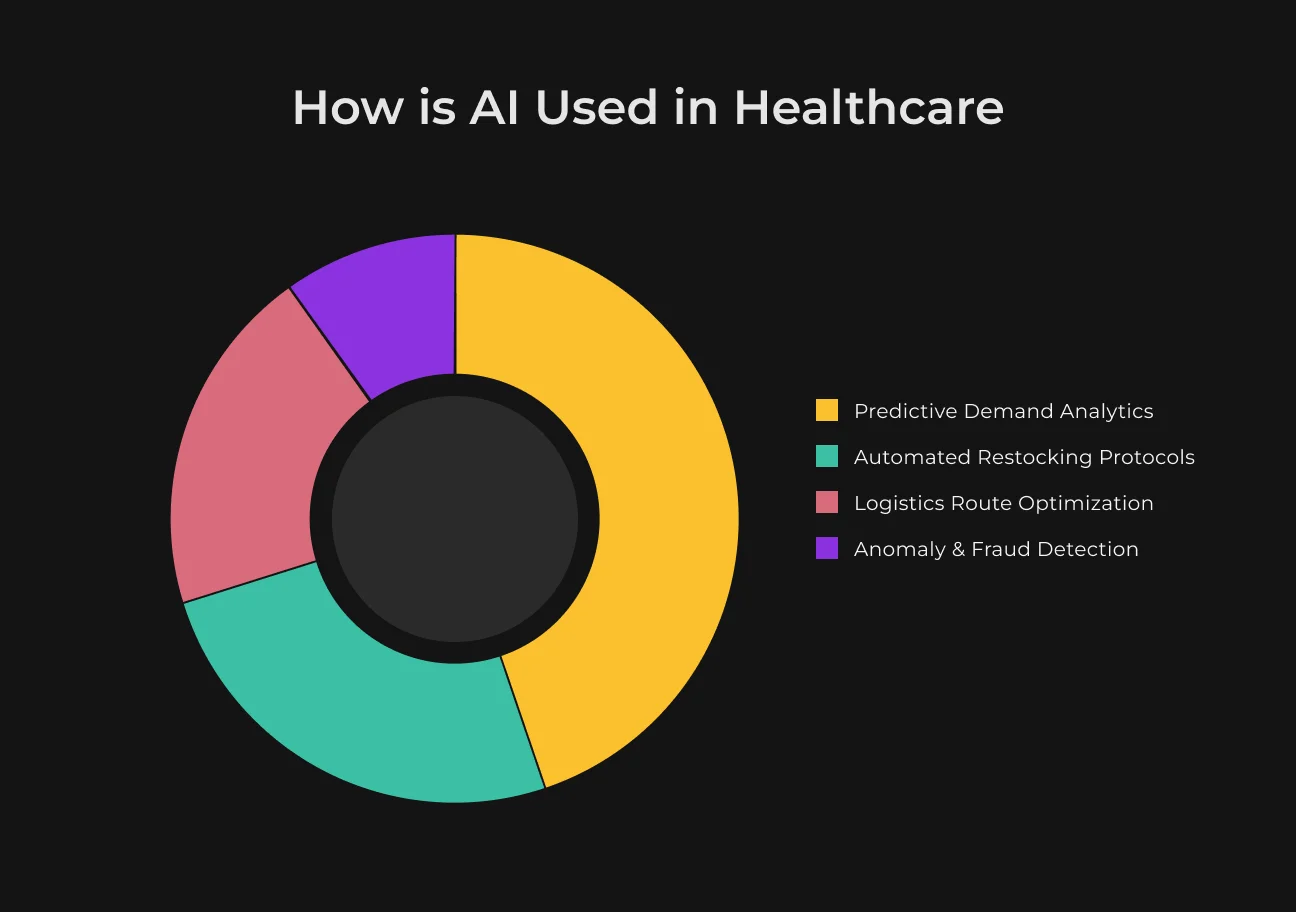
Deploying machine learning models helps clinics move away from reactive purchasing. We think leading health networks will soon adopt enterprise-scale healthcare supply chain automation to lower costs. Here's how AI optimizes medical supply pathways.
Inventory Optimization
Hospitals carry inventory across multiple locations: central stores, procedure rooms, operating suites, nursing unit supply closets, and crash carts. AI-driven optimization works across all of these simultaneously, which is where manual par-level management consistently fails.
It helps with:
- Reducing overstocking.
Excess inventory ties up capital and increases the risk of expiration waste.
AI models identify which locations consistently carry safety stock far beyond actual consumption and recommend par reductions backed by statistical confidence levels. This matters most for high-cost implantables and specialty pharmaceuticals.
- Preventing stockouts.
The model flags items where current inventory, incoming orders, and forecast demand are on a collision course. It accounts for supplier lead time variability, not just the average lead time, but also the distribution of how often a given supplier delivers early, on time, or late.
- Detecting slow-moving items.
Products that sit in inventory beyond a clinically acceptable window represent both waste and clutter. AI classifies items by velocity, flags candidates for return or substitution, and identifies whether slow movement is system-wide or isolated to specific locations.
- Flagging near-expiry products.
This is one of the clearest wins for AI in healthcare inventory. The model tracks lot-level expiration dates against current consumption rates and alerts teams when a product is unlikely to be used before it expires, with enough lead time to redistribute it to higher-consumption locations or arrange a vendor return.
AI Demand Forecasting
Traditional demand forecasting in healthcare relied on trailing averages and manual adjustments by supply chain coordinators. The problem is that healthcare demand is shaped by overlapping signals that no spreadsheet formula handles well simultaneously.
Modern AI forecasting models ingest historical consumption data as a baseline, then layer in variables that move independently of each other. Patient census figures tell the model how many beds are occupied and what acuity mix is present.
Clinical schedules (elective surgeries, procedure blocks, outpatient clinic volumes) produce predictable spikes in specific supply categories days or weeks in advance. Seasonal patterns affect everything from flu-related PPE consumption to orthopedic implant demand tied to post-summer trauma volumes.
External event data adds another dimension. ED volumes can be shifted significantly by:
- Regional disease outbreaks;
- Mass casualty incidents;
- Large-scale public gatherings or local sporting events;
- Weather-related disruptions affecting injury rates and admissions;
- Public health policy changes or vaccination campaigns.
AI models trained on these correlations can adjust procurement recommendations before the surge arrives rather than after the shelves empty.
The practical output for supply chain software is a rolling forecast, typically 30, 60, and 90 days. You get confidence intervals that widen as the horizon extends. Procurement teams get lead time recommendations tied to supplier delivery windows, not just reorder points.
Supplier Risk Monitoring
Healthcare supply chains learned a painful lesson during the COVID-19 pandemic: supplier concentration is a structural vulnerability. AI tools now give supply chain teams continuous visibility into that risk rather than a static vendor scorecard reviewed once a year. They help with:
- AI-based supplier scoring.
Models aggregate delivery performance history, fill rate trends, lead time variance, and financial health signals into a dynamic risk score for each vendor. A supplier whose score has been declining for three consecutive months is a problem to address before a shortage, not after.
- Disruption alerts.
NLP tools scan news feeds, shipping data, regulatory filings, and public health announcements for signals relevant to active suppliers. A port closure in a key manufacturing region, an FDA warning letter to a drug manufacturer, a factory fire — these events trigger alerts that feed directly into supply chain planning workflows.
- Alternative vendor suggestions.
When a primary supplier's risk score crosses a threshold or a disruption alert fires, the system surfaces pre-vetted alternative vendors for the affected items. Ideally, these alternatives are already contracted, so procurement can act without starting a sourcing process from scratch.
- Contract risk analysis.
AI tools applied to contract data can identify clauses that create risk exposure: sole-source provisions, force majeure language that favors the supplier, automatic renewal terms with price escalation tied to indices the hospital cannot control. This is an area where AI assists legal and supply chain teams in parallel rather than replacing either.
Agentic AI for Autonomous Supply Chain Decisions
Agentic AI represents systems that take actions. The capabilities are real.
AI agents can:
- Monitor inventory levels continuously;
- Cross-reference forecasts against open purchase orders;
- Reroute shipments when a delivery is delayed;
- Trigger emergency procurement from backup suppliers;
- Escalate communications to vendor account managers.
The boundaries matter equally. Not every supply chain decision is equivalent. Routine, high-confidence, low-dollar actions are good candidates for full autonomy:
- Reordering standard consumables within pre-approved contract limits;
- Redistributing inventory between facilities or departments;
- Sending expedite requests for delayed shipments;
- Updating stock levels after verified scan events;
- Auto-replenishing safety stock within predefined thresholds.
Sensitive decisions require a different model. Some actions carry clinical, financial, and contractual consequences that warrant human review before execution:
- Switching a primary supplier for a critical medication;
- Approving emergency purchase orders above defined financial thresholds;
- Overriding clinician-preferred product substitutions;
- Modifying contracted pricing terms or SLAs;
- Authorizing non-formulary or off-contract procurement.
You must define autonomy tiers in the software configuration. Actions below defined risk and cost thresholds execute automatically. Actions above those thresholds queue for human approval with a recommended action and deadline.
Digital Twins for Supply Chain Resilience
A digital twin is a computational model of the supply chain, its nodes, flows, constraints, and dependencies, that can be run forward in time under hypothetical conditions.
The twin does not manage live operations. It's a simulation environment where teams test their supply chain's response to stress before that stress arrives in reality.
In healthcare, the relevant scenarios are specific and high-stakes:
- Shortage simulation.
What happens to downstream inventory if a primary glove manufacturer stops shipping for six weeks? The twin models rate across all facilities, identify which service lines are affected first, and calculate when substitution or conservation protocols would need to activate.
- Shipping delay modeling.
A port closure, a weather event, a customs hold — the twin can model the ripple effect of delayed inbound shipments across the distribution network. Planners see which items clear existing safety stock before the delay resolves and which do not.
- Outbreak response.
A disease outbreak drives rapid, non-linear increases in demand for specific supply categories. The twin models surge scenarios drawn from historical outbreak data or predefined surge profiles, showing where the current inventory strategy holds and where it breaks.
- Supplier failure scenarios.
If a single-source supplier becomes unavailable, the twin shows the full downstream impact. It shows how long existing stock lasts, which alternative suppliers could absorb the volume and at what lead time, and what the cost differential looks like.
The output of a digital twin exercise is not a dashboard metric — it is a decision:
- Which contracts need dual-source redundancy?
- Which safety stock levels are genuinely inadequate?
- Which service lines carry the most supply chain risk?
Those answers come from running the model, not from reviewing historical data.
Compliance Requirements for Healthcare SCM Software
Operating in clinical settings means matching strict federal safety rules. Enterprise groups prioritize healthcare supply chain management software development to ensure compliance across all facilities. This helps clinics avoid heavy legal fines and protect patient safety.
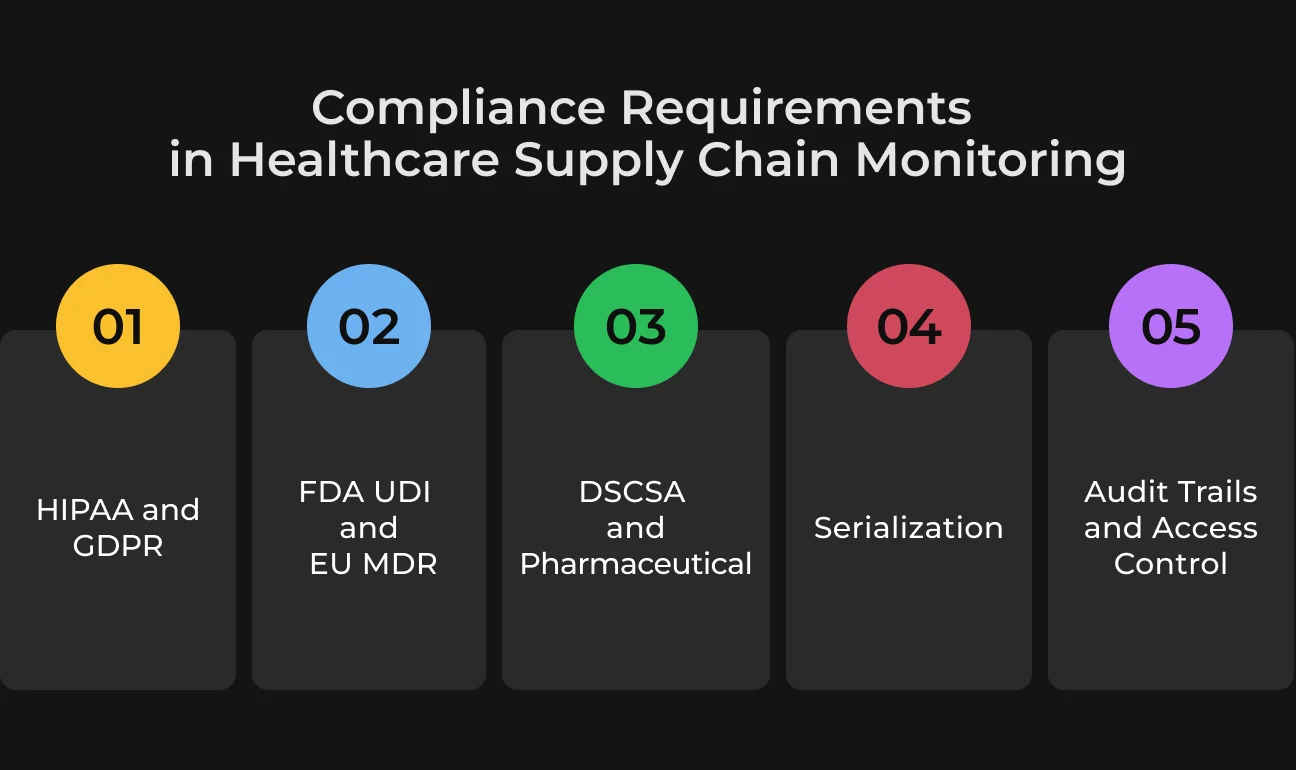
HIPAA and GDPR
Supply tracking tools often connect to patient records to monitor item use.
To protect data privacy, the platform must secure Protected Health Information (PHI) under HIPAA and GDPR rules. Developers must build secure API gateways to exchange data safely, keeping patient details hidden from unauthorized logistics personnel.
FDA UDI and EU MDR
The FDA requires medical devices to have a Unique Device Identifier (UDI) on their packaging.
The system must record these:
- Device identifiers;
- Production details;
- Expiration dates.
If a manufacturer issues a recall, the software must quickly identify affected stock. This protects patients and is a basic requirement of hospital supply chain management software.
DSCSA and Pharmaceutical Serialization
By late 2026, pharmacies and distributors must support full electronic, package-level tracing.
This tracking requires secure data exchange using Electronic Product Code Information Services (EPCIS) standards. If a shipment arrives with missing details or aggregation errors, the product must be quarantined. This complex tracing is managed through specialized healthcare procurement software.
Audit Trails and Access Control
Every inventory change, purchase approval, and recall must be logged on a secure audit trail. Administrators must implement role-based controls to restrict system access.
Complete logging is a major requirement for modern hospital supply chain software. Logistics managers use reliable healthcare logistics software to stay compliant and protect patient safety.
Advanced Technologies to Consider for Healthcare Supply Chain Automation
To build an adaptable platform, development teams can use emerging tracking systems. Adopting modern healthcare supply chain automation helps clinics optimize their logistics lines.
The primary hardware integrations that support software platforms are:
- IoT for cold chain monitoring.
Specialty biologics and vaccines must remain within strict temperature ranges. IoT sensors track temperature, humidity, and movement every few minutes. If transit conditions cross safety thresholds, the system alerts logistics managers. This prevents product waste and protects patient safety.
- Blockchain for drug traceability.
Using a permissioned blockchain provides an immutable record of drug custody. Permissioned networks keep sensitive pricing and contract data secure while proving product origin.
These networks support fast tracking and carry low transaction costs ($0.004 per event). This secure tracking is highly valuable for modern healthcare supply chain solutions.
- Computer vision for warehouse and inventory checks.
Camera systems can scan shelves to check stock levels and read barcodes. Computer vision tools can spot displaced items and verify expiration dates quickly. This helps hospital staff manage inventory without spending hours on manual stock counts.
How to Build Healthcare Supply Chain Management Software: Step-by-Step Guide
Building a reliable healthcare supply chain software system requires a clear plan.
Development Phase | Execution Task | Essential Compliance Measure | Target System |
| Discovery & Scope Definition | Map clinical pathways, list required vendor connections | Define platform targets, outline security rules | Procurement Systems |
| Data Ingestion & Sanitization | Clean supplier catalogs, build ingestion pipelines | Deduplicate supplier names, format lot codes | Inventory Databases |
| Tech Stack Selection | Select cloud architecture, set up secure databases | Isolate databases, choose hosting regions | System Infrastructure |
| Prototyping & MVP | Build basic stock trackers and ordering portals | Connect to basic scanning tools, test interfaces | Warehouse Monitors |
| System Synchronization | Sync EHR systems via FHIR, connect inventory | Match real-time inventory, secure clinical links | Hospital Databases |
| Model & Security Validation | Test AI forecasting, run system trace audits | Verify compliance reports, check security logs | Analytics Tools |
| Production Deployment | Launch across pilot wards, train clinic champions | Monitor data pipelines, support helpdesk staff | Hospital Networks |
Deploying modern healthcare supply chain management software across their locations helps hospitals prevent stockouts. This ensures your finished medical supply chain software runs without performance lags, and it's how clinics build reliable SCM software development pipelines.
Main Challenges in Healthcare Logistics Software Development
Clinical logistics platforms require secure healthcare logistics software to simplify daily logistics workflows.
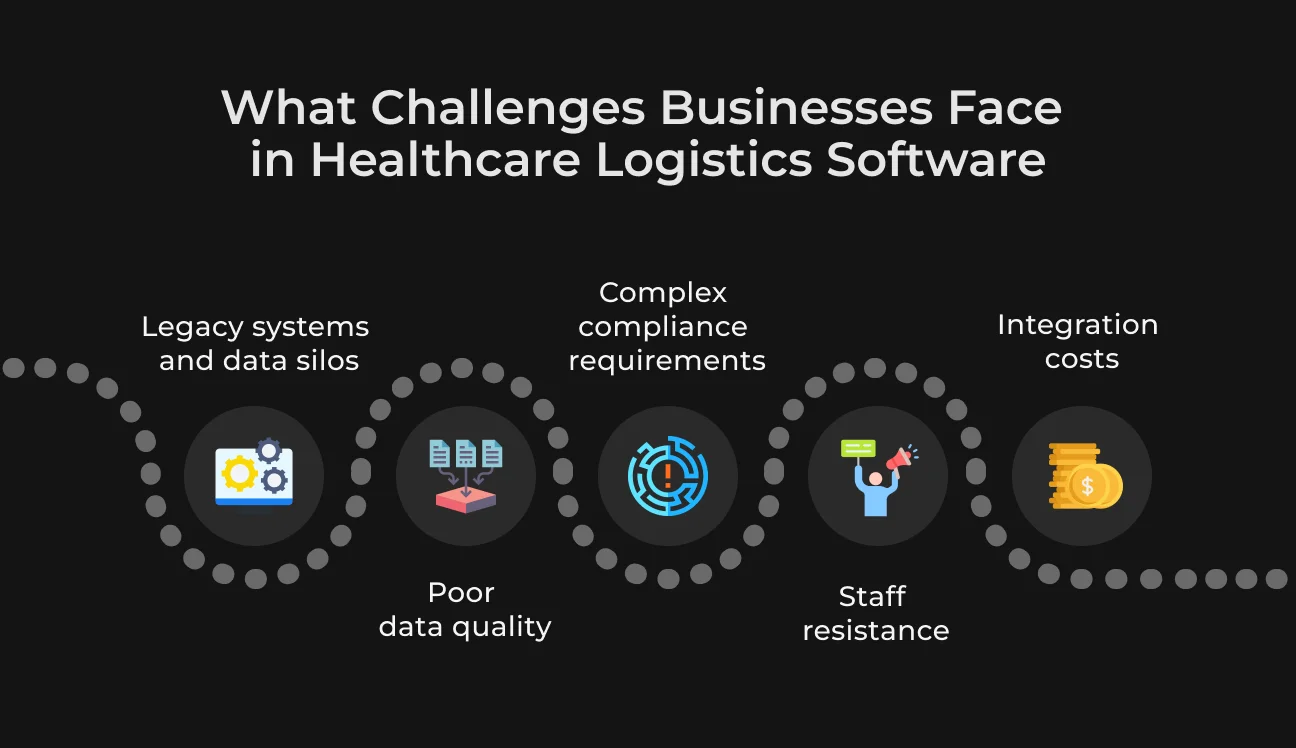
Understanding these barriers helps developers avoid common deployment delays:
- Legacy systems and data silos.
Many hospitals rely on outdated ERP or EHR platforms that do not exchange data easily. These silos force staff to connect legacy tools with new healthcare procurement software manually.
- Poor data quality.
Inconsistent product names and missing lot numbers make tracking medical supplies difficult. Duplicate supplier records and outdated stock figures create major reporting errors. These records complicate supply chain management software development efforts. Resolving these issues is a priority for modern hospital supply chain solutions.
- Complex compliance requirements.
Meeting HIPAA, UDI, and DSCSA rules requires complex tracking within your healthcare supply chain management software. Software teams must build compliance into the platform from the very beginning.
- Staff resistance.
Clinicians often resist using complex inventory tools that take time away from patient care. To increase adoption, developers must design simple user interfaces and run workflow-based training.
- Integration costs.
Synching legacy platforms, RFID systems, and supplier portals can be expensive. To control expenses, clinics invest in professional SCM software development to build reusable API links.
Best Practices for Building Hospital Supply Chain Software
Building successful platforms requires a deep focus on security, data quality, and clinical workflows. Managers rely on professional hospital supply chain management software to improve daily operations. Here are 5 best practices to guide development:
- Add AI only where data quality is strong. Machine learning models require clean, structured, reliable databases to produce accurate forecasts.
- Treat security as a product feature. Build secure logins, automated logouts, and role-based access directly into the software architecture.
- Focus on clinician-first user experience. Create simple dashboards that let nurses find and scan items in seconds. This is a primary focus when deploying custom hospital supply chain software.
- Establish queue-based exception workflows. Build structured queues to resolve data mismatches without delaying patient care. These standards are key when deploying customized healthcare supply chain solutions.
- Plan for multi-tier backup sourcing. Maintain detailed supplier catalogs to switch vendors quickly during shortages. This structured approach helps hospitals implement robust hospital supply chain solutions.
Why Partner with SapientPro to Build Healthcare SCM Software
SapientPro has a strong history of delivering custom web systems, database upgrades, and advanced AI tools. OurThe engineering team takes full responsibility for the finished product, using industry best practices to meet your goals. Established in 2017, we have grown to over 70 specialists and successfully completed over 200 projects.
We have many successful enterprise projects completed:
SapientPro migrated Thailand's largest water delivery CRM to a custom solution. OurThe team automated the call center, optimized order workflows, cut delivery costs by 50%, and expanded the user base by 75,000.
The team rebuilt MasTrack's tracking system from an MVP into a high-performance IoT platform. We added real-time tracking features and automated billing, leading to 10x faster account management and a 30% subscription growth.
SapientPro built a blockchain platform giving steel products a tamper-proof digital identity and cryptographically signed certificates, replacing paper-based certification for chemical and petrochemical companies in the Netherlands. The platform onboarded 3 major European chemical and petrochemical companies and helped attract further investment.
This AI-driven system extracts, updates, and matches multilingual SDS files. It simplifies compliance, improves search, and eliminates barcode dependencies.
Are you looking to replace legacy spreadsheets with an interoperable supply management platform? Contact SapientPro today to map out your healthcare logistics software project with our experts.
Turn Supply Data Into Real Savings
Let SapientPro's team design AI-driven forecasting and inventory tools tailored to your hospital's actual purchasing patterns.