All How to Implement AI-Based Medical Billing in Healthcare
December 1, 202510 min read


Medical billing is quite complex and is full of wrong turns, which can lead to rejected claims, late payments, or even scams. Research indicates 3% to 10% of health costs get lost due to fraud and abuse, adding up to billions every year. Plus, 12% of patients find mistakes in their insurance directories, which causes confusion and coverage problems.
Many healthcare providers are using technology to simplify the billing process. AI, particularly, automates coding, improves accuracy, forwards claims, and directs payments to the right place.
In short, AI makes billing easier and more efficient. For more insights on how AI is transforming medical billing, read on SapientPro’s new guide.
Key Takeaways
- AI uses natural language processing to read clinical notes and machine learning to identify coding patterns and suggest accurate codes;
- AI can detect fraud in real time by comparing claims with known deceptive tactics, which stops scammers from receiving payouts;
- About 46% of hospitals and health systems use AI in revenue cycle management (RCM);
- Using AI in healthcare can be tricky since it processes sensitive patient information.
Main Applications of AI in Medical Billing
AI in healthcare industry automates tasks like insurance verification or checking coding accuracy. It also marks potential errors before submission and analyzes past claims to predict approval chances. Here are six more ways how AI can improve medical billing efficiency.
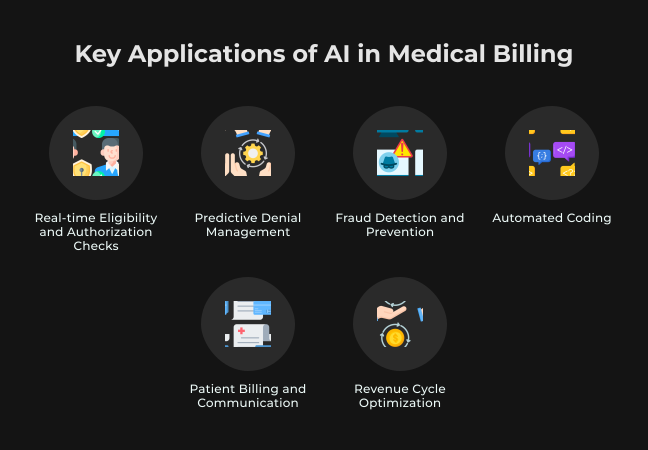
Automated Coding
Medical coding is like trying to find your way through a constantly changing labyrinth, which often causes mistakes and compliance issues. Developers put in a lot of effort to assign the correct codes for diagnoses and procedures for billing, but staying updated with the rules can be really tough.
AI steps in as a valuable partner. It uses natural language processing to read clinical notes and machine learning to identify coding patterns, suggesting accurate codes.
AI-powered systems are incredibly accurate, nailing over 90% of medical code assignments and outperforming manual methods. For now, the HFMA predicts that medical billing automation could cut down coding errors by up to 40%.
With AI medical coding, rejected claims due to mistakes become less common, which results in faster payments.
Predictive Denial Management
Nearly 1 in 5 insurance claims gets rejected. This actually leads to a costly and tedious process of figuring out why, correcting errors, resubmitting paperwork, and persistently bothering insurers until they finally approve it.
Besides, dealing with a denied claim is expensive. Each claim rejection can cost between $25 and $117 in administrative expenses. So, preventing a claim denial is way better than dealing with one later.
AI is streamlining this process by using machine learning to study past claim data and learn patterns from both rejections and approvals. These advanced models can predict which claims are at risk of being rejected. When they identify a potential issue, AI models alert billers to review and resolve any problems before the claim is submitted.
Real-Time Eligibility and Authorization Checks
Checking insurance eligibility by hand is slow and frustrating. It often leads to errors and multiple rejections.
AI automates these checks, accessing payer systems to verify coverage in seconds. Healthcare providers using AI have cut costs by $17 per claim and improved claim accuracy to 96%. Smaller practices especially benefit, saving a lot on admin expenses.
Manual checks might take 5 to 7 minutes, but AI completes them almost instantly with over 99.5% accuracy. Manual methods are just not so reliable.
Fraud Detection and Prevention
Each year, about 3% of healthcare spending (potentially up to 10%) is lost. This amounts to over $300 billion annually.
AI models are crucial in fighting fraud. They reduce false positives and improve detection accuracy. This leads to fewer investigations for administrators and more satisfied accountants, all while streamlining fraud prevention budgets.
AI can detect fraud in real time by comparing claims with known deceptive tactics, which stops scammers from receiving payouts. While machine learning uncovers suspicious billing practices like unnecessary procedures or duplicate claims.
Patient Billing and Communication
Managing patient payments might feel disorganized, with numerous reminders, follow-ups, or phone calls. AI helps classify patients based on their likelihood to pay and their outstanding balances.
It can also send personalized notifications through email, text, or calls. This approach improves collection rates and eases financial management in healthcare.
What's also interesting is that almost half of the patients (47%) notice more attention from their doctors when they use AI agents in their work, and 39% experience more direct interaction. While 84% of healthcare providers reported better patient interactions, and 82% experienced higher job satisfaction.
Revenue Cycle Optimization
The usual healthcare billing is full of paperwork, sluggish payments, and complicated payment rules. Artificial intelligence makes everything in the revenue cycle easier. It automates repetitive tasks, identifies mistakes before claims go out, and accurately predicts denials.
Plus, while the robots work, humans remain involved in the process. They check and implement AI insights. Currently, about 46% of hospitals and health systems use AI in healthcare RCM.
AI is also valuable for future planning. By analyzing past claims and payment data, AI forecasting tools can predict denials, identify financial trends, and improve budget management with precise foresight.
Benefits of AI in Medical Billing
Billing teams spend the lion's share of their time managing claims, checking insurance, and adhering to rules. AI steps in as a powerful tool that automates routine tasks and ensures payments are processed correctly. Here's how else AI can help medical billing:
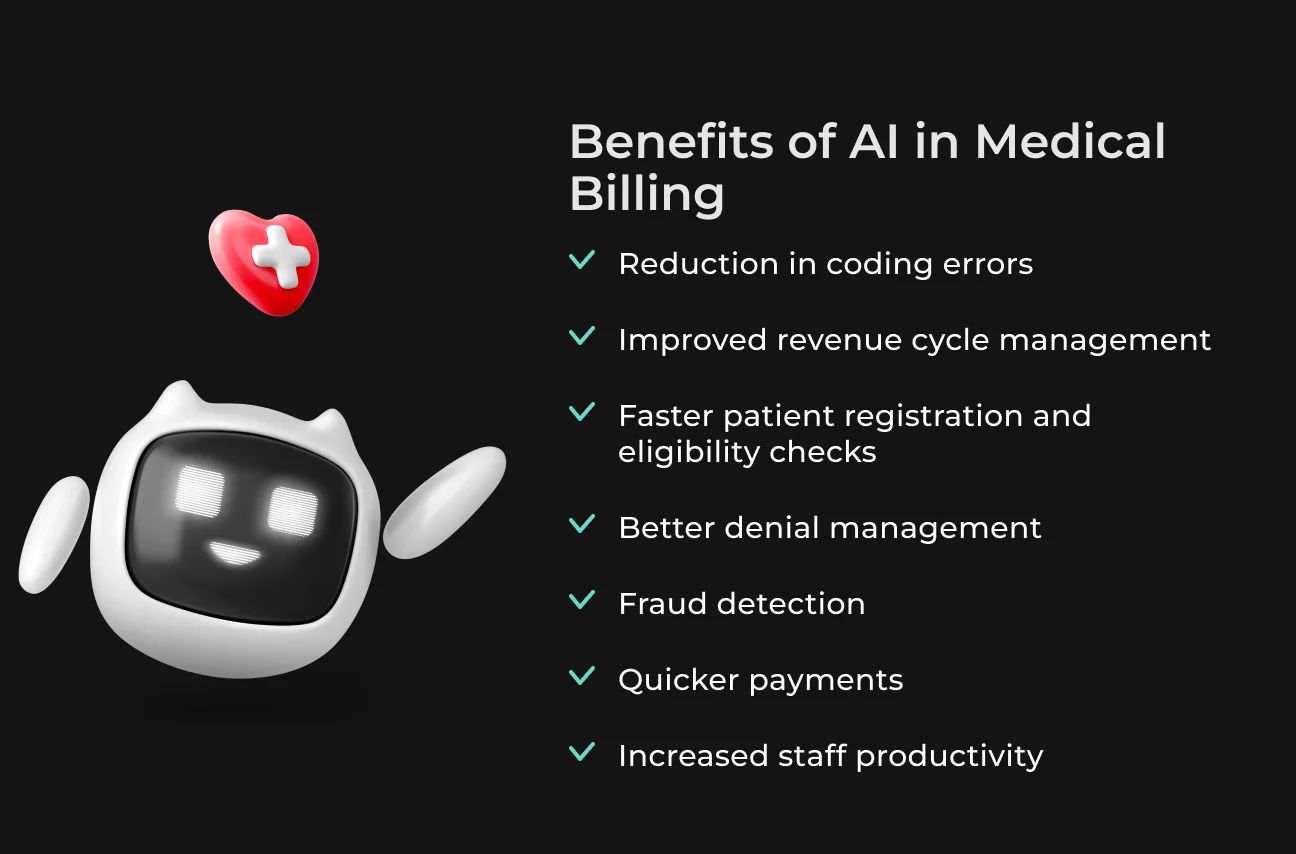
- Reduction in coding errors. AI tools can boost productivity by 5 to 7 times by reducing coding errors. Their accuracy ensures claims are submitted precisely. This allows healthcare professionals to spend more time on patient care instead of doing paperwork;
- Improved revenue cycle management. The AI healthcare revenue cycle management market jumped from $20.68 billion in 2024 to $25.7 billion in 2025 and can reach $180.33 billion by 2034. AI cuts human mistakes, lowers the chances of claims being denied, and fosters payment processes;
- Faster patient registration and eligibility checks. AI speeds up patient registration and eligibility verification. For example, call centers have increased their productivity by 15% to 30% due to generative AI. Many healthcare organizations have adopted technologies such as RPA, natural language processing, and AI to achieve these improvements;
- Better denial management. AI reduces the frequency of denials by predicting and addressing them earlier. In December 2024, for example, an AI system called ReNow helped streamline insurance claims for hospitals in India. This tool uses advanced analytics and automation to ease tasks like admitting patients, checking authorizations, and evaluating claims;
- AI medical billing fraud detection. The American healthcare system loses around $100 billion a year to fake claims. That's actually over $300 for every American every year. AI helps stop fraud. It processes lots of data, detects suspect activity, and catches fraudsters quickly, which saves the healthcare industry billions annually;
- Quicker payments. AI accelerates healthcare payments by efficiently handling tasks like claims processing and insurance verification. This means fewer errors, reduced admin costs, and easier payment and billing for patients. For example, digital verification systems have cut claim rejections by 47% and boosted payment collections by 38%;
- Increased staff productivity. AI takes over monotonous activities like entering patient information or checking vital signs. One survey found that 82% of those who used AI tools eliminated administrative tasks, and 74% felt prepared for new challenges.
Data Requirements for Medical Billing with AI
Data quality faces several challenges, especially in healthcare. Let's name a few:
- Complexity of clinical documentation. Medical jargon or messy data can make it difficult for AI to interpret billing information;
- The possibility of human error. Manual data entries can lead to mistakes and cause billing problems;
- Scattered patient data. Patient information is typically spread all over, making it complicated to gather an accurate billing record.
For AI to improve medical billing, we need:
- Standardized formats for clear and consistent clinical documentation to help AI process better;
- Regular audits and checks to find mistakes and keep data trustworthy;
- Centralized systems to integrate all patient data and keep it easy to access;
- Continuous feedback to refine data and teach AI from past mistakes for better future performance.
Machine Learning Algorithms and AI Models Used in Medical Billing Software
Machine learning in healthcare improves patient outcomes, enhances care quality, and makes healthcare delivery and billing more efficient. Let's check out the key technologies behind medical billing software.
Natural Language Processing (NLP)
AI and NLP in medical billing software transform physicians' notes into tidy, organized data. It does code assignments, cuts down on errors, and streamlines claim submissions.
Since natural language processing helps convert medical vocabulary into plain English, it can extract key billing information, detect fraud, and improve financial management for healthcare providers and insurers.
Machine Learning Algorithms
Machine learning algorithms go through large databases to uncover trends, predict outcomes, and save money. It can estimate patient payments, detect claim denials, correct code mistakes, and automatically verify if patients qualify for services.
Let’s take a look at how some crucial algorithms work in medical billing software:
- Logistic regression. This algorithm predicts claim approvals or denials using historical data, offering simple yes or no answers;
- Support vector machines (SVM). SVM expertly classifies medical claims, which ensures accuracy and precision;
- Decision trees and random forests. These tools manage complicated billing situations and forecast claim results using different decision routes;
- Naive Bayes. This algorithm is great at spotting fraud, quickly checking transactions to find anything suspicious;
- Clustering algorithms. They categorize patient billing data into meaningful groups to identify trends;
- Neural networks and deep learning. These tools recognize patterns in large data sets, optimizing billing processes with advanced data.
Generative AI
Generative AI affects medical billing by improving patient communication and automating appeal letters all on its own. It composes messages that sound human, even when they are all done by robots.
Plus, it plays out billing scenarios to train models, making sure they can run anything you transfer to them.
Robotic Process Automation (RPA)
There should be a balance between patient care and administrative tasks. Activities like patient onboarding, follow-ups, medical billing, claims processing, report generation, or prescription management always run on.
Robotic process automation (RPA) can effectively automate these tasks. It adds to the efficiency of processes like front-office operations, patient interactions, or bill payments. This reduces costs, improves patient satisfaction, and lowers stress for all involved.
How to Develop an AI Medical Billing Solution
Building an AI medical billing system involves some clever planning, designing, constructing, and upkeep. Let’s break down the development process step by step.
Step 1: Strategic Alignment and Data Readiness
To start with an AI project, you should set goals and prepare your data. Make sure to get the right people on board, like healthcare professionals and IT experts, to understand their needs.
Decide what you're after — these can be reducing claim denials, improving accuracy, or just speeding up the process.
The next step would be to check your current data for quality, completeness, privacy, and accessibility. Medical billing needs diverse data like patient records and billing info. So, choose the data sources you'll need to train your AI on.
Clean and organize this data to fix any issues. Make sure to follow rules like HIPAA to keep data private and secure.
Step 2: Solution Design and Model Development
This stage is about turning strategic ideas into detailed technical plans for healthcare AI solutions.
Architectural Design
Create a structure that works best with AI and fits the systems you already have. Choose between cloud or on-site based on their ability to grow, save money, stay secure, and get along with your current IT.
Make sure it's secure and compatible with electronic health records and billing systems.
Data Preparation and Feature Engineering
To augment your model, gather data from various sources and ensure it's clean and well-labeled. Then dive into feature engineering by selecting or crafting features that serve as inputs (like patient info and their medical procedures).
Model Selection and Training
The right algorithms depend on the complexity of your billing scenarios and data patterns. Popular choices, like logistic regression, decision trees, random forests, and neural networks, each have their own strengths.
Use past claims data to train these models for accurate billing predictions. You’ll need to tweak them for better accuracy and fewer mistakes like overfitting or underfitting.
Model Validation
After you've trained your models, test them to ensure they're ready. Use techniques like cross-validation to check how well they manage new data. Also, monitor metrics like accuracy, precision, recall, and F1 score to ensure they're on point.
Step 3: Integration and Pilot Deployment
Once you build the model, link AI to your existing workflows and test it with supervision.
Integration
Create APIs for smooth data sharing between the AI and your current platforms. Get IT teams and vendors to collaborate for compatibility and security. The integration should maintain workflows and increase efficiency.
Pilot Deployment
Test the solution with a trial run before using it everywhere. Choose a few tasks where the AI can work well. Monitor its performance, noting successes and areas that need improvement. Feedback collected here is crucial since it helps make improvements before going public.
Step 4: Training, Adoption, and Continuous Monitoring
To get AI working in medical billing, train your team on its use and keep an eye on how it's doing.
Training
Training helps staff get used to the AI system. You can run training sessions for financial specialists, administrators, and tech teams to demonstrate how AI can make their jobs easier.
Also, give them practical and useful materials to boost their confidence and skills with the new tools.
Adoption
Make innovation and acceptance part of your culture. Share the perks of the system with everyone, like better accuracy, less work, and faster processing.
Set up a space for feedback so users can talk about their experiences, tips, or any concerns.
Continuous Monitoring
You can use dashboards and analytics to continuously check how your AI medical billing software works. Update your models with fresh data to stay in tune with the latest billing standards and laws.
Challenges in Implementing AI-Based Medical Billing
Using AI in medical billing is truly helpful and has lots of benefits. Yet, it's not without its risks and challenges. Here are some key ones that might emerge on the path of healthcare facilities.
Complex Medical Codes and Records
Medical billing involves navigating through different codes, each representing specific medical services. There's so much detail that it can get overwhelming. AI systems need to be trained really well to decode these codes and correctly read medical documents.
Data Privacy and Security
Healthcare organizations are particularly careful about data privacy and laws like HIPAA. Using AI in this field can be problematic since it processes sensitive patient information. Patients can be worried about privacy leaks or their personal data ending up in the wrong hands.
Facilities must secure data using strong encryption, access controls, and regular audits. Plus, healthcare regulations often change, so it's necessary to stay updated on them.
Integration with Legacy Systems
Legacy systems are the backbone of many healthcare operations, but they're not so flexible when it comes to AI. They often come with outdated data formats and tech that can block data flow, making AI less efficient.
Healthcare providers need to plan and sometimes even totally modernise their systems to make AI work.
Limitations in Handling Complex Claims
AI has its limits with medical claims that involve detailed histories or multiple doctors. Such claims need more than just knowledge of medical codes — they require context and judgment that AI might miss.
People often need to ensure these claims are understood and managed correctly. It's key to build AI systems that work seamlessly with human billers and support complicated decisions.
Partner with SapientPro to Integrate AI into Healthcare
SapientPro’s artificial intelligence development services help healthcare organizations turn unstructured data into structured information. You’ll get scalable, efficient, and fast systems that work with all types of documents, images, voice, and more.
Contact us to discuss your project and get a free consultation!
Integrate AI into Your Workflow with SapientPro