
All NLP Applications and Their Use Cases For Modern Enterprises
May 29, 202510 min read


Natural Language Processing is changing how businesses handle text and speech data. By 2028, experts predict the NLP market will hit $68.1 billion, growing at 29.3% yearly. That's no surprise when 80% of business data comes in unstructured forms like emails, documents, and social media posts.
Companies are catching on fast. A survey shows that 75% of workers use NLP tools in their operations. These tools quickly and easily eliminate hours of labor-intensive manual work, from analyzing customer feedback to automating document processing.
But here's what's interesting: while big tech leads the charge, smaller businesses are jumping in too. As more businesses face mountains of text data, NLP isn't just nice to have — it's becoming essential to stay competitive.
Read on to learn everything about NLP from SapientPro’s experts with 8+ years of experience in the industry.
What is a Natural Language Processing (NLP) application?
NLP applications are smart computer programs that can understand and handle human language. Picture them as language interpreters between humans and machines. They can read text, listen to speech, understand the meaning behind words, and respond in ways that make sense to us.
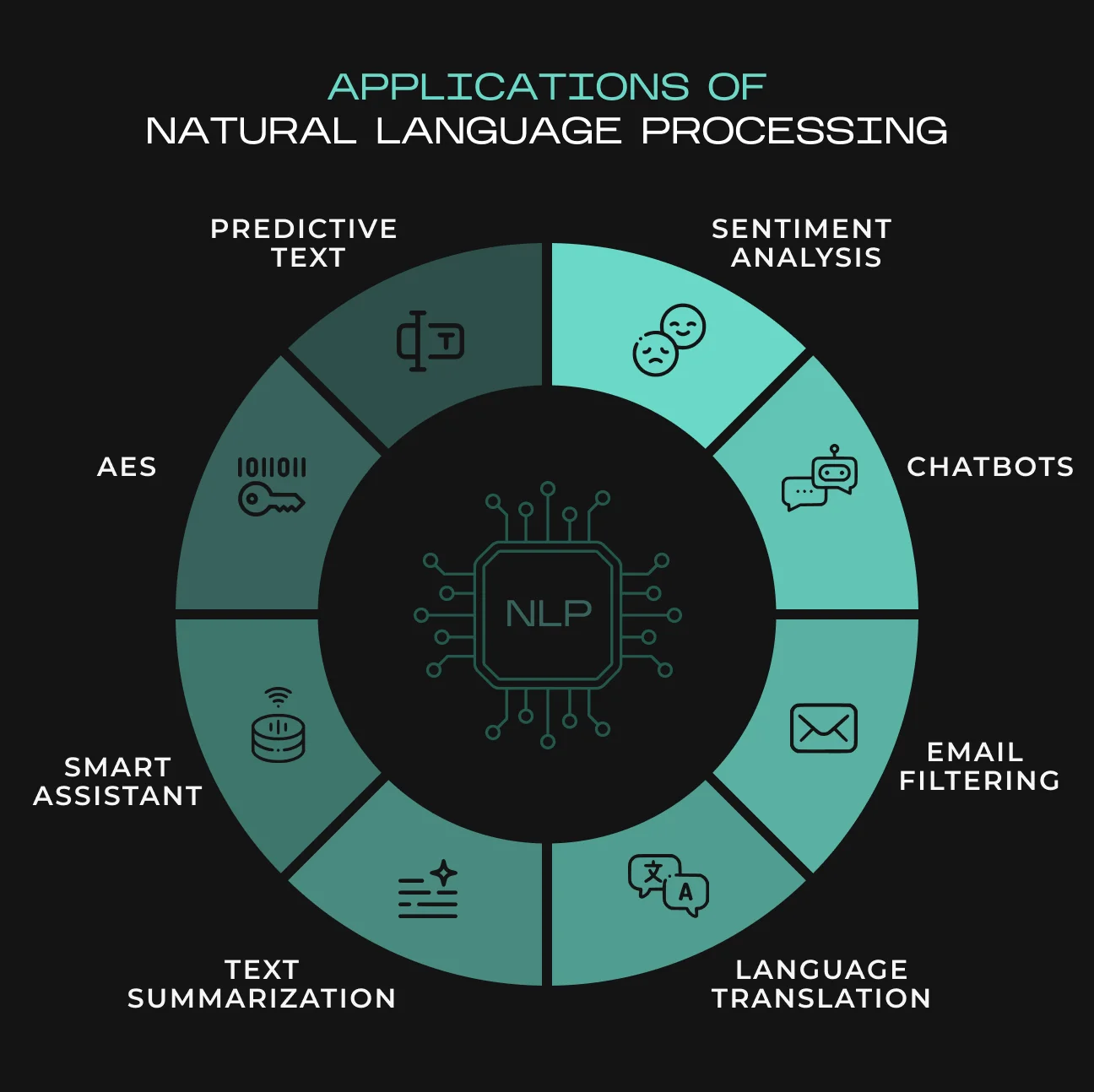
Typical applications of NLP are:
- Translation apps that convert English to Spanish in seconds;
- Virtual assistants (Siri, Alexa) that understand your voice commands;
- Email filters that spot spam without you lifting a finger;
- Writing tools that check grammar and suggest better word choices;
- Chatbots helping customers on websites.
Create Your AI-Powered Chatbot
SapientPro's experts can help you build a powerful chatbot for your business.

How NLP works
NLP technologies break down language processing into smaller tasks:
- Splitting your text into pieces.
- Words, sentences, and paragraphs get separated and tagged. Each word gets labeled — nouns, verbs, adjectives — like putting books in the right sections of a library.
- Understanding meaning.
- The system looks at word order, figures out what pronouns like “it” or “they” refer to, and spots relationships between different parts of sentences. It's like solving a puzzle where each piece adds more context.
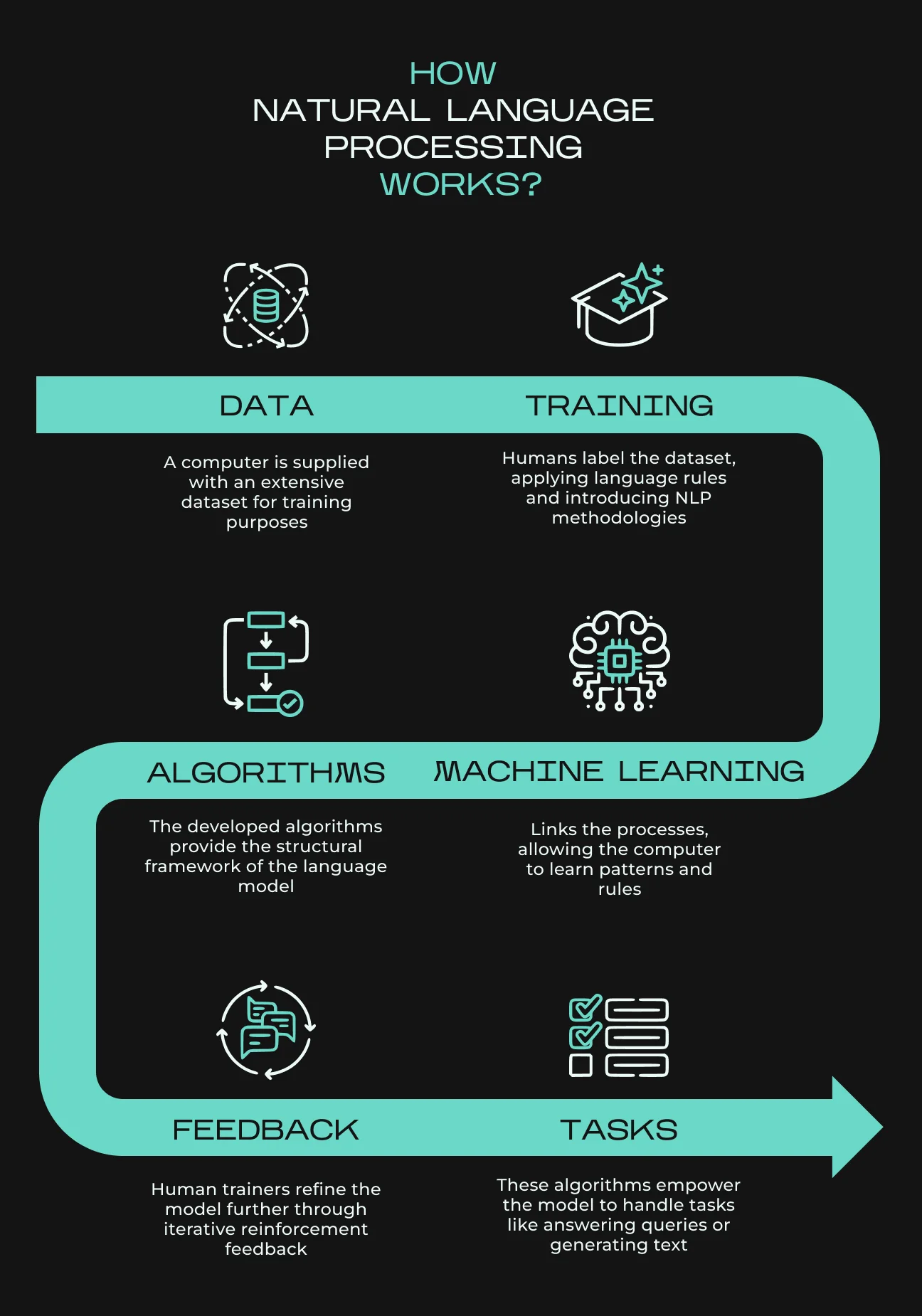
Machine learning powers modern NLP applications in business. These systems study millions of real-world examples to learn language patterns. The more they practice, the better they get at catching slang, jokes, and subtle meanings — just like humans learning a new language.
Behind the scenes, it's all about pattern matching and probability. When you ask a chatbot a question, it's rapidly analyzing your words, comparing them to what it's learned, and crafting a response that fits the context.
Case Study From SapientPro: AI Agent for Call Centers
Our team automated call center operations with an AI agent. We trained AI agents to handle consultations, respond to inbound and outbound calls, provide basic support, and conduct sales. Benefits:
- Cost efficiency. AI agent operation costs $1/hour (infrastructure costs);
- No training. Human staff isn't required;
- Multilingual capabilities. AI agent communicates in dozens of languages;
- Scalability. Infrastructure can be easily expanded as needed.
Learn more about using AI for cloud-based call centers and how it helps businesses earn more.
NLP Applications and Their Use Cases For Modern Enterprises
Let’s take a look at the top examples of NLP applications with detailed explanations.
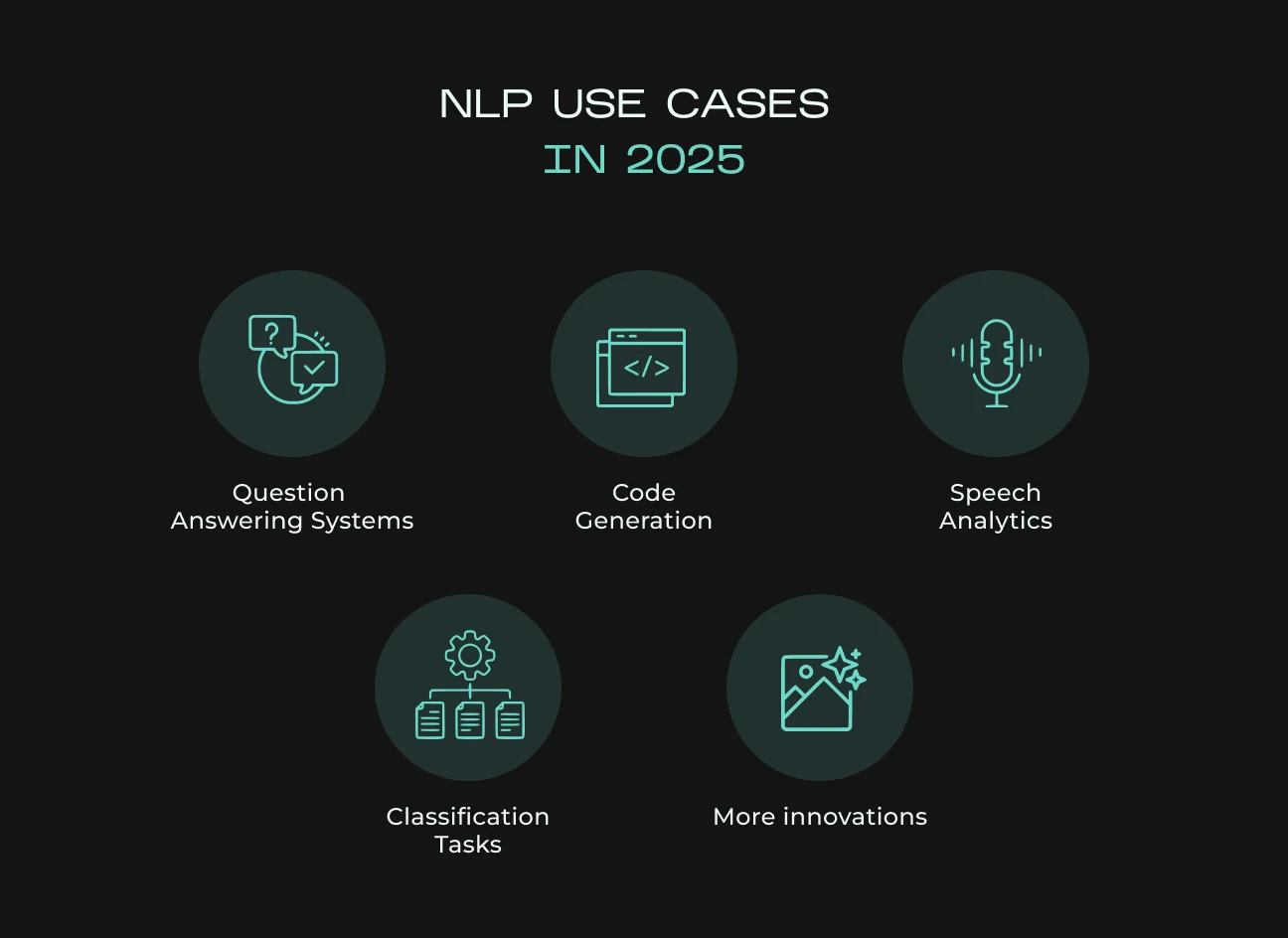
Question and Answer Systems Based On RAG (Retrieval Augmented Generation)
Objective. Reduce operator workload and provide quick and accurate answers to external and internal users on consulting questions.
Any enterprise has specially trained people who often have to help users with similar problems. In order to fire the operators, you can use advanced technology like LLM with the help of NLP.
RAG (Retrieval Augmented Generation) is a modern method of LLM and NLP usage. When a user requests a query, it first searches for relevant information in an internal knowledge base and then asks the LLM to generate a response based on the information found.
How to implement RAG with NLP?
What to pay attention to during the preparation phase:
# | Area | Recommendation | Rationale / notes |
| 1 | Knowledge base content | Build a single, up‑to‑date FAQ‑style knowledge base with no duplicates | Prevents contradictory or outdated answers |
| 2 | Supported file types | Use loaders that handle txt, md, pdf, docx, and similar formats | These formats are directly parsable by most embedding pipelines |
| 3 | Images in the KB | Replace screenshots with concise text descriptions or keep image links and render the image at response time | Current multimodal LLMs are still unreliable for detailed image Q&A |
| 4 | Tables in the KB | Convert tables to compact Markdown; split large or sparse tables into smaller ones by topic | Large tables make it hard for the model to pick the right cell |
| 5 | Dialogue routing | Add a message classifier or UI buttons to steer users to the correct dialog branch | Reduces intent‑guessing and hallucinations |
| 6 | Fallback logic | Define what happens if retrieval fails (e.g., escalate to an operator after N similar queries) | Guarantees a graceful user experience when the KB has gaps |
| 7 | Tech stack | Integrate via LangChain or LlamaIndex; store embeddings in ChromaDB, FAISS, or Pinecone | Battle‑tested, open‑source tooling speeds up prototyping |
Which LLM to choose?
If sensitive information may be used in the dialog, you should use a language model that can be deployed locally (the security service will prohibit passing information via API to a third-party service if there is a risk of transferring personal data).
Pros:
- Can be customized;
- Everything is in your inner loop.
Cons:
- You will have to buy an expensive server with a video card;
- Generation quality is usually worse.
If there is no confidential information, you can use proprietary LLMs on APIs.
Pros:
- Cheap generation compared to buying your own server;
- As a rule, better quality as models are constantly improving.
Cons:
- Fewer possibilities for customization;
- External service on the side.
There are special benchmarks to compare the quality of LLMs, but the problem is that there are usually not all models. Besides, benchmarks are often very general, and the task can be highly specialized, so it is better to try and evaluate several options.
How to evaluate the quality of the solution after implementation?
On an A/B test, evaluations are quite individualized (depending on the task). You can use the following online metrics:
- Percentage of likes/dislikes to a response as well as extended feedback on responses;
- Percentage of dialogs without human interaction;
- Statistics on how many hours per day operators spend answering questions, how many questions they answer on average per session, how long it takes to process one question, etc. Then, these metrics will be compared to the same data after the QA system is implemented;
- Percentage of questions repeated in a row from a single user;
- Time a user spends switching between menus before transferring to an operator;
- How many times the user goes back a step (this determines that the user was unable to find the right answer).
This is one of the brightest natural language processing use cases.
Code generation
Objective. To speed up programmers' work time and get rid of routine tasks.
We all know that programmers are very busy. They have many tasks — writing code, testing, documenting, etc. You can rid them of monotonous tasks and give them an opportunity to focus on interesting things.
How to implement code generation with NLP?
Follow this detailed checklist:
- Define the user experience; decide whether the model will surface as IDE hints (Copilot-style) or as a web-chat;
- Reuse existing IDE plugins like llm-vscode for VS Code or the PyCharm equivalents to shortcut UI work;
- Deploy a dedicated inference server that hosts a generative model fine-tuned on code; choose a single-language or multi-language checkpoint to match the project;
- Expose the server through FastAPI; keep transient messages in Redis for a simple, low-latency store;
- For high-load environments, add Kafka as a durable queue and use celery-batches to collect requests by count or time window before forwarding them to the model;
- Package the inference service (plus any workers) as Docker images for easy scaling and reproducible rollout;
- If a browser chat room is required, spin up a minimal front-end with Gradio.
Which model to choose?
Earlier, the preferred option among open-source solutions was DeepSeekCoder-V2. However, recently Qwen2.5-Coder was released, which shows better quality on the main benchmarks. In our opinion, Qwen looks preferable now.
There are also proprietary code generation models, which can be used via API or through an extension for IDE from the company that owns the model.
What can it help with?
Cases in which the model is best applied:
- Advanced autocomplete (one-line prompts);
- Template code generation;
- Unit test generation;
- Code generation by natural language description;
- Code explanation;
- Code documentation;
- Building simple diagrams by code (mermaid);
- Building regular expressions;
- JSON/XML generation;
- Answering other questions related to development, but not requiring code generation.
Code generation is a remarkable example of natural language processing.
Speech analytics
Objective. Transfer operator calls from audio to text format, analyze the dialog according to certain criteria, and summarize.
There is often a need to evaluate the quality of dialogs with customers to identify patterns that lead to successful interaction or phrases that are better not to use in conversations with customers. You can evaluate operators by success rate, but you won't see the whole picture.
After all, sometimes a call ends in failure not because an employee is at fault, but because the customer urgently needed to feed their cat, who decided it was the perfect time for dinner.
How to implement speech analytics with NLP?
After getting the text transcript, you can proceed to data analysis. In the texts, you may be interested in the following:
- Keywords and phrases.
If there is no word markup, but the dialogs are divided into classes (e.g., successful/unsuccessful, sale, or positive/negative customer evaluation), you can try to extract keywords and phrases that define the classes. The easiest way to do this is with TF-IDF.
This method calculates the frequency of each word in a document relative to the total number of documents in the collection in which the word occurred. That is, words that occur in most documents will have low rates, while unique words that occur many times in some documents will have a high value to them.
- Emotional state.
There are ready-made Sentiment analysis models that can determine the tone and emotional coloring of a particular section of dialog from text or audio. If there is a markup, you can train your own solution (for example, you can use BERT for text).
- Defined criteria.
You can define the criteria by which you want to evaluate dialogs. This will require a markup. This can be either the classification of dialog/sentences or the highlighting of individual words, i.e., the NER task. After that, the classifiers can be trained.
One can use Word2Vec and FastText if one wants a simple and fast solution with little marked-up data. You can also use LLM as a classifier, but it is a large and expensive tool. If there is a lot of partitioning, it is better to use BERT.
Examples of defined criteria are:
- Use of politeness words;
- Greeting, introducing yourself and the company;
- Correct ending of the conversation;
- Empathy;
- Number of parasitic words;
- Name clarification;
- Correct provision of information about the product;
- Following the conversation script;
- Handling objections;
- Identification of needs;
- Client's consent.
For most of the criteria, a classification model must be created. For some criteria, the NER task must be solved because it is necessary to count the number of words (e.g., the number of parasitic words). It should be kept in mind that NER requires more markup than a normal whole-text classification task.
The main problem usually lies in the markup. There is always not enough of it, and the quality of the marked-up data is often questionable.
Classification tasks
A very popular class of tasks is when we need to determine the label of a text using precomposed markup. For example, to determine the class of a request by its description. In the previous section, we have already touched upon tasks of this kind, but in practice, there are a great number of them.
What do you need to pay attention to?
- Number of classes;
- Class balance;
- Text length;
- Number of marked-up data.
How to implement task classification with NLP?
If there is little markup and the texts are short and simple, then you can use classical vector databases. They weigh little and do not require powerful computational resources.
Stages:
- Preprocessing;
- Embedding;
- Classification model.
Classical text preprocessing consists of:
- Converting text to lowercase;
- Stop words removal;
- Removal of punctuation marks and numbers (if they do not need to be removed, they are often capitalized);
- Word lemmatization/stemming;
- Sometimes, it may be necessary to delete some template phrases using regular expressions.
These actions may vary depending on the task. What are stop words in one case may be important information in another.
Next, we proceed to generate embeddings using:
- TfidfVectorizer and CountVectorizer;
- Navec;
- Word2Vec;
- FastText.
Finally, we train a classification model. There are a great number of them:
- LogisticRegression;
- SGDClassifier;
- LGBMClassifier;
- Svm;
- RandomForestClassifier;
- GradientBoostingClassifier.
Often, the most common logistic regression shows results that are not worse than those of analogs.
Generating images from a text description
Objective. This task is not quite related to NLP. However, sometimes, there is a need to select images for design. Often, you need several images in the same style at once. It is difficult to search for suitable images on services, so you can use the generation of your own images.
We all like to play with generating images for corporate materials design. You can implement the service in the inner loop.
How to implement image generation from a text description?
The easiest way to create a web interface is to use Gradio or ready-made, such as fooocus and automatic1111. Advanced models that can be deployed locally are Flux or Stable Diffusion 3.5.
If a company already has a set of images in a certain style and you want to generate new images in it, you can try to train your own Lora adapter for the chosen image generation model. This will require a dataset of several dozens of images and a detailed description of what is on them.
Partner with SapientPro for NLP Development Services
Don't wait for months to tap into your data's potential. SapientPro's NLP development services can help your business leverage modern technology in weeks. Our team has helped companies across various industries unlock value hidden in their text data.
Ready to turn your language data into a business advantage?
Let's discuss your project. Contact us today!

