
All How to Build an Automated Affiliate Management System with AI Integration
October 31, 202610 min read


Affiliate systems are no longer simple dashboards for tracking clicks or commissions.
For SaaS, fintech, marketplaces, and B2B platforms, they now sit much closer to revenue operations. Affiliate marketing software helps teams understand which partners bring real customers, how each conversion should be credited, and where risk may actually appear.
AI adds another layer of quality to affiliate operations. It can flag suspicious traffic, support payout validation, and show which affiliate activity actually leads to valuable revenue.
Read the article from SapientPro experts to understand what affiliate management is and how AI can turn affiliate service into a revenue engine for your business.
What Is an Automated Affiliate Management System?
An automated affiliate management system is a platform that helps companies track, manage, verify, and improve affiliate-driven revenue without relying on manual checks at every step.
It connects partner activity with customer acquisition data, helps confirm whether a commission should be paid, and gives marketing, sales, finance, and compliance teams a clearer view of affiliate performance.
In a more mature setup, it also connects with the CRM, billing platform, payment provider, product analytics tools, and data warehouse. This gives the company more context around each conversion.
For example, affiliate software for SaaS can show whether trial users activated the product, upgraded to a paid plan, or expanded their subscription later. Automation keeps these checks consistent.
This is important because affiliate revenue can become messy as the program grows.
- One partner may bring a lot of traffic, but very few paying customers;
- Another may send fewer leads, but those users may have much stronger lifetime value;
- A third partner may look profitable at first, until refunds and chargebacks reduce revenue.
Without automation, teams often notice these problems only after money has already been paid out.
Why Companies Are Rebuilding Affiliate Management Solutions
Affiliate marketing has grown past the point where companies can manage it with fragile tools or manual checks. The industry is expected to reach $31.7 billion by 2031 with around 81% of brands using affiliate programs to reach wider audiences.
With that level of activity, affiliate management service is becoming more technical.
Affiliate Growth Is Exposing Technical Debt
Many affiliate programs start with something simple: tracking links, promo codes, and a basic partner dashboard. At the beginning, this is usually enough. There are only a few partners, commission rules are clear, and most issues can still be checked manually.
But the setup becomes harder to manage as the program grows. More partners mean more traffic sources, more payout conditions, and more compliance questions. A company may need to check whether a lead is valid or whether traffic comes from an allowed region.
Technical debt also becomes part of the problem. Deloitte’s 2026 study estimates that technical debt accounts for 21% to 40% of an organization’s IT spending.
In affiliate management, this often shows up as extra engineering work or repeated reporting fixes that grow along with the program.
Cookie-Based Tracking Is Becoming a Weak Foundation
Older affiliate management software solutions rely on browser cookies and client-side pixels.
This creates tracking gaps because a large part of the process depends on what happens in the user’s browser. Ad blockers, privacy settings, or cookie limits can all interrupt the path from click to conversion.
So some real conversions may be missed, and others may be credited to the wrong partner or channel. Server-side tracking gives companies a stronger foundation. It records key events from the backend, CRM, or payment flow, instead of relying only on a browser pixel.
The Real Buyer Is Not Only Marketing Anymore
Affiliate tracking software used to be mainly a marketing tool. The team needed tracking links, promo codes, campaign reports, and partner dashboards. These features still matter, but they are no longer the whole decision.
This is why many companies stop patching old affiliate tools and rebuild the system. They need software that can manage the full partner journey and show which affiliates bring real revenue.
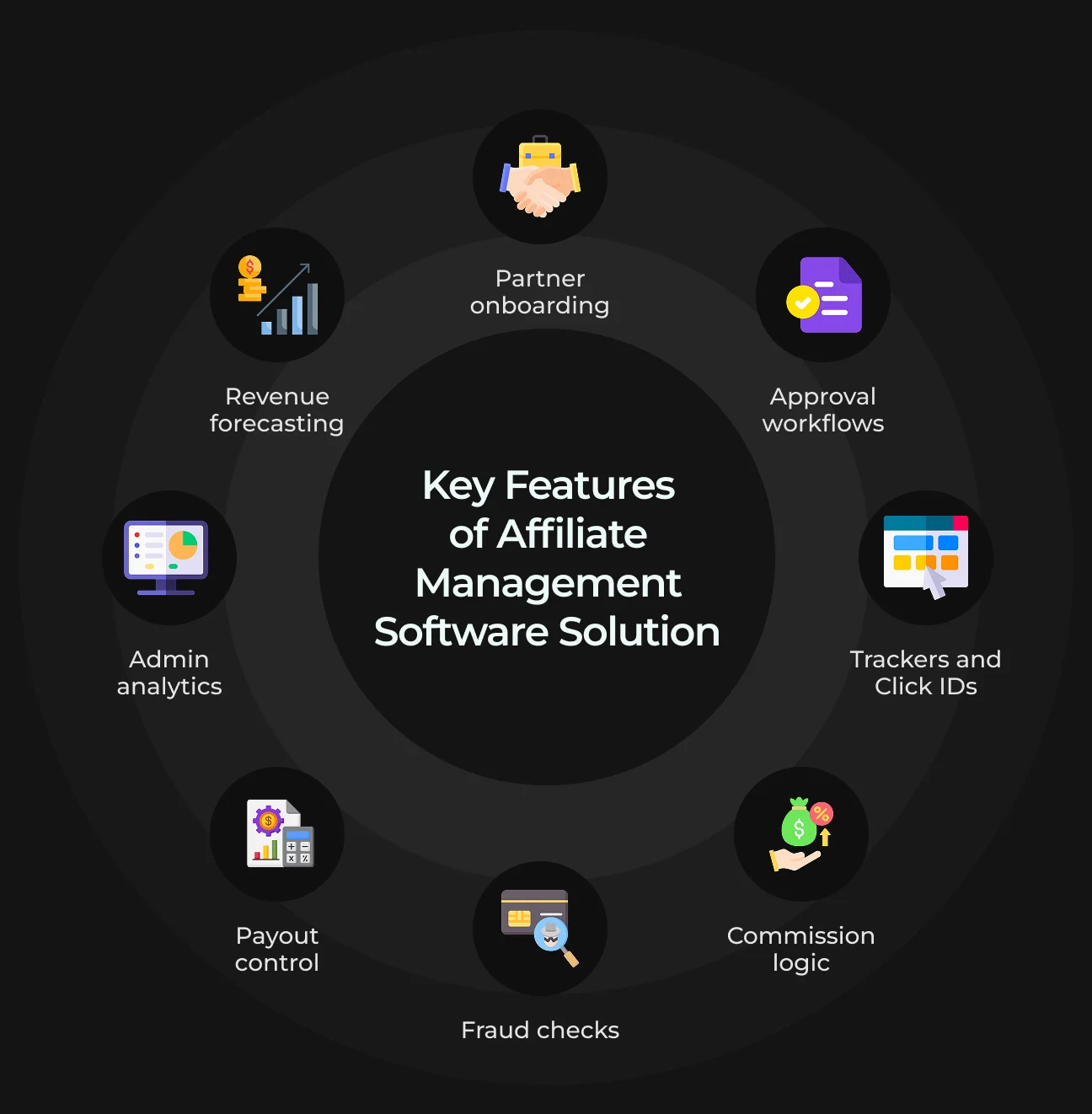
Must-Have Features of Modern Affiliate Management Software Solution
Modern affiliate software gives teams control over the whole partner workflow. The features below are the ones that make this possible in practice.
Partner Onboarding and Approval Workflows
Affiliate onboarding needs to be simple for partners. A good system lets partners register on their own, add company details, describe traffic sources, and choose payment methods.
On the admin side, every new partner goes into a review queue. Managers can approve, reject, or ask for more details before giving access to links, campaigns, or creative assets. Once approved, affiliates get access to banners, landing pages, and promo materials, all in one place.
Campaign, Tracker, and Link Management
Affiliates need separate links for different campaigns, channels, and placements. For example, one partner may use different links for a blog review, newsletter, and YouTube video.
Each link should connect to the partner, campaign, tracker, landing page, and Click ID. The Click ID is what ties a click to later events, like registration, payment, refund, or approved commission. Teams can see which campaign brought the conversion.
Conversion Attribution and Commission Logic
Affiliate program management software needs to define how each conversion is credited. Some companies use first-touch attribution. Others use last-touch or custom rules when affiliates work alongside paid ads, sales teams, or influencers.
Commission logic also needs to match the business model. For example, marketplaces may pay only after completed transactions. Not every conversion qualifies for a paid commission, so teams need clear statuses like pending, approved, rejected, reversed, blocked, or paid.
Reporting for Partners and Internal Teams
Reporting has to work for both affiliates and internal teams. Partners need a clear dashboard with clicks, sign-ups, conversions, pending commissions, and campaign results. Internal teams need deeper data. They should be able to review revenue by partner, campaign, region, product, or customer group.
Fraud-adjusted reporting is also important. A partner may look strong by raw conversions, but weaker after duplicated leads, suspicious traffic, or blocked accounts are removed.
Good reporting helps teams see which partners deserve more budget, which campaigns need changes, and where the program is losing money.
Build Your Affiliate Platform
Tell SapientPro how your partner program works. We’ll help define the software it needs.

Server-to-Server Tracking for Reliable Affiliate Attribution
Server-to-server tracking helps affiliate teams track conversions through the backend. This is useful when commissions depend on real events: paid orders, approved leads, subscriptions, deposits, renewals, refunds, or chargebacks.
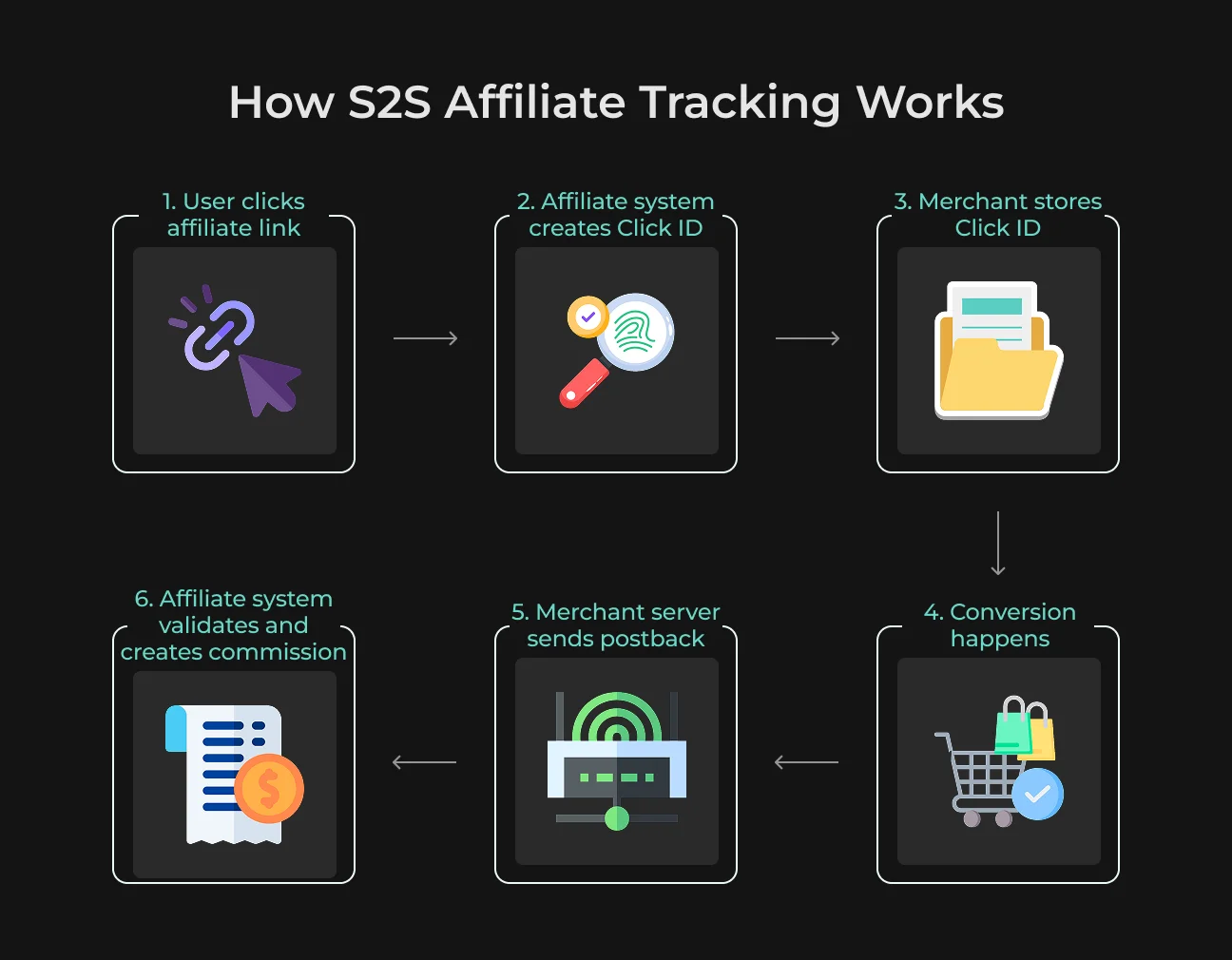
S2S tracking gives cleaner attribution and fewer missed conversions. Finance, compliance, and partner teams can also check why a commission was approved, delayed, or rejected.
How an S2S Affiliate Tracking Event Works
The process usually works like this:
- A user clicks an affiliate link;
- The affiliate system creates a unique Click ID for that click;
- The merchant stores this Click ID in a first-party session, user record, or database;
- The user completes a conversion, like a sign-up, payment, deposit, or subscription upgrade;
- The merchant server sends a postback to the affiliate system;
- The affiliate system checks the Click ID, event data, and program rules.
- If everything matches, the system creates a commission entry.
The key difference is that the merchant’s backend confirms the conversion. The system does not depend only on whether a browser pixel is loaded correctly.
Why Backend Postbacks Beat Browser Pixels
Browser pixels are easy to install, but they are not always reliable. Ad blockers, cookie limits, or slow page loads can all break the tracking path.
Backend postbacks are harder to lose because they are sent from one server to another after the merchant records the event.
S2S tracking also helps with reconciliation. The company can match affiliate conversions against payments, refunds, chargebacks, KYC results, or subscription status. If an order is refunded or a payment fails, the backend can send an update before the commission is paid.
What Engineering Teams Must Secure
A postback setup needs strong controls. Otherwise, the system can create duplicate commissions, accept fake events, or lose important data.
Engineering teams should cover:
- HMAC request signing. To confirm that the postback came from the trusted merchant server;
- Replay protection. To stop the same request from being reused;
- Idempotency keys. To prevent duplicate commissions when the same event is retried;
- Retry logic. So valid events are not lost during temporary API issues;
- Rate limiting. To protect the endpoint from traffic spikes;
- IP allowlists. To accept requests only from approved servers.
- API logs and audit trails. To track what was sent, accepted, rejected, or changed.
Basically, every commission must be linked to a real click, a verified conversion, and a traceable backend event.
Database Architecture Behind Affiliate System Software
As the affiliate program grows, the database has to keep everything in order: clicks, conversions, commissions, reports, and payout history. If something goes wrong there, the problem usually shows up later in attribution, reporting, or finance.
For example, if a Click ID is missing, the team may not know which partner should get credit. If a commission is stored without enough context, it can be hard to explain later why it was approved, changed, or rejected.
Core Entities to Model
A strong affiliate platform starts with clear data entities. Each one needs its own role.
- Users are the people who use the system, like admins, partner managers, finance teams, and sometimes clients;
- Affiliates store partner details, approval status, traffic sources, payment data, and contract terms;
- Campaigns define what the partner promotes, which regions are allowed, and what commission rules apply;
- Trackers separate traffic by channel, placement, page, ad, or content type;
- Clicks record traffic events with a Click ID, affiliate ID, campaign ID, time, device data, referral source, etc.;
- Conversions show what happened after the click, like a sign-up, order, deposit, subscription, or renewal;
- Commissions show how much the affiliate can earn from a valid conversion;
- Payouts group approved commissions into payment batches;
- Invoices support formal billing for partners that require documents;
- Audit logs keep a history of changes inside the system;
- Fraud scores help teams spot risky clicks, leads, or conversions.
Why Click Ingestion Needs a Separate Performance Strategy
Clicks usually create the highest volume in an affiliate platform. A campaign can receive thousands of clicks before it creates a few conversions. The system still has to record those clicks correctly, because one click can later become the source of a commission.
Click ingestion needs its setup. The database has to write click events quickly, search them by Click ID, and clean old data without slowing down the rest of the platform.
Most teams index the fields used every day, like affiliate ID or creation date. Large click tables also need partitioning, usually by date. This helps the system read recent data faster and move old records without scanning the whole table.
Append-only event logs work well for raw clicks. New click events are added as they happen, and old records stay unchanged.
Queue-based writes help during traffic spikes. The application accepts the click event, places it in a queue, and background workers process it. This reduces pressure on the main application and lowers the risk of losing data during busy periods.
Cold storage also belongs in the design. Recent clicks can stay in fast storage for support cases.
How to Design the Commission Ledger
Commissions need the same discipline as financial records. Every commission needs to show where the money came from and why the affiliate earned it.
A commission record needs to connect to the original click, conversion, affiliate, campaign, payout rule, revenue amount, and currency. When someone changes the commission later, the system keeps the reason, the user, and the timestamp.
A commission can be:
- Pending. The conversion is recorded, but the team still needs to check it;
- Approved. The commission passed all checks and is ready for payout;
- Rejected. The conversion does not meet the program rules;
- Refunded. The customer got a refund, so the commission has to be reversed or changed;
- Paid. The commission was already included in a payout;
- Disputed. The partner or internal team is reviewing the case.
Each status change needs to stay in the system.
When to Use SQL, NoSQL, or Event Streaming
Affiliate tracking rarely works well with one database doing everything. Different parts of the system need different storage tools.
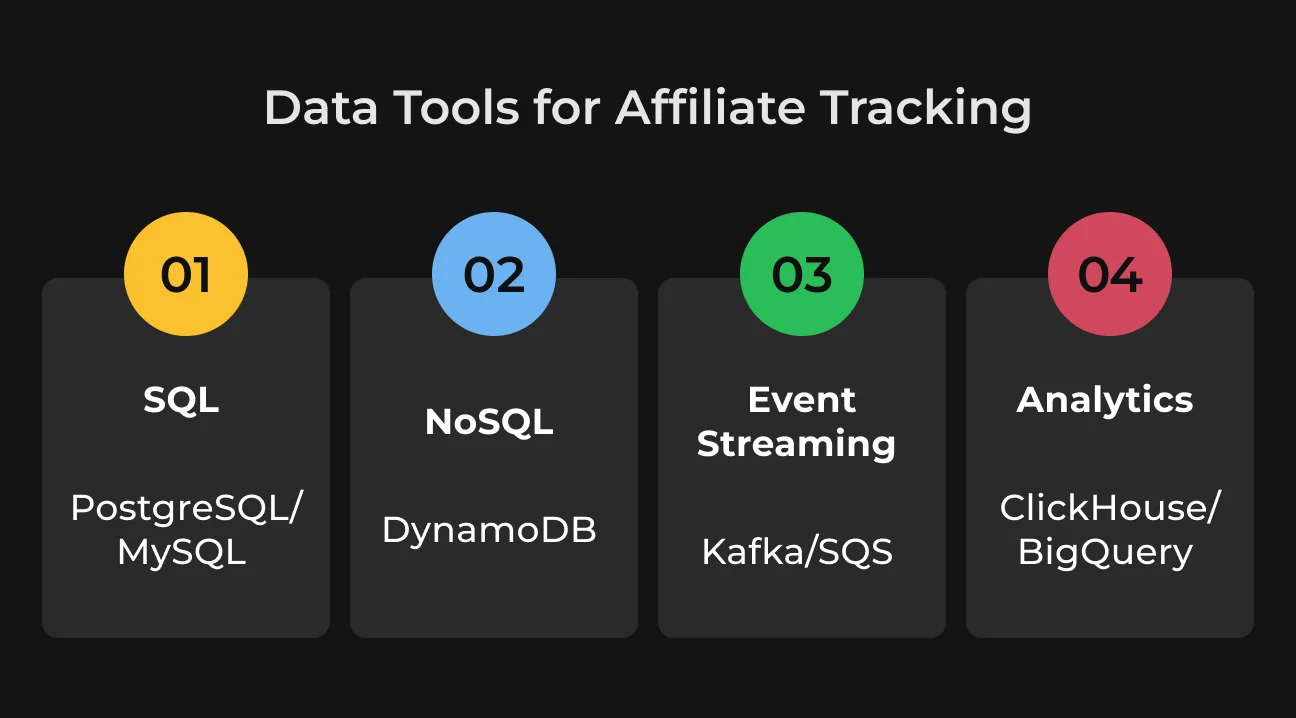
- PostgreSQL or MySQL fit the main business records: affiliates, campaigns, conversions, commissions, payouts, invoices, and audit logs. SQL is usually the right place for money, rules, and reporting accuracy;
- DynamoDB or another NoSQL database can work for high-volume click ingestion. Clicks are simple records, but they arrive quickly and in large numbers. A NoSQL store helps when the main challenge is writing many events with low delay;
- Kafka or SQS help process events in the background. One conversion can update attribution, run fraud checks, create a commission, and send data to analytics;
- ClickHouse or BigQuery works for analytics. Teams can use them for partner dashboards, campaign revenue, or long-term trends.
A proper setup separates these jobs between different tools. SQL stores the records where accuracy matters most, like commissions, payouts, or invoices. NoSQL manages large click volumes, and queues or streams move events between services.
Putting everything into one database may work at the beginning. But as traffic grows, clicks, payouts, fraud checks, and reports start using the same resources. So the system becomes harder to maintain.
AI Fraud Detection in Affiliate Software Is Becoming a Must-Have
Fraud detection is one of the clearest reasons to build affiliate marketing management software around your own rules and data. Standard fraud filters often miss patterns that matter for payouts, like fake leads, repeated devices, or PPC brand bidding.
The global affiliate fraud detection AI market is forecasted to reach $7.9 billion by 2033.
In a custom system, fraud checks can be part of attribution, partner scoring, or commission review from day one, so risky conversions are flagged before they reach payout approval.
Fraud Patterns Custom Systems Can Detect
A custom affiliate system can track suspicious behavior from click to payout.
Lead bots may create many registrations with similar device data, repeated form behavior, or low-quality email addresses. Very short click-to-conversion times may point to automated traffic, especially when a user appears to click, register, or convert within seconds.
Geography is another signal. A campaign may target one region, but conversions suddenly come from countries where the offer is restricted or where the company does not sell.
Coupon abuse is common in e-commerce and subscription products. For example, an affiliate may promote branded coupon pages to users who are already ready to buy, then receive a commission without bringing a new customer.
One strange event does not prove fraud. But repeated patterns across devices, timing, geography, or traffic sources can show which partners need review.
Behavioral Scoring for Clicks and Conversions
AI fraud detection works best when it scores behavior instead of reacting to one rule at a time. Each click, lead, or conversion can receive a risk score based on several signals.
The model can review device signals, browser data, IP reputation, session timing, conversion speed, traffic source, or the affiliate’s past performance. A normal conversion from an allowed region, with clean payment data and expected session timing, may receive a low risk score.
A conversion from a restricted location belongs in a review queue.
Affiliate history matters too. A new partner with a sudden spike in conversions, weak activation quality, and many repeated devices needs closer review. Operators do not have to check every conversion manually. They can start with the cases that carry the highest risk.
Brand Bidding and Ad Hijacking Detection
Some fraud starts before the user even reaches the website. It can happen in search results, paid ads, or redirect paths. For example, brand bidding happens when affiliates bid on the company’s branded keywords, even when program rules forbid it.
Ad hijacking is more aggressive. A partner may create ads that look like the company’s own ads, use misleading display URLs, or send users through hidden redirects before they land on the official site.
Custom systems can monitor this with SERP scraping and proxy-based checks across different regions. OCR can help read ad screenshots and detect fake or misleading display URLs. Redirect-chain analysis can show whether traffic passes through suspicious domains before reaching the merchant.
When the system finds a possible violation, the alert shows the proof and links it to the right partner or campaign.
Human-in-the-Loop Fraud Review
AI must not auto-ban every partner that looks suspicious. Legitimate traffic can also look unusual during viral posts, seasonal campaigns, or regional promos.
A better setup uses AI to flag, rank, and explain risk. Operators need to see why a case was marked. From there, the team can approve the commission, reject it, ask for more details, or suspend the partner.
A person still makes the final call, especially when the decision affects payouts, partner relationships, or compliance.
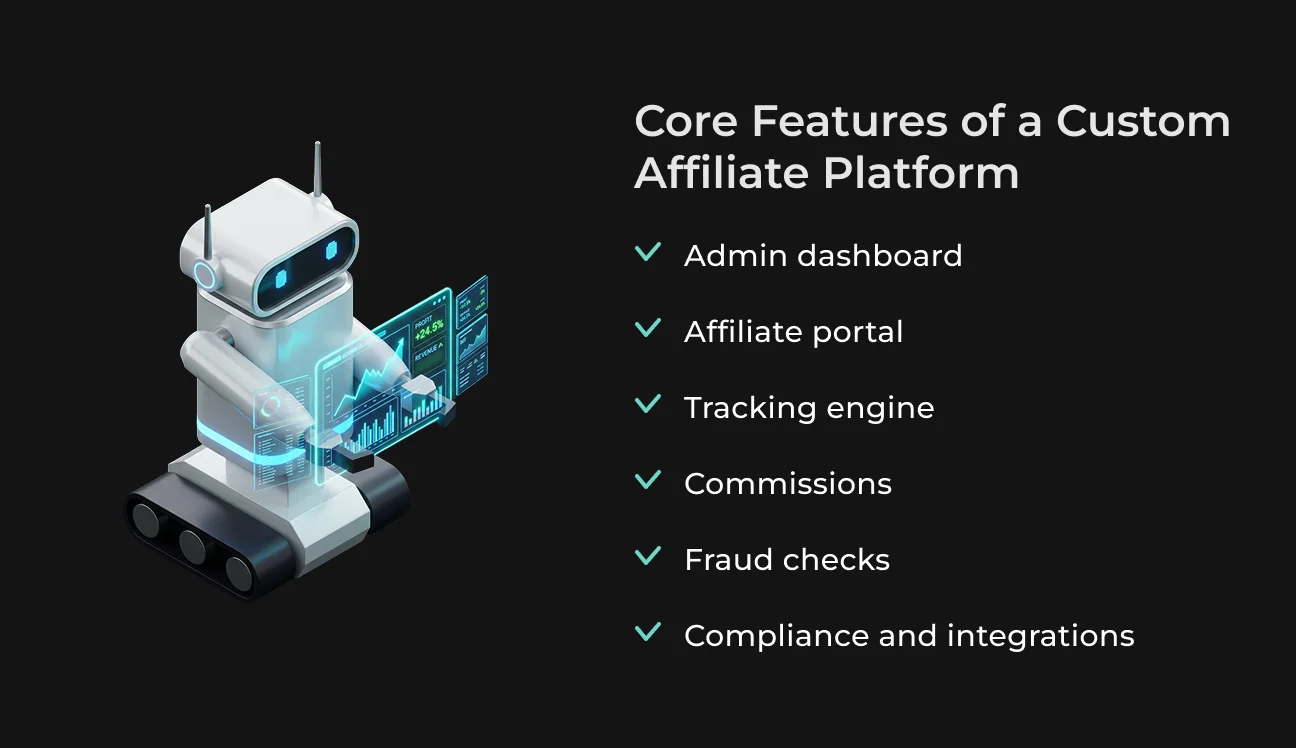
Key Features to Include in a Custom Affiliate Management Platform
A custom affiliate platform works best when it matches how the company attracts customers, checks traffic, pays partners, and reports revenue. The platform has to work for both sides: internal teams that manage risk and payouts, and affiliates who need simple tools for promotion.
Admin Dashboard
The admin dashboard gives partner managers one place to control the program. It shows active affiliates, campaigns, payout requests, fraud alerts, approvals, disputes, and key performance data.
The dashboard lets managers handle the day’s work without opening many reports. They can see new partner applications, conversions waiting for review, or payouts blocked by refunds or fraud checks.
It also shows technical issues that affect payouts, like failed postbacks or duplicate conversions.
Affiliate Portal
The affiliate portal helps partners manage their work without sending emails for every small request. They can update profile details, add tax and payment data, copy tracking links, download creatives, check reports, and see payout history.
This matters most when the program has many content partners, agencies, influencers, or regional affiliates.
Tracking and Attribution Engine
The tracking engine connects affiliate traffic with real business events. Every click needs a Click ID, so the system can link the original visit to later actions like registration, purchase, subscription renewal, refund, or chargeback.
Postbacks send conversion data from the merchant’s backend to the affiliate platform. The system then checks who sent the user and whether the click is still valid.
Commission and Payout Module
The commission module decides how much each partner earns and when the money can be paid. It has to handle recurring SaaS commissions, CPA, CPL, revenue share, bonuses, and refunds.
It also keeps payouts clean. Approved commissions go into payment batches, and blocked or refunded records stay out.
Fraud and Compliance Module
Fraud and compliance tools let teams catch risky traffic before it turns into a payout. The system can check device patterns, IPs, conversion speed, geography, refund rate, and partner history.
Suspicious cases go into a review queue. Managers can check repeated devices, fake-looking leads, or strange payout patterns without stopping normal partners.
The same module can also watch for brand bidding. It can check search results, spot suspicious ads, and link each issue to the right partner, campaign, or tracker.
Compliance rules depend on the business. Fintech teams may need KYC checks and blocked-region controls. SaaS and e-commerce teams care more about disclosures, consent, and GDPR or CCPA-friendly data management.
Integrations
A custom affiliate management solution becomes stronger when it connects to the systems the company already uses.
Billing and payment integrations may include Stripe, Paddle, Chargebee, or other subscription tools. E-commerce programs may connect Shopify, WooCommerce, or custom checkout systems.
CRM integrations help teams see what happens after the lead enters the sales pipeline.
Finance teams need ERP, accounting, and payment integrations for invoices, tax records, payout exports, or reconciliations. Integrations always keep affiliate data close to revenue data.
Common Mistakes When Building Affiliate Tracking Software
Affiliate tracking software often looks simple at the start. The real problems appear later, when there are more partners, more campaigns, and too many manual fixes. Here are the mistakes that usually cause trouble.
Treating Commissions as Simple Calculations
A commission is not always final right after a conversion. The customer may ask for a refund or the payment may fail.
Each commission needs a clear history, like where it came from, what status it has, or what changed later. Without this, the team may see the payout amount but not understand why the commission was approved, rejected, or paid.
Mixing Click Writes With Reporting Queries
During active campaigns, clicks can come in every second. At the same time, reports need to sort and compare a lot of data.
When both tasks use the same overloaded database, problems start quickly. Tracking may slow down, and dashboards may take too long to open. It is better to keep click recording fast and move reporting to a setup made for analysis.
Skipping Idempotency in Postbacks
Postbacks can arrive more than once because of retries, webhooks, or network issues. Without idempotency, one conversion can create duplicate commissions.
Each conversion event needs a unique key, like an order ID, subscription ID, or idempotency key. The system checks this key before creating a commission.
Building Dashboards Before Data Quality
Charts are useless when the data behind them is weak. If attribution is unclear, dashboards only make the problem look cleaner.
Tracking rules, deduplication, fraud checks, payout states, and audit history need to work first.
Ignoring Partner UX
Affiliates need simple onboarding, fast link access, and transparent payout reports. If these basics are hard to use, partners may ask managers for routine help or make avoidable mistakes.
An affiliate management system reduces support work and helps partners promote campaigns correctly.
How SapientPro Built a Web-Based Mass Email Tool with Template Editor
SapientPro built InboxGun as a web-based platform for bulk email campaigns. The product included campaign management, audience segmentation, email previews, billing, and real-time reporting for deliveries, opens, clicks, and other key metrics.
The main technical challenge was sending speed.
InboxGun had to support up to 100,000 emails per hour, with a future target of 1 million emails. SapientPro built the backend to manage heavy sending loads, campaign scheduling, reports, and subscription payments without slowing down the platform.
The team also created a drag-and-drop email template editor, so users could build campaign emails without coding. SapientPro delivered the platform through focused development sprints and managed the product from planning to launch.
Why Choose SapientPro for Affiliate Management Software Development
SapientPro helps businesses build affiliate management software around their real partner model. Before writing code, the team defines the rules for tracking, commissions, fraud checks, integrations, and payouts. This helps avoid rebuilding the system later when the program grows.
For companies moving away from PartnerStack, Impact, Tapfiliate, FirstPromoter, Post Affiliate Pro, or internal spreadsheets, SapientPro can plan the migration step by step.
The team covers the full technical scope, including:
- Web app development;
- Backend engineering;
- Partner portals;
- Admin dashboards;
- APIs;
- Database architecture;
- Cloud infrastructure;
- Third-party integrations.
SapientPro can also add AI features for the parts of affiliate program management that are hardest to check by hand, like traffic quality, suspicious patterns, or brand bidding.
Contact us to build an affiliate platform that keeps tracking, payouts, and partner management under control as your program grows.
Build AI Into Affiliate Operations
Identify where AI can support fraud reviews and partner analysis with SapientPro’s team.