
All All Types of Artificial Intelligence Explained
June 7, 202510 min read


Most people use artificial intelligence every day, sometimes without even realizing it. AI has become our everyday reality, a driver for change in modern businesses. Nearly 80% of companies say that all types of AI technology they use already boost their productivity, and most of them report direct improvements in customer satisfaction.
SapientPro’s team has been working on AI products for over 8+ years, creating practical solutions that help businesses grow their capabilities. Our engineers worked with all types of AI technologies: machine learning, natural language processing, computer vision, and others.
As a result, we can help you understand which technologies fit your business best. This article shares real-world insights to help you cut through the noise. You'll understand exactly which AI technologies matter most for your goals and why.
Key Takeaways
AI technologies differ by capabilities and functionalities. When you understand each type, it helps your business to adopt the right tools and stay competitive.
AI Based on Capabilities
- Narrow AI handles specific tasks effectively, such as virtual assistants and recommendation engines;
- General AI remains theoretical but aims for human-like intelligence across multiple areas;
- Super AI, while speculative, represents AI surpassing human intelligence, requiring careful ethical consideration.
AI Based on Functionalities
- Reactive Machines act only on present inputs without memory, e.g., chess-playing computers;
- Limited Memory Machines use past data, as seen in autonomous vehicles;
- Theory of Mind AI would understand human emotions and intentions, but it remains experimental;
- Self-Aware AI would have consciousness, yet is currently only theoretical.
Other Popular AI Types in 2025
- Robotics AI automates tasks in logistics, healthcare, and agriculture;
- Computer Vision drives autonomous cars, facial recognition, and quality control systems;
- Expert Systems support healthcare diagnostics and financial analysis through rule-based decisions;
- Generative AI creates original content, automates coding, and powers conversational agents.
Future Impact of AI
- AI in healthcare is projected to soar to $613.81 billion by 2034, changing the way patient care is delivered;
- Industries like finance, retail, and manufacturing are already experiencing major boosts in productivity and efficiency thanks to AI integration.
If you want to ensure your business stays competitive and successful, you’ll need to leverage AI technology. Experienced AI developers at SapientPro are always ready to make this happen.
If you’re wondering which coding tools might suit your AI project, check out our overview of the best programming languages for machine learning.
Types of AI Based on Capabilities
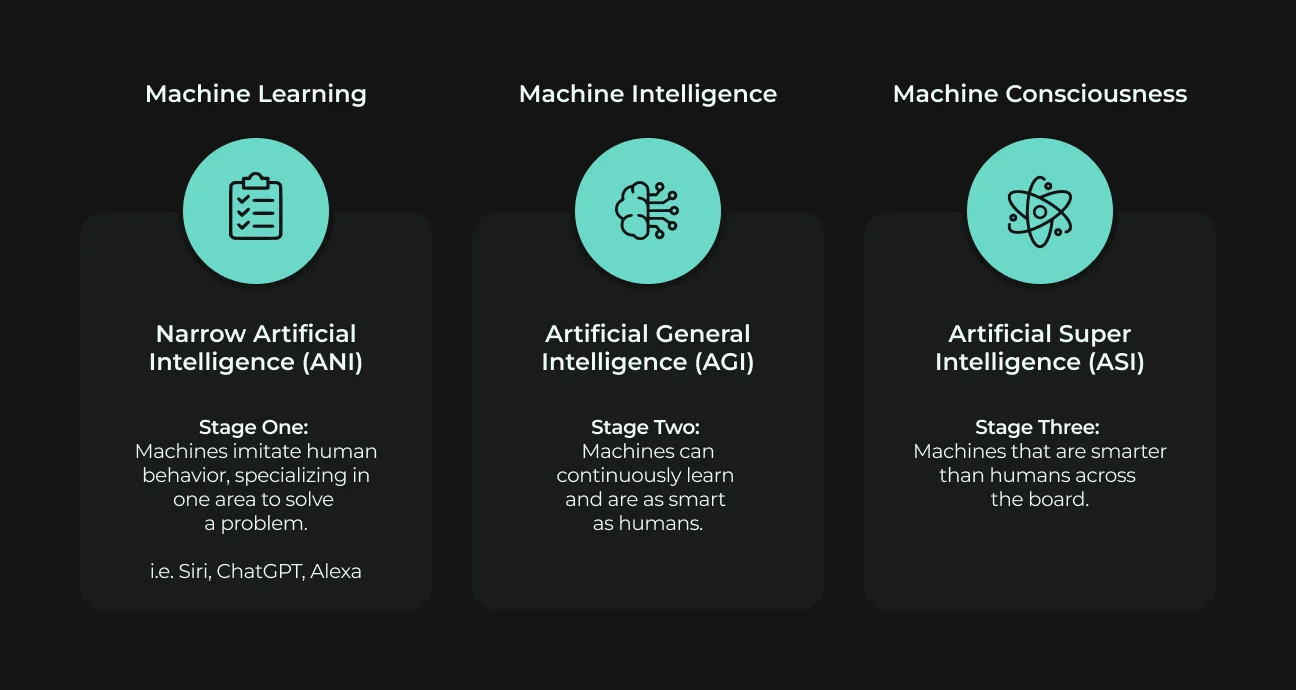
Artificial intelligence types differ significantly in complexity and what they can achieve. Generally, AI capabilities fall into three distinct groups:
- Narrow AI;
- General AI;
- Super AI.
Let's clarify each with practical examples.
1. Narrow AI
Narrow AI (also called Weak AI) performs specific tasks within clearly defined boundaries. It can analyze data, recognize patterns, and solve problems, but only within the limits of its programming. You can compare Narrow AI with an expert specializing in a single field without a general understanding beyond that.
Today, virtually all AI we use is Narrow AI. Common examples include:
- Virtual assistants;
- Recommendation systems;
- Autonomous driving technology.
Common AI virtual assistants like as Siri, Alexa, and Google Assistant can answer questions, manage tasks, and control devices based on pre-defined commands. Video streaming platforms like Netflix and Amazon use AI recommendation systems to analyze your past choices and browsing history to suggest relevant content or products. Tesla's Autopilot technology uses Narrow AI to recognize surroundings and control the car without the driver’s input.
Narrow AI is powerful, but it remains task-specific, lacking broader comprehension and consciousness.
2. General AI
General AI (Strong AI) is a technology designed to mimic human intelligence, with the ability to understand, learn, and apply knowledge across different fields, just as humans do. Unlike Narrow AI, General AI would independently adapt to entirely new situations and demonstrate creativity, reasoning, and problem-solving abilities without explicit instructions.
Note that genuine General AI remains theoretical today. The complexity of replicating human-like awareness, empathy, and intuition is a huge challenge. Companies like OpenAI, DeepMind, and IBM continue research in neural networks and cognitive computing models, trying to achieve this ambitious goal.
When created, General AI could fundamentally alter entire industries by handling complex operations without constant human oversight. It would even manage strategic planning and innovation.
3. Super AI
Super AI remains a part of a hypothetical future where AI surpasses human intelligence and capabilities in every imaginable way. This form of artificial intelligence would go far beyond replicating human thought and exceed our cognitive limitations. It would be able to solve complex global problems that humanity finds impossible today.
Super AI remains speculative and exists primarily in philosophical and ethical debates. Prominent technologists, including Elon Musk and Stephen Hawking, have highlighted the potential benefits and significant risks, urging cautious advancement in AI research.
Super AI is exciting to imagine, but in reality, it remains decades away. To create it, we require technological breakthroughs we cannot yet envision. Until then, Narrow and General AI will continue influencing our immediate future.
Types of AI Based on Functionalities
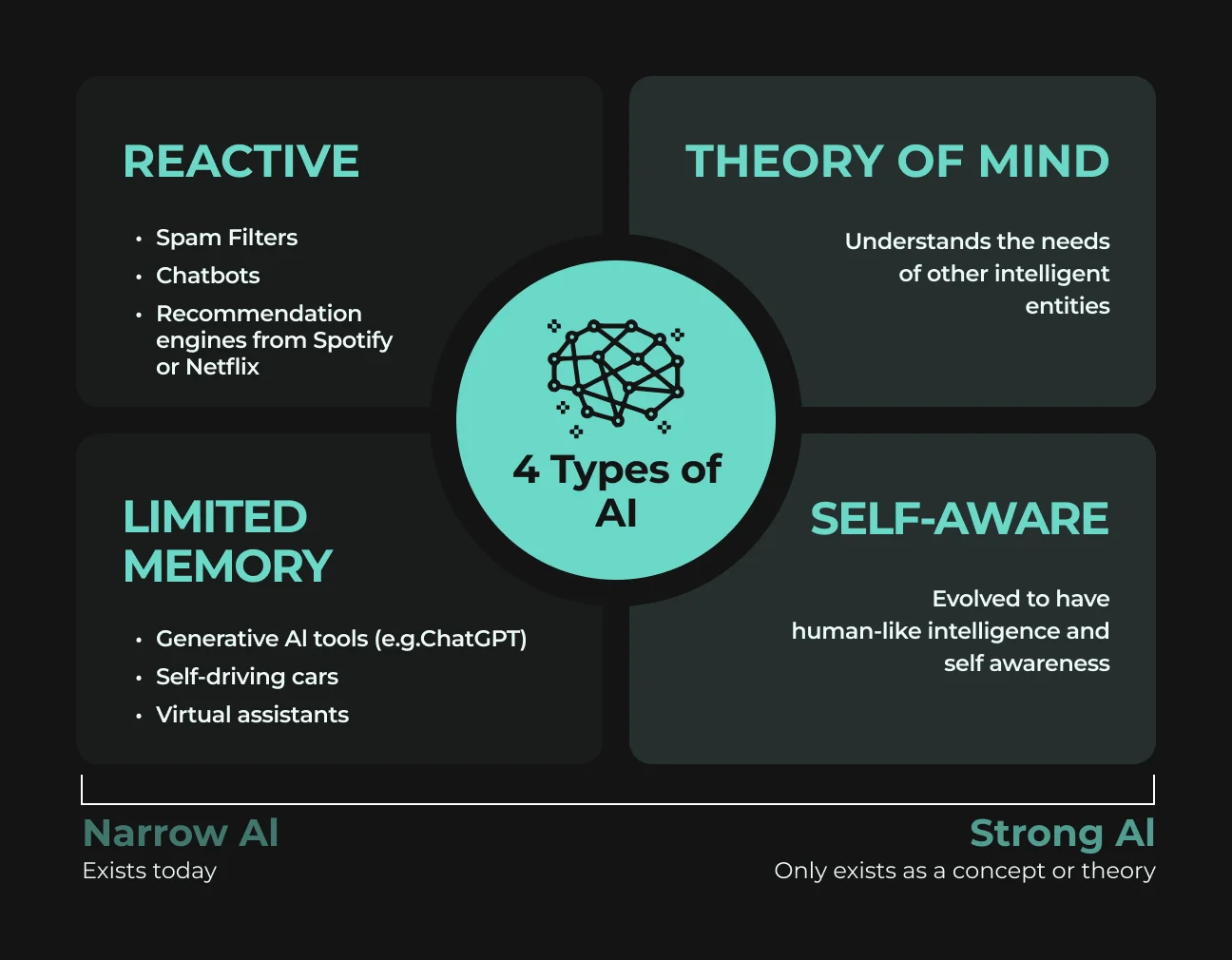
AI can also be classified by the ways it processes information and responds to the world around it. Four functional types explain these differences clearly: Reactive Machines, Limited Memory Machines, Theory of Mind, and Self-Awareness.
1. Reactive Machines
Reactive Machines represent the simplest form of AI. They react to immediate inputs without using memory or past experiences. To put it simply, this AI type cannot learn from previous actions and predict future outcomes.
A popular example is IBM’s Deep Blue chess computer, which famously defeated chess champion Garry Kasparov in 1997. Deep Blue could evaluate the current chessboard configuration, calculate possible moves, and choose the best response, but it couldn’t remember previous moves or strategies.
2. Limited Memory Machines
Limited Memory Machines can look back at past experiences and data to pick the best options. Unlike Reactive Machines, this type of AI learns from historical information. It's widely used in practical applications like autonomous vehicles and chatbots.
For instance, self-driving cars continually process and store data from their surroundings to navigate safely. They analyze such information as the speed of other vehicles or the position of pedestrians. This data helps them adapt to traffic conditions, predict potential dangers, and make accurate driving choices.
3. Theory of Mind
Scholars think that the Theory of Mind AI machines would be capable of understanding human emotions, thoughts, beliefs, and intentions. To achieve this, AI would require genuine empathy and advanced social understanding to be able to interpret subtle human behaviors.
Currently, the Theory of Mind remains theoretical. Researchers at labs like MIT and Stanford are exploring early-stage models, aiming for AI that can truly understand human emotional states. Achieving this could significantly enhance interactions between humans and machines, such as more intuitive conversational AI or personalized healthcare assistants.
4. Self-Awareness
Self-aware AI is the most advanced functional type. It describes machines that possess consciousness, emotions, and a sense of self. This kind of AI would understand its internal state and recognize its own existence, just like humans.
Today, self-awareness is purely speculative and doesn’t yet exist outside of science fiction. Achieving self-awareness would represent a fundamental leap forward that raises many extensive philosophical and ethical questions regarding AI rights, responsibilities, and societal impacts.
Other Types of AI on the Market in 2025
Aside from theoretical frameworks, several practical AI technologies have already created a huge impact on the business world in 2025. Let’s take a look at these artificial intelligence types, their real-world uses, and how they might boost your business performance.
AI in Robotics
Robotics AI helps machines operate independently by adapting quickly to changing environments. This type of technology commonly combines machine learning in AI and reinforcement learning to develop robots that learn from experience and improve efficiency over time.
Businesses often deploy robotics AI to automate repetitive or dangerous tasks. Examples include:
- Autonomous warehouse robots by Amazon and Ocado efficiently sort and transport goods;
- Robotics-assisted surgeries that enhance precision reduce patient recovery time;
- AI-powered drones are used in delivery services and agricultural monitoring.
Computer Vision
Computer vision tech allows machines to interpret images and videos similarly to human sight. Powered by deep learning technology and neural networks, computer vision systems analyze visual data, identify patterns, and recognize objects with accuracy.
Real-world computer vision applications include:
- Facial recognition technologies in security and customer service;
- Automated quality inspection in manufacturing that detects product flaws in real time;
- AI autonomous vehicles, which rely heavily on computer vision to navigate safely.
Expert Systems in AI
Expert systems are rule-based tools designed to mimic human decision-making processes. They leverage structured knowledge bases to deliver precise recommendations or diagnostics.
Key applications include:
- AI healthcare applications such as diagnostic assistants are capable of accurately identifying symptoms and recommending treatments;
- Financial advisory systems used by banks to assess credit risks and investment opportunities;
- Intelligent troubleshooting assistants that provide rapid solutions in technical support.
Generative AI
Generative AI models are among today's fastest-growing technologies, with a potential value of $4.31 trillion by 2030.
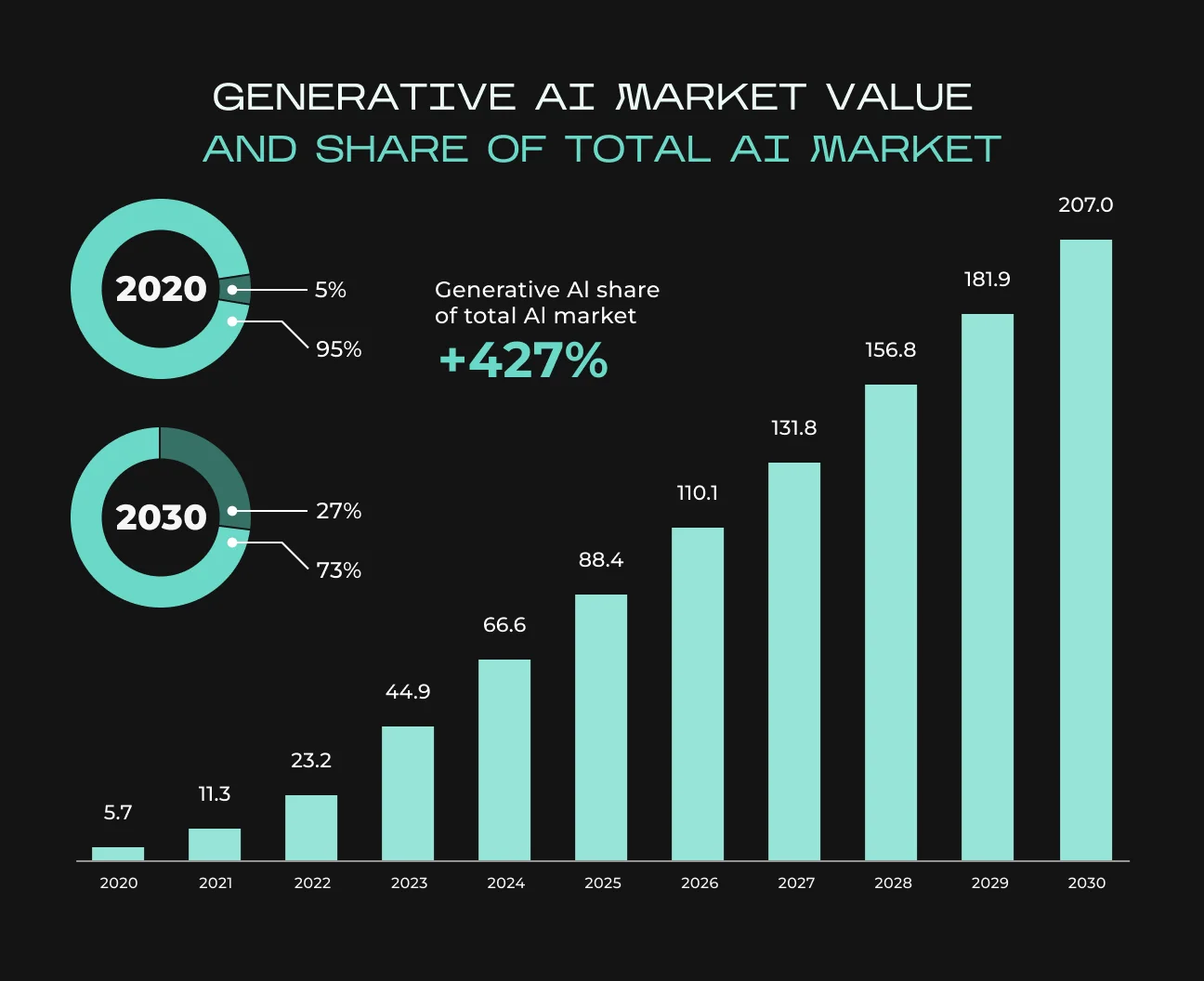
These systems produce original content based on patterns learned from extensive datasets. Examples of generative AI include:
- Text-to-text models, such as ChatGPT, which help businesses automate customer support through conversational AI;
- Text-to-image models like DALL·E or Midjourney, widely used for marketing visuals and creative design;
- Text-to-code models, such as GitHub Copilot, streamlining software development processes.
AI Speech Recognition
AI speech recognition enables machines to interpret and process human speech accurately. Using natural language processing and advanced neural networks, this technology significantly improves user interactions across many industries.
Typical applications include:
- Voice-controlled virtual assistants (e.g., Alexa, Google Assistant) that perform daily tasks hands-free;
- Transcription and subtitling tools, able to automate the conversion of audio content to text;
- Real-time translation services, breaking language barriers during international communication;
- AI-based language learning apps.
Advancements in speech recognition also enhance accessibility, helping visually impaired users work within digital environments.
AI in Gaming
AI game playing technologies create more immersive, challenging, and realistic gaming experiences. Developers use machine learning, particularly reinforcement learning AI, to build intelligent opponents and dynamic game worlds.
Notable examples include:
- AI-driven non-player characters (NPCs) adapting their strategies based on player behavior, enhancing realism;
- Procedurally generated game content that ensures unique gameplay experiences every session;
- Real-time analytics and personalization tools that adjust difficulty levels to match individual player skill sets.
Innovations like this attract and retain gamers and open fresh revenue opportunities.
Our experts have first-hand experience with generative AI. Recently, our team implemented AI-powered systems capable of managing customer requests swiftly, accurately routing inquiries to appropriate specialists, and even analyzing real-time call sentiment to adjust responses dynamically.
Such intelligent agents in AI enhance customer satisfaction, boost agent productivity, and lower operational costs. If you're exploring practical ways to integrate AI into your business strategy, check out our recent post covering profitable AI business ideas.
Future of AI Across Industries
Artificial Intelligence (AI) is no longer a futuristic concept. In recent years, it has become the catalyst that redefines the ways different industries operate worldwide. According to research done by Statista, AI saw its market soar past $184 billion in 2024, which is nearly $50 billion more than the year before.
And with momentum building, it’s on track to break the $826 billion mark by 2030. In 2025, AI's integration across sectors became one of the main means of survival and competitiveness.
AI in Healthcare Brings Precision and Readiness for Any Scenario
In healthcare, AI is helping shift the focus from treatment to prevention. With a global market set to hit nearly $37 billion this year and projected to grow past $600 billion by 2034, reflecting a CAGR of 37%.
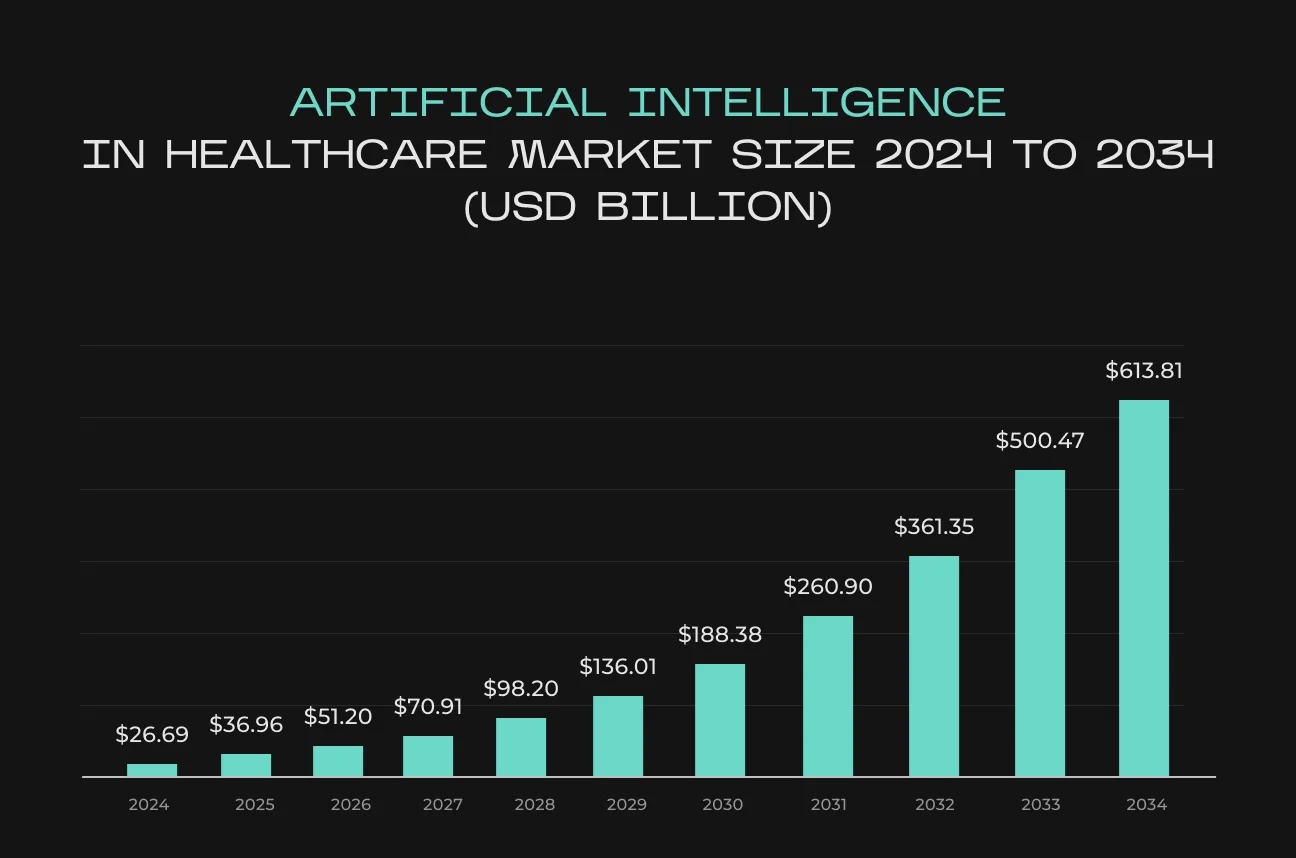
It’s clear that AI's role is only growing. Here is what AI can do for patients and doctors:
- AI-enhanced imaging tools detect tumors and anomalies earlier than humans;
- Predictive models identify patients at risk for chronic illnesses;
- Virtual health assistants offer 24/7 patient support and reminders;
- NLP systems summarize clinical notes, saving time for doctors.
These use cases show that AI is making care faster, smarter, and more cost-effective.
AI in Finance Enhances Decision-Making and Risk Management
In the financial sector, AI is becoming the brain behind better decisions and risk assessment. By analyzing vast datasets, AI algorithms can detect fraudulent activities, assess credit risks, and provide personalized financial advice.
AI investment in the financial sector has surged, with spending climbing from $35 billion in 2023 to $45 billion in 2024, which is a significant year-over-year jump.
The adoption of AI in finance brings actual results:
- AI algorithms spot unusual transactions to prevent fraud in real time;
- AI-powered credit-scoring systems consider alternative data for fairer evaluations;
- Chatbots answer client queries around the clock with human-like accuracy;
- Portfolio management tools adjust investment strategies automatically.
AI gives financial institutions a competitive advantage by providing faster service, fewer errors, and smarter customer experiences.
AI in Manufacturing Improves Predictive Maintenance and Quality Control
Manufacturers are leveraging AI for predictive maintenance, reducing downtime, and optimizing production lines. AI systems analyze equipment data to forecast failures before they occur, saving costs and improving safety.
But most importantly, AI-powered quality control systems ensure product consistency and reduce waste, helping companies move toward more sustainable production models.
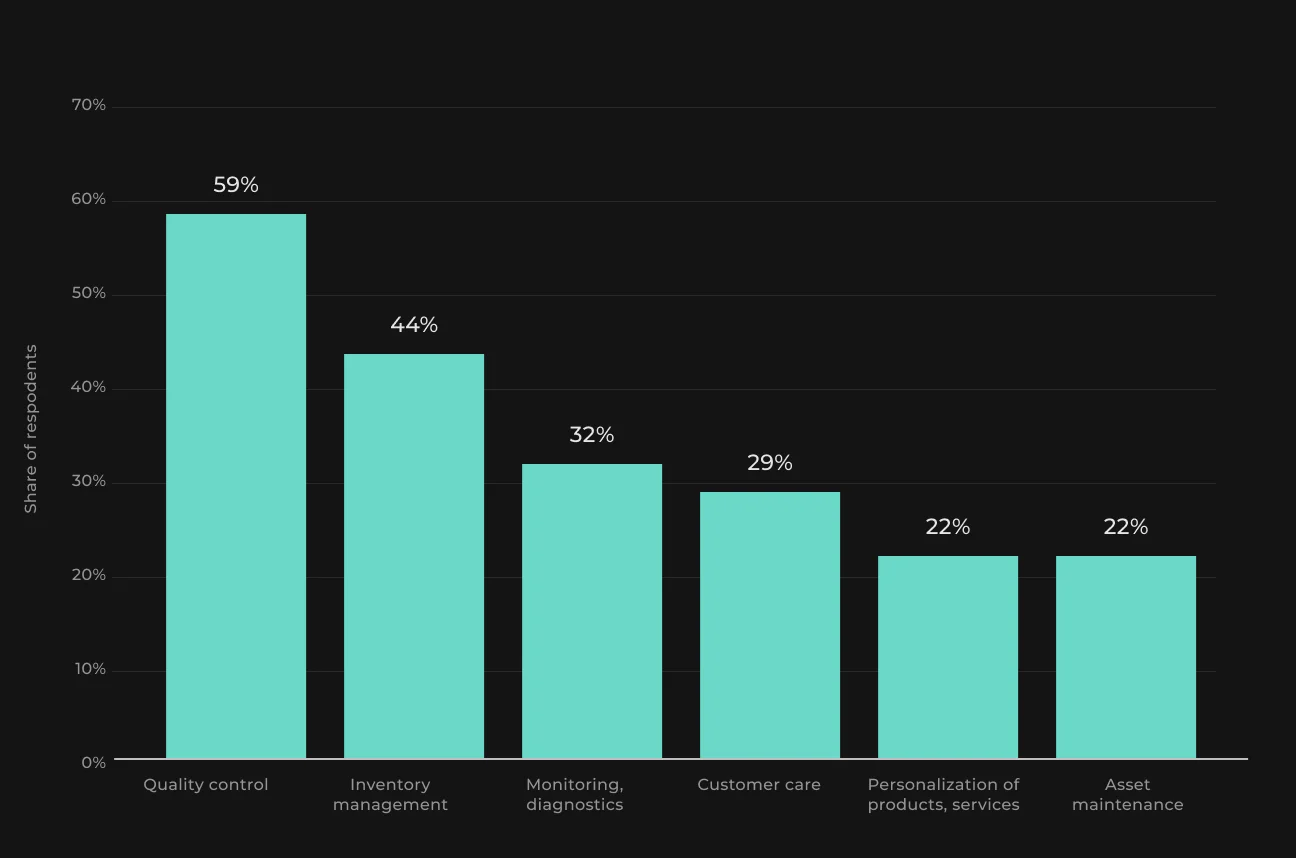
Examples of AI in manufacturing:
- Predictive maintenance uses sensor data to prevent equipment failure;
- AI-driven visual inspection systems catch defects on the production line;
- Demand forecasting models adjust supply chain plans dynamically;
- Robotics AI handles hazardous tasks with improved safety and speed.
Retail AI Offers Personalized Experiences and Inventory Management
Retailers use AI to provide customers exactly what they want. The algorithms create personalized shopping experiences, manage inventory efficiently, and optimize pricing strategies. Here is what a well-designed AI system can offer your business:
- Personalized product recommendations based on customer behavior;
- Computer vision systems can manage shelf stock and store layout optimization;
- Dynamic pricing algorithms adjust costs based on demand and competition;
- AI chatbots are guiding shoppers through product discovery and checkout.
This approach enhances customer satisfaction, brings more profit, and reduces operational expenses.
91% of retail IT leaders say AI tops their tech priority list heading into 2026. According to The CIO Agenda, this insight comes from over 2,400 CIOs and tech execs across 84 countries, outlining where retail is placing its biggest bets.
One thing about AI in business is clear: it's no longer a trend. It has become the driving force for digital transformation. AI offers industries unprecedented opportunities for innovation and efficiency. The organizations that learn quickly and innovate with AI will be the ones setting the pace, and those that delay this shift risk being left behind.
Partner with SapientPro to Build Your AI Solution
Working with SapientPro means getting 8+ years of experience in AI development services for your business. Our engineers work with NLP, computer vision, chatbots, call centers, and other AI-powered solutions that improve workflows and generate profits.
Contact us now to get a free consultation covering your project’s needs. You’ll get an expert overview of your idea from our experts, along with a detailed estimate for future development. It’s time to bring your ideas to life and lead the market!
Get a Free Consultation
SapientPro's experts will help you get an estimate and guide you through the whole development process.

RELATED ARTICLES

10 min
Five Lessons from AI Failures in Production
95% of enterprise AI pilots never make it to production. We asked the founders who've seen it firsthand — here's what they said.