All Five Lessons from AI Failures in Production
May 25, 202610 min read


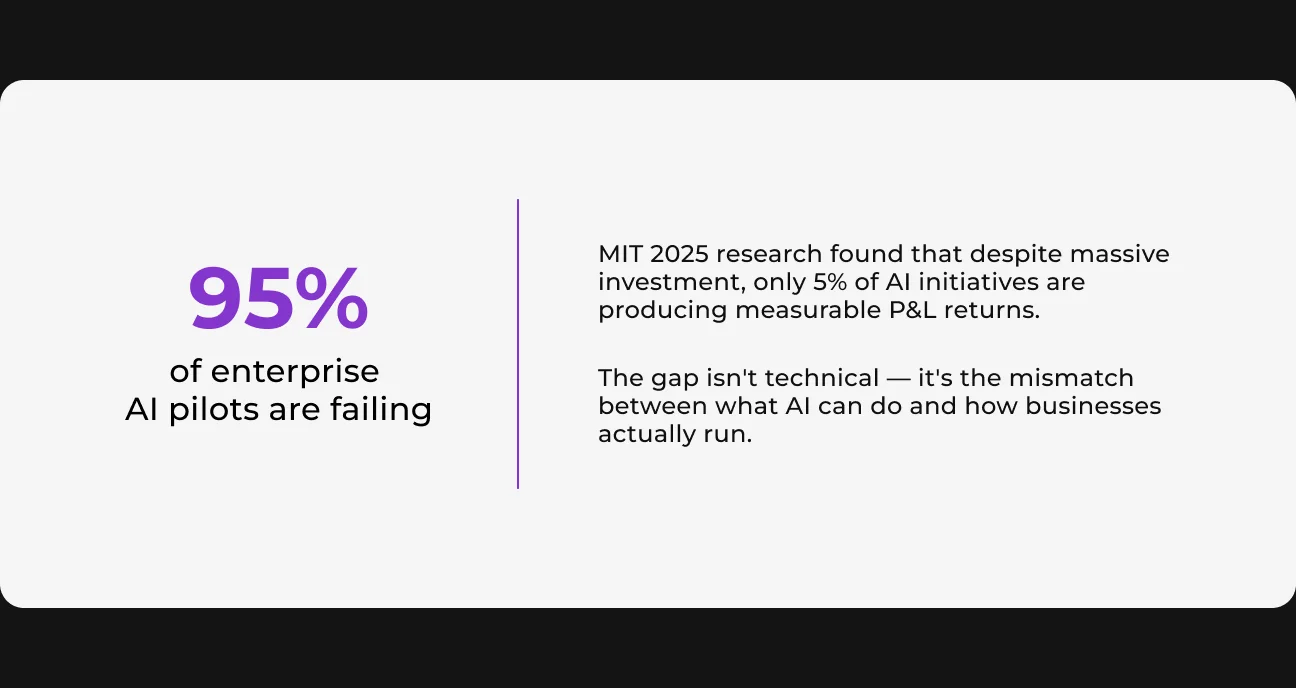
Here is a number worth sitting with: MIT’s 2025 research found that 95% of generative AI pilots at major enterprises are failing to produce measurable returns on profit-and-loss statements.
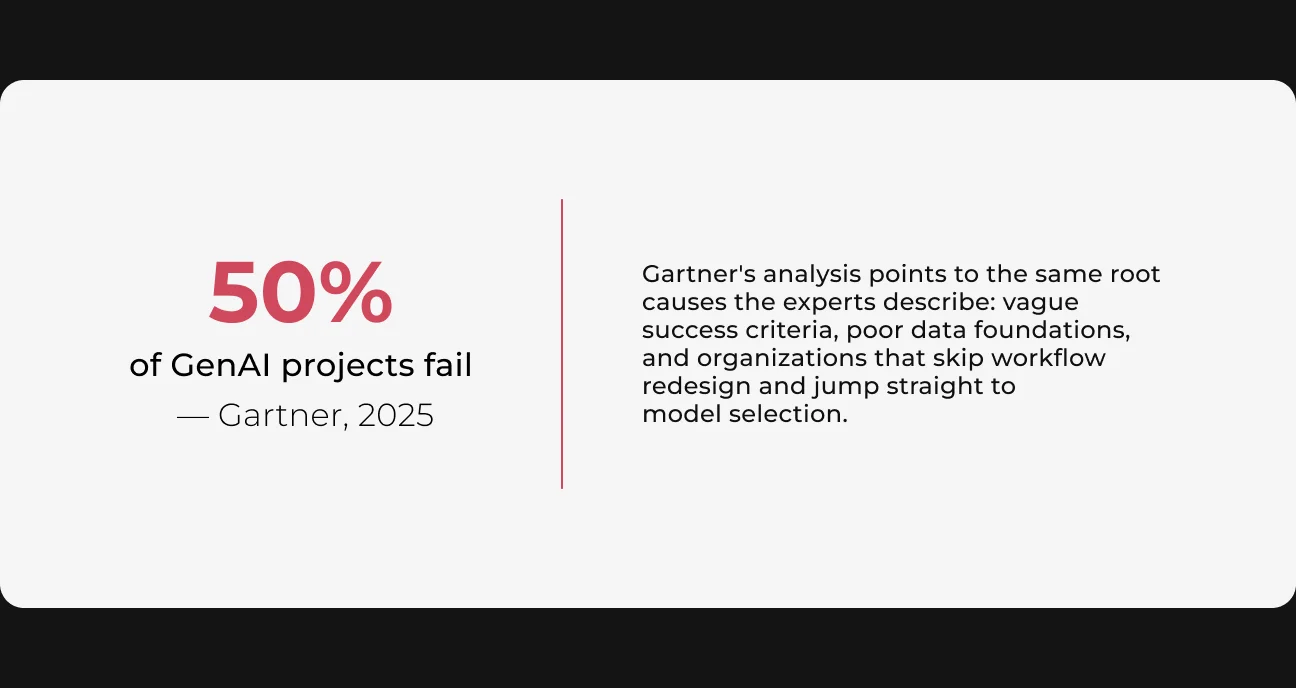
Gartner puts the overall GenAI project failure rate at 50%. These AI project failure rate statistics get cited constantly — in board decks, in vendor pitches, in post-mortems. Across the industry, billions are being spent on AI automation that never escapes the demo stage.
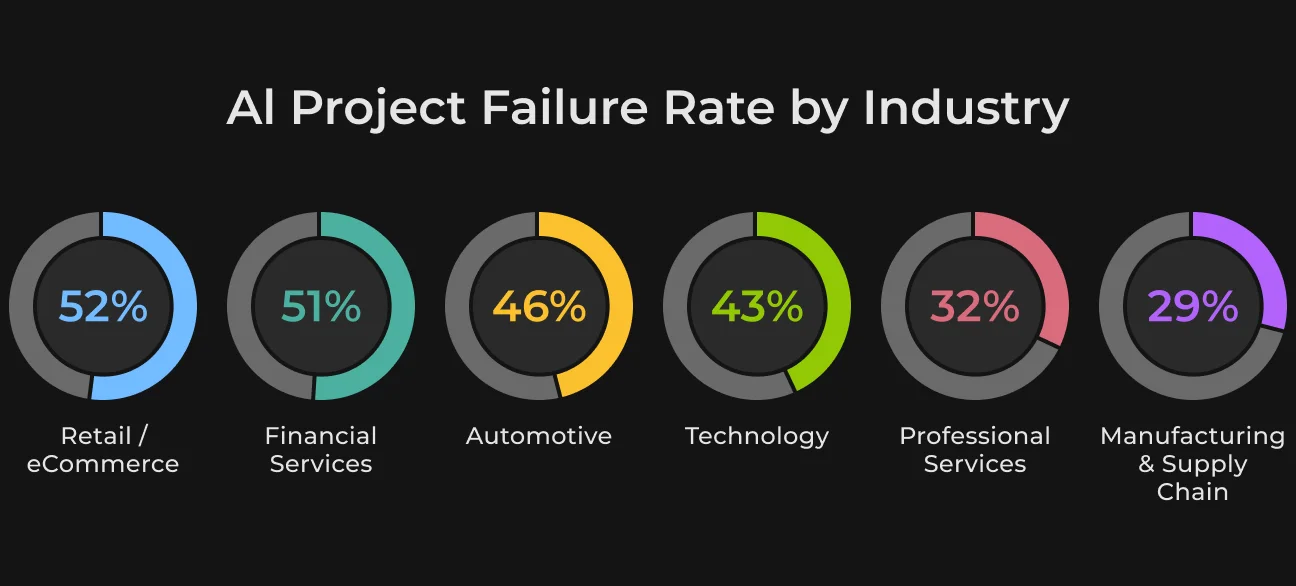
But here's what those statistics don't tell you: the failure is almost never the model.
The transformer doesn't collapse. The API keeps responding. The accuracy metrics look fine in the dashboard. The system fails in quieter, more expensive ways — rejected by a team that didn't ask for it, trusted with decisions it shouldn't own, or quietly degrading for months before anyone notices.
We spoke with five founders and technical leaders who've shipped AI into production and watched it break. Their answers are candid, specific, and sometimes uncomfortable.
They cover everything from security products to enterprise software to internal tooling — and they converge on a set of patterns that no amount of model-switching will fix. Read on to find out the key AI fails and how to mitigate them in your business.
When the Integration Works and Still Fails
The most disorienting kind of AI failure is the kind where nothing is technically broken. The model runs. The pipeline completes. The evaluation scores look reasonable. And yet the product gets rejected — by users, by the business, or by the basic physics of how people actually work.
This is where most AI projects die, and it's the failure mode that's hardest to debug because there's no error log to point at.
Akshansh Sharma, an Automation & AI Engineer, watched this play out firsthand on a code review project. The tool was technically solid — it caught real bugs, flagged security issues, and had measurable accuracy. The model was fine. The infrastructure was fine. And then it wasn't.
The problem was that it inserted itself directly into the PR approval flow. Every pull request now had an AI reviewer as a required check before a human could merge. What we didn't account for was the identity problem. Senior engineers — people with 8, 10 years of experience — suddenly had a bot flagging their code with the same weight as a peer review. It wasn't a technical rejection. It was a cultural one. Within six weeks, engineers were gaming the tool, writing code specifically to satisfy the AI rather than writing good code. The metric we optimized for got better. The actual codebase quality didn't.

Akshansh Sharma
This pattern shows up across industries: an AI system that's built as a gate rather than a collaborator.
The integration designers asked the model-level question (can it detect bugs?) before asking the human-level one (will senior engineers accept having their judgment checked by software?).
Akshansh's diagnosis: "The real failure wasn't the model. It was that we replaced a trust-based social workflow with an automated gate and called it an upgrade. The data was fine. The workflow was the problem — and we didn't ask the right people before we shipped it."
Ihor Hamal, COO at SapientPro, puts the same problem more bluntly.
He sees expectation mismatch as the root cause of most failed integrations — teams arriving with the belief that AI will arrive and solve everything, rather than identifying the specific, narrow problem it should actually address.
AI always integrates badly when the client's expectations are at the level of magic — that AI will come and solve everything. Like AI will sell as a sales agent. Or if the site is bad, an AI chatbot will explain everything to users. Instead of solving a real problem, there's an attempt to integrate AI that will fix everything.

Ihor Hamal
The "magic AI" expectation is its own kind of technical debt. When a team builds an integration around a vague outcome — better sales, happier users, fewer support tickets — there's no clear definition of failure. And without that, there's no way to catch the system drifting away from usefulness until it's already too late.
The False Confidence Problem
There's a failure mode that's arguably more dangerous than getting the wrong answer: getting the wrong answer in a way that sounds right.
Dharmesh Acharya, Co-Founder of ZeroThreat.ai, spent 26 years in cybersecurity before building an AI-powered penetration testing platform.
His team ran into this problem when they tried to use AI to prioritize security findings — ranking issues by exploitability and severity to help analysts triage faster. The model worked. But in a security context, "working" isn't enough.
The problem was not that the system failed technically. The problem was that in security, this kind of over-escalation creates noise, wastes analyst time, and reduces trust in the product very quickly. Customers do not want an AI layer that keeps turning weak signals into high-severity concerns.

Dharmesh Acharya
What ZeroThreat.ai encountered is a specific version of a broader problem: AI systems that add confidence faster than they add certainty. In low-stakes contexts, this is annoying. In security, it's a liability.
A finding flagged as critical gets treated as critical — analysts investigate it, teams get pulled in, resources get spent. If the AI inflated that severity from a weak signal, the cost of that false confidence compounds across every single alert.
Dharmesh's description of the failure is precise:
"We were not dealing with a broken system; we were dealing with a system that could create an illusion of certainty. In security products, that is a bad place to be. Users do not just need something that appears intelligent. They need something they can operationalize with confidence."
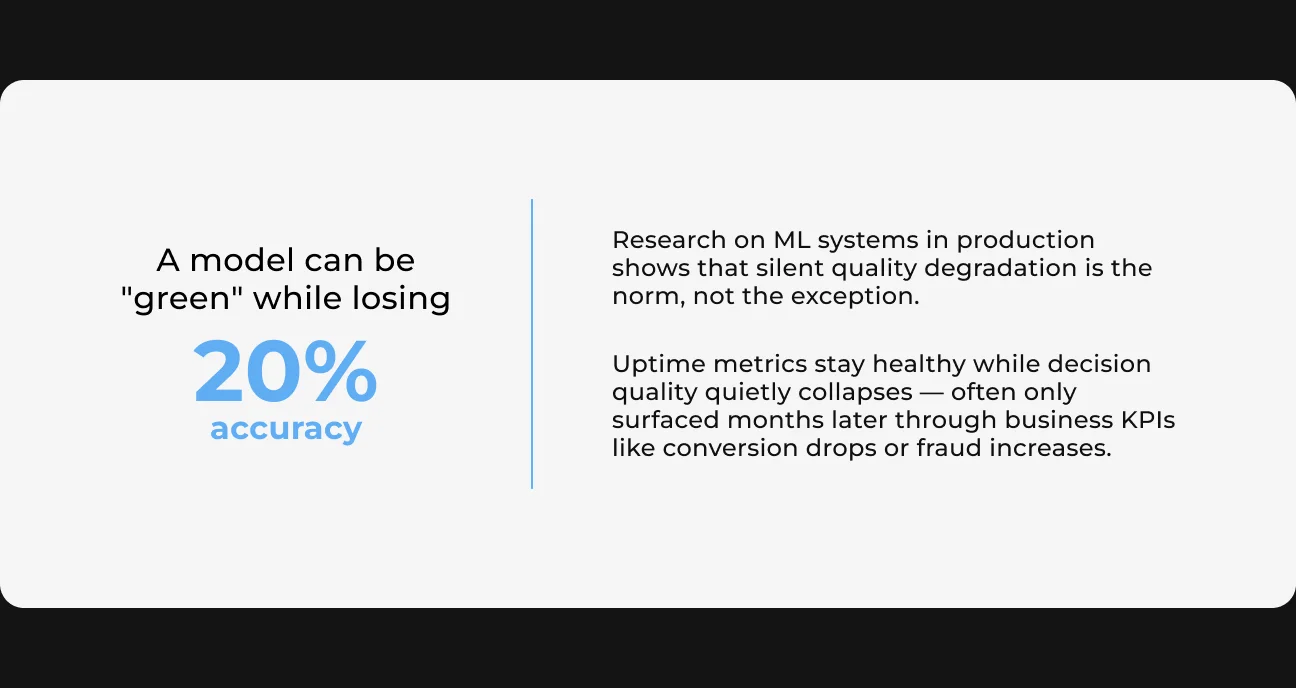
This is the technical version of the same problem Akshansh described — the gap between what the system appears to be doing and what it's actually doing. In ZeroThreat.ai's case, the outputs looked polished. They passed a quick review. But under scrutiny from someone who knew what they were looking for, they weren't strong enough to drive real action.
The deeper issue is structural:
- AI models are probabilistic systems dressed up in confident language.
A model that gives an output with 78% confidence doesn't display "I'm 78% sure" — it just gives an answer. The people reading it often have no mechanism to interrogate that confidence, so they treat the output as settled.
This is the gap that breaks production integrations in high-stakes domains.
When "One More Model" Stops Working
Every team building AI-powered products hits a wall. The model improves. The prompts get better. The eval scores tick up. And then something doesn't change — the thing that actually matters.
That's the moment that separates the teams who understand what they're building from the ones who are still chasing benchmarks.
For Akshansh Sharma, the wall appeared during a document processing project.
The team cycled through GPT-4, fine-tuned variants, better prompts, different chunking strategies. Each iteration produced modest accuracy gains — 2 to 3 percent better extraction. The client kept pushing for higher. The team kept trying.
Then someone on the ops side casually mentioned that the documents we were processing had three different internal formats depending on which regional office sent them, and nobody had documented that anywhere. That was it. That was the real problem. No model was ever going to reliably extract structured data from documents it had no consistent schema for. More compute wasn't going to fix a data governance issue that predated us by years.
Akshansh Sharma
The insight is uncomfortable: in many production failures, the model is the least broken part of the system. The real ceiling is upstream — in the data quality, the schema consistency, the organizational process that produces the inputs the model is trying to reason about.
Dharmesh Acharya reached the same conclusion through a different route.
ZeroThreat.ai kept improving its AI prioritization system — better language, smarter-looking output, more compelling demos. But the core problem, severity inflation from low-confidence signals, wasn't a model problem. It required a different architecture entirely.
What worked best for us was picking the right thing for the right job. The solution was a combination of deterministic and probabilistic systems, not a blind belief that AI should do everything. We kept deterministic logic where repeatability, evidence, and hard validation mattered most, and used probabilistic AI where interpretation, pattern recognition, and contextual reasoning genuinely added value.
Dharmesh Acharya
Max Tatarchenko, CTO at SapientPro, says the same thing in fewer words: everything that classical programming can do should be done with classical programming. The result will always be 100%, not 98% like with AI. That 2% gap sounds small.
Across thousands of daily operations, it compounds into something significant.
Don't use AI for precise calculations — finance and the like. AI can create an algorithm, but it shouldn't do the counting itself. For precise calculations, the algorithm needs predictable logic. Besides, it's simply cheaper and doesn't require additional spending on usage.

Max Tatarchenko
Ihor Hamal frames this mathematically.
Stack two prompts that each succeed 98% of the time, and your pipeline-level success rate drops to 0.98 × 0.98 = 96%. Add a third, and you're at 94%. Each layer of AI adds uncertainty. Layering models and prompts doesn't compound intelligence — it compounds the chance of failure.
The shift that actually works isn't finding a better model. It's asking a harder question:
- What should AI be doing at all?
- Where does probabilistic reasoning genuinely add value that deterministic logic can't provide?
That boundary, once understood, tends to produce much better systems than any amount of prompt engineering.
The One Question That Cuts Through the Noise
If you had to figure out, in a single conversation, whether a company should be building AI at all — what would you ask? We put that question to the experts. The answers aren't what you'd expect from people who spend their careers building AI products.
How many people are currently doing this task, what are they paid, and what else do they do in their day? That one question tells me almost everything. If a company has 10 people doing a task at $100k/year each, that's a million dollars in labor. But if those 10 people spend 40% of their time on actual human tasks — client relationships, judgment calls, exceptions, trust-building — then what you're really automating is 60% of their role, which changes the calculus entirely. You can't automate the relationship.
Akshansh Sharma
The answer that would make him tell a founder to stop? "We just feel like we should have AI in the product." As he puts it: "That's not a reason. That's FOMO dressed up as strategy."
Pratik Mistry, EVP of Technology Consulting at Radixweb with 21 years in enterprise software, asks something adjacent but equally pointed:
What decision or outcome are you expecting AI to improve, and how is that decision being made today? If that answer is vague, or if it quickly turns into 'we just want to add AI because everyone else is,' that's already a red flag for me. Most teams jump to models before they've really understood their data or their workflows. So I'll push a bit further: what does your data actually look like today? Is it consistent, is it accessible, does it reflect the outcome you're trying to influence? You'd be surprised how often the honest answer is that the data is fragmented, noisy, or not even being captured properly.

Pratik Mistry
His stopping condition is clear: "When there's no clear link between AI and a measurable business outcome, and no willingness to fix the underlying system first.
If the process itself is broken, or if decisions are still largely subjective and undocumented, AI doesn't solve that — it amplifies it."
Both answers converge on the same diagnostic: the question isn't "what can AI do here?" It's "what is actually broken, do we understand it well enough to automate it, and are we ready to do the foundational work that has nothing to do with the model?"
Ihor Hamal's version of the question is the most direct: define exactly where and for what you actually need AI. Not magic that solves everything, but a specific, narrow problem where classical programming won't work and AI genuinely replaces manual human effort. That boundary, where rule-based systems stop and probabilistic reasoning earns its place, is where the useful AI lives.
Where We Draw the Line — AI We Won't Ship
The most honest signal of where AI actually stands is what the people building it refuse to automate. Not because they can't technically — but because the cost of being wrong is too high, or the thing being automated is too human to hand off.
These aren't hypothetical limits. They're places where each expert has looked at the capability, looked at the risk, and said no.
I would never trust AI to autonomously mark a vulnerability as an Accepted Risk, and I would not trust it to autonomously escalate into aggressive exploit behavior inside a customer environment. If you let an AI system loose without strong guardrails, it can run wild very quickly. It can chain actions too aggressively, overreact to weak signals, pursue exploit paths that are unnecessary, and keep pushing further simply because it sees another possible branch to explore. In a security product, that is not innovation; that is loss of control.
Dharmesh Acharya
Dharmesh's line is drawn at governance and safety-sensitive actions.
AI can validate, enrich, and add context — but it doesn't get unilateral authority over decisions with irreversible consequences. "Accepted Risk is a business and security judgment. Exploit escalation is a safety-sensitive action. Both require hard guardrails, evidence, and human accountability."
I won't let AI take sales calls or manage the relationships that actually keep a company alive. And I'm extremely careful about any AI that writes directly to a CRM or touches client-facing data without a human checkpoint. The CRM data one is less obvious, and honestly more dangerous. We've shipped AI that handles email outreach, customer support triage, and internal data summarization — and it genuinely outperforms humans on speed and consistency. But the moment that data flows into a CRM, into a contract, into anything a client will see and hold you to — it needs a human to sign off. Not because the AI is always wrong. Because when it's wrong in that context, the blast radius is existential.
Akshansh Sharma
Akshansh's example is specific and instructive: a single bad AI-generated entry in a deal record caused a six-figure contract dispute. The AI wasn't wrong often. But often enough, in the wrong place, with permanent consequences.
Max Tatarchenko at SapientPro holds the same line for calculations: don't use AI where precision is required and the output will be trusted as authoritative. Finance, compliance, anything where the number is the thing — these belong to deterministic systems, not probabilistic ones.
The pattern across these limits is consistent. None of these experts are skeptical of AI in general. They ship AI products. They've built systems that work. What they don't trust is AI in decisions where the error state is irreversible, where confidence can't be interrogated, or where the relationship between the AI output and a consequential action is too short and too automatic.
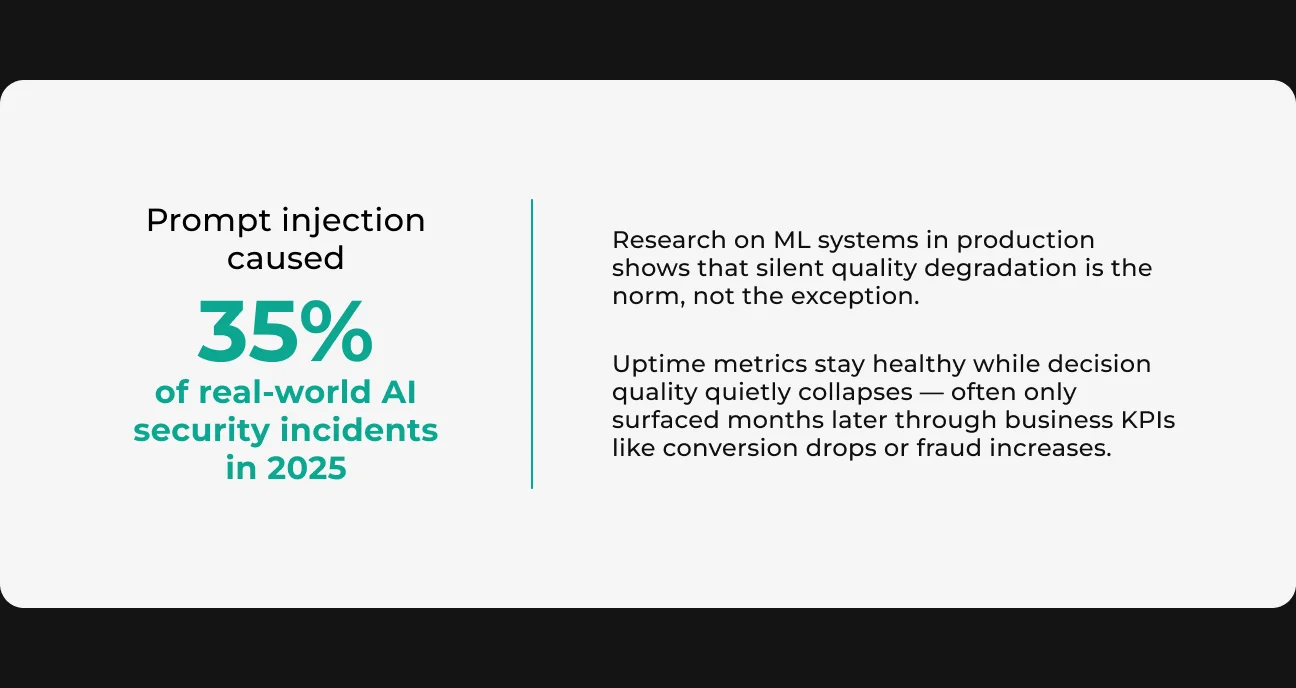
There's also an infrastructure dimension to this line. Production AI systems face attack surfaces that traditional security measures weren't built to defend. In a security product like ZeroThreat.ai, this is obvious.
But the same risks apply more broadly: models that can be manipulated through their inputs, training data that can be poisoned, proprietary outputs that can be reverse-engineered. The question of what AI should not do is partly a reliability question and partly a security one.
Failure Is the Data
None of the experts in this piece abandoned AI after their failures.
They got sharper about where it belongs.
That's the thing the 95% statistic obscures: most of those failed pilots weren't wasted.
They produced information — about where the data wasn't ready, which workflows wouldn't accept automation, which decisions needed human accountability no matter how confident the model sounded. The teams that learned from them built better systems the next time. The teams that didn't went back to chasing models.
The pattern across every conversation we had was the same: the AI wasn't the problem.
The mismatch was. Mismatch between technical capability and organizational readiness. Between model confidence and operational trust. Between what AI can optimize and what humans actually need from a system.
Akshansh Sharma's closing thought is as good a summary as any: treat AI like a highly capable assistant that needs exact instructions — not a replacement for judgment.
It can do extraordinary things, but only when you've told it precisely what to do, when to do it, and how much latitude it has.
The engineers and founders who understand that are building things that last.
TL;DR
- 95% of enterprise AI pilots fail to produce measurable returns, and the model is almost never the reason
- The most common failure mode: technically functional integrations rejected by users, teams, or business reality
- Layering better prompts and newer models won't fix broken data, bad workflow fit, or misaligned expectations
- Everything classical programming can handle reliably should stay there; AI earns its place only where deterministic logic genuinely can't go
- The founders building AI that lasts ask one question first: what specific, measurable outcome does this change — and is the underlying process ready for it?
Prevent Your AI from Failing
Talk to SapientPro's engineers to discover your products weak spots and fix them.