All AI in Insurance: Impact, Use Cases, Trends
June 25, 202515 min read


AI is crucial in nearly every industry, especially in insurance. Generative AI has the potential to transform how insurers manage underwriting, assess risk, set prices, and personalize customer experiences. By 2030, AI might increase productivity and cut operational costs by as much as 40%.
The insurance industry deals with a lot of unstructured data and manual tasks, so it can really benefit from AI. Discover how AI can improve and bring new ideas to the insurance field.
What is Artificial Intelligence in Insurance?
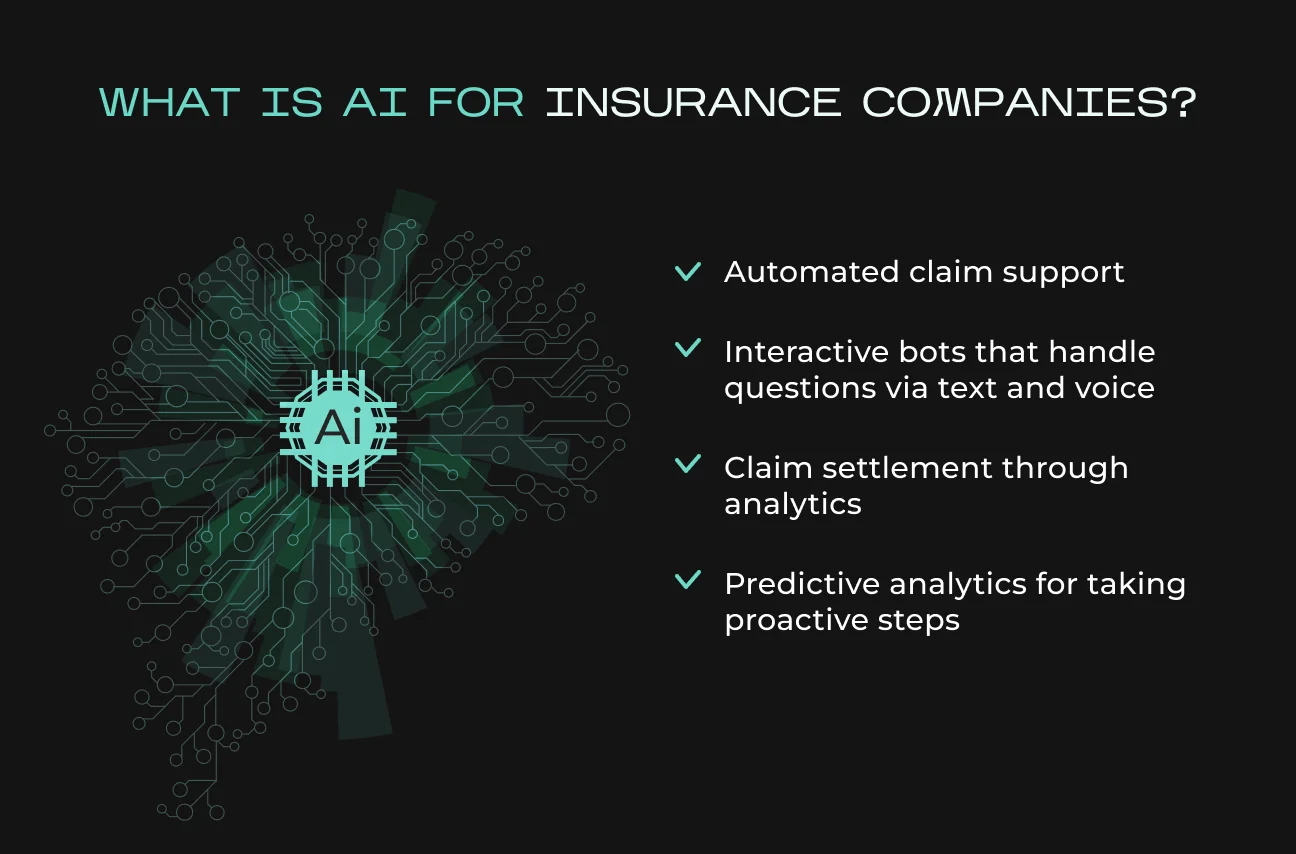
The insurance industry now deals with many challenges like rising costs, complex risk assessments, more frequent disaster claims, and higher customer expectations. AI steps in as a valuable asset that helps solve these by automating tasks, improving accuracy, and personalizing customer experiences.
Here are a few examples of how AI is used in insurance:
- Chatbots and virtual assistants: offer 24/7 customer support and policy details;
- Machine learning: analyzes data to improve quotes and underwriting;
- Image recognition: speeds up claims by automating damage assessments;
- Predictive tools: help insurers identify risks and prevent losses;
- Robotic process automation: simplifies back-office tasks and reduces errors.
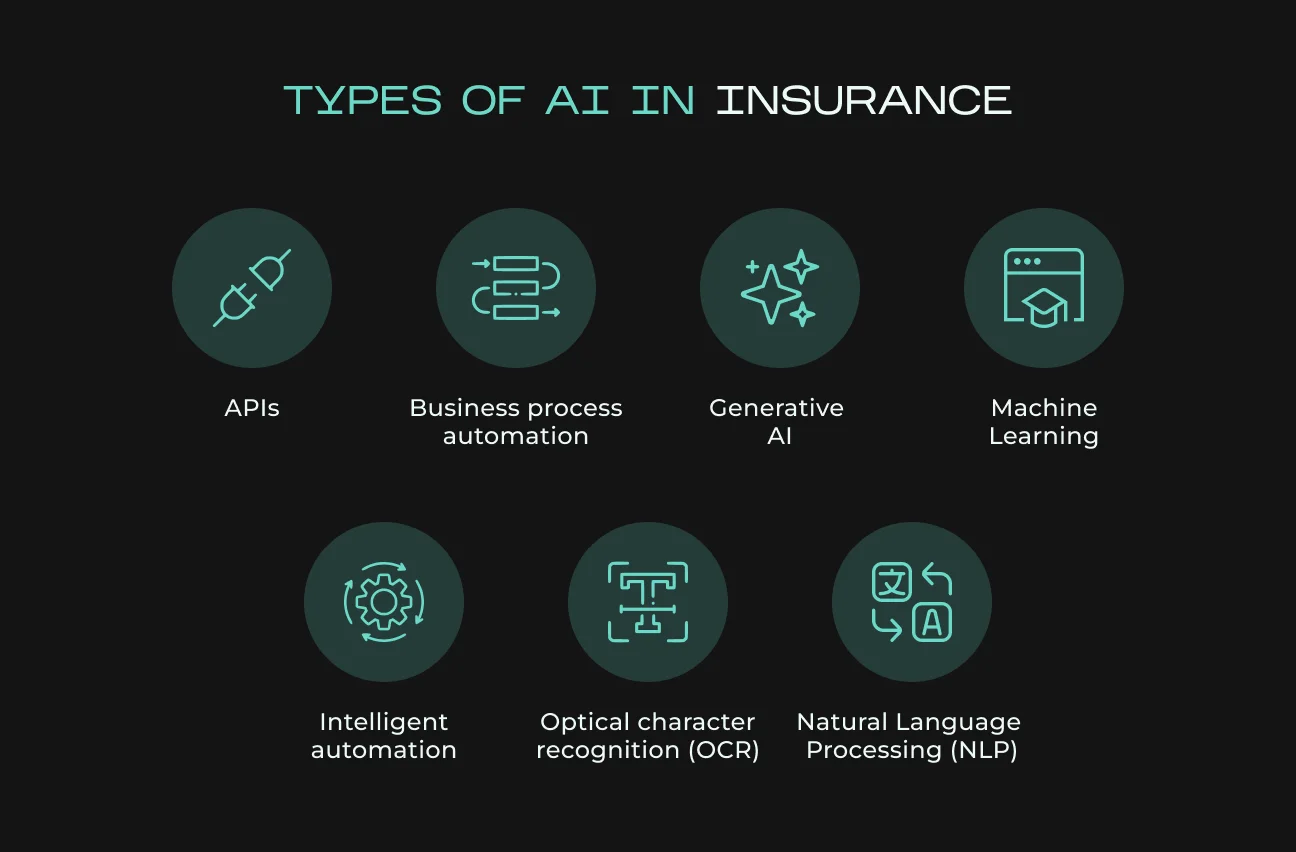
Types of AI Used in Insurance
Insurance companies can use various AI tools to improve their operations. Let's take a closer look.
APIs
APIs help software applications communicate and share information. In the insurance world, they connect different companies, like carriers, adjusting firms, and claimants, to improve collaboration and access to information. Insurtech companies also use APIs to connect with insurers and display available rates and offers to customers.
Business Process Automation
Business process automation (BPA) in the insurance industry uses software to simplify complex and repetitive tasks. Its goal is to make daily operations run smoothly. For example, BPA helps with customer onboarding, underwriting, claims processing, and efficient policy management.
Generative AI
Generative AI that uses large language models (LLMs) offers numerous benefits for insurance companies. It helps streamline tasks like customer service and document analysis, which lets representatives better address customer issues. Actually, 90% of insurers plan to invest in Gen AI next year.
Generative AI also gives customers powerful tools like chatbots and virtual assistants. For example, IBM created a chatbot for an insurance company to assist customers with submitting documents and checking their coverage. As a result, 77% of industry leaders see the need to quickly adopt generative AI to stay competitive.
Machine Learning
Machine learning uses data and algorithms to help artificial intelligence learn like humans and improve its accuracy over time. Insurance companies can use this technology to analyze customer data and provide personalized product recommendations to potential and existing clients.
Advanced machine learning models have made risk assessments 82% more accurate, and false alarms have dropped by 71% compared to older methods. Insurance losses have decreased by 35%.
Intelligent Automation
AI-driven workflows are all about intelligent automation, which uses technology to boost decision-making in organizations. With the growing use of data in the insurance industry, intelligent automation tools help companies efficiently manage customer data, process claims, calculate payments, and ensure compliance, all while cutting down on manual tasks.
Optical Character Recognition
Optical character recognition (OCR), or text recognition, is a technology that turns images of text into machine-readable formats. In the insurance industry, it helps convert scanned documents, PDFs, and images into editable and searchable files. This is crucial for insurers transitioning to digital systems. By automating text and data extraction, OCR streamlines tasks like processing claims, issuing policies, and managing customer service.
Natural Language Processing
Natural language processing (NLP) is a type of AI that uses machine learning to help computers understand human language. Insurance companies can use NLP to analyze customer information to decide on the right coverage and pricing.
For example, NLP can automatically pull important details from claim forms and emails, like policyholder info and claim descriptions. It then sorts and prioritizes these claims by severity and complexity. This system ensures urgent claims get prompt attention, while routine ones are efficiently processed.
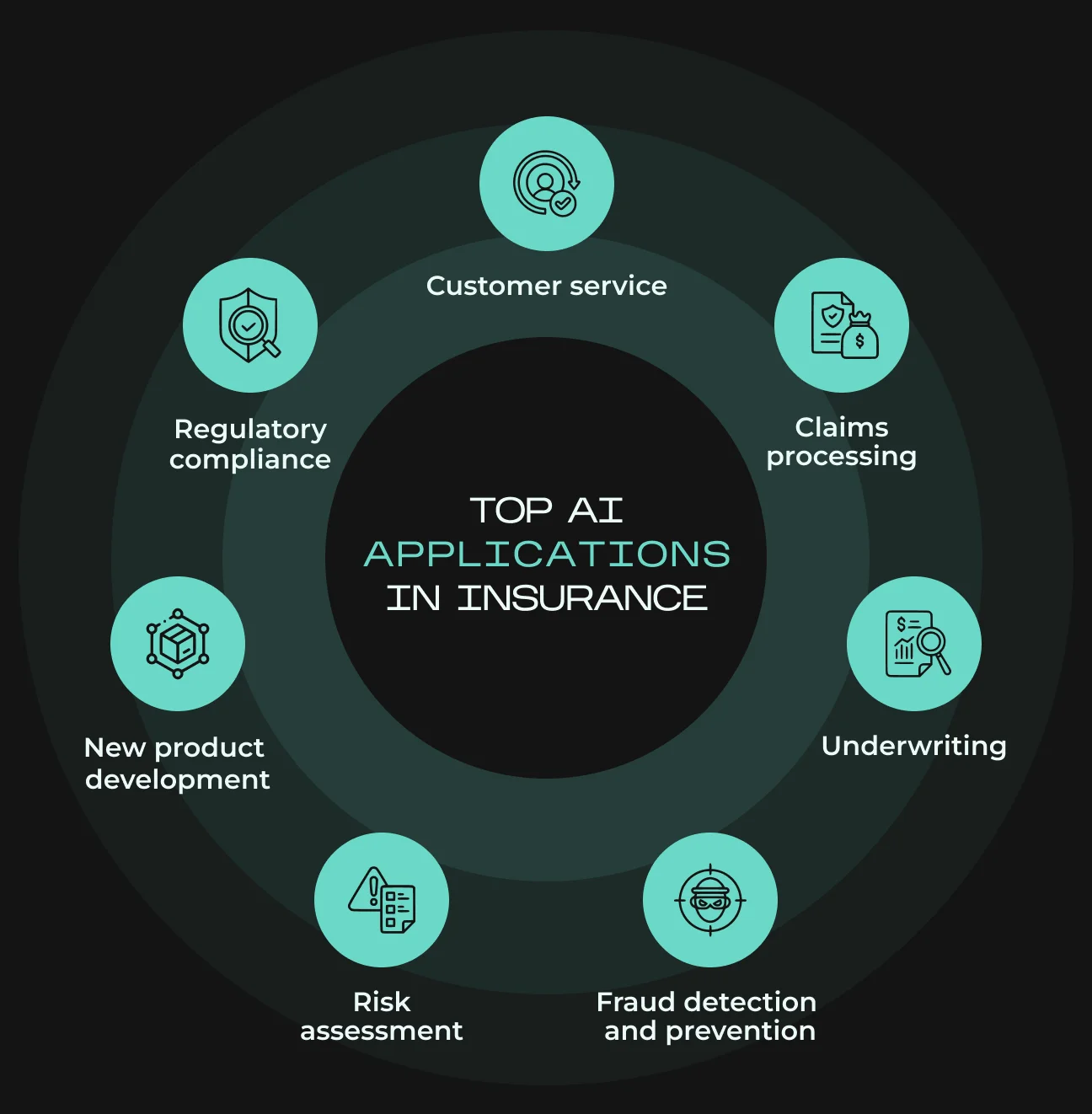
AI in Insurance Use Cases
Here are some common ways of how AI is used in the insurance industry.
Customer Service
Insurance companies use AI tools like chatbots, virtual assistants, machine learning, and robotic automation to manage policies and answer customer questions more efficiently. For example, AI chatbots can provide quotes, update policies, and help with claims. They are available 24/7 and offer quick service even outside regular business hours.
AI can also recommend insurance policies tailored to each individual by analyzing lifestyle, demographic, and behavior data. These suggestions might include home insurance or customized health plans, specifically designed to meet unique needs. AI provides more personalized and effective support by learning from past interactions.
Insurance Claims
Claims are crucial in insurance because they are requests from policyholders for compensation after a covered loss. Traditionally, processing these claims has been slow and detail-focused, which often resulted in human errors and raised the risk of fraud.
AI technology simplifies this process by using automation. Machine learning algorithms analyze data quickly, evaluate claim validity, and assess damage with image recognition. AI systems can look at photos of damaged properties or vehicles, compare them to past cases, and quickly decide if a claim is legitimate. This automation makes the process faster, lowers costs, reduces errors, and provides customers with quicker solutions and a better experience.
For example, in the case of Compensa Poland, even though their goal was to improve customer satisfaction, they also achieved a 10% increase in claims accuracy after implementing an AI-based system.
Underwriting
Underwriting is the process insurers use to determine whether they can cover someone and how much the policy will cost. It's important for various types of insurance, like health, car, and travel. The goal is to set a fair price by evaluating the risk level of the person getting insured.
This process is often slow and complicated, with messy and incomplete information, causing mistakes and delays. Consequently, policies tend to be more expensive and less personalized.
AI and machine learning are changing the game by making underwriting faster and more accurate. These technologies use advanced data analysis to assess risks better and create more personalized policies. For example, AI in auto insurance can analyze data from car telematics to analyze a driver's behavior. This allows policies to be based on actual driving habits, rather than just age or previous claims.
Fraud Detection
Each year, insurance fraud costs American consumers at least $308.6 billion. AI is what helps detect and prevent these scams. It can process big data to spot unusual patterns that people might miss.
For example, AI can analyze the frequency of claims, verify customer information, and even scan social media for signs of fraud. These systems work in real time to stop fraudulent claims before they're paid, which saves both time and money for insurers.
Risk Prevention
A risk assessment aims to give insurance companies a clear view of potential risks. To increase profits, these companies need to understand the risks of each customer possibly making a claim. This is true for any kind of insurance. Almost 60% of insurance companies now use AI, like machine learning, to help spot fraud.
AI can analyze both structured and unstructured data, including sources like SEC filings. This allows for real-time risk assessment and helps companies quickly respond to market changes. Thanks to AI, insurers can make better decisions about risk models, policy terms, and pricing. This ensures that customers receive appropriate and fairly priced coverage.
New Products
AI helps insurers create new and innovative insurance products because it understands emerging risks and changes in customer needs. AI can identify gaps in current insurance offerings and predict future demand for certain products, analyzing market trends, social data, and customer feedback.
For example, AI can help create usage-based insurance options, like pay-per-mile auto insurance, where premiums change based on how you drive.
Regulatory Compliance
Keeping up with changing regulations is a big challenge for insurers. AI can help by automating compliance tasks and keeping all necessary documents current. With the help of NLP, insurers can review policy documents to ensure they meet regulatory standards.
AI auditing tools also monitor transactions to spot any potential compliance issues. This automation reduces the risk of costly penalties, which allows insurers to focus more on delivering value to their customers.
The growing use of AI in life insurance shows how influential it is for the industry. As technology evolves, we can expect AI to bring more innovation, making the industry faster, more flexible, and customer-focused.
Benefits and Disadvantages of AI Insurance
Artificial intelligence has become a transformative 21st-century technology. In the insurance industry, it presents numerous opportunities, but it also brings certain risks and challenges. Let's explore both.
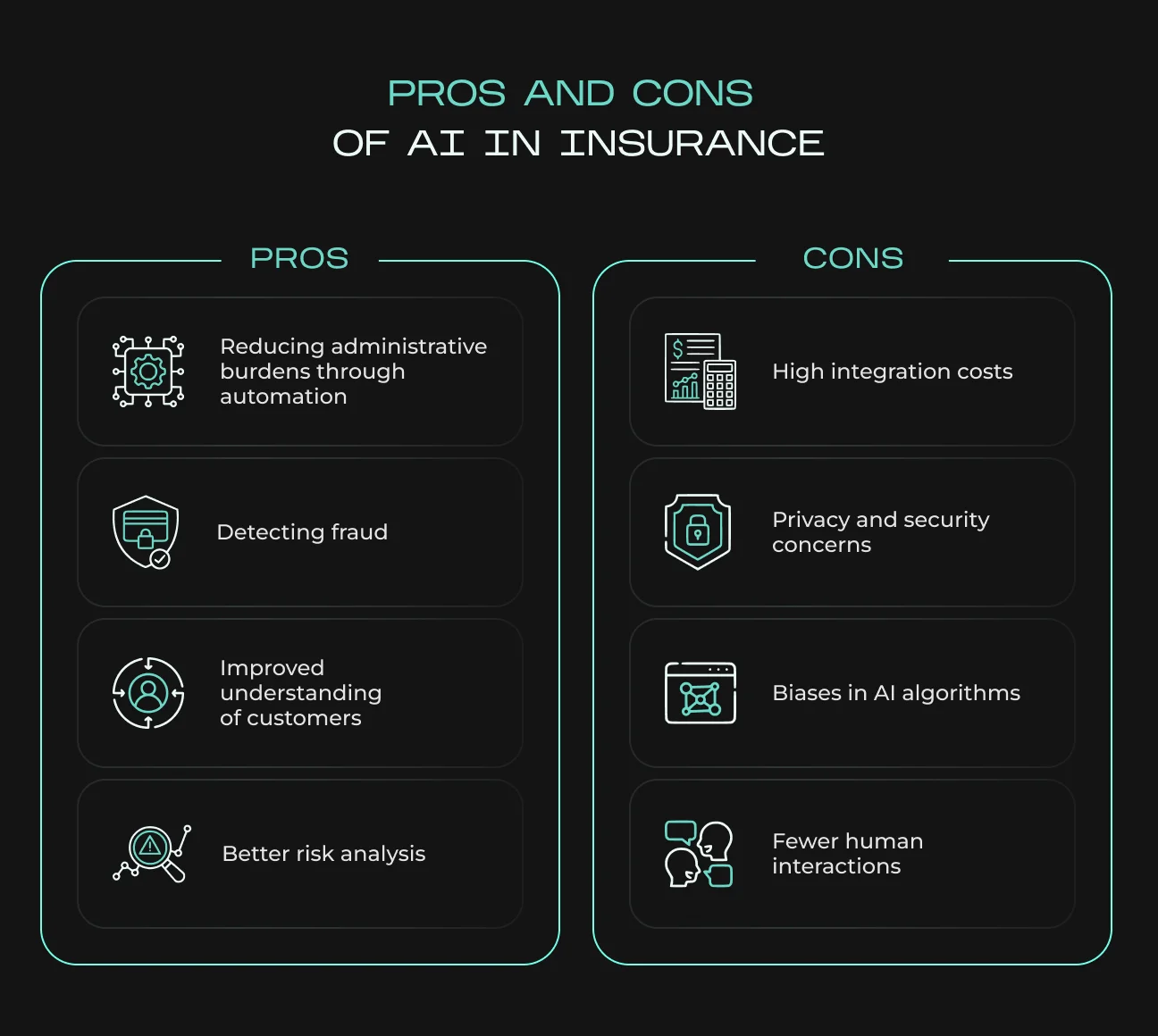
Pros
Key benefits of AI in the insurance industry include the following.
Reducing Administrative Burdens Through Automation
AI can ease administrative tasks for agents and advisors. AI tools can automate processes like underwriting, handling claims, and answering basic customer questions. For instance, virtual assistants can manage initial customer interactions, letting agents concentrate on more complex issues that need their personal expertise.
Detecting Fraud
AI improves fraud detection by identifying patterns and unusual activities that people might miss. For example, if AI detects multiple claims from the same address but with different names, it can alert the fraud investigation team to look into it more closely.
Improved Understanding of Customers
AI gives agents and advisors a big advantage by letting them analyze lots of data to gain insights. It helps agents understand their clients better, anticipate their needs, and offer customized policies. Predictive analytics, a part of AI, identifies customer behavior patterns, so agents can make timely suggestions.
Better Risk Analysis
Traditional risk assessments often use limited data and can be affected by human mistakes. AI, however, can process large amounts of information, like social media activity, purchasing patterns, and data from IoT devices, to create a more accurate risk profile. For example, car insurers can use telematics devices to monitor driving habits and provide personalized insurance rates based on actual driving behavior.
Cons
Now, let's look at the downsides of using AI in the insurance sector.
High Integration Costs
AI technology can be expensive for small insurance agencies. The cost of buying AI tools and training staff can be a financial burden, making it hard for them to keep up with new technologies.
Privacy and Security Concerns
AI often needs to collect and analyze personal data, which can raise privacy worries. People may feel uneasy about the amount of data collected and the potential for data breaches. For example, if an insurance company uses AI to monitor a customer's lifestyle habits via social media, it might feel intrusive.
Biases in AI Algorithms
AI systems rely on historical data, which may contain biases. If these biases aren't properly managed, they can result in unfair treatment. For example, AI in insurance underwriting could charge higher premiums to individuals from specific zip codes or socioeconomic backgrounds.
Fewer Human Interactions
With AI taking on more tasks like answering questions through chatbots, there's a concern it could lack a personal touch. Clients who like face-to-face interaction might feel less connected without it.
Challenges for AI Technology in Insurance Industry
AI provides clear benefits, but it also comes with less obvious challenges like complex implementation and privacy concerns. Let’s look at the key challenges.
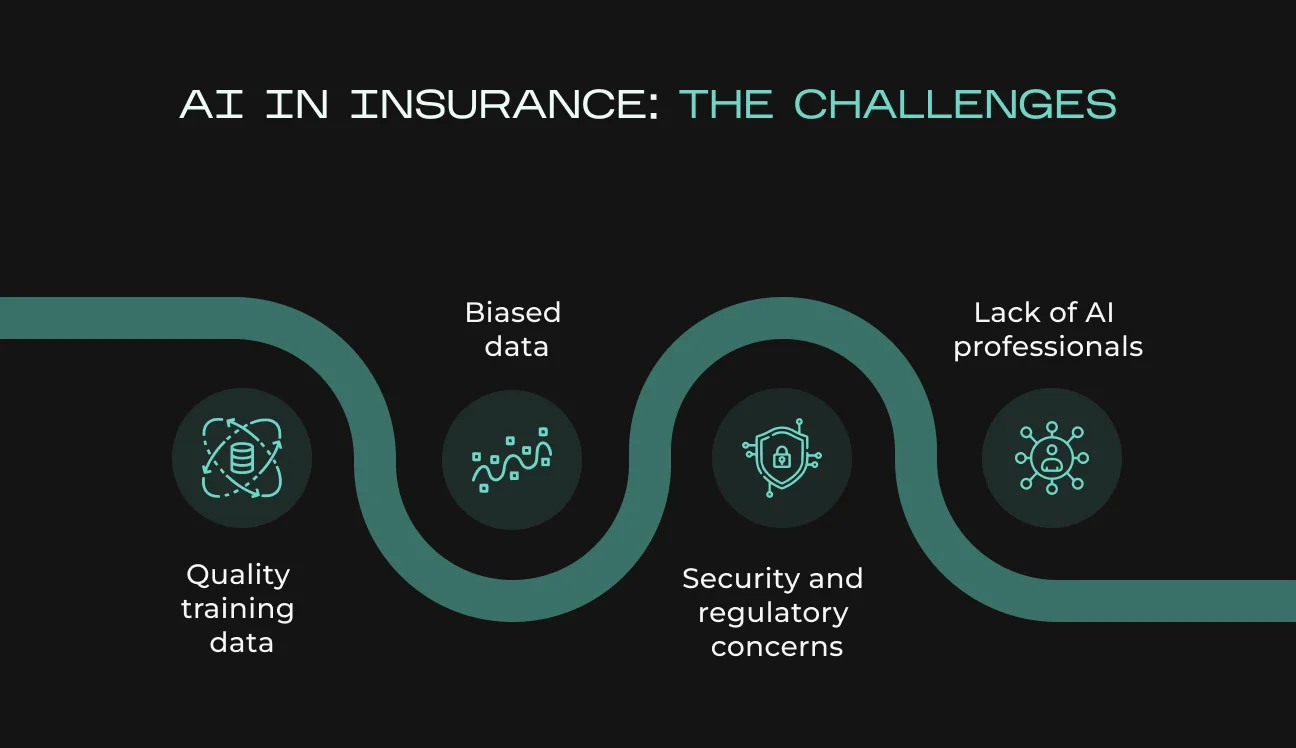
Data Quality
AI's effectiveness depends on the quality of the data it uses. If the data is poor, incomplete, or inconsistent, AI algorithms will produce unreliable results. This can cause errors when evaluating claims, detecting fraud, and assessing risks.
Biased Data
Historical data often includes societal biases and stereotypes, which can unintentionally influence AI systems during training. USC researchers found that up to 38.6% of the facts used by AI are actually biased.
For example, if an insurance company uses AI to set car insurance rates based on past claims data, and that data mostly comes from cities, AI will focus more on city drivers. This means it won't have enough information about rural drivers and those with lower incomes.
Regulatory Issues
The insurance industry has a lot of rules to follow. Adding AI creates new challenges, like maintaining transparency, fairness, and accountability. Although regulations are not the main barrier to using AI, they remain crucial. Insurance companies often struggle to implement AI in a way that meets high standards for auditing, data privacy, and transparency.
Lack of Expertise
There are more positions requiring AI skills than qualified people to fill them. Insurance companies may find it challenging to hire experts in data science, machine learning, and AI development. After implementing AI models, they often don't have the necessary expertise to maintain and improve them.
Partnering with tech companies that have expert AI teams can speed up the development of AI-driven solutions and ensure long-term success. SapientPro is the perfect partner to help you create scalable AI applications, preparing both your insurance business and your employees for an AI-focused future.
Future and Trends of AI in Insurance
Recently, the insurance industry has been dealing with challenges like economic ups and downs, environmental risks, and evolving customer needs. AI became an essential tool that helped address these issues.
It has increased claims accuracy to 99.99%, made operations 60% more efficient, and improved customer experience by 95%. Plus, 87% of customers say that how well claims are processed affects their decision to renew their policies with the same company.
Suggested Best Actions for Underwriting and Claims Management
AI has changed underwriting by reducing decision times from days to just 12.4 minutes for standard policies, all while maintaining a 99.3% accuracy in risk assessment.
In 2025 and beyond, insurance companies will likely rely more on AI for advice in underwriting and claims management. Underwriters may get customized recommendations to adjust coverage limits or access extra data for better risk evaluation.
For claims adjusters, AI will offer targeted suggestions, like asking for more documents or choosing the best settlement options based on previous claims data.
More Sophisticated and Accurate Insurance Risk Assessments
Machine learning algorithms help analyze large amounts of claims data, and identify patterns that human underwriters might overlook. For example, Allstate Insurance used predictive analytics to reduce claims processing time by 40% and improve underwriting accuracy by 25%.
In the future, insurance companies might use specific data, like climate and health information, to improve how they evaluate risks and create policies.
They could even collect local climate change data to understand the risks of property damage and health issues caused by it.
Improved Customer Interactions with Generative AI in Insurance
Generative AI will transform how insurance businesses interact with customers and manage internal operations. Right now, over 40% of insurance executives see its positive impact on customer experience and productivity.
One significant shift will be towards hyper-personalized experiences. Insurers will use generative AI to tailor interactions, policy management, and claims processes according to each customer's unique preferences, behavior, and history. This will boost customer satisfaction and improve retention and conversion rates.
The insurance industry is ready to innovate and adapt using advanced technology. AI, in particular, will reshape the industry in the next decade, driving transformation and inspiring new ideas.
Partner with SapientPro to Build Your AI-Powered Insurance Solution
AI technology is helping insurance companies innovate. At SapientPro, our developers design AI-driven solutions that help transform and modernize your insurance business.
We create AI-powered apps to help you stay ahead, from automating claims processing to sophisticated data analysis. Reach out to our experts for more details and a project estimate.
Need an Insurance Solution?
SapientPro's team will help you integrate AI into your systems and build a custom solution.