All AI in E-Commerce 2026: Key Trends, Benefits & Best Practices
March 1, 202615 min read


In 2025, no one thinks about AI as something out of science fiction anymore. It has entered our everyday life on every level. Shopping online has become more intuitive than ever, thanks to AI-driven tools that anticipate customer needs before they even realize them. 71% of customers now expect personalized recommendations, and businesses using AI in e-commerce see an average sales boost of around 25%.
At SapientPro, we've spent over eight years developing custom e-commerce solutions, using AI-driven customer service, machine learning for inventory management, and advanced systems for product search using AI. We help companies worldwide to improve operations and user experiences. Now we can paint the complete picture explaining how AI in eCommerce benefits your business. In this article, you’ll find practical benefits, the latest trends, and real-world examples provided by experienced engineers.
How is AI Transforming E-Commerce?
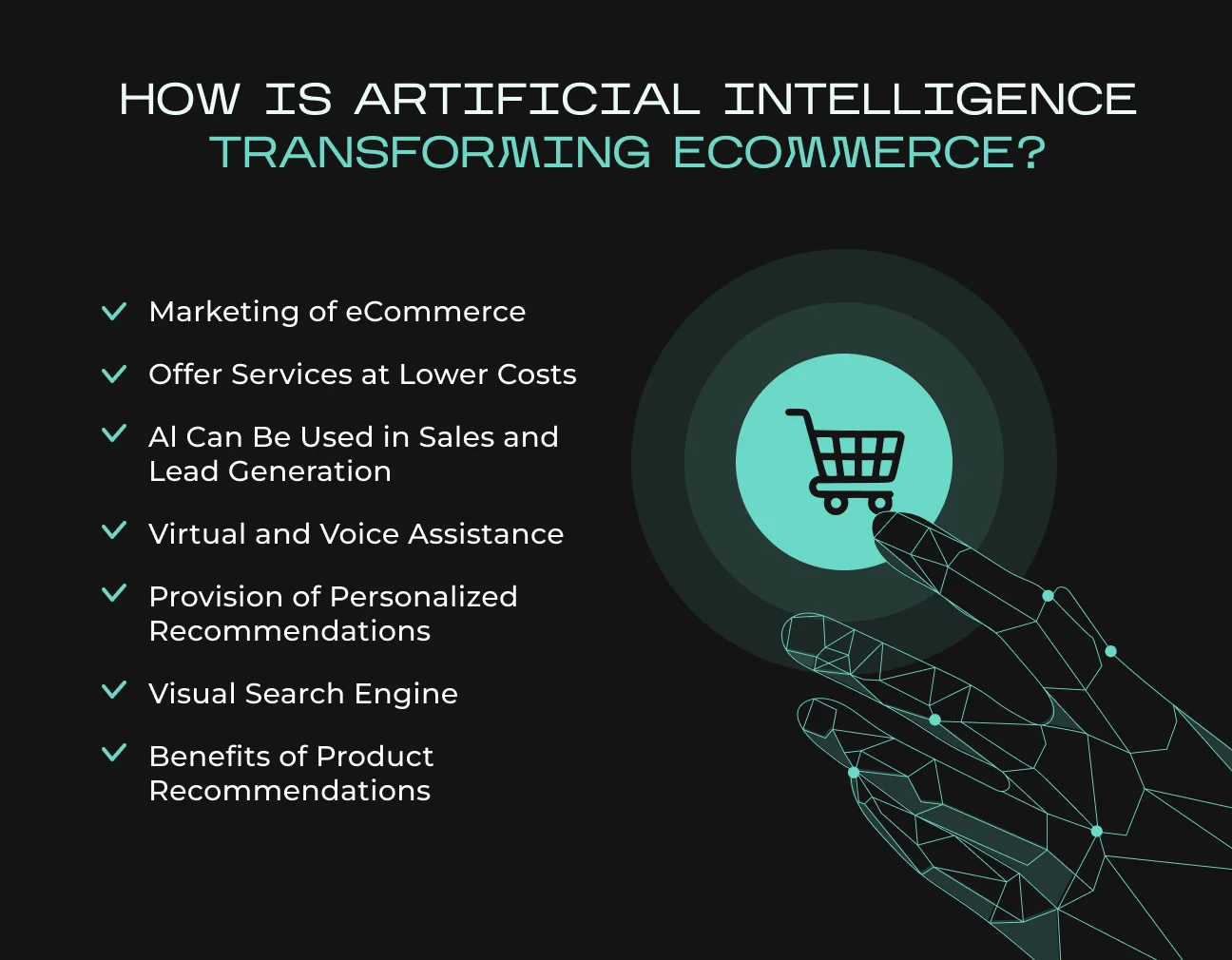
AI is in trend right now, especially in business, because it is changing every aspect of e-commerce, including customer interactions and behind-the-scenes operations. Let's look at some key areas where AI can make a difference.
Enhanced Customer Interaction
AI is changing the way customers engage with businesses. According to Statista, 83% of global brands aim to leverage AI to improve the overall user experience. Hyperpersonalization is the core of this change, going far beyond the standard recommendation of “People who bought this also purchased socks.”
AI analyzes user behavior, past purchases, search histories, and even social media activity to create experiences specifically tailored for each individual. As a result, customers receive exactly what they're seeking, even before they know it, and satisfied customers tend to come back.
Reliable Data Analysis
Your company probably has more data than you know what to do with, right? The challenge isn’t collecting it, but knowing how to use it. That’s where AI-powered analytics shines the most. Unlike manual methods prone to human error and time-consuming spreadsheets, AI processes vast amounts of data quickly and accurately. Machine learning tools can help you with:
- Spotting hidden trends;
- Predicting customer behavior;
- Identifying product performance issues;
- Forecasting market shifts.
This information allows you to make smarter, faster decisions. It’s one of the main ways for AI to help you increase profitability.
Faster Content Creation
Content is king, but creating it fast and keeping it fresh is easier said than done. Generative AI (GenAI) dramatically sped up content creation.
Need product descriptions that sell? GenAI crafts them at scale while sounding natural and engaging.
Want promotional emails personalized for different customer segments? GenAI handles that too, freeing your marketing team from repetitive tasks so they can focus on strategy.
AI-generated visuals, videos, and interactive content also improve user experiences without breaking your budget. With GenAI, your content pipeline moves faster, maintaining your brand's relevancy and readiness for growth.
Improved Operations
AI-driven tools are radically improving operational efficiency across the board. Robotics automates warehouse management, reducing manual labor costs and speeding up order fulfillment. Visual recognition tools quickly categorize products, detect quality issues, and streamline inventory management.
Dynamic pricing eCommerce AI algorithms can adjust your prices in real time based on market conditions, competitor behavior, and customer demand. AI-powered logistics optimization involves adjusting delivery routes and schedules, which reduces costs and satisfies customers even further. You can read more about AI in eCommerce logistics and how it revolutionizes the industry in our detailed guide.
Types of AI Technologies in E-Commerce
But how exactly AI works?
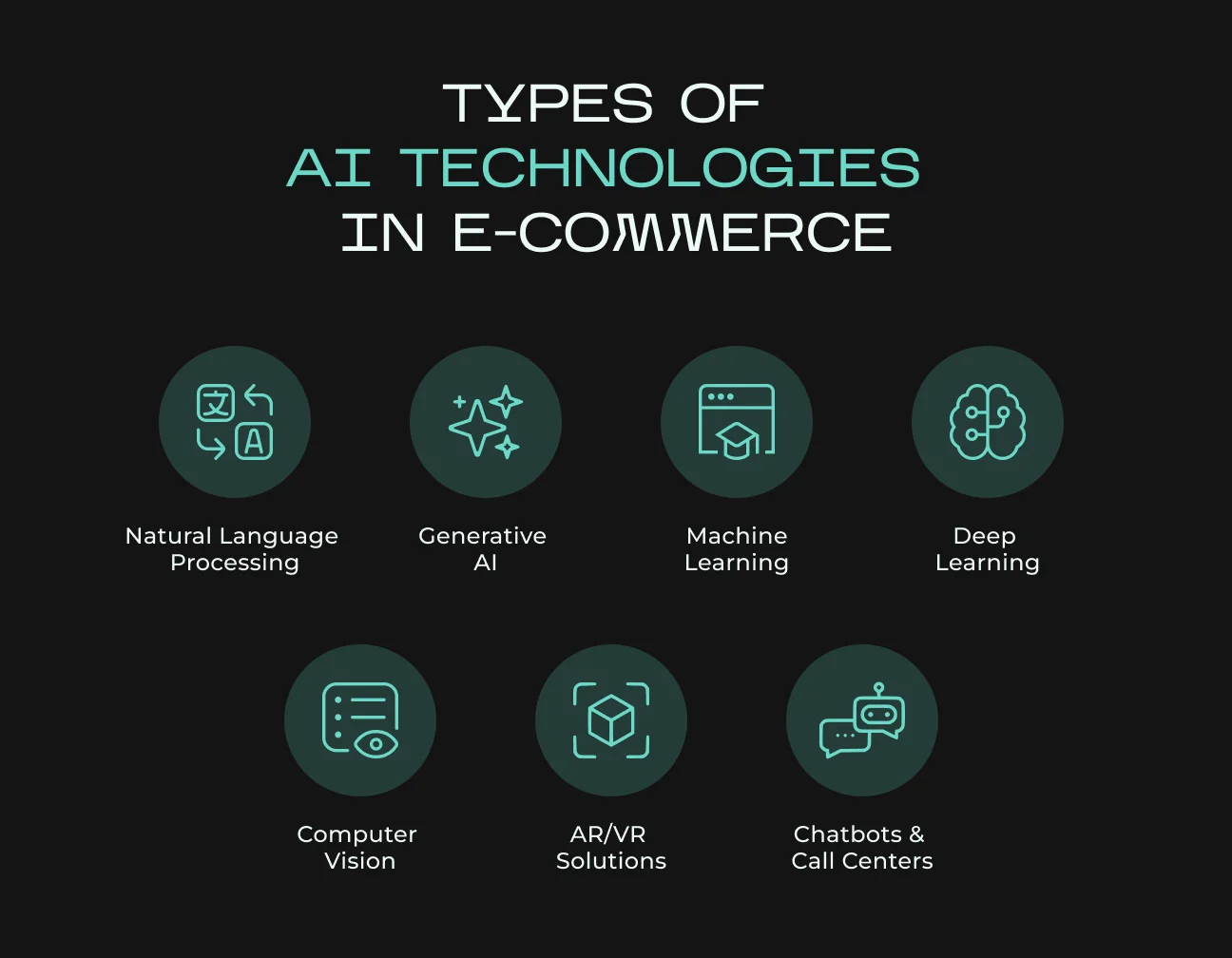
Let’s break down the standout AI technologies making waves and reshaping the way we shop, sell, and interact online.
Natural Language Processing eCommerce Applications
Natural Language Processing (NLP) is the AI equivalent of your most insightful employee who just gets what you mean even when you're being vague. NLP allows computers to understand, interpret, and respond to human language just like people do (sometimes better!). For example, in e-commerce, it allows customers to find products simply by speaking into their devices. Ever asked Alexa to reorder your favorite coffee? That’s NLP at work.
AI-powered sentiment analysis eCommerce tools allow businesses to monitor customer opinions and adapt strategies based on real-time feedback. By scanning reviews or social media chatter, NLP can pick up on the tone and mood of customers, helping brands catch dissatisfaction before it spirals.
Generative AI
GenAI powers content creation at scale. Imagine being able to churn out product descriptions, blog posts, and personalized marketing emails as quickly as ideas pop into your head. With access to massive datasets, GenAI crafts original content in record time — no burnout, no coffee breaks.
Now you can launch a thousand new SKUs or target niche customer segments with custom promos. GenAI brings your content game to another level, making it strategic. It adapts, evolves, and continuously sharpens its output like the best creative team that never sleeps.
Machine Learning in E-Commerce
Machine Learning (ML) helps e-commerce stores predict the future, or at least get pretty close. ML algorithms analyze historical data and customer behavior to spot patterns and make reliable predictions about trends, buying habits, and even inventory demands. Now you know exactly when to restock products or precisely what items your customers are likely to buy next. Personalized recommendations with AI and ML boost conversions by anticipating consumer preferences.
ML-driven fraud detection AI solutions enhance security, spotting suspicious transactions in real time and protecting your business from costly chargebacks. With machine learning, your business becomes smarter with every interaction.
Deep Learning
While ML analyzes data, Deep Learning (DL) runs complex experiments at lightning speed. DL is perfect for processing huge datasets and excels in digital image recognition in online shopping, natural speech interpretation, and behavioral forecasting.
DL powers some of the most advanced e-commerce tools, such as image-based search, automated product tagging using AI and virtual shopping assistants that remember everything. Want to predict stock shortages or catch overstock issues before they spiral out of control? Deep Learning makes even the messiest logistics feel manageable.
Computer Vision
Computer Vision (CV) allows e-commerce platforms to interpret and analyze visual information almost instantaneously. It can identify products from user-uploaded pictures, flag defects, and automate inspections with incredible accuracy. At SapientPro, we've successfully applied Computer Vision, helping our client to accelerate fruit and vegetable inspection processes by a stunning 87.5%.
How SapientPro Used CV for Smarter Fruit & Vegetable Inspections
A client came to us with a challenge: manual inspections were slow, labor-intensive, and often done in offline environments like metal shipping containers. We delivered an AI-driven solution equipped for offline use, enhanced with voice-to-text features and advanced noise filters.
Our photo-analysis system was trained to grade produce against strict quality benchmarks. The result? Rapid, reliable inspections, less manual strain, and big savings.
AR/VR Solutions
Augmented Reality (AR) and Virtual Reality (VR) have added the “try before you buy” option to the online shopping experience. With AR, shoppers can preview how a pair of sunglasses fits their face, try new clothes, or see how a new couch would look in their living room. AR overlays a digital image onto physical space, helping buyers visualize the product before committing to purchase.
VR goes even further, creating immersive virtual stores where customers can interact with products in a lifelike digital environment. Both AR and VR reduce returns, build trust, and make buying feel a whole lot more fun.
Chatbots for eCommerce & Call Centers
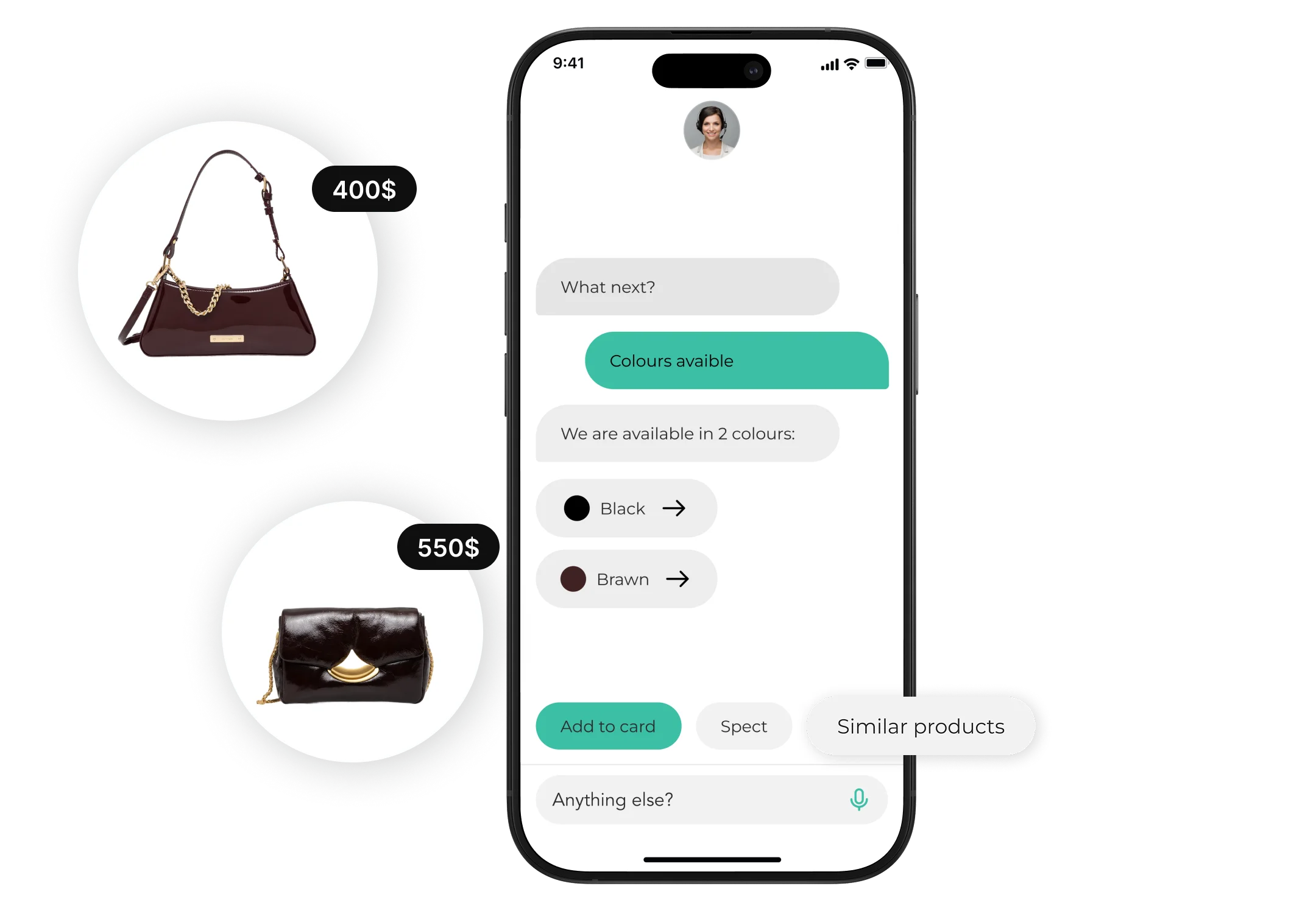
Chatbots and AI-enhanced call centers are perfect for faster customer service. They are always on, always responsive, handle everyday queries instantly, and, if needed, can pass complex cases to human agents. Advanced AI systems detect customer frustrations and suggest solutions.
How SapientPro Developed an AI-Powered Call Center
In a recent project, our team implemented AI-powered systems capable of managing customer requests swiftly, accurately routing inquiries to appropriate specialists, and even analyzing real-time call sentiment to adjust responses dynamically.
Customers experienced shorter wait times, and client satisfaction ratings soared. Operational costs were drastically reduced due to optimized resource allocation and streamlined processes.
Benefits of Using AI in E-Commerce Operations
If you're considering AI for your e-commerce business, you're probably looking for measurable benefits, right? You'll find plenty. The advantages are real and essential for staying ahead in our fast-moving digital era.
Higher Conversion Rates through Personalization
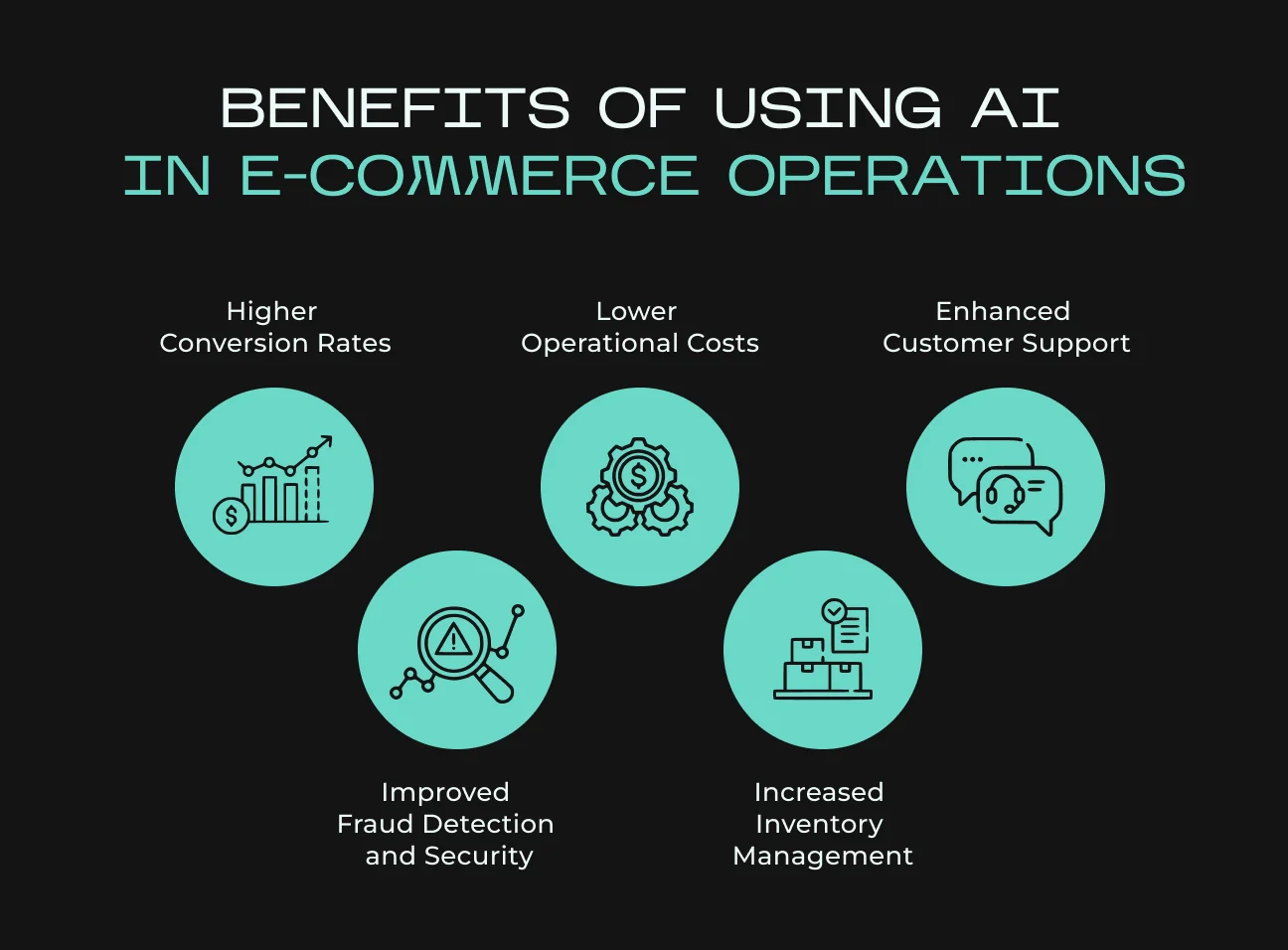
Personalization sells. AI-powered recommendation engines can tailor shopping experiences so precisely, it feels like they know your customers better than they know themselves. Businesses using advanced AI personalization often see 20–30% higher conversion rates and a 10% lift in average order value. It has become a proven way to win customer loyalty. You get happier clients, fuller shopping carts, and a healthier bottom line.
Lower Operational Costs with eCommerce Automation Solutions
AI can automate everything from warehouse operations to logistics. Using AI for supply chain optimization can cut operational costs by as much as 30%. Automation predicts stock needs, optimizes delivery routes, reduces human error, cuts labor costs, and frees up time and budget so you can focus on growth.
Enhanced Customer Support Efficiency
AI chatbots and virtual assistants don’t take breaks or sick days. By integrating AI-driven customer service, businesses report up to 52% reduction in customer inquiry resolution times and a 30% increase in customer satisfaction ratings. Call centers utilizing AI for sentiment analysis and call routing see 35% shorter wait times and 44% higher efficiency. Faster responses, fewer frustrated customers, and your human staff free to tackle more complex issues — it’s a win-win solution.
Improved Fraud Detection and Security
E-commerce fraud is rising, but luckily, fraud detection AI solutions are even faster. Machine learning algorithms quickly spot anomalies and suspicious activities, reducing fraudulent transactions by as much as 50–60%. By acting faster than human teams ever could, these systems help protect both your revenue and your reputation — two things no business can afford to lose.
Increased Inventory Management Accuracy
Inventory mistakes cost you money, customers, and patience. By using AI for inventory management, retailers achieve significant improvement in inventory accuracy and forecasting. By precisely predicting demand, automating restocks, and identifying inventory trends early, you avoid costly stockouts or expensive overstocks. Real-time insights allow you to move stock with confidence, resulting in smoother operations, happier customers, and more stable profit margins.
AI changes the game by rewriting the rules. The businesses embracing it today are the ones dominating tomorrow.
Challenges of Using Artificial Intelligence in E-Commerce
AI may sound like the ultimate e-commerce solution, but every coin has two sides. To make AI truly beneficial, we need to recognize and address common challenges associated with this technology.
Data Privacy
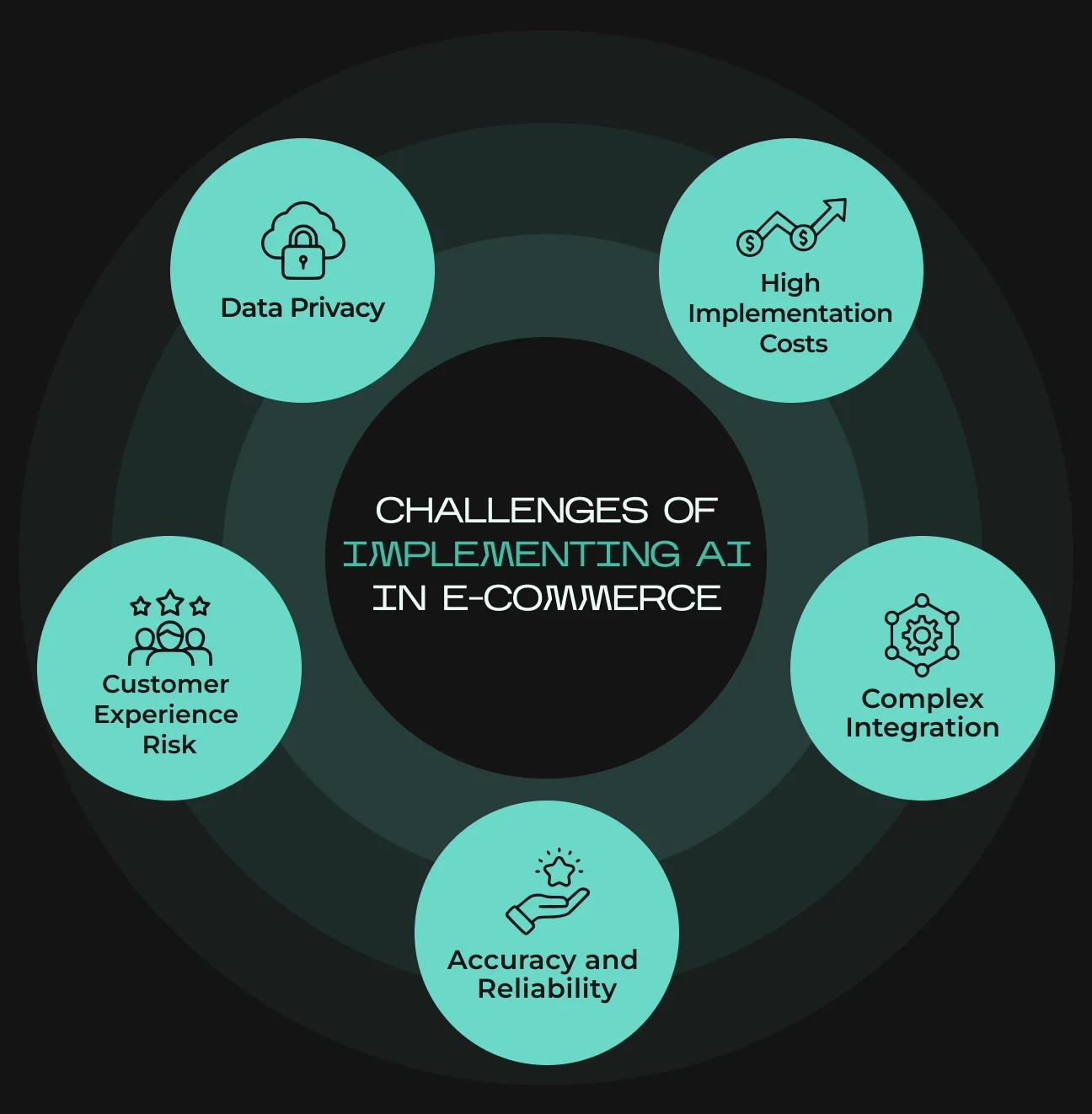
Customers love personalization, but they're not too thrilled about losing control of their personal information. Data privacy is one of the trickiest parts of implementing AI in e-commerce. Regulations like GDPR or the CCPA set strict rules about collecting, storing, and processing personal data.
One misstep can lead to hefty fines, damaged reputations, or worse, lost customer trust. 81% of online shoppers say they're concerned about how companies use their data. To succeed, you need robust data-handling policies, secure data storage solutions, and transparent privacy practices.
High Implementation Costs
You can't just plug AI into your business like it's an ordinary app. Effective AI implementation requires significant upfront investment in hiring skilled professionals, acquiring the right technology infrastructure, and extensive training. Smaller businesses or startups often hesitate because initial costs can range from tens to hundreds of thousands of dollars, depending on complexity.
But here's the good news: once set up correctly, AI typically pays for itself through improved efficiency and increased revenues. The key is careful planning, budgeting, and partnering with experienced AI solution providers like SapientPro.
Complex Integration
Integrating AI with existing e-commerce platforms isn't as simple as flipping a switch. Often, legacy systems aren't built to accommodate sophisticated AI algorithms, requiring extensive modifications or custom development. Complex integration processes can lead to extended downtimes, impacting customer experiences and sales. To handle it the right way, you'll need:
- Detailed integration strategy;
- Careful project management;
- Knowledgeable team capable of bridging old systems with new AI capabilities.
The key is treating integration as a transformation, not a patch job.
Accuracy and Reliability
AI isn't perfect — it’s just really good at pretending to be. Algorithms depend heavily on data quality and training. If your datasets are biased, incomplete, or outdated, AI outcomes might be inaccurate or unreliable.
AI chatbot giving incorrect product information or an inventory prediction model miscalculating stock levels directly impact your business performance and credibility. To ensure accuracy, you’ll need continuous data monitoring, regular algorithm audits, and ongoing fine-tuning.
Customer Experience Risk
If used incorrectly, AI can quickly backfire. Automated customer interactions lacking human empathy or understanding often frustrate rather than help. We’ve all had that one chatbot encounter that left us feeling ignored. A poorly executed AI strategy can lead to customer churn, negative reviews, or damaged brand reputation.
A recent Forbes study found that 87% of consumers prefer human interaction, especially in complex or emotional customer service scenarios. That’s why striking the right balance between automation and empathy is crucial. AI should empower your team, not replace it.
Being aware of these challenges is the first step toward overcoming them. With smart preparation and a trusted partner, AI can be a powerful ally in growing your e-commerce business.
Best Practices for Implementing AI in E-Commerce
Bringing AI into your e-commerce strategy isn’t a shot in the dark — it takes thoughtful planning and well-executed tactics. When done right, it enhances customer experiences, optimizes your operations, and brings you tangible business growth.
Here’s a practical guide based on SapientPro’s experience to help you make the most out of your AI investment.
Strong Data Foundation
If AI is the rocket that launches your e-commerce business into the future, then data is the fuel. Without clean, accurate, and comprehensive data, even the best AI solutions won’t deliver their full potential. That’s why your first priority should be building a clean, organized, and dependable data infrastructure.
Start with structured data collection, make regular audits a habit, and implement solid governance to keep everything accurate and consistent. It's also key to unify your sales, marketing, and operations data across platforms, so your AI tools can work with a full picture. Investing in data may not be flashy, but it’s one of the smartest moves you can make if you want your AI to perform at its best.
Focusing on Customer Experience
When implementing AI, always ask yourself: “Does this make my customers happier” AI shouldn’t just automate processes -it should genuinely enhance the customer journey.
Leverage tools like natural language chatbots, real-time support systems, and personalized shopping journeys to create positive moments across the customer journey. But don’t rely solely on automation — there are times when a human touch still matters.
Keep an eye on customer feedback and stay ready to tweak as needed. When customers feel heard and valued, they stick around and expand your reach organically.
Using the Right Technologies
Not every AI tool is right for your business. Just because something is trending doesn't mean it's a good fit. The trick is matching the tech to what your company actually needs. Maybe your focus is on dynamic pricing, or perhaps AI-driven customer support is where you’ll see the biggest win. Logistics-heavy businesses might benefit more from computer vision than virtual showrooms.
Take time to assess your business model and customer expectations, then pilot AI solutions that match your priorities. Testing tools through MVPs ensures you’re not overcommitting to a solution that doesn’t fit.
Partnering with a Professional AI Development & Integration Team
Let's face it: AI isn't always DIY-friendly. Building an effective AI infrastructure in-house requires extensive resources, expertise, and time — things most companies find challenging to spare. Partnering with experienced AI professionals drastically reduces implementation risk and accelerates your time to market.
SapientPro’s team has 8+ years of experience in creating AI-driven solutions for businesses of all grades. We’ll help you get custom integrations, update legacy systems, and leverage the power of artificial intelligence in your company. Let’s team up!
Need AI in E-Commerce?
SapientPro's experts will help you integrate AI into your e-commerce project.
Future Trends of AI in E-Commerce
The e-commerce landscape in 2025 is undergoing a significant transformation, with AI technologies at the forefront. Businesses are leveraging AI to enhance customer experiences, streamline operations, and drive growth.
Here are some key statistics highlighting the impact and future of AI in online shopping:
- Market growth: the global AI in e-commerce market is projected to reach $9.01 billion by 2025, up from $7.25 billion in 2024, reflecting a strong annual growth rate of 24.34%;
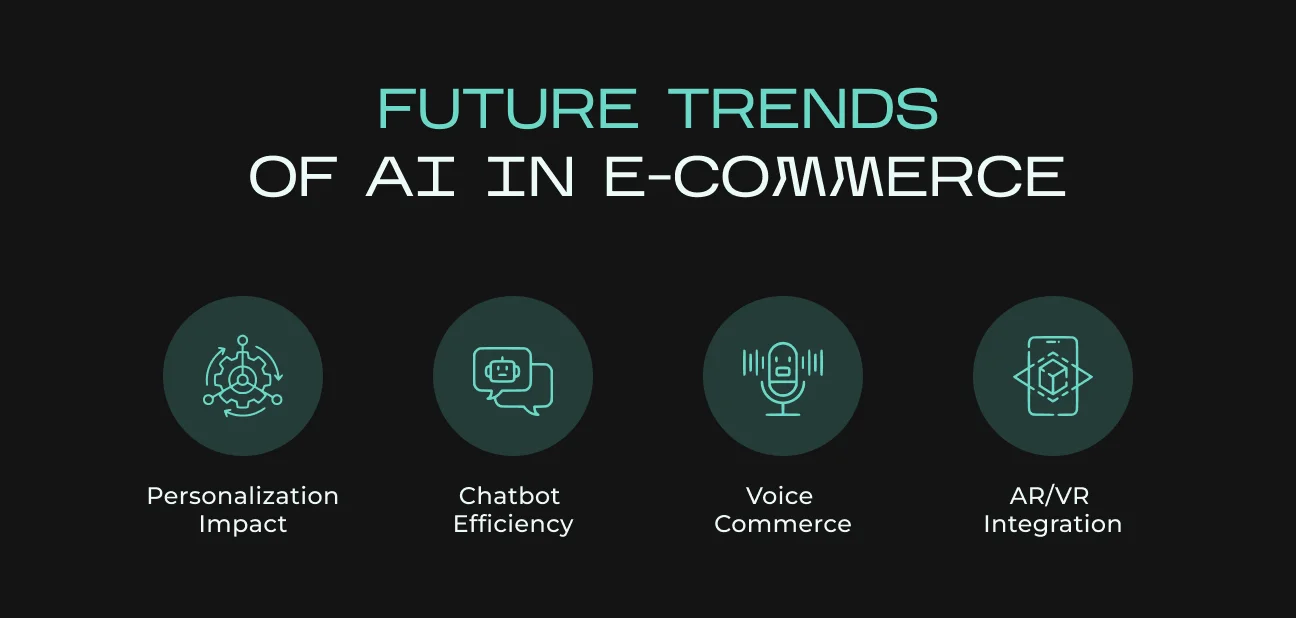
- Consumer preferences: 58% of consumers prefer using AI tools over traditional search engines for online shopping in 2025, a significant increase from 25% in 2023;
- Voice commerce: by 2025, half of all online searches are expected to be voice-activated, emphasizing the growing importance of voice search optimization in eCommerce;
- Personalization impact: AI-driven personalization contributes to a 25% improvement in customer satisfaction, revenue, or cost reduction for e-commerce businesses;
- Customer retention: implementing AI technologies can lead to a 10% to 15% increase in customer retention rates, according to CapitalOne AI in retail statistics;
- Chatbot efficiency: 69% of consumers report positive experiences with AI chatbots, appreciating their speed and efficiency in handling inquiries;
- Fraud detection: AI-powered fraud detection systems continue reducing fraudulent transactions, enhancing security and trust in online shopping;
- AR/VR integration: the integration of AR and VR technologies in e-commerce is projected to continue, offering more and more immersive shopping experiences;
- AI adoption priority: 83% of e-commerce businesses consider AI a top priority in their strategic planning, underscoring its critical role in future growth.
AI technologies are driving significant advancements in the industry. As consumer expectations continue to evolve, businesses that effectively integrate AI into their operations are guaranteed to gain a competitive head start in the e-commerce market.
Partner with SapientPro to Build Your AI E-Commerce Platform
Team up with SapientPro to implement AI into your business. You’ll get expert guidance from engineers who know the e-commerce industry inside-out, supporting you with professional solutions for all needs.
SapientPro’s team has 8+ years of experience in AI development, helping companies from all over the world use AI to increase their revenues and improve operations. Get in touch with our team to get a free consultation and discuss your project!
Need AI in E-Commerce?
SapientPro's experts will help you integrate AI into your e-commerce project.