
All How to Build an AI Agent: Step-by-Step Guide
Updated:April 15, 202610 min read


AI agents aren’t the future. They’re already making an impact on our lives, offering groundbreaking solutions to modern problems. Unlike simple chatbots or tools with set rules, these agents can analyze data, make decisions, and adjust to any new changes. The best part: they can do this all on their own, without constant human help.
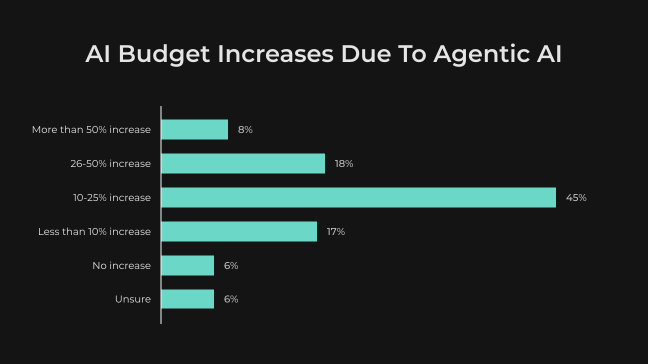
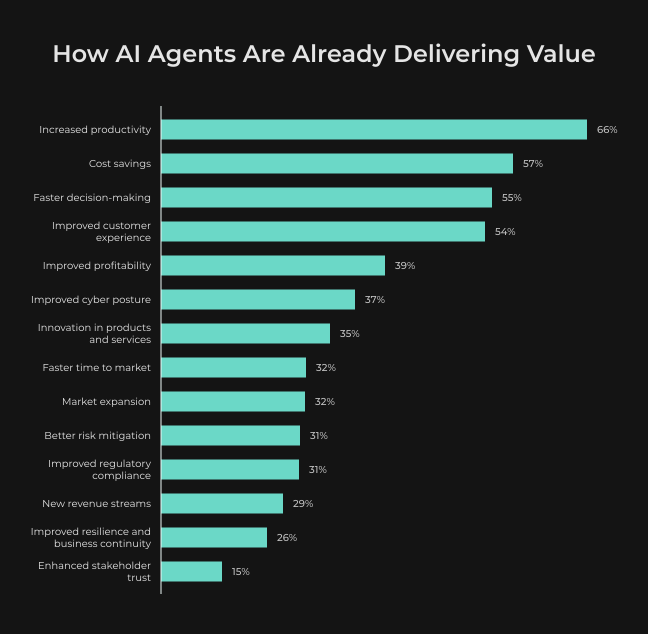
Data indicates 88% of senior executives plan to increase their AI budgets next year due to agentic AI. Apart from that, 79% of companies are already using AI agents, and 66% of those report a boost in productivity.
This guide is prepared by SapientPro’s experts with step-by-step guidance on how to build an AI agent and avoid common pitfalls. Read on now!
Key Takeaways
- AI agents are intelligent software programs that help users complete tasks and achieve their goals;
- Unlike basic chatbots or rule-based tools, AI agents can analyze data, make decisions, and adapt to new changes;
- AI agents can automate complex tasks in logistics and retail or provide intelligent decision-making in education and healthcare;
- To create a high-quality AI agent, you need to use the right algorithms, strong frameworks, effective data strategies, smooth workflows, and thorough safety checks.
What is an AI Agent?
AI agents are smart software programs that assist users in completing tasks and reaching their goals. These agents can think, plan, remember, make decisions, learn, and even independently adapt. This is all thanks to powerful AI models that can simultaneously take over various types of data like text, voice, video, audio, and code.
This versatility allows them to interact, think, learn, and decide effectively. As AI agents evolve, they play a key role in transactions and business processes and can also work with other agents to run complex tasks.
In 2024, the global AI agents market was valued at $5.40 billion. It is expected to grow significantly to $50.31 billion by 2030, with an impressive annual growth rate of 45.8% from 2025 to 2030.
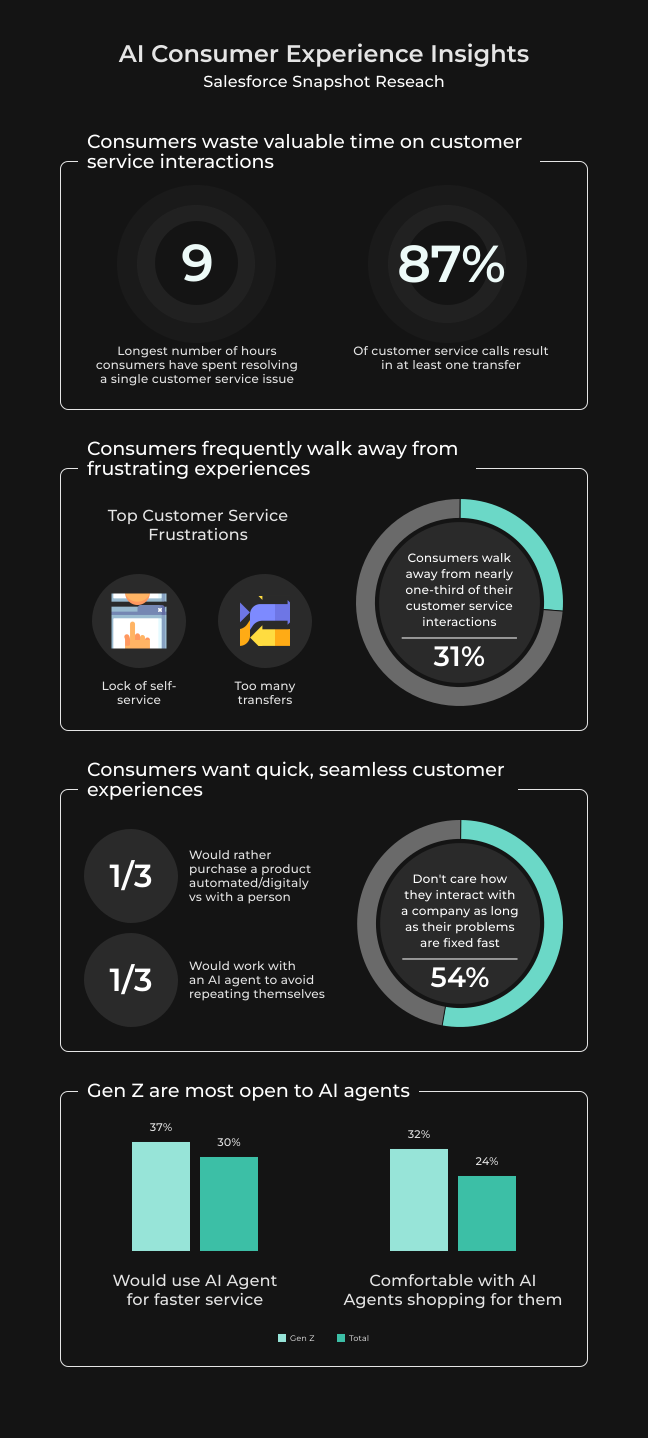
A survey by IBM and Morning Consult showed that nearly all (99%) of 1,000 developers working on AI for businesses are involved with AI agents. Moreover, 75% of senior executives believe AI agents will impact the workplace more than the internet, and 71% think AI will achieve human-like intelligence within two years.
AI agents are proving effective, with about 66% of companies using them reporting higher productivity. More than half also notice cost savings (57%), quicker decision-making (55%), and improved customer experiences (54%).
Initially, most benefits come from internal use, but customer-focused solutions are rapidly gaining ground.
Common AI Agent Use Cases
AI agents' use is quite versatile. For example, AI agents can automate complex tasks in logistics and retail or offer smart decision-making in education and healthcare. AI in these areas helps businesses reduce resource use for everyday tasks and increase efficiency.
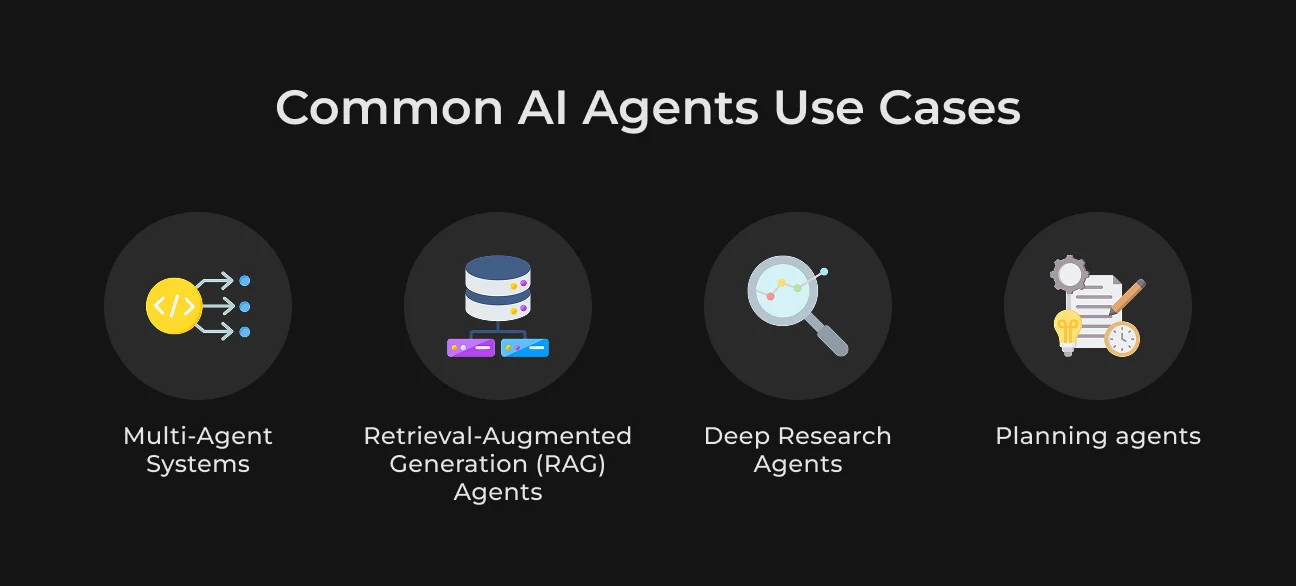
Here are some common examples of how AI agents are applied.
Multi-Agent Systems
Multi-agent systems are like a team of artificial intelligence partners working together to achieve their own or common goals. They’re changing the game for industries like finance, logistics, and manufacturing.
Take logistics, for example. These systems let each part of the supply chain (each “agent”) make smart decisions based on local info while also working seamlessly with others. The result is better routes, lower costs, and increased efficiency.
Plus, adding more agents without redoing everything means businesses can easily grow and adapt to market changes. Companies using these systems are seen as innovation leaders and could offer great returns because they're perfect at adapting and working efficiently.
Deep Research Agents
Deep research agents can handle tons of data, pull out important info, and help make strategic decisions. They've proved really useful in industries like pharma, finance, and tech.
The deep research agent achieved around 58% accuracy on the most difficult questions. Earlier systems couldn't even reach 40-50% on these questions.
This remarkable progress indicates that the agent is managing complex, multi-step tasks better, moving closer to human-like reasoning in tasks that recently seemed out of reach.
Investors and CEOs can achieve speedy R&D and quicker product launches using deep research agents. They help businesses make smart decisions, spot trends, predict future tech changes, and guide long-term planning.
Retrieval-Augmented Generation (RAG) Agents
Retrieval augmented generation (RAG) is a cutting-edge AI technique that boosts generative models by connecting them to an external knowledge base. This link provides extra context for user questions, helping large language models (LLMs) deliver more accurate answers.
RAG allows LLMs to excel in specific areas without needing extra training. Instead of relying only on their training data, AI models with RAG can get real-time updates through APIs and other data sources.
Planning Agents
Planning agents are the so-called experts at figuring out how to use resources and efficiently set schedules. Industries like manufacturing, transportation, or city planning widely use this type of AI agent.
They help companies use resources efficiently, manage assets smartly, reduce waste, and improve schedules, all of which boost profits. Those interested in smart city projects can use planning agents to improve city infrastructure, traffic, energy, and public services.
How to Build an AI Agent: Core Elements
Crafting a top-notch AI agent is basically all about following the right algorithm. You'll need sturdy frameworks, smart data strategies, seamless workflows, and thorough safety inspections. These essential elements will make your AI system reliable, compliant, and efficient.
Here's a step-by-step guide to building your own artificial intelligence agent.
1. Set the Foundational Frameworks
All AI frameworks serve a specific purpose. To choose the right one that suits you best, make sure you understand what you need an AI agent for. Let's overview these frameworks quickly:
- LangGraph. LangGraph is great at understanding complex relationships and keeping track of long chats. Perfect for projects where context is king;
- AutoGen. AutoGen is designed for fast movers who embrace change positively. It focuses on rapid prototyping and easy model deployment, just perfect for those who prioritize speed and flexibility;
- OpenAI Agents SDK. This one is versatile, which makes it easy to slot OpenAI models into your projects with its ready-to-go tools;
- Claude. Claude is a personable conversationalist of the group. If you're looking for AI that combines empathy with a human touch, especially for customer service roles, Claude is the right choice;
- CrewAI. CrewAI excels at teamwork. It's created for situations where multiple AIs collaborate, from robotics to complex simulations;
- Google’s ADK. Google's ADK is like a powerhouse. Its extensive cloud capabilities and advanced AI tools make it perfect for building large, high-performance applications.
Framework | Primary use | Strength |
| LangGraph | Graph-based language models | Context retention, semantic understanding |
| AutoGen | Auto design and deployment | Rapid prototyping, ease of use |
| OpenAI Agents SDK | Integration of AI models | Flexibility, broad application support |
| Claude | Conversational AI | Emotional intelligence, natural language understanding |
| CrewAI | Collaborative AI environments | Coordination, multi-agent systems |
| Google’s ADK | AI development | Cloud infrastructure, high-scale applications |
2. Add a Data Strategy
Creating an exceptional AI agent requires a well-thought-out strategy for managing data effectively. Here's your basic plan:
- Collect. Collect data from sources like CRMs, sensors, APIs, and logs. You may think of it as assembling a big puzzle of user info and their actions;
- Store. Use cloud storage that can grow with your data;
- Label. For supervised learning, make sure your data is labeled correctly. Getting humans involved here helps boost model accuracy by making sure the labels actually make sense;
- Govern: Follow the rules, like GDPR or HIPAA, by setting up smart data management policies. This keeps user info private and ensures you’re not breaking any laws.
3. Develop Workflows
Efficient workflows are key to making AI agents run perfectly. Here are the essentials of their development.
Prompt Chaining
Connecting multiple prompts simplifies complex tasks into manageable steps. This leads to a more comprehensive output. A flowchart, for example, can illustrate the progress from initial input to final output.
Routing
Routing assigns tasks to the most suitable components of an AI system, ensuring efficient task management. A network diagram can illustrate how tasks are distributed across different agents.
Parallelization
Running multiple computations simultaneously enhances efficiency, particularly with large data volumes or complex tasks. Displaying a timeline graph can effectively represent simultaneous task execution.
Evaluator-Optimizer
Evaluation and optimization are separate processes where evaluators assess performance and optimizers adjust parameters. A cycle diagram can depict the iterative process of evaluation and optimization.
Orchestrator-Workers Approaches
In single-agent systems, an orchestrator manages tasks directly. In multi-agent systems, it delegates to specialized workers. A hierarchy chart can show the relationships between orchestrators and workers in different setups.
Understanding that not all tasks need high-level AI intelligence is important. Often, simpler processes can achieve similar results, just highlighting the value of optimizing workflows.
4. Implement Guardrails
Putting guardrails in place keeps AI agents safe, relevant, and rule-abiding. Here's how:
- Relevance filters. Make sure AI stays on topic and delivers appropriate responses, avoiding the off-topic or misleading content;
- Safety classifiers. Stop leaks and harmful interactions by using classifiers that spot and neutralize unsafe prompts, like those prompt injections;
- PII filters. Secure sensitive information by removing personal details, safeguarding privacy, and following data protection regulations;
- Tool safeguards. Rank tools by potential risk and apply the right controls based on their impact level.
Plan for Human Intervention
It turns out that even with advanced AI defenses, the human touch is still indispensable. Being ready for those moments that need human intervention means that issues can be solved faster than you can expect.
As shown above, building an AI agent means getting several key parts to seamlessly work together. You need a solid foundation, a good data plan, efficient methods, and strong rules to guide it. If everything is done right, AI agents can boost operations and help grow and innovate while following the rules.
How SapientPro Automated Call Centers with AI Agents
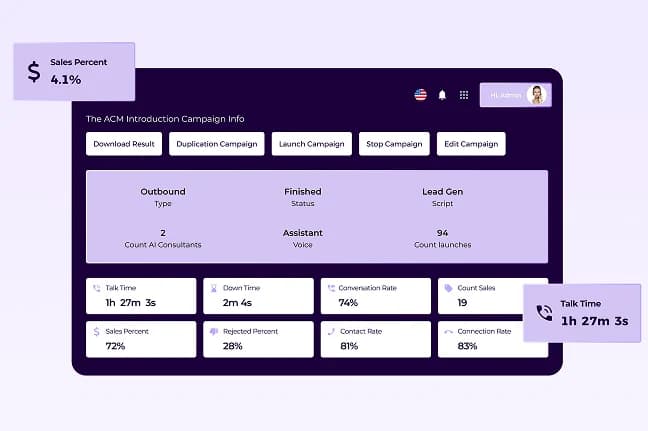
A contact center company wanted an AI tool to chat with customers, manage numerous calls, launch campaigns, work with CRMs, and produce reports.
SapientPro’s team stepped in to help with an AI consultant that talks like a human and improves productivity, scalability, and accuracy. This AI can run customer interactions, solve problems fast, and get rid of the need to train human agents, which saves on onboarding.
During the collaboration, two cold lead chatbot versions were created:
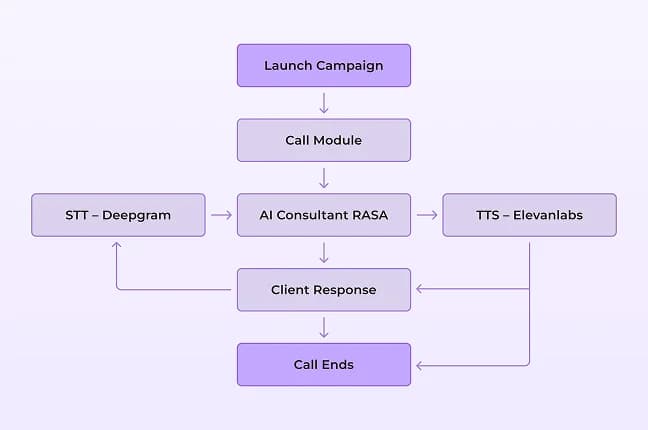
- Rasa-driven chatbot. This version uses scripted chatbots to manage FAQs in voice dialogues. It offers cost-effective, high-quality conversations without advanced NLP and NLU;
- Advanced generative AI assistant: This version employs generative LLM models for complex dialogues across various topics, overcoming traditional limitations and supporting any domain.
After deployment, the chatbots begin making calls within 5 to 10 minutes, support an unlimited range of languages, and provide detailed reports complete with analytics. This gives managers full oversight. The scalable system quickly turns the call center into a data-driven revenue generator.
Our Expertise in AI Agent Architecture in Practice
A capable AI agent has to do more than produce a plausible reply. Its value shows when a request keeps evolving, the context cannot be lost, and the conversation still makes sense across the channels people actually use. That is where implementation starts to matter more than surface fluency.
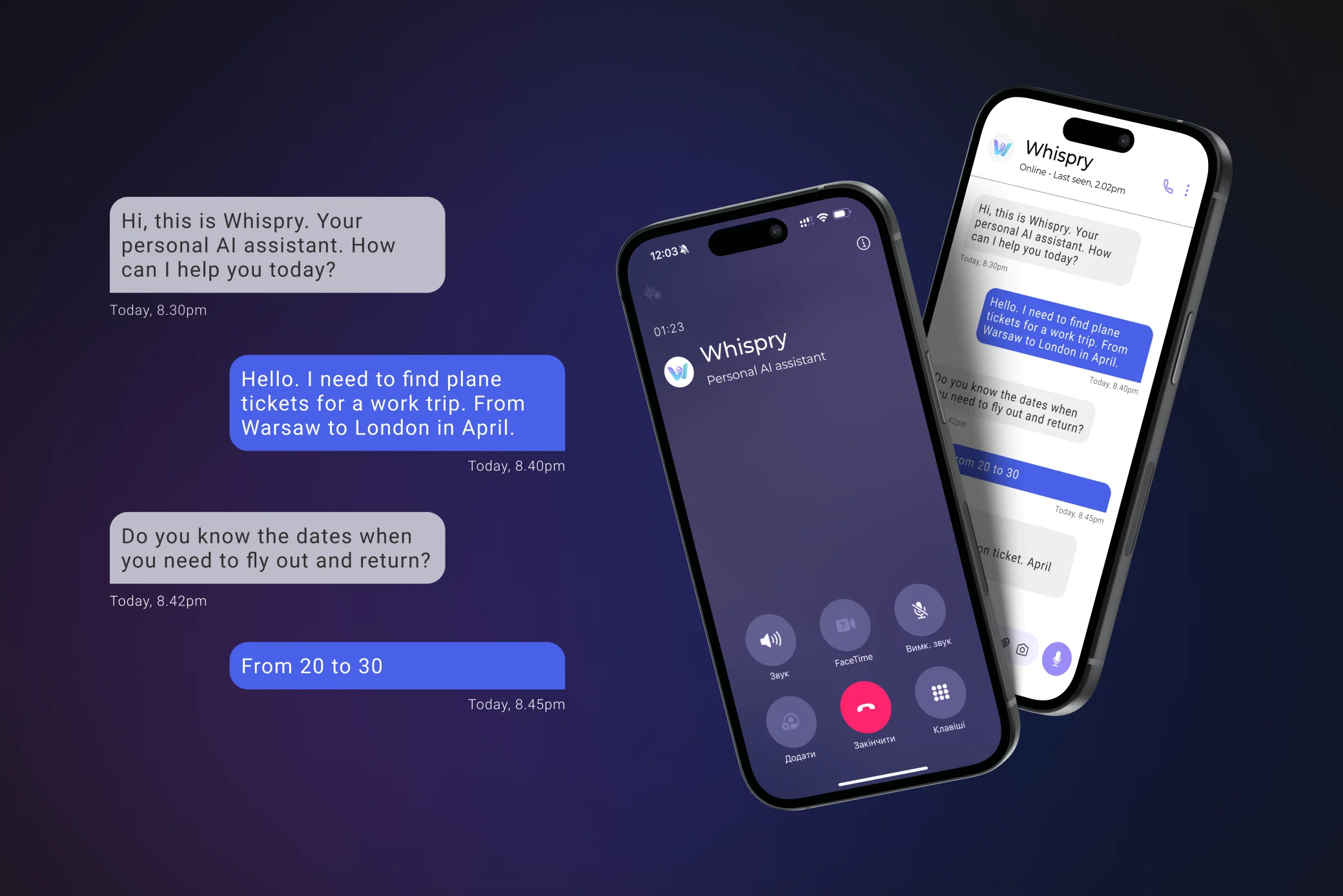
One of our recent projects makes that difference visible. We built a voice assistant for everyday tasks that accepts requests through phone and SMS, keeps track of prior exchanges, looks up the needed information, and returns the result in the format that suits the situation best. The case shows what happens when agent logic is worked out with care, not treated as a thin layer over a model.
For readers interested in the practical side of agent design, our AI Voice Assistant for Everyday Tasks case study offers a concrete example of how such systems behave outside a controlled demo, when continuity, timing, and context all shape the outcome.
Future of Agentic AI
With AI being involved more in performing tasks and making decisions, we can assume that we're now in a new era. AI is no longer just creating content. AI agents successfully perform tasks, follow commands, and execute efficient plans.
They analyze data, decide on actions, and continuously learn and adapt from their experiences. In human resource management, AI revolutionizes talent acquisition with a high-tech update. Imagine this:
- One digital assistant organizes resumes from numerous applicants to find the ideal candidate;
- Another AI system evaluates, ranks, and selects applicants while you have a break;
- A separate AI assistant efficiently schedules interviews almost instantly.
A third of executives are considering using AI to replace some jobs soon. But nearly half prefer to improve productivity by having AI support their teams as an additional resource rather than a substitute.
Startups are developing AI tools that manage company policies and documents with precision, much like a super-efficient librarian ensuring everything is in order and compliant.
By 2028, around 33% of enterprise software will feature agentic AI, up from under 1% in 2024. These tools can autonomously make 15% of daily work decisions.
Partner with SapientPro to Create Your Agentic AI Solution
With over 8 years of AI development experience, SapientPro's experts are committed to improving your business processes and increasing profits. We're leaders in AI, making computers understand language, recognize images, operate chatbots, and improve call centers.
We build & integrate custom AI solutions specifically for your business.
Contact us to discover how we can transform your industry with our AI technologies.
Build Your AI Agent With SapientPro
Talk to our experts and get a free consultation to see your project's potential.