All What is AI in Supply Chain Management? Benefits, Impact, Role in 2025
August 28, 202515 min read


Artificial intelligence is transforming logistics by providing automation, security, and improved customer service. A report by McKinsey states that AI-powered systems reduce supply chain errors by 20% to 50%, which in turn helps to reduce lost sales by up to 65%. That’s a whole lot of innovation in the niche.
AI perfectly complements the logistics industry by overcoming challenges and improving its operations. With the amount of data that is generated at every step of the supply chain process, from product manufacturing to sales, AI can serve as a powerful tool for the industry.
In this article, you’ll learn how AI is changing supply chain management from SapientPro’s experts and why it’s important to start implementing this technology in your processes today.
What is AI in Supply Chain Management?
AI technology has changed how companies handle supply chains, providing capabilities that were simply not possible with traditional software solutions.
From maintaining optimum inventory levels to ensuring product quality and planning fuel-efficient delivery routes, AI brings a completely different level of precision and efficiency to these operations.
AI can do things much better than conventional software could, such as:
- Video content processing and understanding;
- Understanding human language: both speech and text;
- Predicting market trends;
- Smart decisions involved in complex situations;
- Extracting useful patterns from large datasets.
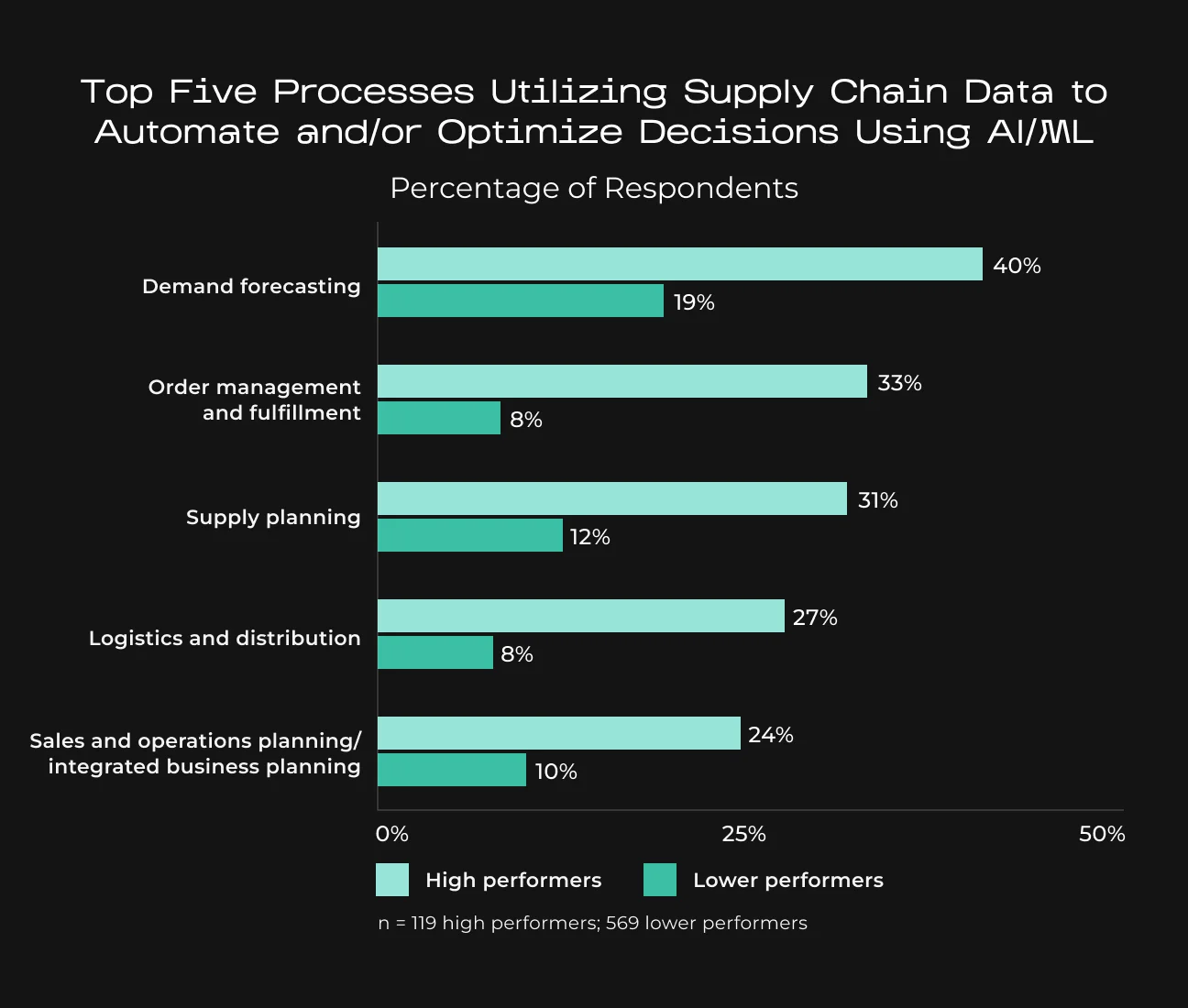
AI in supply chain leads to much more flexible intelligent solutions that easily cope with subtle challenges.
Benefits of AI in Supply Chains
Let’s take a look at the top 5 benefits of artificial intelligence in the supply chain.
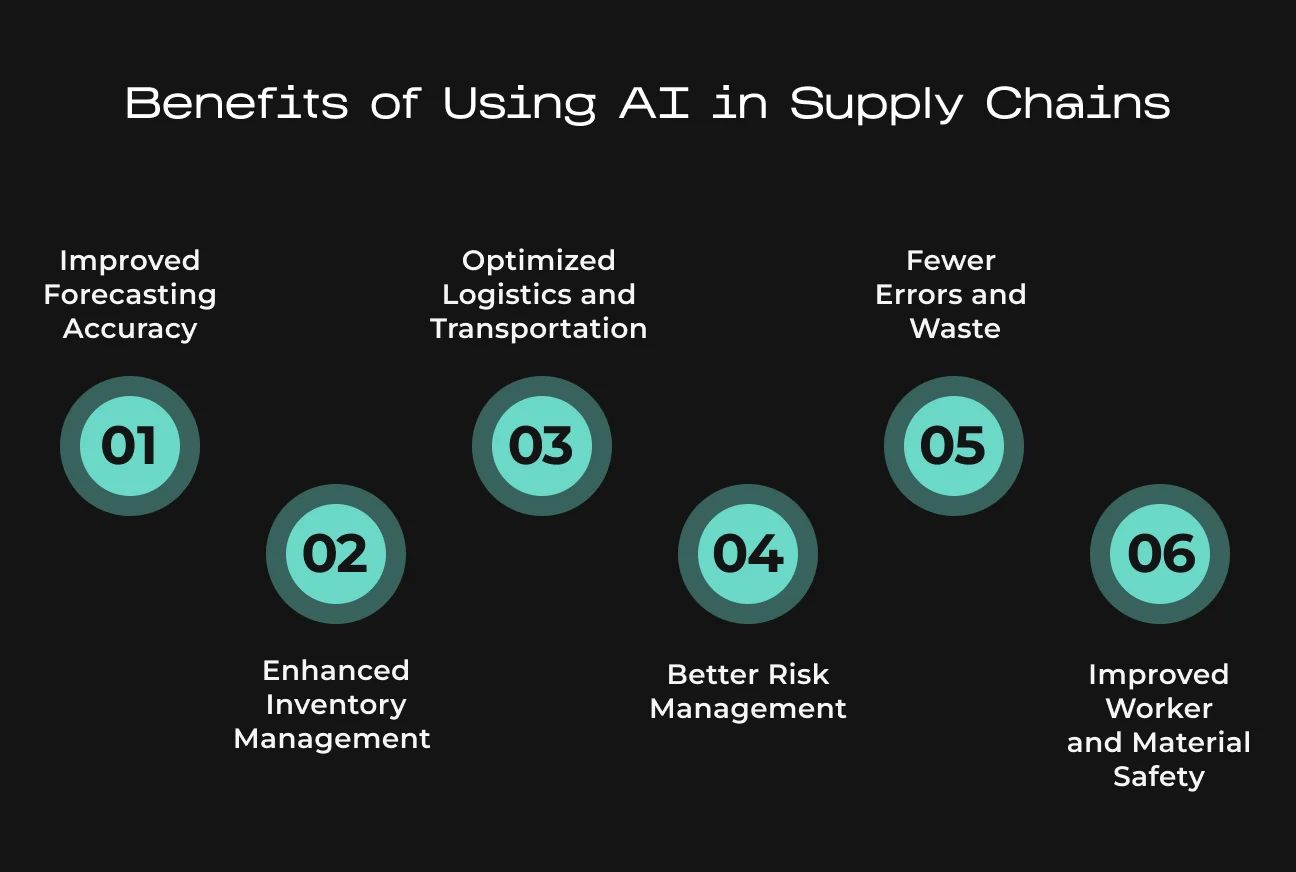
Improved Forecasting Accuracy
Modern demand forecasting relies heavily on AI's ability to process multiple data streams. Applying AI-driven forecasting to supply chain planning can reduce forecast errors by 20–50%, translating into a reduction in lost sales from stock-outs of up to 65%.
These systems analyze internal metrics like sales pipelines and marketing data alongside external factors such as market trends and economic indicators. Due to such a comprehensive approach, you get more accurate demand predictions and can prepare for various scenarios.
Enhanced Inventory Management
AI can reduce overall inventory levels by 20–30% by analyzing customer demand patterns and automatically adjusting inventory forecasts based on downstream data. Computer vision technology, implemented through cameras on infrastructure, vehicles, and drones, provides continuous inventory counts and storage capacity monitoring.
AI technology also significantly improves Warehouse Management Systems (WMS), maintaining accurate digital records of all inventory movements.
Optimized Logistics and Transportation
Machine learning algorithms analyze material flow patterns to optimize floor layouts, reducing travel time between receiving, storage, and shipping areas. Early adopters of AI and ML in the supply chain industry experienced a 15% cost reduction on logistics.
These systems determine the most efficient routes for both human workers and automated systems, significantly improving fulfillment speeds.
Better Risk Management
Supply chain managers now leverage AI-powered simulations to optimize complex logistics networks. These simulations often incorporate digital twins – detailed 3D representations of physical assets and processes. This allows operations teams to test various scenarios and improvements without disrupting actual operations.
The AI-driven simulations provide more accurate results than traditional computing methods, helping managers make better decisions about product redesigns, equipment installations, or supplier changes.
Fewer Errors and Waste
Computer vision systems deployed throughout the supply chain can detect anomalies faster and more accurately than human inspectors. These systems monitor everything from production line defects to shipping errors. At the same time, algorithms perform root cause analysis to prevent future issues. The integration with ERP systems also significantly reduces financial transaction errors.
Improved Worker and Material Safety
AI systems ensure proper use of protective equipment, verify compliance with safety protocols, and monitor equipment operator behavior. Wearable devices connected to AI systems can detect potentially dangerous movements or situations, alerting workers before injuries occur.
For hazardous materials handling, AI-guided robots can perform dangerous tasks while avoiding obstacles and maintaining precise documentation of their activities.
Documentation is also important for safety. SapientPro developed an AI platform for SDS management, allowing full automation of data management, compliance monitoring, and notifications for important events. This solution now helps in the chemical industry.
5 Challenges in Integrating AI in Supply Chains
Getting AI to work in supply chains isn't as straightforward as vendors make it sound. Let's look at what's really holding companies back.
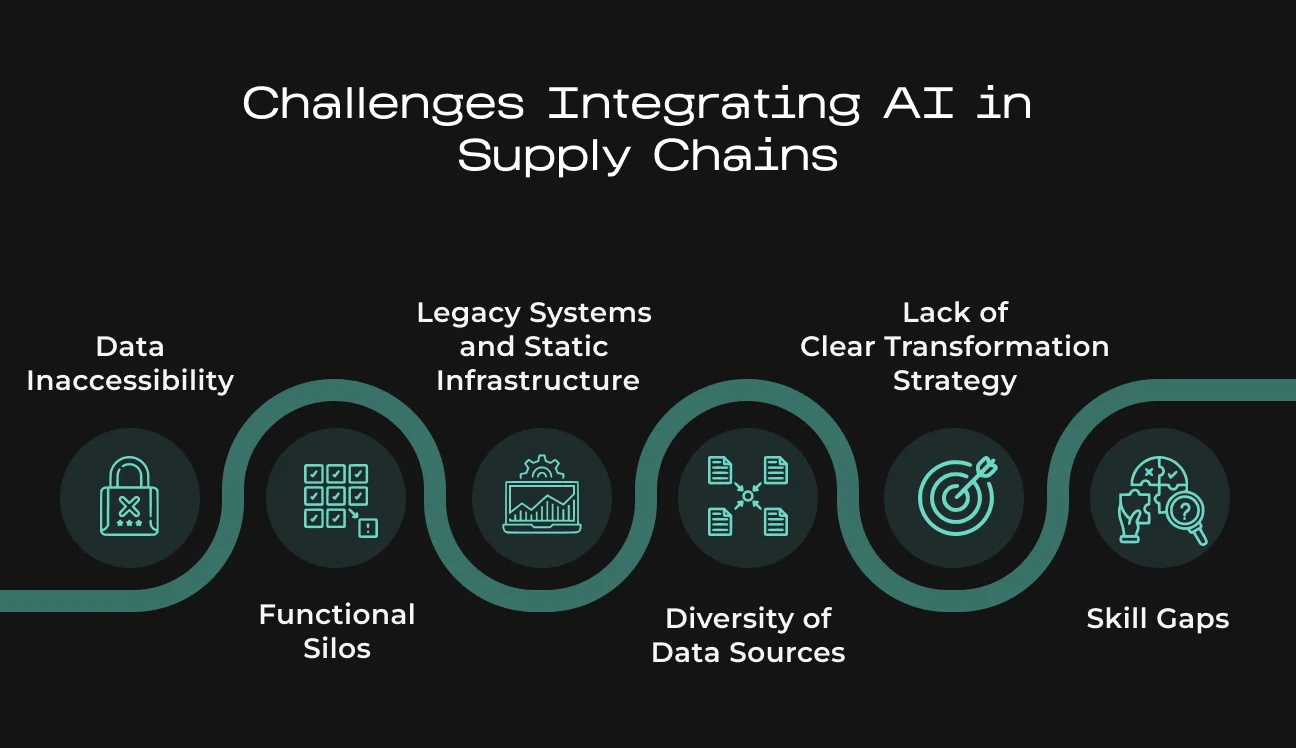
Data Inaccessibility
It is like trying to cook without access to your ingredients. Companies sit on mountains of valuable data, but it's often locked away in old systems or spreadsheets that nobody can find. Worse yet, when dealing with international suppliers, data privacy laws can turn simple data sharing into a legal maze.
Functional Silos
These are the corporate equivalent of departments not talking to each other. Procurement does its own thing, warehousing uses different systems, and logistics teams have their own processes. Getting these groups to share data and work together is like herding cats – technically possible but incredibly frustrating.
The lack of cross-functional collaboration is a major barrier to end-to-end AI solutions. Surveys confirm this misalignment: 37% of companies report that cross-departmental collaboration and data sharing are difficult in their organization.
Legacy Systems and Static Infrastructure
This challenge feels like being stuck with a Nokia 3310 in an iPhone world. These legacy systems weren’t built for AI, and they’re about as flexible as concrete when it comes to data exchange or process changes. They often can’t generate real-time data or interface with modern AI platforms.
Companies know they need to upgrade, but replacing core systems is expensive, risky, and time-consuming, causing hesitation. If that’s your case, SapientPro’s engineers will help you get a full-scale legacy system modernization roadmap for a fast and seamless transition.
Diversity of Data Sources
This challenge means dealing with a tsunami of information coming from everywhere:
- IoT sensors;
- RFID tags;
- Shipping partners, etc.
Each source speaks its own language and follows its own formats or standards. The data is extremely heterogeneous (structured vs unstructured, different units or timestamps, etc.).
Consolidating and harmonizing all this data into a usable form for AI is a massive headache. Data diversity often leads to data fragmentation. When data is coming from dozens of incompatible sources, an AI system might struggle to make sense of it without extensive data cleaning and integration efforts.
This slows down AI projects and requires significant upfront investment in data engineering.
Lack of Clear Transformation Strategy
What happens when companies jump on the AI bandwagon without a map? They often buy fancy tools and hire expensive consultants, but without a clear plan, it’s like throwing darts in the dark – you might hit something, but it probably won’t be what you were aiming for.
Many supply chain AI initiatives fail to scale beyond pilots because the organization didn’t define from the start how these AI projects align with business goals or how to allocate resources and support across departments. A clear roadmap is essential, yet many firms don’t have one.
A recent industry survey found that only 23% of supply chain leaders have a formal AI strategy in place. This means roughly three-quarters of companies are pursuing AI in an ad-hoc, project-by-project manner without an overarching strategy.
The absence of a long-term vision and executive alignment leads to stalled projects, duplicated efforts, or misallocated investments, preventing companies from fully realizing AI’s benefits.
Skill Gaps
This challenge hits companies hard because finding people who understand both supply chains and AI is like finding a unicorn. The current staff and domain experts in a company typically know the supply chain business inside-out but lack AI/machine learning expertise.
On the other hand, new data science or AI hires might be tech whizzes but don’t understand the complexities of supply chain operations and logistics.
Bridging this gap through training or hiring is difficult and takes time – time that nobody feels they have in a competitive environment. It’s a common picture across the industry. Companies frequently cite the lack of in-house talent and expertise as a top barrier to AI adoption.
Without people who can develop, implement, and interpret AI systems – even the best technology will fall flat. That’s why SapientPro’s experts are here to help with any AI integration projects.
5 Examples of AI in Supply Chains: Use Cases
AI is already transforming e-commerce in unimaginable ways. Now, it is time to discuss AI in supply chain examples.
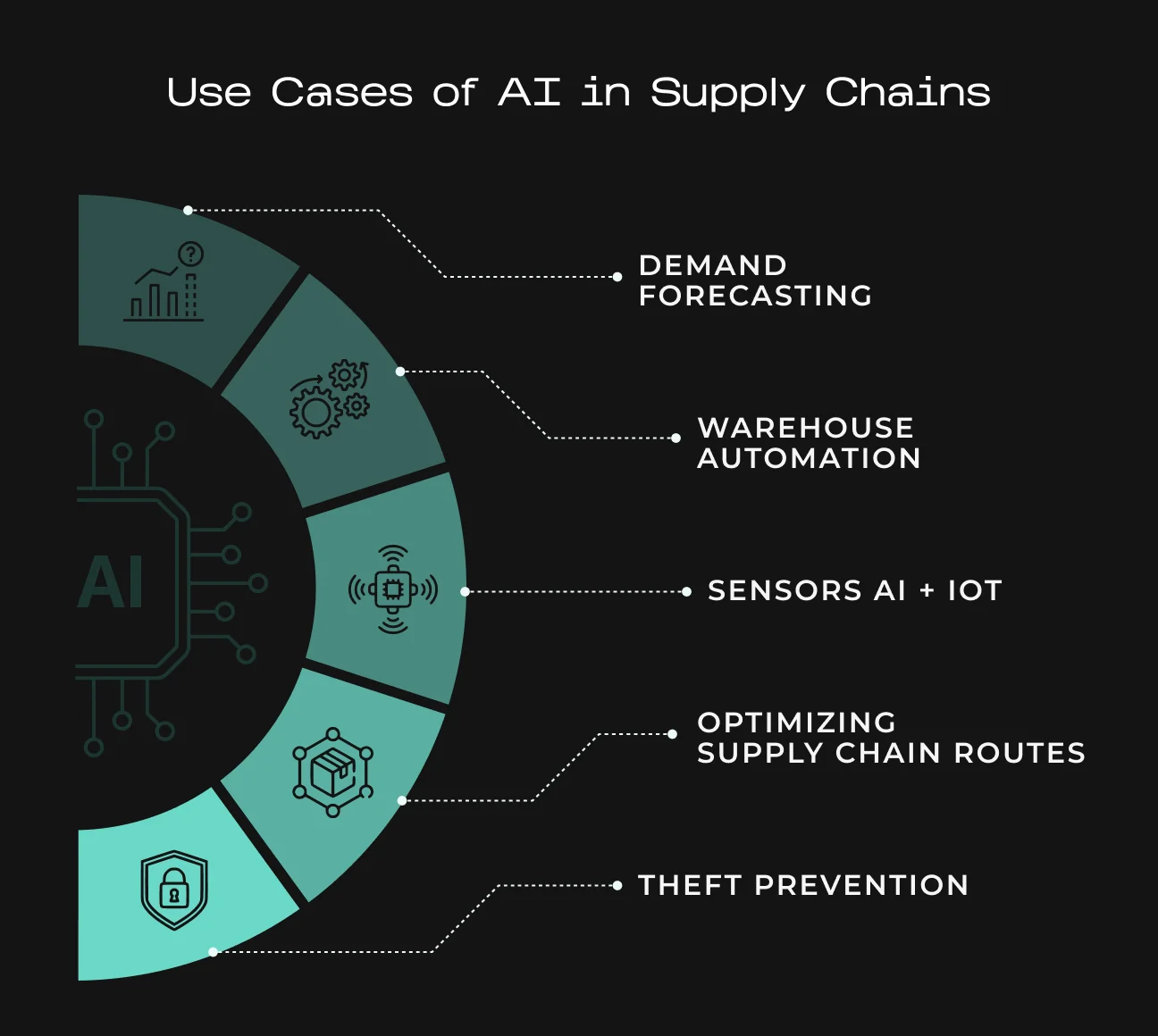
Demand Forecasting
We know that when it comes to manufacturing, resources are limited. Therefore, it is important to predict the exact demand for your product.
Demand forecasting helps companies clearly visualize expectations and, based on these expectations, set adequate inventory levels and price the product correctly. Implementing AI solutions for demand forecasting significantly reduces the risk of:
- Lost sales;
- Spoiled products;
- Additional operational and personal costs;
- Over/under-stocking of products.
With machine learning (ML) and artificial intelligence, companies can analyze large amounts of information related to historical sales data and customer data. They can also process other types of real-time data, such as current discounts, trends, and revenue changes.
Machine learning algorithms improve the accuracy of demand forecasts by finding complex non-linear relationships in huge datasets that no human could process in such a short period of time.
Warehouse Automation
Smart automation and robotics are some of the most valuable capabilities that artificial intelligence offers to the logistics industry.
Artificial intelligence systems free warehouse personnel from repetitive and possibly dangerous tasks, automating the process and providing greater speed and accuracy.
Smart warehouses that use AI-based automation are more productive and can operate around the clock, which would be very expensive and nearly impossible with human labor alone.
For example, after Amazon automated most of the operations in its warehouses, its team no longer has to do the tedious and boring work of moving carts of products, stacking them on shelves, and scanning them to mark their location in the system. Now, all these tasks are done by smart robots that get the job done faster and with greater accuracy, eliminating human error.
Sensors AI + IoT
With the help of artificial intelligence and Internet of Things (IoT) sensors, companies get an overview of all their operations.
Internet of Things sensors can track:
- Shipment status of each product;
- Status of equipment and machinery;
- Room temperature, and more.
This helps managers understand the efficiency and status of their supply chain operations.
Artificial intelligence technologies, on the other hand, use the Internet of Things data, analyze it, and provide tips and recommendations.
For example, by collecting data from the Internet of Things sensors about equipment load and weather conditions, AI systems can estimate when maintenance is needed to avoid equipment downtime.
Optimizing Supply Chain Routes
Fast and cost-effective delivery is very important in logistics because mismanagement of this process can lead to unnecessary costs.
Artificial intelligence can analyze all related data affecting the trucking industry and, based on this data, find the best route for fast delivery in real-time. It can include:
- Weather conditions;
- Traffic jams;
- Speed limit on roads, etc.
Based on this data, artificial intelligence systems can find the best route for the fastest real-time delivery. Short routes are a more environmentally friendly approach as they reduce vehicle emissions and prevent the emission of harmful particles.
Theft Prevention
Artificial intelligence can also guarantee the security of logistics operations.
By having access to data such as:
- Locations where thefts are more likely to occur;
- Types of goods that are most often stolen;
- Times of day when crimes occur most frequently;
- Thousands of hours of real and simulated images of thefts;
Machine learning algorithms can analyze all of this information and alert businesses to theft risks, provide real-time alerts, and suggest safe alternative routes.
Artificial intelligence-powered security alerts have become critical for logistics companies as cargo theft continues to be a huge problem affecting both consumers and businesses.
Future of AI in Supply Chain Management: Trends and Statistics
The use of artificial intelligence in supply chain management right now is qualitatively changing the entire industry as such. But the biggest changes lie ahead. Here are just a few predictions on this area shared by experts:
- AI-based telematics will start to develop even faster. It will provide real-time monitoring of driver performance and training, as well as enable predictive analytics for fleet management. According to GlobeNewswire, the AI telematics market is expected to grow from $9.87 billion in 2024 to $17.24 billion by 2030. The CAGR at this rate will be 9.84%.
- Transportation Management Software (TMS) will become smarter and increasingly integrated. This will enable better planning, execution, and control of goods movement. According to Gartner, the TMS market grew to $2.11 billion in 2024.
- Multichannel logistics will also evolve. In particular, to achieve greater transparency, personalization, efficiency, and speed of delivery. McKinsey’s experts are convinced that the transportation and logistics industry should be “as digital as possible.” After all, this will protect the future of the industry and meet the ever-growing needs of customers.
AI is no longer a futuristic concept in supply chain management—it’s a practical driver of efficiency, transparency, and resilience. We see firsthand how businesses leveraging AI gain measurable cost reductions and smarter decision-making, positioning themselves ahead in an increasingly competitive logistics environment.

Ihor Hamal
Integrate AI into Your Supply Chain with SapientPro
SapientPro is your reliable AI software development company with experience in engineering from scratch, integration in existing systems, and legacy modernization.
Working with us means getting industry-proven expertise combined with the current best practices for your business. Contact us for a detailed consultation right now!
Integrate AI in Your Supply Chain
SapientPro's engineers will help you get a modern solution for your business.