
All AI in Construction: Uses Cases & Tech Challenges
Updated:March 30, 202610 min read


In 2024, the global market for AI in construction was valued at $2.4 billion and is forecasted to climb to $12.1 billion by 2030, driven by a robust CAGR of 31%.
Deloitte reveals that 92% of industry leaders believe AI will significantly change their daily operations while enhancing safety and improving project planning and cost management.
By now, AI has proven to have enormous potential, but many businesses still hesitate, as they’re unsure about the practical ways AI can be integrated into their projects. If you're wondering how exactly you can use AI in your construction project, you've come to the right place.
This article is written by SapientPro’s engineers with over 8 years of hands-on experience building AI-powered tools and platforms for industries like manufacturing, logistics, and construction.
We’ve seen the challenges, built the solutions, and helped our clients scale. Read on to learn how to use AI in construction in real-world scenarios, what benefits to expect, and which limitations still remain.
What is AI in Construction?
AI in construction implies the use of artificial intelligence technologies to support decision-making, reduce risks, and increase productivity at different stages of a construction project. This tech includes tools powered by machine learning, computer vision, natural language processing, and generative models. These systems are designed to learn from data.
AI can analyze site footage, scheduling logs, or supply chain records and use that information to spot issues early, automate repetitive tasks, and paint a clearer picture for project managers and teams on the ground.
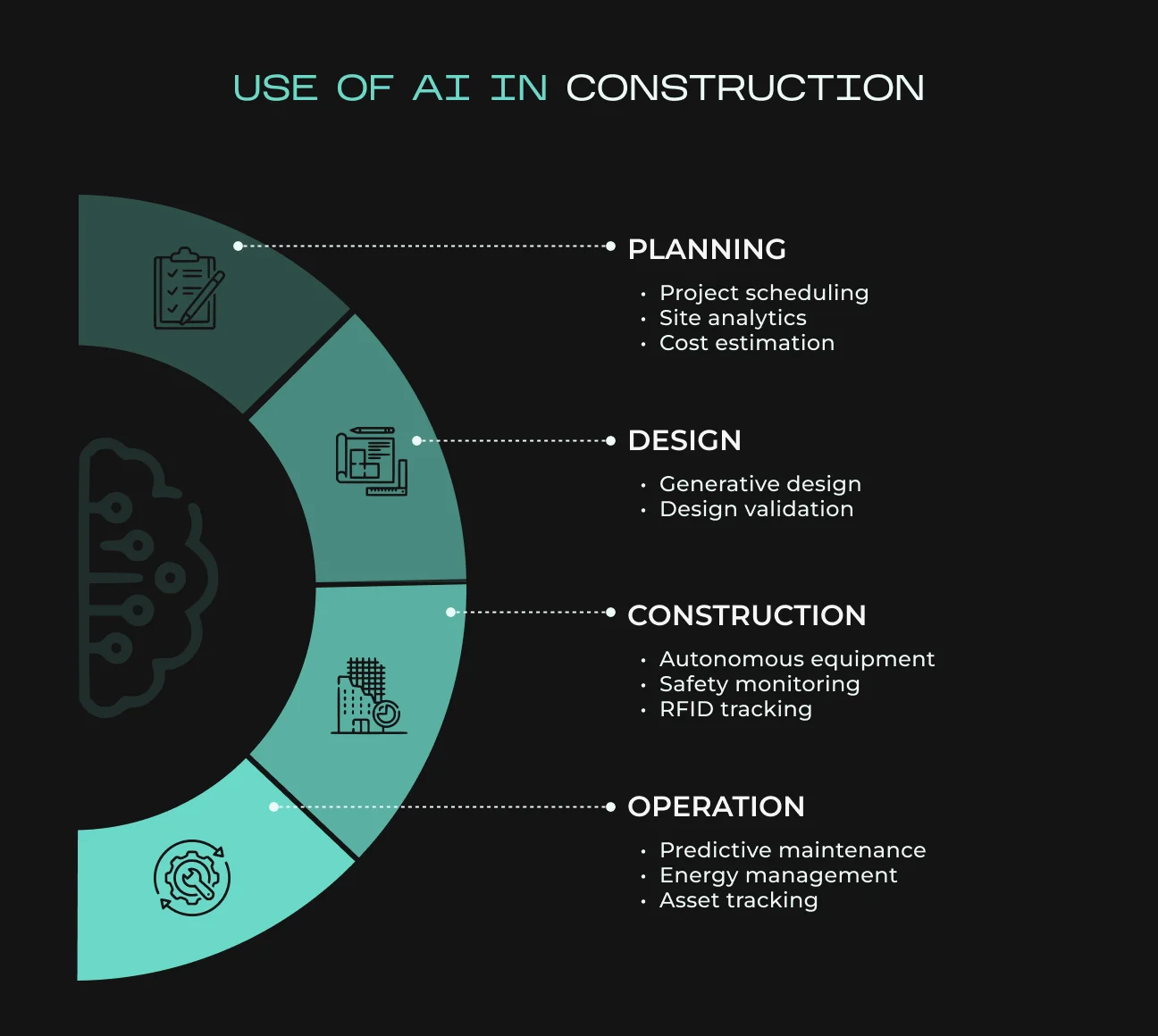
Besides automating processes, AI in construction enhances human capabilities. For example, AI can process thousands of scheduling possibilities in minutes, helping teams choose the most efficient construction path.
It can also analyze years of project data to predict when equipment might fail or where budget overruns are likely to happen. What once required large teams and hours of analysis can now be done in moments and presented clearly on a single dashboard.
One area seeing particularly rapid growth is generative AI in construction. This technology can generate multiple design or project planning options based on parameters like material availability, site size, or budget. It accelerates planning and often uncovers more efficient solutions that might have been missed through manual planning alone.
Paired with computer vision, AI can even monitor live job sites via drone footage or CCTV, identifying safety risks, tracking delays, or verifying that quality benchmarks are being met in real time.
Benefits of AI in Construction
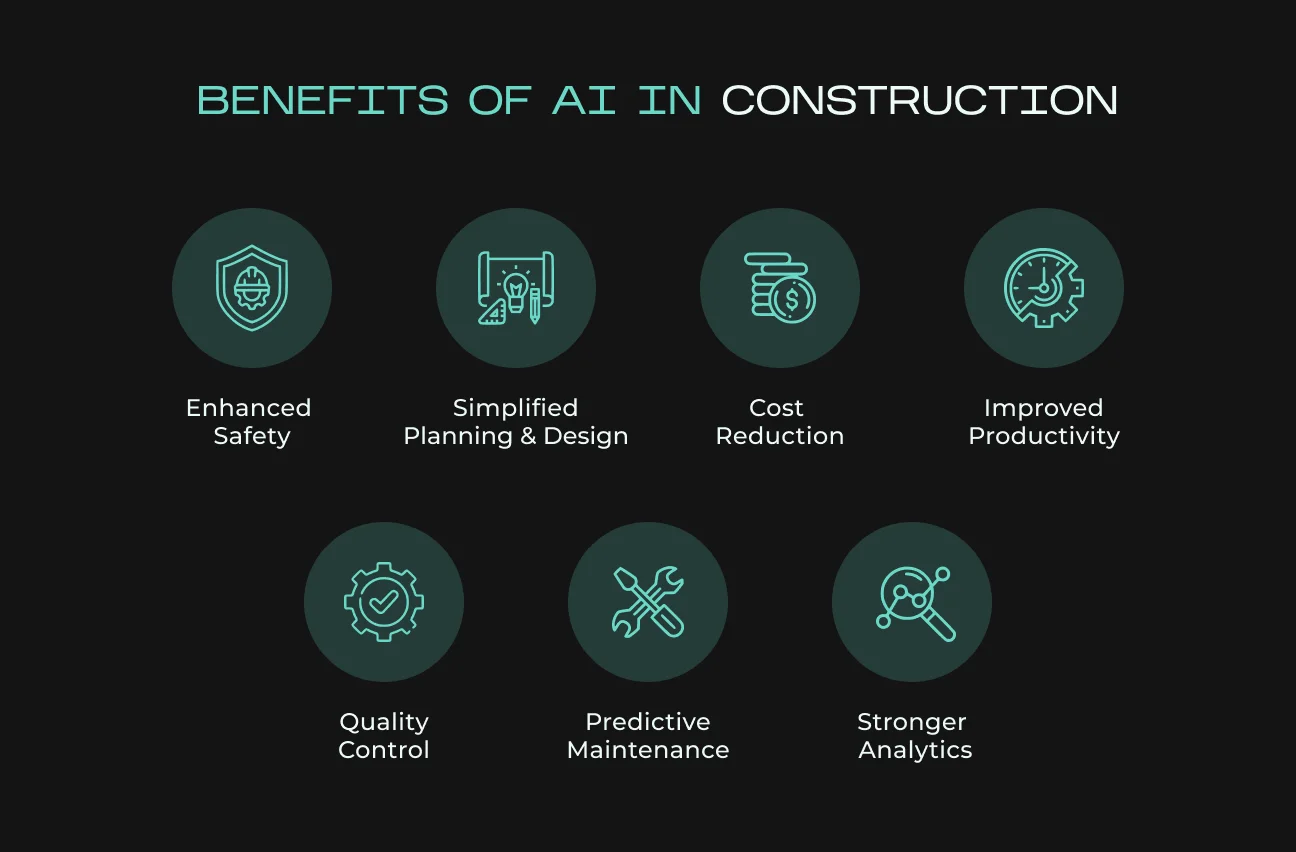
AI isn’t here to replace construction workers, not yet at least. It’s here to make their jobs safer, faster, and more predictable. Across job sites and offices, smart systems are helping teams rethink how they approach planning, cost management, design, and everything in between.
Let’s break down some of the biggest ways AI is already bringing value to construction companies.
1. Enhanced Safety
Construction remains one of the most hazardous industries in the world. In the US alone, over 1 in 5 workplace deaths occur in construction, according to OSHA. That’s why safety is one of the most important areas where AI is making an impact.
AI-powered systems, especially those using computer vision, can monitor job sites through live video feeds to detect safety violations in real time. When a worker comes without a helmet or someone is entering a restricted zone, AI can spot it faster than any human supervisor and alert the right person to take action.
Combined with machine learning, these tools can also analyze past incidents to predict where and when the next one might occur.
Another safety use case involves AI in cybersecurity. As more construction tools and equipment become digitally connected, protecting sensitive project data and systems is essential.
Our engineers have shared more on this topic in our article on AI in cybersecurity, which covers how to protect your data, networks, and connected devices from emerging digital threats. It's especially relevant for companies running AI- and IoT-based tools on-site.
2. Simplified Planning & Design
Design and planning stages often set the tone (and cost) for the entire project. Traditional approaches heavily rely on manual calculations, CAD software, and constant back-and-forth between teams. AI changes this process completely.
With machine learning and generative algorithms, architects and engineers can now feed in parameters like materials, space constraints, budget, and local codes to generate multiple building design scenarios. These models can weigh options that would take human teams days or even weeks to compare. As a result, you can make smart decisions faster.
In planning, AI also helps optimize scheduling. It can analyze data from past projects to estimate timelines more accurately, taking into account weather patterns, material availability, workforce capacity, and even subcontractor performance. These forecasts help reduce project delays and avoid costly rework later on.
3. Cost Reduction
One of the strongest reasons to invest in AI in construction is its ability to cut costs. Between delays, material waste, and unexpected change orders, project budgets are notoriously hard to manage. AI helps by improving accuracy and reducing guesswork at every stage.
Take predictive analytics, for example. These tools help flag areas where cost overruns are likely to happen before they do. AI can also optimize material procurement, track usage, and even reduce waste by helping forecast exactly how much of each material is needed and when.
Labor costs, another major expense, can also be controlled more effectively. AI-powered scheduling tools match tasks with the most available and skilled workers on a given day, preventing downtime and boosting site productivity. This approach leads to fewer budget surprises and more control over cash flow.
We break down real project savings and ROI calculations in our article covering the cost of AI.
4. Improved Productivity
The use of AI in construction is already helping companies squeeze more results out of every workday. By automating routine tasks like reporting, monitoring, and schedule adjustments, AI frees up managers and workers to focus on the tasks that matter the most.
For example, AI-powered digital assistants can automatically update daily reports based on real-time sensor data. Project management tools with AI capabilities can reschedule tasks if a delay happens, keeping the entire team in sync without needing dozens of phone calls and emails.
Even on-site operations benefit. AI-backed equipment like autonomous graders or concrete robots can perform repetitive tasks faster and more consistently than human labor, especially in large-scale builds. When combined with better planning and predictive analytics, these tools significantly increase the output per worker without pushing the team to burn out.
5. Quality Control
No construction project can succeed without quality. But ensuring it day after day across different teams and stages is easier said than done. AI is now helping companies maintain consistency and accuracy without slowing down operations. This shift is happening through automated inspection systems powered by computer vision and smart data processing.
For example, SapientPro developed an AI-powered solution for quality inspection in the agriculture sector. This solution cut inspection time by 87.5% compared to manual methods.
The impact? Fewer errors, better compliance, and less reliance on human effort. Now imagine that same approach applied to construction: checking welds, concrete pours, or surface finishes using drones and cameras, with AI grading the results in real time.
By automating inspection and documentation, AI reduces the risk of human error and improves consistency. It also creates an audit trail that’s easy to track and review later, which is an essential feature for both contractors and regulators.
As you can see, AI in construction helps teams meet quality standards faster and more reliably, even in high-pressure environments.
6. Predictive Maintenance
Breakdowns are one of the most expensive and frustrating problems on any construction site. Equipment failure delays progress and costs money in repair, downtime, and sometimes even penalties. That’s why predictive maintenance has become one of the most practical use cases for AI in construction management.
Instead of waiting for machines to fail, AI systems monitor performance data, including temperature, vibrations, usage hours, and more, to spot patterns that signal upcoming issues. This information helps teams schedule maintenance before the breakdown happens, which allows for reducing unplanned downtime and avoiding expensive repairs.
This approach also extends the lifespan of heavy machinery. When you’re running a multi-million-dollar fleet, keeping equipment in good shape is essential. Predictive maintenance systems can even rank the urgency of repairs, helping managers prioritize the most critical issues first and plan budgets accordingly.
By using AI to monitor and protect high-value assets, your company can lower costs, reduce project delays, and boost site efficiency. It also improves safety for workers who rely on that equipment every day.
7. Stronger Analytics
Data has always been part of construction, just not in ways that were easy to use. With AI, raw data gets turned into valuable information. And for companies that want to improve decision-making, this information can change everything.
AI-powered analytics can process data from:
- Drones;
- Sensors;
- Weather APIs;
- Supply chain platforms;
- Workforce trackers.
This information draws a full picture of what’s happening on-site. For example, a project manager can get alerts if materials are arriving late, progress is falling behind schedule, or weather might affect concrete pouring tomorrow.
What makes AI different from traditional reporting tools is its ability to learn. Besides flagging issues, it understands why they’re happening and what might happen next.
For larger contractors juggling multiple job sites, AI becomes a centralized hub that shows how one site’s problems might affect another’s timeline or budget.
Even at the boardroom level, AI in construction analytics can offer dashboards that connect operational data with financial KPIs. This technology allows you to manage risk more effectively, allocate resources smarter, and scale projects with fewer surprises.
SapientPro's engineers specialize in building custom dashboards and AI platforms, allowing our clients to get the most out of their data. We make information work for your business, not just piling up in spreadsheets.
Challenges of AI in Construction Industry
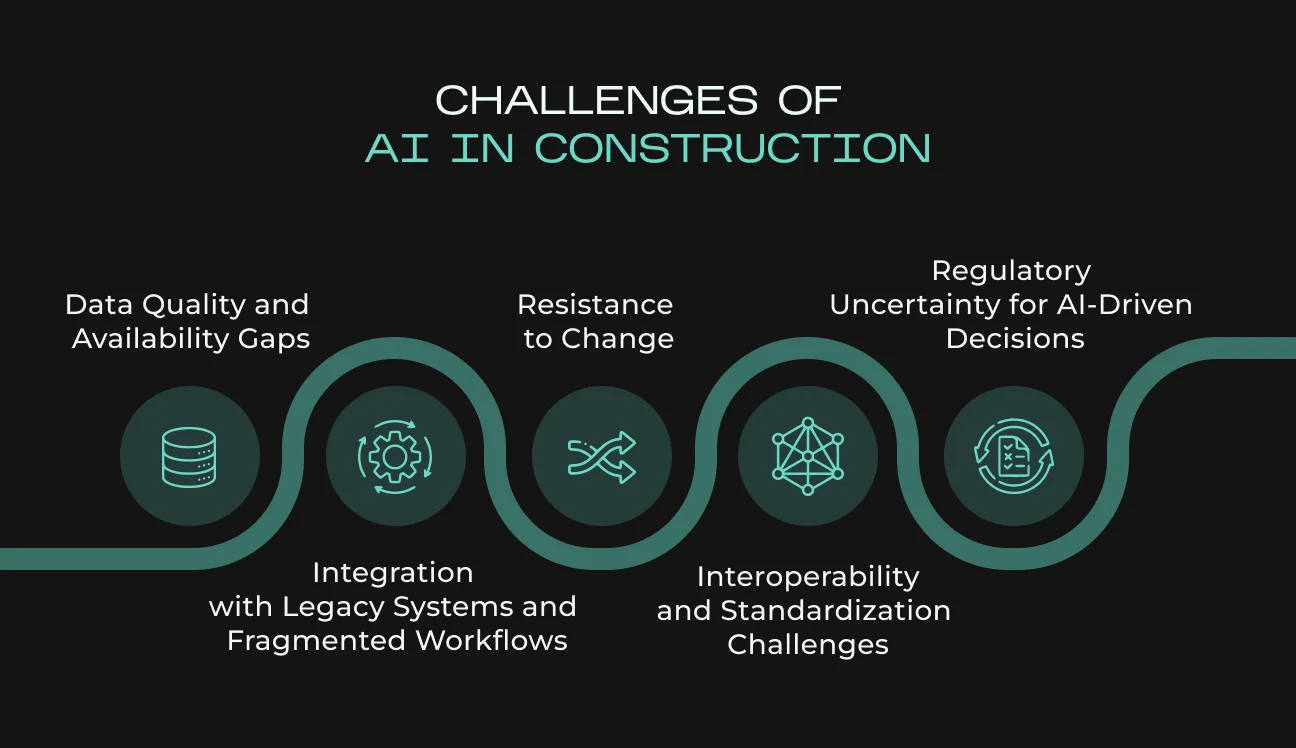
The percentage of AI in construction market is growing fast, but adopting this technology successfully takes much more than just plugging in new software. The construction industry has its own set of technical, operational, and cultural barriers, and ignoring them often leads to expensive pilot failures.
Let’s take a closer look at the top challenges construction companies face with AI and how SapientPro can help solve them.
1. Data Quality and Availability Gaps
AI depends on data. If the data is missing, outdated, or inconsistent, the entire system loses accuracy. This problem is common in construction, where job site conditions constantly change, and teams still rely on paper logs, email chains, and disconnected spreadsheets. AI can’t generate meaningful results if it's pulling from incomplete or messy sources.
Many construction firms don’t have a unified data pipeline across planning, execution, and reporting stages. Bad data makes it hard for AI to recognize patterns or provide reliable forecasts. In other cases, there may be a lot of information, but it’s stored across multiple formats and systems, which makes it nearly impossible to use without hours of manual cleaning.
Our team specializes in setting up centralized data systems that feed clean, real-time information into AI models. We build custom data collection tools and apply preprocessing layers that automatically organize, label, and validate the input before it reaches the AI. This approach ensures the foundation is strong because even the smartest algorithm fails if it’s trained on garbage data.
2. Integration with Legacy Systems and Fragmented Workflows
Construction companies often use a patchwork of tools. Some may have been built decades ago, others purchased off-the-shelf, and a few custom-built in-house. These legacy systems weren’t designed to work with AI. In fact, many don’t support the APIs or data standards needed for smooth integration. This problem creates a serious bottleneck when trying to connect AI-powered modules with existing workflows.
On top of that, different teams, such as design, procurement, field operations, and finance, may all use different tools and processes. Without interoperability, the value of AI drops significantly because it can’t “see” the whole picture. A misaligned system means missed signals, duplicated efforts, or even errors that go unnoticed until it’s too late.
SapientPro doesn't force one-size-fits-all platforms into your stack. Instead, we assess your current tech and workflows, then build lightweight AI layers that connect with your existing tools via custom APIs, middleware, or RPA (robotic process automation) scripts. This way, your team keeps what works and improves what doesn’t without needing a complete system overhaul.
Our engineers are experienced in bridging the old with the new. We help clients gradually upgrade their infrastructure while still gaining value from AI right away. We can sync your Excel-based workflows with a new predictive engine or connect site sensors to an analytics dashboard. In any case, we tailor each solution to fit the client’s reality, not the other way around.
3. Resistance to Change
Even when AI tools show clear benefits, getting people to actually use them is another story. Construction is an experience-driven industry. Many professionals rely on intuition, not data. So when AI tools start suggesting changes to workflows or flagging risks that go against a foreman’s gut instinct, pushback is inevitable. There’s also concern among crews that AI might replace jobs or micromanage their every move.
These reactions are understandable. If teams aren’t part of the process from day one, AI can feel like an outsider trying to control how they work. Without the right onboarding, even the best technology won’t gain adoption, and that can kill ROI before the system has a chance to prove itself.
We approach every AI implementation as a collaboration, not a handoff. Our process includes:
- User onboarding;
- Simple interfaces;
- AI assistants that work alongside the team, not above them.
We design systems to be transparent, explainable, and user-friendly, so crews feel supported, not replaced. In many cases, once workers realize that AI helps them avoid rework and finish faster, resistance turns into buy-in.
4. Interoperability and Standardization Challenges
Construction projects often involve multiple subcontractors, consultants, and tech platforms, each of which has its own standards, data formats, and preferred tools. This complexity creates friction when trying to build an AI system that needs to pull data from different places and speak a common “language.” Without interoperability, AI models can misread data or miss key details entirely.
Lack of standardization also makes it harder to scale AI solutions across projects or regions. What works on one site may not work on another if the data labels, naming conventions, or software tools differ. This inconsistency slows down AI training and limits performance.
To solve this problem, we build solutions with flexibility in mind. Instead of forcing clients to change all their tools, we develop middleware that acts as a bridge between systems. Our AI tools normalize data in the background by cleaning, labeling, and translating it into a unified structure that the AI can understand.
Where possible, we help clients adopt standardized data formats and API-friendly tools to future-proof their workflows. As a result, our clients get AI systems that can scale, adapt to multi-vendor environments, and deliver consistent results across complex construction networks.
5. Regulatory Uncertainty for AI-Driven Decisions
AI decisions can affect budgets, compliance, and even human lives, which is why regulations around AI use in construction are beginning to tighten. The problem is that the regulations aren’t always consistent. What’s legal in one region may be questionable in another. And since AI models often operate in a black-box fashion, proving compliance or explaining decisions becomes a serious challenge.
For construction firms, this uncertainty creates legal risk and hesitation. How do you deploy AI when you’re unsure what rules might change next quarter?
SapientPro's team designs AI systems to be auditable and transparent. We build in explainability so that decisions made by AI can be traced, understood, and justified. We also stay current with emerging legislation and compliance frameworks, helping our clients operate within the legal boundaries of their region.
In some cases, we recommend deploying AI on self-hosted infrastructure or within approved cloud regions to meet data residency laws. We also provide clients with documentation that outlines how their AI systems make decisions to reduce regulatory friction and give peace of mind.
Use Cases of AI in Manufacturing and Construction
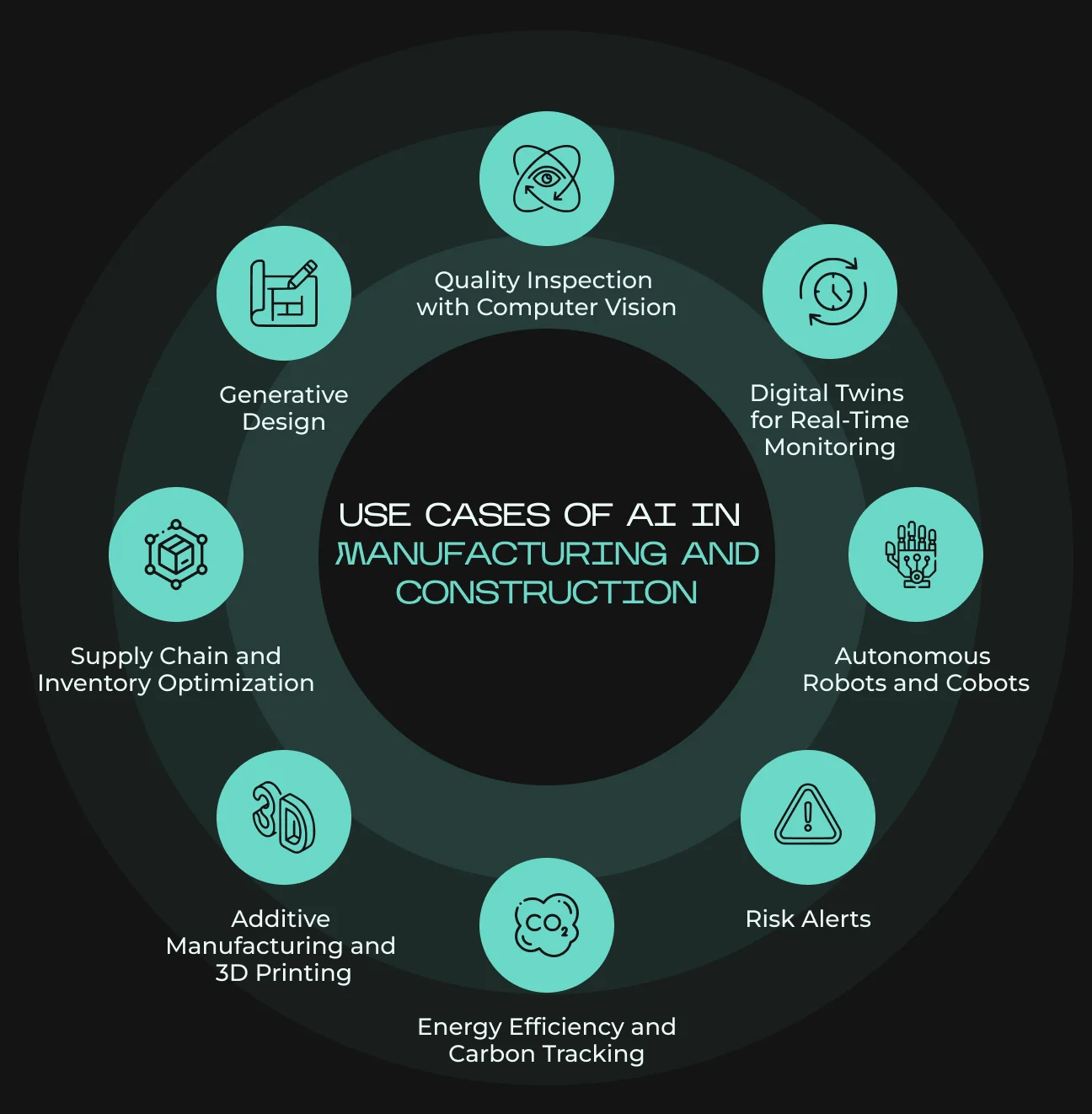
The technology that was considered a future trend not that long ago is already solving real problems on the ground and in the factory. Artificial intelligence can ensure product quality and prevent accidents before they happen. The applications of AI in construction and manufacturing are expanding fast.
Here are some of the most impactful use cases where AI is bringing the most value.
Quality Inspection with Computer Vision
One of the earliest and most successful use cases for AI in construction and manufacturing is visual inspection. Computer vision helps with identifying cracks in concrete, verifying welds, or checking dimensions on manufactured parts, and has proven to be faster and more consistent than manual review.
AI models trained on large datasets of “good vs. bad” images can instantly flag quality issues, highlight defects, and even suggest the severity of each problem. This detection system makes it easier to take corrective action before a faulty part ends up in the final build, or worse, causes a failure down the line.
In construction, drones and stationary cameras equipped with computer vision software can monitor sites continuously, capturing progress and spotting inconsistencies in real time. In manufacturing, high-speed vision systems inspect thousands of units per hour with far greater accuracy than the human eye.
Digital Twins for Real-Time Monitoring
Digital twins are virtual models of real-world assets. You can create buildings, machines, or entire construction sites fed by real-time data from sensors, IoT devices, and equipment logs. They give teams a live view of what’s happening and what might happen next.
For example, a digital twin of a construction project can track:
- Material delivery delays;
- Worker activity;
- Weather risks;
- Structural integrity.
As a result, you get an always-updated model that project managers can trust.
In manufacturing, digital twins help monitor equipment health, process flow, and performance KPIs, allowing teams to test different scenarios without halting production.
These twins also feed AI models with continuous data, improving forecasting, scheduling, and cost management. They’re quickly becoming a must-have for data-intensive projects.
Autonomous Robots and Cobots
AI-powered robots are gaining ground in both construction and manufacturing. We are not talking about sci-fi humanoids but about purpose-built machines designed to take on repetitive, dangerous, or highly precise tasks.
On construction sites, autonomous robots can paint walls, lay bricks, or even install drywall with speed and consistency. In factories, collaborative robots (or cobots) work side-by-side with humans, lifting heavy materials or performing fine-detail tasks without risk of injury or fatigue.
Behind the scenes, these machines are guided by AI systems that constantly adjust for environmental changes, safety, and efficiency. Their learning algorithms improve over time, which makes them more useful with each project.
Want to see what’s coming next in the world of intelligent robotics and assistants? Our article on how to build an AI assistant in 2025 walks through the entire process, from model selection to deployment.
Risk Alerts
Risk alerts powered by AI are another game-changer. By pulling in data from sensors, weather feeds, labor logs, and machinery, AI can detect patterns that signal danger. The system can warn about a structural weakness, unsafe temperature spike, or equipment malfunction.
In construction, these alerts might flag an overloaded scaffold or an area with too many workers in close proximity. In manufacturing, AI might detect a machine running hotter than usual or a worker entering a restricted area. Instead of relying on human supervisors to catch these risks manually, AI systems can send instant alerts via mobile devices, emails, or on-site alarms.
These predictive safety tools reduce the chances of accidents and give teams more time to respond. They also help companies stay compliant with regulations, reduce downtime, and avoid costly insurance claims.
The ability to spot and act on risks before they cause real harm is one of the most practical ways AI in construction is saving lives and money.
Energy Efficiency and Carbon Tracking
Energy consumption and carbon emissions are critical concerns in construction and manufacturing. AI technologies are now instrumental in addressing these issues by optimizing energy use and monitoring emissions.
For instance, AI systems can analyze real-time data from building operations to adjust HVAC systems, lighting, and other energy-consuming processes, which leads to significant reductions in energy usage and carbon output.
Predictive AI models can forecast energy demand and identify inefficiencies, allowing for proactive adjustments that enhance sustainability. These capabilities contribute to environmental goals and result in cost savings for businesses.
Additive Manufacturing and 3D Printing
Additive manufacturing, commonly known as 3D printing, is revolutionizing the construction and manufacturing sectors. AI enhances this technology by optimizing design processes, improving material usage, and ensuring quality control.
AI algorithms can analyze design parameters and suggest modifications that reduce material waste and enhance structural integrity.
In construction, AI-integrated 3D printing rapidly creates complex structures with precision, reducing labor costs and construction time.
Supply Chain and Inventory Optimization
Efficient supply chain and inventory management are crucial for the success of construction and manufacturing projects. AI plays a vital role in this area by analyzing vast amounts of data to forecast demand, optimize inventory levels, and improve logistics.
AI systems can predict potential disruptions and suggest alternative strategies to maintain continuity.
A practical example of AI's impact is the Mastrack project developed by SapientPro. This real-time GPS tracking system allows businesses to monitor:
- Vehicle locations;
- Driver behavior;
- Delivery schedules.
The platform allows for enhancing overall supply chain efficiency. The features include:
- Precise tracking;
- Optimized data storage;
- Accurate arrival time estimations.
This project demonstrates how AI can transform supply chain operations.
Generative Design
Generative design uses artificial intelligence to explore a wide range of potential design solutions, helping architects and engineers pinpoint the most effective options based on defined constraints and project goals. This method supports the development of creative structures that thoughtfully balance visual appeal, functionality, and environmental responsibility.
In real-world applications, AI-powered generative design tools can quickly generate and assess a variety of design alternatives by analyzing factors like:
- Material efficiency;
- Structural integrity;
- Ecological footprint.
The result is a significantly faster design process that often leads to more sustainable construction outcomes.
By incorporating AI into construction and manufacturing workflows, companies can achieve new levels of efficiency and innovation while also reducing environmental impact across their projects.
Real Estate Management Platform with KYC
See how SapientPro developed a property management tool for landlords and tenants.

Future of AI in Construction & Manufacturing
AI adoption is gaining real momentum in traditionally slower adopters like construction and manufacturing. The numbers paint a clear picture: AI is no longer a fringe experiment. It’s becoming part of core operations.
Here’s what recent data shows:
- 72% of companies globally are now using AI in at least one business function, according to McKinsey. That’s up from 55% just a year earlier, showing a massive acceleration in enterprise adoption.
- The AI in the construction market is projected to grow from $3.99 billion in 2024 to $11.85 billion by 2029, at a CAGR of 24.31%, according to Mordor Intelligence. We will see more tools, more pilots, and a bigger push to integrate AI across every stage, starting from design and ending with post-build monitoring.
- In the U.S., just 2.1% of construction companies reported using AI actively in early 2025. That number seems low, but it’s changing fast. As of January 2025, over 4% are expected to deploy AI tools within the next six months, based on Statista projections.
- Within the EU, Montenegro leads in AI construction use, while 4.7% of firms in the Netherlands already apply AI in their operations, which shows that even in conservative markets, adoption is underway.
In manufacturing, AI is already improving supply chain operations, predictive maintenance, and quality assurance. According to Deloitte, 93% of manufacturers believe AI will be essential to their future competitiveness, and over half are already investing in pilot projects.
The message is clear: companies that ignore AI risk falling behind. But those that adopt early, especially with custom, business-specific solutions, gain an advantage in speed, cost control, and performance.
How SapientPro Used Smart Contracts for Supply Chain Monitoring
In the steel industry, where precision and compliance are critical, traditional methods of tracking and certifying materials often fall short. Recognizing this challenge, SapientPro’s team collaborated with SteelTrace to rebuild the steel supply chain through blockchain technology.
The Challenge
SteelTrace aimed to modernize the steel supply chain for the chemical and petrochemical sectors. The existing processes for collecting official signatures and certificate data were time-consuming and susceptible to manipulation. There was a pressing need for a system that could ensure the authenticity of documents and simplify the certification process.
The Solution
SapientPro’s engineers developed a digital platform that leverages blockchain and smart contracts to enhance transparency and traceability. Key features of the solution:
- All product-related data is collected in a digital format, allowing for easy cross-referencing with specification rules;
- Each product is assigned a unique digital identity, preventing forgery and duplication;
- Certificates are cryptographically signed with keys linked to data providers, ensuring their authenticity;
- All certificates are stored digitally, making them fully searchable and traceable;
- Certificate data can be retrieved instantly, facilitating faster decision-making.
The Outcome
The implementation of this platform led to significant improvements:
- The certification process became faster and more reliable, reducing delays in the supply chain;
- The use of blockchain technology ensured the integrity of documents, encouraging trust among stakeholders;
- The platform successfully onboarded three leading European companies in the chemical and petrochemical industries.
In regulated steel supply chains, trust must be verifiable. Smart contracts and cryptographic identities replaced manual signatures, cutting delays and tampering risk. SteelTrace now validates certificates in seconds and scales onboarding without compromising compliance or traceability.

Illya Vorobets
Partner with SapientPro to Build Your AI Solution
To build a good AI solution, you need to know how to solve the right problem with the right tech. SapientPro's experts don’t sell pre-made platforms or throw generic algorithms at your business.
We build custom systems that actually work for your goals.
With over 8 years of hands-on experience in AI development, our team knows how to create tools that boost performance, automate real-world tasks, and give you better control over your operations.
We’ve helped startups, enterprises, and global brands bring ideas to life by creating AI assistants, using computer vision tools, predictive analytics, and smart automation methods.
When you work with SapientPro, our development team becomes your long-term tech partner. We guide you through the entire process:
- Idea validation;
- System architecture;
- Design;
- Training models;
- Testing;
- Scaling.
We’ll help you find the fastest path from concept to working solution.
Ready to explore AI for your business? Reach out for a free consultation. We’ll analyze your use case, outline the tech approach, and provide a clear estimate with real deliverables and timelines.
Integrate AI-powered tools in your business
SapientPro's engineers will help you get a custom AI model or integrate an existing one in your flow.
FAQ
How to use AI in Construction?
AI can support nearly every stage of a construction project, starting with design and planning and ending with real-time site monitoring and predictive maintenance. Common applications include quality inspection with computer vision, scheduling optimization, risk alerts, safety monitoring, and generative design. The key is to start with a clear business case and work with a partner who can customize the tech to your needs.
Will construction be dominated by AI?
AI won’t replace human teams, but it will become essential for those who want to stay competitive. It helps teams work smarter by automating repetitive tasks, improving accuracy, and reducing risk. While manual work remains a core part of construction, AI will increasingly handle planning, analytics, and machine-assisted tasks.
How to develop AI for construction?
AI development starts with identifying the right use case. From there, you need structured data, a clear workflow, and a tech partner with AI expertise. The SapientPro team can handle the full process. We build solutions that are practical, explainable, and tailored to your workflow.
How much does it cost to build AI for construction?
Costs vary depending on the scope, tech stack, and project complexity. No matter the size of your enterprise, we’ll work with you to define a clear budget. Contact us for a free estimate, and we’ll review your goals and give you a realistic price and timeline.

