All AI for Inventory Management: Benefits, Challenges, Implementation Strategies in 2025
May 30, 202510 min read


The digital transformation of inventory management has entered a new era with AI and machine learning technologies. Today's businesses are discovering how intelligent systems can change their stock control, warehouse operations, and supply chain efficiency.
Machine learning inventory management enables precise demand prediction, while AI stock recommendations drive smarter purchasing decisions. Combined with AI-powered warehouse management, these solutions create a fully optimized inventory ecosystem that reduces costs and improves efficiency.
In this article, you’ll learn about SapientPro’s experience working on AI-based projects. Our engineers have been creating high-quality solutions since 2017. Interested? Read on till the end!
What is AI in Inventory Management?
AI inventory management means using various artificial intelligence technologies to optimize inventory control and supply chain processes.
It uses machine learning algorithms to analyze historical data, sales patterns, and market trends to predict demand accurately and automate reordering to maintain optimal stock levels.
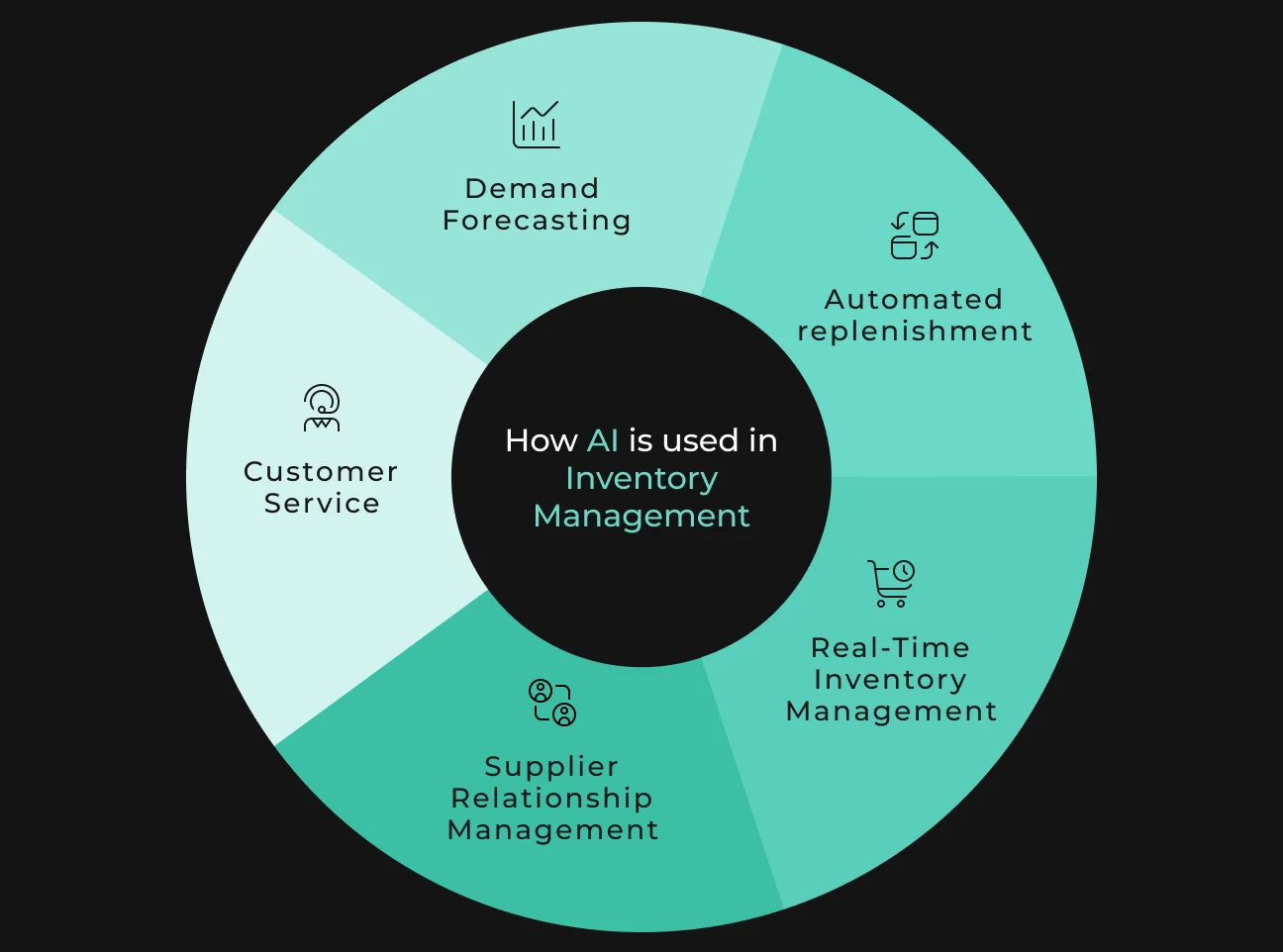
AI inventory management can detect patterns humans might miss, reducing stockouts and excess inventory. They can also adapt to changes in demand, seasonality, and market conditions in real-time, therefore providing more precise inventory decisions.
AI technology assists businesses in minimizing the cost of carrying, improving cash flow, and enhancing customer satisfaction by ensuring the availability of their products.
How Does AI for Inventory Management Help Business?
AI inventory management software completely changes how companies approach stock and supply chain operations by thinking and working with intelligent automation predictive capabilities. In many ways, AI is reworking traditional inventory management into a data-driven model of huge potential in the terms of both operational efficiency and bottom-line results.
Key benefits include:
- Demand forecasting. AI analyzes historical data, market trends, and seasonal patterns to predict future demand with up to 50% more accuracy than traditional methods.
- Cost and resource optimization. Through intelligent automation and waste reduction, AI minimizes holding costs, reduces spoilage, and cuts down on manual labor expenses associated with inventory management.
- Enhanced supply chain performance. The system monitors and optimizes the entire supply chain in real-time. For example, it can automatically adjust order quantities to identify potential disruptions before they impact operations.
- Improved customer experience. By ensuring better product availability, reducing stockouts, and enabling faster order fulfillment, AI helps businesses maintain high customer satisfaction levels and loyalty.
- Data-driven strategic planning. AI provides actionable insights through advanced analytics. Businesses can make informed decisions about inventory investments and market expansion opportunities.
With AI-driven forecasting delivering up to 50% higher accuracy and a market set to top $27B by 2029, every month you delay adoption is margin left on the warehouse floor.

Max Tatarchenko
Key Features of AI in Inventory Management
How is AI used in inventory management? Here are the common key features that drive automation, provide insights, and simplify tracking.
Inventory Forecasting
Advanced AI systems enable intensive tracking in real-time through integrated barcode scanning, RFID sensors, and IoT devices. It automatically monitors and changes the level of your stock across various locations in real-time to give instant visibility into stock movements and their availability. The technology enables automated synchronizing of inventory data from various sources, including:
- Sales orders;
- Shipments;
- Returns.
This way, stock counts can be kept accurate without manual intervention.
Demand Prediction
The core strength of AI in inventory management lies in its predictive capabilities. The system processes vast amounts of data like:
- Historical sales patterns;
- Seasonal variations;
- Market trends;
- Promotional impacts.
Machine learning algorithms continuously improve their predictions by learning from new data and outcomes. This enables businesses to simulate various scenarios and understand the potential impacts of market changes, helping optimize purchasing decisions for both fast-moving and slow-moving products.
Inventory Segmentation
AI systems are good at balancing supply and demand through complex optimization algorithms. Multiple variables are analyzed to foresee any stock imbalances and recommend optimum transfer and reorder quantities across all locations. Safety stock levels are automatically revised based on changes in demand variability or supply chain risks as the system continuously adjusts itself for efficient inventory distribution across the warehouse network while minimizing holding costs.
Order Management
It is a platform powered by intelligent automation that streamlines every purchase order life cycle phase. It monitors order status in real-time to flag delayed shipments and potential disruptions in supply instantly. Supplier performance analytics are comprehensive. Businesses can assess vendor reliability, delivery accuracy, and cost-effectiveness. This helps identify and maintain relations with the most reliable suppliers through data.
Analytics and Reporting
New-generation AI inventory systems contain powerful analytics with customizable dashboards and interactive visualizations. They track vital inventory metrics and KPIs along multiple dimensions. Deep-dive analytics into specific products, locations, or time intervals brings awesome insights. The system will create automated reports on inventory health, stock status, and audit findings of substantial value for actionable insight into strategic decision-making.
Challenges of Implementing AI in Inventory Management
Artificial intelligence in inventory management is not devoid of challenges. Let’s take a look at the key issues faced by most teams.
1. Data Privacy
This includes sensitive business data that AI inventory management systems handle in large amounts. Hence, data privacy and security are paramount. Organizations have to ensure the necessary protective measures regarding their AI systems data are well implemented and overseen.
Comprehensive data protection measures require multi-tiered security. It includes:
- Strong encryption of data at rest and in transit;
- Data minimization principles at the base of collection and retention;
- Anonymization of sensitive information where possible, especially within testing and development environments.
Regular security audits, along with penetration testing and professional security assessments, ensure that the system is intact and spot gray areas.
2. Operations Complexity
The operation of an AI-based inventory management system is very complex, both from technical and operational perspectives. Without proper preparation, most organizations plunge into the adoption of AI with less desirable results. Successful implementation requires:
- Business needs and current process analysis;
- Careful examination of the needs of the system against its capabilities;
- Gradual staged approach for implementation;
- Extended testing and validation;
- Continuous system optimization and refinement.
The complexity of these systems requires scaling to suitable business needs. A too-simplistic system may not adequately provide the functional requirements, but a too-complex one is likely to overburden operations with unwarranted functionality.
3. High Costs
While automated inventory control platforms can offer impressive cost savings through automation and optimization, consideration should be made for the initial investment and ongoing costs. The total cost of ownership includes but is not limited to the following.
Operation costs:
- The costs related to software licensing and customization;
- Hardware infrastructure requirements;
- Integration to existing systems;
- Staff training and change management;
- Professional services and consultation.
Ongoing operational expenses:
- System maintenance and updates;
- Technical support and troubleshooting;
- Periodic security audits and compliance;
- Possible scaling up of the infrastructure;
- Ongoing staff training and development.
This means that organizations, especially small businesses, should consider their budgetary constraints and expected return on investment. A cost-benefit analysis will go into great detail, considering immediate costs as well as ongoing operational costs to ensure alignment with business goals and financial capability.
4. Skilled Staff
Implementing AI inventory systems requires a special workforce that is technically enlightened on advanced levels. This forms a major problem for organizations looking to transition or implement AI-driven inventory management.
Businesses are usually faced with two primary options for building their AI capabilities:
- Talent acquisition. Hiring expert professionals in AI is highly competitive and very expensive. The experts must have an extremely rare combination of technical skills in machine learning, programming, and data analysis, along with knowledge in supply chain and inventory management principles.
- Internal development. This is upskilling the existing staff inventory management with considerable investment in training and development programs. While this option uses existing business knowledge, considerable time and resources are needed to develop technical competency.
Key roles include data scientists developing and tuning machine learning models, AI engineers maintaining and optimizing systems, and business analysts taking AI insights into actionable business decisions.
5. Integration with Existing Systems
The integration of the AI solution with the existing inventory management infrastructure is full of complex technical and operational challenges. Most organizations already have established ERP systems, WMS, or legacy inventory platforms that might not be immediately compatible with modern AI solutions.
Critical considerations for integration:
- Data compatibility. Legacy systems store data in formats that require considerable transformation prior to AI processing. Organizations need to establish robust data pipelines and transformation processes.
- System architecture. The infrastructure should be in place to support AI capabilities by upgrading or making changes in technology, which includes appropriate processing power, storage capacity, and network bandwidth. The processes and workflows need to be redesigned and aligned according to AI-powered decision-making for the continuity of operational efficiency.
- API integration. Development and maintenance of reliable APIs between AI systems and existing platforms for real-time data exchange and synchronized operations become imperative.
Organizations must balance the technical needs of integrating AI with their own operational needs carefully to ensure that the transition augments and does not disrupt their existing inventory management capabilities.
Interested in digitizing your business processes?
SapientPro's team can help you integrate AI into your processes and leverage the benefits of modern tech.

Industries Using AI for Inventory Management
Each industry is adapting the technology to meet specific challenges and requirements.
Retail and E-Commerce
Retailers and e-commerce businesses use AI to manage complex multichannel inventory operations. Major retailers like Walmart and Amazon employ predictive analytics to forecast demand across thousands of SKUs. E-commerce SaaS platforms integrate AI to synchronize inventory across multiple sales channels.
Key applications of machine learning inventory management in retail and e-commerce:
- Automated stock replenishment for thousands of products;
- Real-time inventory tracking across multiple stores and warehouses;
- Dynamic pricing based on stock levels and demand;
- Personalized product recommendations based on inventory availability.
Predictive analytics end stock-outs before they happen, while dynamic pricing keeps profit edges razor-sharp. AI turns multichannel chaos into retail clarity.

Ihor Hamal
Logistics
The logistics sector employs AI to optimize warehouse operations and distribution networks. Companies like DHL and FedEx implement AI-powered systems to improve warehouse efficiency and streamline operations.
Key applications of machine learning inventory management in logistics:
- Automated route optimization for picking and packing;
- Predictive maintenance for warehouse equipment;
- Real-time tracking of shipments and inventory levels;
- Smart space utilization for optimal storage.
AI converts every movement into data you can monetize: RFID-tagged pallets, smart route planning, etc. This slashes delivery times and warehousing costs across the logistics chain.
Max Tatarchenko
Healthcare
Healthcare facilities rely on AI inventory management to track critical supplies and equipment. When integrated with Patient Management Software (PMS), these systems help maintain optimal stock levels of medicines and supplies.
Key applications of machine learning inventory management in healthcare:
- Automated tracking of medical supplies and pharmaceuticals;
- Expiration date management and compliance monitoring;
- Emergency supply chain optimization;
- Real-time equipment tracking and utilization monitoring;
- Integration with electronic health records for supply forecasting.
Real-time AI tracking of drugs and devices is the unseen safety net. It's great for cutting expiries, assuring compliance, and letting clinicians focus on patients, not inventory paperwork
Ihor Hamal
How Much Does it Cost to Create an AI Inventory Management System?
The cost of developing AI inventory management software varies significantly based on multiple factors. Here are the cost components to consider before inventory optimization tool development. This sheet is based on the industry's average costs and SapientPro's experience.
Cost Component | Cost Range | Description |
| Development & Implementation | $50,000—$500,000+ | Custom algorithm development, UI design, basic integrations, testing, and deployment |
| Hardware Infrastructure | $20,000—$100,000+ | Servers, IoT devices, scanners, networking equipment, and physical infrastructure |
| Software Licensing | $10,000—$100,000+ annually | AI platforms, tools, third-party software licenses based on user count |
| Integration Services | $25,000—$150,000+ | API development, data migration, system integration, compatibility testing |
| Training & Support | $15,000—$75,000+ | Staff training programs, documentation, initial support setup |
| Maintenance & Updates | $20,000—$100,000+ annually | System updates, security patches, performance optimization, ongoing support |
Partner with SapientPro to Build Your AI Inventory Management Solution
SapientPro develops automated inventory control platforms and other custom solutions that change the way companies manage their stock and supply chain operations. We build inventory optimization tools that make a difference in driving efficiency and growth with:
- Technical excellence;
- Industry-proven approach;
- Value-driven solutions.
Ready to modernize your inventory management? Get in touch with SapientPro to discuss your project requirements.