
All Warehouse Automation Technologies and Trends in 2026
March 11, 202620 min read


We are now witnessing the maturation of warehouse automation technology, where disparate piloted systems are finally converging into orchestrated ecosystems. The focus for businesses has now shifted from "should we automate?" to "how do we orchestrate?"
The convergence of software intelligence, automated warehouse systems, and labor market realities has made 2026 a pivot point for the industry.
Warehouse automation solutions become the baseline for competition. SapientPro’s engineers prepared modern warehouse automation use cases and share the future of warehouse automation.
What is Warehouse Automation?
Warehouse automation is the integration of digital and physical technologies to streamline inventory movement, tracking, and data processing.
The future of warehouse automation is built on three key pillars:
- Automation. The use of physical systems (e.g., robots, AS/RS) and software to perform repetitive tasks without human intervention.
- Digitalization. The transformation of manual processes (such as paper checklists) into digital data streams, enabling real-time visibility and analytics.
- Optimization. The continuous improvement of operations, often powered by AI, using data generated through automation and digitalization.
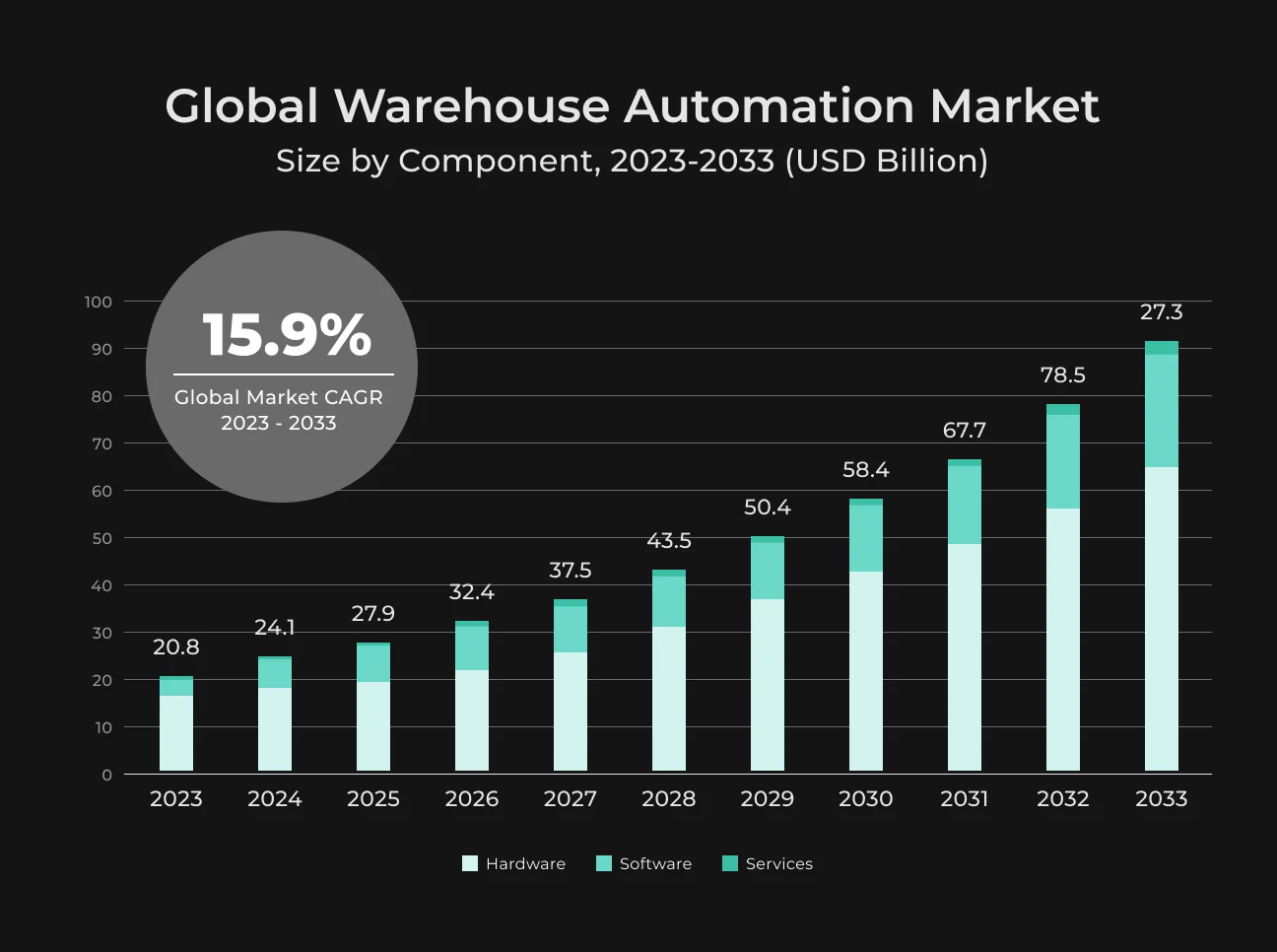
The ongoing labor shortage in industrial hubs highlights a critical shift: human labor is not just costly—it is increasingly unavailable.
As a result, automated warehouse systems are redefining workforce roles, moving employees from manual handling to supervising robotic operations. This shift helps address structural labor gaps while improving safety and operational efficiency.
Examples of Warehouse Automation Technology
The modern facility relies on a diverse stack of warehouse automation technology.
The physical layer includes:
- Automated Storage and Retrieval Systems (AS/RS);
- Autonomous Mobile Robots (AMR);
- Automated Guided Vehicles (AGV);
- Robotic picking arms;
- Automated sortation loops.
The digital layer includes:
- Warehouse Management Systems (WMS);
- Warehouse Execution Systems (WES);
- Warehouse Control Systems (WCS);
- IoT sensors.
Executives prioritize automated warehouse systems to mitigate diverse risks.
Why Companies Automate Warehouses in 2026
We see 3 main reasons why companies automate warehouses in 2026.
Structural Labor Crisis and Economic Imperatives
The primary driver for warehouse management system development and automation adoption in 2026 is the permanent alteration of the labor market.
The narrative of labor shortages has evolved into a structural deficit. In mature markets, the demographic cliff leads to a phenomenon where the availability of manual labor for repetitive, physically demanding tasks is mathematically insufficient to meet throughput demands.
For instance, Germany faced a shortage of skilled workers, with national employment rates around 77-78% and low unemployment (around 3.7%) as of mid-2025. Consequently, the warehouse of 2026 is designing out the dependency on human presence for core material handling.
The "Dark Warehouse" (a facility designed to operate without lighting or human amenities) is a practical solution for specific nodes in the supply chain, such as cold storage or deep-reserve pallet handling.
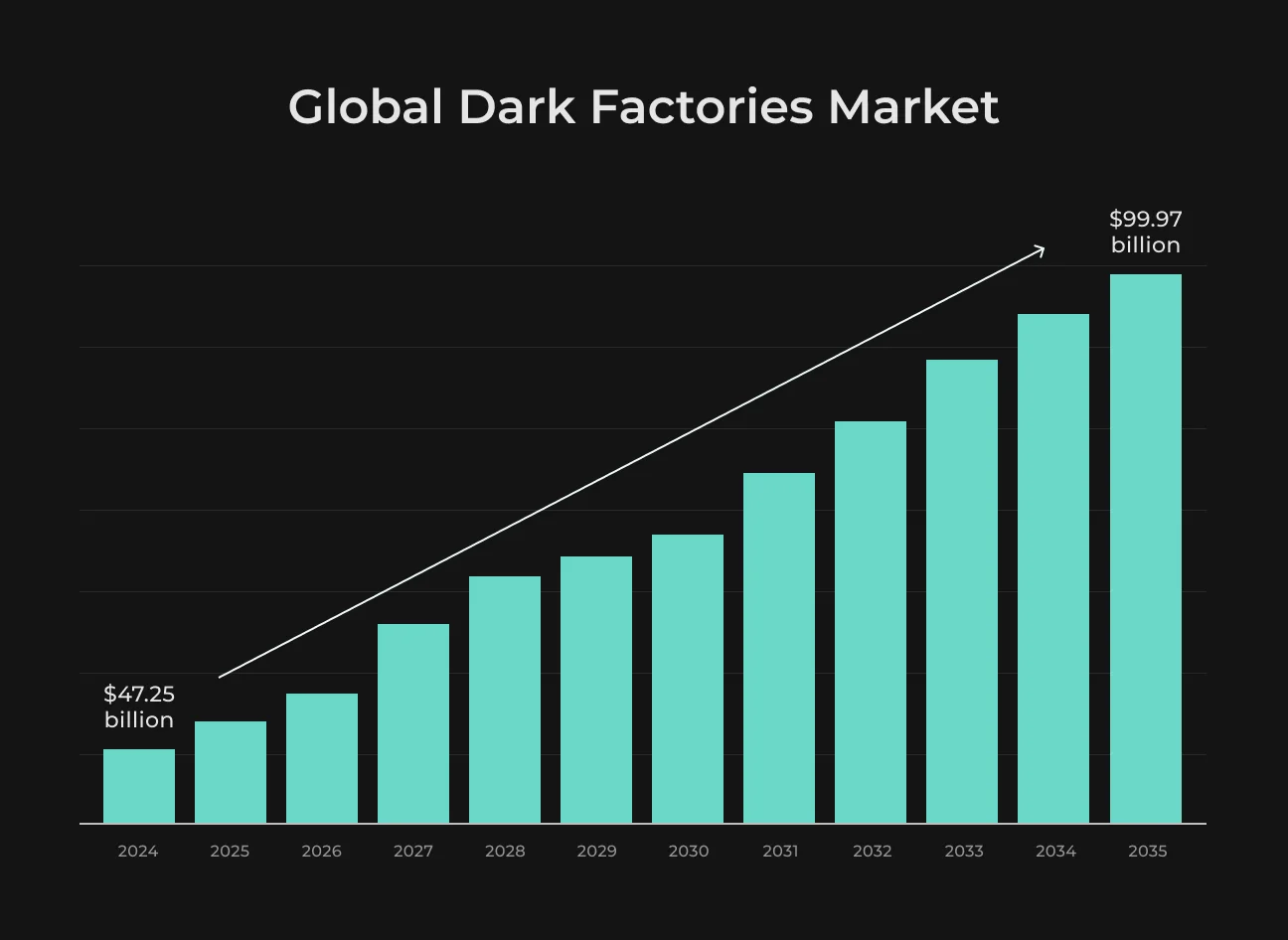
This shift is about risk mitigation. Facilities that rely on manual labor are increasingly viewed as single points of failure, vulnerable to:
- Pandemics;
- Strikes;
- Demographic shifts.
Despite these pressures, the warehouse automation trend is toward "Human-Machine Collaboration"ю Technology augments rather than replaces human capability.
Workers are transitioning from manual handlers to "robot wranglers" and exception managers, requiring a significant investment in upskilling. This labor crisis strongly influences the future of warehouse automation.
The Investment Environment
The 2025 MHI report highlights a sophisticated investment thesis among supply chain leaders. While hardware (robotics) is visible, the underlying capital flows reveal a priority on data and intelligence. The projected adoption rates for the next five years illustrate this hierarchy:
- Inventory and Network Optimization (92%). It is the highest priority, indicating that knowing where goods are is more critical than moving them.
- Cloud Computing and Storage (91%). It is about the foundational infrastructure for data-driven decision-making.
- Sensors and Automatic Identification (88%). The eyes and ears of the digital warehouse matter.
- Predictive Analytics (87%). It is important to have the ability to foresee disruptions before they occur.
AI in supply chain management has become the central nervous system of modern logistics. Executives are prioritizing the "digital brain" over the "mechanical muscle". The surge in AI adoption is driven by the need for agentic AI.
Geopolitics and Supply Chain Resilience
Trade wars, tariffs, and regional conflicts have forced a restructuring of global networks toward "friend-shoring" and regionalization. The "Hub-and-Spoke" model is expanding, particularly in emerging markets across India, the Middle East, and Africa (IMEA).
Why? Because Tier-2 and Tier-3 cities are becoming new fulfillment growth points.
This decentralization requires a robust technological backbone. To maintain visibility across fragmented networks, companies are investing in global GPS tracking platform solutions that provide real-time asset monitoring across borders.
x10 Faster Fleet Management
See how SapientPro implemented GPS tracking for MasTrack.

Warehouse Automation Benefits for Business
The implementation of warehouse automation systems delivers measurable value across the P&L..
Higher Productivity and Throughput
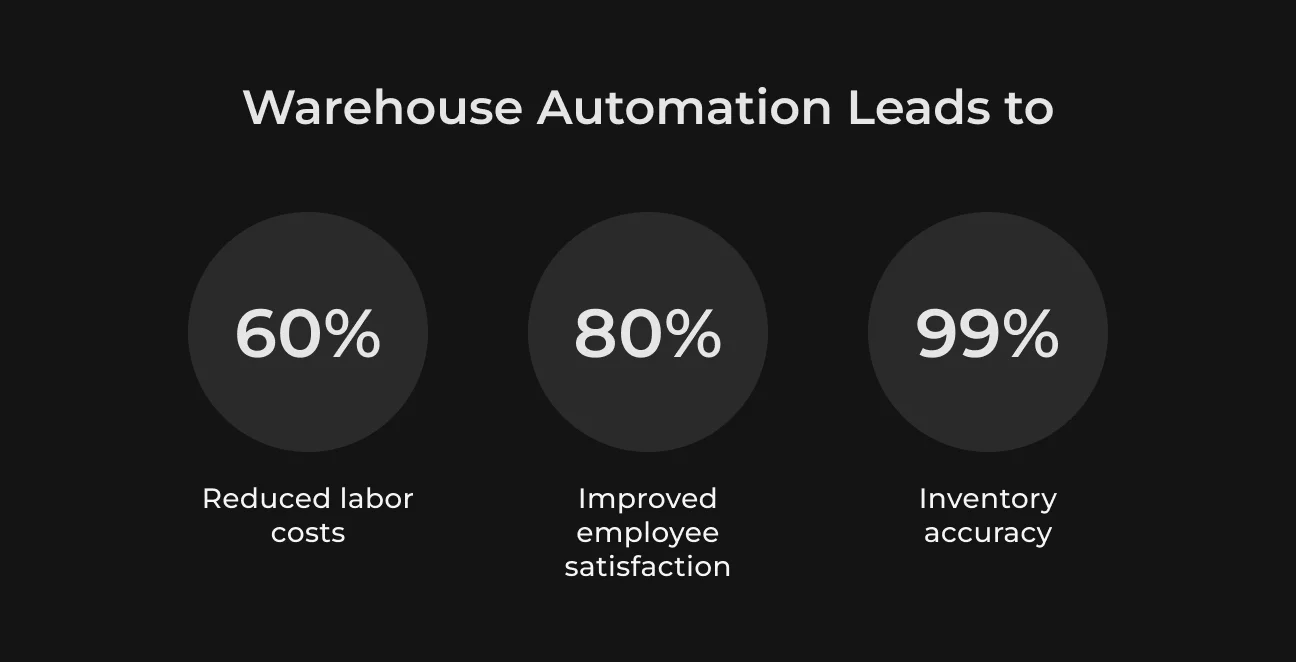
Warehouse automation benefits operations by removing the biological limits of fatigue. Robotics-assisted picking and transport systems operate 24/7. AMRs reduce labor costs by up to 60%. This increases picks per hour. Moreover, 88% of employees say they experience higher job satisfaction when working alongside AMRs.
Improved Inventory Accuracy
Manual counts are prone to error. Automated warehousing using RFID and drone-based scanning ensures near 99.9% inventory accuracy. This real-time visibility prevents stockouts and overstocking. The result? Optimized working capital.
Improved Safety and Ergonomics
By assigning heavy lifting and repetitive motion tasks to machines, companies reduce injury rates. Warehouse automation at the loading dock, for example, removes workers from the "danger zone" of forklifts and heavy trailers.
Scalability and Flexibility
Modern warehouse automation solutions are modular. Unlike rigid bolted-down conveyors of the past, AMR fleets can be scaled up during peak seasons as well as scaled down afterward. This way, capital expenditure aligns closely with revenue growth.
Data-Driven Decision Making
Warehouse automation systems generate vast amounts of telemetry data. This "digital exhaust" allows management to identify bottlenecks in real-time. You replace reactive firefighting with predictive orchestration.
Implementation Challenges in Automated Warehousing
Despite the warehouse automation benefits, the path to an automated warehouse is fraught with hurdles.
Integration Complexity
The "Automation Frankenstack" means disparate systems that don't speak to each other. It is a primary failure mode. Integrating a new robotic fleet with legacy ERPs requires sophisticated warehouse management system development to ensure seamless data flow.
Underutilization Risks
If process design and slotting are weak, robots will just make bad processes faster. Warehouse automation technology requires rigorous process engineering. Otherwise, expensive assets sit idle due to upstream bottlenecks.
Cybersecurity Risks
As warehouse automation systems connect to the cloud, the attack surface widens. The convergence of IT and OT (Operational Technology) exposes physical machinery to ransomware. This is why you need robust security protocols in place.
High Upfront Costs and ROI Uncertainty
While RaaS models are emerging, the initial CapEx for automated warehousing can be daunting. Executives must carefully weigh AI development costs and hardware outlays against long-term labor savings. Why? All to justify the ROI.
Skill Gaps and Change Management
The shift to warehouse automation requires a workforce skilled in maintenance and software operation. Finding talent capable of managing complex warehouse automation software is a significant constraint.
Warehouse Automation Technology Stack
The technology stack for warehouse automation involves multiple components.
Software Layers
The architecture of the 2026 automated warehouse is defined by the convergence of planning, execution, and control. The traditional silos of software have collapsed into a unified operational stack.
The Convergence of WMS, WES, and WCS
In the past, the Warehouse Management System (WMS) was the undisputed master of the facility. However, the latency inherent in legacy WMS architectures proved insufficient for the sub-second decision-making required by modern robotics.
A WMS planning in "waves" could not keep pace with a fleet of Autonomous Mobile Robots (AMRs) requiring real-time traffic adjudication. This gap led to the ascendancy of the Warehouse Execution System (WES).
The operational hierarchy in 2026 is distinct:
- WMS.
It remains the system of record for inventory and financial compliance. It manages long-horizon tasks such as receiving, order processing, and shipping documentation. It focuses on the "what" and the "when" at a macro level.
For businesses seeking to modernize their core record-keeping, custom warehouse management system development remains a critical service. It ensures that the system of record can ingest high-frequency data from lower layers.
- WES.
The WES is the orchestration layer. It operates in real-time, dynamically assigning tasks to either humans or machines based on current resource availability and congestion levels.
Unlike the WMS, which might release a wave of orders every hour, the WES uses "waveless" processing to release individual orders the moment capacity exists. It prevents the "Automation Frankenstack" by acting as the universal translator between disparate robotic systems.
- WCS.
It manages the millisecond-level machine control. It directs the specific movements of conveyor diverters, sorter trays, and AS/RS cranes. In 2026, WCS functionality is absorbed upward into the WES or pushed downward into intelligent edge devices.
The integration of these layers is important for warehouse automation software. A disjointed stack leads to latency and data silos. Leading enterprises turn to warehouse management system development partners to build custom middleware that fuses WMS planning with WES execution.
Thanks to their expertise, they create a seamless feedback loop where inventory discrepancies detected by a robot are instantly reconciled in the financial records.
API and Interoperability Standards
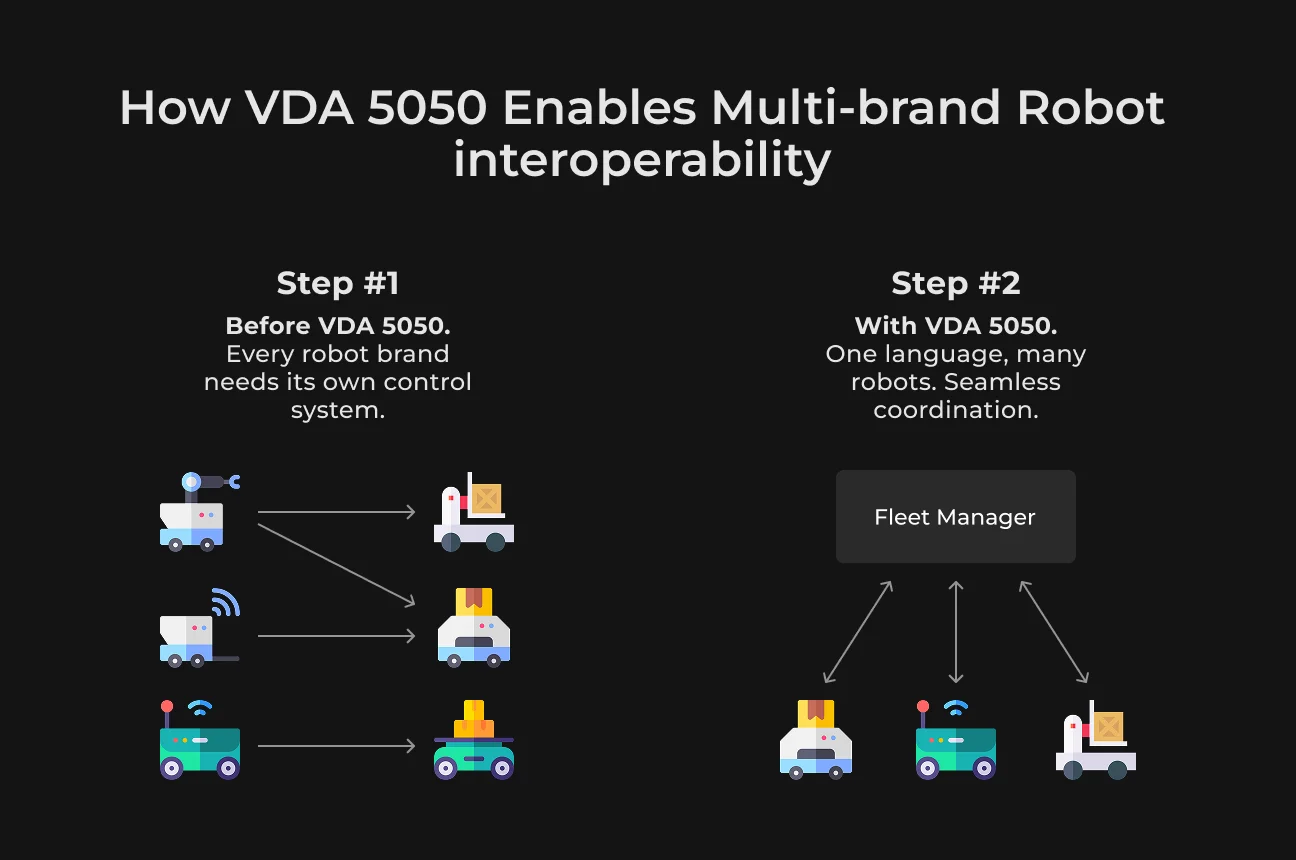
The proliferation of robotics vendors in the early 2020s created a nightmare of integration. A warehouse might have robotic arms from one vendor, AMRs from another, and automated conveyors from a third, each speaking a different proprietary language.
In 2026, this has been mitigated by the widespread adoption of API development standards, specifically VDA 5050. It has emerged as the standard protocol for communication between AGVs/AMRs and a central master control system.
VDA 5050 standardizes the command structure, allowing a single fleet manager to control mixed fleets from different manufacturers. This interoperability commoditizes the hardware. It allows buyers to select the "best of breed" robot for a specific task without worrying about integration lock-in.
To achieve this, rigorous API development is required to build the interfaces that translate VDA 5050 messages into business logic interpretable by the WMS.
SapientPro focuses in high-fidelity API development for such tasks. We ensure that the complex web of JSON messages over MQTT protocols results in smooth physical operations.
Cloud vs. Edge Computing
While the cloud remains the repository for historical data and deep learning training, operational decision-making in 2026 has moved to the Edge. Latency is the enemy of automation.
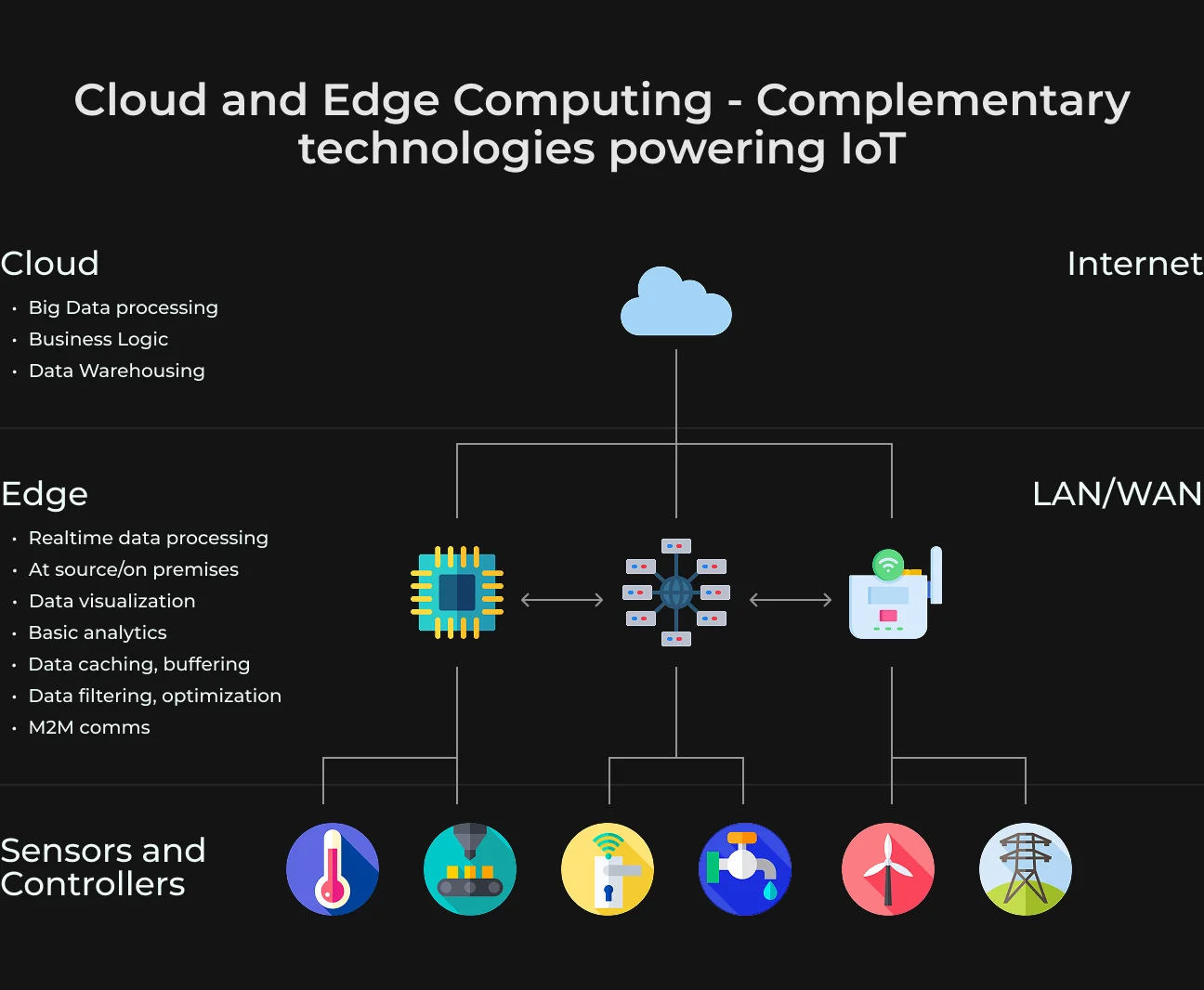
A robot detecting a human in its path cannot wait for a cloud server to authorize a stop. So, you need 2 technologies for your warehouse automation software in place:
- Edge Computing. Modern vision systems and AMRs are equipped with Neural Processing Units (NPUs) that process data locally. This allows for real-time visual intelligence in milliseconds. For example, edge computing allows to detect a damaged carton or read a barcode.
- Cloud Computing. The cloud is reserved for "heavy lifting" analytics. We mean network-wide inventory optimization, long-term demand forecasting, training the AI models that are subsequently deployed to the edge, etc.
This hybrid architecture is important for automated warehouse to anticipate future innovations.
Physical Automation Layers
The physical part of the warehouse also became more complicated from a technological point of view.
Autonomous Mobile Robots (AMRs) vs. Automated Guided Vehicles (AGVs)
The debate between AMRs and AGVs has settled into a nuanced understanding of warehouse automation use cases:
- AGVs.
These are guided vehicles, which follow fixed paths (magnetic tape or wires). They remain superior for high-payload, repetitive, and predictable movements, such as moving pallets from receiving to a bulk storage buffer. They offer determinism and high throughput in stable environments.
- AMRs.
AMRs, which navigate autonomously using SLAM (Simultaneous Localization and Mapping), dominate dynamic environments. They are the preferred solution for e-commerce picking, where workflows change daily.
In 2026, AMRs are "smarter", using AI in supply chain management to optimize path planning dynamically. They avoid congestion zones predicted by the WES.
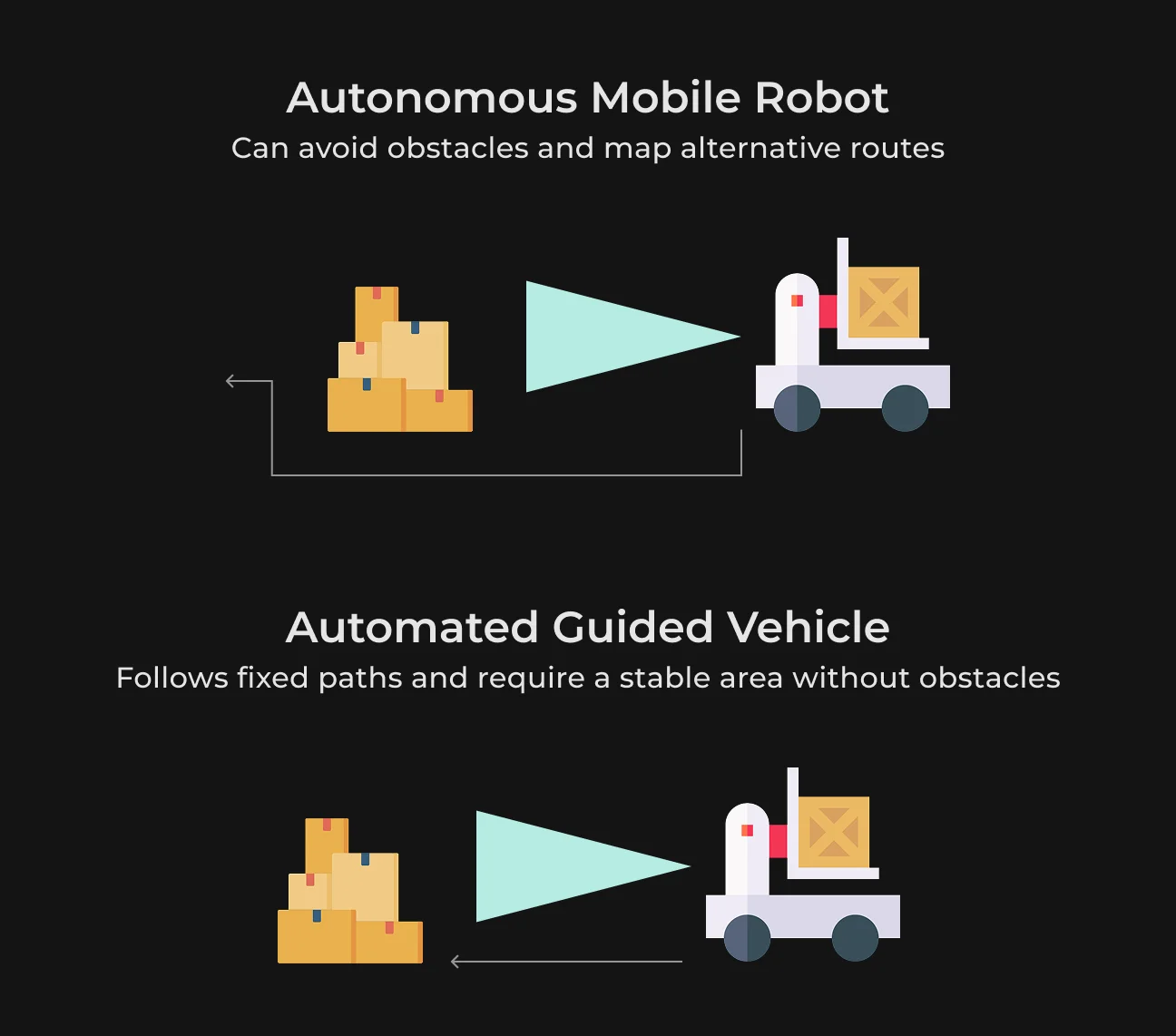
Warehouse automation trends move toward mixed fleets. A facility might use AGVs for heavy pallet movements and AMRs for each picking. The key enabler is the VDA 5050 standard. It allows these distinct machine types to share the same traffic lanes without collision.
Automated Storage and Retrieval Systems (AS/RS)
Space optimization has driven the adoption of high-density AS/RS. The market has bifurcated into two dominant topologies:
- Cube Storage. Ideal for small-parts and e-commerce fulfillment. These systems offer the highest storage density by eliminating aisles entirely, stacking bins in a dense grid accessed by robots from above.
- Shuttle Systems. Better suited for higher throughput requirements where speed of retrieval is more critical than pure density. These systems use captive shuttles on each level of racking to retrieve totes or cases.
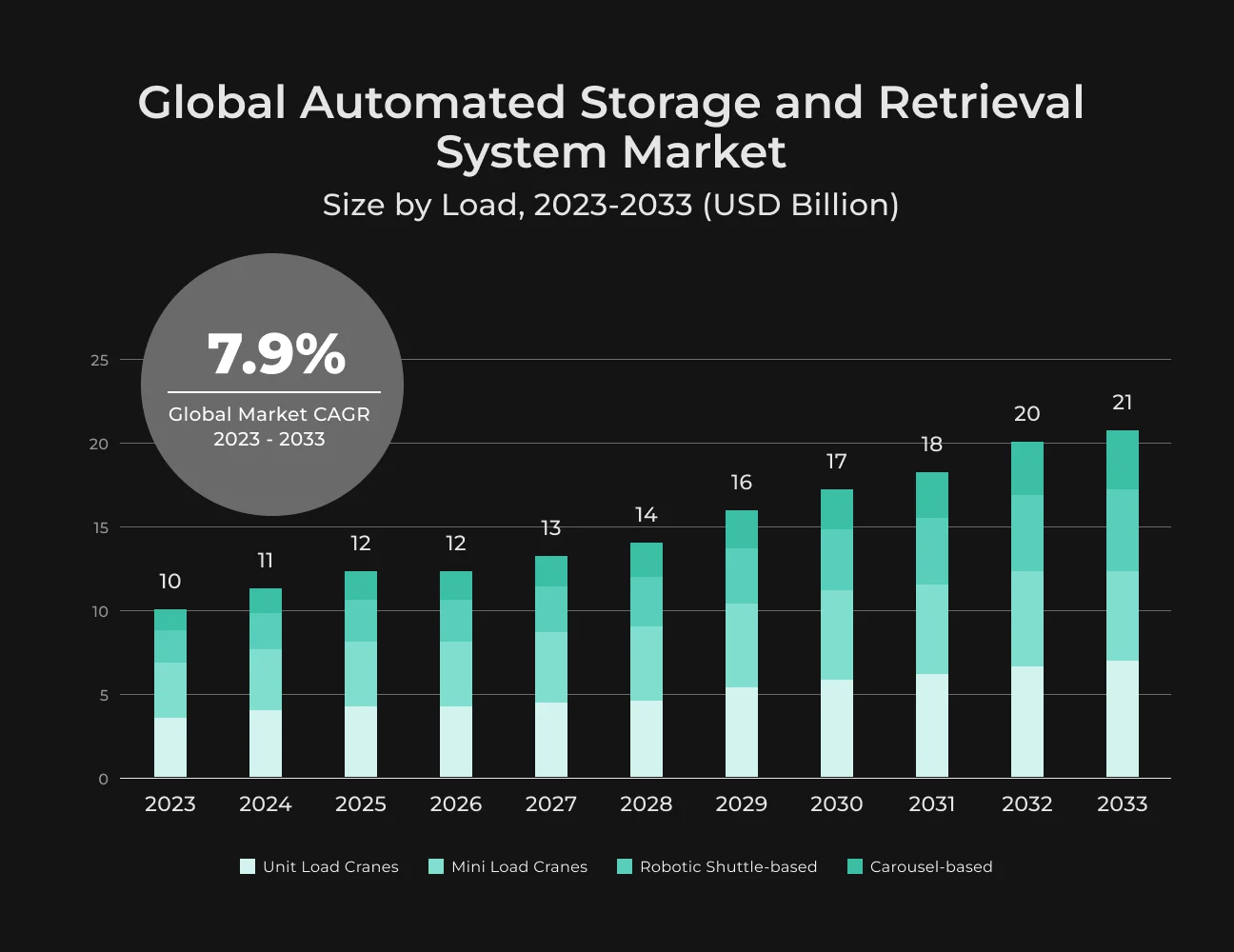
A significant development in 2026 is the energy efficiency of these systems. Modern AS/RS units employ regenerative braking, capturing energy during the descent of the lift carriage to recharge their capacitors.
How is AI Used in Warehouse Automation
If robotics provides the body of the 2026 warehouse, AI in supply chain management provides the mind. The application of AI has moved beyond simple regression analysis to advanced, agentic capabilities.
Agentic AI and Predictive Orchestration
The most significant leap in 2026 is the adoption of Agentic AI. Unlike passive AI that recommends actions, Agentic AI is authorized to take action.
For example, if an agentic AI system detects a potential stockout of a critical SKU due to a weather delay in transit, it can autonomously:
- Trigger a transfer order from a secondary distribution center;
- Adjust the warehouse management system development parameters for safety stock;
- Re-prioritize outbound orders to conserve remaining inventory.
This level of autonomy requires deep trust in the underlying data. Companies are engaging partners like SapientPro to implement robust AI in supply chain management frameworks that include "Human-in-the-Loop" safeguards for high-value decisions.
AI for Inventory Management and Forecasting
Inventory accuracy is the foundation of trust. AI for inventory management uses computer vision and pattern recognition to automate the mundane task of cycle counting. Drones or cameras mounted on AMRs scan locations continuously.
They compare physical reality with the WMS record.
So, AI here applies in 2 contexts:
- Demand forecasting.
AI models now digest vast datasets to predict demand with granular accuracy. We mean social media trends, local weather events, economic indicators, etc. This allows for "anticipatory shipping", where goods are moved to forward stocking locations before the customer even places an order.
- Dynamic slotting.
AI for inventory management algorithms continuously analyze the velocity of SKUs. If a product starts trending on social media, the AI detects the uptick in order frequency and automatically directs the WES to move that SKU to a "golden zone" near the shipping dock to reduce travel time.
Leading organizations use SapientPro’s AI development services to build these predictive models. Our team transforms inventory from a static asset into a dynamic flow.
Computer Vision and Quality Control
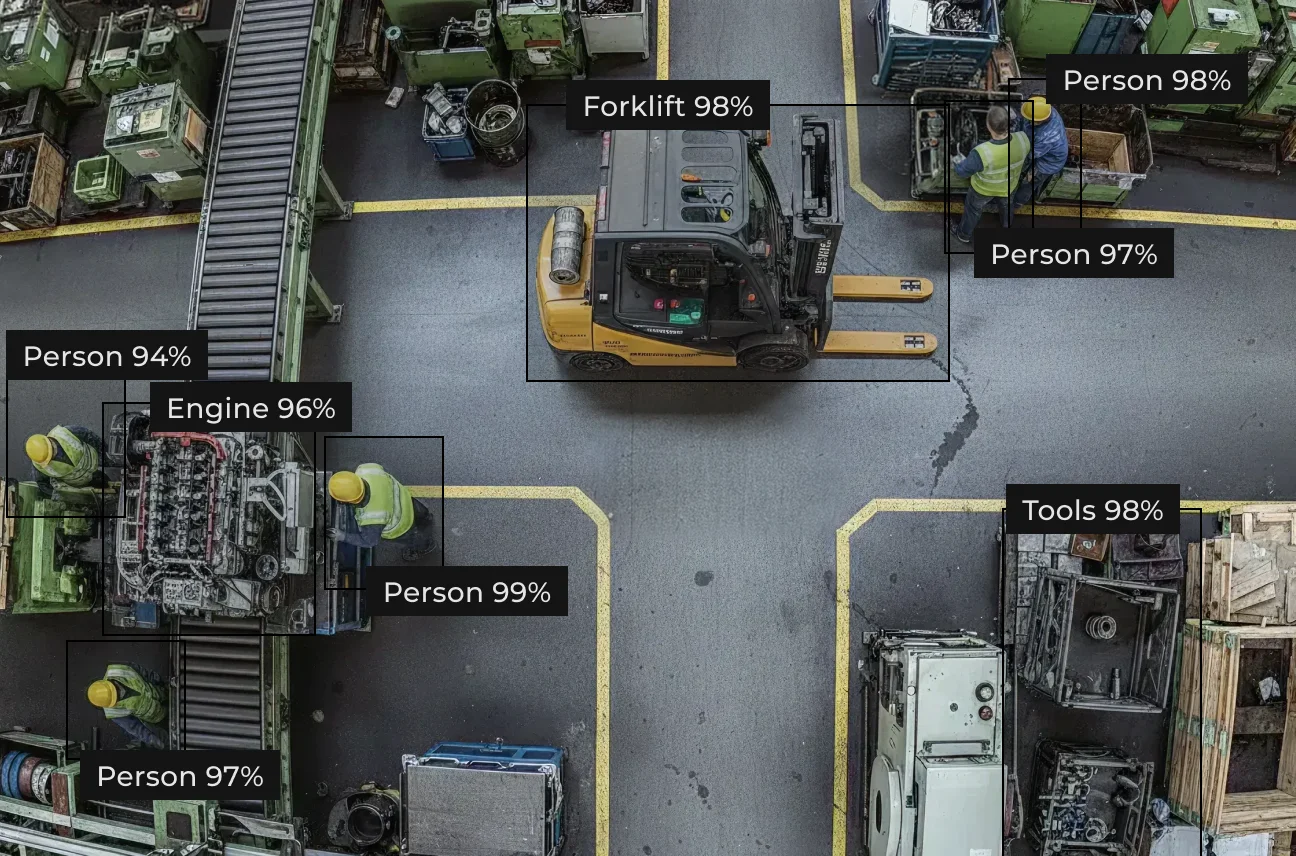
Computer vision, powered by edge-based AI, has revolutionized quality control. High-speed cameras on conveyor lines inspect packaging for damage, verify shipping labels, and ensure compliance with packing standards at speeds no human can match.
This reduces returns and chargebacks within automated warehouses.
Warehouse Automation Trends in 2026
If you experience struggles to identify what innovations to introduce to your warehouse, AI strategy consulting can help you with this problem. Below, you can find the important 15 warehouse automation trends you must be aware of in 2026.
1. Software-First Automation and Orchestration
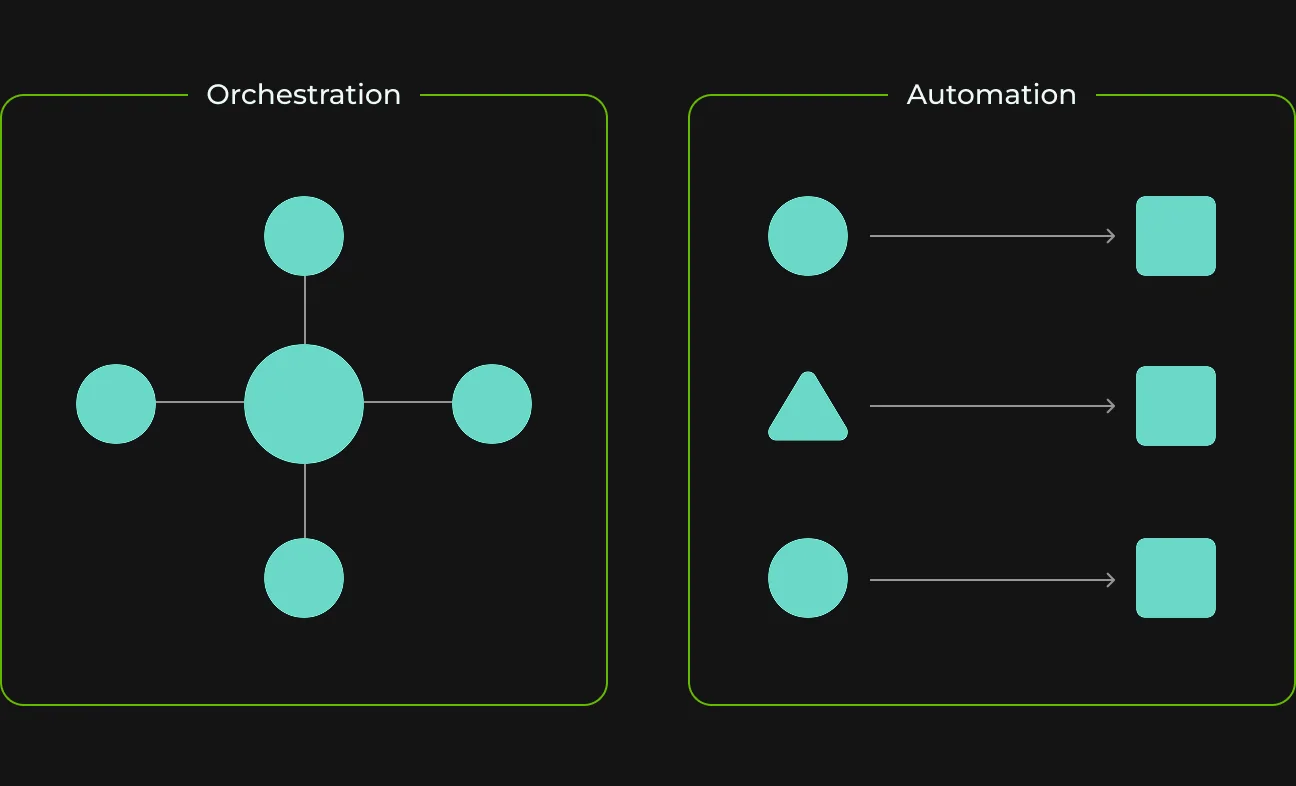
The industry has realized that optimizing individual subsystems (for example, just picking) can create bottlenecks elsewhere (for example, packing). The focus is now on WES platforms that orchestrate the entire flow.
The mantra is "Orchestrate Everything". It is about ensuring that robots, humans, and inventory move in harmony.
2. The Rise of Inbound Automation
With outbound processes largely optimized, efficiency gains are now being sought on the receiving dock. Robotic de-palletizers, combined with AI vision that can identify mixed-SKU pallets on the fly, are streamlining the intake process. This "dock-to-stock" velocity is critical for maintaining inventory availability.
3. RaaS and Outcome-Based Commercial Models
The barrier to entry for automation has been lowered by RaaS. This subscription-based model shifts costs from CapEx to OpEx. This allows smaller 3PLs and retailers to adopt advanced robotics.
It also shifts the risk of obsolescence to the vendor, as the facility can simply upgrade to the latest robot generation at the end of the contract.
4. Micro-Fulfillment Centers (MFCs)
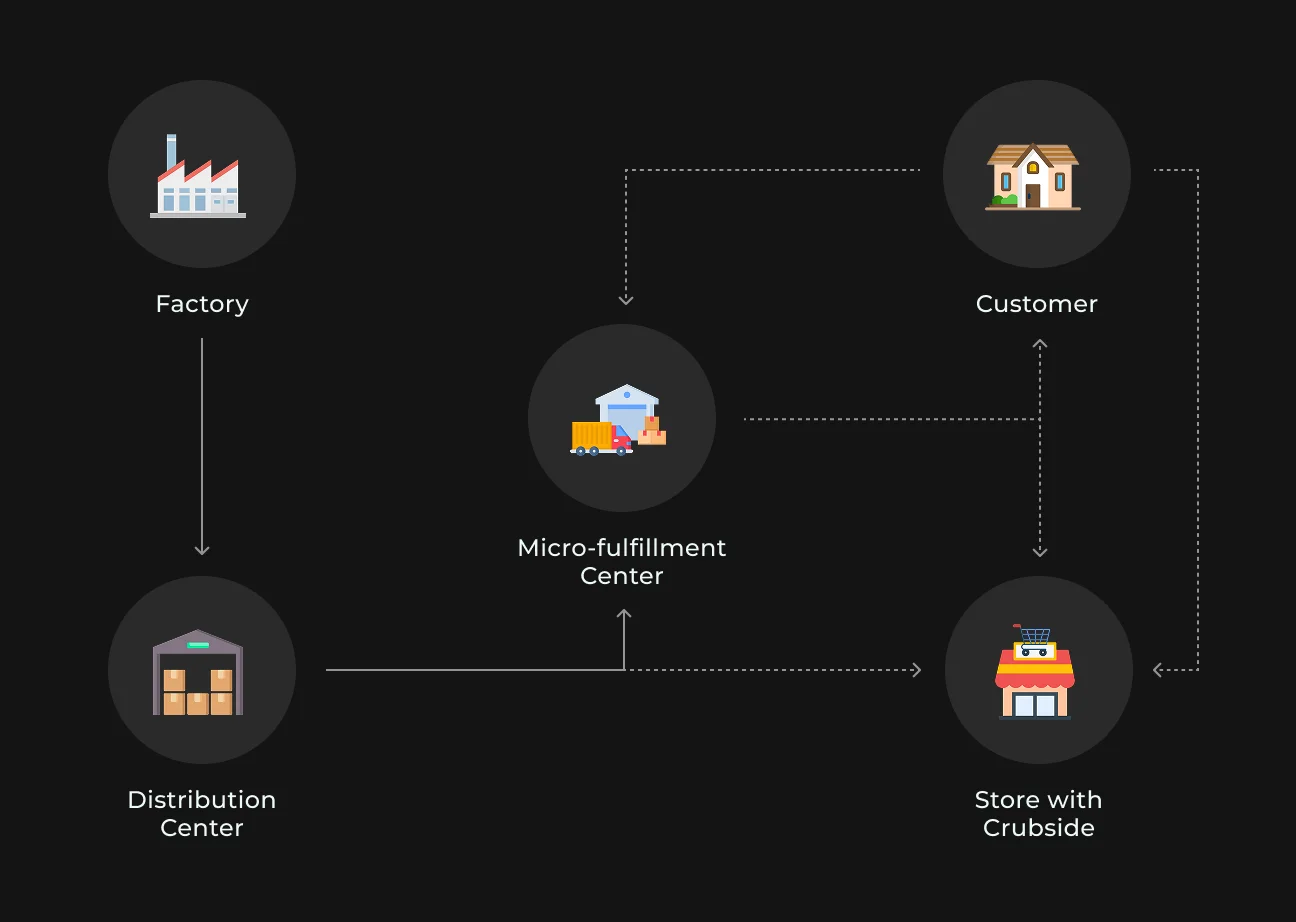
Urbanization and the "instant delivery" culture have solidified the role of MFCs. These highly automated nodes use ultra-high-density storage (like AutoStore) to hold high-velocity SKUs close to the consumer. They are often located in the back of grocery stores or in dense urban real estate.
This reduces last-mile costs and delivery times.
5. The Dark Warehouse
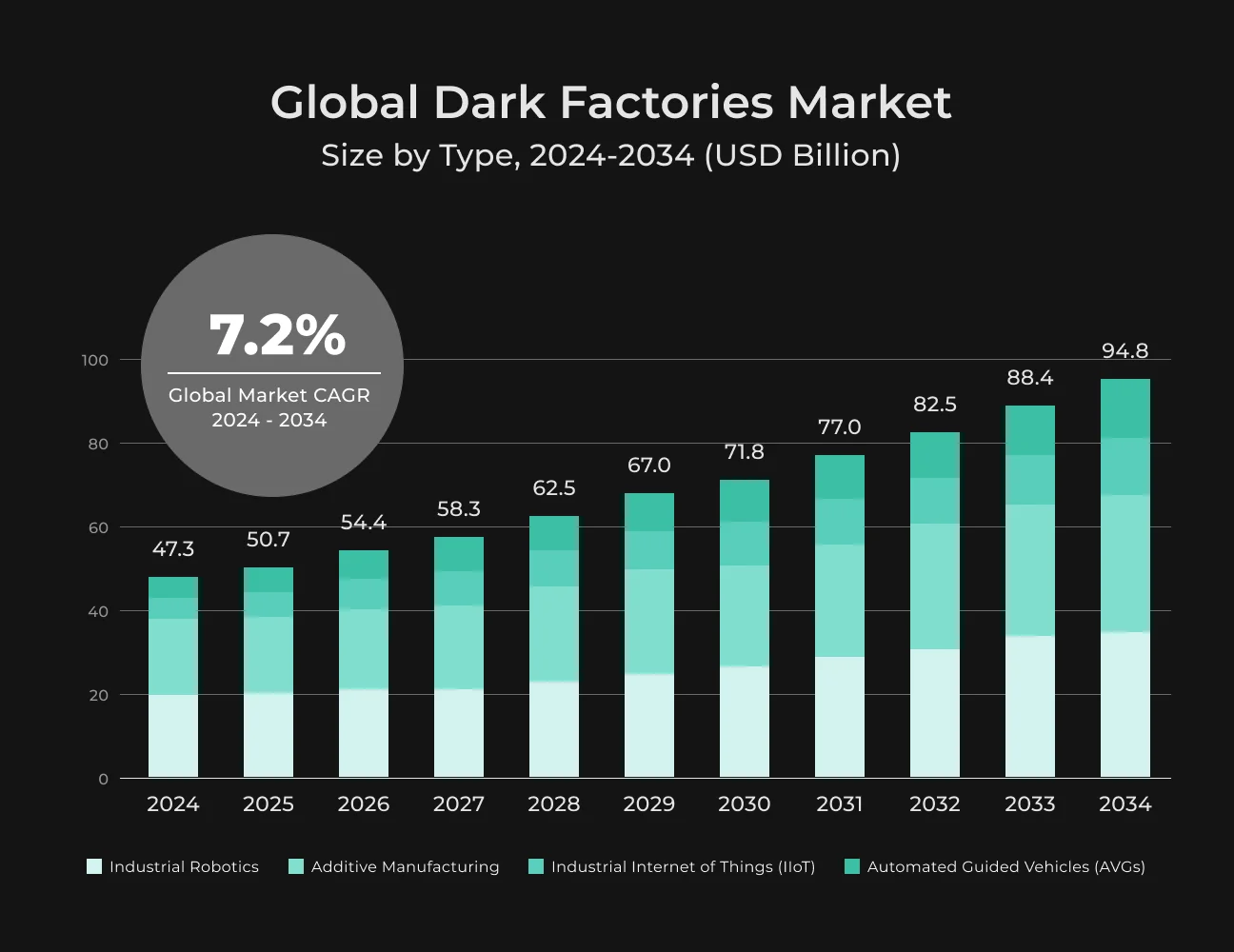
For environments hostile to humans (such as deep-freeze storage) the "Dark Warehouse" is becoming standard. These fully automated facilities operate without lighting or HVAC for human comfort. They significantly reduce energy consumption.
They rely entirely on AS/RS and AMRs for operation, presenting a use case for extreme efficiency and safety.
6. Interoperability via VDA 5050
VDA 5050 is the key to mixed-fleet orchestration. It allows facilities to avoid "vendor lock-in" and deploy the best robot for the job. This standard is forcing hardware vendors to open their ecosystems. As a result, this highly drives competition and innovation in 2026.
7. Automated Trailer Loading/Unloading
Automating the "last 50 feet" is one of major warehouse automation trends. Systems that can automatically load pallets or loose cartons into trailers are reducing turnaround times. Moreover, they eliminate one of the most injury-prone tasks in the supply chain.
8. Green Logistics and Energy Efficiency
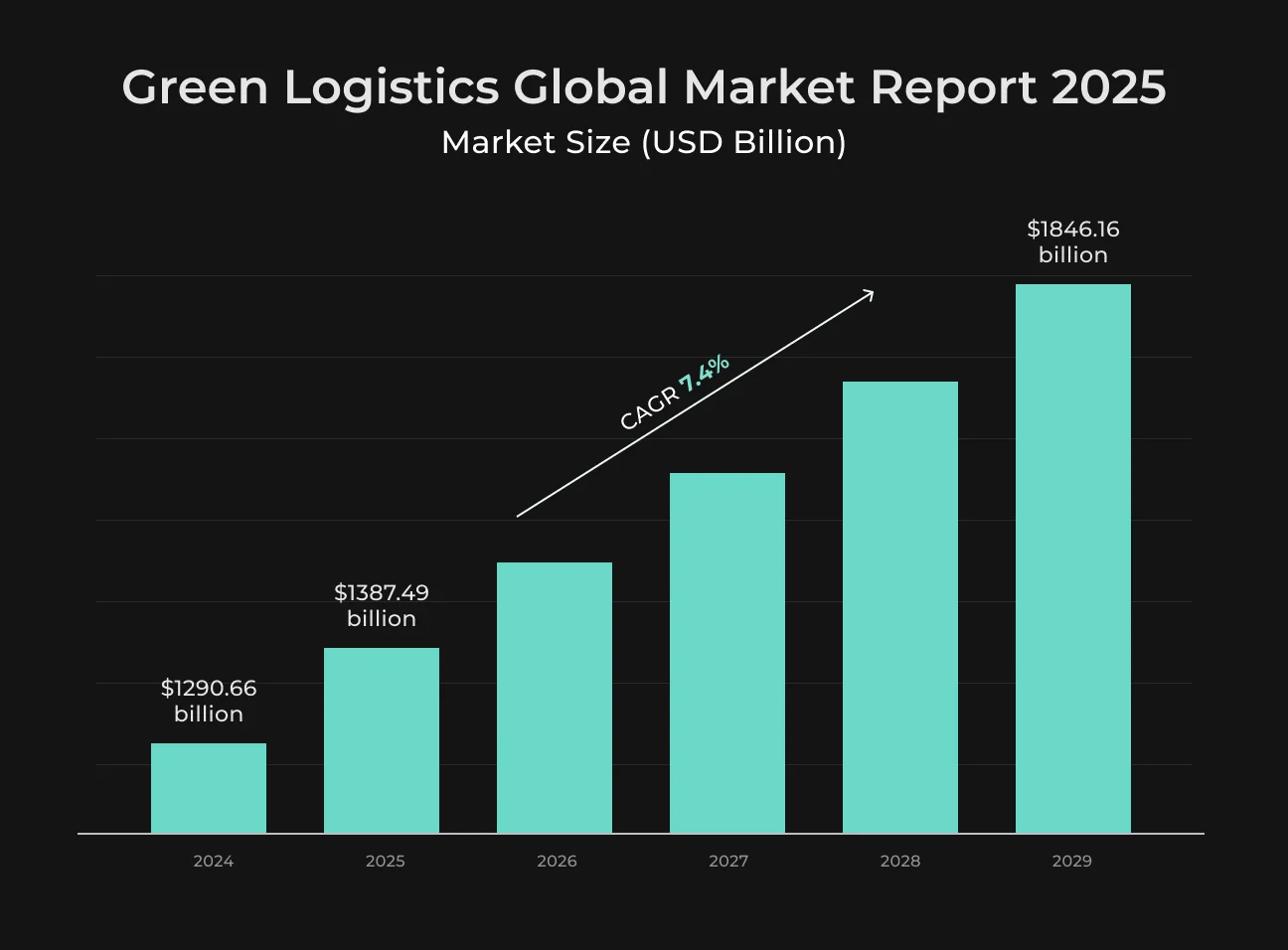
Sustainability is a license to operate. Automation is being used to reduce carbon footprints. "Lights-out" automation reduces electricity usage. Modern robots use supercapacitors and regenerative braking. Solar-powered warehouses with integrated battery storage are becoming the norm for new builds.
9. IT/OT Convergence and Cybersecurity
As OT systems become networked, they become targets. This warehouse automation trend is toward rigorous cybersecurity frameworks (NIST and IEC 62443) applied to warehouse controls.
For example, network segmentation and real-time monitoring of asset behavior are standard practices to prevent ransomware from physically paralyzing operations.
10. Human-Centric Automation (Cobots & Wearables)
The "bionic worker" is a reality. Wearable exoskeletons reduce fatigue for manual lifting tasks, while "Cobots" (collaborative robots) work safely alongside humans without safety cages.
This warehouse automation trend acknowledges that total automation is not always feasible or economic. As a result, augmenting human capability is a viable middle ground.
11. Blockchain for Supply Chain Transparency
Blockchain has matured from a financial speculation tool to a supply chain utility. It is used to create immutable records of provenance, particularly in the pharmaceutical and luxury goods sectors. This "single version of the truth" builds trust and facilitates rapid audits.
12. Digital Twins and Real-Time Simulation
Digital Twins have moved from the design phase to the operations phase. Warehouses now run live simulations of the day's orders before the shift starts to identify potential bottlenecks. Real-time data feeds allow the Twin to mirror the physical state of the warehouse instantly.
13. Humanoid Robots in Logistics
Humanoid robots are moving from R&D labs to pilot programs. Their bipedal form factor allows them to navigate environments built for humans without requiring infrastructure modification. We mean climbing stairs, opening doors, reaching high shelves, etc. While still in early adoption, they represent the ultimate flexibility.
14. Cold Chain Automation
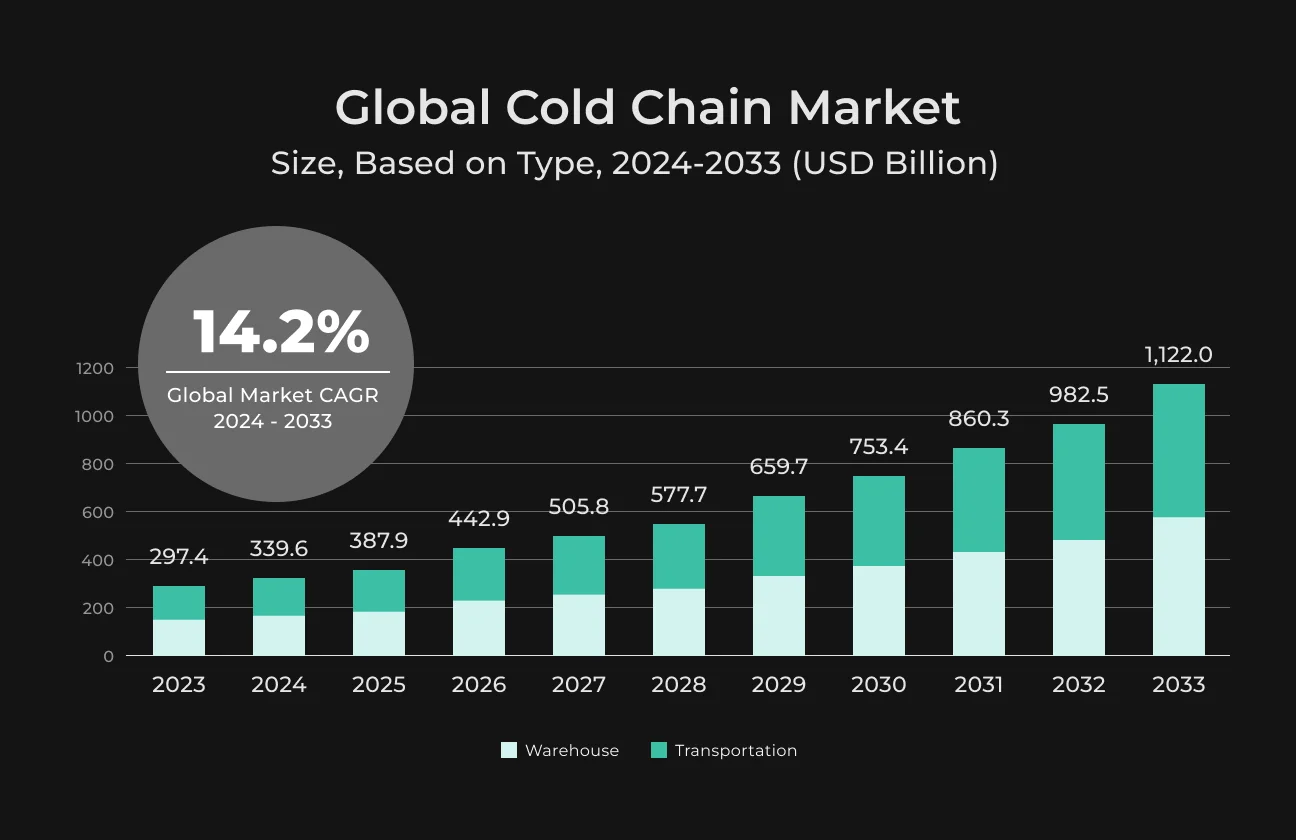
The explosion of biologics and temperature-sensitive pharmaceuticals is driving investment in automated cold chains. Robots that can function reliably in -30°C environments ensure the integrity of the cold chain. At the same time, they are removing humans from hazardous working conditions.
15. On-Demand Warehousing
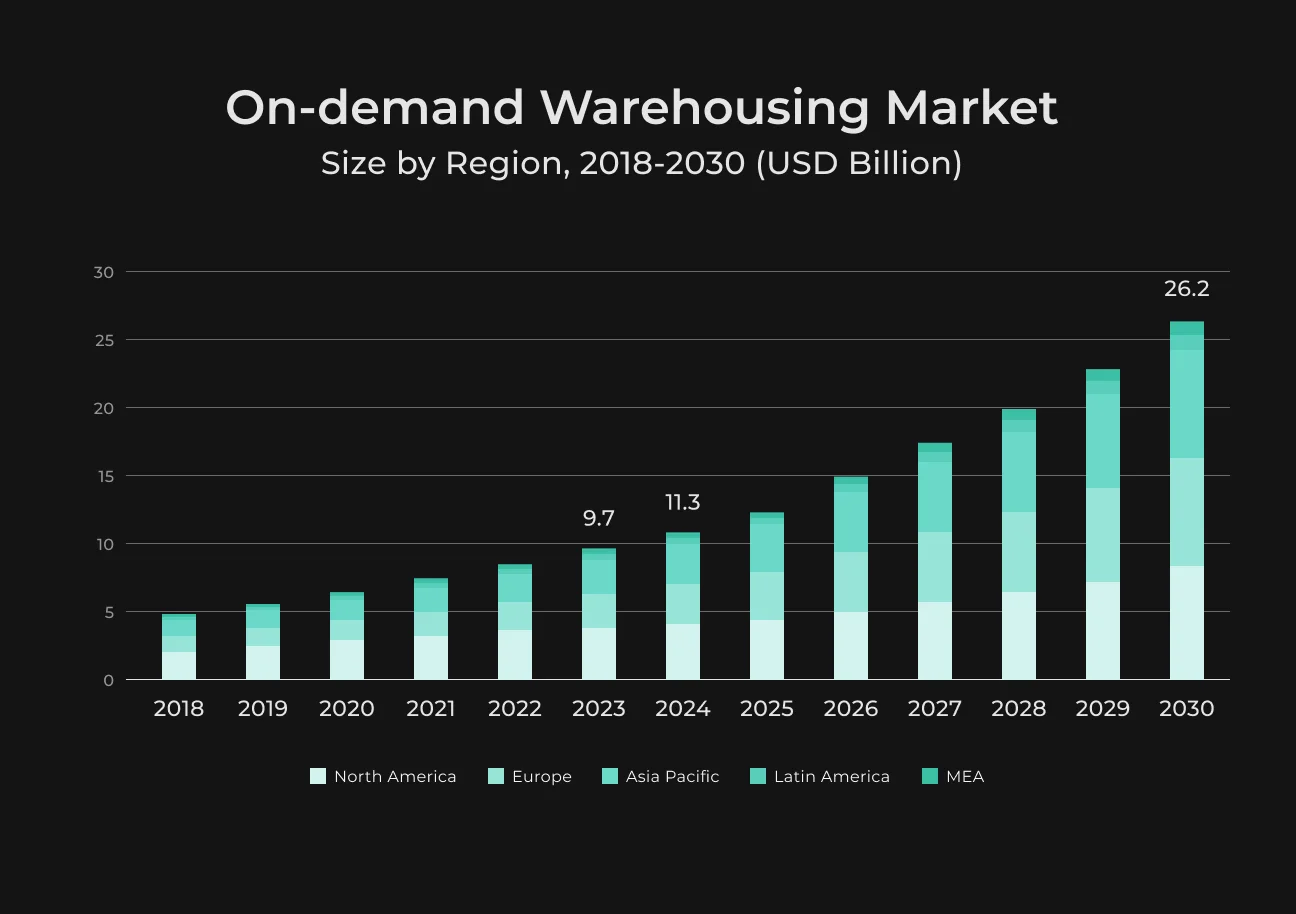
The "Uberization" of warehousing allows companies to flex their storage capacity. On-demand warehousing platforms connect shippers with excess warehouse space. They allow for short-term, flexible storage solutions that can be spun up or down based on inventory fluctuations.
Warehouse Automation Use Cases by Industry
Want to see a persuasive warehouse automation case study? Here are the 4 warehouse automation use cases worth your attention.
Retail and Omnichannel Fulfillment
Retailers in 2026 are tasked with unifying the digital and physical realms. The "Buy Online, Pick Up In-Store" (BOPIS) model requires real-time inventory synchronization.
Four Hands, a furniture retailer, faced challenges at the loading dock—the bottleneck of their operation. They implemented Slip Robotics' Automated Loading Robots (ALRs).
Instead of manually hand-stacking furniture into trailers (a slow and injury-prone process), workers load items onto the ALRs on the dock. The robots then autonomously drive into the trailer and secure themselves.
This innovation reduced unloading times by 75% and loading times by 50%. Product touches were cut in half, reducing damage rates and improving customer satisfaction.
Manufacturing
In the manufacturing sector, warehouse automation trends cover "Just-in-Time" and "Just-in-Sequence" delivery to the assembly line. The main goal is to eliminate the waste of manual "milk runs".
A great warehouse automation case study is IronBov AMR in Luggage Manufacturing. A massive 100,000 square meter luggage factory faced significant bottlenecks in material replenishment.
The reliance on manual labor to move components from the warehouse to the assembly line resulted in downtime and inconsistency.
The factory deployed a fleet of Reeman’s IronBov AMRs. These robots are integrated into the production scheduling system. When an assembly station runs low on parts, a signal is sent to the warehouse. An AMR autonomously retrieves the specific components and delivers them to the line-side buffer.
What was the outcome? The facility achieved a 30% increase in material turnover speed. Furthermore, labor costs were significantly reduced. The staff previously assigned to pushing carts were upskilled to quality control roles.
Pharmaceuticals
The pharmaceutical sector represents the apex of automation requirements due to:
- High value of goods;
- Strict regulatory compliance (DSCSA);
- Need for absolute temperature integrity.
A great warehouse automation use case here is McKesson.
McKesson, a giant in pharmaceutical distribution, has fundamentally redesigned its network with automation. In their new "ultra" distribution center in Central Ohio, the focus is on high-volume, error-free throughput.
The facility processes an average of 17,000 reusable totes daily, traveling over three miles of conveyors.
The system uses smart scanning at multiple checkpoints to track every individual dose. Discrepancies are resolved automatically in real-time. Advanced robotic arms are used for the final palletization and shrink-wrapping of orders, a physically demanding task previously performed by humans.
What is the impact? This automation allows McKesson to absorb volume growth without proportional labor increases, while simultaneously improving employee safety and order accuracy.
Healthcare
Cardinal Health is pushing the warehouse automation trends further with its new facility in Indianapolis, developed in partnership with Swisslog. This facility features the industry's first robotic storage and retrieval system (AS/RS) dedicated to pharmaceutical distribution.
The system integrates robotics, conveyance, and sorting under a unified software layer that provides real-time inventory visibility. It is a critical capability for "forward distribution" centers that handle over 70,000 daily deliveries.
As a result, the facility serves as a benchmark for the industry. It demonstrates how automation can drive both operational efficiency and patient safety. For healthcare logistics providers seeking to replicate this level of visibility and control, integrating a GPS tracking platform is essential.
Case Study: Custom POS Solution for Improved Warehousing
SapientPro developed a custom Point of Sale (POS) solution that bridges the gap between physical retail and automated warehousing. The Magento 2 POS Terminal ensures real-time inventory synchronization across online and offline channels.
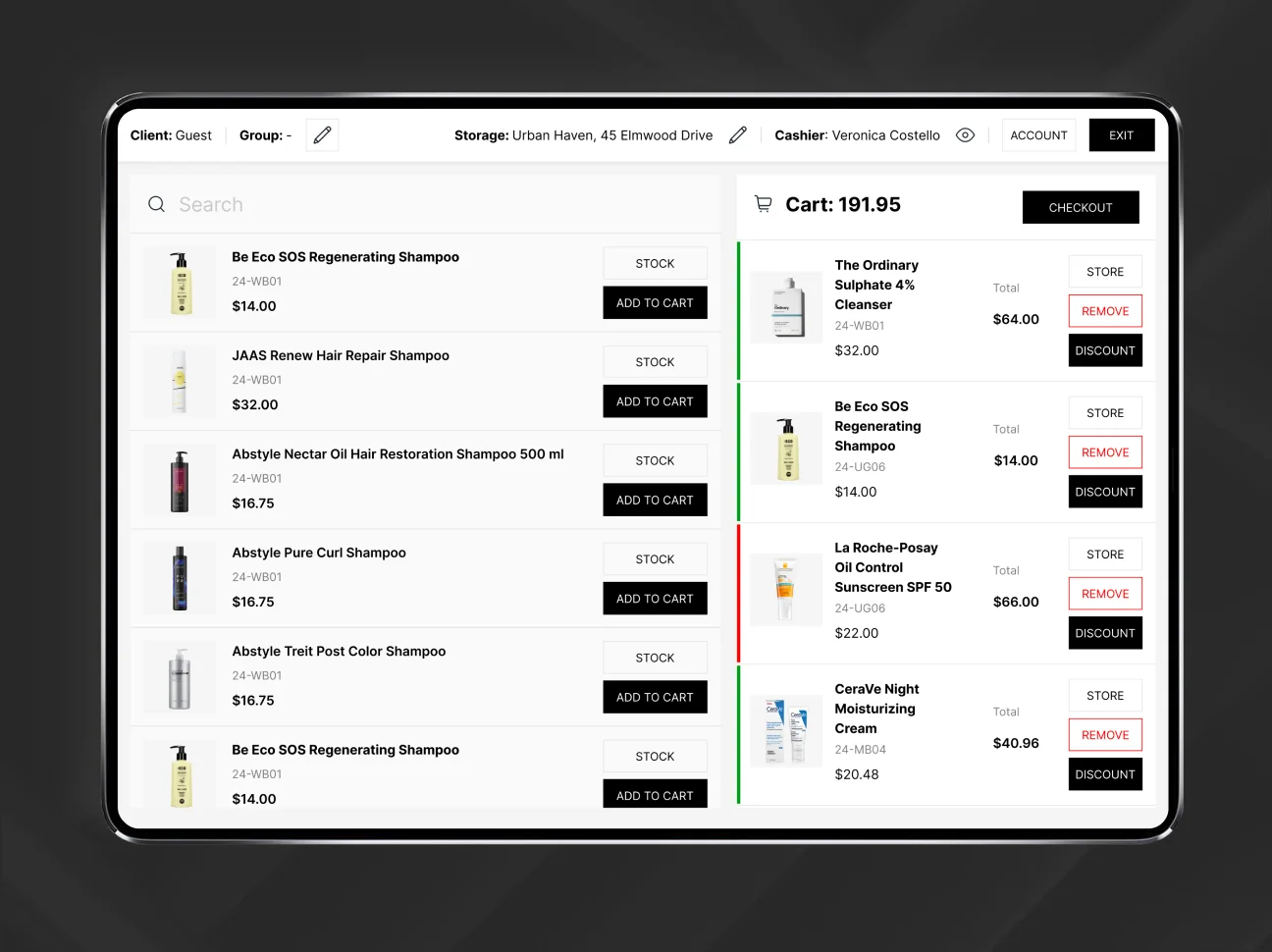
It resolves stock discrepancies instantly, preventing overselling. We know that this is a critical requirement for accurate warehouse automation.
The system supports barcode scanning and real-time data push to the central WMS, acting as a critical data entry node for the entire supply chain. This case study showed how much custom software is important for the future of warehouse automation.
Case Study #2: Full-Scale GPS Tracking Platform for Logistics
Visibility extends beyond the four walls. SapientPro built Mastrack, a comprehensive GPS tracking platform. It processes real-time location data from thousands of vehicles. We built a solution that integrates this flow with warehouse scheduling systems.
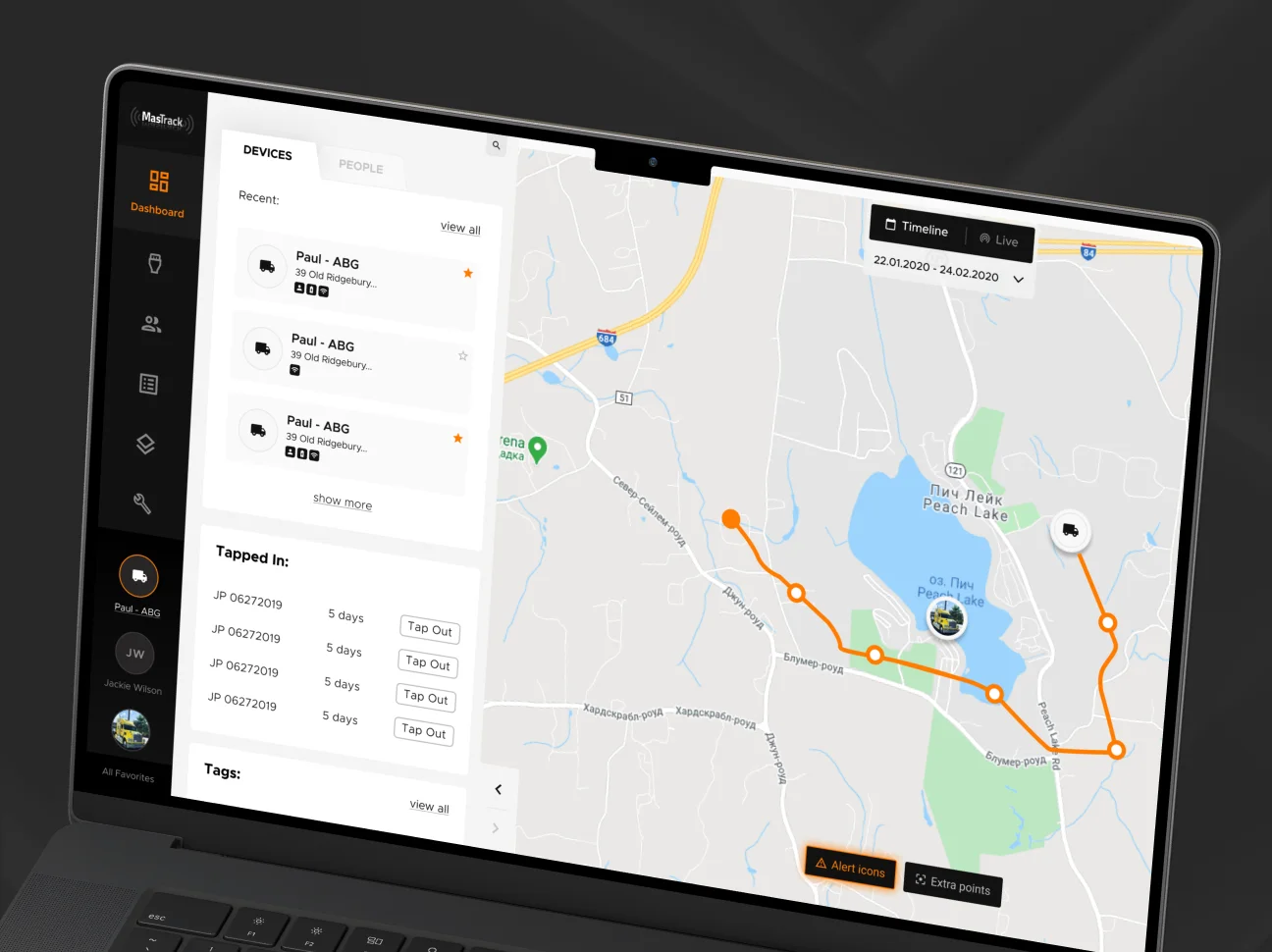
Mastrack allows the automated warehouse to anticipate arrival times accurately, orchestrating dock labor and robots efficiently. We built the device-agnostic architecture with flexible integration capabilities in mind.
Partner with SapientPro to Automate Your Warehouse
Getting a fullly automated warehouse requires a digital partner capable of knitting disparate systems into a cohesive whole. SapientPro specializes in custom software that powers warehouse automation.
We can help you with warehouse management system development, complex API integrations, integration of artificial intelligence & machine learning, and more. You’ll get a full-scale software partner who can create any custom solution specifically for your business.
Let’s automate your warehouse processes today!
Automate Your Warehouse Today
SapientPro's engineers will help you get the best solution for your business.
FAQ
What’s the difference between WMS, WES, and WCS?
All these are warehouse automation solutions. A WMS plans inventory and orders. A WES orchestrates workflow and labor in real-time. A WCS controls the physical machine movements.
Are AMRs better than AGVs for most warehouses in 2026?
Generally, yes. AMRs offer greater flexibility and quicker deployment for dynamic environments. AGVs are better suited for static, high-volume pallet movements on fixed paths.
How long does a typical implementation take?
Timelines vary. A standalone AMR deployment can take 3-4 months. A complex AS/RS or comprehensive warehouse automation case study project may take 12-24 months.
What are the biggest risks in warehouse automation?
The biggest risks are poor software integration (data silos), a lack of internal technical skills to maintain the systems, and insufficient process engineering before automation.
What is the ROI of WMS?
A modern WMS typically requires 3-6 months for implementation. The ROI is often realized within 6-12 months through inventory accuracy gains and labor reduction.
What is the ROI of AMRs?
Mobile robots offer a faster deployment timeline (weeks to months). They typically achieve ROI in 2-3 years. They are a lower-risk entry point into automation.
What is the ROI of AS/RS?
These capital-intensive projects require 18-36 months for full ROI. However, they offer the highest long-term density and throughput gains.
What is the Automation Frankenstack in warehouses?
Automation Frankenstack means disparate systems that function in isolation. In 2026, the industry has moved toward holistic ecosystems where Warehouse Management Systems (WMS), Warehouse Execution Systems (WES), and Warehouse Control Systems (WCS) converge to manage a mixed fleet of robotic and human agents.

