
All AI Strategy Consulting and Roadmap to Save Time, Money, and Costs in 2026
December 18, 202515 min read


The initial wave of enthusiastic experimentation has given way to a disciplined demand for measurable returns. For the C-suite, the era of “AI tourism” is over. The priority is now operationalization, scalability, and the rigorous extraction of value from artificial intelligence consulting.
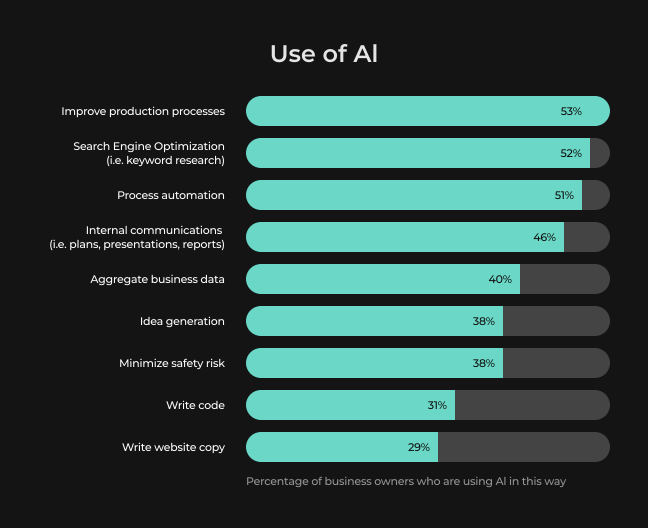
On one side are the “AI winners”, organizations that have successfully integrated generative AI consulting insights into their core operating models, achieving revenue multipliers and efficiency gains. On the other side is a growing graveyard of abandoned initiatives. Recent data is sobering.
In 2025, approximately 42% of enterprise AI initiatives were abandoned, a dramatic spike from previous years. At the same time, research from MIT suggests a failure rate as high as 95% for generative AI pilots that lack strategic alignment. This is why AI strategy consulting services are important in 2026.
Key Takeaways
- Up to 95% of GenAI pilots fail to deliver ROI due to a lack of strategic alignment and integration planning;
- Organizations with a defined AI strategy are 3.5x more likely to realize ROI than those without;
- 70% of tech leaders cite technical debt as the primary hurdle; remediating this is a prerequisite for AI success;
- “AI winners” are moving to agentic AI and structural transformation, while laggards are stuck in “pilot paralysis”;
- External AI consulting services provide the necessary arbitrage of experience, helping firms avoid common pitfalls and accelerate time-to-value.
What is AI Strategy Consulting?
AI strategy consulting is an advisory service that bridges the gap between technical possibility and business value. It is distinct from pure software engineering or general management consulting.
It involves a holistic examination of your company’s readiness to adopt artificial intelligence solutions, focusing on the intersection of data, technology, people, and process.
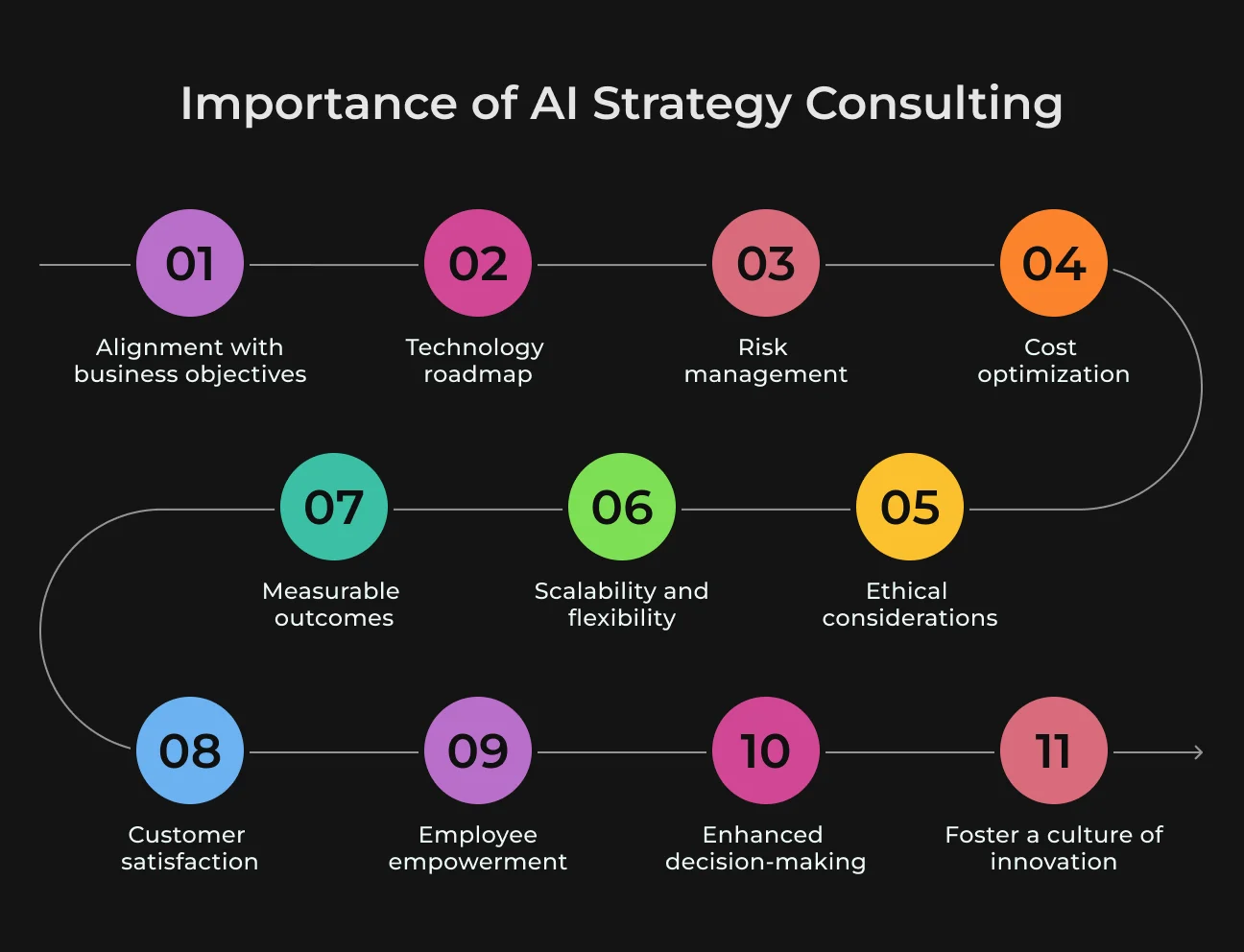
To make a viable strategy, consultants and executives must answer a series of existential questions:
- Strategic alignment. What are the specific business goals (revenue growth, cost reduction, risk mitigation) that AI is expected to impact? How do these align with the overall corporate strategy?
- Use case applicability. Where can AI be applied to generate the highest marginal utility? Which processes are ripe for automation? Which processes require augmentation?
- Resource readiness. Does the company possess the necessary infrastructure (cloud, compute), data assets (clean, labeled, accessible)? Does it have the necessary human capital (data scientists, prompt engineers) to execute the vision?
- Risk and ethics. How will the organization manage the inherent risks of AI, including bias, hallucination, data privacy, and regulatory compliance (EU AI Act)?
- Build vs. buy. Should the organization develop proprietary models to create a moat? Or should the organization use off-the-shelf APIs to prioritize speed?
Using AI strategy consulting services is the best way to get reasonable answers to these questions and understand the perfect direction for growth.
Why Your Business Needs an AI Strategy
The artificial intelligence market is constantly evolving. Today’s solutions can become obsolete tomorrow, so you need someone who monitors these changes and knows what comes next. AI consultants will help you become prepared for any scenario. Let’s take a look at several more reasons.
1. Significant ROI and Revenue Growth
Companies that take a serious approach to AI implementation strategy are significantly more likely to outperform their peers. Data from Thomson Reuters indicates that organizations with visible AI strategies are 3.5 times more likely to see ROI than those without significant plans.
Furthermore, McKinsey estimates that generative AI could unlock between $2.6 trillion and $4.4 trillion in additional value annually. This is not an incremental change. It is a fundamental shifting of the economic value curve.
2. Operational Productivity and Efficiency
The efficiency gains from a well-executed AI adoption strategy are tangible. Professionals using AI tools save an average of five hours per week, which translates to approximately 240 hours per year. It is a productivity gain worth roughly $19,000 per individual annually!
In the banking sector alone, these productivity improvements are projected to generate up to $180 billion in additional revenue by 2027. These gains are achieved by automating routine cognitive tasks. As a result, human capital can focus on high-value problem-solving.
3. Competitive Differentiation and Innovation
McKinsey reports that while 80% of companies use AI for efficiency, the "AI High Performers" are nearly twice as likely to use AI to create new business models and drive revenue growth.
In retail, AI-powered content recommendations now influence over 70% of user engagement, directly dictating market share. Without a strategy to use, businesses risk being commoditized by competitors who use AI to offer superior personalization and speed.
4. Risk Mitigation and Regulatory Compliance
The regulatory market for artificial intelligence consulting is becoming increasingly complex. Ad hoc adoption exposes companies to massive legal and reputational risks. AI strategy consulting ensures that governance is integrated into the roadmap from day one.
Financial institutions using AI for fraud detection have prevented billions in losses. JPMorgan Chase prevented $1.5 billion in losses through AI-driven fraud detection systems.
5. Talent Attraction and Retention
A clear AI strategy roadmap is a powerful tool for talent management. Top-tier engineers and data scientists flock to organizations with a clear vision for the future. Furthermore, 63% of service professionals believe generative AI helps them work faster and reduces burnout.
The Crisis of Internal AI Projects in 2026
The idea that companies can build transformative AI through internal “skunkworks” alone has largely failed in practice. When these projects stall, it’s rarely just a tooling problem — the root causes are usually organizational: incentives, ownership, data access, and how decisions get made.
Let’s see the biggest challenges when working with AI implementation.
The Phenomenon of “Use Case Bingo”
A common failure pattern in enterprise AI is what we call “use case bingo.” It happens when different business units launch isolated AI initiatives on their own—often driven by vendor hype or short-term pressure—without a shared architecture or governance model.
Even when these efforts show local wins, they fragment the organization.
Teams typically:
- Operate on disjointed data schemas;
- Use incompatible governance standards;
- Lack a unified AI implementation strategy.
The result is a portfolio of “toy” applications that don’t integrate, don’t scale, and can’t compound value across the business. Instead of building enterprise capability, companies spend millions across overlapping tools and licenses—without moving the needle on enterprise-level EBIT (earnings before interest and taxes).
Data Silos and the Context Window Trap
The “use case bingo” approach almost always creates — or worsens — data silos. And in 2026, data isn’t just a system of record; it’s the operating fuel for generative AI models. When information is trapped inside SaaS apps or on-premise systems, centralized AI systems can’t access enough relevant context to support high-stakes decisions.
That missing context shows up as irrelevant outputs and higher hallucination risk — which erodes user trust. In fact, 46% of corporate leaders cite the inability to consolidate data into a unified ecosystem as a primary barrier to realizing value from AI.
Decisions Without Reasons
Another common failure mode is launching AI projects without a validated business case. Many teams fall into “model fetishism” — optimizing for technical metrics like F1 score or latency while ignoring the business outcome. Projects get approved because the tech looks novel, not because the ROI model is sound.
SapientPro’s COO, Ihor Hamal, indicates this disconnect destroys value early. Without a clear ROI path before code is written, AI initiatives become a fiduciary risk.
That’s why he advocates for Rapid Prototype Sprints and specialized PoC development: to validate feasibility, quantify ROI, and surface constraints before significant capital is committed. Done right, this approach reduces the “sunk cost” dynamic that often derails large-scale AI implementations.
Technical Debt
The most insidious barrier to an AI adoption strategy is technical debt. Max Tatarchenko, CTO at SapientPro, redefines technical debt in the AI era not merely as “messy code” but as a “structural liability” that actively prevents innovation.
Tech debt slows innovation, drains budgets, and locks enterprises into operating models that simply can't keep up. Without an AI strategy consulting that explicitly addresses re-architecture and debt remediation, any AI roadmap is destined to stall

Max Tatarchenko
Typical Challenges Companies Face Before Creating an AI Implementation Strategy
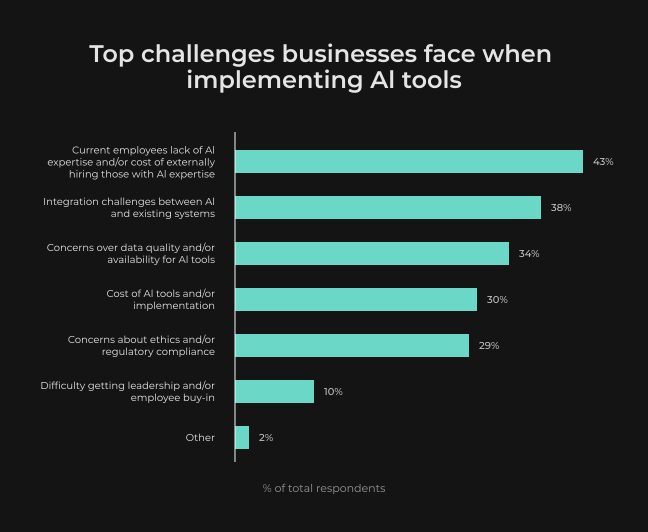
Even with executive sponsorship and a clear mandate, the path from “we should use AI” to production impact is rarely simple. Most teams run into the same predictable blockers — and this is exactly where AI consulting and delivery partners are typically brought in: to help companies design the foundations (data, governance, operating model) that pilots alone don’t solve.
Data Fragmentation and Quality Issues
The most common barrier to AI adoption is still data. In many organizations, information is scattered across legacy on-premise systems, cloud tools, SaaS applications, and spreadsheets — with inconsistent definitions, ownership, and quality controls. 46% of corporate leaders cite the inability to consolidate data into a single unified ecosystem as a top barrier to value realization.
Without a unified data architecture, generative AI systems struggle to perform reliably: they don’t have consistent, governed access to the context required to produce accurate, decision-grade outputs.
The “Pilot Paralysis” Trap
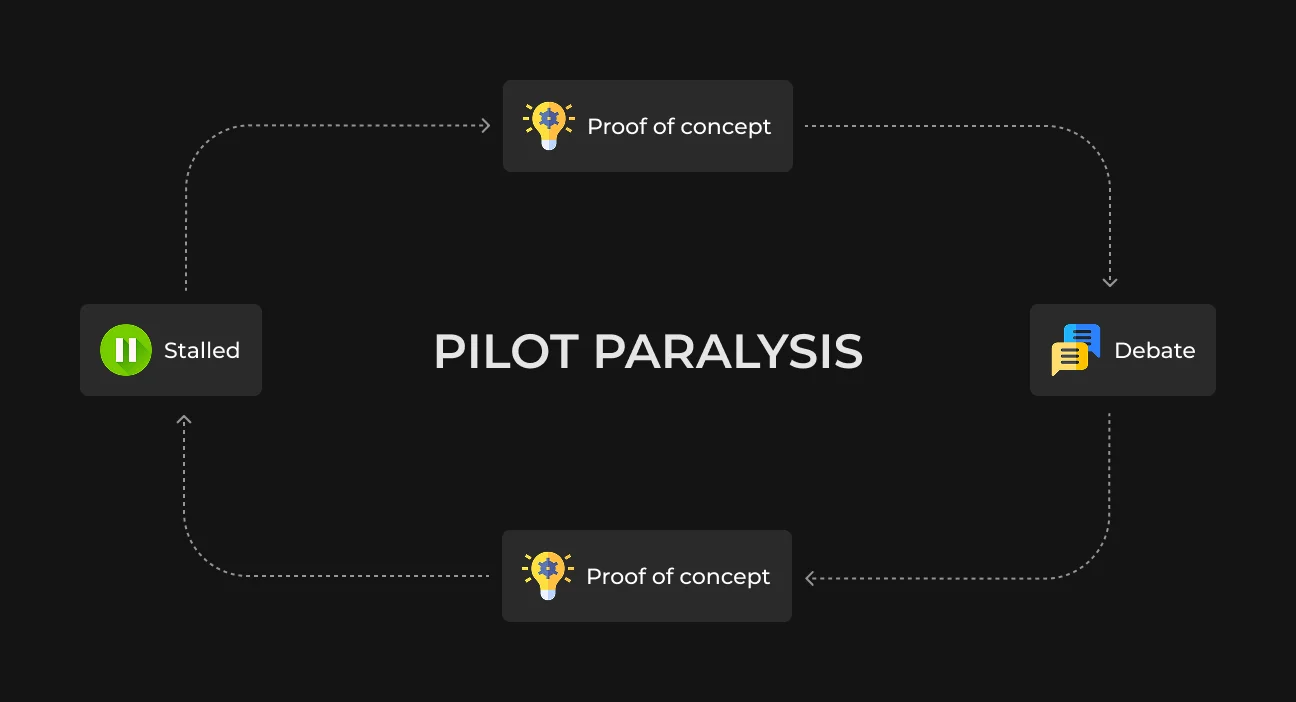
“Pilot paralysis” describes a pattern where organizations launch numerous proofs of concept (PoCs) but fail to scale any of them into production. This typically happens because pilots are designed in isolation — without integration plans, shared data foundations, security and compliance alignment, or an operating model for ownership after launch.
S&P Global reported that 42% of companies abandoned most AI initiatives in 2025, largely due to a failure to plan for production scalability.
Integration with Legacy Systems
Ihor Hamal highlights that legacy infrastructure is a formidable blocker. Integrating modern, API-driven AI agents with legacy COBOL or mainframe systems is technically demanding. 70% of technology leaders identify technical debt as the main barrier to innovation. An AI implementation strategy must account for the time and cost of wrapping or refactoring these legacy systems to make them AI-ready.
Cultural Resistance and Trust Deficits
A significant challenge is the human element. Employees often view AI with suspicion, fearing job displacement or distrusting the "black box" nature of algorithmic decision-making. Trust in AI technologies dropped from 50% in 2021 to 39% in 2023. If the workforce does not trust the tool, they will not use it, rendering the investment worthless.
Unclear Business Value and Metrics
Finally, many companies struggle to articulate the business value of AI. They lack clear KPIs to measure success. Without a defined way to measure ROI, it is impossible to justify continued investment to stakeholders. How can it be done? Whether through time saved, revenue generated, or error reduction. It is up to you.
7 Components of an AI Adoption Strategy That Works
To address these challenges, a practical AI adoption strategy should cover seven core components.
1. Principles and Ethics
The foundation of any AI strategy is a clear set of guiding principles. This typically includes defining:
- “Hard” outcomes such as revenue growth, cost efficiency, and risk reduction;
- “Soft” commitments such as transparency, fairness, privacy, and accountability.
With the rapid adoption of generative AI, ethical guardrails become even more important: they reduce bias, clarify acceptable use, and set requirements for explainability and human oversight.
In practice, this component ensures AI initiatives align with corporate values, regulatory expectations, and broader societal norms.
2. Business Strategy Alignment
AI should serve the business strategy — not the other way around. This means mapping AI capabilities to specific business goals and defining how success will be measured. For example, if the priority is improving customer retention, the AI adoption strategy should emphasize churn prediction, personalization, and proactive support workflows.
Done well, this component ensures AI investment is tied to clear KPIs — so spending translates into measurable business outcomes, not isolated experiments.
3. Governance and Risk Management
Governance defines who can do what with AI — and under what conditions. It typically includes policies and controls for:
- Data access and handling;
- Model deployment and monitoring;
- Output validation, human review, and escalation.
Strong governance balances speed with safety. It reduces “shadow AI” (unsanctioned AI usage), strengthens compliance, and helps organizations meet regulatory expectations such as the GDPR and the EU AI Act.
4. Operating Model and Organization
An AI strategy also requires an operating model: the people, roles, and decision pathways needed to deliver and scale AI responsibly. In practice, this often means moving from functional silos to cross-functional teams that combine data science, engineering, security, and domain expertise.
It also requires a delivery decision: centralize AI in a Center of Excellence (CoE), federate it across business units, or use a hybrid model — balancing consistency and governance with speed and local ownership.
5. Talent and Culture
A strategy is only as good as the people executing it. This component requires a dual approach:
- Hiring for critical roles such as ML engineers, data engineers, and prompt engineers;
- Upskilling the existing workforce — especially around data literacy, AI limitations, and safe day-to-day usage.
The goal is simple: make AI a cross-functional capability, not a specialist bottleneck. When non-technical teams understand how to work with AI tools (and when to escalate), adoption becomes faster, safer, and more sustainable.
6. Technology and Infrastructure
This is the technical backbone of the strategy: selecting the stack needed to build, deploy, and operate AI reliably. It typically includes:
- Cloud and compute strategy;
- LLM frameworks and orchestration;
- Vector databases and retrieval infrastructure (where applicable);
- MLOps / LLMOps tooling for deployment, monitoring, and iteration.
A strong infrastructure plan also addresses the build vs. buy decision and sets guardrails to avoid long-term technical debt — so systems can scale beyond the first few use cases.
7. Activation and Roadmap
Strategy only matters if it turns into execution. Activation means translating priorities into a phased roadmap with clear owners, timelines, and success metrics — typically moving from assessment to PoCs, pilots, and production scale.
This step also requires stakeholder alignment: the roadmap needs shared definitions of “done,” agreement on funding and governance, and commitment from the teams who will operate AI in the real world.
AI Strategy Roadmap: Checklist to Use in 2026
Implementing an AI strategy roadmap requires a disciplined, phased approach. The following checklist provides a guide for 2026.
| Phase | Timeline | Checklist & Key Activities |
| Phase 1: Assessment and Discovery | Months 1-3 | • Conduct Readiness Assessment. Audit data maturity, infrastructure, and talent availability. • Identify Priority Use Cases. Use an "Impact vs. Effort" matrix to select high-value, low-risk pilots. • Technical Debt Audit. Identify "structural liabilities" in the legacy code that must be addressed. • Define Success Metrics. Establish baseline KPIs for measurement. |
| Phase 2: Foundation and Governance | Months 3-6 | • Data Hygiene Program. Implement protocols to clean and structure First-Party Data. • Governance Framework. Establish an AI ethics committee and usage policies. • Tech Stack Selection. Finalize cloud partners and LLM choices. • Secure Sponsorship. Ensure a C-level executive is accountable for the program. |
| Phase 3: Pilot and Prototype | Months 6-9 | • Launch Rapid Prototypes. Execute 2-3 focused PoCs using agile sprints. • Human-in-the-Loop. Ensure early outputs are verified by human experts. • Monitor Model Drift. Set up MLOps to track performance over time. • User Feedback Loops. Actively solicit feedback from frontline users. |
| Phase 4: Scaling and Optimization | Months 9-12+ | • ROI Analysis. Rigorously evaluate the financial impact of pilots. • Operational Integration. Integrate successful models into core ERP/CRM systems. • Scale Training. Roll out AI literacy programs to the broader organization. • Continuous Improvement.; Establish loops for model retraining. |
Examples of AI Strategies for Business
AI consulting services have driven transformative results across various sectors. The following examples illustrate how strategy translates into execution in retail, logistics, and finance.
Retail AI Strategy Consulting Solutions
In retail, the focus is on hyper-personalization and inventory precision:
- Hyper-personalization. Sephora uses generative AI consulting to power its "Virtual Artist". It uses computer vision to analyze facial features and recommend products. This shifts the engagement model from transactional to consultative.
- Dynamic pricing. Walmart uses agentic AI to monitor competitor pricing and inventory levels in real-time, adjusting prices across 50,000 items to maximize margin. This system processes over 500 million price points weekly.
- Inventory optimization. AI agents predict demand with 85% accuracy, automating reordering processes. This reduces overstock and prevents stockouts, optimizing working capital.
Learn more about AI in retail use cases from SapientPro’s team.
Logistics AI Strategy Consulting Solutions
Logistics strategies prioritize autonomy and resilience:
- Predictive routing. AI agents analyze traffic, weather, and port congestion to automatically reroute shipments. This “self-healing” supply chain capability reduces delays and improves customer satisfaction.
- Warehouse automation. Manufacturers are investing heavily in AI-powered machine vision to automate quality control and package sorting. Over 55% of manufacturers plan to invest more than $100,000 in these systems.
- Demand positioning. AI integrates economic indicators and historical sales to predict regional demand surges. This allows logistics firms to position inventory closer to the consumer before orders are placed.
Learn more about AI in supply chain management from SapientPro’s team.
Finance AI Strategy Consulting Solutions
The financial sector leads in risk management and speed:
- Algorithmic trading. Goldman Sachs leveraged artificial intelligence consulting to build trading desks that saw a 27% increase in intraday profitability, reducing execution time from 120 ms to 14 ms.
- Fraud detection. JPMorgan Chase’s investment in an AI strategy led to the development of fraud detection systems that analyze transactions in real-time. This prevents $1.5 billion in annual losses.
- Advisor augmentation. Morgan Stanley’s “AI Morgan Stanley Assistant” allows advisors to query a database of 100,000 research reports instantly. This improved document retrieval efficiency from 20% to 80%. As a result, this enables advisors to spend more time with clients.
Learn more about AI in banking use cases from SapientPro’s team.
How Much Do AI Consulting Services Cost?
If you’re wondering, “How much do AI consulting services cost?” there’s only one true answer: it depends. The pricing varies significantly based on the scope, the reputation of the firm, and the technical complexity of the AI strategy consulting services.
The cost ranges below are approximate benchmarks and vary by scope, timelines, data readiness, and compliance requirements. For an accurate quote, SapientPro experts provide a detailed estimate after a free consultation.
Company Type | Service Scope | Implementation Focus | Estimated Cost Range |
| Mid-Market Retailer | Customer Service Automation | GenAI Chatbot, CRM Integration, Prompt Engineering | $40,000 - $80,000 (Project) |
| Logistics Firm | Supply Chain Optimization | Predictive Analytics, Route Optimization, Data Lake Setup | $100,000 - $250,000 (Project) |
| Fintech Startup | AI Strategy & Governance | Architecture Review, Compliance Roadmap, Virtual CTO | $8,000 - $15,000 / month |
Why Partner with SapientPro as Your AI Consulting Firm
Choosing the right partner is one of the most consequential decisions in an AI roadmap. SapientPro combines strategy and delivery to help enterprises move beyond pilots and build AI systems that are reliable in production, scalable across teams, and measurable in business impact.
With CTO Max Tatarchenko’s focus on sustainable architecture and COO Ihor Hamal’s ROI-driven approach, SapientPro aligns engineering execution with executive outcomes.
Generative AI makes experimentation easy — but scaling it safely is hard. The “Generative AI Paradox” reflects this reality: access to the technology is widespread, yet consistent enterprise value is rare. SapientPro helps close that gap by designing the foundations that production GenAI depends on: data readiness, governance, observability, and integration patterns that don’t break at scale.
Agentic AI raises the bar further. Agents rely on clean modular architecture, stable APIs, and strong controls to operate effectively. SapientPro’s “Clean Code Culture” and modular design practices are a practical fit for this model, because they reduce brittleness, improve maintainability, and support faster iteration without accumulating runaway technical debt.
What you get with SapientPro:
- Architecture that scales: modular, integration-ready systems designed for production, not demos;
- Governance by design: clear controls for access, deployment, validation, and compliance;
- ROI-first delivery: use cases prioritized and validated against measurable KPIs;
- Built to reduce technical debt: roadmaps that include refactoring and platform hardening, not just new features;
- Execution that ships: engineering discipline across build, deployment, monitoring, and iteration.
Build Your AI Strategy with SapientPro

Summary
As we approach 2026, the distinction between “tech companies” and "non-tech companies" has eroded. Every company is now an AI company. The winners will be those with the clearest AI strategy consulting partnerships.
They will be the organizations that:
- Treat technical debt as a strategic enemy;
- Prioritize data governance as a board-level issue;
- Focus on "agentic" workflows;
- Partner with firms like SapientPro to navigate AI adoption strategy.
The failure rates of the past two years serve as a warning: technology without strategy is merely overhead. Conversely, artificial intelligence consulting remains the greatest lever for growth in the modern economy. The question is not “Can we afford AI consulting services?” but “Can we afford the obsolescence of proceeding without them?”
For a precise estimate on how much do AI consulting services cost, contact SapientPro for an initial consultation. Let's begin building your AI strategy roadmap together!

