All AI in Retail: Use Cases and Benefits for Commerce
November 4, 2025


We all feel the technological shift in all industries triggered by AI. Retail is changing fast, and the winners are those who can keep up. Artificial intelligence has become crucial for personalized product suggestions, cashier-less checkouts, and predictive inventory management. AI is the engine behind some of the most profitable moves in commerce.
AI in retail is already driving huge results. McKinsey estimates that generative AI could unlock between $240 billion and $390 billion in annual value for the global retail sector alone, especially in marketing, customer support, and product discovery.
Meanwhile, a PwC and Microsoft study shows that 76% of retail executives recognize the need for technological reinvention with AI to help reduce costs and improve operations.
And the tech is already proving its value in practice. With predictive AI in retail analytics, companies carry out highly precise demand forecasting using sales information and trends. According to SAP, improved product availability can minimize revenue loss for stockouts by up to 30%, and retailers can reduce the cost of stocks by up to 25% through the reduction of overstocking.
This article is written based on real industry knowledge and the experience of SapientPro's AI engineers, who've spent over 8 years developing intelligent software for retail brands. We'll walk you through how AI is used in retail, what tech makes it work, and how your business can benefit from it.
Key Takeaways
- AI in retail industry is actively improving customer experience, boosting sales, and cutting operational costs across physical and digital channels.
- Key technologies include machine learning, computer vision, NLP, generative AI, and IoT — all working together to personalize, automate, and optimize retail processes.
- Top use cases include recommendation engines, chatbots, cashier-less stores, demand forecasting, fraud detection, and market trend analysis.
- AI helps retailers reduce stockouts by up to 30% and cut inventory costs by 25%.
- Generative AI is becoming central to content creation, customer interaction, and automation, with proven progress in conversions and engagement.
- AI-powered sustainability tools help track emissions, reduce waste, and meet modern consumer and compliance demands.
What is AI in Retail?
AI in retail involves using machine learning and data analytics to optimize operations and enhance customer experiences. Key applications include personalized recommendations, demand forecasting, dynamic pricing, inventory management, and AI-powered customer service.
It drives efficiency and growth across physical and digital channels. Let’s take a closer look at all the capabilities of artificial intelligence in the retail industry.
Importance of AI in the Retail Industry
You have always used your intuition and experience to stay competitive. But today, the retail environment moves faster and constantly changes. You need something more to keep your position on the market.
Retailers must be able to respond quickly to changing consumer behaviors, shifting market conditions, and supply chain disruptions. AI can help you meet these challenges head-on by offering automation that improves accuracy, efficiency, and agility across the value chain.
Enhanced Operational Efficiency
AI automates key retail processes such as inventory management, demand forecasting, and pricing optimization. Intelligent systems can predict which products will be in high demand and help retailers stock shelves accordingly, reducing both shortages and overstocking.
Personalized Customer Experiences
Modern shoppers expect customized experiences whether they’re buying online, on mobile, or in-store. AI helps retailers meet these expectations by analyzing customer behavior in real time and recommending relevant products, offers, and content. This level of personalization boosts satisfaction, increases conversion rates, and strengthens brand loyalty.
Data-Driven Decision-Making
Retailers collect vast amounts of data daily — from transactions and social media to logistics and supply chains. AI tools turn this data into actionable insights, allowing businesses to make decisions faster, uncover trends, and respond to market changes with greater precision.
By adopting AI-driven technologies, companies can optimize operations, enhance customer engagement, and improve profitability. As the retail industry becomes increasingly digital, those who fail to embrace AI risk falling behind more innovative competitors.
AI Technologies Used in Retail
Artificial intelligence in retail is a combination of powerful tools working behind the scenes. Together, they form a flexible digital backbone for modern commerce. Let's take a look at the core technologies retail businesses are already using.
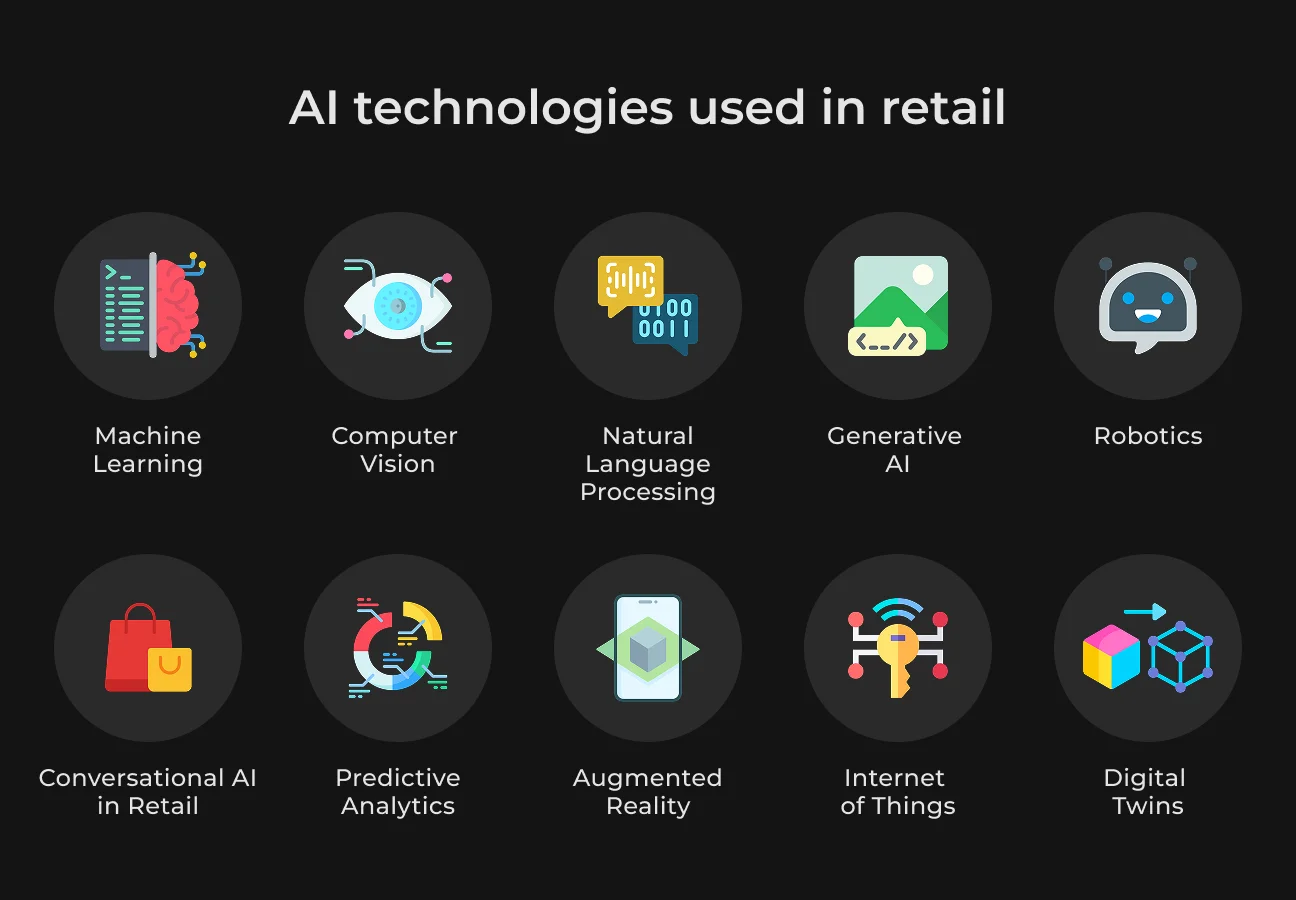
1. Machine Learning
ML is the foundation of AI in commerce. It allows systems to learn from historical data, adjust predictions, and automate decisions without hardcoding rules. Depending on the task, retailers apply different types of ML to achieve specific goals:
- Supervised learning: algorithms are trained on labeled data. For instance, a model might learn to predict customer churn based on past behaviors. It's commonly used in pricing, sales forecasting, and fraud detection.
- Unsupervised learning: the system explores data without labels, identifying hidden patterns. Retailers use this feature for customer segmentation, grouping shoppers based on behavior, not demographics, and market basket analysis, which suggests products frequently bought together.
- Reinforcement learning: learning by doing. Algorithms get feedback through rewards or penalties. It's used in dynamic pricing engines that test different prices in real time to maximize profit and customer satisfaction.
- Deep learning: inspired by the human brain, deep learning uses neural networks to process vast and complex datasets. In retail, it powers visual search, voice assistants, and advanced demand forecasting tools that pick up on seasonality, weather, or social trends.
2. Computer Vision
Computer vision allows machines to “see” and interpret the world through cameras and images. In physical retail spaces, this technology transforms raw video footage into ready-to-use information. And for online commerce, it enriches product discovery and customer engagement.
Key applications include:
- Object detection: used in cashier-less checkout systems, security cameras, and smart shelves to identify products in real time.
- Facial recognition: without identifying individuals, it tracks age, mood, or attention span to analyze customer behavior and improve store layout or ad placement.
- Pose estimation: this technology tracks body movements to understand how shoppers navigate a store. This information is valuable for testing displays or promotions.
- Heat mapping: derived from video and image data, this feature shows where people spend time in-store, revealing hot zones, traffic flow, and bottlenecks.
- Image recognition: essential for visual search and mobile commerce. Shoppers can upload a picture of an item they want, and the AI shows them matching products.
- Video analytics: AI reviews footage in real time for shelf stock status, customer engagement, and even safety events.
3. Natural Language Processing
Retailers talk to customers everywhere: on websites, mobile apps, and call centers. Natural language processing makes these interactions smarter and more scalable.
Here's how NLP shows up in retail:
- Natural language understanding (NLU): this technology allows AI to interpret what the customer means. For example, it powers search engines that can handle vague queries like “comfy black sneakers for winter.”
- Natural language generation (NLG): on the flip side is AI writing. NLG creates product descriptions, summaries, and responses, saving teams hours of manual work.
- Sentiment analysis: AI can scan thousands of reviews or social media posts to detect customer mood. Is the product disappointing buyers? Are people praising your new campaign? This information helps brands react fast.
- Speech recognition & voice AI: voice assistants like Siri, Google Assistant, and custom voice bots in retail apps help users place orders or check delivery status with simple commands.
4. Generative AI
Generative AI has been making headlines, and in retail, it's not hype. This technology can create content, code, images, and even decisions based on patterns learned from data. In stores and online platforms, it's changing how teams work and how customers interact with brands.
Retailers use generative AI to:
- Write product descriptions automatically from a database;
- Design marketing copy tailored to specific shopper profiles;
- Generate customer service scripts or chatbot responses;
- Create personalized promotions based on shopping history and behavior;
- Automate visual content like banners, thumbnails, or even storefront mockups.
5. Robotics
While robotics in retail might seem futuristic, it's already in use, especially in logistics and store operations. Robots equipped with sensors, cameras, and AI can now perform many repetitive or hazardous tasks.
Examples include:
- Autonomous mobile robots (AMRs) that transport goods inside warehouses;
- Shelf-scanning robots that detect stock levels, misplaced items, or pricing errors;
- Cleaning robots for retail floors that operate after-hours;
- In-store assistance bots that help customers find items or answer questions.
These machines cut operational costs and gather a constant stream of data that feeds back into AI systems for forecasting, inventory control, and layout planning.
6. Conversational AI in Retail
Chatbots were just the start. Modern conversational AI tools can handle everything: product recommendations, complaints, returns, and much more. And they do it 24/7 across platforms.
What makes modern tools different is their ability to understand intent and carry on context-aware conversations. You can connect them to your CRM, inventory, and support systems, giving shoppers real-time answers that feel natural.
Even more advanced are AI agents, autonomous software workers that operate without direct human input. These agents can:
- Handle full customer service cases from start to finish;
- Perform backend actions like updating orders or issuing refunds;
- Trigger alerts when detecting anomalies in customer behavior;
- Escalate issues when human support is needed.
Retailers are starting to use agentic AI for sales, compliance monitoring, and internal task automation. The key is integrating them carefully into your existing tech stack, which is something SapientPro's engineers can help you complete.
7. Predictive Analytics
Predictive analytics is where data meets foresight. Instead of just showing what happened, it answers what's likely to happen next. It's one of the most powerful ways to stay ahead in retail.
These models look at historical data from purchases, returns, traffic, weather, and events and use statistical methods or machine learning to forecast future outcomes. Retailers use predictive tools for:
- Demand forecasting;
- Churn prediction;
- Personalized offers;
- Product lifecycle planning.
Our article on AI in cloud computing digs deeper into how cloud-based predictive engines support retail operations. These systems scale easily, update in real time, and help you stay data-smart without building infrastructure from scratch.
8. Augmented Reality
Augmented reality (AR) is not just for gaming; it is already changing how online shoppers interact with products. Combined with AI, AR becomes a personalized, real-time, and context-aware tool for sales and engagement.
AI helps AR systems understand the physical environment, detect surfaces, and adapt to user behavior. For example:
- Virtual try-ons let users see how clothes, glasses, or makeup look on them in real time;
- Furniture and home goods apps visualize products inside a shopper's actual space;
- In-store AR apps help customers locate products, scan for discounts, or access recommendations.
By analyzing user interaction data, AI models can improve the AR experience over time suggesting better items, predicting preferences, or adjusting UI behavior based on what works best. Retailers using AI-powered AR see more engagement, longer browsing time, and higher conversion rates.
9. Internet of Things
The Internet of Things (IoT) is what makes modern retail intelligent. Smart sensors, cameras, RFID tags, and connected devices continuously feed real-time data into AI systems. This data fuels inventory models, shopper analytics, and store performance tracking.
In practical terms, IoT devices allow retailers to:
- Monitor inventory levels on shelves or in storage without manual checks;
- Track foot traffic patterns in physical locations;
- Detect temperature or humidity changes for sensitive goods;
- Keep tabs on machine performance in warehouses and stores.
The real value comes when this stream of raw data is structured and analyzed. Our team helps clients do just that through our big data and scraping services, turning disconnected devices into reliable decision tools.
10. Digital Twins
A digital twin is a virtual replica of a physical store, product, or supply chain. It simulates how changes in layout, inventory, pricing, or traffic might affect results before you make a single real-world move.
AI plays a central role here by:
- Running predictive simulations;
- Testing “what-if” scenarios for promotions, demand spikes, or staffing;
- Identifying weak links in the logistics chain;
- Helping with maintenance scheduling for in-store hardware or warehouse machinery.
Retailers can now test marketing campaigns, operational shifts, or product launches in a digital model first, saving time and money while avoiding risk.
11. Big Data
Retail generates massive amounts of information daily: website clicks, purchase histories, video feeds, voice inputs, and so on. Big data technologies are what make it possible to collect, store, and make sense of it all.
AI sits on top of big data systems to extract meaning. It identifies patterns in buying behavior, matches customers to products with high accuracy, helps marketing teams build smarter segments, and flags anomalies that could indicate fraud or delivery issues.
Big data is not only about the amount of information but also about its speed and relevance. Retailers require systems that can update in real time and scale as necessary.
Top Use Cases of AI in Retail Business
Artificial intelligence drives the retail industry forward, and its impact goes beyond just internal operations. Customers are experiencing significant advantages, such as quicker service, improved product recommendations, and more seamless shopping experiences.
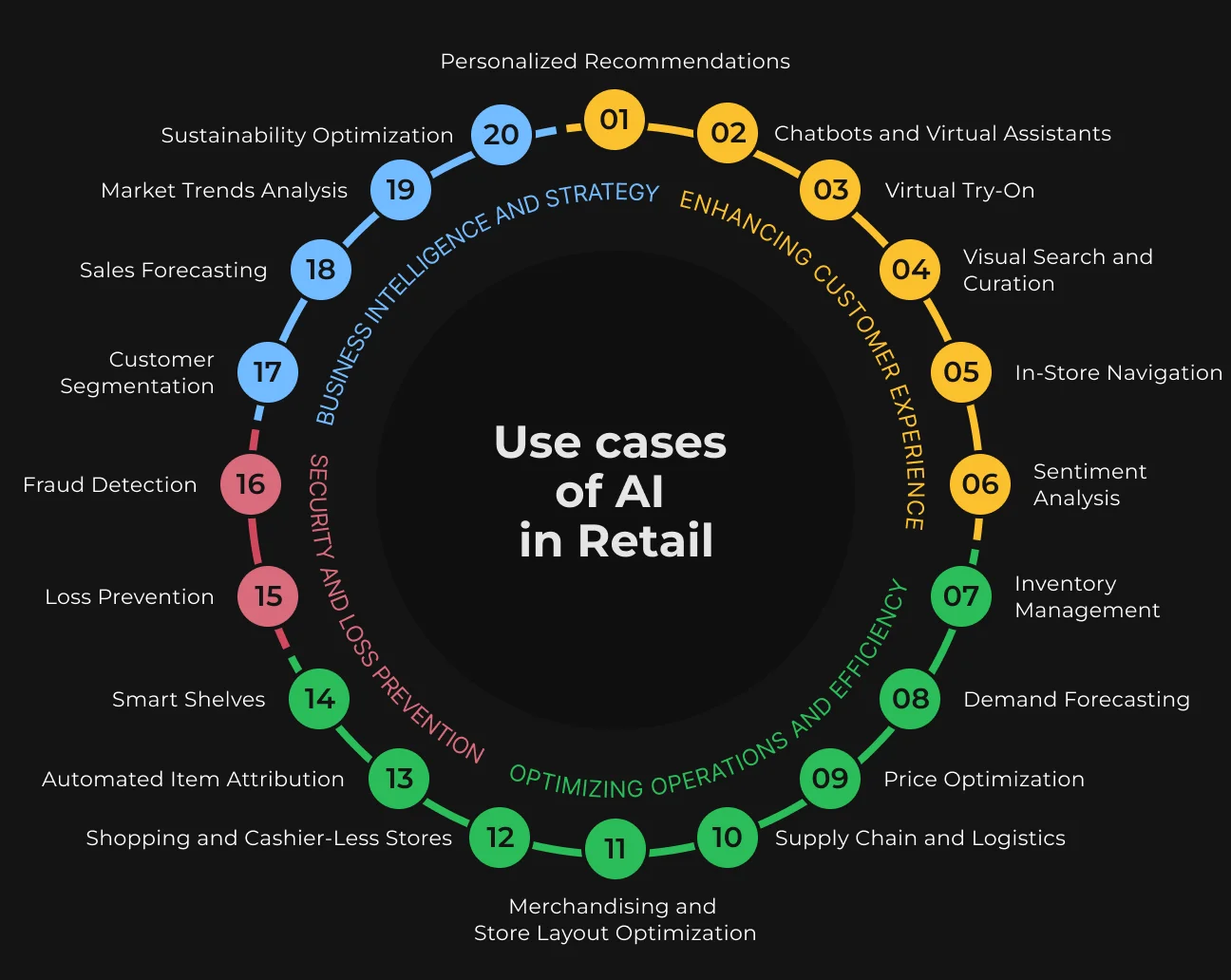
One example of AI-driven retail done right is our work with Footshop, a fashion e-commerce brand that partnered with SapientPro to build a fast, scalable storefront integrated with smart search and inventory systems. Let's explore some of the most impactful cases of using AI in retail.
Enhancing Customer Experience
When AI is directed towards customer satisfaction, it proves to be useful and brings positive outcomes for businesses.
1. Personalized Recommendations
Recommendation engines are one of the clearest AI in retail examples of high value. By analyzing past purchases, browsing behavior, cart activity, and even social media trends, these systems deliver product suggestions that actually make sense.
Instead of offering every shopper the same list of bestsellers, retailers can serve tailored recommendations that drive both engagement and conversions. This approach has been shown to lift revenue significantly—up to 35% of Amazon's sales come from its recommendation system.
Tools like collaborative filtering, deep learning, and real-time behavioral tracking power these engines. In our breakdown of AI in eCommerce, we explain how personalized recommendations influence every step of the buyer journey from homepage to checkout.
2. Chatbots and Virtual Assistants
Smart chatbots have replaced static FAQ pages for good reason. Powered by natural language processing and AI training data, they can respond instantly to customer queries, guide users through the shopping process, and even help resolve issues like refunds or shipping delays.
Retailers using chatbots report faster response times, higher satisfaction, and fewer abandoned carts. For example, Alibaba employs AI chatbots to manage approximately 75% of Alibaba's online consultations and 40% of phone hotline inquiries.
3. Virtual Try-On
Virtual try-on technology powered by AI lets shoppers preview how clothes, shoes, accessories, or makeup will look on them without stepping into a store. This feature improves engagement and reduces return rates, which are a major challenge in online retail.
Using computer vision and body-mapping AI, virtual try-ons help customers make confident decisions. Luxury brands like Gucci, Chanel, Louis Vuitton, and others have already embraced this tech, reporting higher conversion rates and fewer product returns.
4. Visual Search and Curation
Ever had a customer say, “I want something like this,” while holding up a photo? AI makes that possible at scale. Visual search tools allow shoppers to upload or take a photo and instantly find matching or similar products in your store.
Behind the scenes, these tools use image recognition and deep learning to compare colors, shapes, styles, and textures. It's helpful and much faster than manually browsing categories. Combined with curated suggestions, it keeps shoppers engaged while reducing bounce rates.
5. In-Store Navigation
In large stores, finding a product can be a challenge. AI-enabled apps now offer indoor navigation, guiding customers directly to the items they want based on their shopping list or previous behavior.
Using Wi-Fi signals, beacons, and visual tracking, the system maps out real-time routes. Combined with promotions or upsells along the path, it turns store visits into smoother, more productive experiences for shoppers.
6. Sentiment Analysis
What do customers really think about your products? AI can sift through thousands of reviews, social posts, and survey responses to detect emotional tone: positive, negative, or neutral.
This feature helps brands detect issues early, adjust messaging, or even update products based on what users are saying. Tools powered by AI for sentiment analysis make it possible to track trends over time and respond with precision.
Optimizing Operations and Efficiency
Besides enhancing customer satisfaction, AI is good at optimizing business operations. By minimizing stockouts and improving store layouts, AI can greatly assist you in cutting costs, reducing errors, and accelerating daily processes.
7. Inventory Management
Manual stock tracking is slow, error-prone, and expensive. AI improves inventory management by automating monitoring and replenishment. Using historical sales data, shelf scans, and live store activity, AI can predict when to reorder, which products are moving fast, and where shortages are likely to happen.
Advanced systems even consider external factors like holidays or weather to refine their forecasts. In our article on AI for inventory management, we explain how AI tools help balance inventory to avoid both overstocking and missed sales due to empty shelves.
8. Demand Forecasting
How much of each product should you order next month? AI-powered demand forecasting answers this question with high accuracy by analyzing past sales, seasonal patterns, marketing campaigns, and regional behavior.
According to the International Journal on Science and Technology, AI-driven demand forecasting helps reduce out-of-stock rates by up to 30% and slash inventory costs by 25%. Accurate forecasts also help with staffing, delivery planning, and warehousing, giving retail teams more control over the future.
9. Price Optimization
Pricing has always been a balancing act. Too high, and you lose customers. Too low, and you leave money on the table. AI solves this puzzle by adjusting prices in real time based on inventory, competitor behavior, demand, and even customer profiles.
This approach is called dynamic pricing, and it's already used by major players like Amazon and Walmart. We explored the value of smart pricing strategies in our guide to dynamic pricing. When done right, it improves margins without hurting customer satisfaction.
10. Supply Chain and Logistics
AI plays a critical role in keeping the supply chain agile. It can spot disruptions, reroute shipments, optimize warehouse storage, and reduce fuel costs in delivery planning.
AI models also help retailers predict delays, avoid overstock at distribution centers, and maintain transparency across vendor networks. With real-time data and intelligent forecasting, logistics becomes less reactive and more strategic.
11. Merchandising and Store Layout Optimization
The way products are arranged in-store or online affects how people shop. AI uses shopper behavior, heatmaps, and clickstream data to recommend better product placements or category groupings.
You can simulate different layouts, test product clusters, and even predict how visual changes will impact sales. This technology leads to smarter merchandising decisions and higher conversion both in physical stores and on e-commerce platforms.
12. Shopping and Cashier-Less Stores
AI enables completely checkout-free shopping experiences by combining computer vision, sensors, and machine learning. Shoppers simply walk in, pick what they need, and leave, and AI does the rest, tracking selections and charging them automatically.
Amazon Go stores are a prime example. But smaller retailers are adopting similar tech to reduce wait times, staffing costs, and human error. These systems also collect rich behavior data that feeds into other AI tools for personalization or inventory tracking.
13. Automated Item Attribution
Adding or updating product listings takes time, especially when working across thousands of SKUs. AI can automatically generate product titles, descriptions, tags, and attributes by analyzing images, specifications, and user data.
AI helps keep catalogs accurate, consistent, and optimized for search. It's especially useful in marketplaces and fast-moving categories like fashion or electronics.
14. Smart Shelves
Smart shelves combine weight sensors, cameras, and AI to monitor product availability in real time. They alert staff when items need restocking or when shelf organization is off.
Some systems even detect misplaced items or track shopper interaction with products, which is valuable information for both operations and marketing. Combined with inventory AI, smart shelves create a connected ecosystem that reduces manual work and improves on-shelf availability.
Security and Loss Prevention
Security challenges in retail aren't new, but AI makes it possible to prevent loss and fraud in real time. AI systems monitor transactions, detect suspicious behavior, and reduce risk before damage is done.
15. Loss Prevention
Retailers lose billions annually to theft, operational errors, and fraud. AI-powered surveillance systems and transaction monitoring tools help catch these issues early.
In physical stores, computer vision tracks self-checkout stations, watching for missed scans or product swaps. In back offices, AI reviews inventory flow to flag unexplained losses or irregular patterns. Some systems even detect when employees or customers behave in ways that suggest intent to steal.
16. Fraud Detection
Fraud detection goes beyond physical stores; it's a big issue in eCommerce, too. AI is now central to fighting:
- Payment fraud
- Account takeovers
- Promo code abuse
- Refund fraud
Machine learning models flag anomalies in transaction history, such as unusual order sizes, location mismatches, or inconsistent browsing behavior. Over time, these models improve, catching threats faster and with fewer false positives.
Business Intelligence and Strategy
Besides solving problems, AI helps you see them before they start. Smart retailers use AI to support high-level decisions, strategy planning, and customer targeting.
17. Customer Segmentation
Not all customers behave the same. AI helps retailers create dynamic, data-driven customer segments based on shopping behavior, frequency, spending, preferences, and more.
Unlike basic demographics, AI uses clustering algorithms to find natural groupings in your data. This segmentation allows for personalized messaging, targeted promotions, and better product placement. Segments can shift over time, and AI tracks those changes automatically, keeping your marketing efforts relevant and effective.
18. Sales Forecasting
Sales forecasting with AI goes deeper than spreadsheets. It considers a wider range of variables, such as promotions, trends, inventory, external events, and even weather, to predict demand more accurately.
Retailers use this information to plan production, staffing, fulfillment, and pricing. AI-powered forecasts are faster, updated in real time, and continuously improve with new data.
19. Market Trends Analysis
AI systems monitor social media, product reviews, search trends, and competitor activity to detect what's gaining traction. This analysis helps you stay one step ahead in product development, promotions, and inventory planning.
20. Sustainability Optimization
AI helps retailers track emissions, reduce waste, and optimize resource use across operations.
Use cases include:
- Optimizing delivery routes to cut fuel use;
- Monitoring energy consumption in stores and warehouses;
- Predicting food spoilage or expiration in grocery and CPG;
- Flagging suppliers that don't meet environmental standards.
As more regulations and consumer expectations push for transparency, AI helps retail businesses stay compliant and credible. This practice is also known as Green AI.
Benefits of AI in Retail
The value of AI in retail is as practical as it gets. Companies adopting smart systems are already reporting faster operations, higher profits, and better customer relationships. Here are the top business benefits AI brings to the retail world.
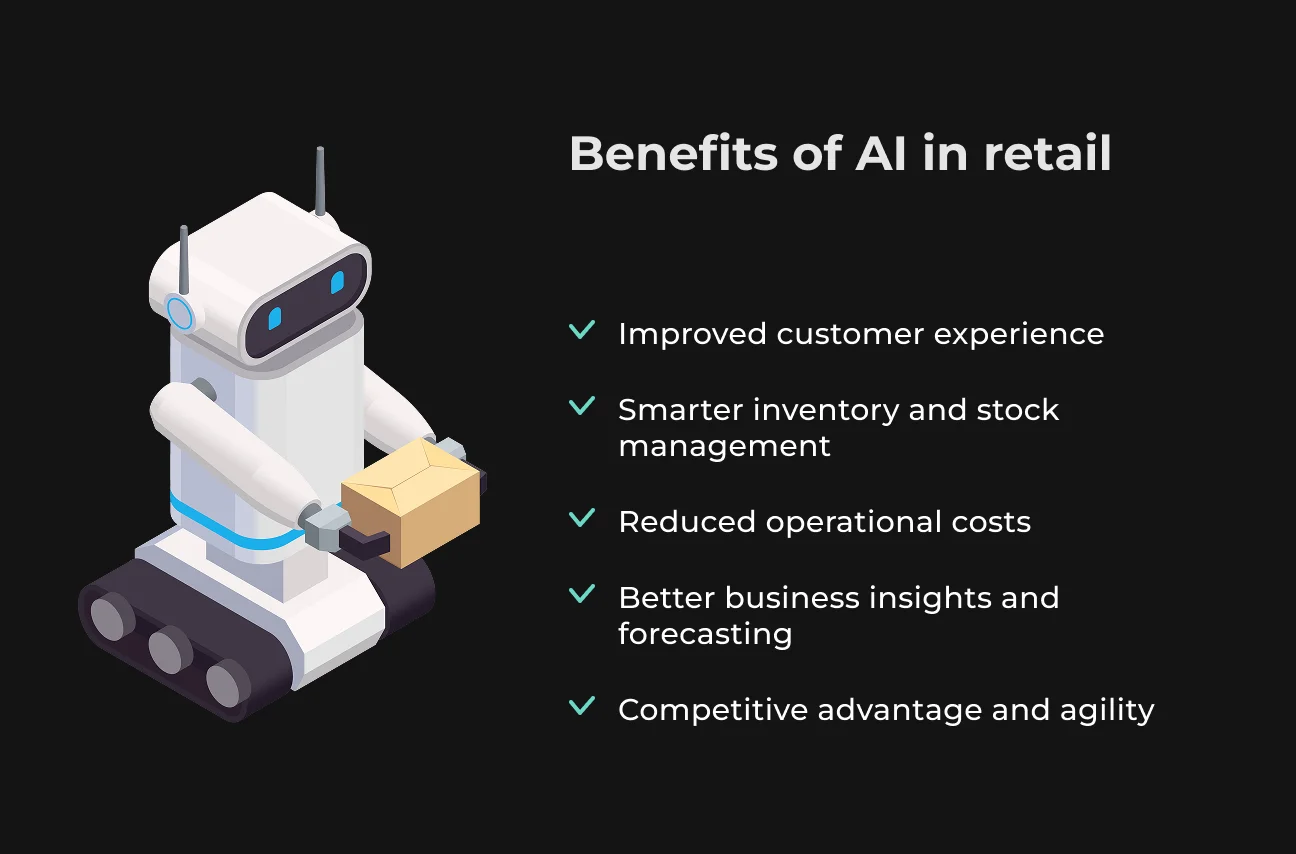
1. Improved Customer Experience
AI helps you treat every shopper like a regular. With recommendation engines, chatbots, virtual try-ons, and voice assistants, retailers can deliver real-time personalization across all touchpoints.
Customers no longer have to dig through cluttered menus or look at irrelevant products. AI tools suggest what they're most likely to buy, answer their questions instantly, and guide them through their journey. Personalization leads to higher satisfaction and more return visits.
2. Smarter Inventory and Stock Management
With AI, retailers no longer need to guess what products to restock or when to do it. Machine learning models forecast demand based on purchase history, holidays, seasons, and even social trends. This feature helps reduce both overstocking and out-of-stock situations.
As reported earlier, AI in inventory forecasting can significantly lower stockouts and cut inventory-related costs. These savings directly improve your bottom line and reduce waste across the supply chain.
3. Reduced Operational Costs
Automation is one of AI's most substantial benefits. With cashier-less stores, smart shelves, fraud detection systems, and chatbot-based support, AI reduces the need for manual work in nearly every department.
Tasks that once took teams of people, like tagging products, analyzing customer reviews, or responding to common support tickets, can now be handled instantly and around the clock. Automation allows human workers to focus on higher-value tasks while AI handles the routine.
4. Better Business Insights and Forecasting
AI can tell you what's likely to happen next. Sales forecasting, customer segmentation, churn prediction, and trend spotting are all enhanced with real-time data and pattern recognition.
This information helps business leaders make faster, more confident decisions. When you're planning inventory, setting prices, or launching a new campaign, AI gives you a clearer picture of what will work and what won't.
5. Competitive Advantage and Agility
Retail moves fast, and AI helps you move faster. Companies that adopt AI tools early are often the first to identify trends, respond to customer needs, and test new ideas without risk.
For example, using generative AI, marketing teams can launch multiple ad variations in minutes. With AI agents, support teams scale instantly. And with digital twins, operations managers test changes in virtual environments before rolling them out.
When competitors are still guessing, AI-powered businesses are already adapting.
Future of AI in Retail
We’ve talked a lot about how is AI used in retail, and the trend is not slowing down; it continues speeding up. Here's a snapshot of what lies ahead:
- The global AI in e‑commerce market is set to grow from $7.25 billion in 2024 to $9.01 billion by 2025.
- Overall, AI in the retail sector is projected to reach $40.7 billion by 2030 with a 23% compound annual growth rate.
- Generative AI in 2025 is expected to become central to delivering multimodal insights, smarter search, and conversational commerce.
- Over 58% of consumers say generative AI has improved their online shopping experience, and 71% believe AI-generated try-on images increase confidence in buying.
What does this mean for your business?
AI's place in retail is shifting from experimental tools to mainstream infrastructure. Expect deeper integration across operations, marketing, logistics, and customer engagement, especially as multimodal AI and AI agents go from pilot to scale.
Real-world examples prove the potential. Retailers are using virtual try-ons, AI-generated content, real-time pricing, and voice agents as competitive advantages. But as these systems gain momentum, data coherence, transparency, and governance become critical.
Your systems must be built on high-quality data infrastructure with safeguards in place — an area where SapientPro guides clients through architecture, security, and scalability.
Partner with SapientPro to Build Your Retail AI Solution
When you work with SapientPro, you're building smart retail systems with a tech partner who understands your business goals. With 8+ years of experience in AI development and a deep track record in retail software, we help brands go from idea to deployment with tools that actually perform.
If you need to build a recommendation engine, set up smart inventory tracking, or launch AI-powered assistants, our team will guide you through every step:
- Planning;
- Prototyping;
- Integration;
- Scaling.
We don't offer cookie-cutter platforms. We build custom solutions tailored to your retail operations. Our engineers work closely with your team to design an impressive AI that is practical, scalable, and built for ROI. Contact us today to receive a free consultation and project estimate.
Implement AI into Your Retail Solution with SapientPro