All How Do Green AI Applications Support Sustainability?
August 31, 202520 min read


As AI and machine learning technologies are becoming more pervasive, sophisticated, and powerful, natural systems are being pushed to their limits. The obvious culprit is the pressing concern: AI systems consume large amounts of processing power.
A sobering statistic: ChatGPT responds to 195 million requests per day, requiring an estimated average electricity consumption of 564 MWh per day or 2.9 Wh per request.
But here’s what works: Green AI steps into the spotlight, producing insights into where energy is used, emissions arise, and efficiencies are achievable. The highlight is that there have been some promising results with eco-smart AI energy savings from 13% up to 115%.
Ever wonder how AI’s full potential can be harnessed without a negative impact on our planet? Or maybe you seek to outperform competitors by being an early sustainable leader?
In any case, this article is for you.
What is Green AI?
A branch of artificial intelligence, Green AI is about using data and algorithms to make smarter decisions on ecological harm reduction. In a sense, this is a movement for building energy-efficient and environmentally sustainable technologies. Green AI promotes eco-friendly practices across the AI lifecycle, from Research and Development (R&D) through to deployment.
The Green AI trend has developed as a response to the so-called Red AI, which prioritizes the use of AI systems with significant computational resource needs, resulting in a high carbon footprint.
Alternatively, Green AI systems are designed for energy efficiency and sustainability with minimized environmental impacts. Compare the facts on these two approaches to AI development in the chart below:
Aspect | Red AI | Green AI |
| Primary Characteristics | Massive computational power, State-of-the-art accuracy, Large-scale deep learning models ⇩ High resource demand | Efficiency-oriented, Optimizing algorithms, Energy-efficient practices ⇩ Reduction in resources spent |
| Environmental Impact |
|
|
| Focus |
| Accuracy = resource efficiency |
Benefits of Green AI Technology for Businesses
Green AI models are a valuable option, reshaping technology through environmentally sustainable practices. See a range of advantages that Green AI is offering to modern businesses.
Key Benefits | Specific Benefits | Description |
| Cost Savings | Energy Bills ↓ | Optimized energy usage in data centers. |
| Hardware Costs ↓ | Extended hardware lifespans minimize maintenance expenses. | |
| Corporate Sustainability | Carbon Footprint ↓ | Reduced greenhouse gas emissions. |
| Brand Image ↑ | Enhanced brand reputation. | |
| Competitive Advantage | Customer Loyalty ↑ | Customers’ environmental concerns satisfied. |
| Investor Appeal ↑ | Socially responsible investments, boosting capital opportunities, attract investors. | |
| Resource Optimization | Waste ↓ | Reduced raw material waste and environmental impact. |
| Operational Efficiency ↑ | Higher productivity with fewer inputs. | |
| Innovation | New Product Development | Businesses create high-demand products and services. |
| Eco Opportunities ↑ | Access to industries and markets focused on eco-friendly solutions. | |
| Business Resilience | Resource Risks ↓ | Businesses adapt to resource shortages and climate-driven challenges. |
| Long-Term Growth | Businesses are better prepared for evolving market demands. |
Each Green AI advantage is dual-focused on profitability and environmental responsibility, ensuring both immediate and long-term gains for your business. By integrating Green AI technologies, enterprises embrace the strategies that are cost-effective, feasible, and environmentally sustainable.
What are the Challenges and Solutions of Green AI?
As with any widespread technological advancement, Green AI poses challenges which continue to grow. If organizations tackle them head-on with innovative solutions, these efforts can turn the promise of a more sustainable, clean-energy future into reality.
Take a look at the core Green AI key challenges along with their corresponding solutions.
Challenges | Solutions | |
Necessity for high-quality, relevant, and available data.
| → | Implementing robust data governance frameworks. Collaboration with stakeholders to aggregate and share relevant data from multiple sources. |
| Ethical and regulatory considerations regarding data privacy, transparency, bias, and accountability. | → | Establishing ethical guidelines for AI development that emphasize responsible practices, transparency, fairness, and accountability. |
Cybersecurity threats and potential privacy violations.
| → | Adopting strong cybersecurity measures and protocols alongside compliance with data protection regulations. |
| Significant energy resources consumption. | → | Optimization of algorithms for energy efficiency. Exploring alternative training methods. |
| Integration of diverse AI systems and sectors. | → | Facilitation of integration through partnerships between technology providers and industry stakeholders. |
| Output inaccuracies and misinformation risks. | → | Implementing rigorous validation processes for AI outputs. |
| Dynamic environmental factors hindering efficient resource management. | → | Utilizing real-time data analytics and machine learning models to adaptively manage resources based on current conditions. |
Applications of Green AI Across Industries + Examples
The Green AI field has reported remarkable progress in creating greener and smarter infrastructure facilities. Admittedly, it also comes with a sidekick: the new infrastructure is adopted and implemented across various stages of the energy value chain.
These vary from business development and construction solutions to healthcare and education. Check out the top picks of Green AI uses across different sectors.
Green AI Application in Building and Construction Services
Aiming to enhance environmental sustainability and safety, Green AI is becoming a powerful tool, which is resorted to for achieving:
- Energy efficiency. AI algorithms analyze factors like solar exposure, wind patterns, building orientation, and materials to minimize energy consumption. Another viable Green AI application is real-time energy management.
- Streamlined construction process. By predicting equipment failures before they occur, Green AI helps reduce energy waste and downtime. Optimized material usage and planning, as well as improved project timelines, are another upshot of sustainable Green AI projects.
- Modular construction. Unlike traditional on-site construction methods, Green AI assists in designing prefabricated components in controlled environments.
- Extended lifespan of building components. AI monitors building systems in real-time, making it possible to address maintenance needs prior to problems emerging.
- Sustainable material selection. AI evaluates the environmental impact of materials throughout their lifecycle, from extraction to disposal. Having been analyzed by AI, factors like durability, recyclability, and energy efficiency can guide the adoption of sustainable alternatives to traditional materials.
- Compliance with sustainability standards. AI automates data collection and analysis for green building certifications, for example, LEED.
- Sustainable design. Generative AI reduces carbon footprints and minimizes waste, creating numerous design alternatives.
AI applications in the building and construction domain are serving multiple purposes, transforming how structures are designed, constructed, and managed. These advancements offer new paths to a more sustainable environment and meet the growing demand for eco-friendly practices in construction.
Green AI Application in Retail and Supply Chain Services
AI plays a crucial role in sustainable retail and supply chain development by driving operational efficiency and fostering innovation. Modern AI solutions help businesses reduce costs, optimize resources, and make more environmentally responsible decisions.
One of the key benefits of Green AI is its ability to identify eco-friendly suppliers and materials, enabling retailers to build transparent and sustainable partnerships. AI can track product origins, ensure responsible sourcing, and promote accountability across the supply chain.
In energy management, AI-powered systems and smart sensors deliver significant savings. For example, advanced HVAC (heating, ventilation, and air conditioning) systems already used by major retailers like Walmart help reduce energy consumption while maintaining efficiency.
When it comes to transportation and logistics, Green AI improves fuel efficiency and reduces emissions through route optimization and predictive disruption management. By analyzing variables like traffic conditions and weather, AI can anticipate delivery challenges and recommend proactive adjustments, ensuring smoother and more sustainable operations.
Retailers also use AI to enhance customer experience while staying sustainable. Smart store operations minimize energy use without compromising convenience. AI-driven insights into customer behavior help businesses design eco-friendly offerings that align with consumer values.
By integrating Green AI, retail and supply chain services gain multiple benefits: reduced environmental impact, optimized transportation, sustainable sourcing, and energy-efficient operations – all while strengthening customer satisfaction and long-term business resilience.
Green AI's Application Role in Urban Settings and Traffic Management
The need to address challenges related to traffic congestion, air quality, and energy efficiency has become increasingly urgent. By applying data-driven insights, urban planners can steadily gain from Green AI. Take a look at the breakup of its possible applications, which will result in the creation of smarter and more sustainable cities.
Traffic Flow Optimization | ||||
| Methods | Real-time traffic data analysis | Historical and real-time data analysis | Roadways monitoring | Emissions monitoring |
| Operations | Dynamic adjustment of signal timing |
| Detection of traffic accidents and violations |
|
| Results |
|
|
|
|
Basically, Green AI seems to fuel significant progress in urban traffic management. It contributes to the integration of AI-driven energy optimization with smart city ecosystems and the adoption of electric vehicles. Green AI also supports ushering in public safety and mobility solutions adapted to the needs of growing urban populations.
Green AI Application in Agriculture and Farming Services
Contributing to sustainable initiatives in agriculture, Green AI can fundamentally transform traditional farming practices. AI applications are blazing a trail in agriculture to promote precision farming, provide valuable insights into crop health, soil conditions, and irrigation needs, permit farmers to make better use of resources, and alleviate ecological strain.
Approach | Overview | Example |
| Precision Farming | Smart data analysis (satellite imagery, soil sensors, weather forecasts) ↓ Informed decision-making on irrigation, fertilization, and pest control. | Microsoft’s FarmBeats project |
| Crop Health | Remote sensing ↓ Detecting crop diseases or pest infestations. | Plant Insights by Prospera |
| Soil Health Monitoring | Soil sensors ↓ Information on nutrient levels and pH balance | Delta-T Devices |
| Irrigation Needs | AI trained-models for data analysis ↓ Optimized water – nutrient uptake for crops Unnecessary watering reduction | CropX, Blue River Technology |
| Resource Optimization | AI-based analysis of soil moisture levels and weather conditions ↓ Water waste reduction Runoff reduction Overuse prevention | Microsoft AI for Earth Initiative Agrivi |
To bring everything together, Green AI practices amplify the agricultural response to the growing global demand for food and resources. AI certainly breaks new ground for farmers in integration with renewable energy sources, expansion of AI-driven climate resilience models, and cost reductions.
Green AI Application in Data Centers and IT Services
Without careful management, computing infrastructures of data centers and IT services could exert severe environmental impact. Green AI plays a transformative role in reducing the carbon footprint while providing energy-efficient solutions. Shown below is an assessment of AI potential for energy using optimization and operational efficiency.
Energy Optimization | ||
How It Works | Impact | Example |
Analysis of energy usage patterns ↓ Inefficiencies identification ↓ Adjusting the cooling systems, power distribution, and server workloads | Energy efficiency Cost savings Reduced environmental footprint | Google’s DeepMind AI |
Smart Cooling Systems | ||
Monitoring temperature, humidity, and server loads in data centers ↓ real-time decisions about power consumption based on current demand ↓ Adjusting cooling in specific zones | Reduced energy consumption Reduced cooling costs Decrease in greenhouse gas emissions | Alibaba Cloud |
Predictive Maintenance | ||
Using machine learning ↓ Prediction of potential failures in data center equipment
| Reduced downtime Reduced maintenance costs Improved energy efficiency | IBM’s AI-based monitoring systems |
Renewable Energy Integration | ||
Predicting energy needs ↓ Aligning energy demand with renewable resource availability | Digital Realty’s San Francisco facility | |
Apart from the highlights outlined in the table, Green AI helps manage dynamic workloads, optimizes virtual machine allocations, and tracks real-time energy consumption and carbon emissions in IT operations.
With AI development accelerating, data centers will contribute positively to environmental sustainability while meeting increasing computational needs.
Green AI Application in Manufacturing Services
Green AI is transforming manufacturing by introducing sustainable, efficient, and innovative practices. Unlike traditional AI, which focuses mainly on performance, Green AI prioritizes reducing environmental impact while maintaining productivity.
Energy optimization is one of its strongest benefits. AI-powered systems monitor real-time energy data to cut costs and consumption. Manufacturers can schedule production during off-peak hours, lowering energy expenses and reducing carbon footprints.
AI also plays a vital role in waste reduction. Smart systems classify and sort recyclable materials, optimize disposal processes, and predict equipment failures. This minimizes downtime, prevents unplanned maintenance, and reduces waste-related inefficiencies.
Another area where Green AI makes a difference is supply chain visibility. By optimizing material selection, logistics, and routing, manufacturers lower transportation emissions. AI also supports the development of low-carbon materials, creating sustainable alternatives with reduced environmental impact.
Prioritizing Green AI offers manufacturers a competitive advantage. It helps tackle rising energy consumption, waste management challenges, resource-intensive materials, and carbon emissions. By adopting AI-driven sustainability practices, manufacturers can significantly cut their environmental footprint while boosting productivity, efficiency, and long-term profitability.
Green AI Application in Healthcare
The advancement of Green AI practices into the healthcare sector seems to be redefining the notions of patient care, efficiency, and sustainability. Here are some basic Green AI applications fitting healthcare low-impact needs.
- Waste management systems: AI algorithms can analyze disposal patterns;
- Energy efficiency: AI regulates lighting, HVAC systems, and equipment operations;
- Telemedicine platforms: AI provides remote healthcare support;
- Medical Imaging: AI streamlines diagnostic visualization processes like X-rays, MRIs, and CT scans.
- Supply chain management: AI can assist healthcare organizations in selecting suppliers based on their sustainability practices.
- Drug development: Green AI accelerates drug discovery.
- Energy-Efficient Data Processing: AI strategies can help minimize the carbon footprint associated with data management.
Waste solutions, optimized energy use, remote clinical care, pharmacological advancement, energy-saving data workflows, and many more – this is where Green AI proves its value. Prioritizing eco-friendly AI in the healthcare sector can significantly reduce its environmental footprint while enhancing overall operational effectiveness.
Green AI Application in FinTech
As Green AI practices are advancing industry-wide, the FinTech sector has adopted them too. By the look of things, eco-smart AI is reshaping tech-driven financial services by enabling sustainable, efficient, and innovative financial solutions.
Get some insights into how this is applied in the real-world.
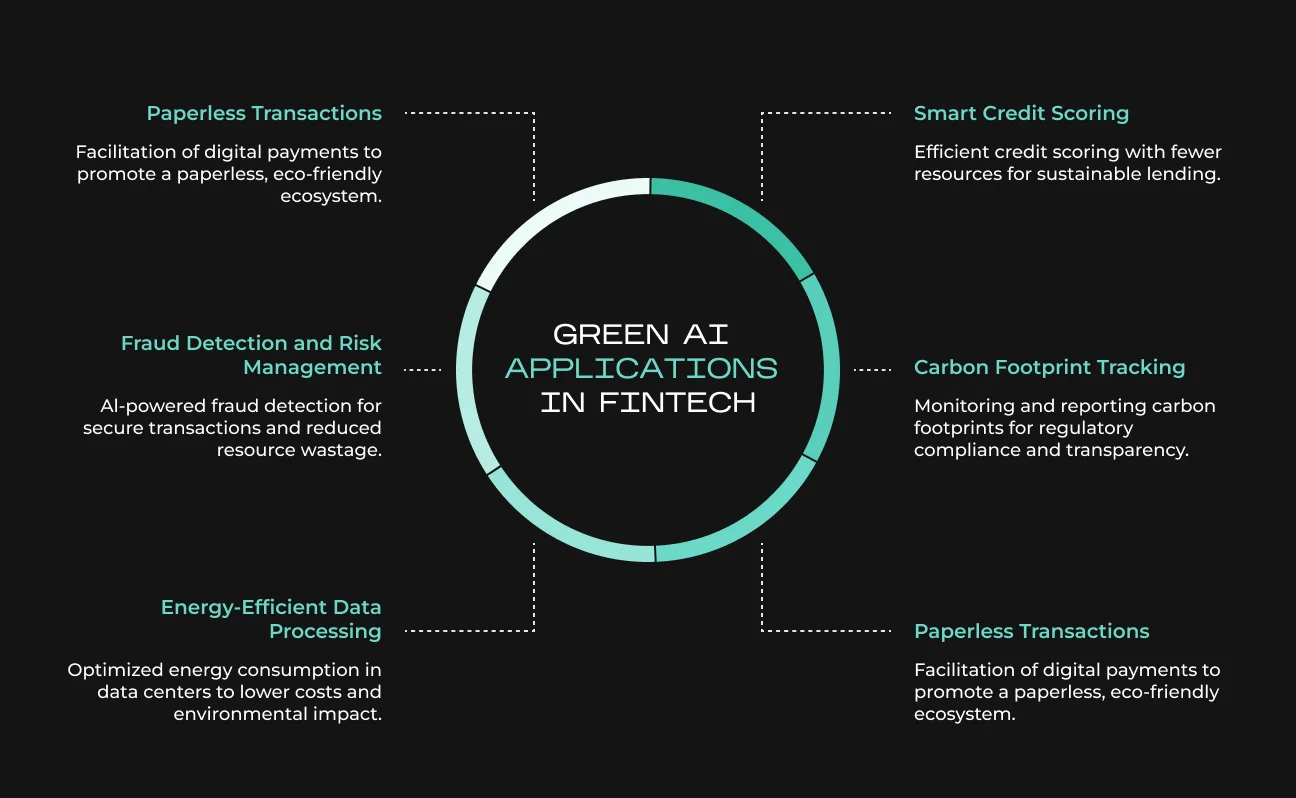
The pressing issues of high-energy consumption in data centers, inefficient resource allocation, lack of sustainable investment insights, inadequate carbon footprint tracking, and increased costs from redundant processes can be adequately addressed by implementing environmentally responsible AI solutions in the digital finance sector.
Green AI Integration in Education
Educators’ arsenal is now being enriched by sustainable machine learning applications. Integrated into the education sector, Green AI enhances learning experiences and promotes eco-consciousness within educational institutions. Gain the clarity with our table: explore eco-AI in education with ease.
Resource Optimization ↓ Reduced need for paper and physical materials | Tailored Education ↓ Resource waste minimized through the emphasis on individual needs and progress | Data-Driven Insights ↓ Informed decision-making based on smart data analysis | Green Learning Platforms ↓ Reduced carbon footprint of digital learning |
Eco-Friendly Administration ↓ Reduced paper usage and resource consumption | Green Skills Development ↓ Students trained for eco-conscious industries | Smart Building Management ↓ Facilities energy conserved. | Efficient Resource Allocation ↓ Minimized waste output and improved utilization. |
Hardly surprising that learning facilitators are sticking with Green AI: it gives the educational sector enhanced quality and accessibility of learning experiences, together with lowered environmental impact.
Green technology contributes to a more balanced future while preparing students to tackle pressing global challenges.
Green AI Application for Transportation
The transportation sector can also do well by pulling sustainable AI deep into its ecosystem. Low-carbon AI potential seems enormous. Take a look at our detailed analysis to find out what tangible results its application can deliver.
Eco-Smart AI Application | Anticipated Gains | Use Case |
| Energy-Efficient Routing | Reduced fuel consumption and emissions | Tesla utilizes AI to recommend the fastest and most energy-efficient routes |
| Efficient Fleet Management | Optimized energy usage, Extended vehicle lifespans, Minimized environmental impact | AI used to monitor fleet conditions, ensuring timely repairs and efficient operations |
| Optimizing Supply Chains | Reduced fuel consumption and lower emissions | AI-powered systems streamlining the transportation of goods |
| Driving Patterns for Autonomous Vehicles | Energy-efficient decisions, such as minimizing unnecessary acceleration or braking | Autonomous driving technologies utilize AI to improve safety and fuel efficiency |
| AI-Enabled Infrastructure | Optimized flow and reduced congestion | Smart intersections equipped with AI dynamically managing traffic |
| Carbon Footprint Tracking | Carbon footprint of individual transportation choices tracked for data-driven decision-making | Apps providing insights into the environmental impact of various travel options |
Building the transportation sector’s efficacy for environmental stability in the digital age is a winning strategy if Green AI solutions are involved. The gains these solutions bring align with the global climate objectives, so that the mobility industry can significantly mitigate its environmental impact while improving overall operational performance.
Create Your Green AI Solution
SapientPro will help you integrate & build a powerful AI solution.

How to Integrate Green AI in Business?
In today’s digital age, as sustainable AI solutions become increasingly powerful, embracing them has become essential for businesses. However, implementation comes with several challenges, mainly related to:
- Balancing performance with eco-friendliness;
- Measuring impact effectively;
- Keeping pace with rapid tech advancements;
- Managing investment costs.
To overcome these challenges, tech companies are adopting strategic approaches. Below are ten practical steps to help integrate Green AI into your business.
Step 1: Set clear sustainability goals
Begin by defining sustainability goals that align with your corporate vision and overall strategy. These goals should be specific, measurable, and realistic, covering areas such as reducing emissions, optimizing energy consumption, and minimizing waste. Clear objectives provide the foundation for integrating AI-driven solutions effectively into long-term sustainability plans.
Step 2: Identify areas for AI optimization
Assess your current operations to identify where AI can deliver meaningful sustainability improvements. This includes analyzing energy usage, supply chain efficiency, and carbon emissions. Additionally, gather detailed operational and environmental data that can be used to train AI models, ensuring they are aligned with the unique needs and challenges of your business.
Step 3: Adopt energy-efficient AI solutions
Choose AI technologies and platforms that are designed with energy efficiency in mind. Partner with cloud providers that prioritize renewable energy sources for storage and processing. By selecting solutions optimized for sustainability, your business can reduce its environmental footprint while still benefiting from the advanced performance that modern AI systems offer.
Step 4: Automate to reduce waste
Introduce AI-driven automation to streamline workflows, reduce reliance on paper, and optimize resource usage. Intelligent automation can also improve logistics, inventory management, and transportation networks, cutting unnecessary emissions and waste. These improvements not only enhance eco-friendliness but also reduce operational costs and strengthen overall business efficiency in measurable ways.
Step 5: Train AI models for sustainability
Develop AI models tailored to address sustainability challenges within your business context. For instance, models can predict energy demand, optimize recycling processes, or monitor environmental risks. Deploying these models across business systems ensures that sustainability is not a side initiative but an integrated part of your daily operations.
Step 6: Monitor and refine AI performance
Once deployed, AI models must be continuously monitored to ensure they are meeting sustainability benchmarks. Use performance metrics to evaluate their effectiveness in reducing emissions, saving resources, or improving efficiency. Regular refinement allows your AI systems to adapt to changing conditions and deliver even greater impact over time.
Step 7: Foster cross-team collaboration
Encourage collaboration across teams by involving stakeholders from IT, operations, and sustainability departments. Green AI integration requires diverse expertise to balance environmental goals with business performance. Fostering collaboration builds a culture of shared responsibility, ensures smoother implementation, and helps employees embrace sustainability as a core part of the company’s mission.
Step 8: Innovate with eco-friendly products and services
Use Green AI to design new products and services that prioritize sustainability without sacrificing customer experience. This may include personalized offerings that minimize waste, or solutions built with environmentally responsible materials. Innovation in this space positions your company as a leader while meeting growing consumer demand for eco-conscious choices.
Step 9: Train employees on Green AI applications
Ensure employees receive proper training on how to use Green AI tools and applications effectively. This builds confidence and increases adoption rates across the organization. A well-prepared workforce can better leverage AI to make sustainable decisions, driving measurable improvements in both efficiency and environmental responsibility.
Step 10: Partner with sustainability-focused providers
Collaborate with vendors and partners who specialize in sustainable AI solutions. Building coalitions with like-minded providers strengthens your impact and creates opportunities for shared innovation.
These partnerships also ensure access to cutting-edge technologies and best practices, helping your company stay ahead in both sustainability performance and competitive positioning.
Partner with SapientPro to Build Your AI Solution
SapientPro is your trusted partner for developing AI solutions that combine innovation with sustainability. We help businesses adopt eco-friendly technologies that reduce environmental impact while driving efficiency and growth.
With us, you’ll get:
- Expertise in building AI systems optimized for energy efficiency and sustainability;
- Smart automation tools that cut waste and improve resource management;
- Scalable, future-ready solutions tailored to your industry needs;
- A partner committed to aligning technology with green business goals.
Ready to transform your business with Green AI?
Contact us today to explore how we can bring your sustainable innovation to life.
Get a Powerful AI Solution with SapientPro
We'll help you integrate and develop the best AI solutions for your business.