All Generative AI in Real Estate: Use Cases & Trends
July 21, 202515 min read


Real estate isn't what it used to be, and that's a good thing. In 2025, the industry is fully about data, automation, and AI-driven speed. Generative AI is rapidly becoming the secret weapon for agencies, investors, and commercial developers who want to make smarter decisions faster.
We're not talking about science fiction scenarios.
We're talking about real tools that are able to change how properties are bought, sold, and managed.
According to McKinsey, companies that integrate AI into their workflows can boost revenue by up to 15 to 40%. Another study from Statista showed that in 2023, only 14% of real estate firms used AI in some capacity, but this technology is no longer a trend; it's a full shift leading to drastic revenue growth.
Imagine generating personalized property recommendations in seconds, staging empty apartments virtually, or predicting pricing shifts before your competitors even notice them. That's what's already happening, and this article will show you how.
The examples described in this guide come directly from SapientPro's engineers, who have over 8 years of hands-on experience building real-world AI solutions. If you're running a real estate agency, investing in commercial property, or building next-gen platforms, this article is your starting point.
Key Takeaways
- Generative AI in real estate improves performance by automating tasks like content creation, customer support, and document analysis;
- Personalized property recommendations and predictive market analysis improve buyer engagement and decision-making;
- Use cases include virtual tours, automated valuations, staging, and risk assessments;
- AI helps real estate teams respond faster, reduce manual errors, and scale operations more effectively;
- The AI real estate market is growing rapidly, with a projected CAGR of 35% through 2030;
- Partnering with experienced AI developers like SapientPro ensures your solution is custom-built to match your business goals.
What is Generative AI in Real Estate?
Generative AI in commercial real estate implies the use of advanced machine learning models, especially those capable of creating new content, to improve the methods of how properties are bought, sold, listed, designed, and managed.
This branch of artificial intelligence can generate property descriptions, simulate interior designs, create 3D virtual tours, draft legal documentation, and even build predictive models that forecast market behavior. Imagine using professional real estate tools that think ahead.
The key difference between generative AI and traditional AI lies in its creativity. Instead of just analyzing data, generative models like ChatGPT, Claude, or DALL·E can generate brand-new assets:
- Texts;
- Images:
- Layouts;
- Entire floorplans.
So, what is AI in real estate? For real estate professionals, using such a system means fewer repetitive tasks and more time spent closing deals and connecting with clients.
For example, a commercial real estate platform can use generative AI to suggest investment opportunities based on zoning data, tenant demographics, and historical yield rates. Residential realtors can use it to instantly generate property descriptions or chatbot responses that sound human, adjusted to each visitor's preferences.
Now you can make your real estate workflow smarter, faster, and far more personalized. But you're not replacing human expertise; instead, you're giving it a powerful assistant that never sleeps, never misses a detail, and gets better with every use.
We've helped clients in the real estate industry design and implement AI systems that generate value from day one. If you're curious about what's possible or ready to build something new, keep on reading to learn what generative AI can do to help you get ahead of the competition.
Benefits of Generative AI in Real Estate
Generative AI is more than a tool for real estate professionals. It completely changes how they do their work. Instead of only responding to client needs, agents, developers, and investors can now anticipate them. The benefits go beyond simple automation.
Let's explore five core benefits of AI in real estate that are already creating a measurable impact.
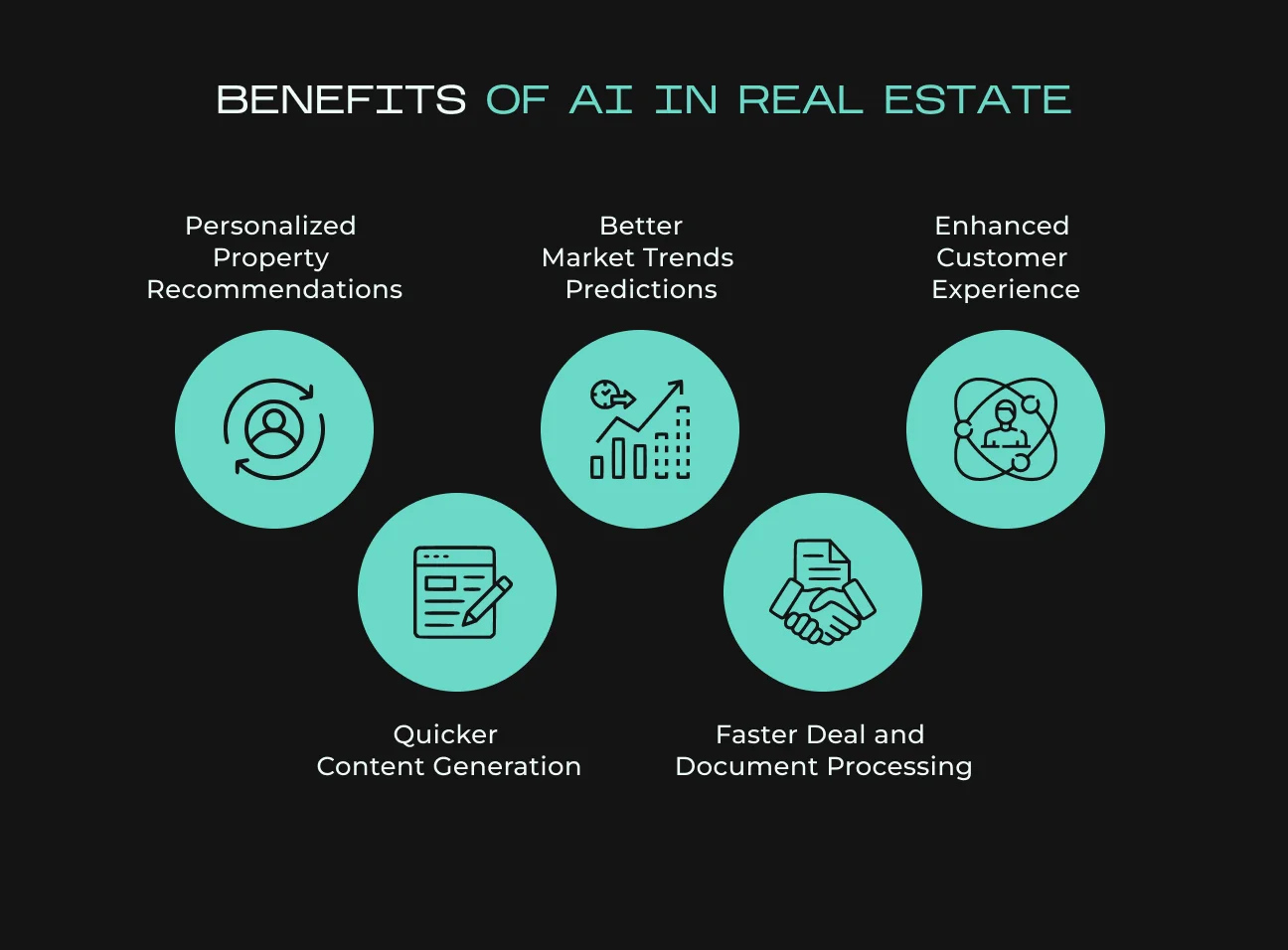
1. Personalized Property Recommendations
Every buyer is different, but most listing engines treat them the same. Generative AI changes that by building a personal profile for each user and then adjusting property suggestions in real time.
Besides taking price, location, or square footage into account, they consider behavioral data, search history, preferences from chat interactions, lifestyle indicators, and even social signals to recommend homes or commercial spaces that actually fit.
For example, if a user frequently looks at listings with large gardens and schools nearby, the system can automatically prioritize similar homes, even if they weren't part of the initial query. And the more the user engages, the smarter the engine gets.
This kind of personalized experience keeps users engaged longer and converts more leads into clients. It also helps agencies stand out in a crowded marketplace where generic listings no longer impress. SapientPro can help you deploy such a system to boost your conversion rate and improve lead quality while reducing manual effort in the sales funnel.
2. Better Market Trends Predictions
No real estate expert can predict the future, but generative AI comes close. By analyzing massive amounts of structured and unstructured data, these models can forecast:
- Property price trends;
- Rental demand shifts;
- Construction costs;
- Regional development potential.
They do it much faster and more accurately than traditional methods.
Generative models can even simulate “what if” scenarios:
- What happens if interest rates change?
- If a new tech hub opens nearby?
- If zoning laws adjust next year?
This information helps investors avoid risky bets, lets developers plan smarter projects, and gives brokers more confidence when advising clients.
In commercial real estate, especially, where long-term planning is crucial, generative AI helps identify patterns in years of local, economic, and demographic data. With the right tech partner, predictive planning is becoming accessible to any company willing to invest in the right tools.
3. Enhanced Customer Experience
In real estate, first impressions matter, and they often happen online. Generative AI helps real estate businesses create smoother, faster, and more relevant experiences that keep users engaged.
Your system can start answering buyer questions through conversational AI and instantly generate tailored property descriptions. Well-built AI tools make every interaction feel one-on-one.
For example, when a visitor lands on your site, generative AI can guide them with personalized suggestions, interactive chat, and dynamic content updates. These tools can adjust the tone of communication depending on user behavior.
They can be more formal for investors, more casual for families, or highly visual for international buyers.
Even after the first interaction, generative AI helps keep the momentum going. Follow-up messages, virtual showings, and document prep can all be automated, which saves time for agents and gives clients a smoother ride. As a result, you get fewer drop-offs, faster decisions, and more satisfied clients.
Our engineers have built conversational AI tools that help agents stay in touch without lifting a finger. Our clients reported a significant drop in response time and a noticeable improvement in client satisfaction. You can have an unlimited number of agents always ready to give potential customers the best answer in any language.
4. Quicker Content Generation
Content is king in any client-oriented industry, but its creation used to take much time and money. Now, generative AI can produce professional-grade content instantly. Property descriptions, blog articles, newsletters, listing updates, and even local guides can be generated in seconds and adapted to your audience.
Besides speed, consistency also matters. Generative tools ensure every listing follows brand tone, highlights the right features, and hits SEO targets. They can adjust the copy for different platforms, too, so you're ready to post on Zillow, LinkedIn, or your company site.
For example, when you upload a new listing, the AI can create a compelling title, description, bullet points, and even a short teaser for social media, all based on the photos and basic input. This versatility helps reduce bottlenecks in your marketing pipeline and gives your team more time to focus on deals.
Automating routine tasks while keeping empathy and creativity for human roles builds trust, engagement, and operational effectiveness. Use AI to enhance, not replace, meaningful interactions with customers.

Ihor Hamal
5. Faster Deal and Document Processing
Speed matters in real estate deals. When you need to draft contracts, verify client documents, or process lease agreements quickly, generative AI can drastically reduce turnaround times. These tools are capable of generating document drafts, summarizing legal text, and extracting key terms without losing accuracy.
Instead of spending hours on manual paperwork, agents can use AI to create legally sound templates, flag unusual contract terms, and highlight missing items in real time. The use of AI lowers the chance of human error and speeds up the closing process.
Commercial developers also benefit. Generative AI can help compile loan applications, zoning permits, and all the necessary documentation, and fill out repetitive forms without mistakes. With the right AI tool, you can turn a multi-day task into something manageable in under an hour. That kind of speed gives you more control and confidence in high-stakes transactions.
Use Cases of Generative AI in the Real Estate Industry
Generative AI is already doing far more than writing text or generating images. In real estate, it's solving everyday problems, such as making property data more usable, listings more appealing, and client journeys more fluid. The tools are practical and measurable. They are already shaping the way agencies, developers, and investors operate.
Let's look at some of the most relevant applications.
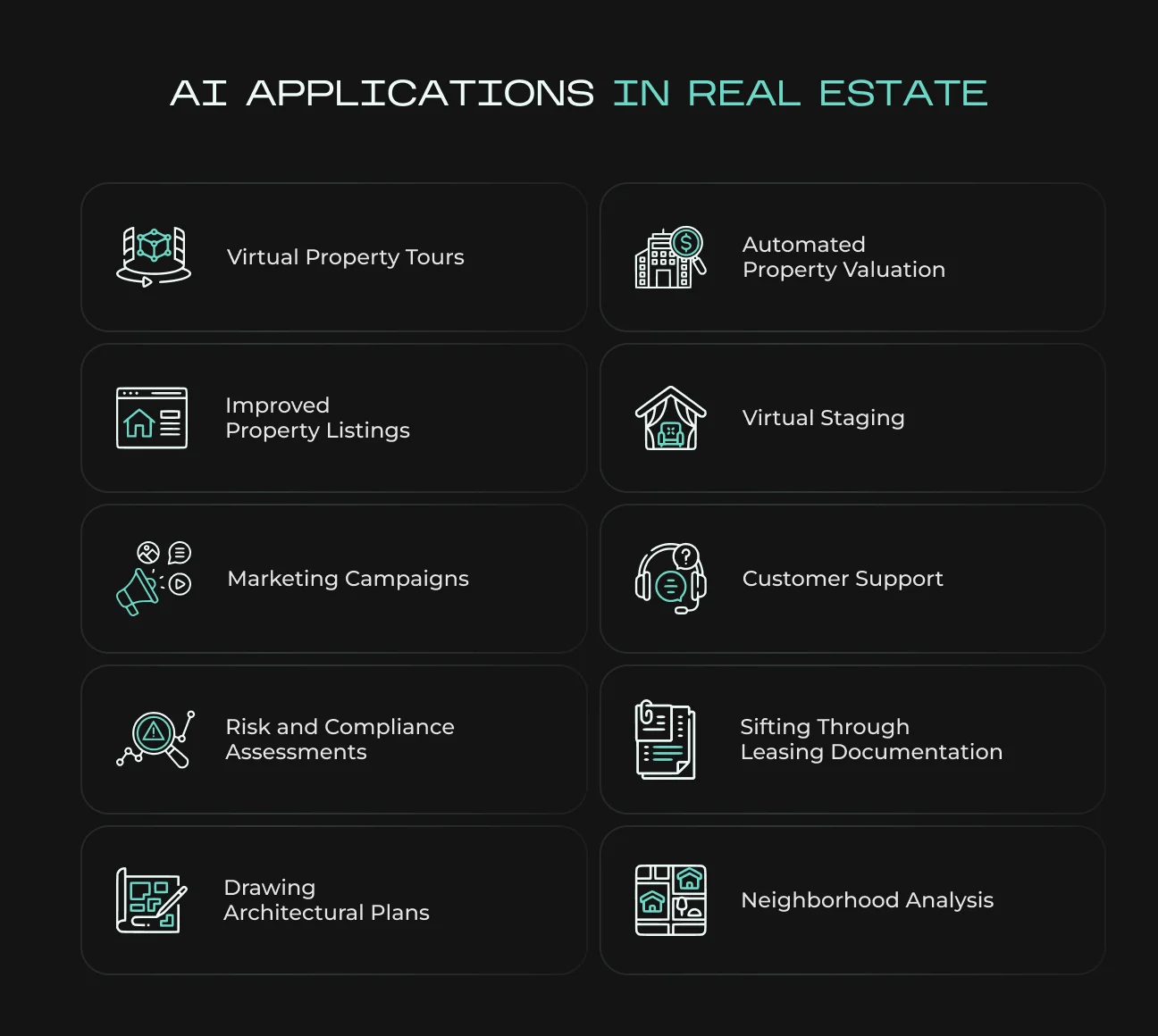
1. Virtual Property Tours
One of the most obvious use cases of generative AI in the real estate industry is the creation of immersive virtual tours. Instead of scheduling multiple in-person visits, potential buyers or renters can now explore properties from any device, anywhere in the world.
Generative models can reconstruct 3D environments from photos or floor plans, letting users “walk through” a space in real time. AI can create dynamic, clickable, and even customizable experiences. Buyers can see how the space looks at different times of day, change the furniture layout, or view staging for different use cases (like a home office or nursery).
This feature is especially useful in commercial real estate and international sales, where clients may not be able to visit every location in person. These tours save time, increase engagement, and make listings more attractive.
2. Automated Property Valuation
Pricing real estate right is part art, part science, and now, part AI. Generative models are being used to assist in real-time property valuation. To do that, they analyze historical pricing data, local trends, building conditions, and market volatility. The result is faster and more consistent pricing assessments.
AI can cross-reference public databases, previous sales, construction records, and even economic forecasts to suggest fair market values for homes, office spaces, or development lots. The valuation engine can also simulate pricing scenarios. For example, it can show how property value might change if the kitchen is renovated or a new subway line opens nearby.
For investors and lenders, this ability to evaluate property reduces risk and removes much of the uncertainty from appraisals. For agents, it means less reliance on outdated comps and more confidence when setting price tags.
If you're exploring how to establish vendor management in real estate, check out our detailed guide on developing a vendor search platform.
3. Improved Property Listings
Well-written listings sell faster, but writing them takes time. Generative AI takes the raw data (location, square footage, features, photos) and turns it into a polished listing copy in seconds. These descriptions can be adapted for different audiences, too. You can target investors, families, or first-time buyers, depending on where the listing is being shared.
Some platforms even use AI to generate multiple listing versions adjusted for different websites or social media platforms, with headline testing to increase click-through rates.
Besides writing text, AI tools can also enhance listings visually. They can optimize photos, suggest the best thumbnail for lead images, or even label rooms automatically in floorplan views. The main goal is to make the property more appealing and easier to understand at first glance.
These tools are especially valuable for agencies managing high volumes of listings or for real estate platforms where high-quality content brings engagement.
4. Virtual Staging
Empty rooms rarely inspire buyers. That's why staging has always been a powerful tool in real estate, but physical staging is expensive and time-consuming. Generative AI solves this by creating virtual staging that's photorealistic, fast, and customizable.
Using just a few photos, AI tools can insert furniture, decor, and lighting into a room with realistic proportions and textures. You can instantly generate different interior styles to match the target audience. For example, a luxury apartment can be staged for young professionals or downsizing retirees with just a few clicks.
Virtual staging also helps agents show a property's full potential without the logistical hassle of renting furniture or hiring a designer. Plus, it allows listings to go live faster, especially for newly built or recently vacated homes.
5. Marketing Campaigns
The success of a real estate marketing campaign greatly depends on the right content, shared at the right time, over the right channels. Generative AI can now take over much of that workload and generate ad copy, headlines, blog posts, social media ads, and even automated email sequences.
AI tools can find trending keywords that match local search queries (“2-bedroom loft in downtown Austin”) and tailor campaigns around high-converting phrases. They can create dozens of listing variants, A/B test CTAs, and even suggest which properties to feature based on engagement metrics.
For agents and teams that juggle dozens of properties at once, this functionality means always having fresh, optimized content without relying on external marketing teams. It's also a great way to keep digital ad campaigns lined up with what's actually in inventory.
6. Customer Support
Real estate clients ask a lot of questions: “What's included in the rent?” or “Can I use this property for short-term rentals?” Generative AI makes it possible to provide instant human-sounding answers 24/7.
You can train conversational AI tools on your specific policies, listings, and even regional laws so that instead of generic replies, they give specific information. These chatbots or voice assistants can guide users through the buying process, suggest listings, help schedule showings, and even assist with documentation.
Unlike traditional support systems, generative AI gets smarter over time. The more interactions it handles, the more context it gains, reducing errors and improving satisfaction.
If you're curious about how blockchain is shaping property transactions, ownership records, and asset tokenization in real estate, check out our guide on blockchain use cases in real estate.
7. Risk and Compliance Assessments
Real estate is tightly regulated, and it can be hard to stay compliant with zoning rules, loan laws, and lease terms. Generative AI can analyze contracts, agreements, and regulations to flag possible risks.
These systems can read through lengthy documents and highlight clauses that are unusual, outdated, or potentially non-compliant. For example, AI can alert developers if a zoning code in a contract doesn't match updated municipal laws, or if a lease agreement includes conditions that violate local rental caps.
It can also run cross-checks across different contracts, looking for inconsistencies or red flags, such as missing dates, incorrect figures, or legally risky terms.
This use case reduces the burden on legal teams and lowers the risk of costly oversights. It also helps agents and property managers keep everything in order as deals scale up or portfolios grow.
8. Sifting Through Leasing Documentation
Leasing contracts are often long, repetitive, and filled with legal terms that slow down the deal process. When a property manager is handling dozens of units or a broker finalizing a commercial lease, reviewing each clause manually means wasting valuable time. Generative AI tools can check these documents at scale and extract the information you actually need.
AI can highlight:
- Rental terms;
- Renewal options;
- Payment conditions;
- Tenant responsibilities.
The system can turn bulky legal text into an easy-to-understand summary. It can compare documents side-by-side, flag inconsistencies, and even suggest edits based on predefined standards or past agreements.
Using AI reduces the risk of missing critical details and helps teams onboard tenants faster and more accurately respond to client questions. If you're interested in how AI can support tenant screening and financial assessment, check out our full guide on developing an app for tenant solvency analysis.
9. Drawing Architectural Plans
Generative AI is also starting to support one of the most technical parts of real estate: architectural planning. By feeding models with zoning rules, lot dimensions, and building codes, AI tools can propose multiple design variations for a new residential or commercial space.
These models can generate basic floor plans, room layouts, and 3D concept visuals in minutes. Some systems can even incorporate elements like natural lighting, ventilation flow, and estimated construction costs to refine their suggestions.
While final plans still require a licensed architect to validate, generative AI significantly cuts the initial drafting time. It's a fast way to explore different layout ideas and iterate on designs before involving engineers or city planners. This option can be a big advantage in early-stage development or when clients want visual proposals during negotiations.
10. Neighborhood Analysis
Some of the most important features of any property are the things you cannot change yourself, and it's everything around it. That's why neighborhood analysis is so critical for buyers and investors. Generative AI helps here by pulling and summarizing a wide range of data sources to create detailed neighborhood profiles.
It can scan such sources as:
- Local news;
- Social media sentiment;
- Economic reports;
- School rankings;
- Traffic data.
This information paints a full picture of what it's like to live or invest in a certain area. It can be delivered in real time and automatically updated, which makes it more reliable than static reports.
For example, a system can give the buyer a breakdown of how safe the area is, what kind of retail is nearby, average noise levels, and the potential for price growth. For developers, this kind of intel is essential for choosing high-return locations and anticipating buyer behavior.
Generative AI correctly interprets raw data, which gives a great advantage to anyone trying to understand what makes a location truly valuable.
Leverage the Power of AI in Real Estate
SapientPro can help you integrate artificial intelligence into any process within your real estate business.
Future Trends of AI in Real Estate Usage
Artificial intelligence started a great revolution in all industries. The real estate sphere is experiencing remarkable changes, too. Let's look ahead and predict the key trends expected to shape the future of AI in real estate development.
1. Rapid Market Growth
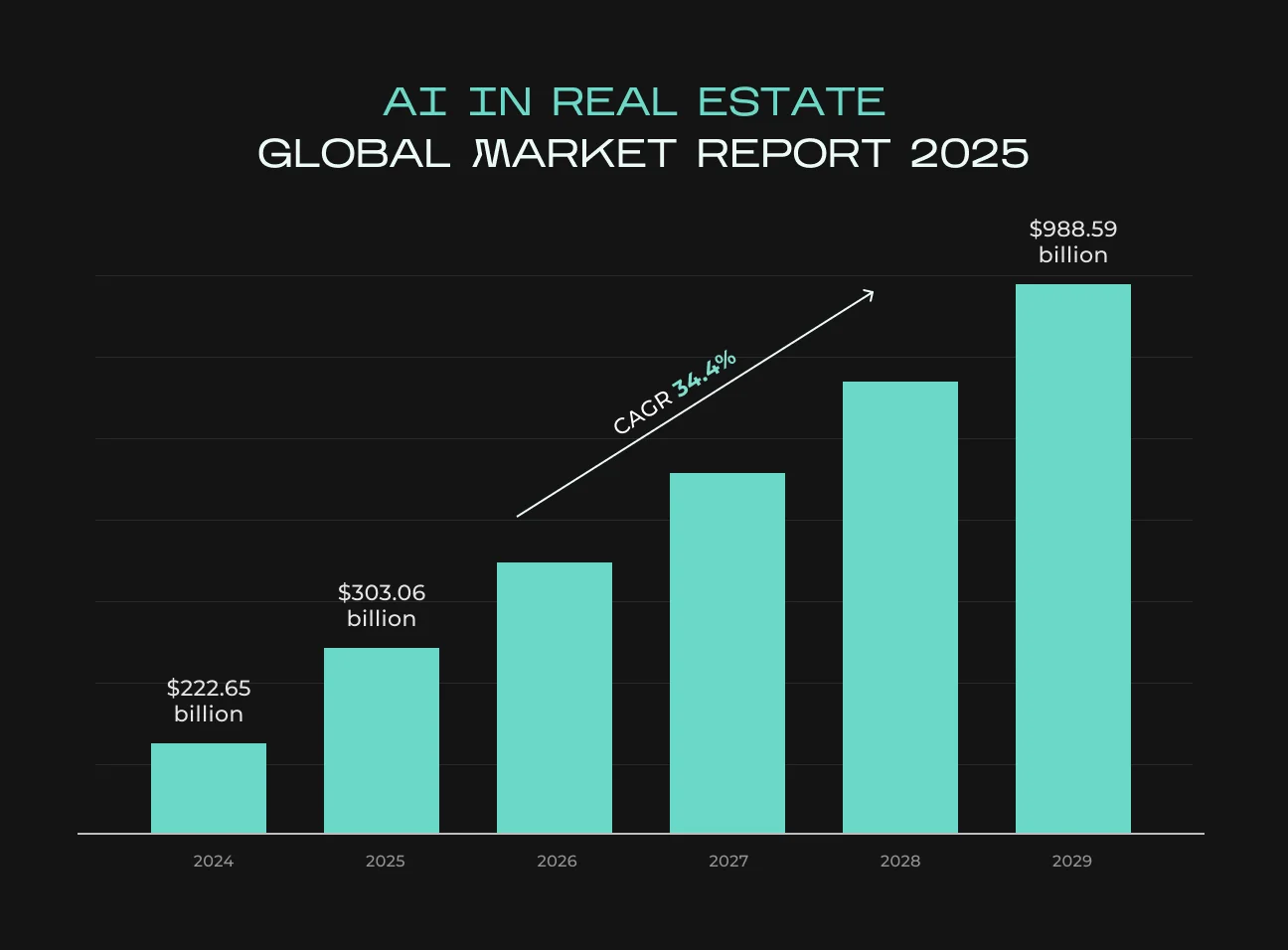
The AI in real estate market is experiencing substantial growth. According to Maximize Market Research, the market is projected to reach $1,803.45 billion by 2030, growing at a compound annual growth rate (CAGR) of 35%. This growth is fueled by the increasing adoption of AI technologies across various real estate applications.
2. Integration of IoT and AI
The intersection of the Internet of Things (IoT) and AI is enhancing property management and tenant experiences. IoT devices collect real-time data on building operations, which AI algorithms analyze to optimize energy usage, predict maintenance needs, and improve overall efficiency. This integration leads to smarter buildings and more responsive property management.
3. Generative AI in Design and Planning
Generative AI is the driver of changes in architectural design and urban planning. By analyzing vast datasets, AI can generate multiple design options that meet specific criteria, such as sustainability goals or zoning regulations. This analysis accelerates the planning process and allows for more innovative and efficient building designs.
4. Enhanced Predictive Analytics
AI-powered predictive analytics are becoming essential tools for real estate investors and developers. By analyzing historical data and market trends, AI can forecast property values, rental income potential, and market fluctuations. This functionality gives valuable information to investors and helps assess risks more accurately.
5. AI-Driven Customer Engagement
AI is changing the way how real estate professionals engage with clients. Conversational AI in real estate provides 24/7 support and instant follow-ups. Chatbots and virtual assistants quickly respond to inquiries, schedule viewings, and offer personalized property recommendations. Quick engagement enhances customer satisfaction and stimulates the sales process.
6. Data-Driven Decision Making
The abundance of data in real estate now can be put to good use through AI to make strategic decisions. Advanced algorithms can determine optimal pricing strategies and identify emerging market opportunities before the competition. AI enables real estate professionals to make data-backed choices that enhance profitability and competitiveness.
Roughly 49% of real estate business owners have reported seeing cost savings since adopting AI, bringing potential reductions in operational expenses by as much as 15%.
AI continues to get more and more advanced. Its integration into the real estate industry will deepen to offer new capabilities and efficiencies. If you want to leverage AI for strategic advantage, keep an eye on these trends.
Partner with SapientPro to Build Your AI Solution
Building an AI system for your real estate company means solving your specific business challenges with the right mix of tech and expertise. SapientPro's specialists don't push generic platforms or plug-ins.
We create customized solutions that match your goals in managing residential portfolios, leading a commercial development firm, or building a prop-tech startup.
With 8+ years of experience in AI development, our engineers know how to build tools that improve decision-making, reduce manual work, and increase deal flow.
We've worked with agencies, platforms, and investors to create generative AI systems that support listing generation, pricing predictions, document automation, neighborhood analysis, and more.
Partnering with SapientPro means gaining a long-term tech team that helps at each step:
- Clarifying your business goals;
- Choosing the right AI architecture;
- Designing the user experience;
- Training and testing models;
- Deploying and scaling the solution.
We build systems that bring measurable value. Book a free consultation with our team and we'll review your project, map out the solution, and deliver a clear estimate with real timelines. It's time to turn your real estate data into real results.
Get Expert AI Engineers in Your Project
SapientPro's team will help you get any type of AI in your solution: chatbots, agents, assistants, and more.