All How to Develop a Text Mining NLP Platform for Semantic Analytics in 2025
October 15, 202520 min read


Every email, support ticket, survey response, or social media post your business receives is loaded with useful information. The main challenge is making sense of it. IBM estimates that around 90% of all enterprise data is unstructured and can't be processed by traditional analytics tools.
And with the world generating 2.5 quintillion bytes of new data every day, the gap between “having data” and “using it” is only getting bigger. In this situation, a text mining NLP platform becomes invaluable.
It combines natural language processing with semantic text analytics, allowing companies to truly understand meaning, context, and sentiment in human language. That's why the global text analytics market is projected to grow from $10.1 billion in 2024 to $35.5 billion by 2033.
This article breaks down everything you need to know about building a text mining NLP platform for semantic analysis. You’ll get expert insights from SapientPro’s engineers with over 8+ years of expertise in AI development and integration.
Key Takeaways
- Semantic text analytics helps businesses move beyond keywords and interpret meaning, sentiment, and context in large volumes of text;
- A text mining NLP platform can handle structured, semi-structured, and unstructured data types, giving organizations a full picture of their information;
- Industries like finance, healthcare, retail, legal, and government are already leveraging NLP and text mining to detect risks, improve customer experiences, and accelerate research;
- Foundational methods like sentiment analysis, topic modeling, and information extraction transform raw text into structured knowledge;
- Building an AI NLP platform requires a strong architecture with ingestion, NLP processing, semantic enrichment, analytics, and DevOps security layers;
- Cloud services like AWS Comprehend, Google Cloud NLP, and Azure Text Analytics allow businesses to scale faster while reducing infrastructure overhead;
- Future-proofing your NLP text analytics system means integrating large language models, enabling continuous learning, and preparing for multimodal data analysis;
- Partnering with engineers with extensive experience like at SapientPro ensures that your text mining project delivers real business impact.
Business Impact of Semantic Analytics
We suspect that your business isn't struggling with a lack of data — it's overwhelmed by it. The real challenge is understanding what customers, employees, and users are actually saying in real time. That's where semantic analytics changes the game. You can combine NLP with structured and unstructured text mining to move from reading documents to understanding them at scale.
This process is already happening. Teams across industries are using text mining NLP platforms to detect intent, automate classification, monitor sentiment, and extract meaning from millions of words every day. Semantic analytics enables your organization to find patterns you didn't even know to look for and act on them fast.
Here are the business results:
- Faster customer support response times;
- Smarter decision-making in product development;
- Real-time risk and compliance alerts;
- Personalized user experiences at scale;
- Automated document processing workflows.
Industries Using Text Mining
Text mining and NLP aren't limited to tech giants or research labs. Let’s take a look at some of the industries getting real value out of AI NLP platforms.
Finance and Banking
Banks, insurers, and investment firms deal with oceans of reports, contracts, and regulations. A text mining platform can automate compliance monitoring, detect potential fraud in communication logs, and analyze sentiment in market commentary.
Healthcare and Life Sciences
Hospitals, research labs, and pharmaceutical companies process endless volumes of patient records, clinical notes, and publications. NLP and text mining help extract critical details, track drug side effects, and accelerate medical research. Semantic analytics even assists in matching patients with clinical trials.
Retail and eCommerce
Reviews, support chats, product descriptions — retailers generate massive text data. Text mining allows for real-time sentiment tracking, feature request clustering, and intent analysis for better search and recommendations.
Legal and Compliance
Law firms and compliance teams deal with thousands of contracts and legal documents. A well-structured AI NLP platform can automate clause extraction, identify risky language, and reduce document review times from weeks to hours.
Government and Public Sector
Agencies utilize text mining to analyze citizen feedback, track public opinion, and identify misinformation. It is also employed in security to flag potentially harmful communications across various languages.пгфм
With the right text mining NLP platform, these industries can understand their data at scale.
Types of Text Data
Before you build a text mining NLP platform for semantic analytics, you need to recognize the three main categories of text data. Each type carries different processing needs and value. Understanding them will help you choose the right tools and design your pipeline wisely.
Unstructured Data
This is text in its raw, free-form state. It has no fixed format or schema. This includes emails, customer feedback, chat logs, support tickets, web pages, PDFs, and even voice-to-text transcripts. As such, it resists traditional storage and querying methods.
Still, unstructured data constitutes the vast majority of information generated by organizations. Estimates suggest that anywhere between 70% and 85% is unstructured text, especially in business contexts.
Despite the messiness, this data holds untapped insight. NLP techniques, such as sentiment analysis, topic extraction, and named entities, can transform it into a structured form that your team can act upon. Without handling unstructured text, you risk missing the voice of your customers and stakeholders.
Structured Data
This data fits neatly into tables: fixed fields, regular columns, and predictable formats. Examples include survey scores, transaction logs, CRM entries, or numeric metadata flags. It's easy to query and suits traditional database systems.
Because structured data is already machine-readable, integrating it into your semantic text analytics platform is relatively simple. It can serve as metadata or input for hybrid analysis, like correlating sentiment from reviews (unstructured) with numeric user ratings (structured) to spot performance trends.
Semi-Structured Data
Semi‑structured data sits in between structured and unstructured. It doesn't fit neatly into tables but includes self-describing markers like tags or metadata that offer some structure. Common formats include XML, JSON, CSV, or loosely organized documents such as emails with headers.
This type of data blends flexibility and organization, enabling indexing. It's much easier to work with it than working with raw text alone. It supports diverse formats and integrates more smoothly with structured systems.
However, it introduces complexity: formats may vary, and an inconsistent structure can lead to analysis challenges and scaling issues.
Why These Distinctions Matter
When developing a text mining NLP platform, each type of data requires different handling:
- Preprocessing: structured data needs minimal cleanup. Unstructured text demands robust normalization, cleaning, and parsing. Semi‑structured requires both structural parsing and free text handling.
- Storage and Indexing: structured fields go into tables or data warehouses. Unstructured passages need indexes, embeddings, or document storage. Semi‑structured often demands hybrid storage like NoSQL or JSON-aware engines.
- Analysis Paths: you may combine structured metadata with text classification or enrich structured logs with topic modeling on embedded text. A well-designed platform supports fluid transitions among them.
You need to build different pipelines that treat each type of data according to its nature. This approach will draw a complete picture of the information generated by your organization.
Challenges of Linguistic Data for Semantic Analytics
Turning human language into something machines can understand isn't as easy as it sounds. People are vague. We use slang, sarcasm, mixed languages, or just bad grammar. While a human can usually read between the lines, a machine needs strict rules or enough examples to figure things out.
That's what makes semantic analytics difficult — especially when building a reliable NLP text mining platform for real-world use. Let's break down the most common challenges you'll face when dealing with linguistic data and what they mean for your platform's performance.
Ambiguity in Language
Words can have multiple meanings, depending on the context. For example, the word “bank” could refer to a financial institution or the side of a river. A human reader can usually tell the difference based on nearby words.
But an algorithm needs clear context rules, or a strong language model, to make the right choice. Without that, your system may misclassify entities, intents, or even entire sentences.
Impact: entity extraction, topic detection, and document classification accuracy drop without disambiguation strategies.
Synonyms and Variations
People say the same thing in different ways: “car,” “vehicle,” “auto,” “ride.” If your platform treats these as separate concepts, you're fragmenting insights. That hurts tasks like clustering, semantic search, or intent matching.
Building a good semantic text analytics system means creating mappings, or using embeddings, that understand similarity across wording.
Impact: keyword-based systems fail to scale. You need semantic matching, embeddings, or knowledge graphs to group variations effectively.
Misspellings and Noise
Social media posts, product reviews, and chat logs are full of typos, emojis, broken punctuation, and mixed languages. Cleaning that up is essential before you run NLP models.
But overcorrection can distort meaning. Under-correction makes your system fragile. Striking a balance takes custom preprocessing pipelines.
Impact: poor-quality input leads to model errors, false positives, or failed entity recognition.
Domain-Specific Jargon
Each industry speaks its own language. In healthcare, “CABG” means coronary artery bypass surgery. In construction, “punch list” has a very different meaning than it would to a layperson.
General NLP models like ChatGPT or BERT don't always understand domain-specific jargon. You'll need to fine-tune them with specialized corpora or dictionaries.
Impact: out-of-the-box models underperform without tuning. Domain-specific accuracy requires curated training data.
Multilingual and Cross-Cultural Nuances
Your users don't always stick to one language. A single sentence might jump between English and Spanish. International reviews, support messages, and internal documents often blend local languages with English tech terms. Handling this well means using multilingual models or running language detection + routing.
Impact: monolingual NLP pipelines break when encountering mixed or non-English content. You'll need flexible architecture to support global inputs.
Context Dependency and Sarcasm
Some sentences are only clear when you know what came before. Others, especially sarcastic ones, say the opposite of what they mean. Machines struggle with tone and intent unless the context is long or deeply trained. Think of customer feedback that says, "Great, another broken update…"—this is likely negative, but a literal interpretation could misread it.
Impact: sentiment analysis and intent detection accuracy drop in sarcasm-heavy or contextual texts. Sequence modeling and transformers help—but need training.
Evolving Language
New terms, hashtags, and slang emerge daily. A model trained last year may not recognize today's trending phrase. Without a continuous learning mechanism, the platform risks becoming outdated.
Key NLP Development Techniques for Your Project
Developing a strong text mining NLP platform for semantic analytics means combining multiple natural language processing methods. Each one tackles a different challenge in understanding and structuring human language.
1. Tokenization
Tokenization is the process of splitting text into smaller units, tokens, that can be analyzed by a machine. Tokens can be words, subwords, or even characters. For example, “semantic text analytics” becomes [semantic], [text], [analytics].
Choosing the right tokenization strategy affects model accuracy, especially for languages without spaces between words or for handling punctuation and compound terms.
2. Part-of-Speech Tagging
Part-of-speech (POS) tagging assigns grammatical labels (noun, verb, adjective, etc.) to each token. This step helps your NLP platform understand the role each word plays in a sentence, which improves downstream tasks like sentiment analysis or syntactic parsing.
Accurate POS tagging is essential for differentiating between similar words in different contexts, like “run” (verb) vs. “run” (noun).
3. Named Entity Linking
Named entity linking (NEL) goes beyond detecting entities like people, companies, or locations; it connects them to a specific entry in a knowledge base. For instance, if “Apple” appears, NEL clarifies whether it refers to the fruit or Apple Inc.
This linking is crucial for semantic analytics, where misidentifying entities can lead to entirely wrong conclusions.
4. Coreference Resolution
Coreference resolution identifies when different words or phrases refer to the same thing. For example, in “Sarah left her laptop. She came back to get it” the model needs to know that “she” is Sarah and “it” is the laptop.
This technique allows the NLP system to track meaning across sentences instead of treating each sentence in isolation.
5. Semantic Role Labeling
Semantic role labeling (SRL) identifies the relationships between entities and actions in a sentence. For example, in “John sold the car to Mary,” SRL determines that John is the seller (agent), the car is the item sold (theme), and Mary is the buyer (recipient).
This deeper understanding supports complex analytics, such as mapping cause-and-effect relationships or extracting structured knowledge from narratives.
6. Language Modeling
Language modeling predicts the probability of a sequence of words, enabling more accurate text generation, autocomplete features, and context-aware understanding.
Modern language models like Claude, ChatGPT, and LLaMA rely on advanced architectures such as transformers to capture long-range dependencies and nuanced meanings. A well-trained language model forms the backbone of any AI NLP platform, powering sentiment analysis.
Start building your NLP solution today
SapientPro's engineers will help you create a powerful solution for your business.
Foundational Text Mining Methods for Your Project
When you build a text mining NLP platform for semantic analytics, basic language parsing is just a beginning. Foundational methods bring structure to raw text, making it possible to uncover trends, relationships, and useful information at scale.
1. Sentiment Analysis
Sentiment analysis determines the emotional tone behind a piece of text, whether it's positive, negative, or neutral. In a business context, it helps you measure customer satisfaction, detect dissatisfaction early, and even forecast market reactions.
For example, an e-commerce company can process thousands of product reviews daily to identify top-rated features or recurring complaints. Advanced sentiment models also detect subtleties like sarcasm or mixed emotions, which are common in social media and informal communication.
Incorporating sentiment scores into your analytics dashboards lets decision-makers react faster to public perception changes.
2. Topic Modeling
Topic modeling groups documents or text snippets into clusters based on shared themes. Popular algorithms like Latent Dirichlet Allocation (LDA) or neural-based models detect patterns without manual labeling.
For example, a news monitoring system can automatically classify articles into categories such as politics, sports, or technology, even if the dataset has no pre-existing tags.
In a semantic text analytics workflow, topic modeling is key for uncovering hidden subjects, tracking evolving conversations, and summarizing large collections of documents.
3. Information Extraction
Information extraction (IE) is about pulling structured facts from unstructured text. This method includes identifying entities, relationships, events, and key attributes.
For example, from a sentence like “Tesla will open a new factory in Mexico in 2026,” IE can extract {Company: Tesla}, {Action: Open Factory}, {Location: Mexico}, and {Date: 2026}.
When paired with natural language processing, IE allows your platform to automatically populate databases, power search engines, and feed decision-making systems with verified facts.
Best Text Mining Tech Stack for Business Projects
The choice of tools for a text mining NLP platform directly impacts how fast, accurate, and scalable your solution will be. You can choose from a variety of open-source frameworks or go for cloud-based AI services; the right stack ensures you can process data effectively while keeping infrastructure manageable.
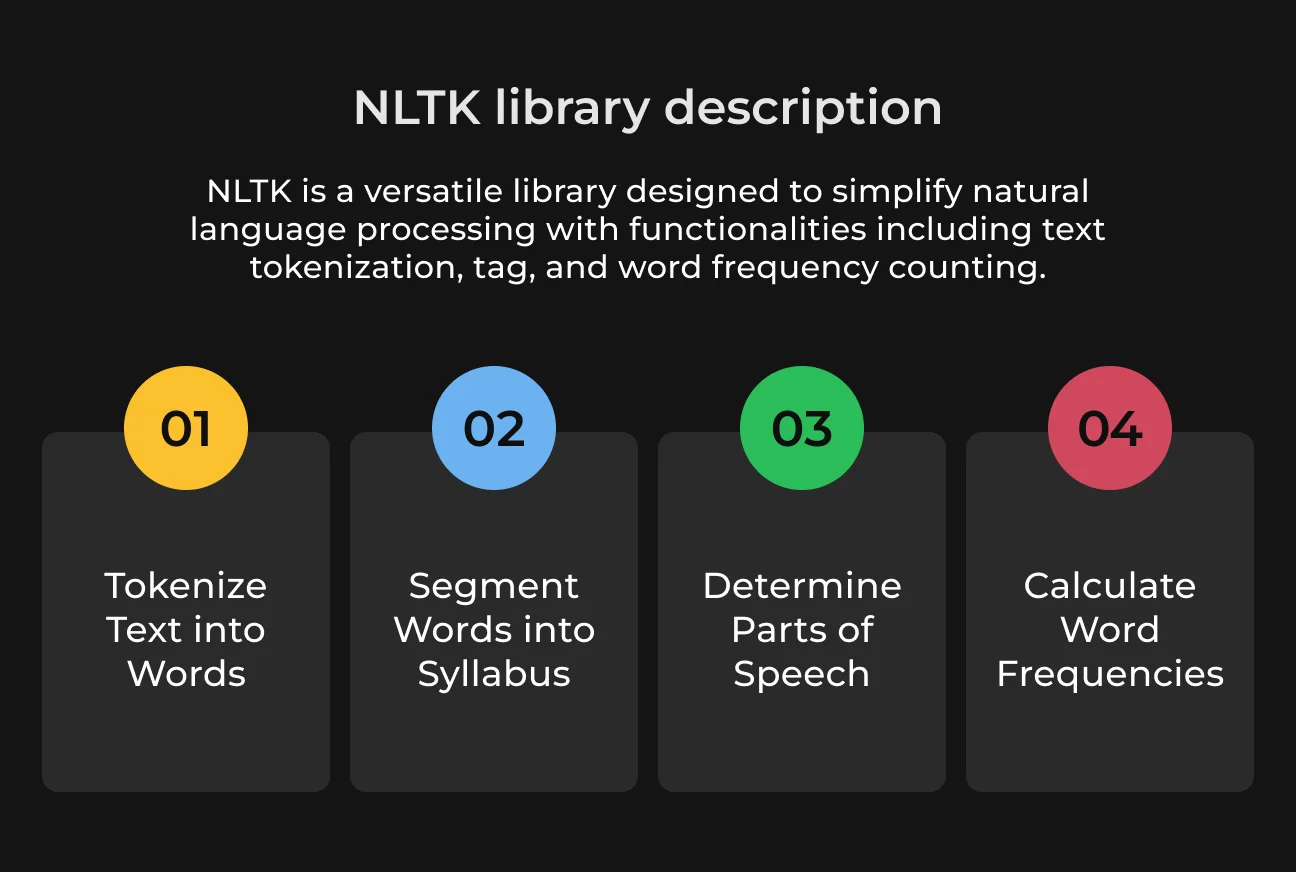
1. NLTK (Natural Language Toolkit)
NLTK is a Python library with prebuilt functions for tokenization, stemming, POS tagging, and more. NLTK is excellent for prototypes, teaching, and basic NLP pipelines.
2. spaCy
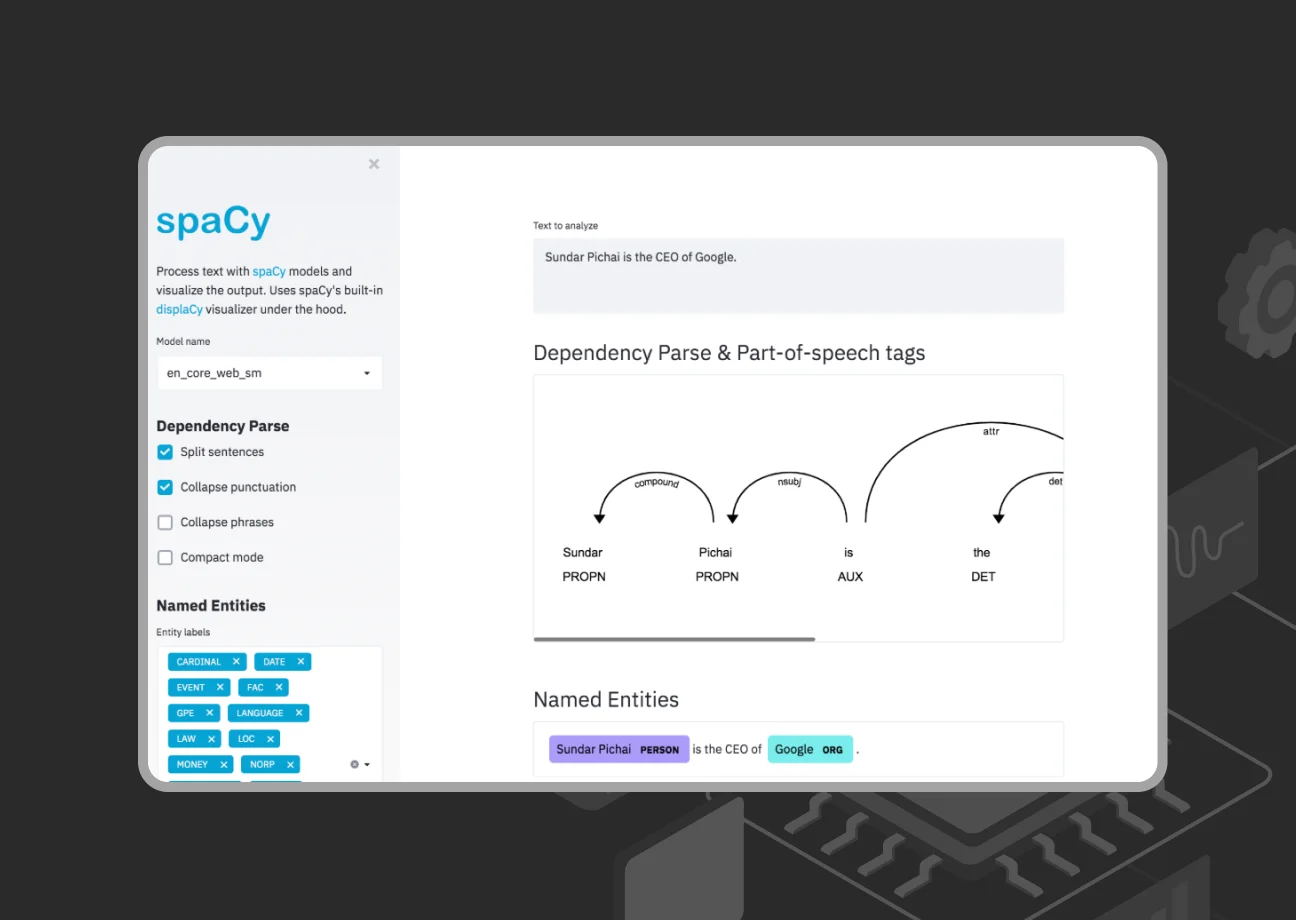
Designed for performance in production environments, spaCy offers efficient tokenization, named entity recognition, and dependency parsing. It supports deep learning integrations through PyTorch and TensorFlow.
3. GATE (General Architecture for Text Engineering)
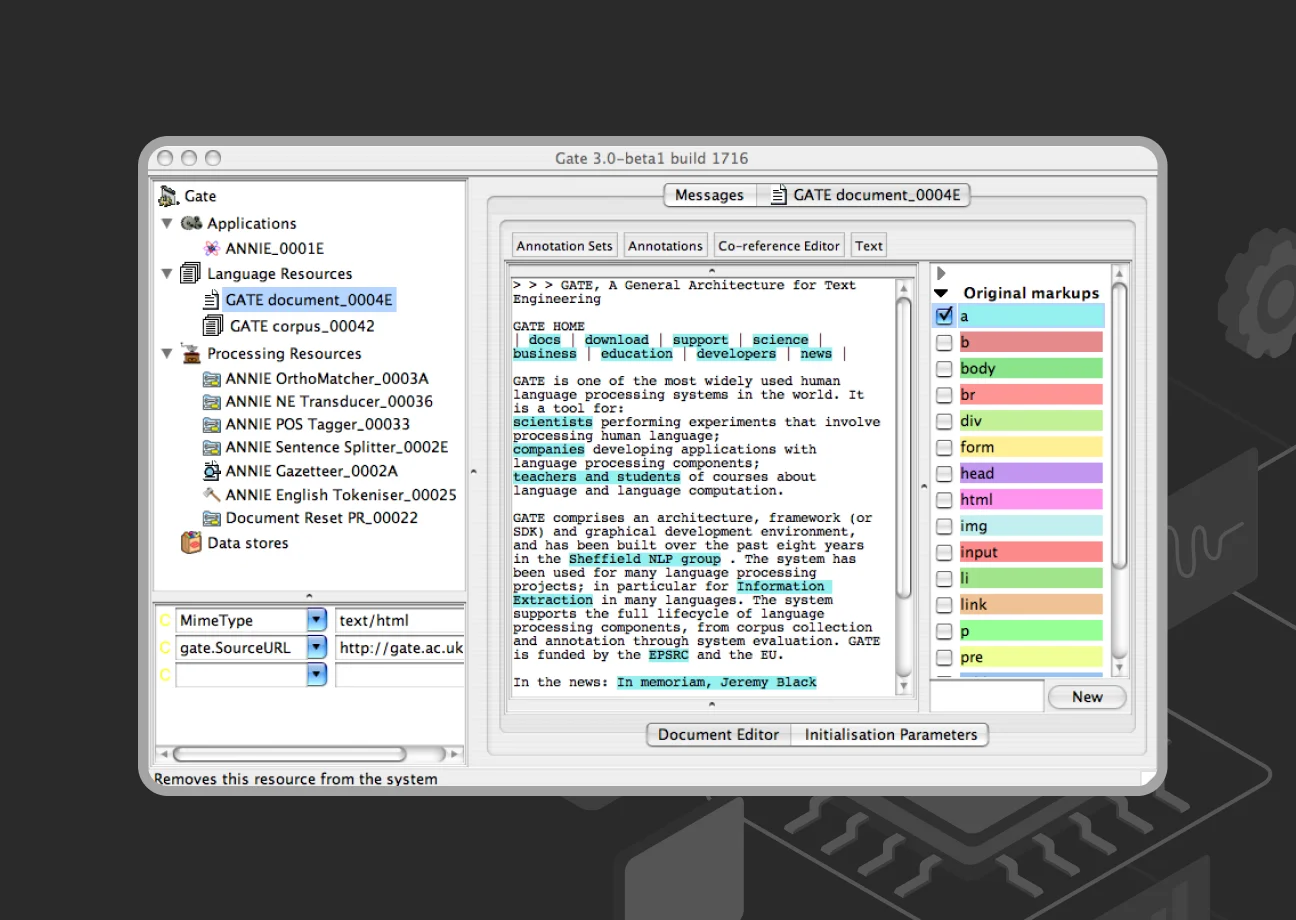
GATE is a Java-based framework that's been used for decades in research and enterprise NLP applications. It supports large-scale text processing workflows and comes with plugins for entity extraction and semantic annotation.
4. TensorFlow Text
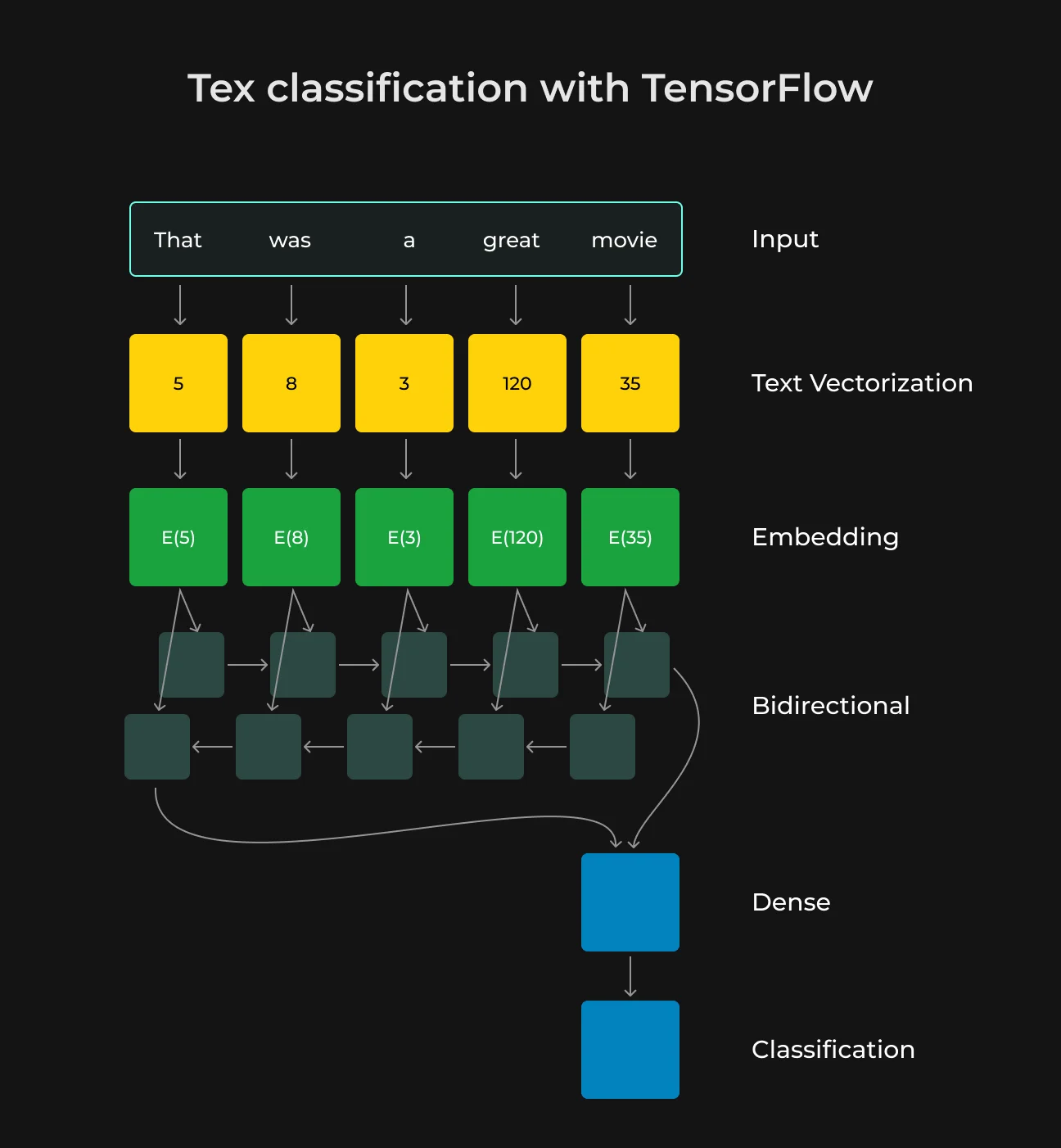
This extension of TensorFlow for advanced NLP tasks like embeddings, classification, and sequence modeling works well when you want deep learning models powering your AI NLP platform.
5. Text.com Platform APIs
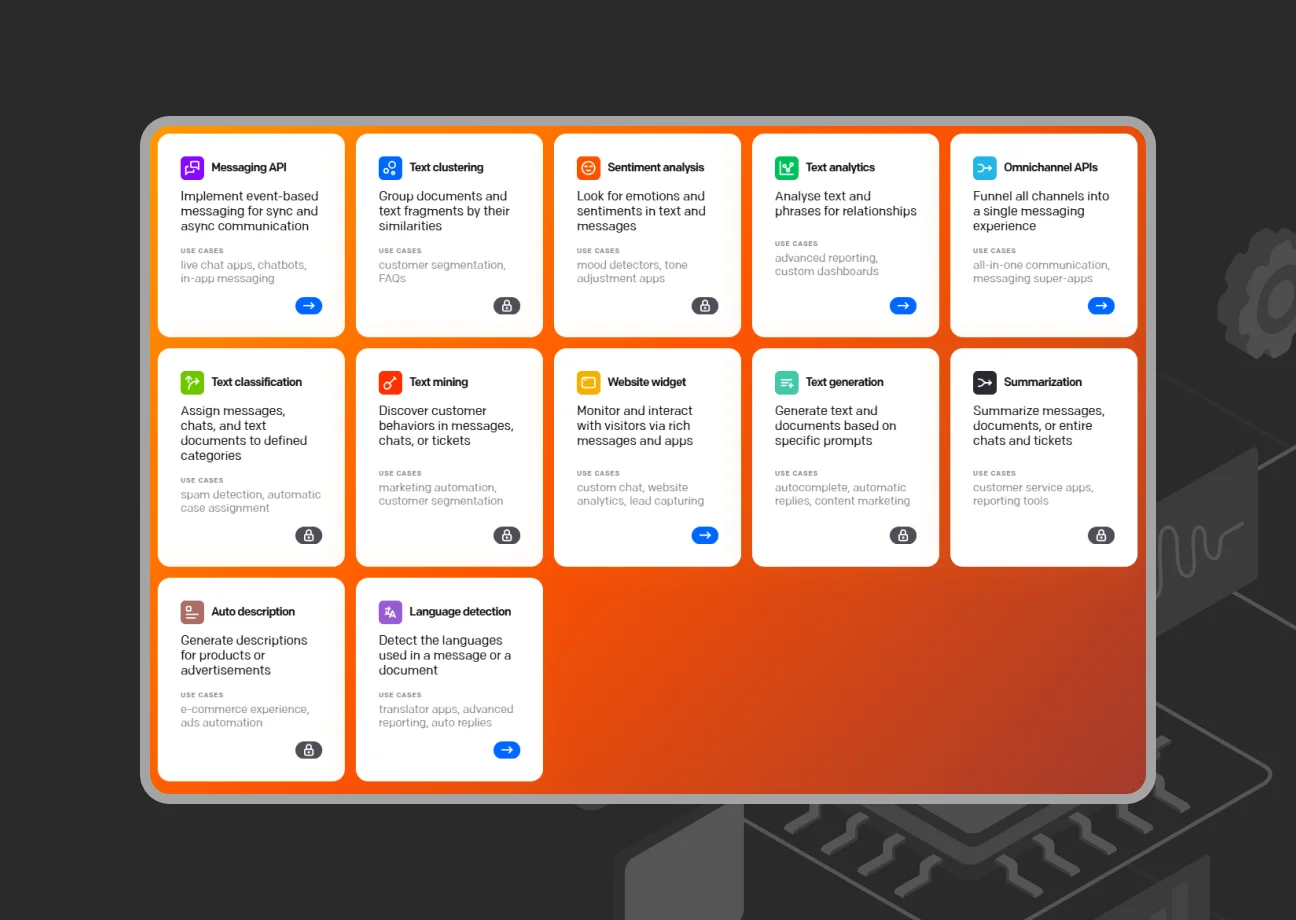
Text.com offers cloud APIs for sentiment analysis, topic detection, entity extraction, and text generation. Ideal for businesses that want prebuilt, scalable text analytics without building models from scratch.
6. AWS Comprehend
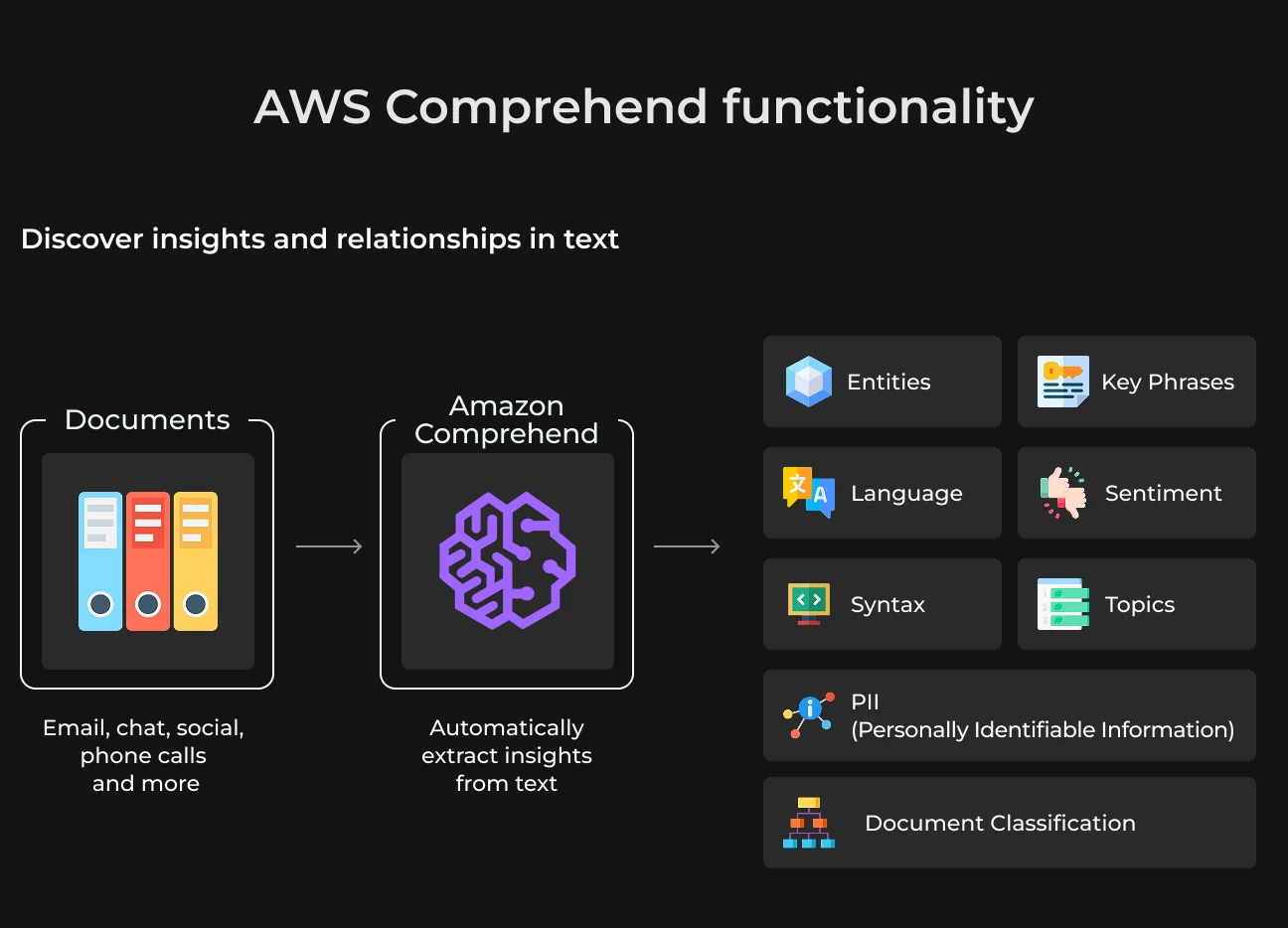
AWS Comprehend is a fully managed NLP service from Amazon Web Services. It can detect entities, key phrases, sentiment, and topics at scale. AWS Comprehend is useful for multilingual data and can integrate directly with S3 and Redshift.
7. Google Cloud Natural Language API & Azure Text Analytics
Google Cloud's NLP API offers syntax analysis, entity recognition, and content classification. Azure's Text Analytics service provides sentiment analysis, key phrase extraction, and language detection. Both are strong options for organizations already using these cloud ecosystems.
Reference Architecture of a Modern NLP Platform
A production-grade text mining NLP platform for semantic analytics follows a layered architecture. Each layer has a specific role, from pulling in raw data to presenting results securely and at scale.
1. Ingestion Layer
The ingestion layer is responsible for collecting raw text from multiple sources like databases, APIs, file storage, message queues, or streaming platforms like Apache Kafka.
- Key requirements: handle batch and real-time inputs, support multiple formats (JSON, XML, CSV, plain text, PDFs), and ensure data quality checks before it enters the pipeline;
- Tech examples: Apache NiFi for complex data flows, Amazon Kinesis for streaming, or custom ingestion scripts tied to cloud storage buckets.
2. NLP Pipeline
This is the heart of the system where raw text becomes machine-readable.
- Tokenization & Normalization: break text into tokens, handle punctuation, apply lowercasing, remove stopwords, and normalize numbers/dates;
- Embeddings: convert tokens or sentences into vector representations for semantic similarity and classification. Transformer models like BERT, RoBERTa, or Sentence-BERT are common here, providing contextual embeddings that capture meaning beyond keywords;
- Preprocessing extras: lemmatization, stemming, and language detection for multilingual datasets.
3. Semantic Layer
The semantic layer enriches processed text with meaning. This includes entity recognition, entity linking to knowledge graphs, sentiment scoring, topic classification, and relation extraction.
- It acts as the bridge between raw NLP outputs and domain-specific insights;
- In more advanced systems, this layer uses ontology-based reasoning and custom taxonomies to align results with industry-specific terms.
4. Analytics & Visualization Layer
Once the semantic layer structures the data, the analytics layer aggregates, filters, and visualizes it for business users.
- Dashboards: built using Power BI, Tableau, or Kibana to display trends, entity co-occurrence maps, and sentiment timelines;
- BI connectors: direct links to SQL warehouses or data lakes so analysts can run custom queries on top of NLP-enriched data;
- Alerting: real-time triggers based on sentiment shifts, emerging topics, or entity spikes.
5. DevOps & Security
A production NLP platform needs a DevOps backbone to ensure reliability and compliance.
- MLOps: continuous integration/continuous deployment (CI/CD) pipelines for retraining and updating models;
- Monitoring: tools like Prometheus and Grafana for tracking system health, latency, and model performance;
- Security: encryption at rest and in transit, role-based access control, and compliance with regulations like GDPR or HIPAA for sensitive data;
- Scalability: Kubernetes or cloud-native orchestration to handle spikes in processing demand.
An efficient development process starts with structure. A layered architecture is a way to ensure scalability, clarity, and measurable impact at every stage of product evolution.

Illya Vorobets
Text Mining NLP Platform Development Checklist
Use this checklist when planning, building, and launching your text mining NLP platform for semantic analytics.
Step | Task | Description | Owner |
1 | Define business objectives | Identify the main goals: sentiment monitoring, document classification, fraud detection, etc. | Product Manager / Stakeholders |
2 | Identify data sources | List all input types: CRM records, emails, PDFs, web pages, APIs, streaming feeds. | Data Architect |
3 | Assess data quality | Check for missing values, inconsistent formatting, duplicates, and language diversity. | Data Engineer |
4 | Select NLP methods | Decide on tokenization type, embeddings, and text mining techniques like topic modeling or sentiment analysis. | NLP Engineer |
5 | Choose tech stack | Combine open-source frameworks (spaCy, NLTK) with cloud services (AWS Comprehend, GCP NLP API). | Tech Lead |
6 | Build ingestion pipeline | Configure batch and streaming ingestion with validation and logging. | Data Engineer |
7 | Develop an NLP pipeline | Implement preprocessing, embeddings, and core analysis modules. | NLP Engineer |
8 | Implement the semantic layer | Add entity linking, relationship extraction, and ontology mapping. | NLP Engineer |
9 | Integrate analytics layer | Set up dashboards, BI connectors, and alerting systems. | Data Analyst |
10 | Apply DevOps & security | Add CI/CD, encryption, RBAC, and compliance checks. | DevOps Engineer |
11 | Test with pilot data | Run controlled experiments and evaluate accuracy, speed, and scalability. | QA / Data Science Team |
12 | Deploy to production | Roll out with monitoring and scaling in place. | DevOps / IT Ops |
13 | Establish a feedback loop | Capture errors, update models, and retrain as language evolves. | Data Science Team |
How to Future-Proof Your NLP Platform
The language technology space moves fast. New models, frameworks, and data formats emerge every year. Without a clear strategy, even the most advanced text mining NLP platform can become outdated in just a few cycles. Future-proofing is about building flexibility into your system so it can adapt to new demands without costly rebuilds.
1. Integrate LLMs
Large Language Models like GPT-4, LLaMA, and Claude can handle complex reasoning, summarization, and multi-step entity extraction far beyond traditional NLP models. You can integrate LLM APIs or fine-tuned open-source versions into your semantic analytics workflow to extract value:
- Process more diverse queries, including natural questions from non-technical users;
- Generate human-like summaries of large text datasets;
- Handle low-resource languages without building separate pipelines;
- Hybrid setups where LLMs handle high-level interpretation and smaller models handle bulk processing offer cost control and scalability.
2. Continuous Learning & Active Feedback Loops
Language evolves. New slang, hashtags, and domain-specific jargon appear every week. A static model will slowly lose accuracy. Setting up continuous learning pipelines ensures your platform adapts:
- Use feedback from analysts and end users to label tricky cases;
- Automate model retraining with new datasets;
- Monitor concept drift when the meaning or usage of terms changes and update embeddings accordingly;
- Active learning frameworks like Prodigy or Label Studio help prioritize uncertain cases for human review, speeding up model improvement.
3. Scaling to Multimodal Analytics
Text is just part of the picture. Businesses increasingly need to combine text mining with image, audio, and video analysis for better results. For example:
- Pairing call transcripts with voice tone analysis can improve customer service metrics;
- Combining product reviews with product images can help detect emerging quality issues;
- Analyzing meeting transcripts alongside slide decks allows for more complete knowledge capture.
Adopting a multimodal-ready architecture where text, audio, and visual data can be processed in a unified pipeline will keep your NLP platform relevant as analytics needs expand.
Partner with SapientPro to Build Your NLP Solution
SapientPro is a dedicated team of professionals that knows how to turn complex language data into business value. With 8+ years of experience in building AI NLP platforms, text mining systems, and semantic analytics pipelines, we've helped businesses process millions of documents, detect patterns in real time, and uncover information that allows making the right strategic decisions.
Examples of our case studies include:
You’ll get an expert team that knows the market’s best practices and integrates them into your solution. Whether your goal is to analyze customer sentiment, classify large document sets, or power a multilingual search engine, we will ensure your NLP solution is accurate, scalable, and secure.
Contact us today to get a free consultation!
Start NLP development today
Get a free consultation from SapientPro's engineers to see your project's roadmap.