All What is Technical Debt and How to Manage It
August 11, 202610 min read


Every shortcut in software comes at a price. Missed code reviews, postponed refactoring, and rushed features might speed things up until your team starts spending more time fixing old bugs than building new solutions. In our world, it's called technical debt.
A Stripe report found that developers spend almost 33% of their time dealing with tech debt instead of writing new code. That's over 13 hours a week per developer eaten up by past decisions. Another study by McKinsey reveals that CIOs believe 10% to 20% of the technology budget goes directly to servicing this kind of debt.
Yet the real cost is lost momentum. It's the teams stuck in firefighting mode. It's missed deadlines, painful upgrades, and frustrated users.
This guide provides a technical debt definition, how it shows up in your software, and, most importantly, how to manage it. Everything here is written by SapientPro's engineers, who've spent over 8 years building and fixing complex systems across fintech, e-commerce, healthcare, and more.
Key Takeaways
- Technical debt meaning is the idea of the long-term cost of taking shortcuts in software development, often trading speed for future stability.
- If left unmanaged, it leads to higher maintenance costs, slower development, and reduced product quality.
- Tech debt comes from business pressure, outdated architecture, poor documentation, weak processes, and team inexperience.
- The five main types include code debt, architectural debt, design debt, documentation debt, and infrastructure debt.
- Fixing starts with knowing how to measure technical debt using tools like code analysis, bug tracking, and visualizations.
- Teams should prioritize debt based on severity, urgency, and business impact.
- Solutions include re-architecting, modular design, automation, and a clean code culture.
- To avoid future debt, teams must plan for cleanup during sprints, keep it visible in the backlog, and hold regular reviews.
- Tools like SonarQube, Codacy, CodeClimate, and Snyk help monitor, manage, and reduce technical debt at scale.
- Partnering with SapientPro ensures expert guidance in identifying, reducing, and preventing technical debt.
What is Technical Debt?
If your team is still debating the tech debt meaning, you're likely losing time to fixes that could've been avoided.
Technical debt occurs when software development teams take shortcuts. Instead of writing good & scalable code, they go for quick fixes. While these shortcuts save time now, they create major problems later, leading to:
- Bugs and production issues;
- Delays in feature delivery;
- Fragile code that is difficult and risky to change.
The term was coined by Ward Cunningham, who famously compared rushed code to financial debt.
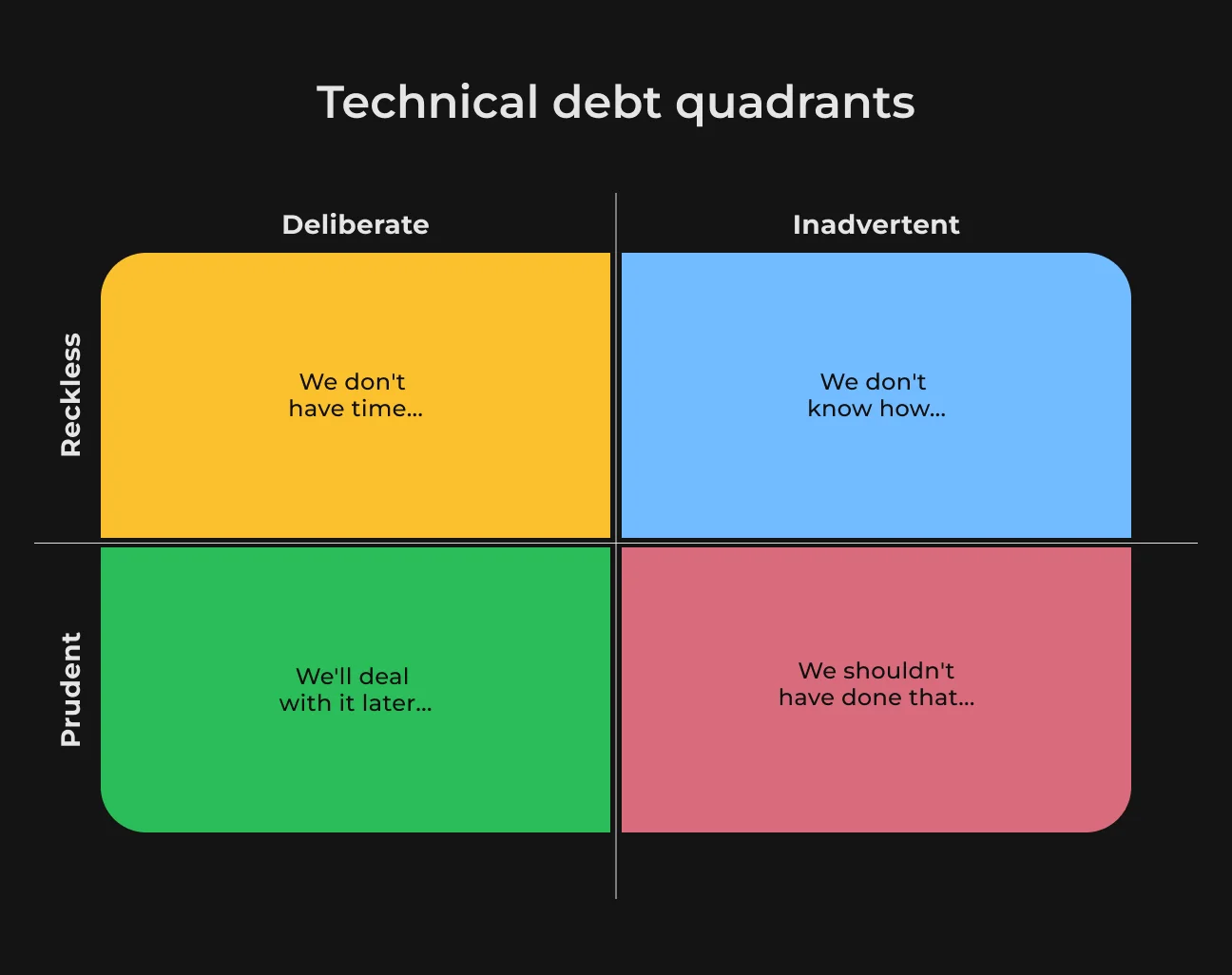
Crucially, not all tech debt is bad. Sometimes it's intentional, like a strategic trade-off. For example, a team might consciously skip certain tests to meet a critical product launch deadline.
This is a valid decision if there's a clear plan to “repay” the debt soon. Problems truly begin when this debt is ignored and allowed to pile up, crippling future development speed.
Technical Debt Examples
Technical debt means extra work caused by earlier decisions. It can take many forms:
- Copy-pasted code instead of reusable functions;
- Missing or outdated documentation;
- Poor test coverage;
- Legacy APIs no one wants to touch;
- Quick hacks that “just work” (for now).
Over time, these things slow everything down. When even simple features take weeks to implement, your team is likely struggling with unresolved tech debt.
So what is tech debt? It’s a business problem. A high technical debt ratio often signals that your codebase is becoming harder to maintain and scale. Understanding how technical debt is impacting your team is key to keeping your product healthy.
Importance of Addressing Technical Debt
Ignoring technical debt is like ignoring a leaky roof. You might not notice the damage right away, but over time, it'll rot the foundation of your product. Technical debt is a threat to your whole business.
Unresolved tech debt slowly erodes your ability to ship, maintain, and grow. It adds hidden costs, delays, and frustration at every level of your software project. Here's how it shows up in real life.
Increased maintenance costs
Every shortcut taken today turns into extra work tomorrow. You might save a few hours now, but fixing bugs, debugging tangled logic, and reworking fragile code will take weeks later.
CISQ reports that poor software quality, often linked to tech debt, in the US alone in 2022 cost businesses more than $2.4 trillion.
When developers are constantly putting out fires, they're not building new features. Tech debt affects your roadmap, your speed to market, and your bottom line.
Besides code, tech debt includes documentation, deployment scripts, testing frameworks, and third-party dependencies. The more patchwork you accumulate, the more time (and money) it takes to keep the engine running.
Limited scalability
Technical debt often traps your business in systems that can't grow.
Let's say your platform gets popular. Suddenly, your team needs to add new users, handle more traffic, or integrate new tools. But the quick-and-dirty solutions built earlier are now standing in the way.
Code that's too tightly coupled or not modular is hard to expand. Legacy APIs might break under load. Poor database design slows down performance. Infrastructure that wasn't built with growth in mind starts failing under pressure.
Our team has seen companies struggle to scale just because their foundational code was too brittle. Fixing it mid-growth is always more expensive than addressing it early.
Reduced product quality
Product quality depends on reliability. When tech debt builds up, reliability takes a hit. Features break in unexpected ways. Bugs reappear. Updates get delayed because developers are scared of triggering regressions.
This frustration leaks into your user experience. Customers notice slower performance. They hit more bugs. They stop trusting updates. In industries like fintech, medtech, or SaaS, technical issues can quickly lead to churn or even compliance risks.
And if your QA team spends weeks retesting fragile features instead of validating new ones, your release cycle slows to a crawl.
Technical debt also affects team morale. Developers get tired of patching the same parts of the codebase over and over. New engineers struggle to onboard. Eventually, your team velocity drops, and your product falls behind.
What Causes Technical Debt?
Technical debt is the result of choices, some intentional, others accidental, made throughout the lifecycle of a software project. Business needs, team structure, tools, processes, and shifting priorities shape these decisions.
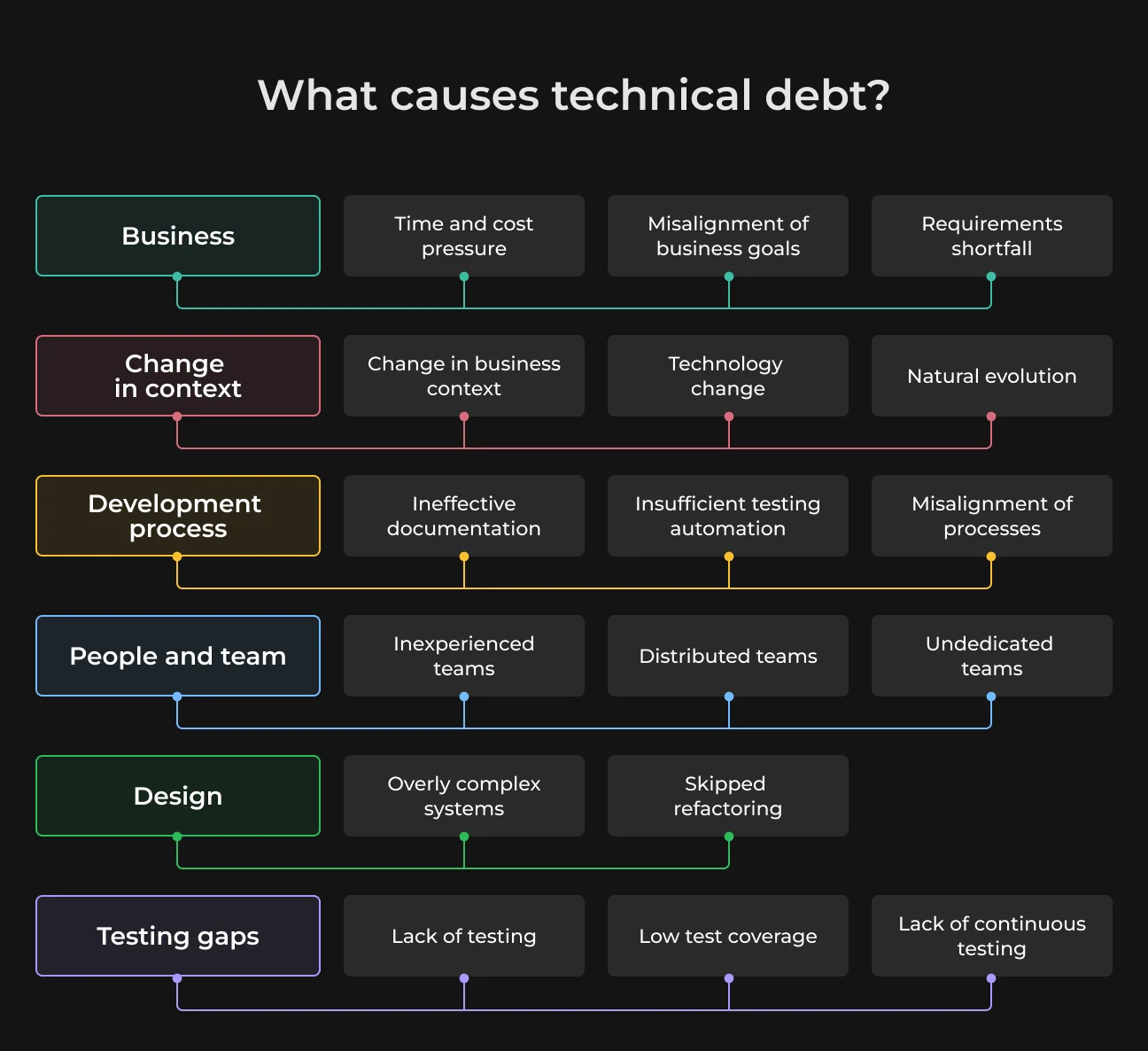
Based on SapientPro's experience across hundreds of software projects, we break the causes into six major groups.
1. Business Pressures
Speed is often a business advantage. But when delivery speed consistently outweighs code quality, you rack up debt.
- Tight deadlines and limited budgets push developers to ship “good enough” features instead of sustainable ones;
- Changing priorities or strategies mid-project often leaves half-finished components or unused features;
- Unclear or shifting requirements lead to patchwork code — features get rebuilt again and again as the goalpost moves.
These situations are common in startups, fast-scaling SaaS products, or companies racing competitors to market. The problem is in failing to go back and clean up the mess afterward. Startups that build their first version through disciplined MVP development tend to avoid the worst of this, because scope stays fixed on what the product must prove rather than everything a longer roadmap imagines.
2. Changes in Context
Even well-written code becomes debt if it no longer fits the environment it was built for.
- A market shift might make a previous architecture obsolete;
- Adoption of new technologies can expose weaknesses in your legacy stack;
- Organic product growth can lead to inconsistencies, workarounds, and outdated components that quietly pile up.
In other words, debt can build even if no one's making bad decisions. Software ages — just like physical infrastructure. Without modernization, it becomes a liability.
3. Development Process Gaps
Your code is only as strong as the processes behind it. Weak or inconsistent practices almost always lead to growing technical debt.
- Outdated or missing documentation slows down maintenance and onboarding;
- No automated testing increases the risk of regressions and discourages changes;
- Disorganized workflows or mismatched methodologies between teams introduce inefficiencies and errors.
SapientPro's team has helped companies with technical debt reduction significantly just by improving CI/CD pipelines, adding code reviews, and enforcing better branching strategies.
4. Team and Collaboration Factors
People matter. Even good systems break down when the team structure doesn't support quality.
- Inexperienced developers may introduce anti-patterns without realizing it;
- Distributed teams with weak communication can produce inconsistent or redundant code;
- Overloaded developers split between projects or responsibilities rarely have the time to build things the right way.
In many cases, technical debt is caused by long-term neglect and unclear ownership.
5. Design Complexity and Delayed Refactoring
Even with great developers and solid processes, you can still accumulate debt by overengineering.
- Overly complex systems that try to solve too many problems at once become fragile and hard to maintain;
- Skipped refactoring, often seen as “non-essential”, leaves legacy patterns in place long after they should've been cleaned up.
When developers consistently postpone refactoring, tech debt compounds, and small inefficiencies snowball into major roadblocks.
6. Testing Gaps
- Lack of testing is one of the most direct routes to unstable code.
- Insufficient or manual testing hides bugs and makes developers fearful of breaking things;
- Low test coverage means you never really know if a new feature broke an old one;
- Lack of continuous testing slows releases and makes technical debt harder to detect before it becomes visible to end users.
Together, these factors build up silently until your roadmap slows down, your system becomes brittle, and your team loses momentum.
Types of Technical Debt
Some development issues slow down the process, while others threaten stability or security. For managing technical debt effectively, you need to know what kind you're dealing with.
Our engineers categorize tech debt into five common types:
- Code debt;
- Architectural debt;
- Design debt;
- Documentation debt;
- Infrastructure debt.
Each one creates a different kind of friction and needs a different approach to fix.
Code Debt
Code debt is the most visible and most common form of technical debt. It includes messy code, hardcoded values, duplicated logic, and a lack of proper error handling.
You'll notice it when:
- Developers avoid touching certain files;
- Small updates require big rewrites;
- Bugs pop up in unrelated parts of the system.
Code debt often comes from rushed work, skipped code reviews, or junior-level decisions that were never cleaned up. Over time, it makes the entire codebase harder to understand, test, and maintain.
Architectural Debt
Architectural debt is harder to spot but much more dangerous. It lives in the foundation of your software and affects how components interact, how data flows, and how services are split (or not).
You'll feel it when:
- The system doesn't scale as expected;
- New features break existing ones;
- Integrations or upgrades take months instead of days.
This kind of debt often appears when the original architecture no longer fits the size or needs of the product. We've seen it in growing SaaS platforms, where a monolith becomes a bottleneck, or in enterprise tools built on outdated frameworks.
Fixing architectural debt usually requires rethinking the system itself, not just rewriting files.
Design Debt
Design debt happens when UI/UX decisions are inconsistent, outdated, or created in a rush. Your app's looks are not the main issue, it's all about how usable and maintainable the front end is.
You might notice:
- Repeated UI patterns with slight variations;
- Confusing user flows;
- Legacy CSS files that break everything with one change.
This debt frustrates both users and developers. A lack of design systems often causes it. Skipped testing or tight deadlines lead to “just make it work” solutions. If your front-end code is difficult to update without breaking visual components, you're probably sitting on design debt.
Documentation Debt
Documentation debt includes missing, outdated, or unclear documentation across your system.
Common symptoms include:
- New developers asking the same questions;
- No clear onboarding process;
- Confusion over how certain APIs or services work.
Without solid internal docs, every task takes longer. Teams duplicate work or waste hours reverse-engineering past decisions. And when senior developers leave, they take essential knowledge with them.
Infrastructure Debt
Infrastructure debt shows up in the tools, platforms, and environments your product runs on. It's often the result of legacy hosting, manual deployment, or poor cloud configurations.
Watch for signs like:
- Frequent downtime during deployments;
- Inability to support scaling or load spikes;
- Security risks from outdated dependencies.
Infrastructure debt slows down releases, increases failure risk, and blocks your move to DevOps practices like CI/CD or containerization. All these types of tech debt are connected. One weak area often triggers problems in others.
Technical Debt in AI Coding: A New Category You Can't Ignore
Everything above still holds once AI tools enter the workflow, but AI-assisted development adds problems older technical debt frameworks never had to account for. In Sonar's 2026 developer survey, 88% of developers report at least one negative impact from AI on technical debt, while 93% also cite measurable benefits. The trade-off plays out inside the same codebase, sometimes inside the same pull request.
Speed is the multiplier. A study tracking over 300,000 AI-authored commits, published as “Debt Behind the AI Boom,” found unresolved technical debt introduced by AI tools grew from a few hundred issues in early 2025 to over 100,000 by February 2026. Traditional debt piled up one shortcut at a time. AI debt piles up one prompt at a time, often faster than a review process built for human-paced commits can catch it.
What Is AI Technical Debt?
AI technical debt is the extra work a team inherits when AI-generated code and AI-assisted features ship faster than anyone reviews or maintains them. It behaves like classic technical debt in one way: skip the cleanup, and the interest compounds. But it shows up in more places than code alone.
Some of it sits in familiar territory: duplicated functions, inconsistent patterns, and code nobody fully understands because nobody wrote it line by line. Some of it hides in machine learning systems themselves—model versions that drift after retraining, training data nobody documented, evaluation pipelines that never got built. That's the hidden technical debt in machine learning systems a code review alone won't catch. It's also the hidden cost of AI adoption budget forecasts that tend to miss: the tooling looks free, and the debt shows up months later in a support ticket nobody can trace back to a root cause.
Vibe Coding and Technical Debt
Vibe coding, building software by prompting an AI assistant and accepting what it generates with light or no review, is the fastest route from idea to working demo. It's also the fastest route to a fragile codebase.
An analysis of 623 million real-world code changes from 2023 to 2026 found AI-assisted commits now make up a quarter of all commits, with technical debt rising across eight maintainability metrics and code reuse dropping as duplication climbs. Separately, developers using AI reported feeling roughly 20% faster, while measured task completion in mature, complex codebases came in about 19% slower. The assistant writes quickly. The developer still has to understand what it wrote before shipping it.
If your team is vibe coding and wants to keep the debt manageable:
- Treat every AI-generated pull request like a junior developer's first draft. It needs a second set of eyes before merging, not after a bug report;
- Run static analysis (SonarQube, Codacy, or similar) on AI-authored commits the same way you would on human-written ones;
- Log what got vibe-coded versus reviewed. Six months in, you'll want to know which parts of the app still need a second look.
What Is Prompt Debt?
Prompt debt is what happens when the prompts driving your AI features or coding assistants are never versioned, reviewed, or documented, the same way unmanaged code shortcuts pile up into code debt. A prompt gets written to hit a deadline, it works, and nobody touches it again until the model changes underneath it or someone copies it into a new feature and tweaks a line without knowing why the original line was there.
The risk isn't hypothetical. IBM's Institute for Business Value found 81% of executives already say technical debt is constraining their AI initiatives in 2026, and prompt debt is one of the categories driving that number. Unlike a code bug, a broken prompt often doesn't throw an error. It just quietly produces the wrong answer.
What Is Non-Coding Technical Debt?
Non-coding technical debt never touches your application code. It lives in the surrounding layers: the prompts, the training, and retrieval data, the model configuration, and the evaluation suites that are supposed to catch an AI feature behaving badly.
Common examples:
- A prompt template copied across three product teams with no owner and no version history;
- A retrieval pipeline feeding an AI feature from data nobody has re-validated in a year;
- An AI-powered feature with no evaluation suite, so regressions ship silently after every model update;
- Documentation that describes how a feature worked at launch and hasn't been touched since.
To identify it, check whether anyone would notice a change: if the model or the prompt shifted today, would it get flagged before a customer noticed? If not, that feature is carrying non-coding technical debt.
How AI Increases Technical Debt in Your Codebase
AI code generation introduces debt through a specific pattern: code that looks correct and passes review at a glance but hides a defect. Sonar's research found 53% of developers say AI-generated code appears correct while introducing hidden defects and a false sense of security. Security research goes further: reviewed studies put the share of AI-generated code containing an OWASP Top 10-class vulnerability at 40% to 45% overall, and above 70% for Java specifically.
None of this means AI coding tools are the wrong choice. It means the review process has to change to match how the code gets written.
When a developer writes a function, I know what assumptions they made because I can ask them. When an assistant writes it, I have to reconstruct those assumptions from the code itself. That's a different kind of review, and most teams still review AI output like it's a human's first draft instead of a black box that needs its own checklist.

Taras Hanych
Reducing AI-generated code quality issues comes down to treating AI output as a starting point, not a finished feature: mandatory review before merge, static analysis on every AI-authored commit, and dependency and vulnerability scanning (Snyk, Veracode, or similar) applied without exception. Teams that skip this step don't avoid the debt. They find out about it later, usually in production.
If your team is generating code faster than it can review it, that gap is where the debt is forming. SapientPro builds AI-assisted workflows with review and security gates in from day one — explore our AI-driven solutions to see how.
Costs of Ignoring Technical Debt
Ignoring technical debt is a hidden cost center. When left unchecked, it drains productivity, inflates maintenance budgets, and holds your team and your business back.
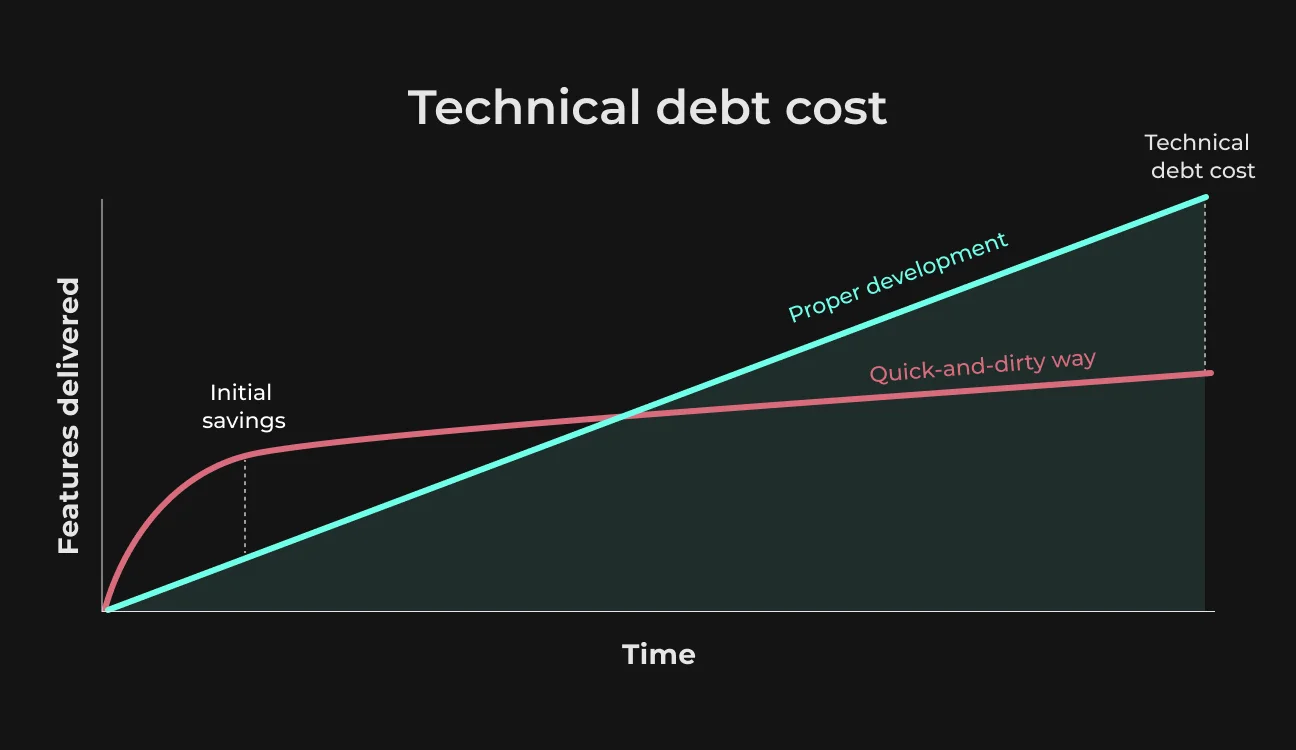
Sky-High Financial Impact
On average, fixing one million lines of code over five years can cost up to $1.5 million or around 27,500 developer hours. This steep price comes from Sonar's analysis of real-world projects. Another projection places the total economy-wide cost of poor software quality at over $1.52 trillion globally.
Productivity Lost to Bad Code
Developers spend 17 hours per week on maintenance and refactoring due to technical debt, including around 4 hours a week dealing with "bad code.” That equates to an estimated $85 billion lost annually in opportunity cost.
Innovation Takes a Back Seat
A Stepsize survey found that technical debt saps developer morale—engineers feel compelled to prioritize new features over critical clean-up. Many said they'd ship up to 100% faster if technical debt were managed more effectively.
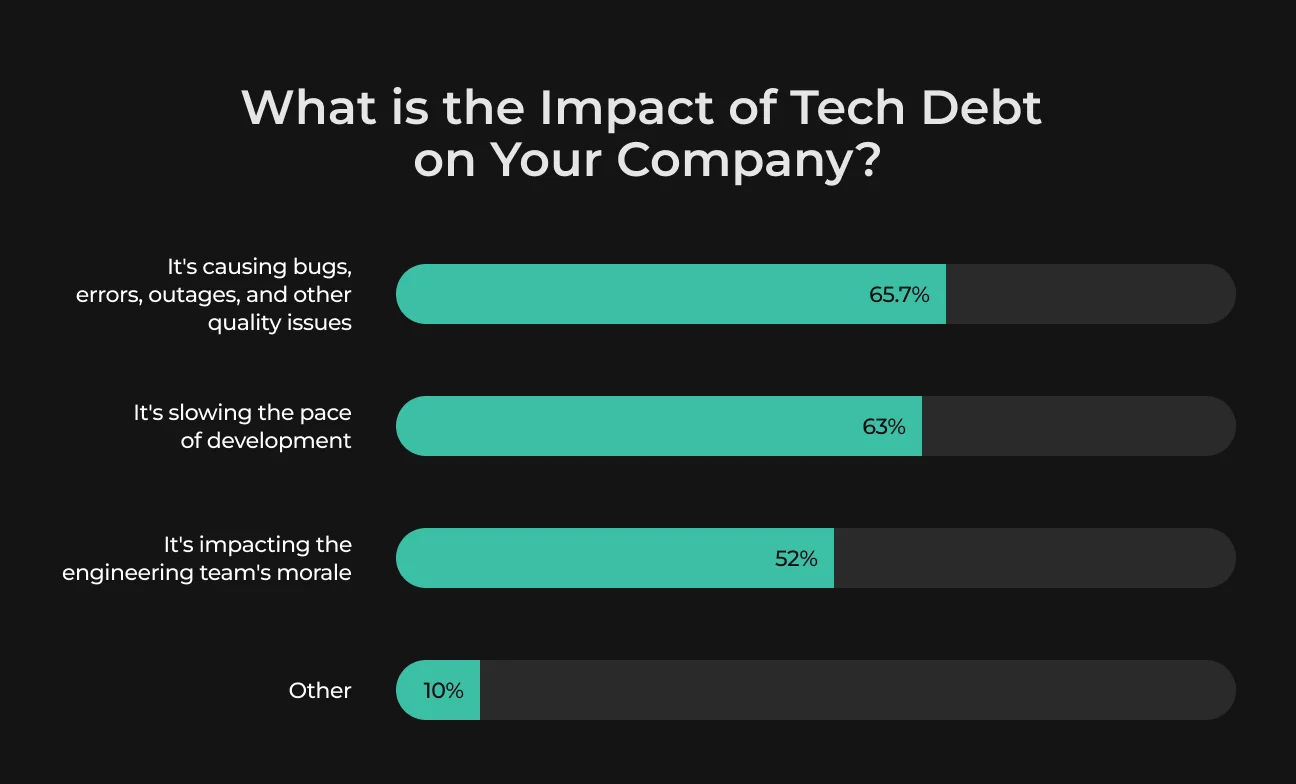
Strategic Drag on Your Business
McKinsey warns that unmanaged technical debt blocks innovation. Outdated systems make integration costly and complex, diverting IT resources to firefighting rather than forward-looking work.
Ignoring technical debt is charging interest against your future success. Cost-wise, it hits you hard in both dollars and developer morale. Strategically, it slows growth and burdens your roadmap.
6 Steps to Reduce Tech Debt in Your Project
Reducing technical debt is possible through smart decisions, clear priorities, and steady cleanup. Here's how to approach it effectively.
1. Find and Measure Technical Debt
Start by identifying the debt across code, architecture, and processes.
Use tools and methods like:
- Architectural reviews;
- Bug tracking and incident analysis;
- Static code scanning (e.g., SonarQube);
- Code visualization;
- Project documentation audits;
- SQALE Method or Gartner Model for structured assessment;
Key Technical Debt Metrics
Metric | What It Shows |
| Number of impacted assets | How widespread the debt is across systems |
| Debt per business capability | How debt affects specific business functions |
| Debt per quality attribute | Impact on maintainability, security, etc. |
| Debt trend line | If the debt is growing or shrinking over time |
| Estimated remediation cost | Total investment needed to clean it up |
| Cyclomatic complexity | Areas of code that are hard to understand |
| Bug fix vs. feature ratio | If tech debt is slowing innovation |
| Deployment frequency & rollbacks | Signs of fragility and instability |
| Code coverage & duplication | Gaps in testing and code reuse |
| Bug tracking data | Recurring issues linked to bad code |
| Dev velocity | If teams are slowing down due to messy systems |
2. Prioritize the Most Critical Issues
After identifying your technical debt, the next step is to fix what hurts the most. Prioritization should focus on issues that pose the greatest risk or cause the biggest slowdowns.
Focus your efforts by assessing three key factors:
- Severity: how much it disrupts users, customers, or the development team's workflow.
- Urgency: how soon it could break or fail, leading to production incidents.
- Business impact: how directly it affects key goals or revenue generation.
Deciding which debt to repay first is a judgment call, and it benefits from someone who has seen the same tradeoff across dozens of codebases. CTO consulting services give the team a remediation order tied to business milestones rather than developer preference.
Start with issues that actively block scaling, slow down releases, or risk high customer churn.

Max Tatarchenko
3. Conduct Re-architecting & Modernization
Sometimes, simple patches aren't enough, and you require structural changes to the system. Modernization involves scaling up or replacing the underlying architecture:
- Re-hosting (Lift-and-Shift): move to a better environment (e.g., cloud migration) without changing the existing codebase;
- Re-platforming: shift to a new platform or managed service, requiring only minor code adjustments;
- Replacement: retire outdated systems entirely and rebuild from scratch using modern technologies.
4. Use a Modular Design
Modular systems are crucial for managing future debt. They isolate risk and simplify updates.
By breaking down a system into independent modules, you make it:
- Easier to scale: components can be scaled individually.
- Simpler to test: changes are contained within one module.
- Safer to refactor: you can update or replace a module without breaking the entire application.
If your current codebase isn't modular, future changes will inevitably cost more. We often help clients redesign legacy systems into flexible modules.
5. Add Automation and Continuous Integration
Automation is a critical defense against accumulating technical debt. By integrating modern CI/CD practices, you embed quality checks directly into your workflow:
- Automated testing, CI/CD pipelines, and frequent deployments are essential for spotting technical debt early and reducing human error. This is because every code change is immediately verified against a comprehensive suite of tests.
- They provide your team with the confidence to release without fear of unexpected failures, leading to faster delivery cycles and less time spent on emergency fixes.
Strong Continuous Integration (CI) practices make the necessary task of refactoring safer and faster. Since the system is constantly being built and tested, developers can make structural changes knowing that a safety net of tests will immediately catch regressions.
6. Implement a Clean Code Culture
Managing technical debt must be a cultural mindset, not just a task list. This means establishing debt prevention as a core value:
- Encourage and enforce practices that prioritize code health:
- Mandatory code reviews to share knowledge and catch complex issues early;
- Clear coding standards to ensure consistency and readability across the entire team;
- Robust testing habits to ensure maintainability and functionality;
- Allocating dedicated refactoring time (sometimes known as “debt repayment”) in every sprint to prevent small issues from becoming crippling problems.
- Hold the team accountable for actively maintaining a healthy, high-quality codebase. This shift from focusing only on features to also focusing on system hygiene is key to long-term scalability and development velocity.
Fix Your Tech Debt with SapientPro

How to Avoid Technical Debt in Future Development
You can't eliminate technical debt entirely, but you can stop it from piling up. The key is treating it as a routine part of development, not a crisis you deal with later. If you're unsure how to measure tech debt, start with static code analysis, bug tracking, and development velocity trends. Here's how your team can stay ahead of the mess.
Incorporate Debt Consideration into Sprints
Don't wait for things to break: plan time to prevent that from happening.
When your team scopes a sprint, include:
- Time for refactoring old code;
- Updating documentation;
- Adding missing tests;
- Cleaning up hacks made in previous cycles.
Even one or two “debt tasks” per sprint can help maintain long-term code quality.
SapientPro's teams often pair new feature development with low-effort cleanup tasks. That way, tech debt is addressed without slowing velocity. Our engineers also help businesses boost performance with tailored AI solutions.
Prioritize Technical Debt in the Product Backlog
Technical debt should be visible in the same backlog as features and bugs, not on a separate list that no one looks at. Assign each tech debt item a priority based on:
- Business risk;
- Cost to fix later vs. now;
- Impact on future development speed.
This approach makes it easier for product owners and non-technical stakeholders to support technical work. Add estimates to each tech debt task, just like you do with features, to create transparency around the real cost of postponement.
Regular Technical Debt Reviews
What gets measured gets managed.
Hold quarterly technical debt reviews with your dev team and product leads. Discuss:
- Where friction is slowing you down;
- What areas of the codebase are being avoided;
- Which debts are now urgent due to scaling, security, or user issues.
Use data from bug reports, failed deployments, or static code analysis tools to guide the conversation. Reviews don't have to be formal, but they must be consistent. Just 30 minutes per quarter can make a difference in preventing chaos later.
When you normalize these practices, technical debt stays under control, and your team stays focused on shipping high-quality software.
10 Best Tools for Technical Debt Management
Below are ten trusted platforms used by dev teams worldwide, many of which we also rely on in our projects.
Tool | Description | Cost |
| SonarQube | Open-source platform for continuous inspection of code quality. Detects bugs, vulnerabilities, and “code smells” in 25+ languages. | $720 a year for essentials + higher tiers for enterprise features |
| Codacy | Automated code review tool that checks code quality, test coverage, and security issues on each commit. | Free for individuals; Paid plans for teams |
| Snyk | Finds and fixes vulnerabilities in open-source libraries, containers, and IaC. Ideal for reducing security-related tech debt. | Free for small teams; Tiered pricing for larger organizations starting with $18 per dev per month |
| CodeClimate | Offers automated code review and complexity analysis; integrates with GitHub to provide feedback in pull requests. | Free for OSS; Paid plans for teams, starting with $24 per month per user |
| Stepsize | Designed to help teams track and prioritize technical debt directly from the IDE. Works with Jira and VS Code. | 2-week free trial, $29/month per Jira board or Linear team |
| Veracode | End-to-end application security platform offering SAST, DAST, and SCA to manage security-related tech debt. | Contact for pricing |
| Klocwork | Real-time static code analysis tool focused on C, C++, C#, Java. Ideal for large enterprise codebases. | Contact for pricing |
| NDepend | Powerful static analyzer for .NET. Offers visualizations, metrics, and rules to track and reduce code debt. | From $492 per developer/year |
| Teamscale | Analyzes code and test quality. Great for dashboards, metrics tracking, and identifying quality regressions. | Starter plan: €39 per contributor/month |
| Embold | AI-powered platform that finds design flaws, bugs, and performance issues. Offers prioritization suggestions for fixing debt. | Contact for pricing |
Partner with SapientPro to Manage Your Technical Debt
Tech debt doesn't fix itself, but the right partner can help you take control of it without slowing your roadmap. SapientPro's engineers spent over 8 years helping companies modernize legacy systems, improve code quality, and scale with confidence.
We can help you with:
- A one-time audit;
- A full re-architecture;
- Ongoing technical guidance.
We speak business and code, so you get practical solutions that help you improve your software immediately. Let's clean up what's slowing you down and build a foundation for smarter growth.
Contact us to get a free consultation!
Talk to our experts to fix your technical debt