All Vibe Coding Definition: Pros, Cons, and Use Cases for Your Business
October 11, 202510 min read


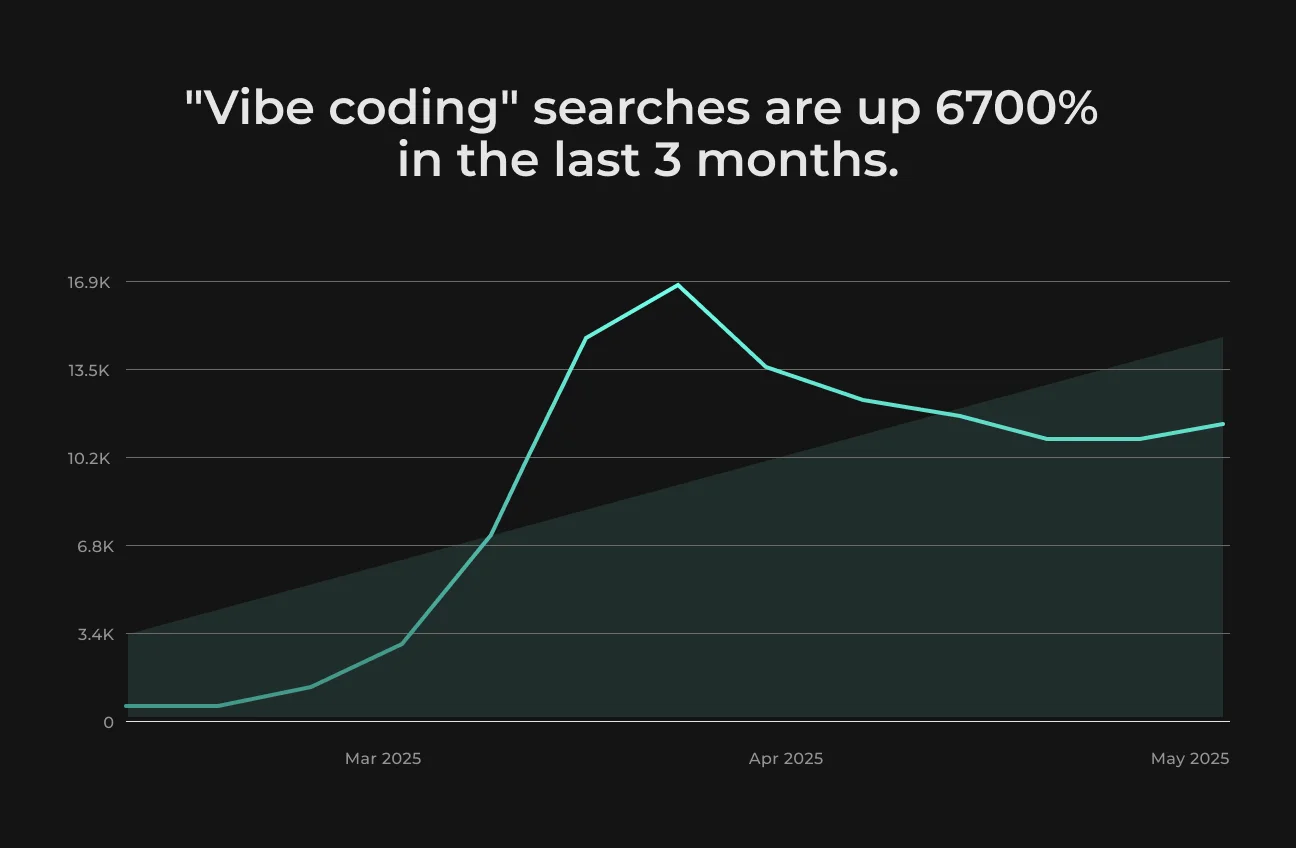
Vibe coding is the latest trend in AI and tech circles that took off in early 2025. In 2023, getting AI agents to work 5% of the time was impressive. Now, they excel in the tests over 60% of the time and continue to improve. Teams often use this to enhance their productivity.
But with AI’s great power come significant challenges. Studies show that up to 73% of AI-generated vibe coding samples contained security flaws when manually reviewed. Experts are also worried about the increased reliance on artificial intelligence doing the legwork.
While vibe coding transforms programming and allows even non-technical people to build apps, there are quite a few issues with this approach. SapientPro’s experts will break down what does vibe coding mean, its strengths, weaknesses, and vibe coding best practices.
Key Takeaways
- Vibe coding programming is a new method for developing software using AI that turns natural language prompts into code;
- Instead of coding by hand, developers guide an AI assistant to do that and focus on more complex tasks;
- Unlike code written manually, which often explains the reasoning behind decisions, AI-generated code usually does not clarify the logic;
- Even with detailed instructions, developers must still review, test, and improve AI-generated code.
What is the Vibe Coding Definition?
Vibe programming lets you create software by using AI to turn natural language instructions into real code. It speeds up coding and simplifies app creation, especially for beginners with no coding skills.
Instead of typing out code, developers explain their ideas to an AI assistant. The developers focus on the concept while the AI takes care of the technical details.
This type of programming basically comes in two types:
- Pure vibe coding: in this experimental mode, you can let the AI do all the workflow. It’s ideal for quick prototypes or weekend projects when speed is key;
- Responsible AI-assisted development: this is the grown-up version. Here, AI acts as a helper. You guide it, then review and test the code it produces, taking full ownership of the end result.
A Silicon Valley CEO claims that vibe coding enables 10 engineers to accomplish the workload of 100. Here's a list of several popular vibe coding tools that embrace this user-centric development approach.
Cody
Cody is an AI coding assistant that acts like a senior developer who is familiar with your entire codebase. It delivers relevant and contextual suggestions, which makes tasks like refactoring complex services much faster.
It also integrates with IDEs like VS Code, Eclipse, Visual Studio, and JetBrains, as well as tools like Linear and Notion.
Bolt
Bolt.new allows developers to create and launch full-stack apps directly from a browser. All you need is just prompt, run, edit, and deploy, without local setup. Bolt.new is perfect for quick prototyping because it lets you handle packages, run backends, and edit code all in one place.
GitHub Copilot
GitHub Copilot is a pioneering AI programmer that learns from public code and often does what you anticipate, even suggesting entire functions while you type.
Copilot can adjust to your coding style. It offers suggestions that are more specific and accurate. It also works with VS Code to give you various suggestions.
Cursor
Cursor is an AI-centric code editor designed to boost development speed with its natural language code editing feature. Cursor also learns your coding style over time, which makes suggestions more relevant.
AI is excellent at writing code when it can remember all the task and project details, similar to how we keep things in our heads. But when developers need extra information, they usually look at the documentation, which AI can't access.

Ihor Hamal
Vibe Coding vs Traditional Coding
Before you start with a new project, you should know about the difference between vibe programming and traditional coding. This will help you choose the best coding approach for your needs.
Vibe coding uses AI to generate software from natural language prompts. You simply describe what you need in plain language, and AI creates the code or app to match.
Traditional coding is the classic way of creating software, writing code in languages like Python, Java, or C++. This methodology lets developers fully tailor all aspects of the software, from features to interfaces. You need to use your coding skills to build an app.
Let's take a look at what makes these approaches different.
Will vibe coding transform programming?
Feature | Vibe Coding | Traditional coding |
| Learning | Vibe coding is easy for beginners and doesn't require coding experience, since AI uses simple prompts to generate code. | Traditional coding requires learning programming languages and SaaS development logic, which can be challenging. |
| Development speed | It’s fast, producing vibe coding software much quicker than traditional methods. | It takes more time because it involves manual coding and testing. |
| Flexibility | It’s less flexible and sticks to platform-specific structures. | It lets you customize everything to fit your project's unique needs. |
| Security | It uses security built into the platform, which is helpful but can restrict you. | It lets you set up your own security, giving you more control over it. |
| Scalability | It’s great for small to medium projects with limited needs. | It's better for large, complex systems. |
| Use cases | It suits quick prototypes, personal projects, and small apps without requiring coding expertise. | It’s best for developing full-scale apps, enterprise software, or high-performance systems. |
Advantages of Vibe Coding
Let's look at what are the main benefits of using vibe coding.
Easier Access for Non-Developers
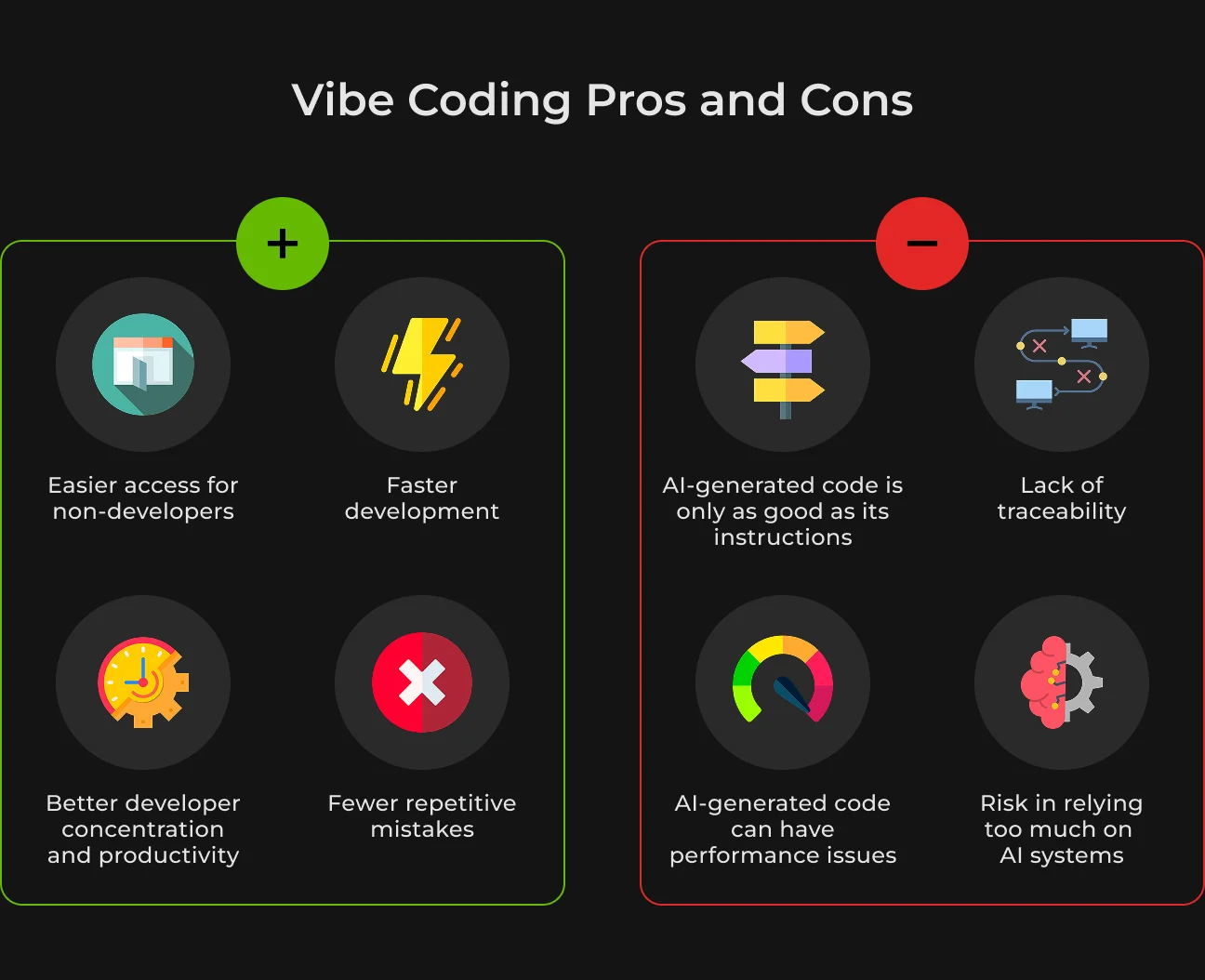
Vibe coding software development is open to everyone by removing the usual technical hurdles. Like low-code or no-code, it makes developing software easier. Users just explain their needs in simple language, and AI turns these into working code, skipping the complicated parts.
You no longer need formal programming training to bring ideas to life.
Faster Development
With AI-driven development, ideas can become a working product in just hours, unlike the weeks traditional prototyping may take. Vibe programming speeds up the initial phases by removing repetitive tasks and basic code setup. Just describe to the system what you want, and it will take on the rest.
It allows for quick testing of new ideas and collecting real user feedback. And this happens without the usual loss of time or resources that comes with large development projects.
If you have a small project like an MVP, a proof of concept, or a basic prototype to attract investors, you can use vibe coding. For example, creating a website from scratch typically takes 100-120 hours, but with vibe coding, it only took us 60.

Illya Vorobets
Fewer Repetitive Mistakes
Just a small error (something like a missing semicolon) can lead to a major bug. That's where vibe coding offers a more practical solution. It uses AI trained on tons of code to produce consistent results.
Although it doesn't replace testing, it cuts down on repetitive and structural mistakes in the very first stages of development.
Better Developer Concentration
Developers usually spend a lot of time doing the same work. Vibe coding changes this by letting AI run the basics, like generating default components, setting up routes, or pre-building validations. Developers can instead focus on solving complex questions, building scalable software, or improving the user experience.
Disadvantages of Vibe Coding
Vibe programming is undeniably a strong tool. Yet, to know when to use it and when it's better to choose manual coding, it's important to understand its limitations.
AI-Generated Code Is Only as Good as Its Instructions
If you want high-quality AI-generated code, you need to be clear and detailed with your instructions. Mention the tech specifics, performance goals, and security requirements to get accurate results. Vague prompts can result in poor or unsafe code.
But even with comprehensive instructions, developers must still review, test, and refine this AI-generated code. It's necessary to verify the logic, check assumptions, and ensure the code fits project goals. The code must not only work but do so correctly.
Vibecoders try to organize files in a project structure to help AI remember important details. It helps, but it's not a complete solution. It's like having a programmer who can code but forgets what you said the day before, so you have to explain everything again. Right now, AI is good with small projects or scripts, but can't handle full production solutions yet.
Ihor Hamal
Lack of Traceability
Unlike human-written code, which often explains the reasoning behind decisions, AI-generated code usually does not clarify why specific choices like certain patterns or libraries were made. This makes debugging harder and creates risks for future maintenance.
AI-Generated Code Can Have Performance Issues
While AI-generated code can actually work, it may not be effective or enough. This can lead to using more resources than necessary or cause issues with scalability. In critical situations, such issues might be unacceptable.
Risk in Relying Too Much on AI
AI can't replace real engineering judgment. If you trust AI results without checking their quality, you might face hidden bugs, security issues, or architecture problems that can be hard to fix later.
Dangers of Using Vibe Coding
Developers, of course, recognize the benefits of using AI for efficiency and time savings. Still, many have concerns about its potential issues. Human supervision is crucial to make sure the AI-created code functions correctly, is secure, and is easy to maintain.
Vibe Coding Security Vulnerabilities
AI code suggestions from vibe coding can make developers use insecure practices without knowing it. A 2024 CSET study found that large language models often create code with serious issues like missing input validation, outdated libraries, and poor security practices.
Besides, an analysis of 80 coding tasks using over 100 LLMs showed that while AI can generate functioning code, it presents security vulnerabilities in 45% of cases.
Data Leakage
Vibe coding tools often need project context, and if not set up correctly, they could send sensitive code snippets to external APIs. This could expose internal logic, secrets, or customer data, especially in industries with strict data handling rules.
The main risk with vibe coding is that it can overlook important details when adding new tasks, like requiring users to log in for access. This could make sensitive information visible to everyone. In short, it isn't secure. Moreover, vibe coding struggles to keep a consistent style throughout a project. It tends to create slightly different code every time, leading to duplicate files and modules because it forgets the ones it made before.
Ihor Hamal
Technical Debt
Another issue is the accumulation of code that's not fully reviewed or understood. When developers are really focused, they might accept generated code without fully grasping it.
But in the long run, this leads to technical debt. It makes maintenance harder and raises the likelihood of mistakes. Companies should set aside about 15% of their IT budgets to tackle technical debt in new projects.
When to Use Vibe Coding for Your Project
Vibe coding is popular for good reasons. There are specific situations where it's especially useful and offers great value. These are the best scenarios for using vibe coding:
- Vibe coding helps you develop and adjust prototypes really fast, which makes it perfect for MVPs to test new ideas. These prototypes use sample data, so real personal info stays safe;
- It can be used for creating marketing and product landing pages. It uses vibe design to create flexible, stylish, and brand-friendly single-page sites. You just choose the layout, style, and content, and the tool does the rest. Since landing pages typically don't contain logins or personal info, using an AI-generated solution poses minimal risk;
- It's good at creating interactive websites and short demos. These mini projects are often used in marketing, product displays, or education to impress users with interactivity and slick design;
- AI tools can be used for learning coding skills. They help you see how your ideas become real code and give you instant feedback. When you use platforms like ChatGPT or Copilot, you come across a lot of code that, even though it is created by AI, still meets basic standards.
AI will likely write better code in the future. But since large language models (LLMs) tend to create inaccurate information, AI won't become a programmer or replace developers.
Ihor Hamal
Partner with SapientPro to Clean Up Your Vibe Code
SapientPro’s experts will help you improve your software and ensure it meets the industry’s best practices before deployment. We’ll help you get a scalable, secure, and efficient solution that gets all the benefits from vibe coding and traditional engineering.
Contact us today to discuss your project and see how we can help.
Clean Your Vibe Code Today
SapientPro's engineers will help your app turn into a well-built solution with the best practices in your industry.