All How to Build an AI-Based Recommendation System
Updated:October 13, 202610 min read


Companies today use AI recommendation systems to personalize experiences and drive revenues. Personalization has the potential to boost revenues by 5–15%. Product or movie recommendations based on individual taste (whether by a product recommendation engine or a movie recommendation engine) save time for the users and dramatically increase engagement, loyalty, and repeat business.
New generative AI recommendation systems based on large language models are taking this even further now by creating extremely personalized recommendations. In this article, we want to discuss how to develop recommendation system algorithms along with all the pitfalls of recommendation system AI.
Key Takeaways
- Personalized recommendations can result in conversion rate and sales boosts. Companies at the forefront of personalization see 40% greater revenue. For example, Amazon attributes 1/3 of its revenue to its recommendations.
- Modern recommenders use collaborative filtering, content-based filtering, contextual filtering, or hybrid approaches. Recommendation engine algorithms take into account user behavior and item attributes to suggest relevant items.
- Recommendation engines power e-commerce, media streaming, social websites, etc. Leading providers like Amazon, Netflix, and Spotify employ AI-powered recommendation engines to offer personalized product catalogs, movie suggestions, and music playlists.
- A complete system includes data pipelines (ingestion of user-events, feature stores), machine learning models (typically offline-trained), and real-time serving layers (APIs, low-latency databases). This end-to-end process must handle massive data and make recommendations in milliseconds.
Why Recommendation Systems Matter
Personalization drives business outcomes. For example, companies that are personalization leaders are reported to bring in about 40% more revenue. McKinsey found personalized experiences can lift sales-conversion rates by 10–15%.
One survey found 91% of consumers are more likely to shop with brands that remember them, and 77% will pay more for a brand that provides a personalized experience.
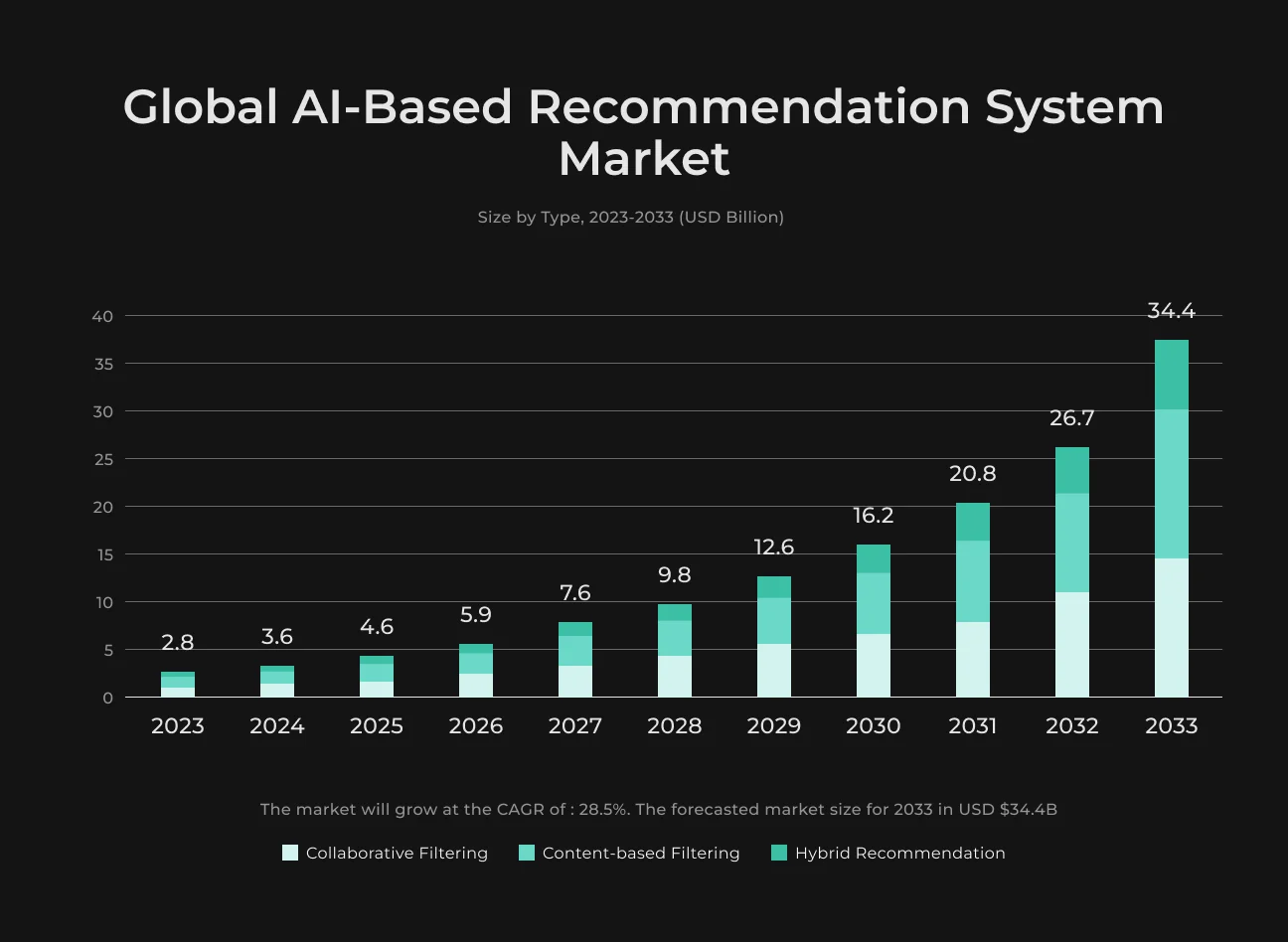
Recommendation engines have a profound impact on loyalty and retention when put into practice. These numbers underscore that effective recommendation algorithms (be it a content recommendation engine or an AI recommendation engine) directly and positively impact revenue, customer satisfaction, and lifetime value.
So, we can conclude:
- Personalization = more sales. Customers purchase more because of targeted recommendations. McKinsey illustrates 10–15% higher sales-conversion rates for more personalized sites, and a top retailer's recommendations can account for 35% of its revenue.
- Increased loyalty. Personalization increases loyalty. Satisfied customers spend 20% more and stay longer. 91% of consumers said they'd shop more with brands that recognize them.
- Retention and engagement. Recommendations that are pertinent keep users coming back. A study found that Netflix and Spotify retain users by making heavy use of recommender engines. Not only does personalization generate clicks, but it also results in longer session times and reduced churn.
Types of Recommendation Systems
Recommendation systems are categorized according to their filtering and matching techniques. This categorization defines the answer to the question “How does a recommendation system work?”
Each filtering approach has its place. Innovative methods can be incorporated by systems as well, such as generative AI recommendation systems that use LLMs to create recommendations or LLM-based recommendations that understand complex user queries.
As LLMs and generative models advance, new recommendation paradigms are expected.
The main types of filtering are the following.
Collaborative Filtering
Collaborative filtering algorithms recommend items based on finding similarities between users or items. It assumes people who concurred in the past will still concur in the future.
For example, if User A and User B have the same preferences, a collaborative filtering system will suggest items liked by User B to User A.
{{a2}}
There exist two subtypes of this approach: user-based (searching for similar users) and item-based (searching for similar items). Companies like Amazon and Spotify use collaborative methods in their recommendation engine algorithms.
The advantage is fine-grained personalization without the need for rich item features. However, it suffers from the cold-start problem, as new items or users with no history are poorly recommended.
Content Filtering
Content-based filtering recommends items that are similar to what a user has liked, based on item features. It represents items (and users) as feature vectors (genre, category, tags, etc.) and computes similarity.
For instance, a news recommender might match articles by topic keywords, or a movie recommender engine might match movies by genre and actors.
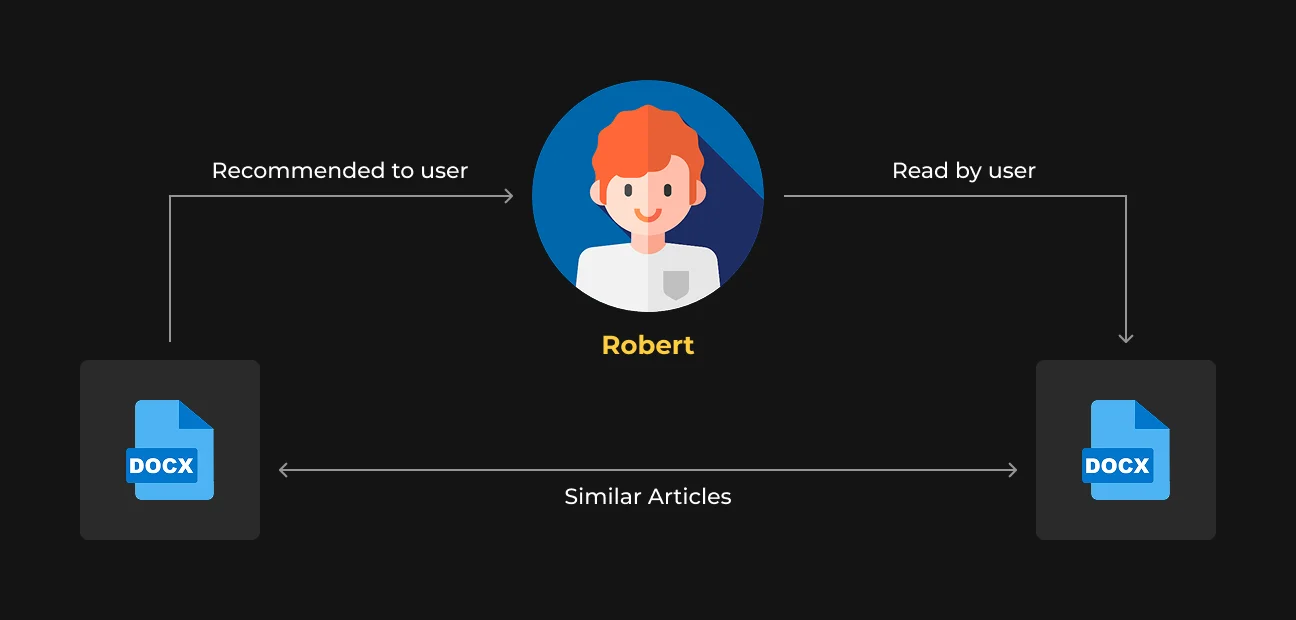
Content-based systems aren't based on other users' behavior, so they perform better with new items (less cold start). However, they might suffer from a lack of novelty and will tend to suggest items very similar to what has been liked in the past.
Context Filtering
Contextual filtering (or context-aware recommendation) takes into account situational factors. It changes recommendations based on contextual factors like time of day, location, device, or current events.
For example, a music service might recommend different music in the morning and the evening, or a shopping application might favor weather-friendly products.
Context-aware recommenders use these extra signals to provide more targeted recommendations. This line crosses over with hybrid and adaptive systems and is a very active research area.
Hybrid Filtering
Hybrid filtering systems bring together diverse recommendation techniques to balance their strengths. A hybrid recommender can combine collaborative and content-based strategies to improve precision.
For example, Netflix uses a hybrid recommendation system for television and film, combining collaborative signals with content analysis.
Hybrid filtering systems perform more effectively but are more complex to develop. They might even include knowledge-based or graph-based components.
Use Cases of AI-Powered Recommendation Systems
Here are the main use cases of implementing an AI-powered recommendation engine.
1. E-Commerce: Amazon
Online retailers use recommenders to surface relevant products. For example, Amazon’s product recommendation engine analyzes your browsing and purchase history to suggest items you’re likely to buy. Already in 2013, nearly one-third of Amazon’s sales came from these personalized suggestions.
Case studies show Amazon’s recommendation system dramatically increases average order value and repeat purchases.
2. Streaming Services: Spotify & Netflix
Media sites rely on recommendation engines to personalize content. Netflix's movie recommendation engine suggests films and shows based on past history. It drives about 80% of streams and saves Netflix an estimated $1 billion a year.
Similarly, Spotify's music recommender uses an AI recommendation system in music and media to generate playlists (Discover Weekly, Release Radar) that are apt for each listener's preference. These sites keep users engaged by continuously surfacing content that the users adore.
3. Social Media: TikTok, X, and Meta
Social media platforms use content recommendation engines to personalize user feeds. TikTok's algorithm figures out which videos you like to show you more. Facebook and Instagram suggest friends, groups, and posts based on your interactions. X's timeline organizes tweets in terms of relevance to the reader.
Others
Recommender engines are utilized in several other industries:
- In FinTech, American Express employs recommendation models to offer credit cards and investment products based on each customer's profile;
- Travel and hospitality sites (e.g. Airbnb) suggest hotels, flights, and activities based on user history and preferences;
- E-learning systems suggest courses;
- News apps provide personalized headlines.
Each use case demonstrates how an AI-driven recommendation system can transform raw data into actionable recommendations.
Technical Architecture of a Recommendation System
Modern recommendation engines blend batch analytics and real-time serving. Here’s an example of a typical architecture approach.
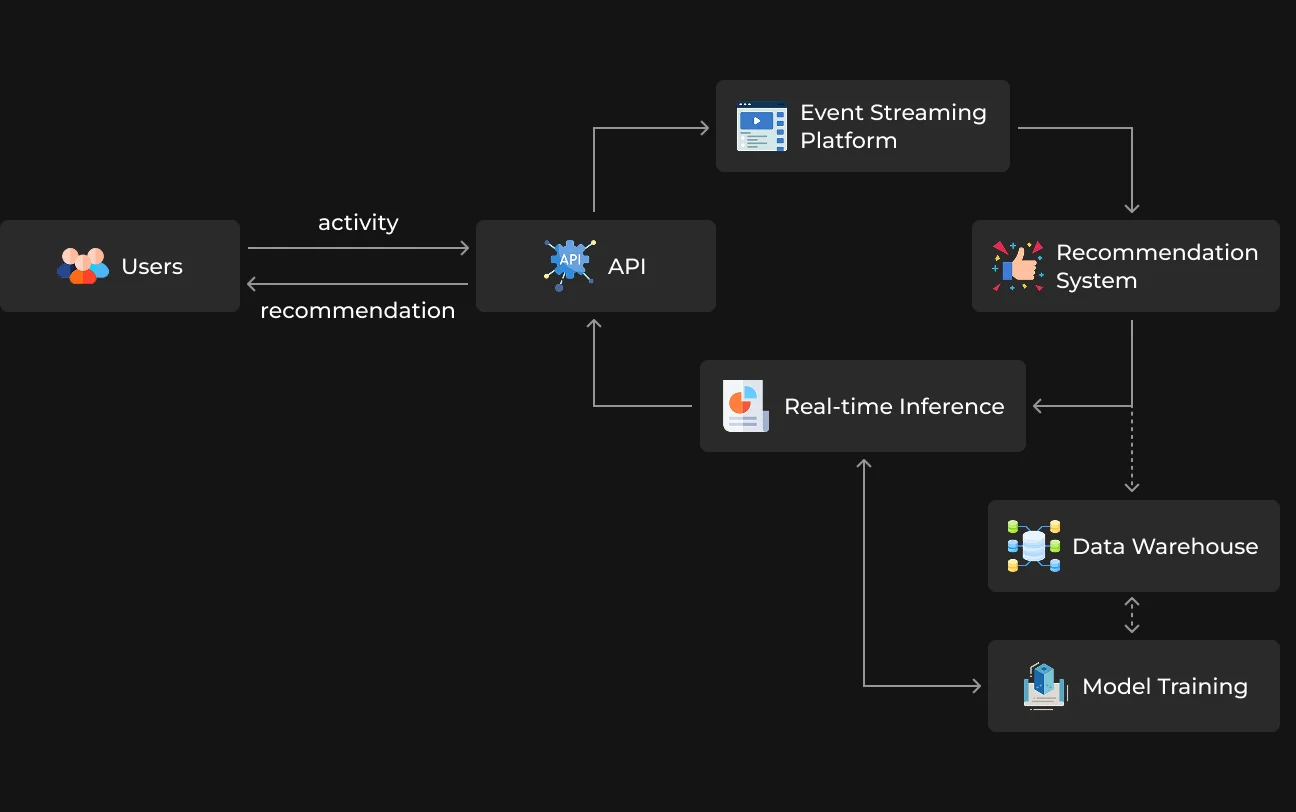
User actions (clicks, views, purchases) are sent to the system through an API or event stream. These events are written both to a fast storage layer (such as Redis or ClickHouse) for real-time access and to a data warehouse for long-term analysis.
Using the historical data in the warehouse, machine learning models (for example, collaborative filtering, deep learning, or embedding-based models) are trained offline. Once a model is trained, it is deployed to a real-time inference service.
When a user requests recommendations, this service queries the live data store and the deployed model (typically via an API) to generate personalized recommendations on the fly. The user’s subsequent behavior (what they clicked, ignored, or purchased) is then fed back into the pipeline, so the model can be periodically retrained and continuously improved.
Alibaba's engineering blog also outlines an enterprise-scale recommender architecture with matching (candidate generation) and ranking phases.
First, reduce to a candidate set of items quickly, then score/rank them for the final output. Modules include data ingestion, feature computation (batch/stream), model training clusters (Spark, TensorFlow), feature storage, and a low-latency serving layer.
We emphasize building scalable pipelines and real-time APIs. To reduce latency for high-traffic systems, we parallelize recommendation algorithms and use distributed databases.

Illya Vorobets
In practice, the system must balance recommendation accuracy with strict performance constraints. This is why offline model training (large-scale ML on historical data) is separated from online serving (fast inference during a user session).
Core building blocks usually include a feature store for model inputs, a model repository for versioned deployments, and an API gateway to expose the recommendation service.
To reduce operational overhead, teams often rely on cloud-managed streaming and database solutions instead of managing all infrastructure components themselves.
Challenges in Recommendation Engine Development
Building a recommendation system comes with several key challenges. Teams often address them using hybrid approaches, model regularization, and scalable cloud infrastructure. Let’s see the most common issues.
Cold-Start Problem
Collaborative algorithms struggle to make good recommendations when new users or items do not yet have interaction history. Common solutions include blending collaborative methods with content-based signals and using demographic or contextual information to initialize recommendations.
Bias and Fairness
Training data can reflect societal bias or popularity bias. A typical example is a model that mostly recommends already popular items, which reinforces a “filter bubble.” Ensuring fairness is difficult because the system should promote diverse content and avoid discriminatory behavior.
These issues can be reduced by adding fairness constraints to the models and choosing evaluation metrics that reward diversity and balance.
Scalability
Large platforms must deliver recommendations to millions of users in real time. The system has to handle heavy traffic while continuously updating models on very large datasets. This demands optimized storage such as caches and indexes, as well as distributed computing.
Companies like Netflix note that ranking extremely large catalogs in real time is hard without an effective candidate selection step. Producing recommendations within a few milliseconds at peak load is a major engineering challenge.
Data Quality & Integration
Recommendation engines depend on consistent, well-integrated data from many sources, including user behavior logs, item metadata, and user profiles.
If the data is inconsistent, noisy, or too sparse, recommendation quality will suffer. Engineering teams must invest in reliable data pipelines, careful feature design, and ongoing data monitoring.
At the same time, the use of personal data in recommender systems raises important privacy concerns. Developers need to anonymize user data where possible and comply with privacy regulations such as GDPR and CCPA when designing and operating these systems.
Key Components of AI-Based Recommendations
Successful AI-powered recommenders share several common building blocks.
Data Collection & Storage
Collect user interactions such as clicks, views, and ratings, as well as item attributes like descriptions and categories, in real time. This data is ingested into high-speed storage systems such as NoSQL caches or real-time analytical databases to support fast reads and writes.
Data Preprocessing & Feature Engineering
Raw data must be cleaned and transformed before it can be used. This step includes encoding categorical variables, normalizing numerical features, and computing aggregate signals such as a user’s average rating.
Many teams rely on an online feature store or a streaming SQL engine to compute and serve these features in real time.
Machine Learning Algorithms
The core models analyze this data to predict user preferences. Common techniques include matrix factorization, nearest neighbors, neural networks, clustering methods like k-means, and sequence models.
These collaborative, content-based, or hybrid approaches learn from past interactions to assign relevance scores to items. More advanced systems increasingly experiment with LLM-based models to better understand user intent and context.
Real-Time Serving & Processing
A recommender service needs a low-latency inference layer, usually exposed through an API. When an application requests recommendations, the service fetches up-to-date user data, runs the model to score candidate items, and returns a ranked list. Real-time databases such as Redis or ClickHouse are often used to power these APIs and support rapid lookups.
Personalization & Feedback Loop
The system must adapt to the individual preferences of each user. By tailoring suggestions to personal tastes, it greatly improves relevance and engagement. As users continue to interact with the system, their new behavior is fed back into the pipeline to retrain or update the model. This continual learning loop ensures that recommendations stay aligned with evolving interests.
Data is the foundation of AI-powered recommendations – the more interaction data, the better the model. End-to-end systems marry these components into a pipeline that delivers accurate, personalized recommendations at scale.

Ihor Hamal
How Much Does it Cost to Build a Recommendation System
Development costs for recommendation engines can vary significantly. A small pilot project with simple algorithms and a prototype user interface typically falls in the range of $10,000–$30,000. A more capable, mid-range system usually costs around $50,000–$100,000.
For a fully featured, enterprise-grade AI recommender that includes advanced models, complex integrations, and production-ready infrastructure, budgets often range from $100,000 up to $300,000 or more. These estimates typically include data engineering, model development, integration with the product UI, and basic maintenance.
On top of the initial build, you should also plan for ongoing expenses such as hosting, data storage, and regular model updates. These operational costs commonly start at about $500 per month and can reach $10,000 per month for large-scale deployments.
Project Scope | Estimated Cost (USD) | Notes |
| Small Pilot System | $10,000 – $30,000 | Basic prototype with simple recommendation engine algorithms, limited dataset, and minimal UI integration. |
| Mid-Range System | $50,000 – $100,000 | Includes scalable infrastructure, multiple recommendation system algorithms, and full front-end integration for production use. |
| Enterprise-Grade System | $100,000 – $300,000+ | Advanced AI recommendation engine with real-time data pipelines, hybrid filtering, cloud infrastructure, and support for millions of users. |
Note: prices are highly situational.
Final pricing depends on project complexity, data volume, technologies used, and performance requirements. SapientPro’s engineers will provide you with a detailed estimate after discussing all your expectations and requirements.
Partner with SapientPro to Create Your Recommendation Engine
Building an effective recommendation engine requires both technical expertise and practical experience. Start with a free consultation with SapientPro to discuss your business goals, data landscape, and technical requirements. Our AI services cover the full lifecycle of recommender systems, from architecture design and data engineering to model development and production rollout.
Check out some of our key case studies using machine learning and artificial intelligence:
- Language Learning Assistant Enhanced by AI;
- AI Assistant for Easier Online Shopping;
- AI Solution for Efficient CV Processing at Scale.
We rely on modern machine learning stacks such as Python, PyTorch, and TensorFlow to design solutions tailored to your domain, traffic, and products. Our team focuses on scalability from day one, ensuring your recommendation engine can grow with your user base and data volume.
Book a call with our team to discuss your project!
Create Your Own Recommendation System
SapientPro's engineers will provide a free consultation and build a top-tier solution.