All How Can an AI Document Processing System Improve Data Management
December 5, 202510 min read


With a strong growth pattern, the global Intelligent Document Processing (IDP) market was valued at $7.89 billion in 2024. It is expected to grow from $10.57 billion in 2025 to $66.68 billion by 2032, reflecting a CAGR of 30.1% over the forecast period.
In the U.S. alone, the IDP market was worth $355.29 million in 2023 and is projected to reach $1,965.46 million by 2035, with a CAGR of about 14.13% over the same period.
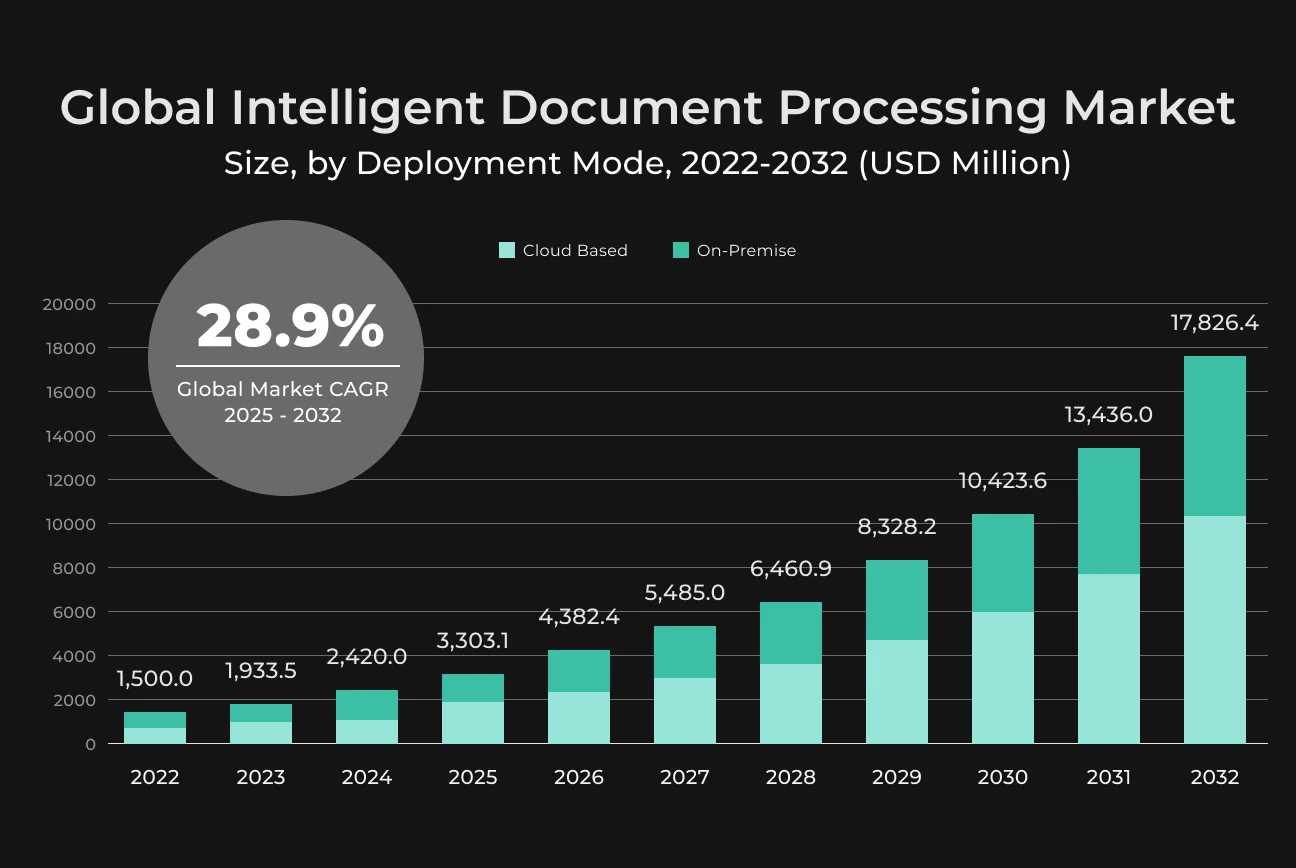
This sustained growth means IDP is no longer a gamble technology. Instead, it has become a rapidly evolving element of digital transformation strategies. Demand for document processing AI is fueled by the need for higher levels of automation and more advanced data intelligence.
As a result, the IDP market is increasingly attractive for investors and strategic planners, as organizations look to document automation AI to process larger data volumes and improve operational efficiency.
Let’s take a look at the impact of IDP on the transformation of modern data management.
Key Takeaways
- IDP uses AI (ML, NLP, OCR, CV, GenAI, and LLMs) to automate the extraction of data, organization of data, and analysis of data from multiple documents;
- RPA can accelerate processing rates by up to 90% and reduce data error rates by as much as 85%;
- Document processing AI enables mass task automation, where 70% of data entry tasks can be automated using IDP solutions;
- By 2025, 50% of B2B invoices worldwide will be processed without any manual intervention;
- IDP can reduce error rates by over 52% in data entry and extraction;
- AI fraud analyst tools spend on average 72 seconds reviewing a document, a far cry from 10 minutes spent by human reviewers;
- IDP is mission-critical across industries, including finance (70% faster loan approvals), healthcare (HIPAA compliance), HR (streamlined onboarding), logistics, government, retail, and legal.
Components of AI Document Processing
If you’re wondering what is intelligent document processing, then the answer is simple: it’s a technology that uses AI to automatically read, understand, and extract data from documents. Any intelligent document processing platform will consist of a minimum of 3 of the following components.
Optical Character Recognition (OCR) & Intelligent Character Recognition (ICR)
OCR is a core technology used to convert printed or typed text from images and scanned documents into machine-readable data. Typically, a document is scanned to create an electronic image, then processed so that the text can be detected and converted into digital form. Modern OCR supports more than 200 languages, making it a crucial tool for global document digitization.
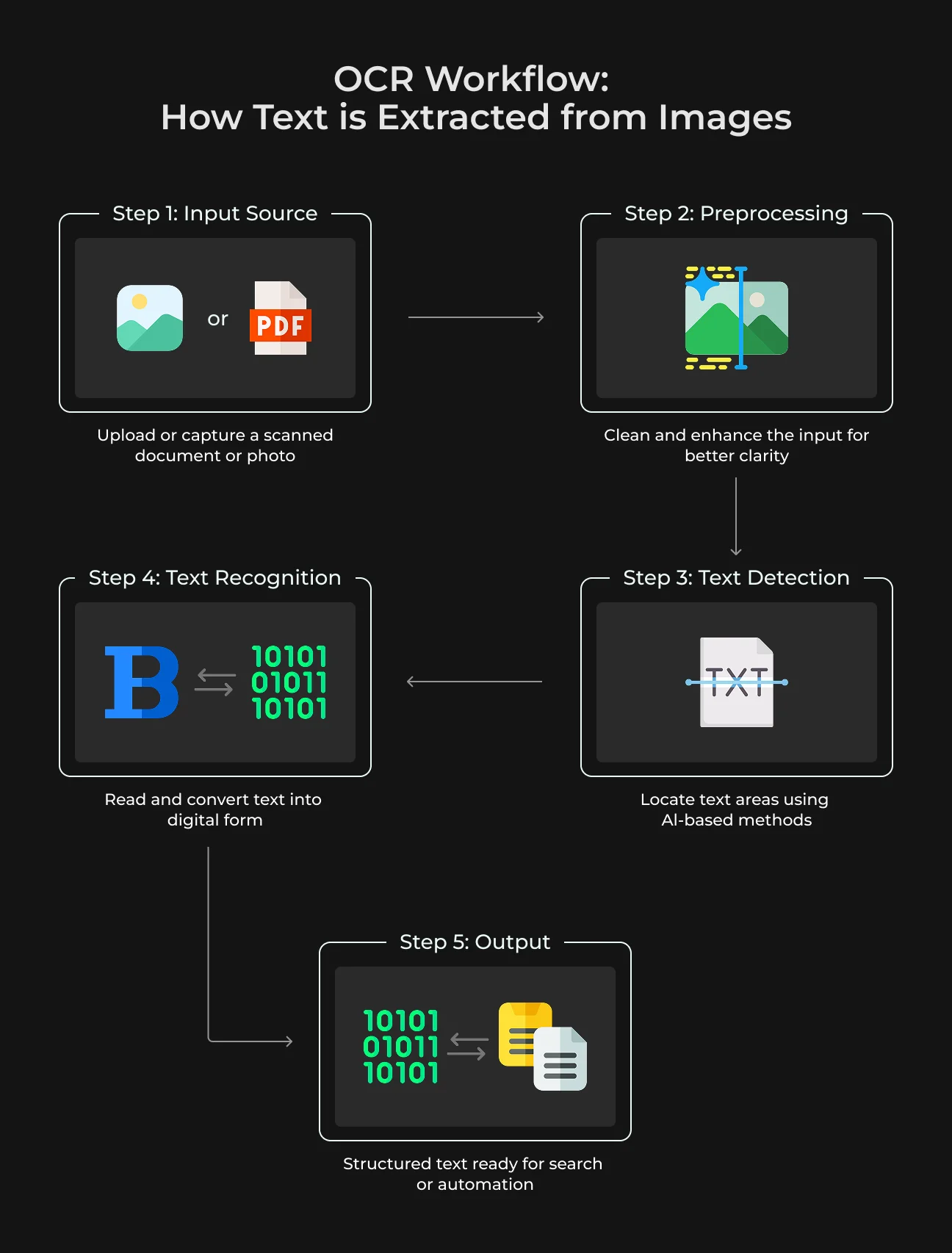
ICR is an advanced form of OCR designed to read handwritten text. It uses neural networks and continuously learning algorithms to recognize many handwriting styles and fonts. While OCR focuses on speed and requires fewer computing resources, ICR prioritizes accuracy for handwritten content and can reach 97% or higher accuracy on pre-formatted handwritten forms.
OCR and ICR work together rather than compete in the IDP sector. OCR handles typed and printed text, while ICR extends coverage to the harder task of handwriting.
Intelligent document processing combines both technologies. It is often enhanced with machine learning and natural language processing to deliver highly reliable data extraction from all kinds of document types and formats, ensuring no valuable information is lost because of how it was originally written.
Here’s an overview comparison of OCR and ICR capabilities for AI document processing:
Feature | Optical Character Recognition (OCR) | Intelligent Character Recognition (ICR) |
| Primary Function | Converts printed/typed text to digital data | Interprets handwritten text |
| Best Suited For | Structured & high-quality printed documents | Handwritten forms |
| Core Technology | Pattern recognition, feature detection | Advanced neural networks (CNNs, RNNs), machine learning |
| Accuracy (Printed Text) | 95-99% | Accuracy falls on printed text compared to OCR |
| Accuracy (Handwritten Text) | Struggles | 97%+ (for structured forms) |
| Speed & Resource Intensity | Faster & less resource-intensive | Prioritizes accuracy over speed |
| Cursive Handwriting Support | No | Cannot read (character-level recognition) |
Natural Language Processing
NLP uses ML to read and handle human language embedded in documents. Some features of NLP include being able to detect individual entities such as names, dates, and currency values in documents like invoices. This allows IDP to identify some data points of a document in relation to the entire document.
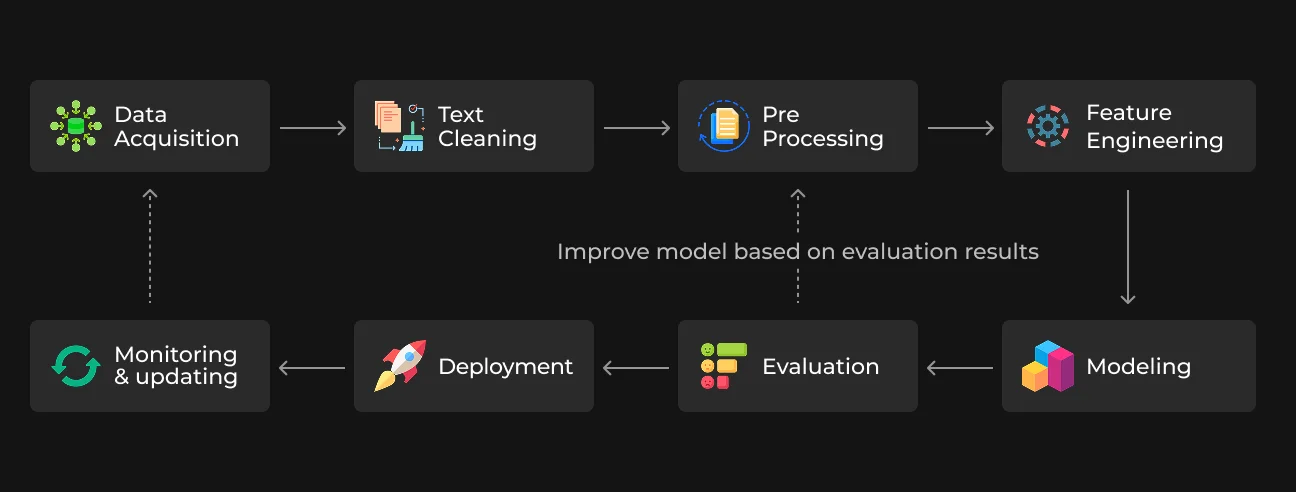
NLP is necessary to allow the system to understand the meaning and context of text while classifying data and extracting data, in a way that extracted information is not just characters but useful data.
Machine Learning & Deep Learning
Machine learning and deep learning are key to intelligent document processing, seamlessly integrating with optical character recognition and other AI algorithms. They allow IDP systems to learn and improve automatically to enable smart interpretation of complex and diverse documents.
These technologies are also needed for smart document classification:
- Function: ML/DL-powered systems classify documents by their content and type;
- Benefit: this ensures each document is correctly routed to the appropriate automated processing stream, which is vital for organizations handling high volumes and various document types.
ML is also central to improving the accuracy and quality of automated data processing via Human-in-the-Loop (HITL) Validation:
- Mechanism: it employs supervised learning to create rapid feedback loops;
- Process: human operators can directly correct derived data, providing immediate training input to the AI;
- Outcome: this significantly improves the AI's training, leading to higher-quality automated data processing over time.
Computer Vision
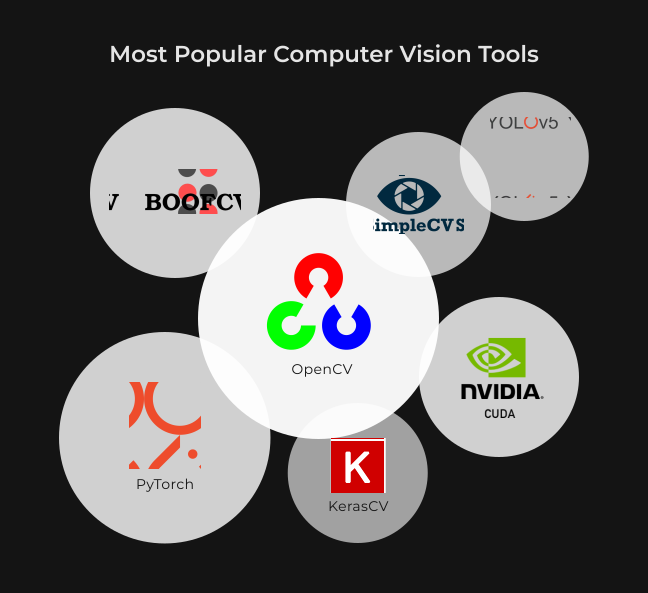
Computer vision is a crucial component that enables a system to visually detect various contents within a document, including text, images, and charts. It is particularly useful for classifying documents based on their visual form and composition, which includes the layout and structure.
This classification based on visual properties is essential for efficient routing of the document to the correct processing routines. For example, it allows the system to differentiate between an invoice and a contract by recognizing their distinct visual layouts, often before performing detailed text analysis.
Generative AI & Large Language Models (LLMs)
LLMs and generative AIs are transforming the scale and efficiency of automated document processing. In addition to extracting and classifying information, these advanced AI models can generate short summaries from multiple sources and deliver actionable insights from vast amounts of unstructured data.
This lifts IDP from simple data capture to the creation of knowledge.
Generative AI-powered IDP is particularly capable of acting as a “human analyst”:
- Sift through large sets of documents in an efficient way and retrieve relevant data;
- Complete preformatted templates;
- Make summary reports;
- Draft detailed reports or portfolios based on the extracted information, etc.
Generative AI-based IDP dramatically reduces the amount of human resources required to process data and generate reports. However, LLMs can hallucinate. That's why it is necessary to implement AI observability, which can prevent this issue.
Robotic Process Automation (RPA)
IDP improves RPA capabilities by introducing judgment and decision-making intelligence to complex processes such as:
- Mortgage processing for banking;
- Claims processing for healthcare;
- Invoice processing for accounts payable teams.
RPA robots can capture document information from various sources (scanners, PDFs, email, and watched folders) to:
- Automatically identify and classify document types;
- Read out important data fields;
- Pass them through to downstream processes.
These robots perform repetitive rules-based work with high speed and accuracy with ease. One study shows that RPA, when integrated with automated document processing tasks, has the capability to accelerate processing rates by up to 90% and reduce data error rates by as much as 85%.
IDP Workflow Step-by-Step
Intelligent document processing changes the manner in which organizations process unstructured information through automated downstream integration, data extraction, and document classification. Below is the step-by-step description of an average IDP document processing workflow.
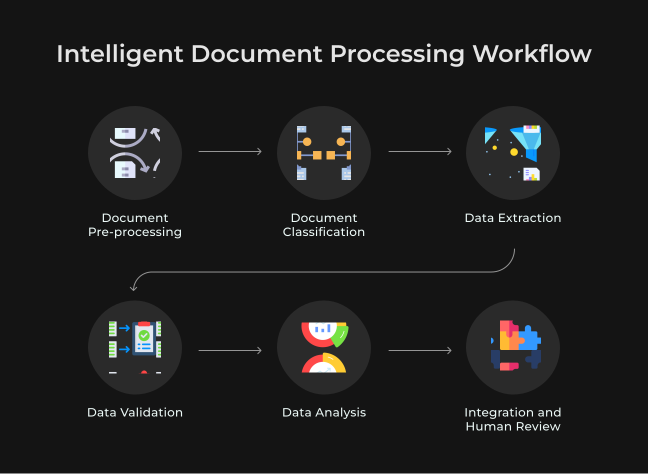
1. Pre-Processing
Documents are normalized before smart interpretation for maximum accuracy. This involves:
- OCR. Scanned or image text is converted into machine-readable data.
- Noise reduction & de-skewing. Improves quality for simplified interpretation.
- Language and format normalization. Ensures data in PDFs, handwritten text, and forms are normalized for downstream processing.
Correct pre-processing lays the foundation for correct classification and extraction.
2. Intelligent Document Classification
With AI models, the system classifies incoming documents into categories such as invoices, contracts, receipts, or medical records. This is typically done through:
- Natural Language Processing (NLP);
- Computer Vision (CV);
- Rule-based filters.
This automated classification removes the need for human triaging. It cuts processing time and errors.
3. Automated Data Extraction
After a document is understood, the system recognizes and pulls out key data points such as invoice numbers, due dates, patient names, or policy terms automatically. This process uses:
- Named Entity Recognition (NER) that assigns appropriate field tags;
- Layout-savvy models that understand non-linear layouts like columns and tables;
- Field training tailored to individual business needs.
Accuracy can be achieved with high-quality pre-trained AI models and domain fine-tuning.
4. Validation and Verification
Data integrity is validated through the following validation of information:
- Confidence scoring flags low-confidence extractions for human oversight;
- Cross-referencing with internal databases ensures consistency.
This step integrates AI with human-in-the-loop (HITL) systems, where it’s necessary to deliver both speed and integrity.
5. Integration and Action
The output is formatted and routed to relevant systems (ERP, CRM, DMS, RPA bots), enabling:
- Automated document processing workflows that trigger actions like payments, approvals, or alerts;
- Structured data pipelines that feed into analytics or reporting systems;
- Audit trails and traceability that maintain quality control and compliance records.
Through seamless integration with existing enterprise environments, IDP guarantees that analytics yield direct business impact.
Benefits of AI Document Processing
Automated document workflows bring the following advantages.
1. Automation and Efficiency
IDP can significantly reduce document processing time and save over 320 hours per month for each employee. For example, SapientPro built a CV management system using Azure OpenAI for automated data extraction and Azure AI Search for indexing. This tool processes unstructured resumes, extracts key details (education, experience, projects), and converts them into a unified, structured format.
In accounts payable, IDP can increase the throughput of invoice processing by as much as 60% compared to manual processing, where a typical staffer might handle only about 20 invoices per day. It is predicted that by 2025, 50% of B2B invoices worldwide will be processed without any manual intervention, a transformation largely enabled by IDP technologies.
2. Improved Accuracy and Error Reduction
IDP can significantly reduce errors in data entry and extraction. Advanced IDP systems achieve extremely high data accuracy, up to 99% in data extraction, whereas AI-based systems can achieve accuracy levels of 99.9% across various document types.
This precision is a direct result of the automation of data validation, classification, and extraction that prevents mistakes usually created by manual processing, such as incorrect data entry or incorrect filing.
High IDP precision is not only an advantage but also an utmost requirement for data integrity. Error reduction (often by over 52%) and near-perfect data extraction (up to 99%) give analytics quality inputs, reduce rework cost, and augment regulatory compliance.
3. Enhanced Fraud Detection and Compliance
IDP provides safe processing of confidential data and adherence to many regulations like HIPAA, Sarbanes-Oxley, and GDPR. With the automation of compliance audits and adherence to rules of data collection and processing all the time, document processing tools accomplish this.
Besides absolute compliance, IDP is a useful tool for detecting fraud. In finance, IDP was discovered to increase fraud detection by 50%. It:
- Identifies irregularities in financial documents;
- Flags suspicious activity before it simmers into something worse;
- Cross-checks records against enormous databases.
For instance, an AI fraud analyst spends on average 72 seconds reviewing a document, a far cry from the 10 minutes spent by human reviewers, with pretty good performance in preventing review escalations. The complexity of fraudulent attempts is already observed to be on the rise, as detected fraudulent templates are noted to have increased by 50% from 2023 to 2024.
It is observed that 89.4% of the fraudulent documents have been found to comprise modifications to financial details either alone or combined with identity changes, indicating the need for proper financial detail validation.
4. Scalability and Cost Savings
IDP removes the need for manual labor directly, leading to significant labor cost savings. A financial services company, for example, estimated to save $2.9 million annually by implementing IDP to cut in half its manual document extraction workforce.
Studies consistently show an extremely high ROI for document processing tools, between 30% and 200% in year one alone, predicated largely on the savings of labor costs. Companies typically recover their IDP investment one to three times in the first year.
The velocity at which this return is achieved is a very compelling sales argument for companies considering document automation AI.
5. Enhanced Decision-Making and Customer Experience
IDP accelerates customer-focused documents, such as those involved in onboarding, booking, and payment. Faster speed directly translates to increased customer satisfaction.
Moreover, information from customer documents can be utilized by chatbots to provide more specific and accurate customer queries, improving customer experience.
During the pandemic, businesses reported significant gains:
- 54% enhanced staff collaboration;
- 33% reported greater process flexibility;
- 32% realized greater worker engagement and improved ability to capitalize on insights from digitized document processes.
AI also provides 24/7 availability, uniform service quality, and customization, all further building on customer interaction.
Key Challenges and Strategic Solutions in IDP Implementation
Here are the common challenges and solutions for developing automated document processing software.
Complexity of Document Diversity
Businesses are receiving a wide variety of document types. They include scanned, handwritten, multilingual, semi-structured, or even completely unstructured documents. This variety may puzzle generic models. Solution:
- Invest in adaptive AI models that are trained on industry documents;
- Use template-free extraction with layout-agnostic features;
- Harness feedback loops to continuously tune model performance.
Your intelligent document processing software must consider all the types of documents from the start. This will save you from rework in the future.
Data Privacy and Security Risks
Processing sensitive documents (medical records, financial reports, contracts) raises compliance risks under regulations like GDPR, HIPAA, or CCPA. Solution:
- Use on-premises or private cloud deployment to maintain data control;
- Use encryption in transit and at rest with access restrictions based on roles;
- Use redaction technology and audit logs to offer transparency and confidentiality.
All these actions are a must for an intelligent document processing platform that operates in sensitive domains like healthcare document processing.
Integration with Legacy Systems
Many organizations still operate legacy document management systems or standalone tools that are difficult to integrate with modern IDP platforms. Solution:
- Use middleware and APIs to integrate IDP outputs to legacy applications;
- Deploy RPA bots to fill gaps where APIs are unfeasible;
- Roll out phased implementations starting with lower-priority departments to reduce disruption.
It is an especially hot challenge for mortgage document processing, as most financial institutions are built based on legacy systems and don't hurry to change that.
AI Transparency (“Black Box” Concern) and Bias
The “black box” concern is the inability to understand how complex AI systems, particularly deep learning models, arrive at a specific decision or output. Trusting such a system is quite difficult, especially when it is unclear to you why it makes its decisions. This also creates ground for bias.
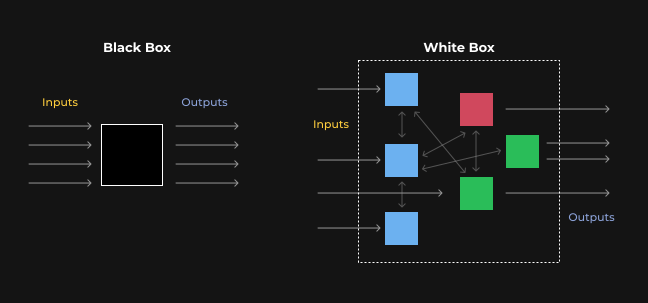
Stakeholders are reluctant to use AI-driven output, especially where decisions carry regulatory or legal implications. Possible solutions include:
- Implement explainable AI (XAI) frameworks that focus on why a decision was taken;
- Use model interpretability tools to plot feature importance;
- Use review workflows that combine document processing tools with human attestation, especially for high-risk scenarios.
Even the best AI for document processing can be biased. This challenge must be processed early on regardless of what type of AI you use.
Scalability and Cost Considerations
Scaling the IDP across departments or geographies may prove expensive and technically complex, particularly if up-front configurations are not flexible. Solution:
- Choose modular IDP platforms that scale with your business;
- Use usage-based pricing models to align cost with value delivered;
- Optimize use-case ROI mapping—start with high-volume, high-impact documents like invoices or compliance documents.
These solutions are especially valuable for EHR document processing as healthcare facilities constantly have an increasing number of clients.
Use Cases of Intelligent Document Processing
Intelligent document processing demonstrates widespread applicability, transforming document processing workflows across numerous industries. Let's take a look at how different industries are harnessing this powerful technology to achieve unprecedented efficiency and accuracy.
Finance & Accounting: The Core of Data Integrity
In a field built on precision and regulation, IDP offers a pathway to faster, more compliant, and less error-prone operations. Financial institutions handle a deluge of paperwork daily, including loan applications, invoices, financial statements, contracts, tax forms, and bank statements.
IDP automates essential actions, from speeding up loan processing and credit approvals to handling complex invoice processing and reconciliation. Critically, it enhances compliance efforts like KYC and AML while providing sophisticated fraud detection and risk assessment.
The results speak for themselves: institutions have reported a massive 70% cut in time for loan approvals, a 60% reduction in KYC/AML onboarding times, and up to a 75% reduction in reporting errors, ensuring faster risk assessments and lower operational costs.
Healthcare: Focusing on Patients, Not Paperwork
Healthcare providers are constantly juggling patient care with overwhelming administrative tasks. IDP is the solution, helping to ensure compliance and improve patient outcomes. Core documents here include claims, doctor's notes, clinical trial reports, medical records, and patient intake forms.
By implementing IDP, organizations can rapidly triage claims, accurately process medical records, and securely manage sensitive patient information. It plays a vital role in integrating data with Electronic Health Record (EHR) systems and ensuring strict compliance with crucial standards like HIPAA, GDPR, and PHI.
The impact is significant: IDP ensures the accurate and secure handling of sensitive patient data, leading to improved patient outcomes and better experiences while reducing the heavy workload on insurance customer advisors.
HR & Employee Operations: Streamlining the Talent Lifecycle
From the moment a candidate applies to managing an employee's benefits, HR is document-intensive. They deal with volumes of resumes, employment contracts, personal identification, tax forms, and timesheets. IDP modernizes these functions, creating a better employee experience from day one.
IDP is used to automate resume processing and employee screening, streamline the entire employee onboarding process, and ensure flawless payroll transactions. This consistent data handling leads to a streamlined onboarding experience and a significant reduction in data entry errors.
The technology eliminates human mistakes and prevents delays in payroll, ultimately resulting in an improved employee experience and shorter to-do lists for HR personnel.
Logistics and Transportation: Keeping the Supply Chain Moving
The movement of goods relies on a constant flow of time-sensitive documents like shipping manifests, invoices, customs forms, and delivery receipts. IDP ensures operations remain smooth, compliant, and efficient.
The primary use cases involve automating shipping documents, compliance management, and managing inventory records. The benefit is an enhanced supply chain velocity and overall efficiency. By reducing manual workloads and minimizing errors, IDP delivers smoother operations and guarantees improved compliance throughout the transportation chain.
Government and Public Sector: Better Public Service Delivery
Public services require accuracy and transparency. Agencies handle critical documents such as permits, licenses, public records, taxes, and benefit claims. IDP helps agencies process citizen requests faster while adapting to ever-changing regulations.
The technology is crucial for efficiently processing complex applications, issuing secure e-documents, and extracting data to enhance decision-making.
The direct impact is the faster processing of citizen requests and significantly improved public service delivery, ensuring enhanced decision-making and better transparency.
Retail and E-commerce: Turbocharging Fulfillment
Retailers use IDP to manage orders, invoices, and shipping records. IDP is used for customer data management, supply chain optimization, and accelerating order fulfillment. This results in faster order fulfillment and enhanced operational agility across the board. Furthermore, the reduction in data entry errors directly leads to better customer service.
Legal: The Future of Contract Management and Review
The legal field is synonymous with dense, complex documents like agreements, court filings, legal dockets, and contracts. IDP transforms legal practice by bringing unprecedented speed and accuracy to document review.
Its primary applications are processing, archiving, and managing legal data, automating time-consuming review workflows, and instantly extracting text and specific terms for contract management.
IDP delivers greater accuracy and a notable reduction in manual effort, leading to faster and more accurate legal analysis and ensuring consistent language throughout all documentation.
Manufacturing: Proposal Power and Production Control
From complex RFPs (Requests for Proposal) to monitoring intricate supply chains, IDP helps manufacturing plants maintain peak operational efficiency. Key use cases include efficiently processing RFPs, generating proposals, and monitoring supply chain documents to maintain production schedules.
This results in improved efficiency and a real competitive edge, with some companies reporting an increased proposal win rate of 40% and drastically faster RFP response times—cutting a three-week process down to just one week.
Real Estate and Mortgage: Accelerating the Homeownership Dream
The process of buying a home is notoriously document-heavy, involving mortgage documents, loan applications, tax returns, pay stubs, bank statements, appraisals, and legal contracts. IDP eliminates the bottlenecks, making the approval and closing process faster and less stressful.
It is essential for comprehensive mortgage processing, loan application intake, income verification, and underwriting. For property managers, it handles detailed lease abstraction.
The core benefit is faster approval times (moving from weeks to days), achieved through instant data extraction and cross-verification, ensuring consistent 24-hour Service Level Agreements (SLAs).
| Feature | Traditional Manual Processing | Intelligent Document Processing (IDP) |
| Speed | Slow, often taking days or weeks (e.g., loan processing). | Rapid, often minutes or seconds (e.g., data extraction). |
| Accuracy | Prone to human errors, data entry mistakes, and misclassification. | High, leverages AI/ML for validation and cross-verification. |
| Cost | High operational costs due to labor and rework. | Lowered operational costs and reduced need for manual oversight. |
| Scalability | Difficult to scale up or down during peak periods. | Easily scalable, handles massive volumes with consistent performance. |
| Compliance | Dependent on human vigilance; higher risk of regulatory errors. | Enhanced compliance with automated audit trails and data security. |
How SapientPro Implements AI in Document Processing
Our Swiss client needed to standardize and manage Safety Data Sheets (SDS) across formats, languages, and regulatory versions. They struggled with inconsistent structures, multilingual matching, and barcode-based identification.
SapientPro built an advanced system leveraging OpenAI tooling and Mistral, among other technologies, to:
- Extract structured data from varied SDS documents;
- Match records across multiple languages and versions without relying on barcodes;
- Automate regulatory compliance updates and searchable tagging;
- Alert users to SDS updates and manage bulk uploads via API.
The platform effectively became the core of a flexible and compliant SDS management system for clients across industries.
We also developed an AI-powered recruitment tool for our U.S.-based HR agency handling corporate hiring workflows. It needed to transform unstructured resumes (CVs) into their internal structured format—manual parsing was slow and inconsistent.
We developed an AI-driven CV processing system that uses OCR and NLP to:
- Extract and standardize education, experience, and project details from CVs of various formats;
- Reduce manual review time from hours to minutes per resume;
- Offer minimal human moderation post-automation.
As a result, it saves over 320 hours per month, accelerating candidate processing dramatically while maintaining accuracy.
Partner with SapientPro to Integrate AI in Your Workflow
SapientPro is a leading AI development company that can help you implement AI document processing features into your workflows and unlock new levels of productivity. Our team builds tailored solutions for businesses and startups of all kinds. You’ll reduce manual tasks and streamline operations with us.
Contact us today to discuss your project and get a detailed estimate.
Build Your AI Solution with SapientPro