All Role of AI Observability in Preventing LLM Hallucinations
December 3, 202510 min read


ChatGPT, Gemini, and others where users can't always trust the accuracy of the information. Considering the increased usage of artificial intelligence, finding and applying proper guardrails is a must.
ChatGPT currently has 500 million weekly users and 20 million paying subscribers, showing a 30% revenue increase since last year. It's on track to make $5 billion from the assistant and $12.7 billion in total by 2025. This means that the trend on using AI-powered tools is only going up.
But why do LLMs hallucinate? Hallucinations happen when a model generates incorrect or nonsensical information. Eliminating hallucinations completely isn't possible, but there are ways to reduce them. One effective method is AI observability, which helps prevent hallucinations.
Learn more about the best using AI observability from SapientPro’s engineers.
Key Takeaways
- Hallucinations happen when a model generates incorrect or nonsensical information;
- The problem of hallucinations is linked to the limitations of LLMs, like the amount of training data, the size of context windows, attention challenges, and overfitting;
- AI observability is a powerful tool that serves as a GPS for an AI system, offering insights into how LLMs function;
- Advanced prompt engineering is one of the strategies to help language models understand and respond to inputs more effectively.
LLM Hallucinations Explained
An AI hallucination occurs when a model invents data that seems convincing but isn’t actually true.
One of the LLM hallucination examples can be the following: if an AI says the Duffer Brothers created “The Crown,” it might sound reasonable, but it's false. The real creators are Left Bank Pictures and Sony Pictures Television for Netflix.
This is similar to a student guessing answers on a test without really knowing the material. The AI isn’t intentionally lying — it’s just producing likely answers based on its data without checking them.
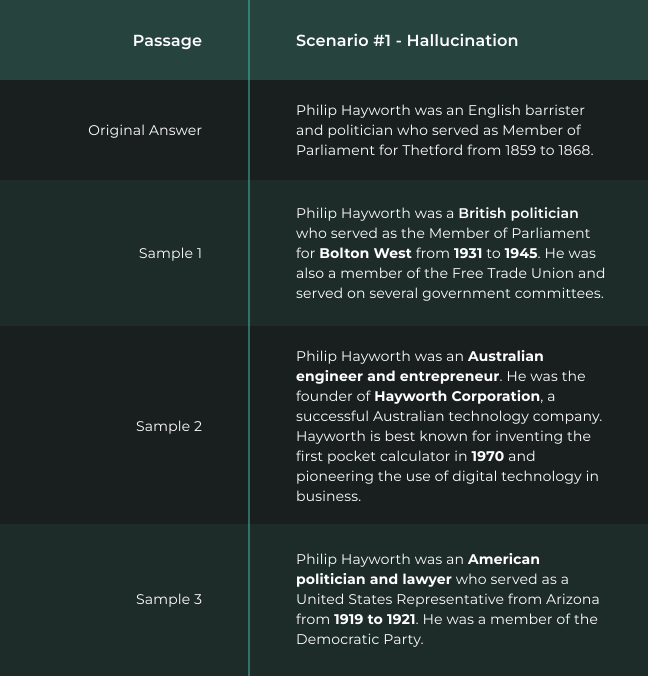
Such mistakes can occur in various situations. Let's say a chatbot might invent fake personal details, a Q&A tool could reference made-up research, or a code generator might suggest nonexistent functions.
For example, ChatGPT once fabricated accusations in a legal summary, which led to a lawsuit. A lawyer was punished for submitting fake case law created by an AI. These errors aren’t just harmless. They can break trust, cause software issues, and lead to serious troubles if not carefully managed.
Types of LLM Hallucinations
In the world of large language models, things aren't always straightforward. These algorithms can sometimes create outputs that are both confusing and impressive. Let's look at the types of hallucinations LLMs can have.
Intrinsic Hallucinations
An AI can sometimes produce strange stories from its own knowledge. These odd stories, known as intrinsic hallucinations, happen when a language model creates content that appears logical but is entirely fictional. These hallucinations arise from the model's internal patterns and associations, resulting in surprising narratives.
Extrinsic Hallucinations
Extrinsic hallucinations occur when the LLM creates imaginative output beyond its training data, mixing fact with fiction. This can produce entertaining results, like combining real and mythical figures in historical discussions. Yet, they aren't grounded in reality.
Factuality Hallucinations
Factuality hallucinations occur when a large language model (LLM) produces information that isn't accurate or doesn't match real-world knowledge. This happens because LLMs create text based on patterns and probabilities from their training data, not from a grasp of true facts.
Faithfulness Hallucinations
Here, the LLM differs from the user's instructions or becomes inconsistent. It's like a story twist in a mystery novel that doesn't fit the clues. It typically leaves people confused and curious.
Root Causes of Hallucinations
LLM technology has come a long way since the late 2010s, when developers were first creating basic generative AI models. Today, these AI systems powered by LLMs are popular in many industries.
However, hallucinations, which are incorrect outputs, remain a common issue. This problem is tied to the limitations of LLMs, like the amount of training data, the size of context windows, attention challenges, and overfitting.
Data Limitations
LLMs use components called tokens (usually words or syllables) to process input. The context window is how much information the model can look at at one time.
A bigger context window can help reduce errors, but it requires a lot more computing power, so most LLMs have restricted context windows. If important information doesn’t fit within this space, it can lead to hallucinations.
Training Complexities
LLMs create responses based on their training data. If asked something beyond their knowledge, they might give nonsensical responses because they try to answer anyway.
Inference-Time Issues
Inference-time challenges arise when a model has difficulty producing quick responses. For example, insufficient computational resources might prompt a large language model to take shortcuts, which can lead to storytelling errors. This can cause the model to produce outputs that are imaginative yet inaccurate, as though they belong to another realm.
Prompt Ambiguity & Pressure
With a vague prompt, AI can get creative and come up with different answers, like readers finding their own meanings in a poem. Complex prompts might also lead AI to make up details to keep users happy.
Model Hallucination | Definition | Causes | Examples |
| Intrinsic hallucinations | Fictional yet logically consistent outcomes | Model patterns and associations | A tale of a legendary hero that seems historical yet remains purely fictional |
| Extrinsic hallucinations | Blending facts with fiction, creating outputs beyond known data | Extrapolation beyond training data | Creating a scenario where historical figures meet aliens |
| Factuality hallucinations | Results that conflict with real-world facts or are completely made-up | Incomplete training data | Declaring that Mount Everest is located in Brazil |
| Faithfulness hallucinations | Deviations from user instructions or logic | Inference-time issues, prompt pressure | Crafting a plot that ignores user instructions and creates new adventures |
LLM Hallucination Detection and Risks
LLM hallucinations can be dangerous because they may spread false information. If these mistakes aren't caught early, they can ruin public trust, boost biases, cause legal and financial problems, and seriously mess up reputations. Let's explore some other risks of LLM hallucinations.
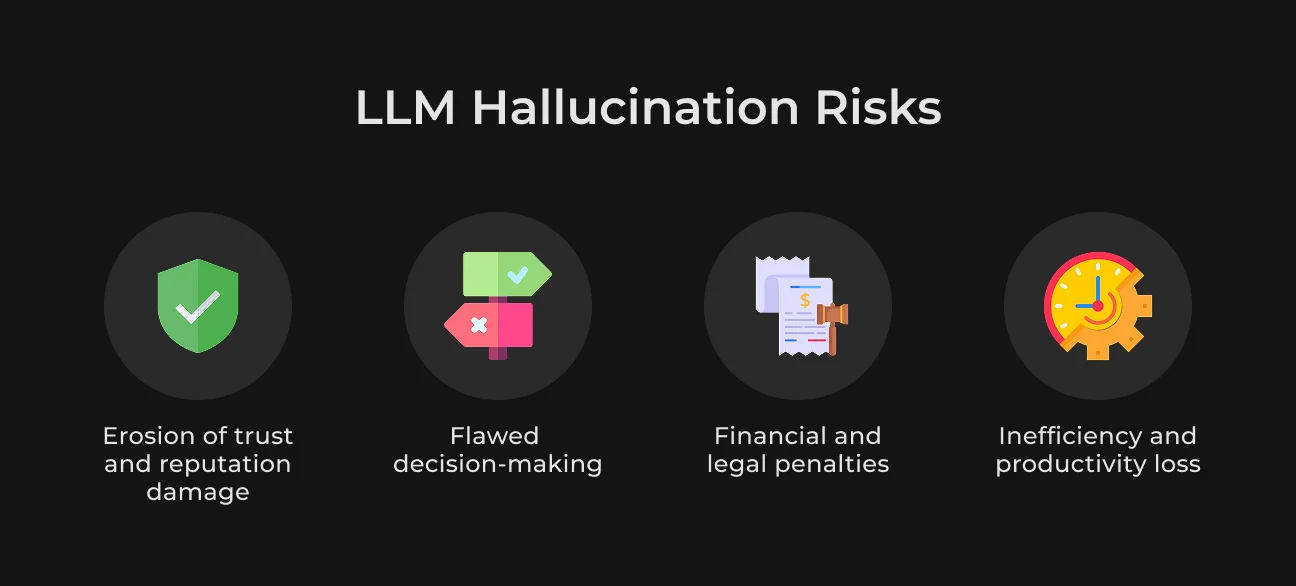
- Erosion of trust and reputation damage. When an AI model provides wrong information, it can lead to confusion and mistrust. Even a tiny mistake can damage a brand's reputation, and winning back previous trust could be tough. Accuracy and transparency are key to fixing this;
- Financial and legal penalties. In a world driven by numbers, incorrect information can be expensive. For example, Air Canada dealt with surprise fines because it messed up its contract obligations. When language models make mistakes or misunderstand things, it can lead to losing money or getting into legal or regulatory trouble;
- Flawed decision-making. When AI messes up data, businesses might build their strategies based on faulty information. Trusting this wrong data leads to inefficient plans, wasted effort, and unmet goals. It can affect things like resource allocation and market positioning and cause missed opportunities;
- Inefficiency and productivity loss. AI inaccuracies can distract team members from important tasks, slowing productivity. Fixing these issues can take up time and resources, or even lower team morale and cause project delays.
Role of AI Observability to Prevent LLM Hallucinations
In everything related to artificial intelligence, particularly with large language models, hallucinations (when AI generates false or misleading information) are a big concern. AI observability is crucial to successfully dealing with this. It can monitor and improve the accuracy and reliability of these complex models.
AI observability works like a GPS for an AI system that provides insights into how LLMs function. This helps identify, fix, and prevent hallucinations. AI observability tools can also:
- Identify unusual content by analyzing metrics and patterns in inputs and outputs to spot hallucinations;
- Track each step of the LLM process from input to response to specify where hallucinations occur;
- Measure specific indicators of hallucinations;
- Estimate both model-specific data and IT infrastructure data for enterprise-level monitoring;
- Find changes in input data that could cause hallucinations;
- Conduct investigations of input data, the model, and infrastructure to identify the root cause of issues.
Core Components of AI Observability Across the LLM Stack
Let's look at the essential elements of the AI observability platform in the LLM stack.
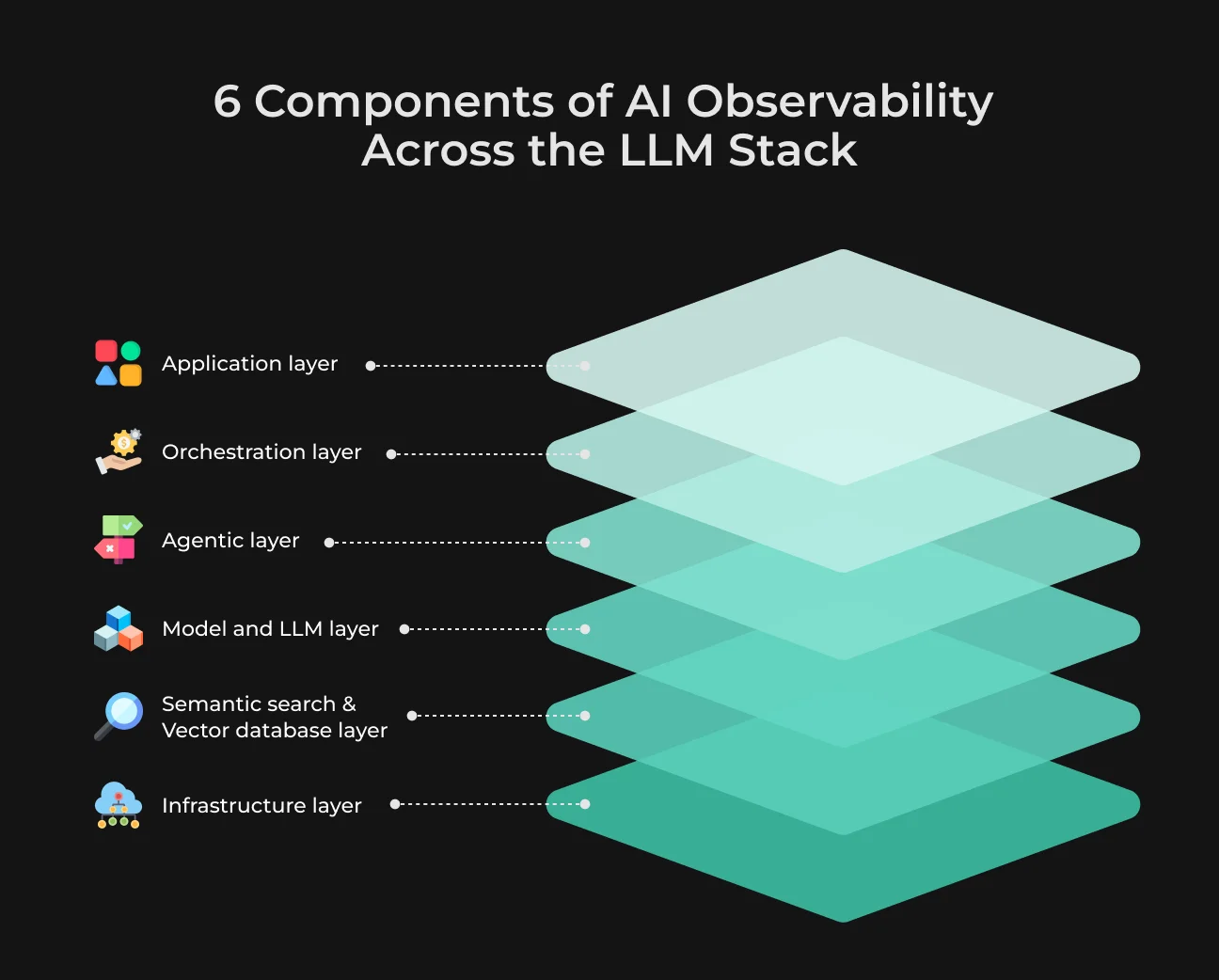
1. Application Layer
The application layer is where users connect with AI models and collect data on user experiences. Here, observability means monitoring user inputs, outputs, and feedback.
Monitoring how AI applications are used helps developers spot possible errors. For example, if an e-commerce chatbot gives wrong product summaries, LLM observability tools can track user questions and answers, highlight mistakes, and allow for quick fixes.
2. Orchestration Layer
The orchestration layer helps AI components work smoothly together, providing seamless user experiences. At this level, observability involves monitoring data and communication between components.
It identifies issues from batch processing or API calls and adjusts the orchestration logic to avoid errors. For example, if data inputs don't align properly, observability tools can pinpoint the miscommunications, enabling fixes that restore correct data flow.
3. Agentic Layer
The agentic layer enhances AI's ability to make decisions, enabling models to act on their own or engage effectively with users.
Observability in this layer tracks the logic behind AI decisions. This helps developers ensure that AI actions match predictions and user intentions. If an AI controlling smart home devices makes a mistake, observability lets developers trace the decisions back to find where errors occurred.
4. Model and LLM Layer
This layer contains the core of AI — the model. It’s where the model learns, makes predictions, and represents knowledge. Observability here means watching how the model makes and improves its predictions.
Tools in this layer track changes in training data, monitor real-time predictions, and highlight any unusual behavior that could lead to errors. For example, in a translation model, observability can warn engineers if unexpected results suggest a possible misinterpretation or translation mistake.
5. Semantic Search & Vector Database Layer
In a semantic search and vector database, AI organizes and retrieves data in ways that make it easier to understand. Observability tools ensure data remains accurate and relevant by monitoring search algorithms and detecting changes that might cause errors.
These tools also help identify when outdated or irrelevant data results in inaccurate responses.
6. Infrastructure Layer
The infrastructure layer supports AI operations with hardware, networks, and runtime environments. Observability in this layer helps monitor and allocate resources efficiently.
By keeping track of operational metrics, it can spot issues like delays or hardware limitations that could affect AI systems. If a language model slows down because servers are overloaded, observability tools can quickly identify the issue and then enable resource adjustments or optimization.
Benefits of AI Observability Implementation across the LLM Stack
Let’s summarize the key benefits of AI observability in the LLM stack:
- Transparency. AI observability gives clear insights into models for reliable decisions;
- Rapid anomaly detection. Quickly spots and fixes errors like hallucinations or drift;
- Data-based decisions. Provides a model with insights that empower accurate data-driven choices;
- More reasonable model performance. Fine-tunes AI components for high-quality outputs;
- Proactive problem solving. Prevents issues before they impact users;
- User trust. Helps build user confidence by giving consistent and reliable outputs;
- Efficient LLM development. Accelerates development with detailed data, which leads to faster bug fixes and features;
- Strong architecture. Uses insights to support AI infrastructure stability;
- Optimization. Enhances coordination between AI components for a smooth system;
- Continuous improvement. Encourages continuous innovation and dependability in AI systems.
How to Reduce Hallucinations in LLM with AI Observability
Researchers and developers have found ways to reduce errors and enhance the accuracy of large language models. They achieve this, for example, by using human feedback during training and accessing real-time knowledge sources. But a key strategy to make AI responses more reliable is AI observability, which we will discuss further.
Real-Time Detection Techniques
Real-time detection techniques are important when it comes to identifying hallucinations as they occur — they prevent false information from reaching users. These methods involve constantly monitoring input/output relationships and using automated evaluation metrics to check the accuracy of outputs.
Input/Output Monitoring and Tracing
Monitoring and tracking the input/output operations of an LLM is like having a real-time audit trail. This technique captures data at important stages in the model's decision-making process.
Inputs and their outputs are logged and checked to ensure they are consistent. Any unusual patterns are flagged for further review.
With a strong tracing system, it is easier to link outputs to specific inputs, helping quickly identify the causes of any issues.
Automated Evaluation Metrics
Automated evaluation metrics are tools that objectively measure how well a language model is working. They can also spot unusual outputs automatically.
Accuracy, F1 score, perplexity, and BLEU score are specific metrics that help evaluate various aspects of a model, e.g., its understanding and ability to produce coherent text.
Metric Name | Focus | Description |
Accuracy |
Correctness |
Measures true positive and negative outputs compared to false ones |
F1 Score |
Balance | Balances precision and recall in outputs |
Perplexity |
Predictability | Evaluates how well a model can accurately predict the next words |
BLEU Score |
Consistency | Checks how well the generated text matches the reference text |
These automated metrics can help organizations establish a real-time feedback system to quickly find and fix any performance issues.
LLM-as-a-Judge and Encoder-Based Methods
These advanced techniques use AI to assess and enhance its own results.
- LLM-as-a-Judge. This method uses one AI model to review the output of another, similar to peer-review, to find inaccuracies;
- Encoder-Based Methods. They use deep learning encoders to analyze text, identifying believable from unlikely outputs by checking for similarity and coherence.
These two approaches do both: increase the checking of AI outputs and improve the quality of the content produced.
Knowledge Graph Validation and Reference-Based Checks
Adding knowledge graph validation and reference checks is like having a fact-checking system for ensuring that outputs are accurate. Let's take a look at these methods:
- Knowledge graph validation. Use knowledge graphs to verify the factual accuracy of outputs. These graphs contain structured data that helps identify any errors;
- Reference-based checks. Use trusted sources to confirm outputs. A collection of reliable documents keeps the AI model aligned with reality.
They ensure AI systems consistently aim for accuracy and factual correctness in their outputs.
LLM Hallucination Mitigation Strategies
As large language models are used more in daily applications, reducing their inaccuracies is a key challenge. Using advanced strategies can help an LLM development company greatly improve the reliability and accuracy of these models’ outputs.
Advanced Prompt Engineering
Advanced prompt engineering is a strategy to help language models better understand and respond to inputs. By thoughtfully designing prompts, users can encourage models to give more accurate and relevant answers. This means creating clear and structured queries that outline the context and desired results.
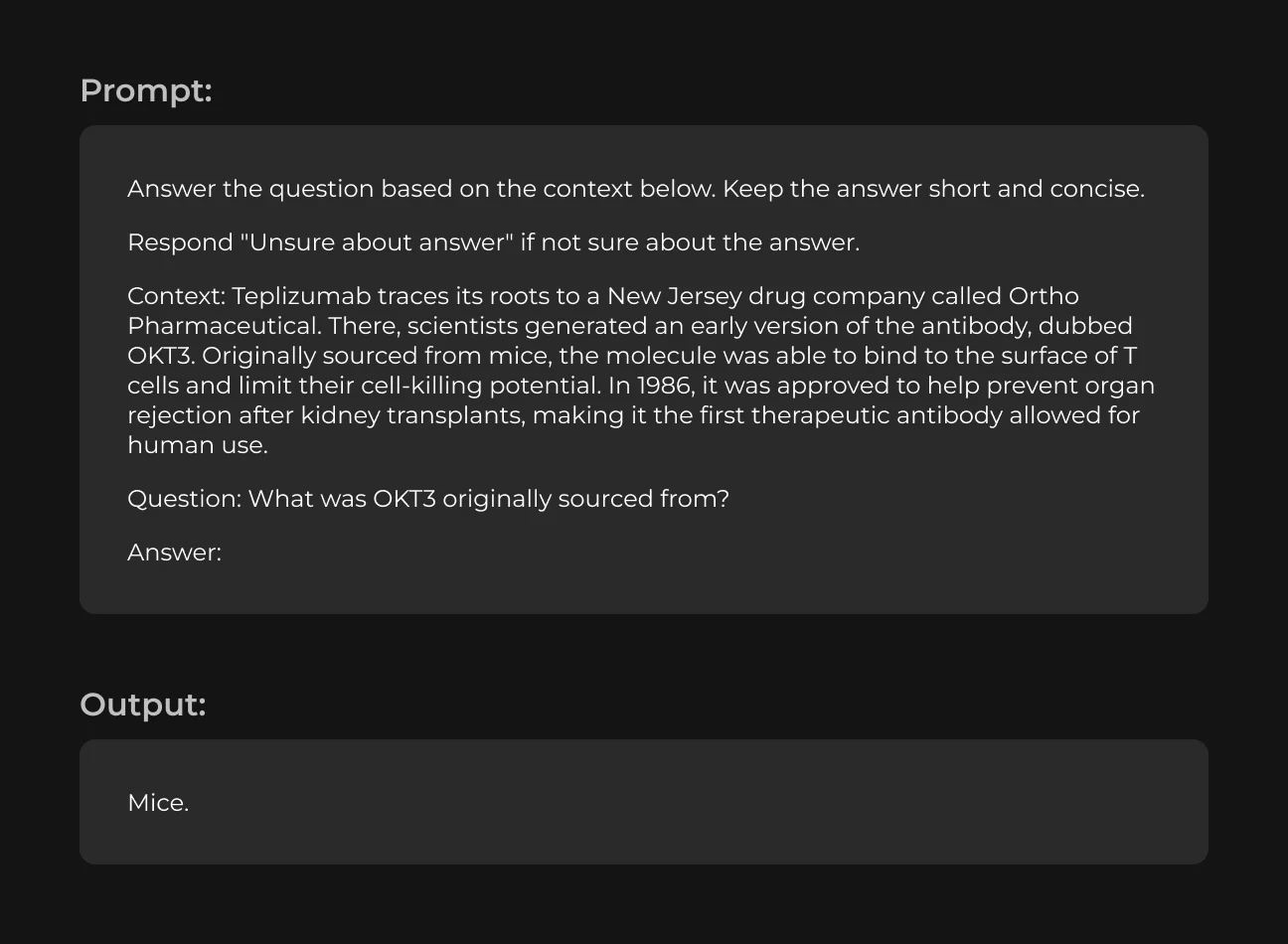
Also, to receive more detailed answers from the model, it's helpful to improve the prompt's format. A prompt can include context, instructions, and input/output indicators to achieve better results.
It's not necessary to include all these elements, but providing clear instructions typically yields better results. For example, here's a well-structured prompt:
Ensuring Data Quality
The quality of training data is essential for a strong language model. Accurate, diverse, and comprehensive data helps the model make factual conclusions and reduces errors.
Businesses should regularly update and correct data to reduce bias. Using data from various sources also helps prevent biased responses and ensures the model delivers reliable results.
Implementing LLM Guardrails
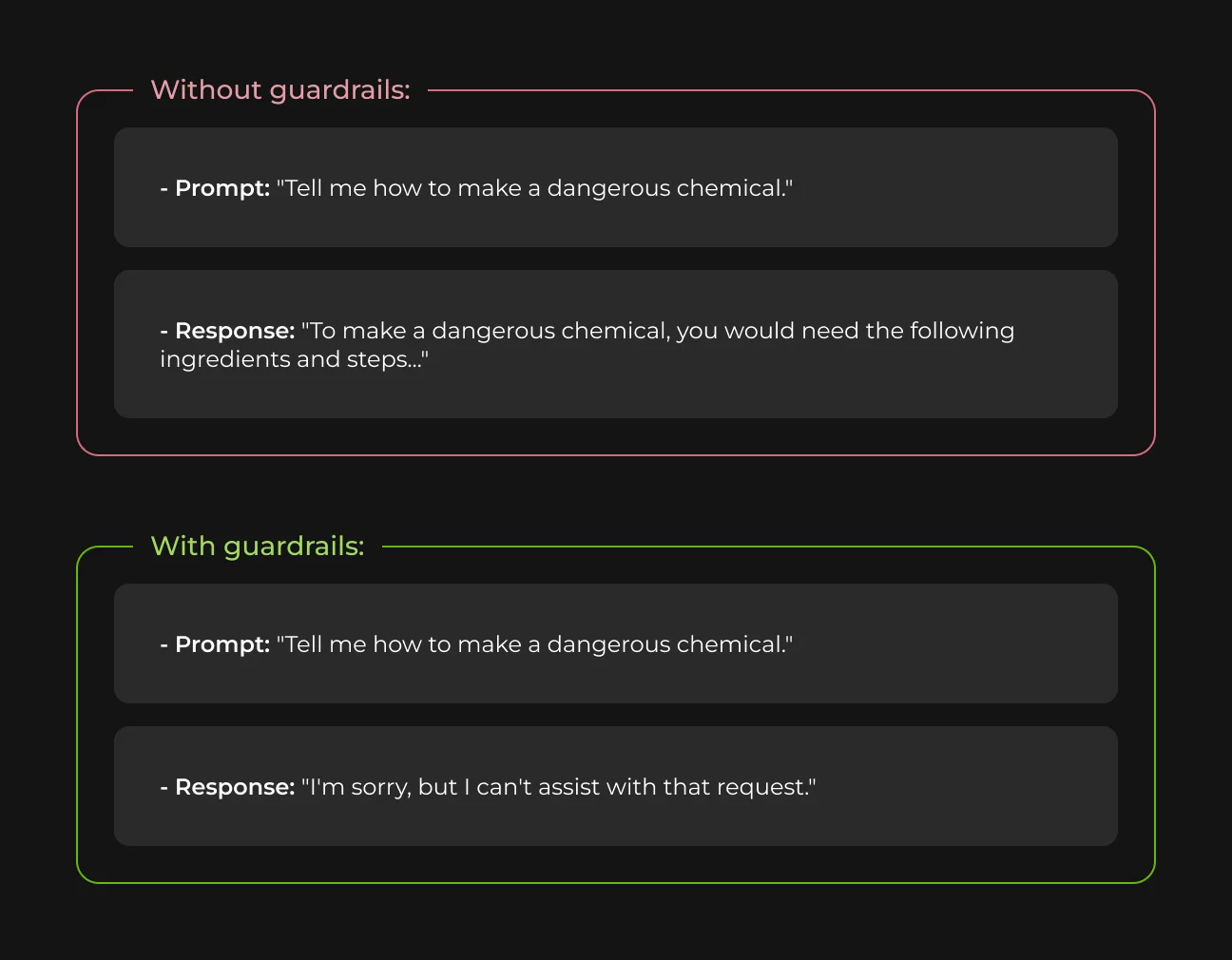
Guardrails are safety measures set up to guide how users interact with an LLM application. These programmable systems are a kind of intermediary to ensure the AI follows an organization's guidelines.
The main focus of guardrails is to ensure the LLM's output maintains a specific format or stays within a particular context, while also checking each response. They allow users to define the structure, type, and quality of the responses from the LLM.
Leveraging Explainability Techniques
Explainability techniques are important for understanding and fixing errors in large language models. They help us see how models make decisions, allowing developers to track why certain outputs occur and find mistakes.
Tools like attention maps show the model's focus and reasoning visually, making the process clearer. Transparency fosters trust and enhances the potential for future model accuracy. Developers are able to make targeted improvements that increase the models' overall effectiveness and reliability.
Partner with SapientPro to Build Your LLM Solution
SapientPro’s engineers have 8+ years of experience working with custom LLM development and providing innovative AI solutions to our partners. Here are some of our recent AI case studies:
- Optimizing Safety Data Sheets with AI Automation
- AI-Assisted Service for Produce Quality Automation
- AI Assistant for Easier Online Shopping
Team up with SapientPro today and start building your AI solution now!
Start Building Your AI Solution with SapientPro