
All How Does Facial Recognition Work: Use Cases, Benefits, and Implementation Roadmap
February 4, 202615 min read


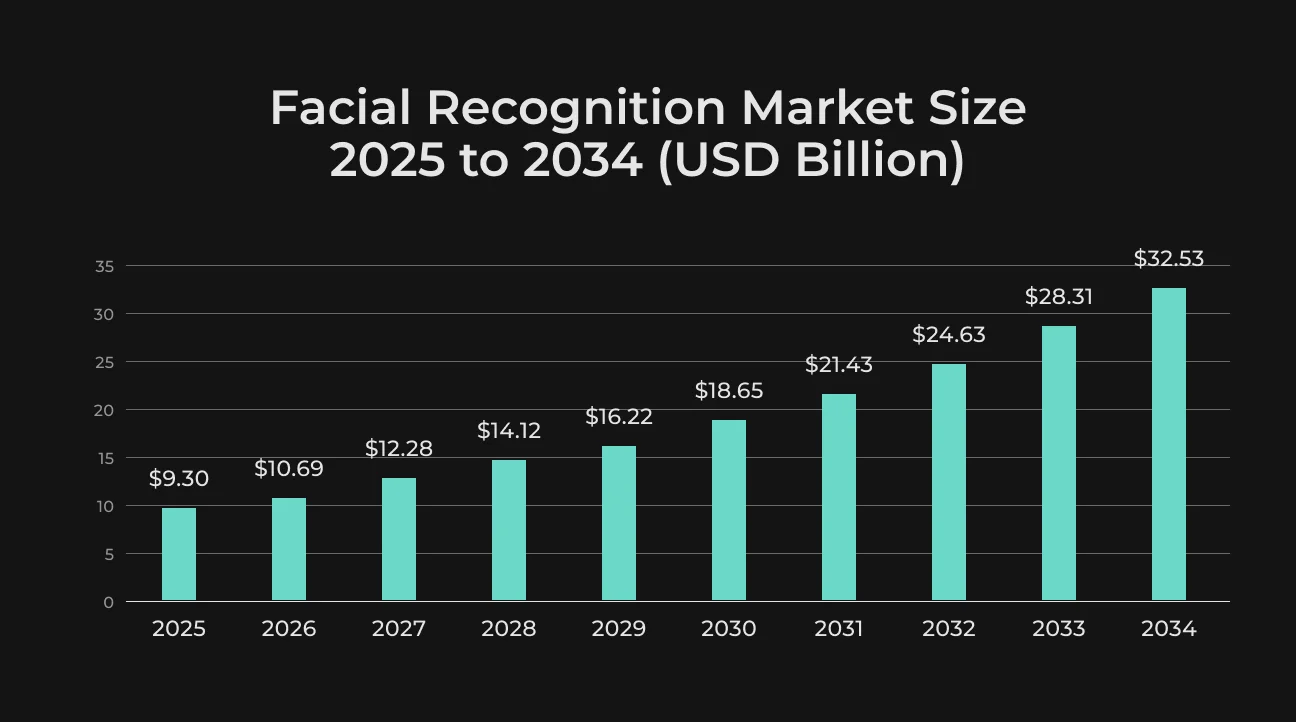
Facial recognition tech can confirm and verify a person's identity by comparing biometric data in digital images or video. This technology’s market size is anticipated to reach $32.53 billion by 2034, growing from $10.69 billion in 2026.
Apart from unlocking smartphones in daily use, face recognition is widely applied to office or factory access control. It also improves customer experience in areas like retail and finance.
There will be even more drivers to boost facial recognition adoption in 2026. It could be practical for smart cities, offer more personalized experiences in retail, e-commerce, and marketing, or lay the foundation for ethics rules across industries.
In this article from SapientPro’s experts, you’ll see how a facial recognition system works and the basic principles behind it.
Key Takeaways
- Facial recognition tech can develop a digital map of your face and then compare it with images or videos other people have posted online;
- Face detection answers the question of whether there is an image of a human face in the photo, while facial recognition verifies who the person is;
- Facial recognition systems differ in their architectural design. This depends on the needs for scalability, response time, and where they will be used.
What is Facial Recognition?
Facial recognition is a way of identifying a person’s face using technology. With just an image or video feed, the system can detect all faces in it and compare them against a database of known ones.
An easy face detection just discovers if a face is in an image, whereas facial recognition can recognize who the person is. The technology generates a faceprint, which is like a digital fingerprint works.
Basically, it captures unique traits, like the space between your eyes, skin texture, or the angle of your jawline. For example, in security settings, it is used in airports to automate passenger checks or public surveillance projects.
As a result, we are getting exposed to facial recognition tech more and more in our daily lives.
How Does Facial Recognition Work: Step-by-Step Explanation
Facial recognition records a digital map of your face and then stores the data, matching it with other profile pictures or videos online.
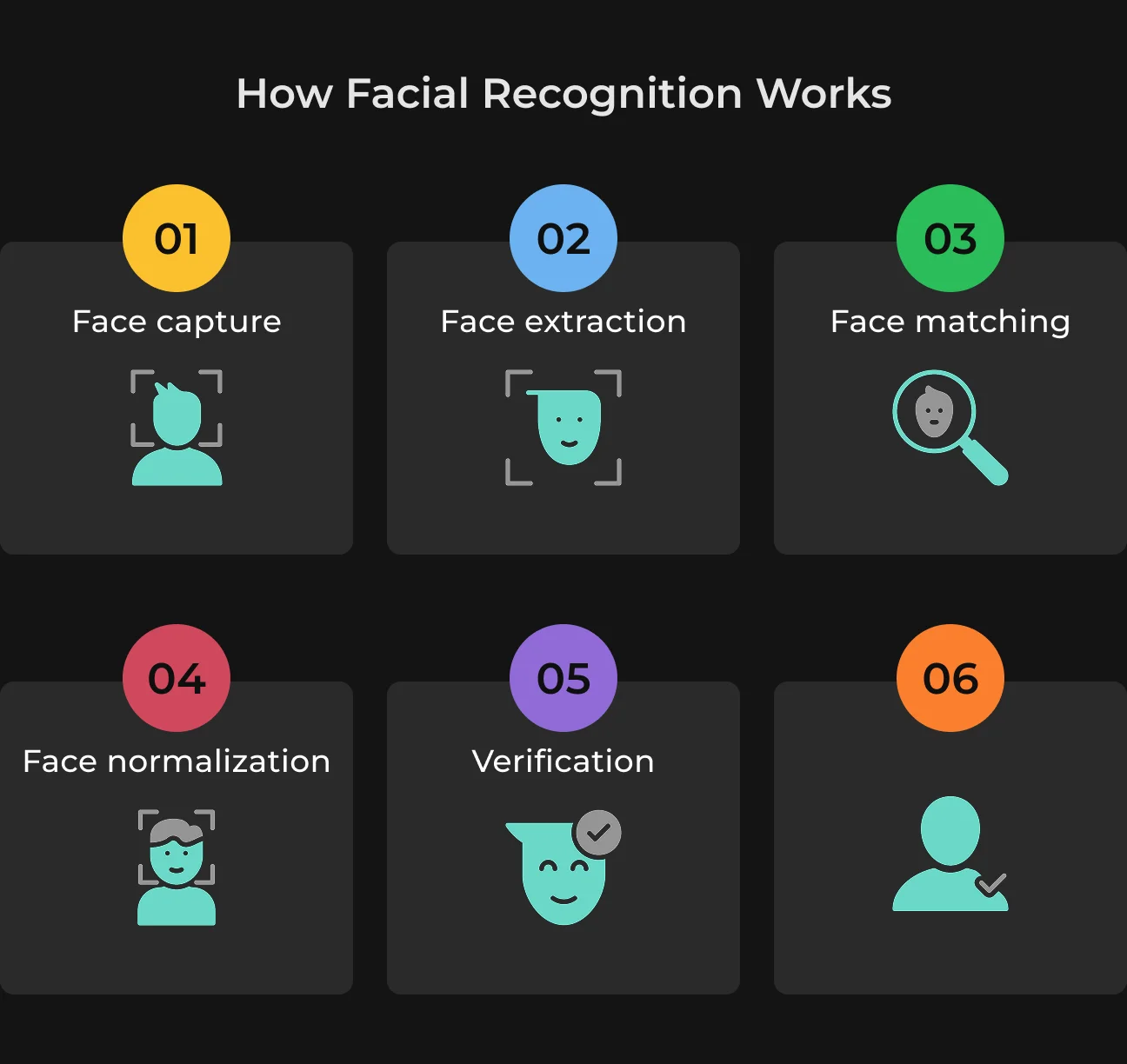
Here are the five steps to understanding facial recognition:
Step 1: Face Captured
As with face detection applications, facial recognition technology initially begins by locating a face in an image or video stream.
Many modern facial recognition systems with sophisticated algorithms even incorporate thermal imaging to find faces in adverse conditions (like severe darkness or a jam-packed room).
Step 2: Face Extraction
When it recognizes a face, the system narrows in on unique facial features (the shape of the face, nose, distance between eyes, etc.). Those characteristics are then turned into a digital faceprint.
In retail, for example, facial recognition kiosks can scan and digitize a customer's face instantly to deliver tailored shopping experiences (like greeting repeat customers).
Step 3: Face Normalization
Normalizing the faceprint enhances the recognition accuracy of the system. This includes a normalization of expression, pose, and illumination.
In facial recognition-enabled smartphones, normalization must ensure that the system learns to identify a person despite wearing sunglasses or smiling. This allows the face of the same user to be learned in different postures.
Step 4: Face Matching
In this stage, the faceprint is compared to a database of known images of other people. It can then recognize and authenticate the person if a match is detected.
New technologies also use context, like location and time, to improve decision-making during matching. This makes it easier to identify things accurately in various scenarios.
Step 5: Verification
Once a face has been matched to a stored image, the system takes action based on the intended application. It might let someone in, start a transaction, or alert security.
In many secure facilities, facial recognition is employed for access control and opening doors for employees who have the right to enter. It also notifies security services in case an unauthorized visitor tries to enter.
Facial Recognition System Architecture
Face recognition systems can be designed in numerous architectural styles, depending on scalability, latency and deployment needs. Below are some possible architectures, the components they contain, and typical deployment patterns.
Facial Recognition System's Layers
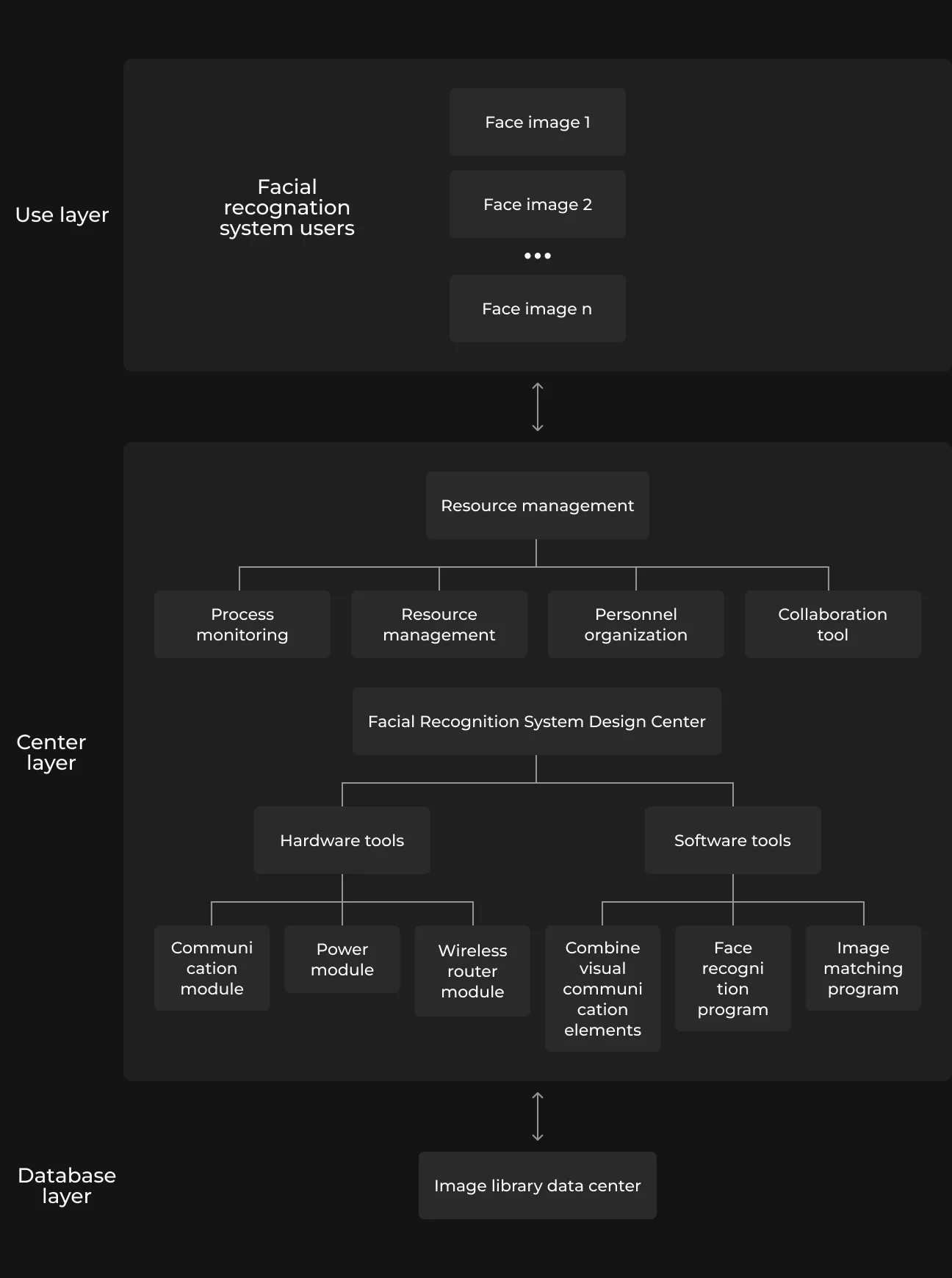
Facial recognition is decomposed into three layers, including the user layer, the central layer, and the database layer.
The user layer is an interface that helps people use computer systems easily and efficiently.
The mid-layer acts as the center manager for resources and organization of system functionalities. It combines different aspects like hardware, power sources, wireless connectivity, and software. They all interact with each other for face recognition.
Upon intent, the middle layer processes the images to recognize the person. After identification, the results are sent back to the user layer, where users receive the information.
The recognized facial images are then stored in the database layer for future access by the central layer.
Edge-Based Architecture
This solution is carried out directly on devices like smart cameras and mobile phones. This reduces the amount of logic a central server would otherwise have to perform.
Its key components include:
- Edge devices.
This may be a smart camera, a mobile phone, or another edge device;
- Local processing.
On-device engines offering instant recognition and analysis;
- Local storage.
Space on the device that can be used to store detected face data.
Centralized Cloud-Based Architecture
In this system, data produced by edge devices is transmitted to a single centralized cloud server for processing. The cloud-based one is suitable for heavy calculation processing and big data analytics.
It consists of edge devices, a cloud server, and a database.
Centralized cloud-based architecture is widely adopted in enterprise security systems, smart cities, and global retail chains that monitor client trends.
Hybrid Architecture
A hybrid architecture integrates edge and cloud applications for local and centralized processing. This approach allows us to process data in real time while providing deep data analysis.
The main components of hybrid architecture are:
- Edge devices for facial detection and basic computation;
- Local nodes as batch processors in groups of edge devices;
- Cloud server that carries complex recognition and long-term data analysis;
- Network infrastructure bridges edge devices, local nodes, and clouds to end-to-end communication.
A hybrid design fits large campuses, distributed retail chains, and scalable city surveillance installations.
Benefits of Facial Recognition
Let’s look at why facial recognition is currently finding its way into so many sectors.
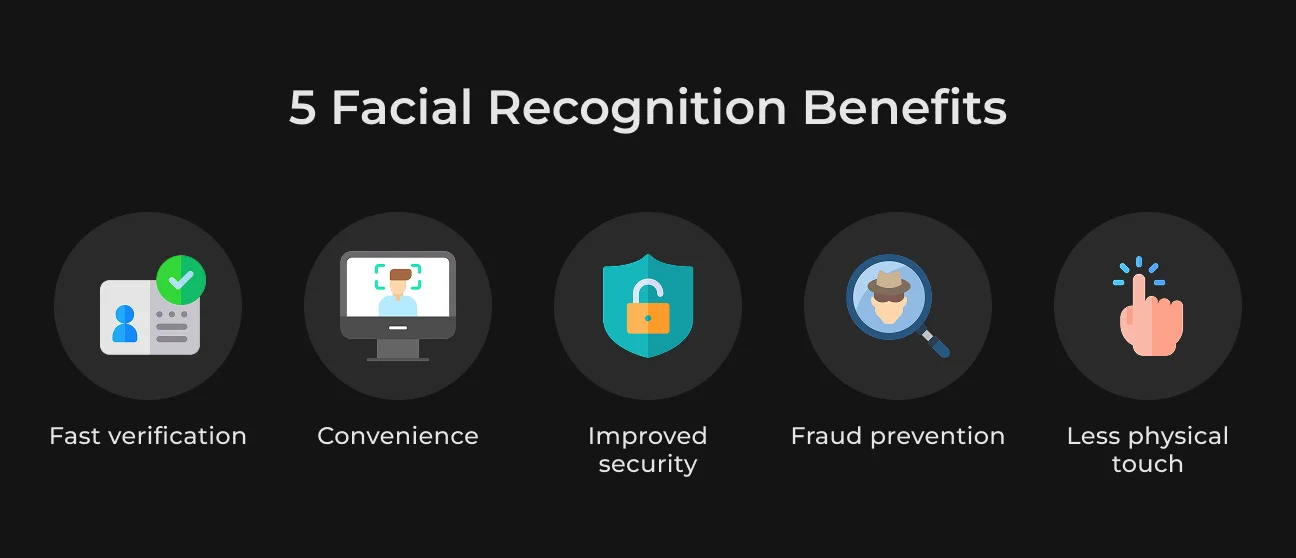
Fast Verification
Your face can be processed quickly with facial recognition, which greatly reduces waiting times for logging into devices, boarding at airports, or making payments.
Once facial recognition is set up in a system, it operates automatically, verifying users effortlessly. Many people find it more convenient than fingerprint scanning because it doesn't require any action from the user.
The processing speed can vary between different face recognition systems and the size of the data groups, but for most systems, it usually takes less than 2 seconds per person.
Convenience
Facial recognition lets users effortlessly unlock devices, make payments, and enter secure locations without having to remember long passwords.
Technologies with new designs will also extend the deployment of password-free authentication. The global passwordless authentication market is projected to grow from $21.58 billion in 2025 to $60.34 billion by 2032.
Improved Security
Facial recognition solutions are secure and ensure the accuracy of results. Unlike passwords or PINs, which people can forget or criminals can steal, the human face is hard for unauthorized users to copy.
It’s roughly a 1 in a million possibility that someone can unlock your iPhone with Face ID. Certain algorithms even boast accuracy rates of over 99%.
Facial recognition also reduces the risk of shoulder surfing attacks, which are becoming more common.
Fraud Prevention
Many financial companies struggle to deliver friction-free customer experiences, prevent fraud, and meet regulatory requirements. Organizations can augment their use of facial biometrics to stop account takeovers.
These improvements enable the detection of evolving fraud models without impacting real users.
Automated face verifications fast-track regulatory checks for know-your-customer (KYC) and anti-money laundering (AML) compliance, whereas the risk of delay grows with slow manual verification.
Facial recognition usage on mobile banking, for instance, jumped from 17% to 28% in just two years. This shows that both consumers and financial institutions quickly accepted it.
Less Physical Touch
There is a growing demand for hygiene-conscious and non-intrusive security. Contactless payment products have gained popularity especially since the pandemic of 2020.
Most facial recognition systems no longer require physical interaction.
Therefore, verification becomes seamless and just through a face scan, without human intervention or touching devices.
Business Use Cases of Facial Recognition
From retailers to restaurants, businesses design and expand facial recognition systems to improve customer service.
Here are some of the common ways they use this technology.
Identity Verification and Onboarding
Adding facial verification to digital onboarding accelerates the recruiting process and creates a frictionless user experience without paperwork. Technology scans a person’s facial details, which are then compared with files held in government databases.
This process creates a secure means for companies to confirm the legitimacy of an individual's physical records and identity. For example, Jumio makes onboarding more secure by comparing a live selfie to ID documentation in real time to detect any fraud or anomalies.
Secure Access Control for Facilities and Devices
Face recognition in access control alters security by allowing contactless and smooth entry to buildings and devices.
Apple’s Face ID, for example, uses advanced infrared camera and dot projector technology to generate a detailed 3D map of the user’s face. It can also account for changes in your appearance over time.
A system like this offers more than a security enhancement. You can unlock devices without a code or fingerprint, which can be helpful when it’s dark.
Workforce Time and Attendance
Conventional time tracking is a serious operational obstacle for employers of hourly or mobile workers. Challenges like buddy punching or attendance falsification waste resources and create more work for HR teams trying to manage timesheets.
Facial recognition time clocks, like OLOID, use AI-driven facial mapping to verify employees' identities in real time. You simply approach a terminal, and the system recognizes you instantly.
Personalized Customer Experiences
With facial recognition technology, online merchants can provide an enhanced and more intuitive shopping experience. Customers would no longer need to enter a username and password – just face recognition for identification.
For e-commerce, that would mean when a customer logs into an online store, the site uses a webcam or smartphone camera to scan the person’s face. This scan is then compared to previously stored facial data to grant access or verify identity.
Some systems use this technology to monitor customer behavior and preferences, enabling better targeting and personal recommendations.
For example, Steak ’n Shake introduced biometric facial recognition to check in and out at its 300 stores in the United States.
Safe Transactions and Fraud Prevention
As digital technology has advanced, more people (particularly younger ones) now rely on mobile banking as their primary way to access their banking services.
For example, over 20,000 cases of internet fraud, including phishing and identity theft, were reported in Thailand. Financial institutions mitigate these risks with biometric authentication methods like facial recognition.
Global banks like CaixaBank, HSBC, and RBS are using facial recognition software to offer secure app logins, open digital accounts, and allow for cardless ATM withdrawals.
Enhanced Event Safety
At the event level, facial recognition tech can speed up entry protocols and controls, recognize VIPs, verify staff, and even be used to complete transactions.
Guests just show their faces to camera-equipped checkpoints and get access. This method is a good substitute for manual ID checks, which sometimes give false results.
AI face recognition can also be used to monitor crowds and raise awareness of anything dangerous, like threats or missing people. Facial recognition apps already exist at music festivals, stadiums, and corporate events.
How is AI Used in Facial Recognition
With the advances of technology, AI will be used more for facial recognition and other features that bring convenience to society and individuals.
AI facial recognition uses machine learning algorithms to match faces between photos or videos for verifying identity. A facial image is checked against a photo from an official ID document or a photo stored in a database.
Artificial intelligence face recognition technology is widely applied everywhere for convenience and security.
It is used to unlock smartphones, gain access to workplaces, check the identities of bank customers, personalize shopping experiences in stores, or monitor attendance at schools or offices.
Main Concerns in Facial Recognition Usage
Facial recognition technology has many applications, but it also raises privacy, accuracy, and security concerns. The problem is mainly that it collects and uses personal biometric information, sometimes without permission.
This can cause inaccuracies in person identification and issues in recognizing people of different races and ages.
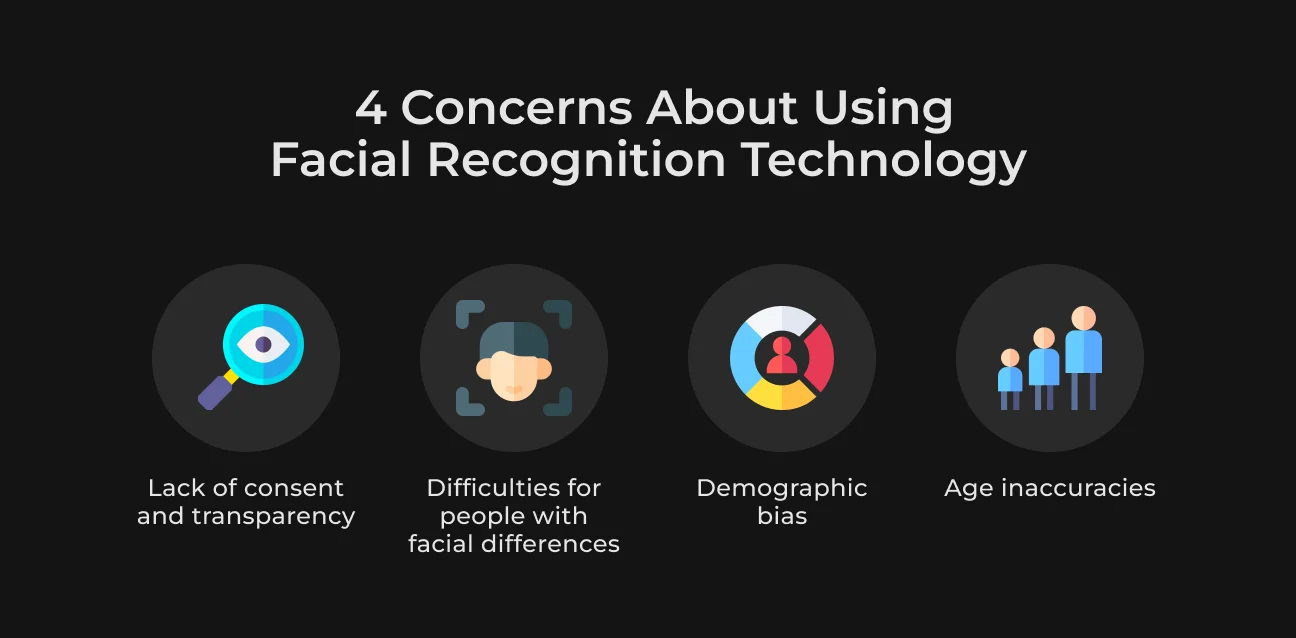
Now let us look into these areas.
Lack of Consent and Transparency
It’s a major concern not to get permission to use facial recognition tech. Large volumes of facial data are scanned, stored, and mined in many systems without the individuals necessarily being aware of it.
Receiving information about how businesses and government officials protect such personal details, and whether they are kept secure, is actually tough. This lack of visibility can damage trust and possibly even breach essential data protection principles.
Difficulties For Individuals with Facial Differences
Facial recognition search algorithms are often trained on data that is primarily focused on typical faces. They might ignore the huge variations in human appearances.
For people with facial differences, this can be harmful. The technology can fail to recognize faces with disabilities like a cleft lip, facial palsy, or individuals after facial surgery.
Demographic Bias
Face recognition technology still functions poorly across various demographic groups, deepening social disparities. Rates can vary by race, ethnicity, and gender — some groups have a higher rate of false positives or negatives.
Research shows that face recognition systems can achieve varying levels of accuracy depending on a person’s skin color and gender.
For instance, the study Gender Shades found that darker-skinned women were misclassified as men 34.7%, while lighter-skinned men were classified as women only 0.8%.
Age Inaccuracies
People’s faces change as they get older, due to growth, wrinkles, and external factors like sun exposure. These changes can make it difficult to accurately guess someone’s age, which is a challenge for systems that depend on current facial data.
Face ID and other biometric tech might not work equally for everyone. For example, Apple admits that the facial features of those under 13 are not yet fully developed.
And while the company's facial recognition technology can adapt to small changes over time, the major changes in kids’ faces can confuse Face ID.
The result is a comparably higher mismatch rate when it comes to identifying children.
Check out some general recommendations that can help lay the groundwork for removing risks and biases:
- Comply with existing legal obligations, like the GDPR, which focuses on use-based consent and minimum necessary data;
- Define best ethical practices and be committed to the right values regarding AI;
- Train your algorithms on diverse datasets that represent a wide variety of ages and demographic details. This may improve your system’s generalization across the various age groups;
- Employ machine learning models to enhance the accuracy, since these algorithms learn and improve with new data;
- Complement facial ID with biometric information like voice analysis to produce a more complete, accurate picture of a person’s age and identity.
How Much Does a Facial Recognition System Cost?
It is sometimes difficult to understand how much facial recognition software will cost. Hidden expenses are the most unsuspected budget busters for companies.
Let’s explore the estimated costs.
Solution Type | Cost Range | Description | Features |
| Basic facial recognition software | $5,000 to $30,000 | Suits basic needs like small business security systems. | Licensing fees, limited customization, and basic support. |
| Advanced enterprise solution | $50,000 to $200,000+ | Invented for large organizations that need more advanced capabilities like real-time processing and analytics. | Customization, scalability, ongoing support, and maintenance services. |
| Custom-built facial recognition application | $100,000 to $500,000+ | Fits industries like healthcare or law enforcement. Custom solutions need special features and high processing power. | Full customization, extensive support, and integration with complex infrastructures. |
| Cloud-based facial recognition service | Pay-as-you-go (usage-based) pricing
| Uses cloud infrastructure, which makes it perfect for scaling and flexible use. | Access to updated algorithms, maintenance conducted by the provider, and no upfront hardware costs. |
These costs are general and depend on factors like the level of complexity in the technology stack, the number of features, the scale for deployment, special compliance, privacy requirements, and others.
For a detailed breakdown of AI development expenses, you can learn more at SapientPro's guide on AI development costs. Working with an experienced developer or vendor will be key to customizing the system and getting a good ROI.
Partner with SapientPro to Build Your Facial Recognition Software
By collaborating with SapientPro for facial recognition software development, you can expect a solution that’s made to fully fit your requirements. Using their expertise in AI and ML development, our engineers will deliver the latest tech at a high level of accuracy.
No matter if you need a simple product or a custom solution, our specialists work with you from concept through to market. Here are some of our case studies:
- AI-Assisted Service for Produce Quality Automation
- AI Solution for Efficient CV Processing at Scale
- Dialect-Sensitive AI Voice Assistant
Get in touch with our team to start creating facial recognition software that will lead the industry.
Build Your Facial Recognition Software Today
SapientPro will help you integrate existing frameworks or develop your own solutions for your business.
FAQ
What’s the difference between face verification and face identification?
Face verification mostly checks if a person’s face is the same as some other specific image (for identification). Face recognition technology matches one face against many others to identify an individual.
What are the pros and cons of facial recognition technology?
Facial recognition technology boosts security and convenience and offers highly personalized client experiences. But it can also be an issue for privacy, expose biases, and introduce data security risks.
How accurate is facial recognition?
Facial recognition systems can be almost perfect (99%) when lighting is good, and they have a clear view of your face. Yet, performance can degrade in their real-world applications — bad lighting, odd angles, aging, etc.

