
All What is Vector Search and How Does it Work
February 1, 202615 min read


We don't often realize how much work vector search is doing in the background of our everyday experiences. For example, if you're looking for a new TV series to watch, the recommendations you get are probably fueled by a vector search engine.
Just like when you are swiping your card online, vector search can be used to quickly identify anything that looks out of place.
Vector search transforms various types of data, like text, images, or audio, into vectors. These make it possible to compare the items based on a deeper meaning rather than an overt level.
The world vector database market will generate nearly $13.3 billion by 2033.
So, how does vector search work?
Read on to learn what exactly vector search is, and its key advantages and challenges.
Key Takeaways
- Vector search is a key technique in data retrieval and machine learning, which can find items within massive datasets;
- Vector search helps language learning models (LLMs) find results based on meaning rather than just matching exact words;
- Vector embeddings turn different kinds of data, whether organized or not, into numbers that keep their main features;
- The world vector database market could generate about $13.3 billion by 2033;
- Strict privacy and security standards must be followed when performing a vector search on sensitive data.
What is Vector Search?
Vector search is a crucial technique in data retrieval and machine learning, which can effectively find items within massive datasets.
It sorts items depending on their vector embeddings (numeric sequences defining properties of an item). These embeddings can be words, documents, images, audio, or video.
For example, take a photo of a car in a parking lot. The vector embedding of this image may have numbers that describe the color, shape, and model of this car and any background like trees or sky.
These numerical representations, typically generated using machine learning and neural networks, enable computers to efficiently organize and retrieve similar items based on their very fine-grained details.
Vector search, also called "similarity search" or "nearest neighbor search," is unbeatable when it comes to quickly finding items. So, someone searching for an image of a “luxury black car,” for example, gets a vector search system that can quickly retrieve images with all that description.
Companies use vector embeddings for various data types, including documents, products, or consumer interactions. Businesses can use embeddings and business-specific data, like pricing, combined with tools like retrieval-augmented generation (RAG).
This allows them to use large language models (LLMs) to provide answers based on current operational facts.
What is a Vector Embedding?
Vector embeddings convert data into arrays of numbers, which is the form machine learning models can consume (whether images or words). The addition of numbers to unstructured data enables computers to process that data, leaving its meaning intact.
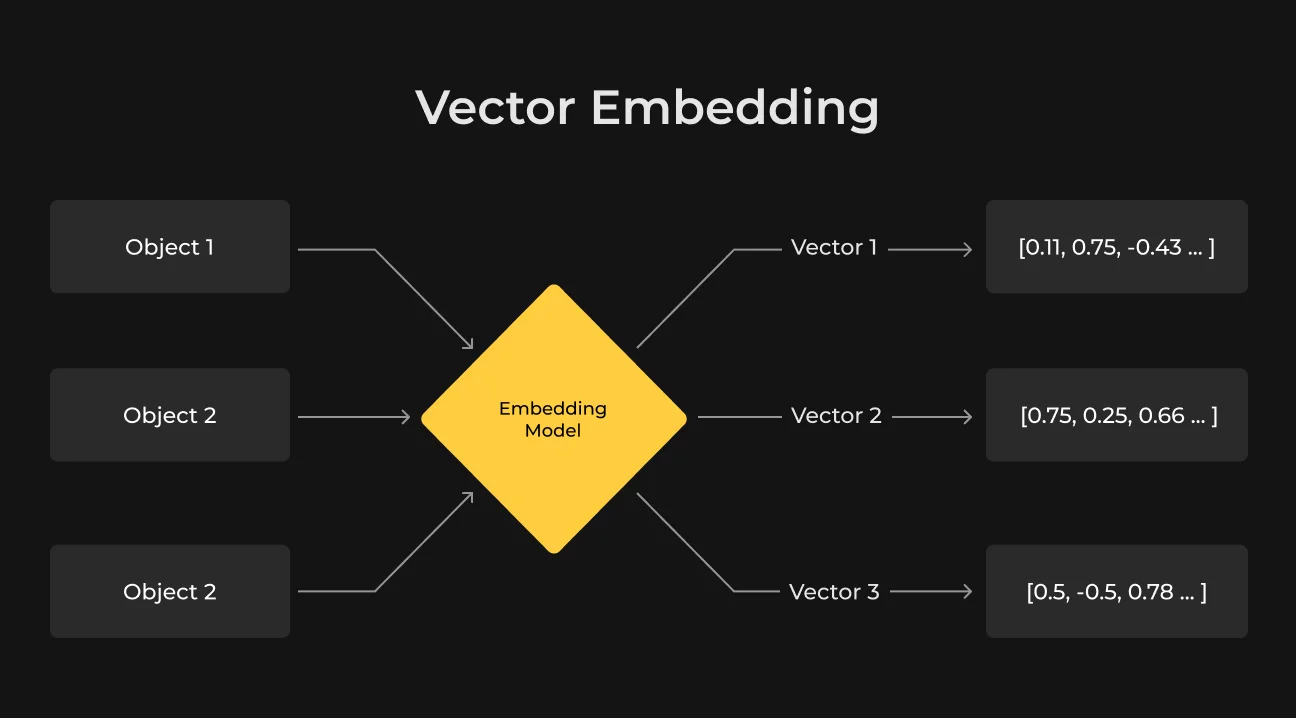
Machine learning models, however sophisticated they might be, work on numerical data. Vector embeddings simply convert almost any kind of data, structured or unstructured, into numbers that maintain important properties.
By teaching models to learn powerful vector representations, we can compare and analyze relationships between each data point. If they are similar, then their vectors will be close. If not, then the vectors will differ. The vector image contains matching data points.
Embeddings help us use data in models to perform tasks like comparing or sorting through mathematical operations. They are what allow different data formats to communicate, like a universal language.
For example, a spoken word is processed by voice assistants using vector embeddings.
More than anything else, vector embeddings are at the heart of contemporary machine learning, powering natural language processing and computer vision. They also serve as the backbone of generative AI.
How Does Vector Similarity Search Work: Explained
Vector similarity search is a technique used in natural language processing where words, sentences, or documents are converted to individual numbers (like a number for each word). This helps businesses turn text into valuable insights and understanding.
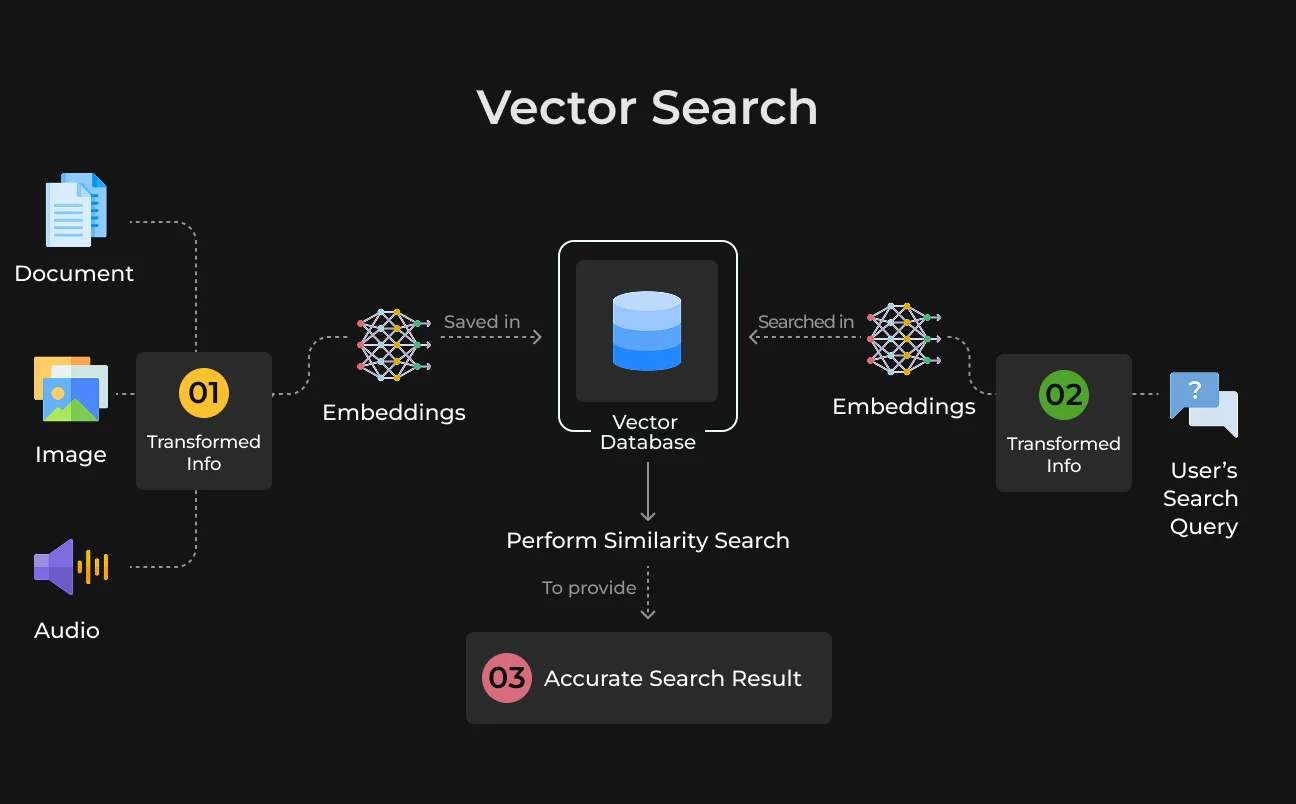
Let's see how it works.
Vectorizing Text
We begin by vectorizing sentences. Commonly used models are GloVe, Word2Vec, FastText, and transformer-based ones like BERT. Let's take Word2Vec as an example.
Embedding Models
The Word2Vec model generates word vectors by studying their context and relationships with other words.
BERT models output richer vector representations by looking at the whole context of words in a sentence.
The Process
After the vectors are generated, they’re saved to a database. If a search is performed, the system calculates similarities between the search vector and these stored vectors. In this way, the system learns to comprehend and reply with relevant information.
Efficient Search
Structures like hierarchical navigable small world (HNSW) graphs make searching faster and more scalable by organizing vectors.
Real-time Applications
You can create a vector instantly for a new query if you use an API. This way, by keeping your search experience dynamic, you can continuously add vectors for potential matches.
Types of Vector Search Algorithms
Vector search algorithms are also important to quickly find the required information within complex and high-dimensional spaces. There are several well-known kinds of vector search algorithms, their variations, and advantages. Let's check out some of them.
k-Nearest Neighbors (k-NN)
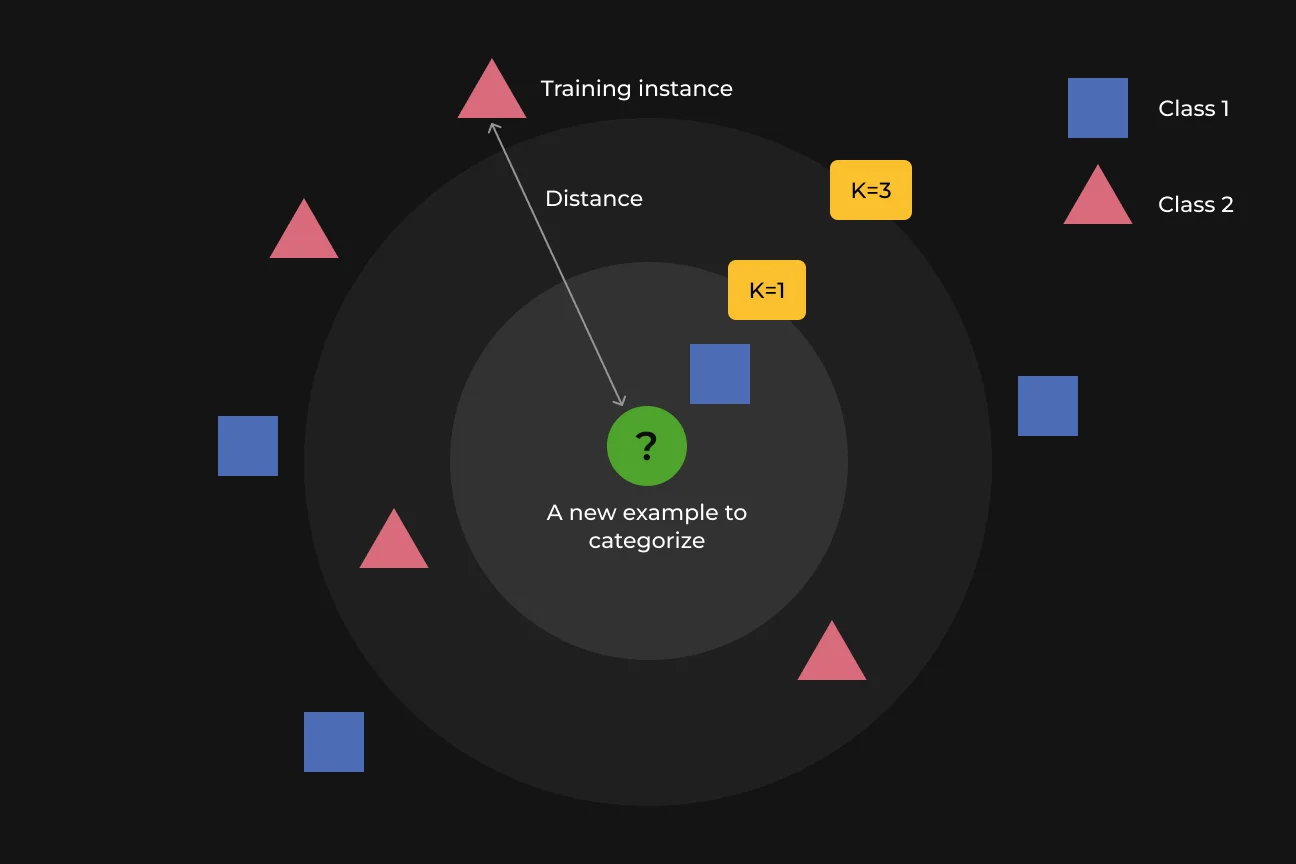
The k-Nearest Neighbors (k-NN) algorithm is simple yet powerful. It's used to determine the value of an unknown variable or data point based on the similarity between other data points.
It’s great for problems like classification and regression, with distance measures like the Euclidean distance. It also has several subtypes:
- Brute Force k-NN computes the distances between a query point and all points in a dataset to find the nearest ones. Although the approach is sound, it’s not practical for big data applications because of high computational complexity;
- Tree-Based k-NN is any method where data is indexed in tree-like structures like KD-Trees or Ball Trees. This helps speed up the search for potential nearest neighbors. Yet, these methods may fail in case of high-dimensional data;
- Hierarchical Navigable Small World (HNSW) is a hierarchical graph-based data structure. It organizes data to make nearest neighbor searches fast and accurate, balancing speed and quality.
Approximate Nearest Neighbor (ANN)
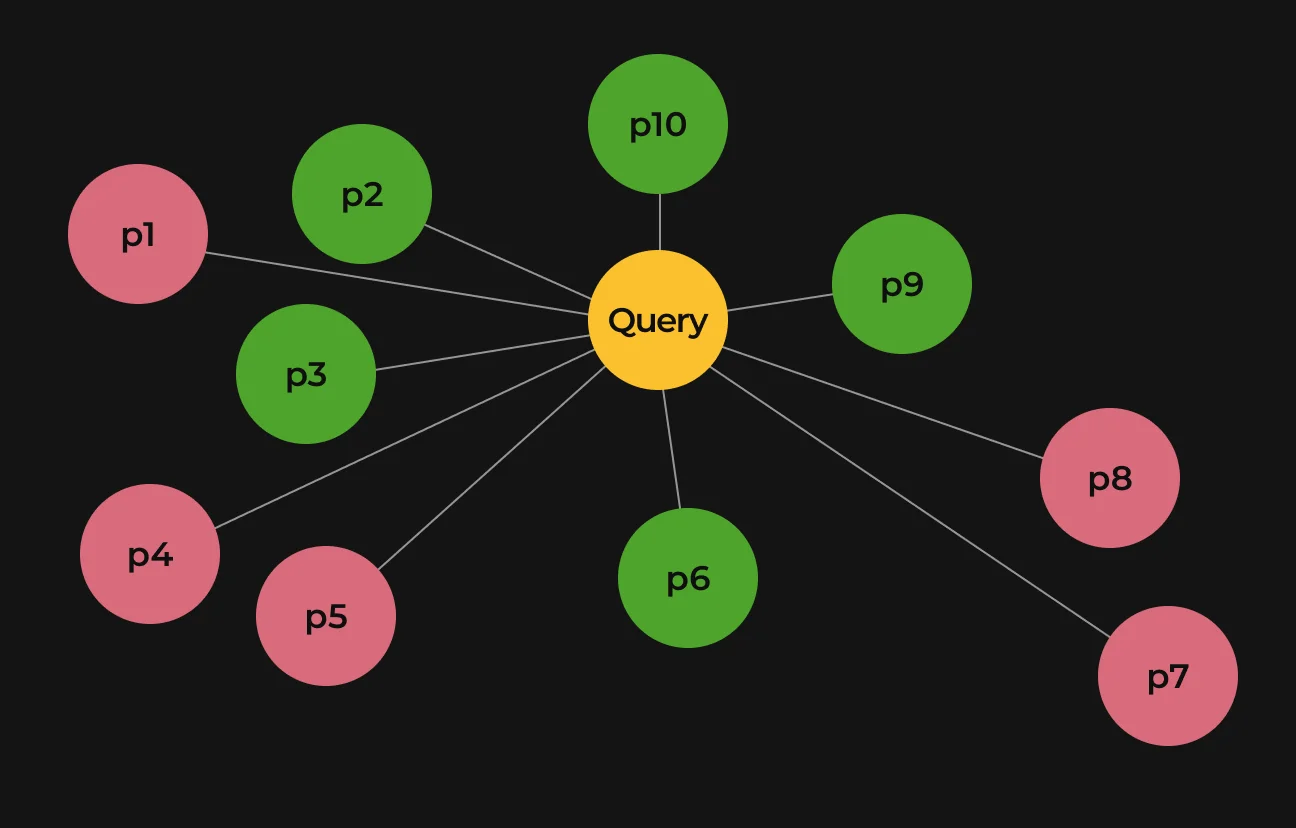
Similarity matching algorithms can trade off a bit of accuracy for search speed. This is ideal when you need quick results in real time. These algorithms fall into several categories:
- Locality-Sensitive Hashing (LSH) groups similar data points together for quick searching, even when accuracy is not perfect;
- Product quantization divides the space into smaller pieces, compresses them, and searches fast with those smaller processed parts;
- Graph-based methods use structures like HNSW to link data points dynamically. By querying only a small part, the process becomes much faster.
Hybrid Algorithms
Hybrid algorithms combine different techniques to reach both precision and efficiency. They can address small and large vector searches. Look at their types:
- Tree and graph synergy. An algorithm can begin with tree-based methods to decrease the search region. It also employs graph-based techniques to perform detailed local searches;
- Multi-level approaches. They use several approximation steps and achieve better accuracy at each stage;
- RL-aided search. Some setups use machine learning to dynamically optimize search strategies based on data and user needs. This makes them improve over time.
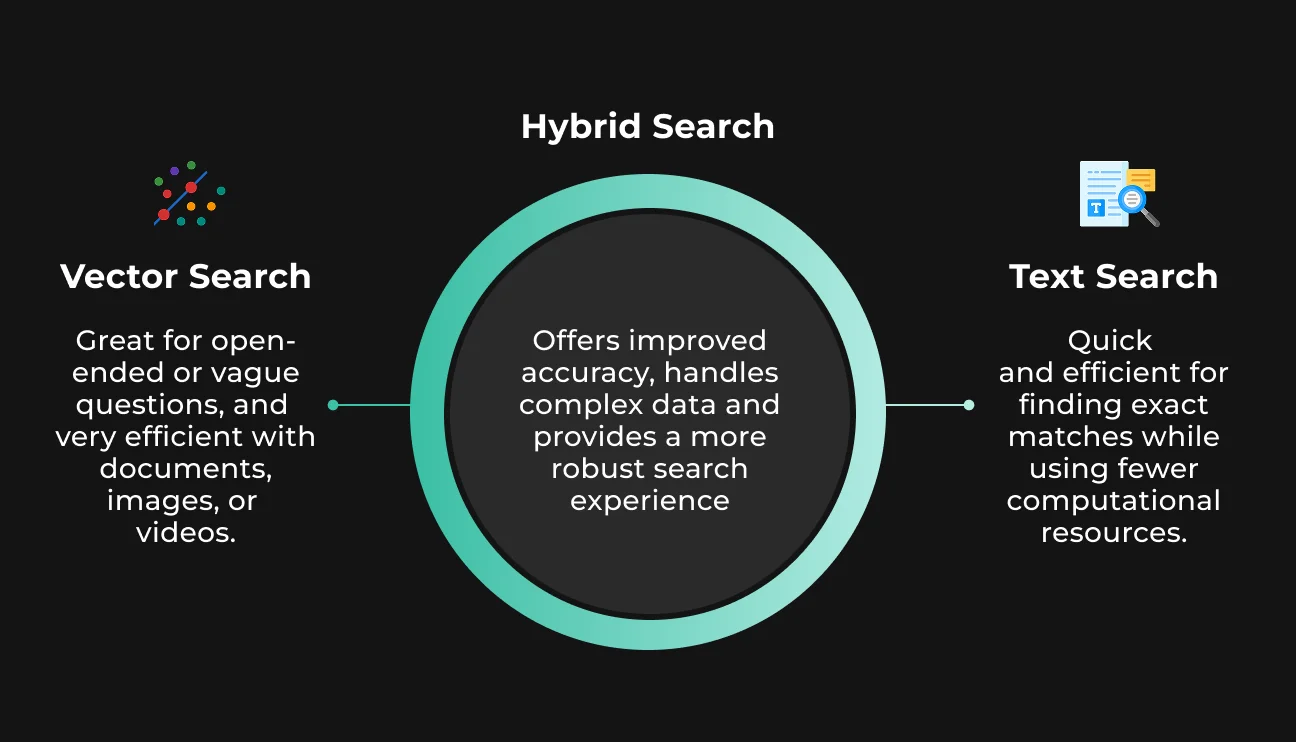
Benefits of Vector Search in LLMs
Let's see how vector search benefits LLMs.
Enhanced Relevance and Accuracy
Vector search allows language learning models (LLMs) to retrieve results based on meaning, not just matching words. It performs this by transforming its search query and document content into high-dimensional vectors. Thereby, it can comprehend the deeper context of the text.
Scalability with Large Datasets
Vector search algorithms are designed to operate fast over big datasets. Techniques like approximate nearest neighbor (ANN) searches can rapidly locate and fetch data, enabling real-time use without any decrease in performance.
Contextual Understanding
With vector search, LLMs can gain a stronger context for incoming queries. This approach helps models grasp the intent and nuances of user questions, which leads to more relevant responses.
Others
Take a look at some more benefits:
- Vector search personalizes user experience by identifying patterns and preferences in data;
- It automatically translates content in different languages to overcome language barriers;
- Vector search can greatly increase user engagement and satisfaction by offering smart content recommendations and summarization.
Challenges of Vector Search
It's important to be aware of the bottlenecks in vector search.
Understanding them will help you use this technology wisely and responsibly.
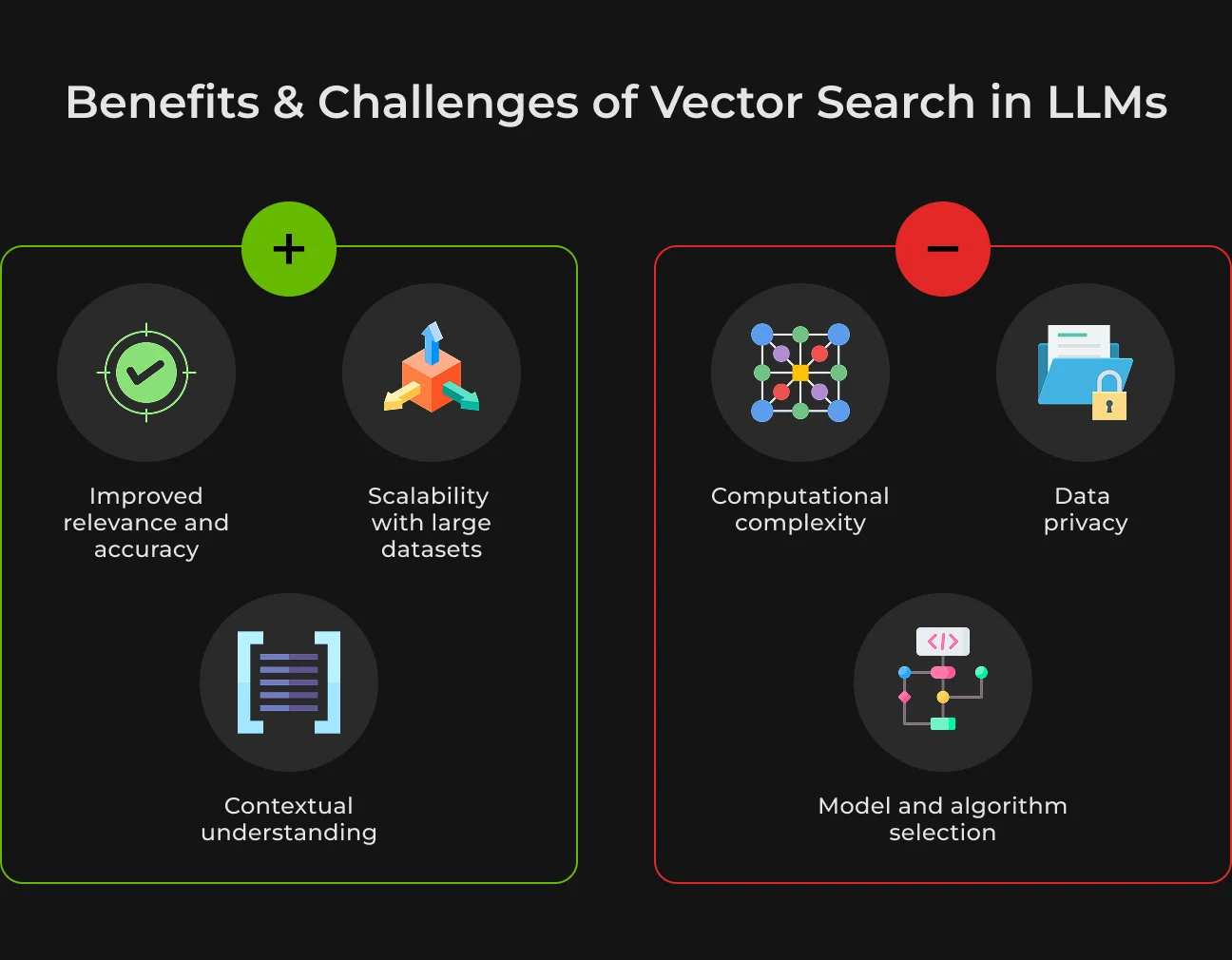
Computational Complexity
Large high-dimensional datasets are particularly challenging to handle and process. The complexity of the new architecture also results in greater resource requirements (in terms of memory and computing power), which can be tough for smaller businesses with fewer resources.
Data Privacy and Security
Strict privacy and security standards must be maintained when conducting a vector search on sensitive data. Representing text and user data as vectors might lead to privacy issues. Strong encryption and good data hygiene are key to minimizing these risks.
Model and Algorithm Selection
It can be difficult to get the vector search algorithm or model right. Various algorithms put varying weights on accuracy, speed, and resource usage.
If you choose the wrong one, you might end up with inefficient searches, a poor user experience, or the need to adjust it to meet future needs.
Other Limitations
Check out some other drawbacks:
- It can be complicated and time-consuming to incorporate the vector search system into your current setup;
- Challenges also arise in maintaining performance, reducing update delays, and balancing accuracy with speed when applying algorithms.
Semantic Search vs Vector Search
Traditional keyword search relies on exact word matching, which often misses the mark if the user doesn't use the specific terminology found in a document. Modern search methods solve this by focusing on intent and context.
Vector search converts words, phrases, or entire documents into vector embeddings, which are mathematical points in a multi-dimensional space.
By calculating the distance between these points, the system can identify relationships between concepts even when the words differ. For example:
- The vectors for "parliament" and "council" are positioned close together because they share a similar conceptual space;
- This allows the system to infer semantic relations like synonyms and related concepts automatically.
Semantic search uses natural language processing to bridge the gap between a user’s query and the available content. Instead of just looking for matching characters, it improves precision by:
- Determining intent: understanding what the searcher is actually looking for;
- Analyzing context: processing both the query and the source material to ensure the results are relevant to the specific situation.
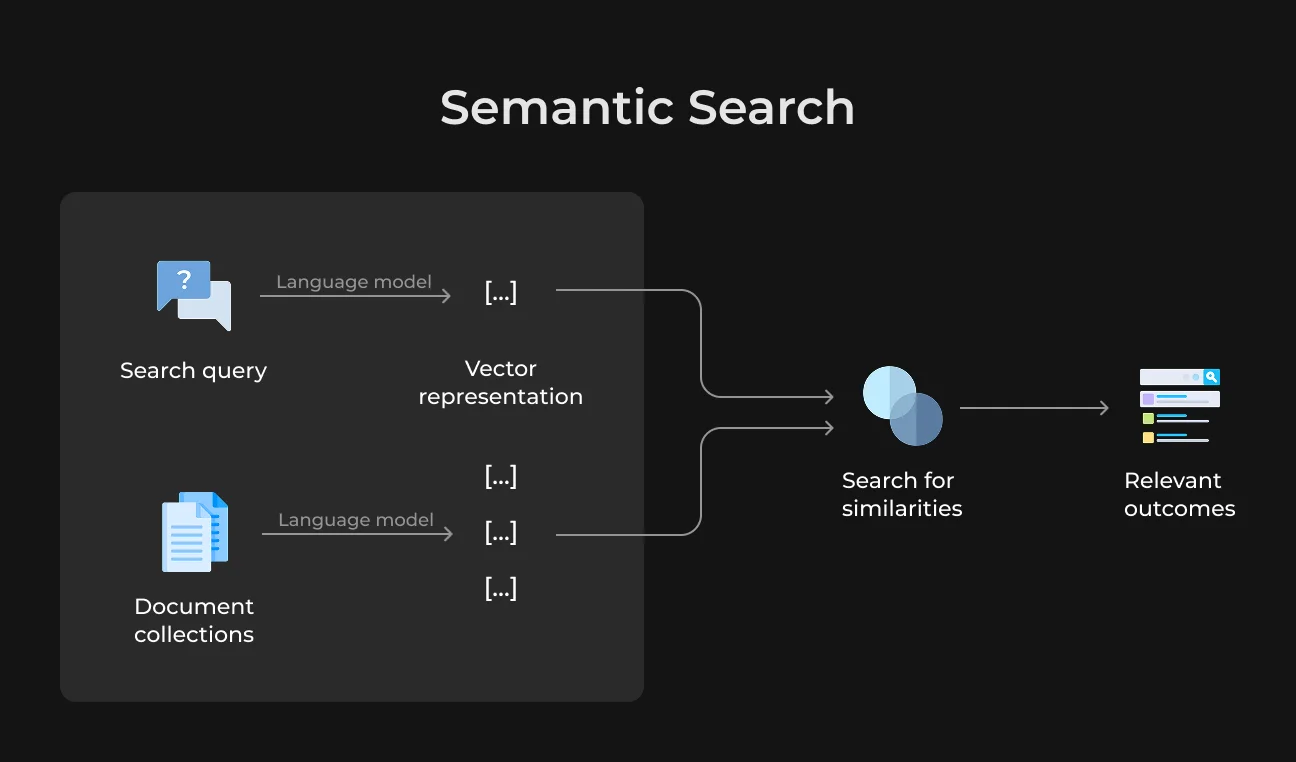
Here’s a look at the main differences between these two search approaches:
- Contextual handling.
Vector search encodes wider data relationships and context with vectors containing semantic meanings. Semantic search understands context by interpreting language and user intent. And it also relates concepts together for more accurate results.
- Scalability.
Vector searching is scalable because it allows data to be converted into high-dimensional vectors. It uses distributed computing and machine learning to improve as it processes more data, but it requires a lot of computing power.
- Understanding approach.
Vector search works numerically and spatially, placing items into a vector space. Objects near each other are similar in this space, which allows us to handle large and complex data.
The idea of semantic search is that, in theory, machines can understand language better through natural language processing.
How SapientPro Used Vector Search Engines to Build an AI-Powered E-Commerce Assistant
Here’s how SapientPro created an AI e-commerce assistant that simplifies finding products.
Our tech-savvy client frequently adds new features themselves. Their website uses ShopWare, which is great for adjusting code. Given the client's confidence and specific requirements, we suggested developing a proof-of-concept AI shopping assistant directly on their website.
To boost the assistant’s capabilities, SapientPro used advanced vector search tools for efficient handling of large data. Key features we implemented include:
- LLM-powered search assistant.
By integrating a large language model, the assistant combines keyword and vector-based searches to understand and answer natural language queries.
- Dual-mode search engine.
Our custom search server combines traditional and semantic search using the store’s product database. The LLM chooses the best search approach based on user requests.
- Contextual product discovery.
Users can describe items in broad terms. The assistant then determines relevant details, asking clarifying questions as needed, making searches more intuitive.
- Semantic flexibility with real-world accuracy.
When you search for "a green T-shirt," the system suggests similar choices, like light green or turquoise. We moved from using Qdrant to Postgre SQL with pgvector to improve filtering.
Using vector search technology, SapientPro developed an advanced AI e-commerce assistant that offers personalized, accurate, and timely responses to user inquiries.
Partner with SapientPro to Implement Vector Search in Your Product
Partner with SapientPro to easily add modern vector search solutions to your product. Our professional team has expertise in using advanced vector search engines to optimize your application.
Whether you want to work on semantic search accuracy, increase personalization, or deliver data faster, SapientPro will design a tailor-made solution for your business needs.
Contact SapientPro and let's stay ahead in the challenging digital industry.
Implement Vector Search with SapientPro

FAQ
What is a vector search database?
A vector database is a system designed to organize and process complex types of data, namely vectors, with high performance. It’s optimized for fast, high-accuracy similarity searches. This makes it great for recommendation systems, machine learning, and natural language processing.
What are the leading open-source vector databases?
Some of the best open-source vector databases include:
- Faiss. Developed by Facebook AI. It’s great for powerful vector searches;
- Annoy. Created by Spotify. It’s efficient for high-dimensional searches;
- Milvus. A scalable cloud-native database perfect for managing large amounts of vector data.
Can SapientPro integrate vector search in my product?
Yes, SapientPro can help add vector search capabilities to your product. Our specialists leverage superior tech to enhance data search and recommendations. We work with you to define your requirements, so the integration provides fast and accurate search results.

