All Tech Guide to LLM Optimization Techniques and Best Practices
August 30, 202615 min read


The era of experimental GenAI is over. With 71% of organizations now integrating these tools for various needs and the global market projected to hit $644 billion in 2025, the focus has shifted. The new battleground is now both capability and economic sustainability.
As growing inference costs trigger an industry-wide "price war," tech leaders must prioritize efficiency to survive scaling. This guide provides a critical analysis of LLM optimization techniques, security protocols, and the strategic LLM performance metrics essential for 2026.
Key Takeaways
- The economic imperative for LLM optimization cannot be overstated, as enterprises that fail to master LLM inference optimization techniques face a future where their gross margins are eroded by ballooning cloud bills;
- The difference between a profitable AI application and a cost center often comes down to the implementation of strategies like quantization, speculative decoding, and effective caching;
- Despite advancements in GPU compute power, the speed at which data moves from memory to processors lags behind;
- With the EU AI Act and similar global regulations in full effect, metrics for bias, toxicity, and hallucination are as critical as latency and throughput;
- The era of the single, monolithic "do-it-all" model is fading in favor of hybrid approaches where small, highly optimized models handle routine tasks, and larger models are reserved for complex reasoning.
What is LLM Optimization?
LLM optimization is the strategic process of refining Large Language Models to run faster and cheaper while maintaining high performance. It transforms a raw AI model into a viable business asset by balancing three critical factors:
- Latency (speed);
- Throughput (scale);
- Cost (hardware efficiency).
Unlike traditional software updates, LLM optimization is a must-have requirement that impacts every stage of deployment:
- Selection: choosing the right model architecture.
- Training: fine-tuning for specific tasks efficiently.
- Inference: ensuring real-time responsiveness for end-users.
Why is this necessary?
The core challenge of what is LLM optimization lies in the unique hardware demands of GenAI. LLMs are incredibly memory-intensive; generating even a single word requires fetching billions of parameters.
Without optimization techniques like Model Compression and Inference Scheduling, processors sit idle waiting for data, driving up costs and slowing down user experiences.
Main LLM Performance Metrics
Scaling AI remains a major hurdle due to 3 key challenges:
- Lack of AI talent (44%);
- Unpredictable costs associated with large language models (42%);
- Persistent concerns around data privacy and regulatory compliance (41%).
That is why evaluating the success of an AI deployment requires a nuanced dashboard of indicators. Executives must look beyond simple "accuracy" to a composite of system health and output quality.
The following metrics constitute the standard for assessing LLM performance metrics in 2026.
Metric Category | Metric Name | Strategic Importance |
| Speed | Time to First Token (TTFT) | User Experience & perceived latency. |
| Throughput | Tokens Per Second (TPS) | Scalability & Batch Processing efficiency. |
| Modeling | Perplexity | Raw intelligence & prediction confidence. |
| Reliability | Hallucination Rate | Trustworthiness for mission-critical tasks. |
| Compliance | Bias & Toxicity | Legal safety & Brand reputation. |
| RAG Utility | Faithfulness | Accuracy of enterprise data usage. |
System and Operational Metrics
These metrics quantify the efficiency of the infrastructure and are critical for the CTO and COO to monitor operational overhead.
Time to First Token (TTFT)
Time to First Token measures the latency between the moment a user sends a request and the moment the first character of the response appears on their screen. In interactive applications like customer support chatbots or coding assistants, TTFT is the primary determinant of user satisfaction.
A delay of more than 200 milliseconds is often perceptible and can break the flow of conversation. TFT is dominated by the "prefill" phase, where the model processes the input prompt before generating any new content.
Optimizing this metric often involves ensuring that prompt processing is parallelized and that the model is readily available in GPU memory.
The "Perception" Metric In interactive apps like chatbots, first impressions are everything. TTFT measures how quickly the model "wakes up" and starts replying. If this takes longer than 200ms, the interaction feels laggy. Optimizing TTFT ensures the conversation feels natural and responsive.
Tokens Per Second (TPS)
Tokens Per Second, or throughput, measures the rate at which the model generates text once the first token has been produced. While TTFT matters for the feeling of speed, TPS determines the volume of work the system can handle. High TPS is essential for batch processing tasks, such as summarizing long documents or generating code, where the user is waiting for the completed output rather than a stream.
This metric is heavily influenced by memory bandwidth. If the system cannot move weights from memory fast enough, TPS drops.
Queue Time and Total Latency
Total Latency is the end-to-end time for a request to be completed. It is the sum of Queue Time (time spent waiting for a specialized slot on the GPU), TTFT, and the time taken to generate all subsequent tokens. In high-traffic scenarios, Queue Time becomes a silent killer of performance. If the arrival rate of requests exceeds the service rate (TPS), queues build up exponentially.
LLM performance metrics dashboards must track queue depth to trigger autoscaling events before users experience timeouts.
Quality and Evaluation Metrics
These metrics assess whether the model is performing its intellectual task correctly, a key concern for product leaders and investors.
Perplexity
Perplexity is a fundamental scientific metric that quantifies how "surprised" a model is by new text. A lower perplexity score indicates that the model is predicting the next word in a sequence with high confidence and accuracy. Mathematically, it is the exponentiation of the entropy. While highly technical, it serves as a robust proxy for the raw modeling capability of the system.
If an optimization technique like quantization aggressively reduces precision, perplexity is often the first metric to degrade. It signals a loss in reasoning quality.
Hallucination Rate
For enterprise adoption, reliability is paramount. The Hallucination Rate measures the frequency with which the model generates factually incorrect, nonsensical, or ungrounded information.
In sectors like legal, finance, and healthcare, a high hallucination rate is a showstopper. Rates can vary wildly (15%-80%), depending on the model and the complexity of the prompt. Tracking this requires rigorous evaluation against "golden datasets" of verified facts. Reducing this metric is often the primary goal of RAG architectures.
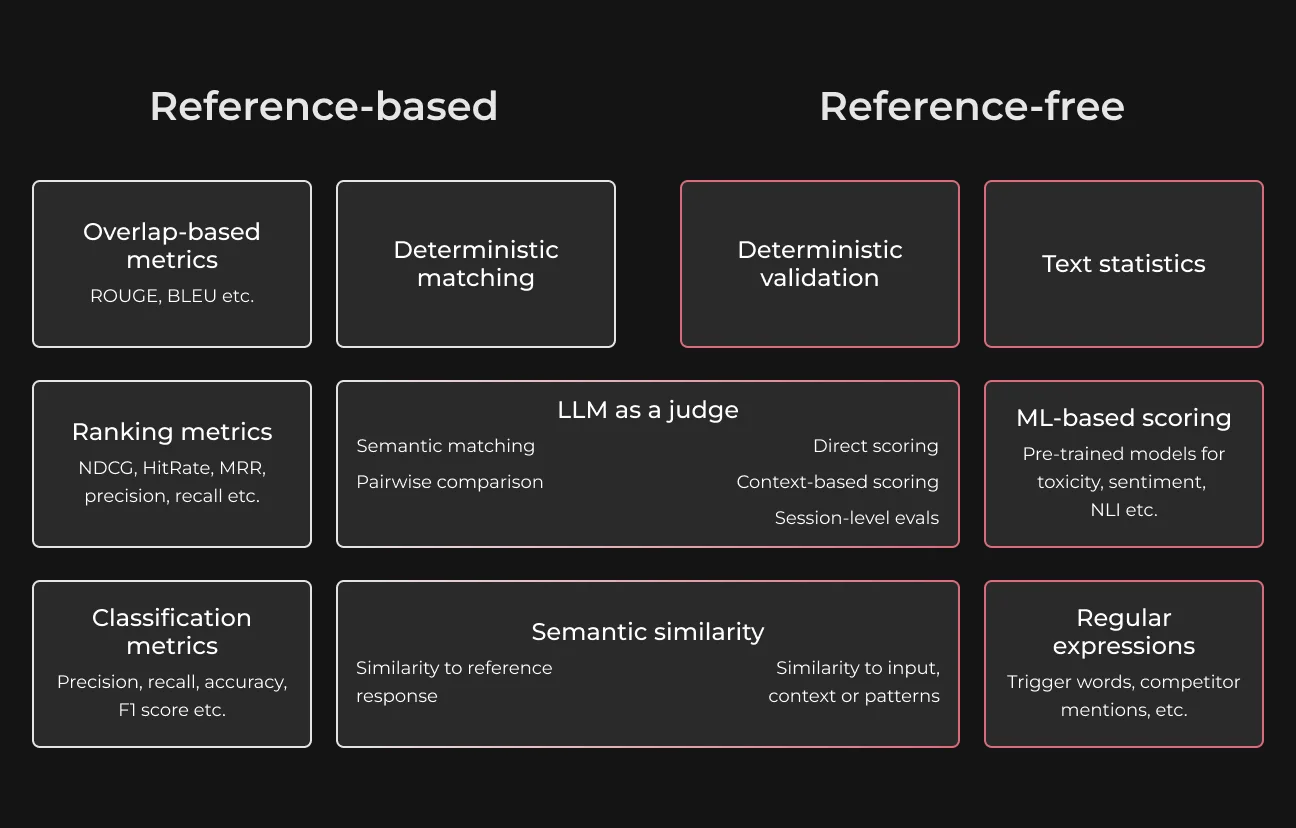
BLEU and ROUGE Scores
These are standard metrics for evaluating text generation against a reference:
- BLEU (Bilingual Evaluation Understudy) focuses on precision. It counts how many words in the machine-generated output also appear in the human-written reference. It is widely used in translation.
- ROUGE (Recall-Oriented Understudy for Gisting Evaluation) focuses on recall. It measures how much of the reference content is captured by the model. It is the standard for summarization tasks.
While useful for automated testing, leaders should note that these metrics can fail to capture semantic nuance. How? A model might phrase an answer differently but correctly, yet receive a low BLEU score.
Responsible AI Metrics
As regulation tightens, these metrics protect the brand and ensure compliance.
Bias and Toxicity Scores
These metrics evaluate the presence of prejudiced, harmful, or offensive content in model outputs. Automated tools (like G-Eval or toxicity classifiers) scan outputs to generate a risk score. This is critical for compliance with the EU AI Act and internal corporate ethics standards.
RAG Metrics: Faithfulness and Relevancy
In RAG systems, which are standard for enterprise data, two specific metrics matter:
- Faithfulness. Does the answer accurately reflect the information found in the retrieved documents? This measures whether the model is making things up despite having the facts.
- Answer Relevance. Does the generated answer actually address the user's query? A faithful answer that is irrelevant to the question is useless.
These metrics ensure the "Smart Search" capability is actually smart.
6 LLM Optimization Techniques in 2026
To achieve the targets set by LLM performance metrics, organizations employ a suite of advanced LLM optimization techniques. These methodologies address the physical constraints of hardware and the mathematical redundancies of neural networks. 2026 is defined by a layered approach, combining compression, architectural innovation, and novel training strategies.
1. Model Compression Techniques
The most direct way to improve LLM inference optimization is to make the model smaller. Reducing the memory footprint allows the model to fit on cheaper hardware and reduces the data transfer time. This directly attacks the Memory Wall.
Quantization
Quantization is the process of reducing the precision of the numbers used to represent the model's parameters (weights) and activations:
- The problem. Models are typically trained in 16-bit floating-point precision (FP16 or BF16). This provides high accuracy but consumes significant memory. A 100-billion parameter model in FP16 requires 200GB of VRAM just to load.
- The solution. Quantization maps these continuous values to a smaller, discrete set of values, such as 8-bit integers (INT8) or even 4-bit integers (INT4). This can reduce memory usage by 2x to 4x.
- Optimization. Techniques like GPTQ and AWQ (Activation-aware Weight Quantization) are standard in 2026. They analyze the model to identify which weights are most critical for accuracy and keep those with higher precision. At the same time, they aggressively compress the rest. This allows a model to run on a single commodity GPU instead of a cluster.
Beyond memory savings, INT8 operations are often supported by specialized tensor cores on modern GPUs, allowing for faster computation. However, the primary speedup comes from reducing the time spent reading data from memory.
Knowledge Distillation
Knowledge Distillation is a "teacher-student" transfer learning method:
- The problem. The most capable models (the "teachers") are too massive and slow for real-time deployment.
- The solution. A smaller model (the "student") is trained to mimic the behavior of the teacher. Instead of training the student on raw data, it is trained to match the output probabilities (soft targets) of the teacher model.
- Optimization. This effectively compresses the "reasoning" capability of a trillion-parameter model into a 7-billion-parameter model. The student model learns the generalizations and logic of the teacher without needing the massive parameter count.
This LLM optimization technique is particularly effective for domain-specific tasks, where a distilled model can match the performance of a generalist giant at a fraction of the inference cost.
2. Architecture Modifications
Modifying the fundamental architecture of the LLM is one of the most powerful levers for LLM inference optimization techniques. These changes alter how the model processes information to eliminate bottlenecks.
Key-Value (KV) Cache Optimization
The KV Cache is a critical component for autoregressive generation, but it is also a massive memory hog:
- The problem. To generate the next token, the model needs the context of all previous tokens. Recomputing this every time is wasteful, so the "Keys" and "Values" (mathematical representations of the context) are cached in memory. For long conversations or document analysis, this cache grows linearly. It is quickly consuming gigabytes of VRAM and limiting the batch size.
- The solution #1. Multi-Query Attention (MQA) & Grouped-Query Attention (GQA) share Key and Value heads across multiple Query heads. Instead of storing a unique KV pair for every attention head, the model stores one pair for every 8 or 16 heads. This reduces the cache size by 8x-16x. Consequently, it drastically reduces memory bandwidth pressure and allows for much larger batch sizes (higher TPS).
- The solution #2. PagedAttention is popularized by frameworks like vLLM. This technique manages the KV cache like an operating system manages virtual memory. It breaks the cache into non-contiguous blocks, eliminating memory fragmentation and allowing the system to use nearly 100% of available VRAM for active requests.
Architecture Optimization: Pruning
Pruning involves removing unnecessary connections or layers from the neural network:
- The problem. Neural networks are often over-parameterized. They contain many "dead" or redundant neurons that contribute little to the final output.
- The solution. Unstructured pruning removes individual weights, creating "sparse" matrices. While theoretically efficient, this often requires specialized hardware to realize speed gains. Structured pruning removes entire attention heads, neurons, or layers.
This "Not All Attention Is Needed" approach is a hot trend in 2026. By identifying and excising redundant layers, engineers shrink the depth of the model. They directly reduce the latency of every forward pass.
Mixture of Experts (MoE)
MoE is a sparse architecture that is redefining LLM optimization:
- The problem. Increasing model size improves intelligence but explodes inference cost.
- The solution. MoE models consist of many distinct "expert" sub-networks. For any given token, a "gating network" or router selects only a tiny subset (e.g., 2 out of 64) of experts to process it.
- Optimization. This allows a model to have massive total capacity (e.g., 1 trillion parameters) but very low active compute (e.g., 10 billion parameters per token). This decouples model size from inference latency.
Managing the routing and ensuring all experts are used effectively (load balancing) is complex. Optimization techniques in 2026 focus on dynamic gating and "expert buffering" to keep throughput high across distributed clusters.
Speculative Decoding
Speculative Decoding is a breakthrough LLM inference optimization technique for latency reduction:
- The problem. LLMs generate text sequentially, one token at a time. This is slow because each step is memory-bound.
- The solution. A small, ultra-fast "draft" model guesses the next few tokens (e.g., 5 tokens). The large "target" model then verifies these guesses in a single parallel computation step.
- Optimization. Because the target model can verify 5 tokens in roughly the same time it takes to generate 1, this results in a 2x-3x speedup if the draft model is accurate.
2026 advancements like EAGLE-3 have refined the draft capability, making this a standard for low-latency applications.
3. Training Strategies
Optimization is not just post-processing. It begins with how the model learns.
Hybrid Optimization Strategies
The most effective deployments in 2026 use a hybrid approach. This involves stacking multiple LLM optimization techniques. For example, an organization might start with a Mixture-of-Experts model (Architecture), apply Knowledge Distillation to specialize it for their domain (Compression), and then deploy it with 4-bit Quantization and Speculative Decoding (Inference).
This layered strategy compounds the efficiency gains, resulting in systems that are orders of magnitude more efficient than stock models.
Reinforcement Learning from Human Feedback (RLHF)
While traditionally an alignment tool, RLHF is a potent optimization strategy for utility:
- The Optimization. By training a model to prefer concise, direct answers over verbose ones, RLHF reduces the average number of tokens generated per query. Since cost and latency are directly proportional to output length, a model trained to be succinct is inherently an optimized model.
- Direct Policy Optimization (DPO). A more stable alternative to RLHF, DPO optimizes the model to satisfy preferences directly without a complex reward model. It streamlines the fine-tuning process for specific, efficient behaviors.
How to Fine-Tune LLM to Mitigate Bias
In the era of responsible AI, LLM optimization includes optimizing for fairness. A model that is fast but discriminatory is a liability. Fine-tuning to mitigate bias is a critical workflow for complying with the EU AI Act and maintaining corporate integrity.
Data Curation
The foundation of bias mitigation is the training data. Biased inputs yield biased outputs.
Optimization begins with rigorous curation of datasets to ensure diverse representation across gender, race, culture, and ideology. This is not just about removing "bad" data but actively sourcing "good" data that provides a balanced worldview.
Using automated tools to scan training corpora for underrepresented groups and overrepresented stereotypes allows data scientists to rebalance the dataset before training begins. This effectively "optimizes" the model's starting point for neutrality.
Counterfactual Data Augmentation
This technique involves actively teaching the model to ignore spurious correlations. If the training data contains the sentence "The doctor bought his lunch”, the model might learn a correlation between "doctor" and "male."
Counterfactual augmentation automatically generates a swapped version: "The doctor bought her lunch". By training on both, the model is forced to decouple the concept of the profession from the gender. This optimizes the model's internal representations to be invariant to sensitive attributes.
Logic-Aware and Neutral Modeling
Standard models often rely on statistical shortcuts rather than reasoning. The goal is to train the model to prioritize logical deduction over statistical likelihood when those statistics reflect societal biases.
Researchers are developing "neutral language models" and "logic-aware" fine-tuning datasets. These datasets explicitly teach the model that certain relationships (like gender and occupation) are neutral unless specified. This optimizes the model's reasoning engine to reject stereotype-based predictions in favor of context-based ones.
Evaluation-Driven Fine-Tuning Loops
Bias mitigation is an iterative optimization process. Continuous monitoring using LLM performance metrics for bias (e.g., demographic parity) is essential.
Implementing a feedback loop where the model is periodically evaluated against fairness benchmarks is very effective. If a specific bias drift is detected (e.g., against a specific dialect), a targeted fine-tuning run with curated data is triggered to correct it. This treats fairness as a continuously optimized system parameter.
Build Your AI Assistant with SapientPro
Talk to SapientPro about optimization strategies that protect your AI application from hallucinations and bias.

LLM Optimization Checklist for Your Startup
Launching a GenAI product requires navigating a minefield of costs and technical debt. This checklist ensures your LLM optimization strategy is robust.
Category | Optimization Action Item | Why It Matters |
| Strategy | Define Success Metrics | Clearly define targets for TTFT (<200ms?), Cost ($/1k tokens), and Hallucination Rate. Don't optimize blindly. |
| Architecture | Model Selection | Evaluate MoE vs Dense models. Choose the smallest model that meets your intelligence requirements (use Distillation if needed). |
| Compression | Apply Quantization | Deploy using INT8 or INT4 quantization (AWQ/GPTQ) to slash memory usage and boost throughput. |
| Inference | Enable KV Caching | Ensure your serving infrastructure (e.g., vLLM) uses PagedAttention to maximize batch sizes. |
| Latency | Speculative Decoding | Implement a draft model to accelerate token generation if your use case is latency-sensitive (e.g., chat). |
| Data | Semantic Caching | Use a vector database (e.g., Redis) to cache common queries. If a user asks a known question, serve the cached answer instantly for zero cost. |
| Security | Input/Output Guardrails | Deploy guardrails to filter toxic prompts and PII before they reach the model or user. |
| Bias | Fairness Audit | Run a bias evaluation scan on your fine-tuned model using counterfactual datasets before release. |
| Monitoring | Cost Tracking | Tag every request with a user ID and track cost per tenant. Identify "power users" who might destroy your margins. |
| Ops | Autoscaling Policies | Configure Kubernetes HPA based on Queue Depth, not just CPU usage, to prevent latency spikes during traffic surges. |
How SapientPro Built an AI Assistant for Sales
The practical application of LLM inference optimization techniques is best illustrated by SapientPro's development of an AI-powered sales expansion tool. What was the challenge? The client needed a voice-based AI assistant to conduct sales calls. In voice interactions, latency is the enemy. Any pause longer than a heartbeat breaks the illusion of conversation.
The system had to understand speech, process intent with an LLM, and synthesize a voice response. All in real-time. Furthermore, call volumes were unpredictable, requiring a system that could scale instantly without crashing.
SapientPro engineered a solution heavily focused on LLM optimization:
- Low-latency pipeline. We developed a custom "AI Consultant Algorithm" that optimized the handoff between Speech-to-Text, the LLM, and Text-to-Speech modules. By minimizing network overhead and optimizing the inference triggers, we achieved a total response time of under 700ms.
- Scalable microservices. Instead of a monolithic app, we used a microservices architecture orchestrated by Kubernetes. This allowed the computationally expensive LLM components to scale independently of the lighter-weight logic components.
- Cost efficiency. By optimizing the infrastructure usage, we drove operating costs down to approximately $1 per hour.
- Security. The team integrated robust security protocols to handle sensitive sales data, ensuring compliance with privacy standards while maintaining high performance.
You can find more of our projects in the case studies section on our website.
The Future of LLM Optimization
By understanding and implementing these LLM optimization strategies, you can ensure your organization is efficient, sustainable, and profitable.
The Unit Economics of Intelligence
We are witnessing a profound shift where LLM optimization is commoditizing intelligence. Jevons' Paradox suggests that as LLM inference optimization drives down the cost per token, the demand for those tokens will explode. Applications that were previously cost-prohibitive, such as AI agents that continuously monitor and analyze every single log file in a server farm, are becoming feasible. This shifts the value capture from the production of intelligence to the integration of intelligence.
The Fragmentation of Architectures
The "One Model to Rule Them All" paradigm is dead. The future belongs to specialized, optimized architectures. We are seeing a divergence:
- Massive "Reasoning Models" (like DeepSeek R1 or OpenAI o1) that use Chain-of-Thought to solve complex problems slowly;
- Ultra-fast "Instinct Models" (highly quantized, distilled SLMs) that handle 90% of user interactions instantly.
What is LLM optimization in this context? It is the orchestration layer that routes queries to the cheapest model capable of answering them.
Sustainability as a Constraint
Energy consumption is the next major hurdle. With data centers projected to consume significant global electricity, all performance metrics will increasingly include "Energy per Token". LLM optimization techniques like sparse MoE and aggressive quantization are not just financial strategies.
They are environmental necessities. In 2026 and beyond, we expect "Green AI" optimization to become a regulatory requirement for large-scale deployments.
Partner with SapientPro to Build & Integrate LLM in Your Business
The journey to a high-performance AI infrastructure is complex. Mastering LLM optimization techniques, navigating the "Memory Wall," and ensuring your models are bias-free requires deep engineering expertise.
SapientPro’s engineers are your tech partners in implementing LLM inference optimization to reduce latency, building a custom RAG solution, fine-tuning a model for your specific domain, and more. We’re proficient in AI development, helping enterprises turn ambitious concepts into realities.
Don't let infrastructure bottlenecks or spiraling costs stall your innovation.
Partner with SapientPro to engineer an AI strategy that is as efficient as it is intelligent.
Build Faster, Cheaper, Compliant AI
Partner with SapientPro to engineer your full LLM optimization strategy today.