All What is AI Observability: Benefits & Best Practices
October 13, 202515 min read


Businesses can achieve better troubleshooting, reduce downtime, and improve user experience through observability. Current stats show 91% of IT leaders agree that observability is fundamental for the software lifecycle, effective planning, and operations.
AI model observability is now a fundamental requirement for delivering transparency to users about how systems operate and their internal processes. This article from SapientPro's tech experts explores the key advantages of AI observability along with its best practices.
Key Takeaways
- As organizations grow, it becomes harder for them to keep track of their AI systems;
- AI observability offers insights in real time into the behavior and performance of an AI system;
- It goes beyond just tracking CPU or memory usage and aims to fully understand how models interact;
- The benefits of AI observability include increased transparency, better issue detection, identifying root causes, and enhancing model performance.
What is Observability AI?
AI observability offers real-time visibility into an AI system's behavior and performance. The system extends just past monitoring CPU or memory usage statistics: it works to achieve a complete understanding of model interactions. This helps detect bottlenecks to improve performance, cost efficiency, and security.
Let's look into the key metrics of AI observability:
Metric | Description |
| Model precision | Shows how predictions match real outcomes. |
| Accuracy and recall | Define how appropriate and complete the predictions are. |
| Latency | Measures the time to process inputs and give predictions. |
| Throughput | Counts how many transactions are processed in a given time. |
| Data drift | Identifies changes in data that might affect accuracy. |
| Feature importance | Decides which factors most impact predictions. |
| Error rate | The percentage of wrong predictions by the model. |
| F1 score | Combines precision and recall into one measure. |
| Resource utilization | Tracks the use of CPU, memory, and disk for processing. |
| Fairness/Bias metrics | Checks predictions for biases across various groups. |
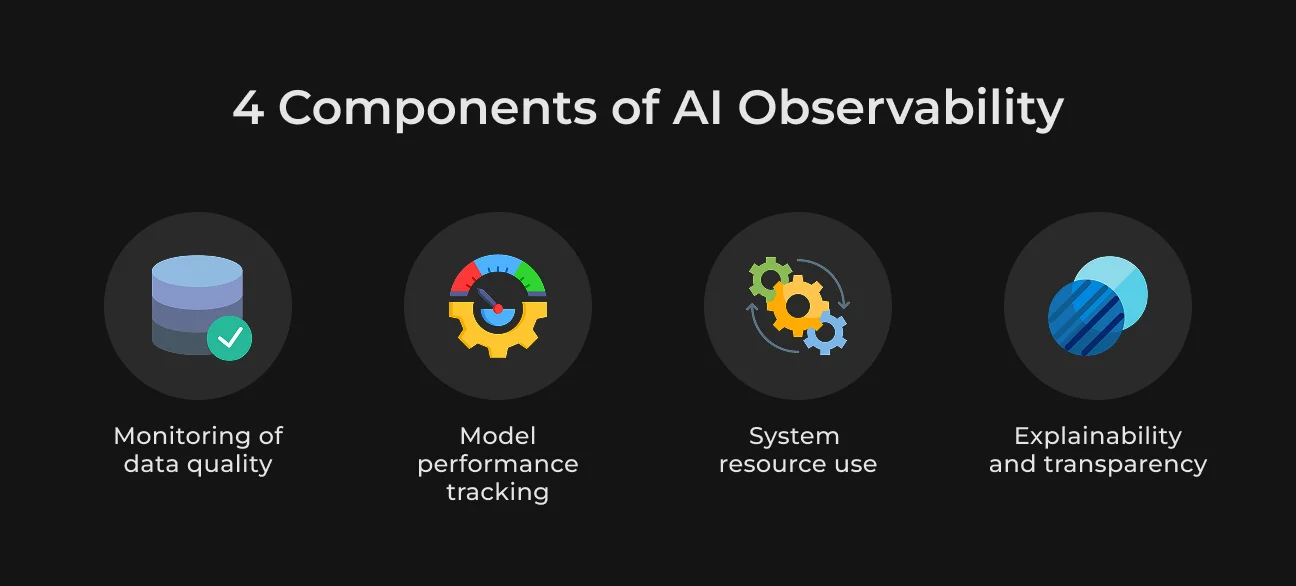
Main Components of AI Agent Observability
To better understand how AI observability works, we must first understand its major components.
1. Monitoring of Data Quality
The process of data quality assessment is about periodic checks for errors, missing information, and inconsistent data points. The whole model prediction accuracy depends on this step to ensure reliable decision-making.
2. Model Performance Tracking
You need to look at the AI model's accuracy, precision, and speed to truly evaluate its performance. Monitoring helps capture any unusual changes, which could suggest model drift or an issue with the data.
3. System Resource Utilization
By evaluating how much CPU and memory an AI system uses, organizations can make it more efficient. Companies can control expenses, optimize resource distribution, and prevent AI processing delays through continuous monitoring of this data.
4. Explainability and Transparency
AI decisions need to be transparent to users. The implementation of explainability tools enables users to understand the reasoning behind model predictions. This transparency is crucial for building trust, especially in important areas like healthcare.
Benefits of AI Observability
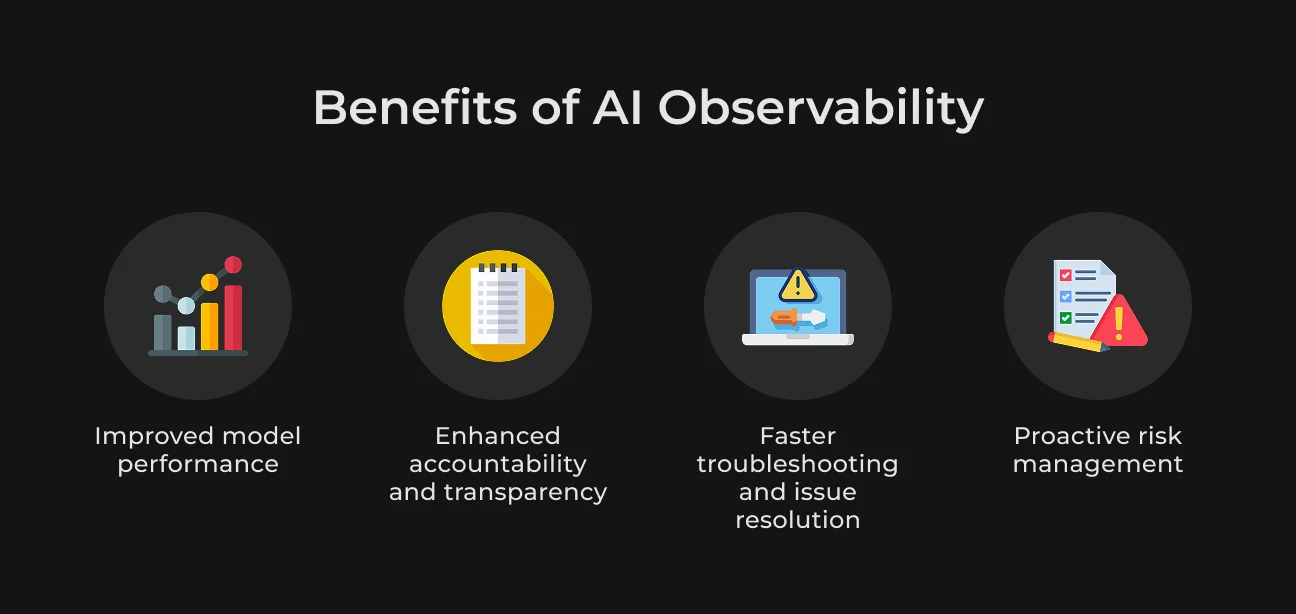
AI observability provides multiple advantages, from improved transparency and issue detection to root cause analysis and better model performance. The following section explores these advantages in more detail.
Improved Model Performance
Companies can use AI observability to monitor their artificial intelligence models' performance. The system allows organizations to detect any performance issues, unpredictable behaviors, or errors more efficiently.
McKinsey’s research shows that companies using this MLOps practice shelve 30% fewer models and increase the value of their AI work by up to 60%.
Businesses can also follow model performance metrics (like accuracy, precision, recall, and speed) to monitor their models in real time under various circumstances.
Teams can make data-based improvements through continuous monitoring, which results in better model operation and adaptation to new data and conditions. This continuous evaluation process results in improved outputs and higher-quality AI systems.
Enhanced Accountability and Transparency
AI observability provides a kind of groundwork for both accountability and transparency in AI systems. The transparent operation of AI systems creates trust among users, clients, and regulators who require proof of system fairness and responsible operation.
Organizations use observability to track fairness while detecting bias and maintaining ethical standards for their AI systems. This method enables organizations to minimize their reputation risks and support their corporate responsibility initiatives.
Faster Troubleshooting and Issue Resolution
26% of teams need a week or even more to detect and resolve issues with models in production. However, companies with complete observability experience 79% less downtime and save more costs than competitors.
Observability tools help detect and fix AI model issues by providing clear performance monitoring. By constantly tracking performance and resource use, teams can spot and address errors or odd behavior. This leads to less downtime, fewer disruptions, and more reliable AI systems.
Quick problem-solving improves the development process, allowing teams to test and launch models more efficiently and boost innovation.
Proactive Risk Management
Organizations can manage risks through AI observability because it detects and resolves issues before they grow. Organizations can detect upcoming issues early by monitoring important factors like data changes, system errors, and resource use.
This early intervention helps prevent expensive errors, system breakdowns, and reputation damage.
Challenges in AI Observability
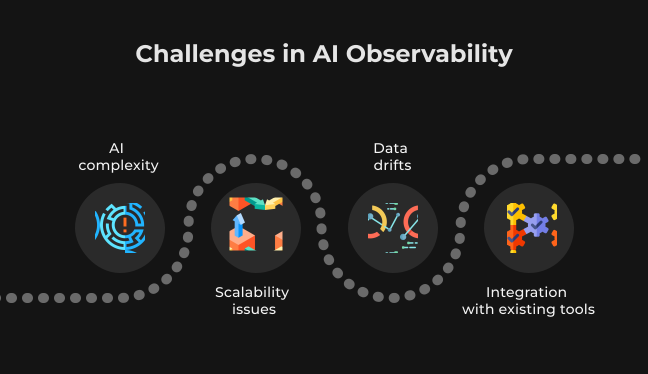
Let's check out multiple elements that make it challenging to achieve observability in AI systems.
AI & LLM Complexity
When systems manage large amounts of data from various sources, it can be challenging to keep track of their activities. The difficulty especially grows with advanced AI technologies, like neural networks, because they function like black boxes.
It might be hard to understand how they work and ensure they're operating correctly. Monitoring AI systems requires advanced tools to gather, run, and analyze the data they produce.
Data & Concept Drift
Data drift happens when the statistical characteristics of input data shift (while concept drift refers to changes in how input data relates to outputs). These shifts can cause models to lose accuracy since they were originally trained under different data conditions. This often requires actions like retraining the models or making necessary adjustments.
Scalability Issues
Organizations face growing difficulties in monitoring their AI deployments as they expand their operations. The extensive data output from large AI systems can create data overload. This makes analysis harder, increases costs, and slows down the system's response time.
Integration with Existing Tools
Integrating AI observability with current tools can be problematic because organizations use various technologies. So, this could lead to compatibility issues.
AI systems must work with infrastructure monitoring tools, data analytics platforms, and CI/CD pipelines. Each integration requires careful planning to ensure the right operation without disrupting current workflows.
Real Problems Solved by AI Observability
AI models are quite complex, so it's sometimes tough to understand how they judge. Observability solutions help keep track of significant details like accuracy, errors, and speed. This way, any problems, like the model not performing well, can be spotted and fixed before they get worse. Let's look at a few real-life examples of how AI observability has been essential in solving issues.
Low Performance and Model Degradation
When the AI model's real-world data greatly differs from the data it was trained on, data drift could occur. AI models need to be updated and retrained regularly in order to adjust to any changes.
Observability tools are practical since they can catch data drift, anomalies, and check for schema mismatches or missing values. They ensure that the existing data matches the training data. This helps prevent biased predictions and keeps the model working the way it should work.
Lack of Transparency in Decision-Making
Too often, malicious data inputs (tricky questions) can guide AI models to make false decisions. They might even seem normal to us, but still have small changes that can mislead AI or result in major failures.
AI observability solutions explain how AI models work and help organizations find biases, boost transparency, and follow ethical guidelines. With metrics like trend tracking or feature importance, these instruments help build trust in AI systems.
LLM Hallucinations in Chatbots
AI hallucinations happen when models like GPT generate information that seems reasonable but is actually wrong. For example, an AI-based voice assistant in a legal company might provide incorrect legal references. Around 77% of businesses are worried about these hallucinations and the integrity risks they pose.
Professionals who rely on AI outputs might make crucial decisions based on the system's errors. This can be especially risky in areas like healthcare, where mistakes could lead to false diagnoses or treatment plans.
AI observability improves content accuracy and checks out the quality and relevance of outputs. Output validators identify and fix mistakes, which ensures the generated content meets quality standards and follows ethical guidelines.
If a problem is found, observability tools quickly point it out. So, engineers can make the needed adjustments by refining the filters or retraining the model.
Visibility into AI-Powered Infrastructure Bottlenecks
Think of running a large city where AI models act like high-speed trains carrying crucial data. Sometimes these trains hit traffic jams in the city's infrastructure. AI observability is like a traffic monitor specifically for these AI systems.
AI manages tasks like making recommendations or real-time analytics, which rely on infrastructure (servers and networks). When components like CPUs or memory become overloaded, AI can struggle, causing inefficiencies and downtime.
AI observability gives a clear view of these infrastructure layers. It’s like having an assistant monitoring all routes in your digital city, alerting you to traffic issues, and helping you fix them before gridlock hits.
Take, for example, an e-commerce site during a big sale. Observability solutions can recognize overloaded elements, like a slow database. By timely identifying these issues, your business can add resources or redistribute the load, preventing unexpected breakdowns.
Observability turns complex AI systems into understandable, manageable tools. It bridges the gap between performance and responsibility.

Illya Vorobets
Standardizing Agent Telemetry (OpenTelemetry for AI)
Telemetry in tech collects and sends essential information about system performance. In AI specifically, telemetry lets us understand how different elements work together. Without standardization, this data can become confusing and chaotic.
OpenTelemetry for AI serves as a universal translator, ensuring data is collected and shared in a consistent language. This standard makes performance data easy to understand, regardless of its source.
For businesses, this means smoother operations. Think of it as a global airline where AI handles tasks like ticket bookings and luggage tracking. Standardized telemetry identifies issues consistently, making it easier for IT teams to address problems and boost performance.
It also enhances teamwork by giving everyone a clear view of system performance. This approach simplifies adding new AI features and makes compliance reporting easier through clear and consistent records.
Best AI Observability Tools in 2025
There are many paid and free tools available in the market. Datadog and New Relic are just two examples that enhance current observability. We'll look at three tools for 2025 from this category.
Datadog AI Observability
Datadog AI Observability is a monitoring system that provides analysis for AI applications. The platform delivers complete visibility across your entire tech stack, monitoring data pipelines together with model performance and infrastructure.

Key Features
- The platform provides immediate monitoring and alert capabilities for AI models along with infrastructure components;
- OpenTelemetry integration enables unified data collection through the platform;
- The platform includes dashboards that allow users to monitor machine learning models;
- The system uses AI to detect anomalies in its operations;
- The platform provides tools to display performance trends and detect system bottlenecks.
Pricing
Datadog provides multiple types of plans with different features. You can start with a free 14-day trial and scale as you grow. The paid plans are from $15 to $34 per host monthly.
New Relic AI Observability
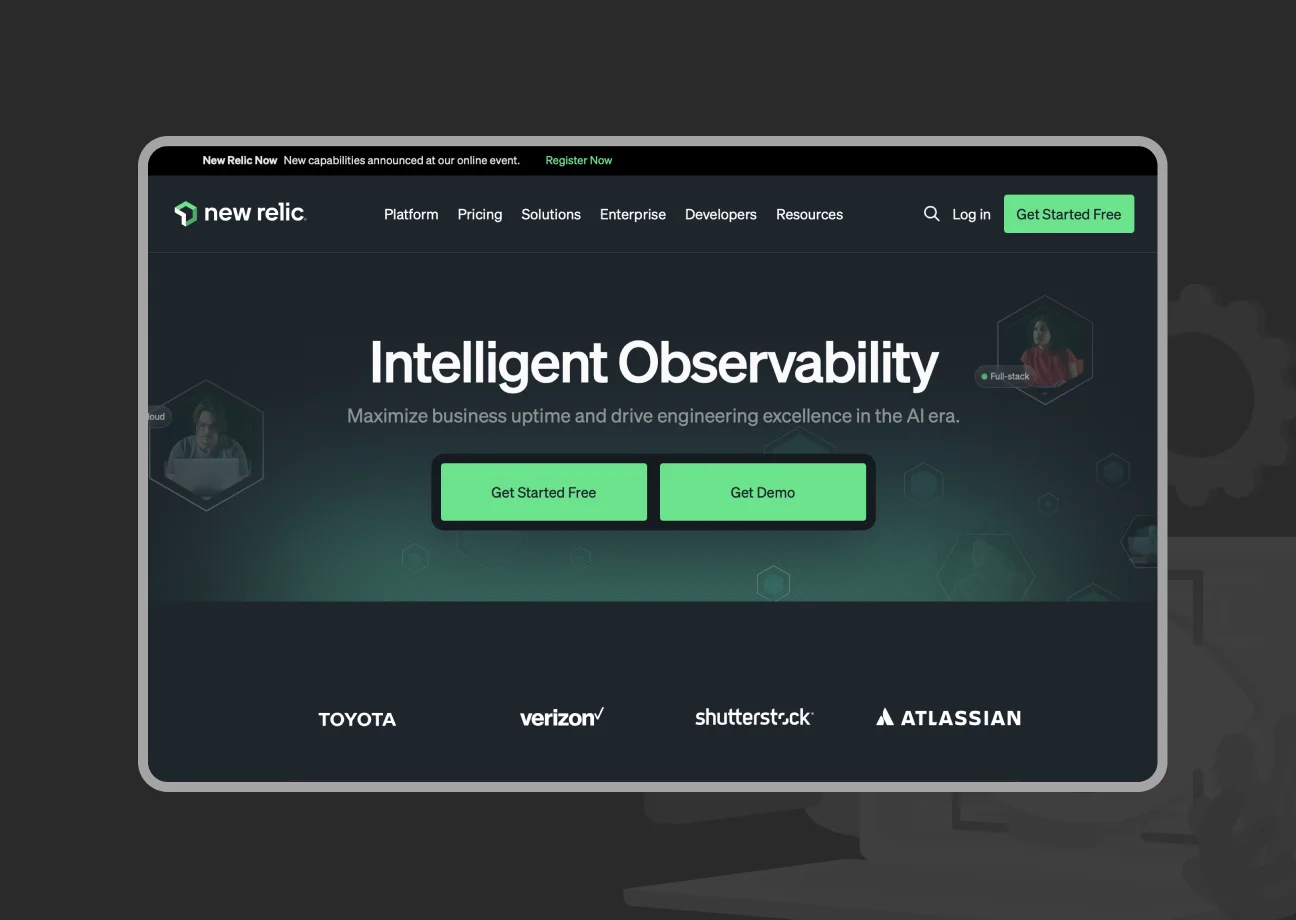
The AI Observability platform from New Relic enables complete monitoring of AI systems. The platform provides detailed monitoring capabilities through its easy integration with various environments.
Key Features
- The system provides complete visibility into applications, infrastructure, and AI models;
- The platform uses AI to generate alerts, which helps detect problems;
- The system allows users to create personalized dashboards and reports;
- New Relic accepts large amounts of telemetry data for integration;
- The system includes tools for performance optimization.
Pricing
The platform provides a free basic version and three paid plans: Standard, Pro, and Enterprise. These plans adjust based on your data use and the number of users.
Grafana AI Observability
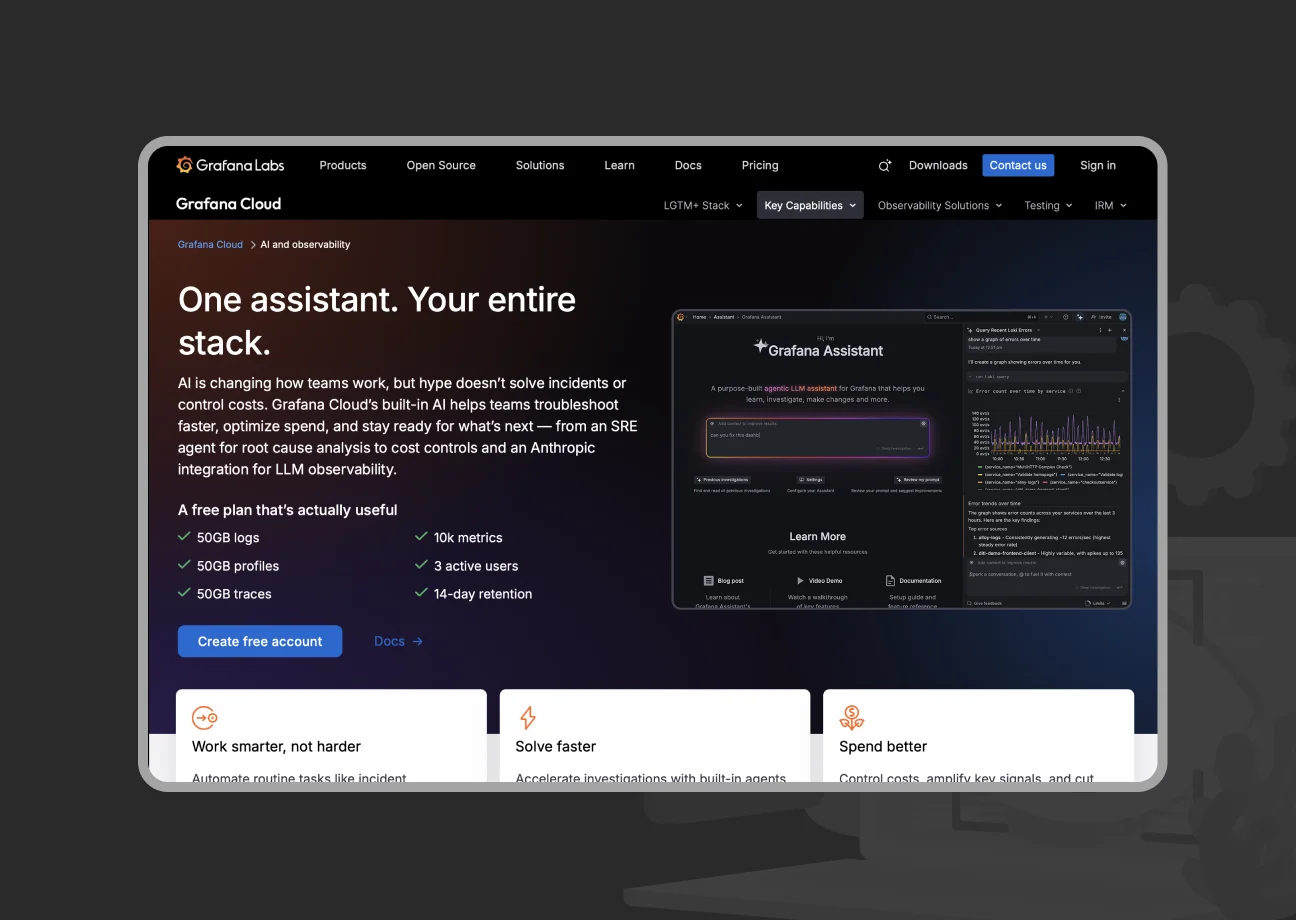
The Grafana platform offers monitoring tools for AI systems through both open-source and enterprise solutions.
Key Features
- Customizable dashboards;
- Multiple data source integrations;
- Alerting and incident management capabilities;
- Flexibility of open-source with advanced features;
- Extensive plugins for extra functionality.
Pricing
Grafana Cloud offers complete observability with open-source technology and standards. They have free, Pro, and Enterprise plans. The Pro plan starts at $19 per month plus usage costs, and the Enterprise plan starts at $25,000 per year.
Comparing the Best AI Observability Tools
Each tool provides unique capabilities that serve different organizational needs and use cases. Datadog and New Relic, for example, deliver comprehensive integrated solutions with extensive features. Grafana stands out for its exceptional flexibility and open-source customization options. Let’s compare these tools:
| Feature / Tool | Datadog | New Relic | Grafana |
| Real-time monitoring | Yes | Yes | Yes |
| Anomaly detection | Yes (with AI-driven insights) | Yes (AI-driven) | Limited (requires plugins) |
| Custom dashboards | Yes | Yes | Yes |
| OpenTelemetry support | Yes | Yes | Yes |
| Pricing | Tiered, based on hosts/features | Free tier + paid data/users plans | Free, paid, and enterprise options |
Partner with SapientPro to Integrate AI in Your Business
SapientPro’s engineers have 8+ years of experience in AI development and integration, supporting businesses worldwide with high-tech solutions. We’ll help you leverage various technologies like NLP, OCR, ML, CV, GenAI, and more. You’ll get modern and scalable software for all needs.
Ready to talk about your project?
Contact us today for a free consultation!
Implement AI Observability in Your Project
SapientPro's engineers will help you get the most from artificial intelligence and its capabilities.