All What is Agentic AI: Key Use Cases
Updated:April 29, 202610 min read


Many businesses are turning to AI for chatbots, automation, and data analysis. But modern AI is developing beyond just these uses. Agentic AI is a technology that can solve complex tasks by using advanced reasoning and planning.
As of now, 66% of customer service representatives spend their time on tasks that don't include direct communication with customers. By 2029, agentic AI might resolve 80% of common customer service issues without human involvement.
Imagine AI agents planning international trips, providing virtual support for the elderly, or optimizing supply chains by adjusting inventories based on demand. In customer support an AI agent could monitor a user’s balance, recommend accounts, and then wait for the user to finish the transaction.
These are just some of the many possibilities of agentic AI. Explore more practical ways agentic AI can be used across different industries with insights from SapientPro’s tech experts.
Key Takeaways
- Agentic AI can perform tasks or make decisions fully on its own, without the need for human help;
- Agentic AI system differs from a non-agentic because it can adjust its actions to achieve its goals;
- This type of AI plays a significant role in sectors like healthcare, transportation, finance, and customer service;
- Agentic AI should follow regulations, include ethical policies, and ensure transparency.
What is Agentic AI?
Agentic AI is a smart assistant that can think and make decisions on its own. It gets tasks, gathers information, plans solutions, and acts based on feedback similar to how a junior colleague would work.
Unlike regular chatbots or machine learning models that follow scripts, agentic AI is proactive and autonomous. It can work with others, assign tasks to different agents, and change its strategy if necessary.
By 2034, this AI market is projected to be valued at about $196.6 billion. Let’s explore the main parts of agentic AI.
Autonomy and Goal-Directed Behavior
Agentic AI is a type of artificial intelligence that works independently to achieve goals without human help. It understands user needs and situations, then uses technologies like machine learning and automation to make decisions and act on them.
By 2028, 33% of business software will use agentic AI, allowing 15% of daily decisions to be made automatically.
Unlike generative AI models like ChatGPT, agentic AI focuses on decision-making rather than content creation. Its purpose is to meet specific goals, like boosting sales, enhancing customer satisfaction, or streamlining supply chains.
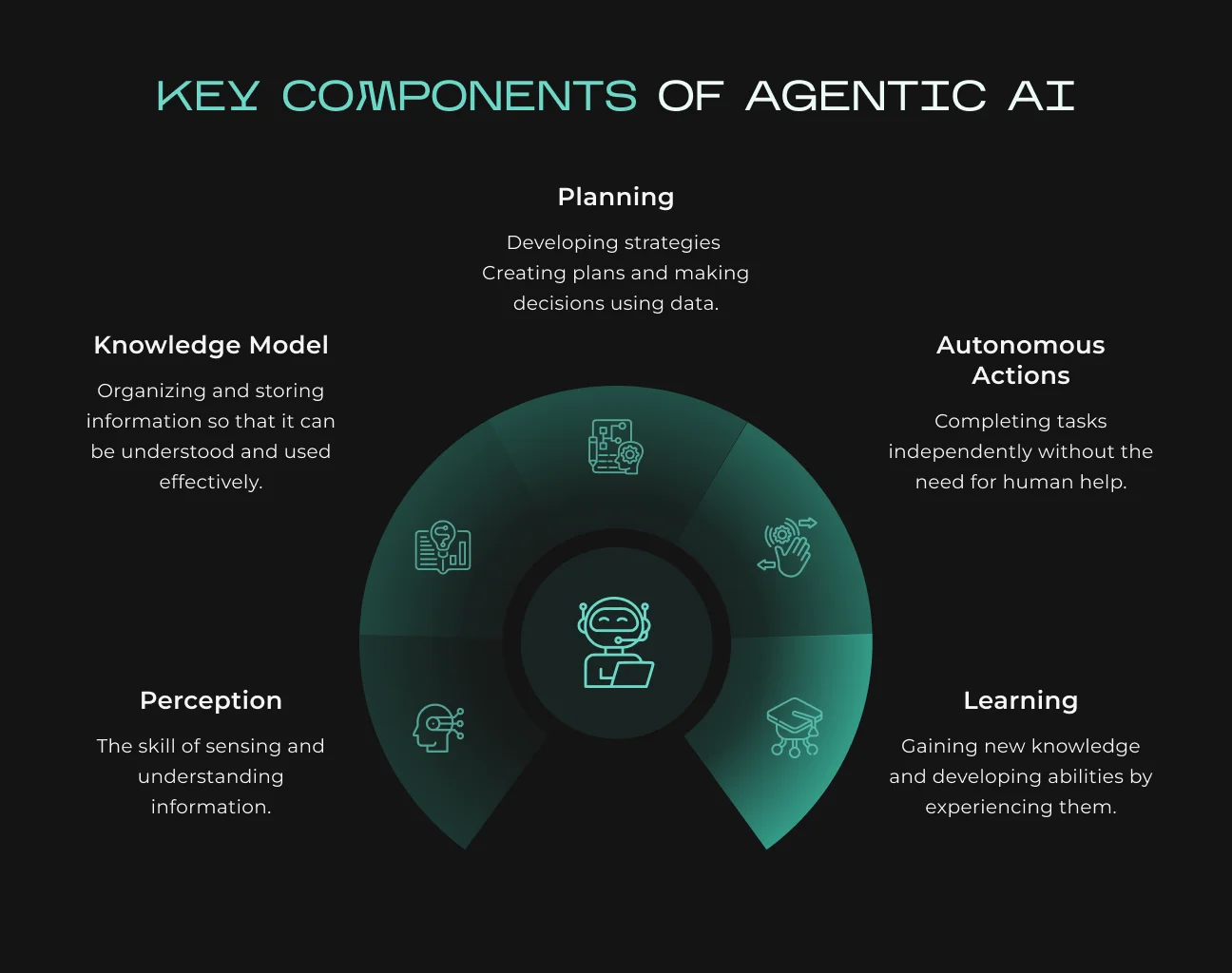
Planning
Reactive agents only respond to immediate stimuli. Planning agents, in contrast, can think ahead and figure out their actions beforehand. This approach works best for AI tasks like controlling autonomous robots, optimizing logistics, and managing schedules.
After gathering information, an AI needs to break down complex issues into smaller, manageable tasks, decide the order of actions, and identify dependent tasks. They do this using logic, machine learning, or set guidelines to find the best approach.
When multiple agents work together or share resources, planning becomes more complicated. Effective planning requires using AI models to predict unexpected events. Without proper strategy, an agent might not achieve long-term goals, improve processes, or adapt to changes.
Reasoning
Not long ago, chatbots used simple rules to make decisions. Modern advanced AI agents can weigh different options, judge their effectiveness, and get better with practice. Their core technology is the reasoning module, which helps them decide what to do by analyzing different factors and using logic or learned strategies. Two popular reasoning frameworks are ReWOO (reasoning without observation) and ReAct (reasoning and action).
Different types of AI agents think in their unique ways. For example:
- Goal-based agents try to meet specific goals and choose actions to get there, but they don't always find the best way;
- Utility-based agents focus on the best possible result by using a utility function to evaluate outcomes.
Basic AI systems work using simple rules, like “if A happens, then do B.” More advanced systems can adapt by using techniques like Bayesian inference, neural networks, or reinforcement learning. They can solve problems in multiple steps, especially in areas like automated financial analysis or legal contract review.
Memory
The memory module helps AI remember and access information and allows it to learn from past interactions and maintain context. It includes:
- Short-term memory for recent conversation details, which helps the AI stay on topic;
- Long-term memory for structured knowledge and historical information used in decision-making.
Good memory management is crucial for customer support bots, recommendation systems, and virtual assistants. Without it, AI can't remember past interactions, forcing users to repeat themselves. In systems with multiple agents, memory allows them to update and share information, which improves teamwork.
Types of Agentic AI
AI agents vary in intelligence, decision-making, and interaction with their environment to reach goals. Some use set rules, while others learn and adapt. Each type has unique strengths and uses, so let's explore them a bit further:
1. Reinforcement Learning Agents
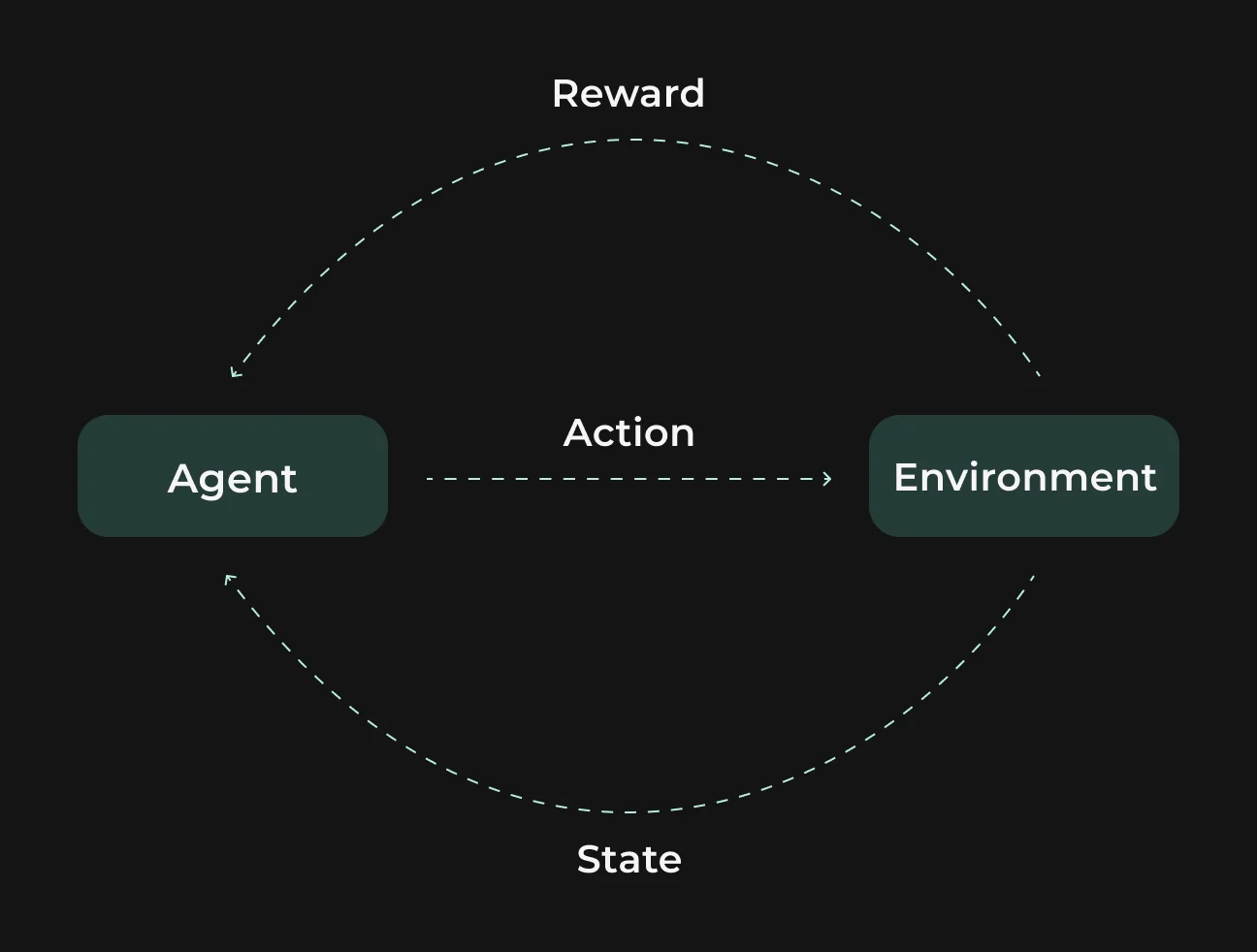
Reinforcement learning agents are software models that learn to make decisions by experiencing different situations and their outcomes. They choose the best actions to take by trying various options and seeing what works best to get the highest rewards.
This learning process helps them develop a plan, known as a policy, that tells them what to do to maximize success. The agent chooses actions that change the environment. The environment then gives rewards: positive ones to encourage actions and negative ones that work as penalties.
2. LLM-Based Agents
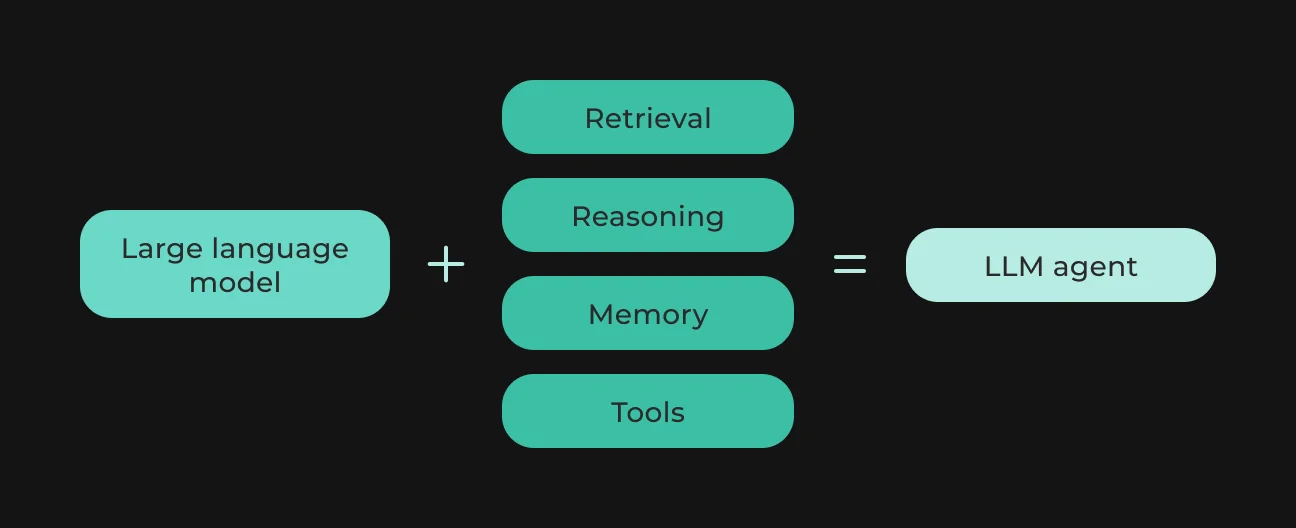
LLM agents are AI systems that create detailed text by reasoning each step. They can predict future steps, recall previous conversations, and adjust their responses using various tools according to the situation and style. These agents use a language model that processes and understands language based on the large dataset it was trained on.
When you work with an LLM agent, you can start with a specific prompt. This prompt guides the agent on how to reply, what tools to use, and what goals to focus on. It's very similar to giving directions to a navigator before your trip starts.
3. Multi-Agent and Orchestration Frameworks
As AI systems advance, there’s a need for coordinated agents that can work in complex real-world situations. Multi-agent collaboration is when different agents work together to achieve a specific goal. Each agent has unique skills and tasks, and by working together, they can solve problems that are too tough for a single agent.
For example, in e-commerce, an AI multi-agent system can manage inventory, set prices, and suggest products to customers.
4. Classic Planning and Symbolic AI
Symbolic AI uses symbols to represent objects, concepts, and their connections. It uses logic and rules to make conclusions. Let's say, if a patient mentions they have a fever, the system checks for further symptoms like difficulty breathing or cough. If these are found, it might suggest the patient has pneumonia.
Symbolic AI agents don’t need a lot of training data like machine learning and deep learning do. They work by reasoning with clear, rule-based knowledge, which makes them perfect for situations where information can be logically explained.
5. Tool-Augmented Reasoning
Tool-augmented reasoning is when an AI uses external tools to improve its problem-solving abilities. It's similar to a technician choosing the right tool from a tool bench.
For example, the AI might use a calculator for math, a browser to look up new information, or a file reader to open documents. This approach helps the AI perform tasks efficiently instead of relying on guesswork.
How Does Agentic AI Work?
Agentic AI involves the use of autonomous software agents that continually learn from data and user interactions. These agents use machine learning and predictive analytics to independently perform tasks and quickly manage agentic AI workflows.
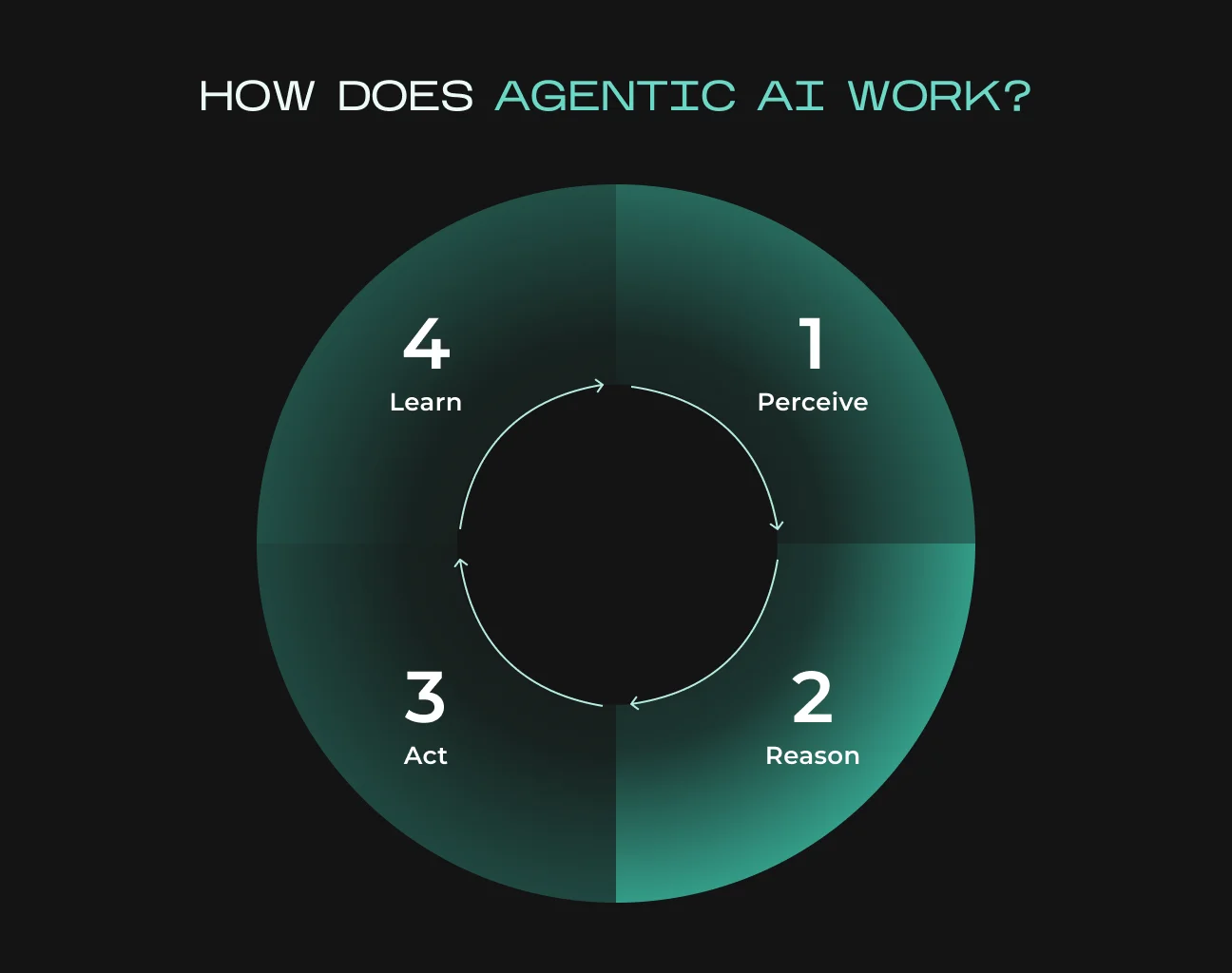
This system is designed to grow without slowing down. It allows numerous agents to work on different servers at the same time that boosts the system's efficiency and reliability. Basically, agentic AI solves tasks through four steps:
- Perceive. AI agents gather information from sources like sensors and databases and analyze it to identify key patterns and insights;
- Reason. A large language model helps understand tasks, develop solutions, and organize specialized models for specific tasks, like creating content or analyzing images;
- Act. Agents use APIs to interact with external systems and complete tasks;
- Learn. Agents improve by learning from feedback, which helps them make better decisions and work more efficiently in the future.
How Does Agentic AI Know What to Do?
There's a clear algorithm that shows how AI can think and act like humans.
- Agentic AI mimics human thinking and actions using a pre-trained model, like GPT-4.
- These models, which form the backbone of intelligent systems, learn language from books and websites. Although they're designed to predict the next word in a sentence rather than act independently, the right prompts can make them seem like they're planning or problem-solving. Yet, they're just generating responses based on their training;
- Agentic AI follows specific instructions in the prompt. For example:
- Write a movie script with characters 'A' and 'B';
- Plan and research developer tools using Wikipedia;
- Write a Facebook ad (125 characters max) to show how our [product] solves a [specific problem].
- AI needs to know what tools to use. It doesn't automatically know how to use tools like search engines or calculators. Developers give AI access to these tools, and it then follows instructions like choosing to search somewhere for information;
- Some AI agents use short-term memory to remember recent interactions, while others store information in databases. Unlike humans, these algorithms don’t actually learn, they only remember what they are programmed to retain;
- Agentic systems have limited autonomy. They don't completely teach themselves or have self-awareness. They rely on a mix of pre-trained AI, prompts, tools, and memory. Their autonomy is actually based on how these elements interact.
We're almost at the point of having fully autonomous AI. Now, AI works like an intelligent assistant that can follow orders, use agentic AI tools, and plan. But developers still need to guide it with instructions, choose the right tools, and set rules for it to follow.
Use Cases of Agentic AI
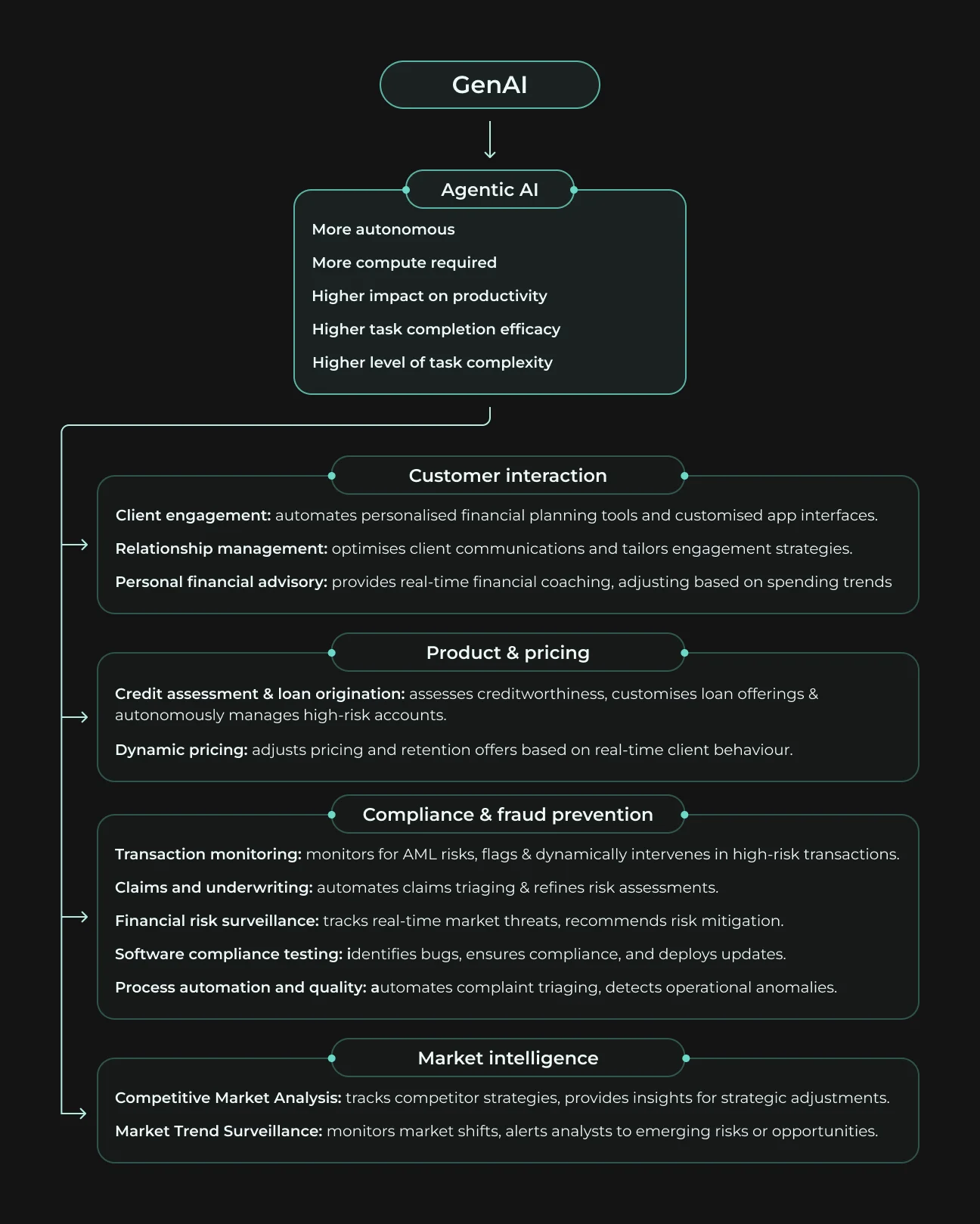
Many industry leaders believe agentic AI can really help businesses streamline workflows, improve decision-making, and automate complex tasks. Here are some agentic AI examples that show how it can change the way we work and run a business.
Customer Service
Businesses need to meet customer expectations by offering fast solutions and personalized help across many channels. Agentic AI is what stands out because it acts as a virtual employee that manages and responds to customer service requests on time. It uses advanced machine learning to understand situations, anticipate customer needs, and complete tasks on its own. By 2030, the agentic AI market in customer service could reach $47.1 billion.
For example, if a customer reports a billing error, a typical chatbot might pass it to a human. While an AI assistant might gather some details for a human to take it over, agentic AI can verify the transaction, identify the mistake, correct it, issue a refund, and update the CRM system. This reduces wait times, minimizes the need for human assistance, and provides faster, more efficient solutions.
Healthcare
Agentic AI delivers tailored treatments by examining each patient's individual data, including genetic profiles, medical history, and current health information. This helps doctors suggest the best therapies, like chemotherapy, radiation, or surgery, for each person.
These AI-driven recommendations have increased survival rates by 20% and extended the time patients live without disease progression by 15%.
Besides, agentic AI helps minimize administrative tasks in healthcare, giving more time for patient care. As a digital assistant, it can automatically transcribe doctor-patient conversations into clinical notes, schedule follow-up appointments, or retrieve relevant patient information during consultations.
Workflow Management
AI agents provide great flexibility to businesses by creating plans, tracking progress, and adjusting methods to perform tasks. They perfectly work for both complex and repetitive jobs, like report generation, which requires time and resources. In finance, for example, AI agents can speed up invoice processing and approval management, reducing delays.
In logistics, agentic AI companies can optimize delivery routes and schedules based on real-time traffic and shipment priorities. This makes them particularly useful for managing growing workloads.
Financial Risk Management
Financial institutions keep and manage large amounts of data, like transactions and customer records. Traditional AI requires constant supervision of this data, but agentic AI offers a whole new approach.
It can independently analyze market data, monitor trends, interpret signals, adjust strategies, and manage risks in real time.
Agentic AI can achieve this by linking tools via sensors and APIs, employing advanced reasoning to adapt to new information. It automates financial tasks that traditional AI can't, like rapidly updating risk assessments when new threats emerge. For example, a fintech company might use agentic AI to monitor market changes and automatically update portfolio allocations.
Software Engineering
Agentic AI can truly make developers more productive by generating high-quality and efficient code. It uses pre-trained models and natural language processing to convert project specifications into efficient code that meets best practices and standards.
Agentic AI helps IT project managers predict resource needs and identify potential issues, letting them make better decisions and complete projects on time.
Agentic AI is also great at debugging. It can quickly check code, find errors, and suggest precise fixes, which makes it much faster than traditional methods. It can even identify issues like memory leaks or runtime errors in large systems during development.
Content Creation
Traditional personalization methods are a bit limited because they rely on restricted data or set rules. Agentic AI, on the other hand, uses extensive data to create truly personalized experiences. It can offer content like product recommendations, emails, or ads that match each customer's preferences.
Agentic AI tailors marketing messages based on how we interact with a brand. For example, if someone leaves items in their cart, the AI might send a reminder or offer to prompt a purchase. If a person seems interested in an ad, the AI can change the content to fit them better.
In gaming, companies like Ubisoft and Epic Games use agentic AI to create side quests, item descriptions, dialogues, and NPC behaviors that evolve with the game's environment and player actions. Experts believe that 60% of side content in major games will be developed this way, reducing costs and making games more immersive.
Education
AI agents use data on student behavior, goals, and academic status to interact effectively. These intelligent systems track each student's performance using analytics and adaptive algorithms, considering factors like test scores to personalize learning. For example, if a student finds a topic difficult, the system can recommend extra materials, practice exercises, or alternative explanations to help.
AI agents also connect with university systems (LMS, CRM, HR, etc.) to automate tasks like answering financial questions, managing documents, providing IT support, and registration. This results in quicker solutions, reduces admin work for staff, and improves the student experience.
Challenges of Agentic AI
AI agents can certainly make work more efficient, minimize costs, and let developers focus on more significant projects. However, they still have challenges. For example, protecting these systems isn't just about standard data protection.
Multi-factor authentication often isn't enough to secure them without disrupting their functions. Businesses must understand and address these security and reliability issues before using AI agents. Let’s take a look at the key challenges faced by most companies.
Ensuring System Reliability
Standard software follows strict step-by-step instructions, while agentic AI works more independently, deciding how to achieve its goals on its own. This independence boosts efficiency and scalability, but it can also be unpredictable, as the AI might take unexpected approaches to find solutions.
This isn't an entirely new idea. Early generative AI like ChatGPT sometimes produced random or inconsistent answers, but they improved over time through techniques like human feedback loops.
To make agentic AI more predictable, we need similar efforts and investments. The technology must consistently deliver reliable results to be truly useful and efficient.
Getting High-Quality and Relevant Data
Agentic AI can function effectively only if it has accurate data. Many AI models have trouble because they lack access to real-time, high-quality data, often because of issues with the data itself or the systems that provide it.
Developers can use Apache Kafka or Kafka Connect to merge data from various sources, while Apache Flink helps these models communicate with each other. Agentic AI systems can only succeed, reduce mistakes, and deliver accurate results when they have reliable and current data.
Ensuring the Security and Privacy of Data
AI agents often access different systems and sensitive information, so organizations must know how to protect data privacy and security. Like generative AI, these agents might accidentally cause risks like data breaches or attacks.
Companies should separate their data and use strong segmentation to keep data safe. They also need to make sensitive information anonymous by removing personal details before entering it into systems.
For example, if a bank uses AI to manage customer requests, they should anonymize transaction details to protect this data.
Making Model Reasoning and Understanding Better
Agentic AI systems consist of several agents that collaborate to make the right decisions. For example, one agent creates a strategy, while the others evaluate and refine actions. This teamwork forms a feedback loop, helping each agent improve its decision-making abilities.
However, these systems require training with a large amount of data that mirrors real-world complexities to be effective. Typically, they run many iterations and simulate thousands of scenarios to help the model make accurate decisions.
Finding the Right Talents
Exploring agentic AI is like entering new ground for many businesses. They need to invest in new hardware and build a modern data system for running quick and long-term storage. Developing an AI model in-house requires hiring people with the right skills or training existing employees. ROI might be slow in such cases, especially for those who start early.
Of course, adopting this technology might be challenging, but it’s worth the effort. Success depends on investing in quality data, strong security, and the right infrastructure. With these, AI can help grow your business and significantly improve efficiency.
Agentic AI opens remarkable opportunities, but real value comes only when reliability, data quality, and security mature together. Too many companies rush ahead without reinforcing these foundations. When we pair autonomous workflows with strong governance and robust infrastructure, we unlock systems that accelerate innovation instead of amplifying risk.

Max Tatarchenko
Agentic AI vs Generative AI
Let's talk about the difference between agentic AI and generative AI. Generative AI produces new content, like text and images, according to what the user requests. It uses deep learning models and algorithms that work like the human brain.
Agentic AI can make its own decisions and work with minimal oversight. It uses technologies like natural language processing, machine learning, and reinforcement learning. Unlike generative AI, which responds to user commands, agentic AI takes the initiative to achieve its goals.
Take a look at the comparison of the key elements below.
Agentic AI | Generative AI | |
Key features |
|
|
Use cases |
|
|
Future Trends of Agentic AI
With the rapid development of AI, we're looking at a future where agentic AI can answer more complex questions and problems than today's customer service chatbots. This new AI will likely use a mix of voice, video, and text for communication.
In cybersecurity, AI can help experts by automating most of their tasks, like identifying attacks, generating reports, and improving security, which could reduce their workload by up to 90%.
Startups are developing AI tools to quickly check company policies and documents for compliance. These tools can help professionals by pointing out specific regulations and offering proactive insights.
By 2028, 75% of enterprise software engineers are likely to use AI. These AI tools can do more than write and finish code. They will work alongside developers to brainstorm, improve code quality, and help them learn new programming skills.
These examples show just a bit of what agentic AI can do. By 2027, it's expected that half of AI-using companies will be experimenting with agentic AI technology. In recent years, investors have poured over $2 billion into startups focused on agentic AI solutions.
Partner with SapientPro to Build Your Agentic AI Solution
SapientPro's tech experts have over 8 years of experience in AI development. We focus on areas like NLP, computer vision, chatbots, and call centers to improve your business processes and increase profits. We tailor AI to meet your unique needs, ensuring lasting benefits.
Contact us to discuss your project and develop an AI solution that makes a real difference in your industry.
Start building your AI solutions with SapientPro