
All How to Build AI-Based Demand Planning Software for Forecasting and Sales in 2026
January 25, 202615 min read


Businesses around the world are shifting toward using AI-powered demand planning software. Why? It can help them anticipate customer demand with far greater speed and accuracy than traditional methods.
This guide will walk through everything you need to know about AI demand planning software.
Key Takeaways
- Idaho Forest Group used AI-powered improvements to reduce forecasting time from more than 80 hours to under 15;
- McKinsey Research has stated that better forecast accuracy through AI means 10-40% less warehousing and logistics expenses;
- Walmart made digital twins for 1,700+ stores, using simulations to test display layouts and improve sales performance before investing in physical changes;
- Walmart enriched its 850 million product listings using GenAI 100× faster than manual edits to improve search and recommendation quality;
- 88% of retail executives say demand forecasting is one of the key areas where they plan to leverage AI to improve performance.
What Is AI Demand Planning Software?
AI demand planning software is a high-intelligence system that integrates machine learning, predictive analytics, and real-time data processing to anticipate future market needs.
Unlike traditional planning, which relies on static historical data and manual adjustments, AI-based demand forecasting acts as an autonomous control tower for your supply chain.
It provides a two-fold solution:
- AI forecasting: identifying what will be needed, when, and where by analyzing complex, non-linear variables.
- Strategic planning: translating those predictions into actionable schedules for production, procurement, and logistics.
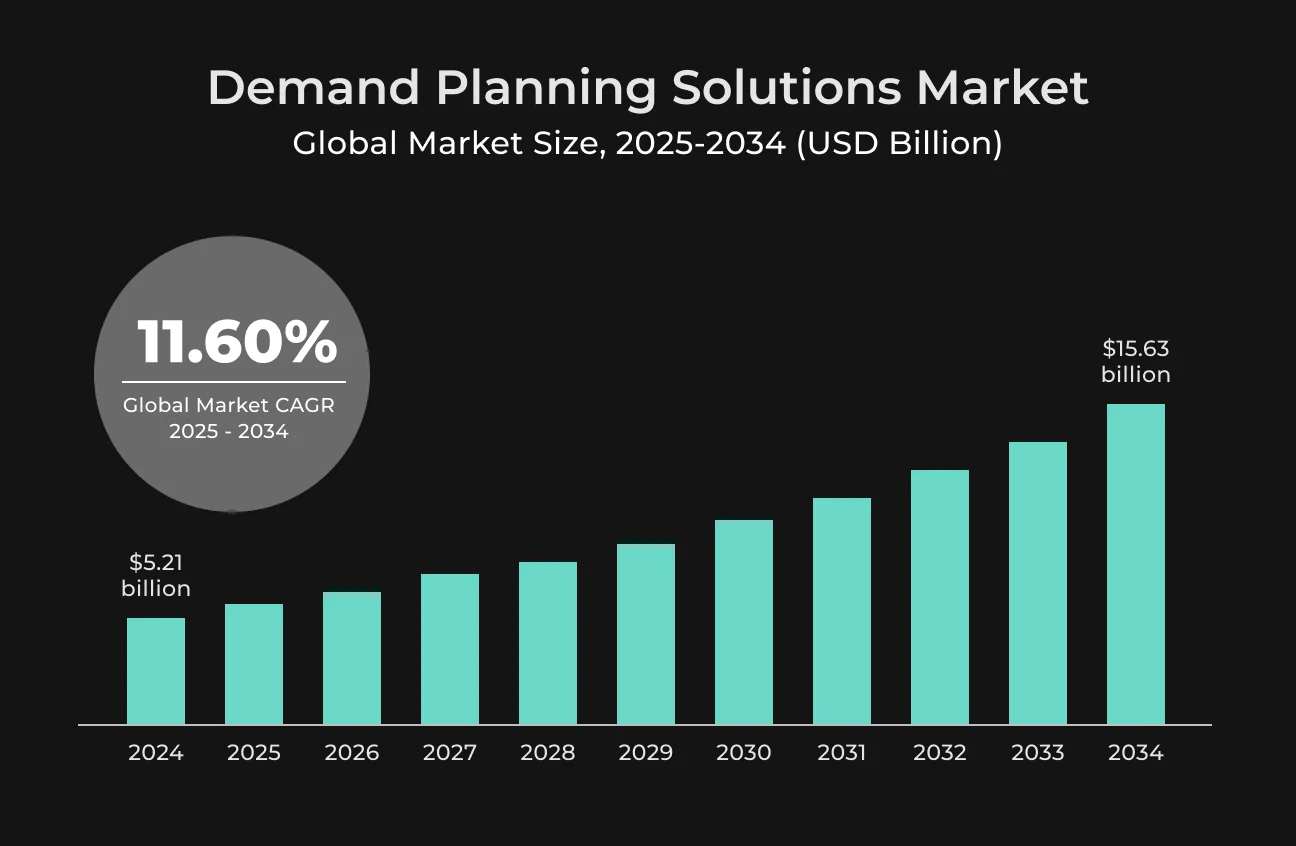
Traditional planning often struggles with "noise"—unexpected disruptions like shipping delays or sudden viral trends. AI-driven systems eliminate this by processing thousands of data points simultaneously.
Feature | Traditional Planning | AI Demand Planning |
| Data Focus | Purely historical sales data. | Historical + real-time + external signals. |
| Adaptability | Reactive; relies on manual updates. | Proactive; adjusts in real time to disruptions. |
| Granularity | Broad estimates (e.g., regional). | Hyper-local (e.g., store-level or SKU-level). |
| Accuracy | Prone to human bias and lag. | 20–50% reduction in errors via ML algorithms. |
How AI Demand Planning & Forecasting Works
Implementing AI within demand forecasting is a step-by-step process that demonstrates a data-to-decision pipeline. Here is how demand forecasting with machine learning is carried out.
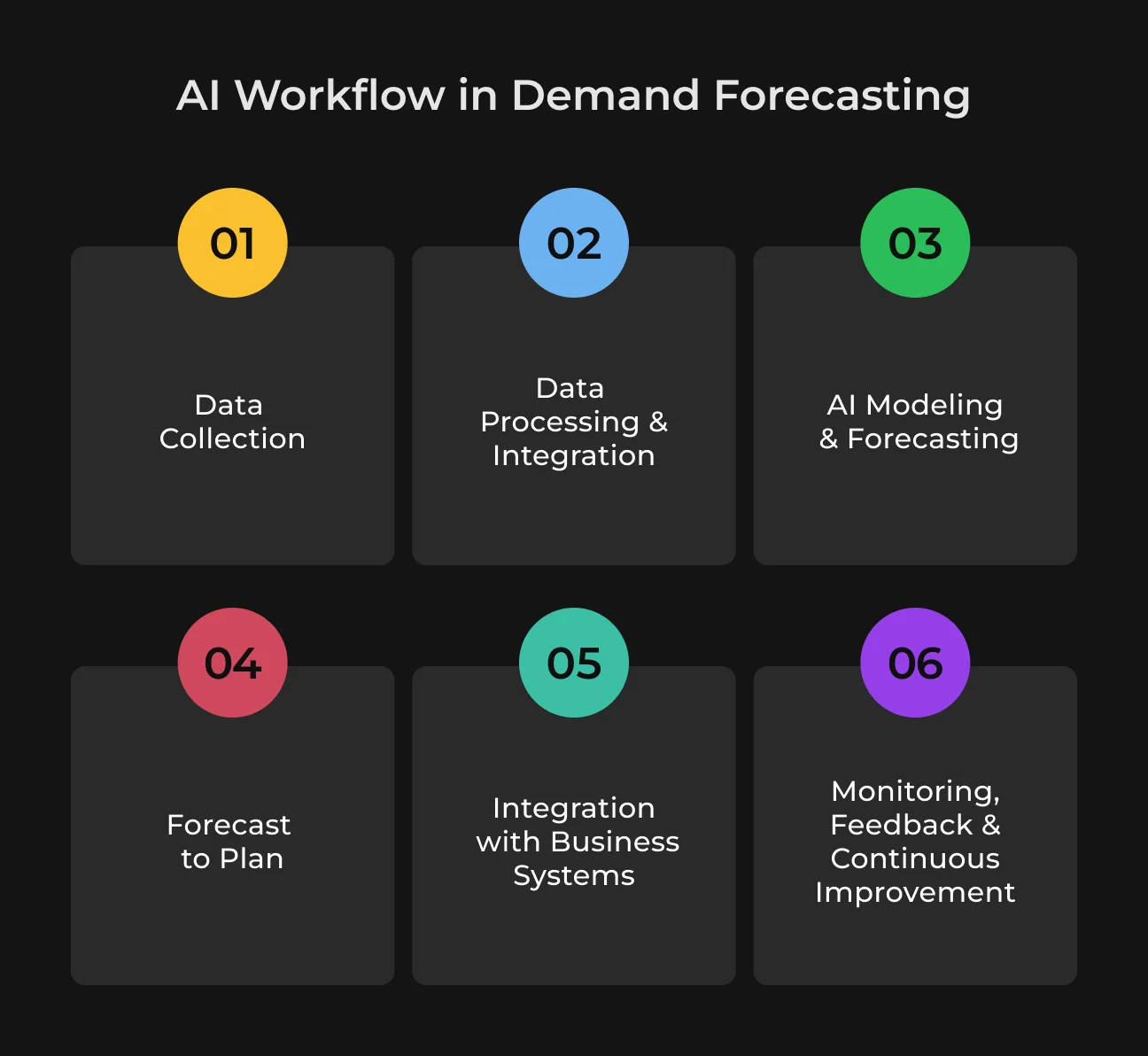
Step 1: Data Collection
Every AI initiative starts with data. The system first gathers a wealth of varied signals from inside and outside your organization.
Internal streams of data are:
- Your previous sales transactions;
- Inventory levels;
- Purchase orders;
- Any other appropriate operational data, such as point-of-sale data or web visits.
External streams of data add useful context:
- Market patterns;
- Economic data;
- Competitor prices;
- Weather patterns;
- Social opinion about products.
The more relevant the information, the more the AI will be capable to learn demand patterns.
Step 2: Data Processing & Integration
Raw data is often fragmented and inconsistent, containing duplicates, gaps, or formatting errors. In this phase, diverse feeds are cleaned and consolidated into a unified, high-integrity database. This transformation ensures the AI has a reliable foundation for generating accurate forecasts.
Engineers focus on resolving missing values, removing outliers, and normalizing disparate units or terminology. Frequent update cycles are established to maintain data freshness and relevance. This process eliminates "data silos" and ensures the model operates on real-time information.
The ultimate goal is to create a "single source of truth" for the entire organization. By centralizing high-quality data, the AI-based demand forecasting model can produce precise, actionable insights. This architectural clarity prevents the "garbage in, garbage out" cycle common in legacy systems.
Step 3: AI Modeling & Forecasting
With a clean data foundation, the machine learning demand forecasting phase begins. Data scientists select specialized AI models and train them on historical data to identify complex patterns that traditional tools miss.
This process uses a blend of time-series analysis and advanced neural networks to capture non-linear relationships. The model analyzes years of sales history alongside external variables to understand deep correlations.
For example, the AI might discover that a specific temperature drop combined with a weekend promotion increases online sales by precisely 15%. These nuanced insights allow the system to move beyond simple averages.
The training phase is iterative, constantly refining the algorithms to improve predictive accuracy. By recognizing these hidden drivers, the system transforms historical data into a forward-looking map of consumer behavior. This allows businesses to anticipate market shifts before they occur.
Step 4: Forecast to Plan
The AI planning engine serves as the bridge between raw predictions and operational execution. Once the AI generates a forecast, it applies optimization routines and pre-defined business rules to recommend specific actions.
This transforms a passive data point into a proactive strategy, such as shifting inventory to high-demand regions or triggering manufacturing runs. If the demand for a product is forecast to double in the next month, the software can suggest actions like:
- Increase the next buy order by 100%;
- Transfer inventory from low-demand to high-demand locations;
- Schedule extra manufacturing runs;
- Adjust price/promotions to capitalize on or even out the spike.
To ensure recommendations are realistic, the system integrates your specific operational constraints. It factors in supplier lead times, minimum order quantities, and warehouse capacity before suggesting a move. This ensures that the AI's ideal plan is fully compatible with your physical and financial limitations.
In advanced implementations, routine decisions—such as reordering stock within budget limits—are handled autonomously. This automation reduces the administrative burden on your team while maintaining high accuracy.
By acting on signals in real time, the AI demand forecasting software minimizes stockouts and optimizes capital allocation without manual intervention.
Step 5: Integration with Business Systems
Seamless integration is achieved through an API-first architecture or specialized middleware that facilitates bidirectional data flow with legacy systems. This design allows the AI module to slot into your existing IT ecosystem without requiring a costly infrastructure overhaul.
By connecting directly to ERP and CRM platforms, the software ensures insights drive immediate operational change.
To build organizational trust, many implementations utilize a human-in-the-loop model. Planners can review the rationale behind specific AI recommendations—such as a 25% inventory increase—and approve them via an auditable interface.
This transparency ensures that every decision is logged and justified, providing a clear trail for compliance and strategy refinement.
As confidence in the system grows, businesses can transition from manual approvals to full automation for routine tasks. This deep integration prevents AI insights from becoming siloed in static reports.
Instead, demand planning machine learning insights become a dynamic & streamlined process that actively optimizes the supply chain in real time.
Step 6: Monitoring, Feedback & Continuous Improvement
AI in demand planning is not a "set and forget" tool-markets change. Consumer behavior evolves, and models can drift if not updated. Companies need to track the model's accuracy over time:
- How did last month's forecasts compare to actual sales?
- Are certain products or locations consistently off?
Key performance indicators such as mean absolute error or forecast bias can be monitored. When discrepancies arise beyond acceptable thresholds, that is the signal to retrain or tweak the model.
Benefits of AI Demand Planning Software
Adopting AI in demand forecasting can yield substantial benefits across your company’s operations.
Improved Forecasting Accuracy
Identifying complex patterns leads to more precise forecasts. For example, Idaho Forest Group used AI-powered improvements to reduce forecasting time from more than 80 hours to under 15. They avoid lost sales and unnecessary excess inventory holding costs.
Optimized Inventory and Cost Savings
With machine learning demand forecasting, businesses avoid overstocking. This ties up capital and increases costs of storage and understocking, which leads to expensive rush orders and lost sales.
McKinsey Research has stated that better forecast accuracy through AI means 10-40% less warehousing and logistics expenses. Fewer emergency restocks, optimized reorder points, and better production planning all drive cost efficiency.
Higher Service Levels & Customer Satisfaction
AI for demand forecasting directly improves customer service metrics. By minimizing stockouts and avoiding long backorder waits, companies ensure they can regularly meet customer demands.
For example, Walmart made digital twins for 1,700+ stores, using simulations to test display layouts and improve sales performance before investing in physical changes. Smart design keeps customers engaged longer. Engaged customers spend more money.
Operational Efficiency & Automation
AI demand planning software automates much of the repetitive forecasting and planning work that consumes many hours of analysts' time. Planners and supply chain managers are no longer spending a lot of time creating reports but rather working on strategic problem-solving.
For example, Walmart enriched its 850 million product listings using GenAI 100× faster than manual edits to improve search and recommendation quality.
Production schedules, ordering, and distribution can all be orchestrated by the AI. It can make sure everything runs as smoothly as possible with less firefighting. This provides greater efficiency by reducing last-minute expedited orders or emergency stock transfers, because the AI forecasted the needs right.
Use Cases AI in Demand Forecasting
Below are 3 prominent use cases and examples of AI in demand forecasting.
Retail and E-Commerce
Retailers use AI demand forecasting to predict customer demand at a granular level by:
- Store;
- SKU;
- Day, etc.
In fact, 88% of retail executives say demand forecasting is one of the key areas where they plan to leverage AI to improve performance.
For example, Walmart implemented AI-powered demand forecasting that analyzes factors like local weather and events alongside sales data, which improved forecast accuracy and cut stockouts by about 30%.
Target uses AI across more than 40% of SKUs, making billions of weekly SKU-level predictions to optimize assortment per store.
Food and Beverage
Food retailers, restaurants, and beverage companies are using AI-based demand forecasting to tackle the complexities of perishable goods and shifting consumer tastes. AI can catch the early signal.
Grocery stores use machine learning demand forecasting for seasonal products, such as predicting ice cream demand spikes during heat waves and ensuring optimal stocking of such products.
Manufacturing
Traditionally, production planning relied on forecasts that couldn’t adapt quickly to changes. This led to overproduction or stockouts of components.
Now, AI-driven demand forecasting allows manufacturers to anticipate demand fluctuations and adjust their operations proactively.
7 Steps to Implement AI Demand Planning into Your Workflow
Here is the general roadmap with steps to incorporate machine learning for demand forecasting.
Step 1: Assess Current Systems and Data Readiness
Analyze your current tech stack and data environment. Make a list of the systems used during the demand planning process. They can be:
- ERP;
- CRM;
- POS;
- WMS;
- OMS, etc.
This stage uncovers aspects that must first be addressed before applying AI.
Step 2: Identify Pilot Use Cases with High Impact
Identify a use case or two that has a great impact with limited risk. Use that as a starting point to pilot demand forecasting using machine learning. Make a list of the options based on factors such as:
- Business impact;
- Availability of data;
- Complexity of integration.
Then, select a business case where AI can deliver immediate and demonstrable ROI.
Step 3: Creating a Strong Foundation of Data (Pipelines, Integration, and Cleaning)
Now, interlink all the sources of related data into a common storehouse – whether that's a data warehouse, a data lake, or even a real-time pipeline solution.
For instance, if the sales-related data resides in the ERP system and the marketing-related information resides in another CRM solution, develop the ability to merge them together.
While doing the above, standardize data formats. User IDs and product IDs should match across sources.
Next, clean the data thoroughly. Remove the duplicates, impute or highlight the missing information, and correct errors. Automate processes for updating the information so that the AI model can work with the latest available information instead of outdated information.
Step 4. Develop the AI Model and Planning Engine
Here, the first thing to accomplish is the design and development of the actual demand forecast model based on the processed data. The data will be used to create a training set and a test set. For feature engineering:
- Identify the input features the model should use, like sales history, promotions, and weather patterns;
- Develop additional derived features, for example, moving averages, day-of-week flags;
- Develop multiple models for each set, for example, for stable vs. highly seasonal product classes.
AI-driven demand forecasting evaluations can be carried out based on traditional measures such as MAPE or Root Mean Squared Error.
When a model has been identified as accurate to the required specifications, the actual implementation phase involving the incorporation of the AI component with planning engines will begin.
Step 5: Integrate the AI Solution into Daily Operations
The application aspect of this phase revolves around implementing the solution and interfacing it with the end-user tools and processes. In this regard, the first aspect would involve incorporating the AI output results into the systems mentioned in Step 1.
Here, you can create a basic dashboard/interface where the planning team can view the AI forecasts and recommendations directly in the tools/planning systems they already use.
Importantly, implement the human-in-the-loop process: the AI can share the recommendations, but the planning team can agree to or decide not to implement them.
6. Pilot Rollout, Monitor Results, and Refine
When implementing AI in demand planning for the first time, treat this as a pilot and track the results. Test the solution in the limited capacity selected (identified in Step 2) for the full business cycle (for example, a few months or a season).
Monitor:
- Measures such as the forecast error (comparison between the prediction and actual consumption);
- Service level (stock-out rate and fill rate);
- Inventory turns;
- Cost changes, etc.
If the aim has been a 25% stock-out reduction, are things going as planned?
7. Scale Up and Institutionalize AI Demand Planning
On the back of a successful pilot implementation, plan the rollout of the machine learning demand forecasting to more products, geographies, or business units. Rollout should happen in phases.
For example, rollout can happen one product category or geography at a time instead of the whole company at once.
3 Main Challenges in Developing AI-Powered Demand Forecasting Software
Investing in AI for demand forecasting can be quite rewarding. Still, challenges present.
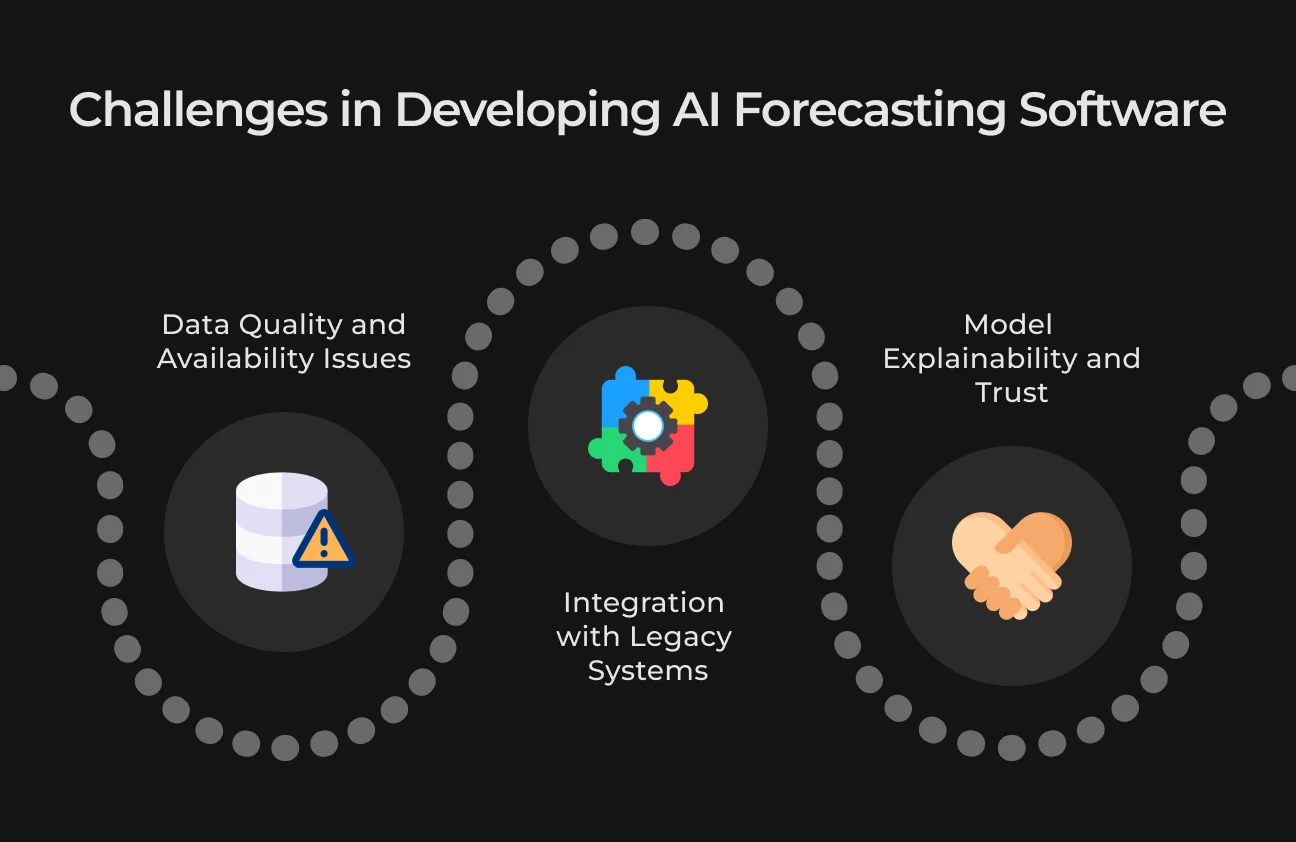
Data Quality and Availability Issues
Most companies have fragmented, inaccurate, or incomplete data for their AI-driven demand forecasting models. Suppose your historical sales data is incomplete or riddled with errors, and your external data sources are unreliable or biased. Then, the AI forecast will likely be flawed.
Before even starting to develop AI for demand forecasting, businesses often need to invest in data cleaning and integration work:
- Standardizing data across systems;
- Filling gaps or choosing a strategy to handle missing data;
- Continually updating data so that it's current.
The challenge is that these tasks can be pretty labor-intensive. Still, shortcutting them will almost certainly yield an AI that offers no better insight than a human guess.
Integration with Legacy Systems
Most enterprises have a host of legacy IT systems running business-critical operations: ERP, supply chain management, warehouse systems, etc. Integrating a new AI planning engine with these legacy systems is tricky.
Legacy software may not support modern APIs or may use outdated data formats that make it difficult for the AI system to fetch the data it needs or to push its outputs back in.
Moreover, data might be trapped in silos. For example, your online sales platform data might not naturally merge with your retail store sales data. The challenge is building interfaces and connectors without disrupting existing processes.
Model Explainability and Trust
If AI predicts a 30% fall in demand next month but cannot explain it, then decision-makers may dismiss the prediction or feel uncomfortable acting upon it.
One of the main barriers to using AI is building trust in it. People first need to get confidence from the model's suggestions, matching reality and, where possible, understand the drivers behind those suggestions.
Partner with SapientPro to Build AI-Powered Demand Forecasting Software for Your Industry
Your ideal partner in transforming forecasting and planning with custom AI solutions is SapientPro. We focus on openness and collaboration in our work. You will receive timely updates, see early prototypes, and have a voice at every stage. Let us help you develop AI demand forecasting software!
Building an AI demand planning tools requires extensive knowledge in the usage of algorithms, models, and related technologies. SapientPro’s experts have 9+ years of experience in the niche, supporting clients with development and integration from A to Z.
Check out our previous case studies:
- Optimizing Safety Data Sheets with AI Automation
- AI Solution for Efficient CV Processing at Scale
- Dialect-Sensitive AI Voice Assistant
Contact us to get a detailed estimate and start building your software now!
Build Your Software with SapientPro
You'll partner with tech experts who know how to implement AI in your business.

FAQ
1. What is the minimum required data volume and quality to train an accurate and reliable AI demand forecasting model?
Reliable AI demand forecasting typically requires 18-24 months of historical data to accurately identify seasonal patterns. High quality is non-negotiable; your dataset must be clean, consistent, and free of gaps.
You can use the "bananas & monkeys" example: If you only see monkeys eating 10 bananas on a sunny Monday, you might assume they always want 10.
But with two years of data, the AI learns that when it rains (external factor), monkeys stay inside and eat zero bananas, preventing you from overstocking during a storm.
SapientPro engineers handle this case by case: in our initial consultations, we audit your data to determine if it's sufficient and identify any cleaning or enrichment needed.
2. What is the best technology stack for the AI planning engine, and how can it integrate with existing ERP, POS, and WMS legacy systems?
An AI demand planning engine will consist of:
- Model development language/platform, usually Python with frameworks like TensorFlow, PyTorch, or scikit-learn;
- Database or data lake to store large datasets, for example, SQL databases, cloud data warehouses, or Hadoop/Spark for big data;
- Forecasting framework or an AutoML tool if you desire automated model selection.
For the AI demand planning engine, one may use optimization libraries (Google OR-Tools or linear programming solutions) or custom business rule engines on top of the forecasts. Integration is usually through APIs or intermediate data exchanges.
If your ERP is modern and supports RESTful APIs or web services, the AI engine can push forecasts or order recommendations directly into the ERP through those endpoints.
SapientPro’s team will pick stack components that best fit your IT environment, and, importantly, we don't let the AI demand forecasting software sit in a silo.
3. How is model accuracy measured, and how to deal with the “black box” problem?
Model accuracy in demand forecasting is typically measured utilizing metrics like Mean Absolute Error (MAE), Root Mean Square Error (RMSE), and Mean Absolute Percentage Error (MAPE).
A second accuracy dimension is bias – observing if the model tends to under-forecast or over-forecast systematically, a difference that firms care about since bias in one direction will have the effect of leading to stockouts or too much inventory regularly.
Resolving the "black box" problem is extremely important for user acceptance. The majority of state-of-the-art AI models (e.g., deep neural networks) are not readily interpretable – they might consider hundreds of variables in nonlinear interactions.
To mitigate this, we employ explainability and transparency measures. We, for example, run SHAP (Shapley Additive Explanations) or LIME on the model, which are techniques that help determine which input features were most influential for a given prediction.

