All How to Use GenAI for Product Design in 2026
January 21, 202615 min read


To create products that meet user needs, you should think about design. Great designs help companies stand out and bring in more customers. Generative AI is becoming a truly transformative tool that improves how businesses run and develop products.
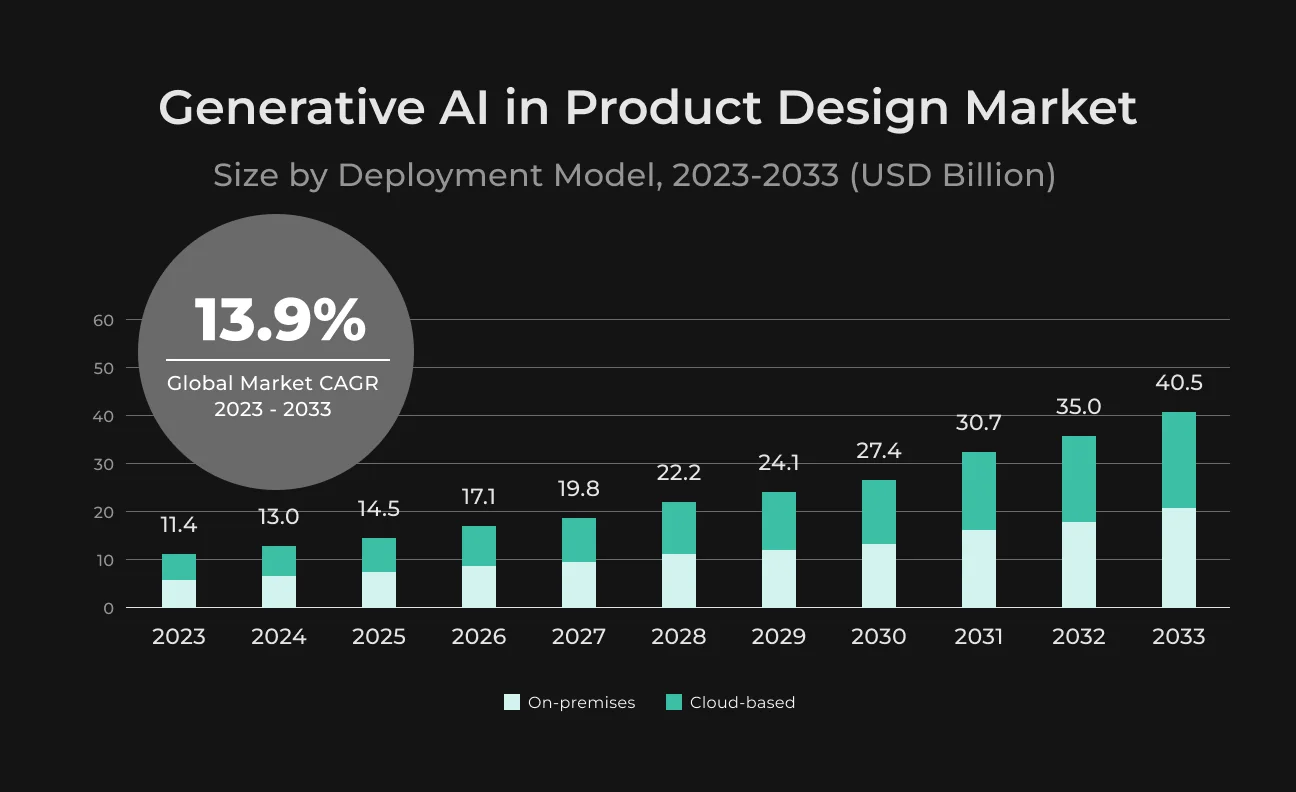
Generative AI product design was worth $11.4 billion in 2023 and is expected to go up to $40.5 billion by 2033. Also, this tech could bring $60 billion in productivity boosts just in product research and design.
Check out this article from SapientPro's experts to learn how generative AI can be a breakthrough for product design prototyping.
Key Takeaways
- Generative AI in product design can minimize development time by over 70%;
- Designers now effectively use AI to understand user feelings and make accurate creative choices;
- In graphic design, 56% of designers leverage AI to develop concepts, which saves them approximately 8 hours per project;
- The main concern with using generative AI in product design is protecting data privacy, as AI needs large amounts of data.
Why Should You Use Generative AI for Product Design?
Generative AI is now key in product development and design — it offers benefits that conventional methods just can't match. Generative AI in product design can minimize development time by over 70%. This gives teams extra time to test with consumers, refine designs, secure suppliers, and ensure products are both producible and environmentally friendly.
Commonly, transforming a product design idea into a prototype took weeks or even months.
Now, AI accelerates this process, completing tasks in days or hours, which allows for more trial and error. In graphic design alone 56% of designers leverage AI to develop concepts, saving approximately 8 hours per project.
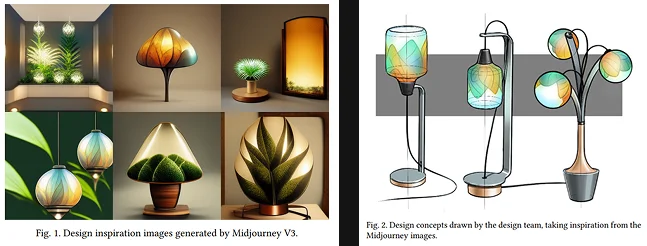
In product design, the goal is to get a product idea. While AI-generated images might not always be flawless, they are a great source of inspiration. Designer Tom Gernetzke, for example, used AI images to inspire his sketches for new lamp designs.
Generative AI also checks out data and user feedback to offer smart design tips. It helps teams figure out what users want and how products are performing, so they can adjust designs before making prototypes.
This technology takes care of tedious calculations and simulations and lets designers focus more on being creative and strategic.
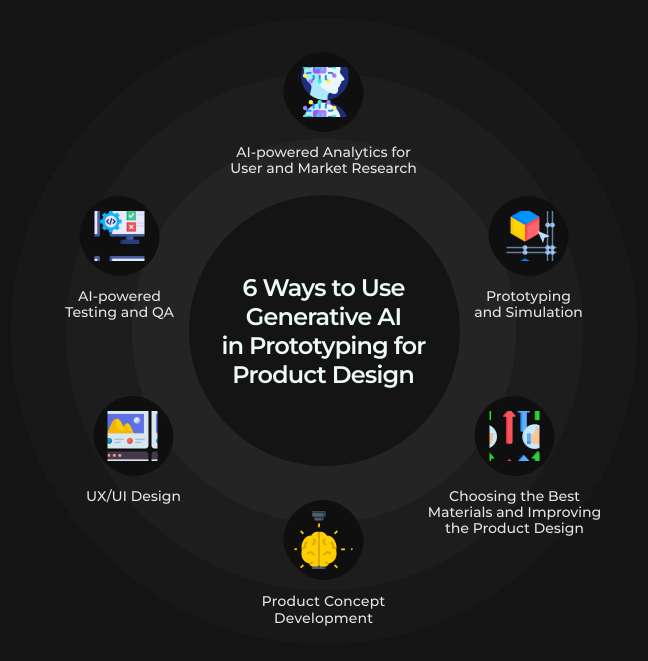
6 Ways to Use Generative AI in Product Design Prototyping
Designers usually follow several main steps when designing or redesigning products. They begin with market and user research, and then move on to concept testing.
Generative AI can make these stages much more efficient. It helps designers generate new ideas and then test them quickly.
Here’s more on how to use generative AI in product design.
1. AI-Based Analytics For User and Market Research
You need to use predictive analytics to avoid creating a product that no one wants. Basically, 65% of early adopters and 58% of planners use generative AI to quickly respond to market changes and shape their strategies. By sorting through data like sales numbers and online reviews, AI helps designers understand what customers want now and what they might want in the future.
Designers now effectively use AI to understand user feelings and make accurate creative choices. Since AI analyzes a lot of data, it leads to less guessing and more designing of products that people really want.
2. Product Concept Development
Technology can make realistic images from expert prompts to inspire new ideas. Designers can combine these tools with sketches and insights to speed up product development. However, experienced designers are still crucial to polishing these creations so they align with the company’s vision and are ready for rollout.
Like CAD or 3D printing, generative AI helps designers save time by automatically generating concept images and mood boards. For example, industrial designers can enter specifications and quickly explore design options without testing each idea manually.
3. Prototyping and Simulation
Creating prototypes often takes a lot of time and resources. AI can help by managing simulations and usability tests. This means your product can hit the market faster than you expect, and sketches can easily turn into 3D models.
Gen AI also identifies potential issues before designers do. You’ll just get product performance forecasts without the need to test on actual users.
4. The Impact of AI on UX/UI Design
AI tools track where users click, creating more user-friendly product interfaces. With heatmaps and click patterns, AI automates UX/UI design and makes everything more intuitive. AI is used by 53% of UX/UI designers to analyze user behavior, which leads to improved interface designs.
AI also personalizes user experiences by responding to what users want and sticking to brand guidelines.
5. Choosing the Best Materials and Improving Product Design
In industries like healthcare or automotive, choosing the right materials is extremely important. AI examines material properties, providing efficiency and strength. Designers receive quick suggestions for making more sustainable and smarter choices that cut weight and cost while improving performance.
Integrating AI in structural analysis means designers can save resources and drive innovations.
6. AI-Powered Testing and QA
Gen AI gives product testing a big boost. It predicts design flaws, makes products last longer, and mimics real-life usage.
With generative AI models, companies can identify design weaknesses, strengthen products, and adjust everything before production. This leads to better products and fewer recalls.
Challenges in Using Generative AI for Product Design
Generative AI is what can really boost product design, but it also has some burdens. Let's look at these challenges and ways to overcome them.
Concerns About Data Privacy
Probably the biggest concern with using generative AI in product design is keeping data private. AI needs loads of data to do everything correctly, but this can put sensitive information at risk.
This is especially relevant for areas like healthcare or finance, where personal data must be kept secure. Any unauthorized access or a data violation could lead to legal issues and reputation damage.
As cyber threats become more sophisticated and common because of AI, organizations are making their defenses stronger. This means security budgets will continue to rise from 2023 to 2028, potentially reaching $377 billion by 2028.
You can protect sensitive data with security tools like data encryption and anonymization. AI models with privacy features, like federated learning, can create models without the data ever leaving your device.
Issues Related to Integration and Compatibility
Integrating generative AI into your current design processes can sometimes be difficult. Many companies might use outdated software systems, which don’t always get along with newer ones. Design teams might struggle with inefficiencies while trying to match AI insights with their existing work.
Research shows that 65% of the surveyed are worried about cybersecurity, 64% see data protection as an issue, and 61% criticize the lack of transparency about sources and information in AI programs.
Using open-source platforms and APIs can help because they offer customizable solutions for specific needs. It's also pivotal to invest in employee training to switch to AI easily and use it fully.
Ensuring Design Usability
Generative AI can create complicated designs that are innovative but might not be practical. The trick here is to balance creativity with usability so that AI designs can actually meet what users need and work for them.
Keep designers in the driver's seat when working with AI. They should work with AI tools for inspiration, rather than letting them take control over the process. When AI intelligence combines with human creativity, we get designs that are practical and user-friendly.
There's even a concept called AI Creativity. It involves humans and artificial intelligence working together and using each other's strengths to achieve more.
Ethical Concerns
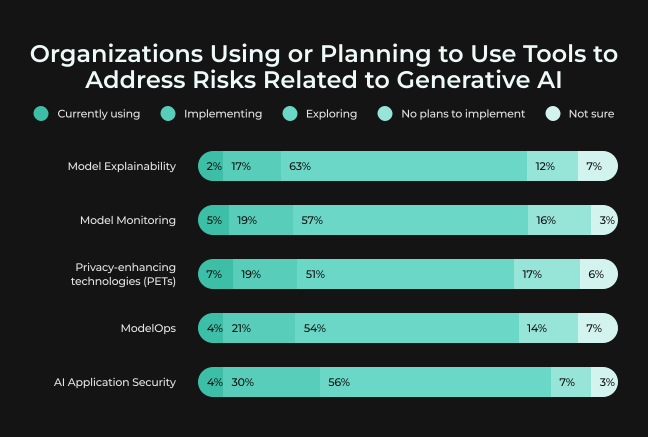
AI models are dependent on the quality of their training data. If the data used is faulty, the models tend to reflect that bias, particularly about certain user groups. This can provoke ethical issues and make other users feel left out. That’s why, a solid 34% of companies are getting ahead by using or planning to use AI security tools to manage the risks of generative AI.
You have to choose your data wisely and train AI with care. Use diverse and balanced datasets, add bias-detection tools like sprinkles, and regularly audit to keep everything transparent and fix any biases that might pop up.
Over-Reliance on AI
Leaning too much on AI for product design can become a pitfall. It might make us depend on technology, which actually limits our creativity or intuition. The result could be products that miss the special details or lack uniqueness.
Balancing the use of AI with human creativity is essential. New research from MIT Sloan shows that generative AI enhances employee creativity, especially for those who are flexible and thoughtful in how they use it.
Organizations can encourage innovation and adaptability by supporting both experimental design and AI use. You can learn more about this from SapientPro’s designer Stanislav Makhun.
A strong UI/UX designer does more than produce screens. They clarify problems, validate direction before development starts, and think in systems that stay consistent as teams and features grow. That approach reduces risk and keeps products usable in the long term.

Stanislav Makhun
Best Product Design AI Tools in 2026
We've prepared a list of the best AI tools for product design in 2026. These tools will definitely help designers, product managers, and developers come up with ideas quickly, test efficiently, and launch products with confidence.
Name | Description | Use Cases | Pricing |
Uizard | Uses AI to transform sketches into digital designs.
| Rapid prototyping, transforming sketched ideas into digital formats, and facilitating design collaboration. | They offer four pricing plans:
|
| Midjourney | AI product design software for generating artistic images and visuals. | Great for sparking creativity and coming up with design ideas.
| Midjourney has four subscription options: Basic for $10/month, Standard for $30/month, Pro for $60/month, and Mega for $120/month. |
| Framer AI | AI features integrated into Framer improve web design prototyping.
| Enhances web design workflows, generates responsive layouts, and creates interactive prototypes. | Pricing is divided into two categories: Personal and Business. Personal plans include Mini, Basic, and Pro options, ranging from $5 to $30 per month. Business plans offer Launch, Scale, and Enterprise options, starting at $75 per month, with custom billing available for the Enterprise plan. |
| Khroma | AI-powered tool for generating and matching color schemes.
| Helps designers come up with new color ideas and keep things consistent across their projects..
| Khroma AI is free to use without any limitations or subscription plans. |
| Adobe Firefly | An element of Adobe's generative AI projects for generating creative tasks.
| Integrates with Adobe Creative Cloud for AI-driven image and video creation and editing. | Firefly is free, but you can get the full creative AI experience for images, video, audio, and graphics with a Firefly plan or Creative Cloud Pro. Firefly Standard, for example, costs $9.99 per month, and Creative Cloud Pro is $69.99 per month. There are options for both individuals and students/teachers. |
| Maze | AI-driven insights on a user testing platform.
| Provides quick feedback on prototypes and UI designs using AI analytics to improve the user experience. | Maze has three plans: Free, Starter, and Enterprise.
|
Future of GenAI in Product Design
The future of product design with GenAI appears promising, with the primary focus likely on:
- Adaptability. AI systems should adjust with real-time feedback to meet users' changing needs;
- Inclusivity. AI tools should be accessible to everyone.
- Collaborative tools. When people work with AI, they make incredible designs and experiences. This collaboration mixes human creativity with technology and opens up new opportunities in product design.
As creativity is now in high demand, generative AI is rising in popularity. By 2035, this market could reach up to $98.7 billion, which shows its growth potential. A survey of nearly 600 companies across 11 industries found that about one-third are diving into GenAI for product design and simulation.
Besides, companies using generative AI can cut product development time by up to 50%, getting new products to market a lot faster.
GenAI is more than just a high-tech tool. It changes the game in product design and research. Generative AI helps manage routine tasks, inspires creativity, and reveals valuable insights. This enables teams to explore new areas with ease.
Design Your Product with SapientPro
Let's create software that's unique and easy to use with SapientPro's design services.
Our professional engineers and UI/UX designers work together with you to make sure your product has a clear and strong vision. We design interfaces with usability and customer satisfaction in mind while integrating branding elements for a consistent market presence.
Partner with our creative team to perfect your ideas.
Contact us for a detailed consultation about your project.
Design Your Software Product with SapientPro