
All Guide to Using the LLM-as-a-Judge Model in Modern LLM Evaluation
January 19, 202615 min read


AI adoption reached a tipping point in 2024, with 78% of organizations now leveraging the technology – a significant jump from 55% just a year prior. This growth is fueled by massive investment, including $33.9 billion dedicated specifically to generative models.
However, this explosion of AI activity has created a data deluge. Traditional human review simply cannot scale to meet the volume of generated content. To solve this, many organizations are turning to the LLM-as-a-Judge model. This is the practice of using large language models to automatically evaluate the quality of other models' responses.
Automating quality checks allows teams to process millions of data points rapidly and cost-effectively.
While powerful, LLM judges are not a total replacement for people; they can occasionally miss the subtle nuances or creative context that a human would catch. Consequently, the industry gold standard is a hybrid approach that combines automated speed with human oversight.
In this article, we explain what is LLM as a judge for evaluation, how to evaluate LLM performance, how to use LLM judges effectively, and compare LLM as a judge vs human evaluation.
Key Takeaways
- LLM-as-judge applies an AI model, such as GPT-5, to automatically score outputs at scale far beyond human review;
- Human evaluators remain the "gold standard" for nuance and correctness, but they're slow, costly, and subject to biases;
- The strongest strategy is LLM-as-a-judge vs human evaluation in tandem: let LLM judges filter obvious cases and flag issues, then have humans handle complex or ambiguous cases;
- Some of the key LLM evaluation metrics, customized for each use case, include Answer Relevancy, Task Completion, Correctness, and Hallucination;
- Improvements such as chain-of-thought prompts and few-shot examples can greatly improve LLM judge accuracy.
What is LLM-as-a-Judge for Evaluation?
LLM-as-a-Judge is the practice of using a high-reasoning language model to evaluate the outputs of other AI systems. Unlike traditional software that looks for exact matches, an LLM judge uses its deep linguistic understanding to simulate a human reviewer, scoring content based on complex, subjective, or unstructured criteria.
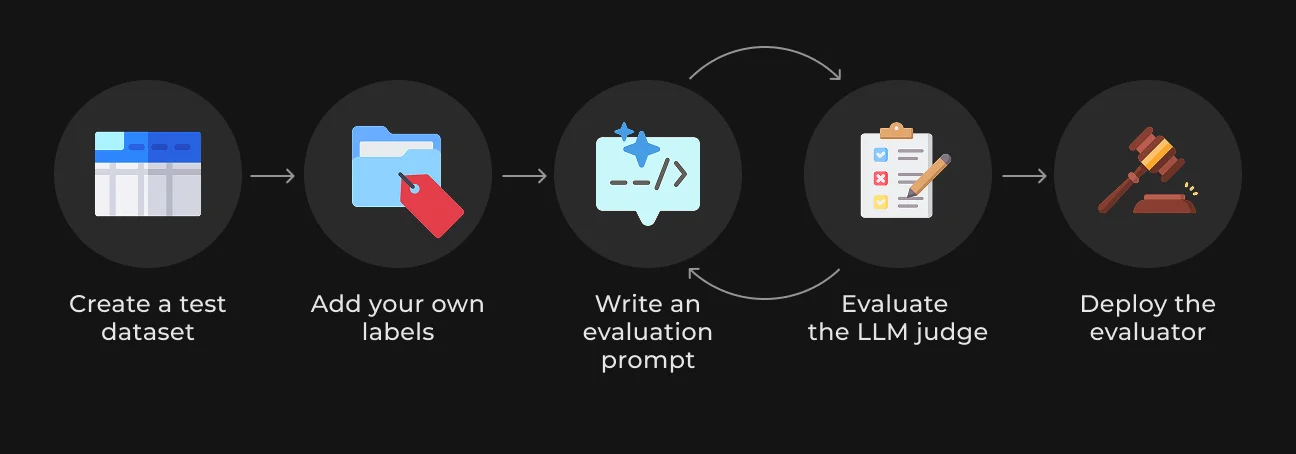
To implement this, you provide the "judge" model with two primary inputs:
- The output: the specific response or data that needs to be assessed.
- The rubric: a set of clear evaluation criteria or scoring guidelines.
For example, when testing a summarization model, you would provide the judge with the original news article and the generated summary. You then prompt the judge to rate the summary’s coherence, factual density, or tone on a defined scale.
This approach is particularly valuable when "gold standard" answers (exact correct results) are unavailable or when simple accuracy metrics fall short. If you’re still wondering what is LLM as a judge for evaluation, then keep on reading to learn more.
Types of LLM-as-a-Judge
There are three key approaches to LLM-as-a-judge evaluation. Each come with their own advantages and disadvantages. While single-output methods provide the absolute metrics needed for long-term tracking, pairwise methods excel at identifying clear winners in head-to-head competitions.
In a professional workflow, these aren't mutually exclusive. A a robust evaluation pipeline might use single-output scoring to monitor live production data while reserving pairwise tests for choosing between two competing model versions.
Let’s take a closer look at each method.
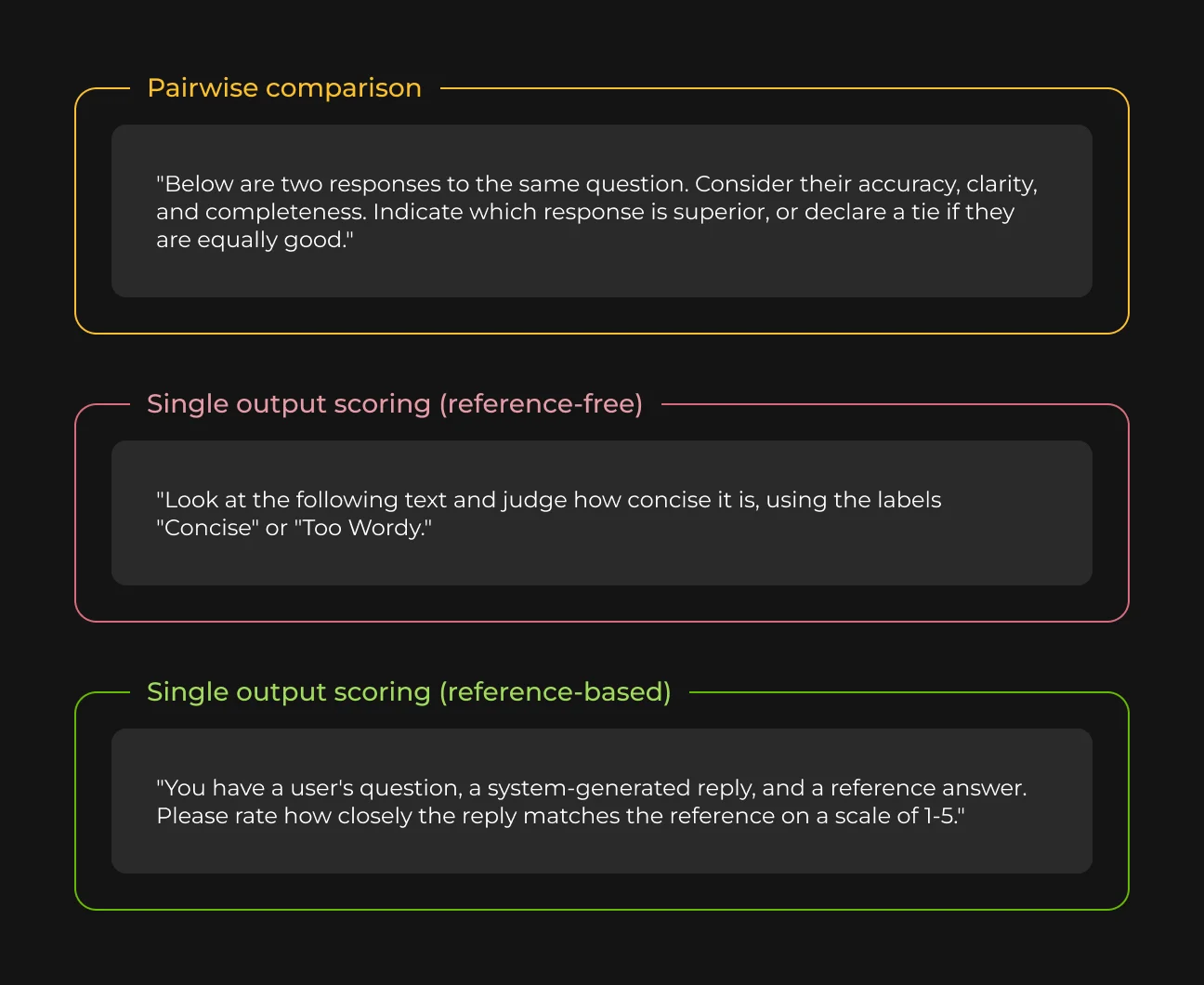
Single Output Scoring (without reference)
In this approach, the LLM judge evaluates a response in isolation, relying entirely on the provided prompt and specific evaluation criteria. Without a "correct" answer to use as a benchmark, the judge assigns a discrete score (typically on a scale of 1 to 5) based on a predefined rubric.
This method is particularly effective for open-ended and creative tasks where there is no single "right" way to answer, such as poetic composition or stylistic writing.
To maintain consistency, you must define exactly what each numerical value represents.
For instance, you might instruct the judge to rate a chatbot's fluency from 1 (poor) to 5 (excellent).
Because this method focuses solely on the relationship between the output and the criteria, it is easy to implement, though it remains sensitive to the judge's internal interpretation of the rubric.
- Pros: highly versatile and easy to scale; requires no manual "ground truth" data; perfect for subjective or creative content;
- Cons: higher risk of "score drift" over time; results can be less precise due to the lack of a comparative anchor.
Single Output Scoring (with reference)
When accuracy is non-negotiable, the evaluation process moves from abstract grading to a guided comparison. In this model, the LLM judge is provided with a "ground truth". This is an ideal or expected answer that serves as a benchmark for the output being tested.
By anchoring the judgment to a specific reference point, the judge no longer has to guess what "good" looks like. It simply measures how closely the generated response aligns with the facts.
This method is particularly powerful for technical or objective domains like checking a complex math solution or verifying a snippet of code.
For instance, when evaluating factual correctness, the judge compares the AI's response against the known correct answer to identify discrepancies that a reference-free judge might overlook.
This extra layer of context significantly reduces subjectivity, ensuring the evaluation remains consistent and aligned with human standards.
- Pros: highly objective and consistent; significantly reduces "hallucinations" in the judge model; ideal for technical or high-stakes factual domains;
- Cons: requires a pre-existing "gold standard" dataset for every prompt; can be time-consuming and expensive to curate the initial reference answers.
Pairwise Comparison
In the third approach, the evaluation shifts from grading individual answers to a direct "head-to-head" tournament. The LLM judge is presented with two different outputs generated from the same input and must determine which one is superior.
Rather than working with an abstract numerical scale, the model simply selects a winner based on specific criteria like clarity, completeness, or tone. This relative judgment side-steps the common issue of "score inflation," where a judge might be too generous or too harsh with absolute numbers.
This strategy is the gold standard for A/B testing, whether you are comparing two different model versions or experimenting with new prompt engineering techniques.
For example, if you need to know which of two marketing email drafts feels more engaging, an LLM often finds it much more intuitive to pick the better option than to decide if one is a "4.2" and the other is a "4.5."
While powerful, this method is best used surgically; because the number of possible pairings grows exponentially as you add more samples, it is better suited for model selection and spot-checks than for massive, daily data streams.
- Pros: much more intuitive for the judge; effectively captures subtle differences in vibe or preference; eliminates the inconsistency of absolute scoring scales.
- Cons: computationally expensive at scale due to the high volume of comparisons required, susceptible to "position bias," where the judge may favor the first output it reads.
LLM-as-a-Judge vs. Human Evaluation
Large language models can process vast data quickly, but human experts bring nuanced judgment. The question of LLM-as-a-judge versus human evaluation is not a competition but a collaboration.
On one hand, LLM judges offer speed and consistency. They can analyze thousands of responses in seconds, and they always apply the same criteria. This makes them cost-effective for initial screening.
On the other hand, human reviewers excel at context and ambiguity. Research has shown that human evaluators can be swayed by factors like confidence or style, leading to biases.
For instance, people tend to rate more "assertive" answers as more accurate, even if they contain errors. Humans can also understand domain-specific subtleties and catch ethical or safety issues that an LLM might miss.
Because of these differences, most teams use an LLM-first, human-second workflow. An LLM judge quickly filters obvious pass/fail cases and flags tricky items. Human experts then review the flagged outputs, refining criteria and catching edge cases.
This "human-in-the-loop" approach leverages the strengths of both: LLMs for scale and broad coverage, humans for deep expertise. As Nvidia's CEO Jensen Huang noted, even with advanced AI, "the answer is… human in the loop" for as long as it's sensible.
Automated LLM scoring turbocharges throughput and objective consistency, while human review ensures trust, fairness, and attention to nuance. Keeping humans in the loop is crucial for maintaining accuracy and catching what an LLM alone might overlook.
Feature | LLM-as-a-Judge | Human Evaluation |
| Speed | Instantaneous; thousands of reviews per minute. | Slow; limited by manual reading time. |
| Cost | Minimal (pennies per 1,000 evaluations). | High (requires professional labor). |
| Consistency | Perfect; applies the same logic every time. | Variable; subject to fatigue and mood. |
| Contextual Depth | Strong, but limited to training data. | Superior; understands culture and irony. |
| Bias | Programmatic (reflects model training). | Cognitive (swayed by style or confidence). |
| Safety/Ethics | High-level (based on guardrails). | Deeply nuanced; catches subtle red flags. |
How to Evaluate LLM Performance: Best Scoring Methods for LLM-as-a-Judge
Selecting the right metrics is the foundation of a successful evaluation framework. When implementing the LLM-as-a-Judge approach, the model is essentially acting as a multi-dimensional critic.
Instead of a single "pass/fail" grade, a judge is typically prompted to score several distinct categories to provide a full view of the model's performance.
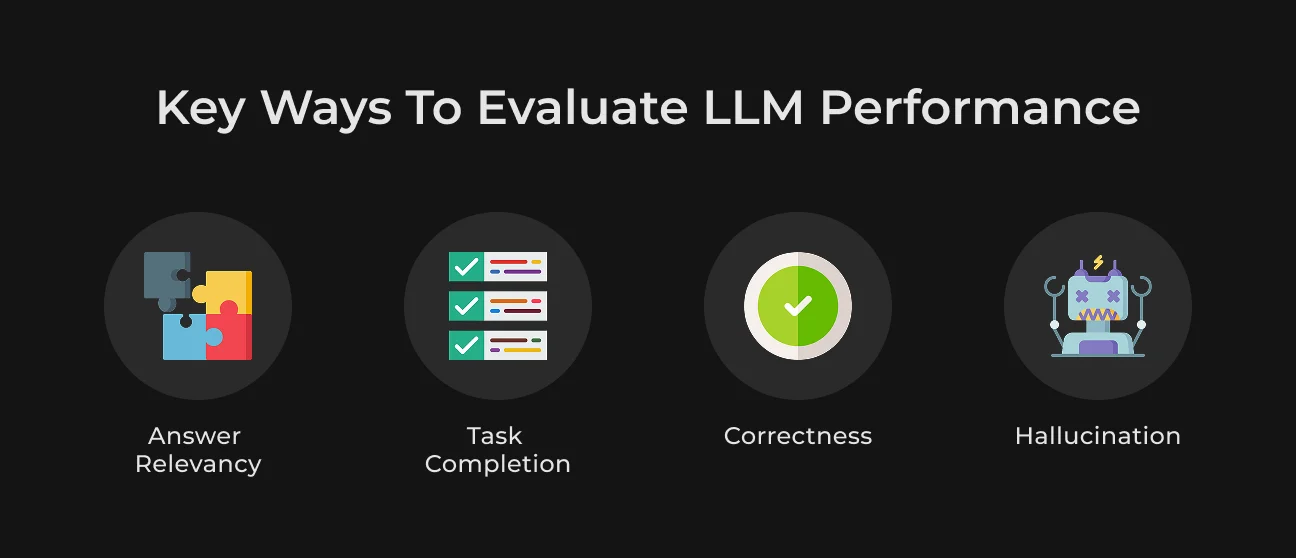
In practice, an LLM judge evaluates performance through four primary LLM evaluation metrics:
- Answer relevancy: measures whether the output actually addresses the user's intent or if it has drifted off-topic;
- Task completion: determines if the model fulfilled all instructions (e.g., "Write this in 100 words and include a call to action");
- Correctness: audits the response for factual and logical accuracy against a known reality or provided data;
- Hallucination rate: specifically identifies "fabricated" information like claims that are stated as facts but have no basis in the source material or reality.
A common concern is whether an automated judge can be trusted to mirror human intuition. The data suggests that with the right prompting techniques like G-Eval, which uses chain-of-thought reasoning to guide the judge, the gap is nearly closed.
In a massive study of 250,000 test cases, single-output LLM judges achieved a 95.1% agreement rate with human experts. Pairwise judges performed similarly, reaching 94.6% agreement.
These figures demonstrate that when given clear rubrics and detailed prompts, an LLM doesn't just "guess"; it mimics human professional judgment with remarkable precision and far greater consistency.
Let’s take a closer look at all the metrics.
Answer Relevancy
Relevancy is the measure of how well a response aligns with the user’s original intent. A relevant answer is both informative and concise, cutting straight to the heart of the query. To evaluate this, the LLM judge compares the original user prompt against the generated response to determine if the model stayed on topic or drifted into irrelevant territory.
- Pros: keeps the model focused; excellent for identifying "vague" or "evasive" AI behavior.
- Cons: high relevancy doesn't always mean high accuracy. A model can be perfectly on-topic while being factually wrong.
Task Completion
While relevancy measures "what" the model said, task completion measures "how much" it accomplished. This is vital for complex multi-step instructions like drafting a legal email that must include a specific disclaimer, a summary, and a call to action.
The LLM judge acts as a checklist, verifying that every required component was included.
- Pros: essential for agentic workflows; ensures the model doesn't skip "boring" but necessary formatting steps.
- Cons: can be binary (Pass/Fail), which may miss the quality of the content within those completed steps.
Correctness
Correctness is the gold standard of evaluation. It measures whether the output is factually and logically sound. When a "ground truth" reference is available, the judge compares the AI's math, code, or data against the known facts. In the absence of a reference, the judge uses its internal reasoning to verify the logic.
Because LLMs are famous for being "confidently wrong," this metric is the primary defense against misinformation.
- Pros: high correlation with human expert grading; identifies logical fallacies and calculation errors.
- Cons: fifficult to score without a high-quality reference or an extremely powerful "Judge" model.
Hallucination
Distinct from a simple mistake, a hallucination occurs when a model invents information or makes unsupported claims. To score this, the LLM judge meticulously audits the response, checking if every statement is grounded in the provided context or verified knowledge. A low hallucination score is a major "red flag," signaling that the model is making up facts.
- Pros: critical for high-stakes industries (medical, legal, financial); helps maintain long-term user trust.
- Cons: detection can be subtle; sometimes requires "Search" capabilities for the judge to verify external facts.
How to Improve LLM Judgments
While LLM judges are inherently powerful, their accuracy can be significantly enhanced through strategic prompting and specialized techniques. By using well-crafted prompts, illustrative examples, and structured reasoning, you can ensure more reliable and consistent evaluations.
Modern evaluation frameworks, such as DeepEval, often integrate these strategies directly into their scoring logic. This includes combining techniques like Chain-of-Thought (CoT), few-shot learning, and ground-truth references for teams to achieve evaluation results that closely mirror human quality while eliminating the associated time and labor costs.
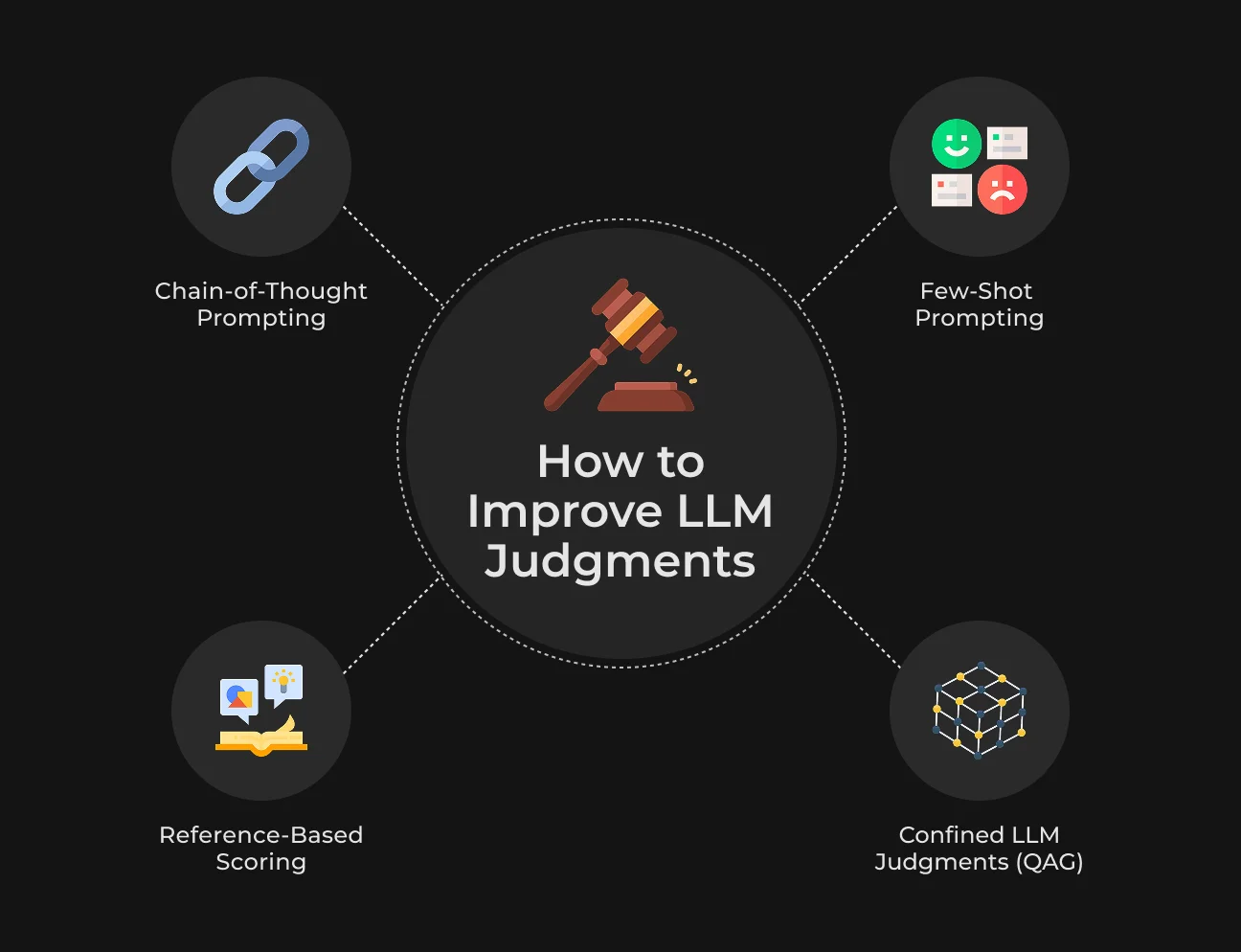
Chain-of-Thought Prompting
Have the LLM judge spell out its reasoning steps when scoring. Instead of asking for a number outright, the prompt should ask the model to “follow these steps.” For scoring bias, for example, one might list a set of questions to be considered by the judge internally before settling on a final score, such as “Is the information presented fairly?”
This chain-of-thought approach makes the LLM consider various aspects of the output and leads to more accuracy and alignment with human expectations. It essentially decomposes the task into smaller checks, thereby making the judgment all the more transparent and robust.
Few-Shot Prompting
Include examples of scored outputs in the prompt to guide the LLM judge. Showing a few labeled examples of good vs bad answers calibrates the model's scoring. Although this increases token usage, this has been shown to significantly improve consistency, such as GPT-4's agreement jumped from 65% to 77.5% with examples.
In practice, one can list 2 or 3 sample questions and answer pairs with the correct score and then ask the judge to continue with the new case. This "learning by example" helps the judge understand subtle differences in quality.
Reference-Based Scoring
When appropriate, provide a known correct answer as part of the prompt. Even if doing single-output, referenceless scoring, you can slip the expected answer into the context. This gives the judge a concrete anchor to work from.
For example, to score an assistant's answer, you might include an "Expected Answer" section in the prompt. In that case, the judge has something to compare the output against (a gold standard), which reduces variability in scores. Reference-based scoring is particularly powerful in the case of fact-based tasks, where an ideal answer exists.
Confined LLM Judgments (QAG)
Break complex outputs into smaller pieces. For example, use LLM to generate questions about the output (Question-Answer Generation) and then answer them with yes/no. The fraction of “yes” answers can serve as the score, like a percentage of correct sentences.
This reduces arbitrary scoring and makes the metric more continuous. For example, assessing relevancy by checking each sentence's relevance gives an accurate score. This type of binary or granular sub-scoring can improve the LLM judge's precision.
Online vs. Offline LLM Evaluation
To build a reliable AI application, evaluation must happen at two distinct stages: during development (offline) and during live operation (online). Using consistent scoring metrics across both stages allows teams to compare lab results with real-world performance.
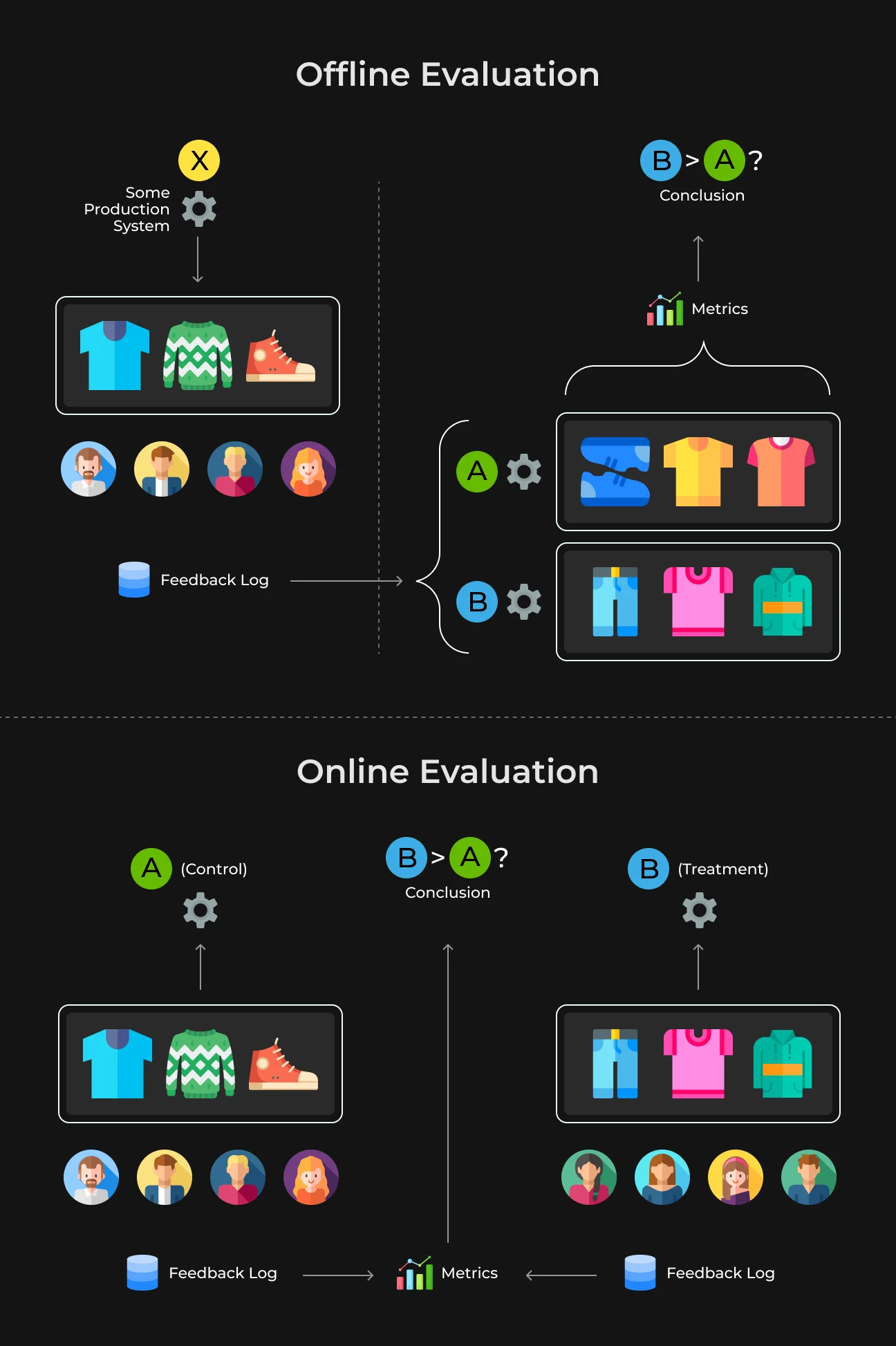
Offline evaluation takes place before a model ever reaches the user. This stage relies on curated datasets and "golden" test cases—sets of ideal prompt-response pairs that serve as the standard for quality.
By integrating these tests into a CI/CD pipeline, engineers can experiment with new prompts or model versions and catch regressions before they are deployed.
- Pros: controlled environment; prevents bugs from reaching production; allows for deep benchmarking.
- Cons: cannot predict every possible way a real user might interact with the model.
Once the application is live, evaluation shifts to the production environment. Online monitoring involves using LLM judges to score actual user interactions in real time.
This serves as a dynamic guardrail, allowing teams to identify data drift, performance degradation, or safety risks as they happen. For example, an automated system could track the hallucination rate across live chats and immediately alert developers if it spikes.
- Pros: captures real-world edge cases; provides immediate safety guardrails; tracks "drift" over time.
- Cons: gigher operational costs due to continuous API usage; requires low-latency judge models to avoid slowing down the user experience.
Partner with SapientPro to Implement LLM Solutions Into Your Business
SapientPro helps companies harness LLM-as-a-judge evaluation to boost AI reliability. Our expert team can integrate custom LLM evaluation pipelines into your workflow using advanced scoring metrics and prompts tailored to your domain.
We combine the most modern LLM judging methods with human-in-the-loop design to make your AI outputs accurate, relevant, and safe.
Need an automated QA on a customer service bot or robust scoring on an AI agent?
SapientPro’s team will help define clear evaluation criteria and deploy an efficient LLM-as-judge system. Get a free consultation today!
Build Your LLM with SapientPro

FAQ
How to evaluate LLM performance?
Evaluating LLM performance involves a combination of offline testing (with curated datasets and fixed rubrics) and online monitoring in production. Key metrics involve answer relevancy, correctness, completion of the task, and hallucination rate. Modern teams increasingly use LLM-as-a-judge to automate large-scale scoring and then apply human review only to complex or ambiguous cases.
What's the difference between LLM-as-a-judge vs human evaluation?
LLMs acting as a judge provide speed and scalability of scoring across large datasets. Human evaluation brings nuance and contextual reasoning with ethical oversight. The best overall strategy is hybrid. We recommend you let the LLM judges do high-volume screening tasks and leave the edge cases, safety concerns, and domain-specific judgments to humans.
What is LLM as a judge for evaluation?
LLM-as-judge uses a large language model to automatically score or compare the output of some other model with respect to specified criteria. Rather than have human reviewers, an LLM judge can assess the relevance, correctness, and quality of outputs more quickly at scale. The evaluation will be done faster, cheaper, and in a way more adaptable across tasks.
Under what circumstances should organizations apply LLM-as-a-Judge to their evaluation workflow?
LLM-as-Judge is ideal in situations where you require fast, repeatable scoring across large datasets, such as regression testing, comparing model variants, or validating fine-tuned models. This becomes particularly useful for early-stage filtering before human experts review critical outputs.
Are LLM-as-Judge evaluations reliable enough for enterprise use?
Yes, if implemented correctly. Enterprises use the LLM-as-a-Judge only for scale and uniformity in assessment, where it's paired with targeted human audits. Thus, this hybrid model gives high accuracy, reduces the cost of evaluation, and minimizes the risks driven by biases or hallucinations.

