All How to Build an AI Trip Planner: Development Guide for 2026
February 1, 202615 min read


Imagine planning your perfect holiday by merely chatting with a witty assistant on your phone. No more hundreds of open tabs or spreadsheets. Just tell a personalized travel AI what you want, and it will create a custom itinerary tailored to your interests, budget, and schedule.
This is not fantasy.
AI-based trip planners already exist and are gaining speed. These applications are able to plan itineraries 3x faster, save consumers 40% on expenses, and achieve 90%+ satisfaction ratings.
Read on to learn more about AI-based travel app development from SapientPro’s tech experts.
Key Takeaways
- An AI trip planner is a virtual travel buddy that automates itinerary creation using AI technology, offering personalized recommendations on where to go, where to stay, what to do, and how to get there depending on each traveler's interest and circumstances;
- AI facilitates hyper-personalized travel plans through analysis of user taste, previous travel, and current context;
- New-generation AI-based travel planners offer real-time updates about flights, weather, traffic, and local happenings;
- A conversational interface (voice assistants or chatbots) powered by NLP enables trip planning as if texting a travel agent friend;
- UX matters: interactive maps, calendar views, and intelligent notifications must transform planning into a fun and easy experience for everyone, from CEOs to backpackers.
What is an AI Trip Planner?
An AI trip planner is a digital travel assistant that uses machine learning to design custom itineraries in seconds. Think of it as a virtual travel agent that lives on your phone.
Instead of manually scouring hundreds of websites, users simply input their preferences. This could be, for example, "a 10-day family road trip in Italy with a focus on history and beaches."
The AI trip planner then handles the heavy lifting, instantly curating destination suggestions, optimized routes, and flight or hotel bookings all in one place.
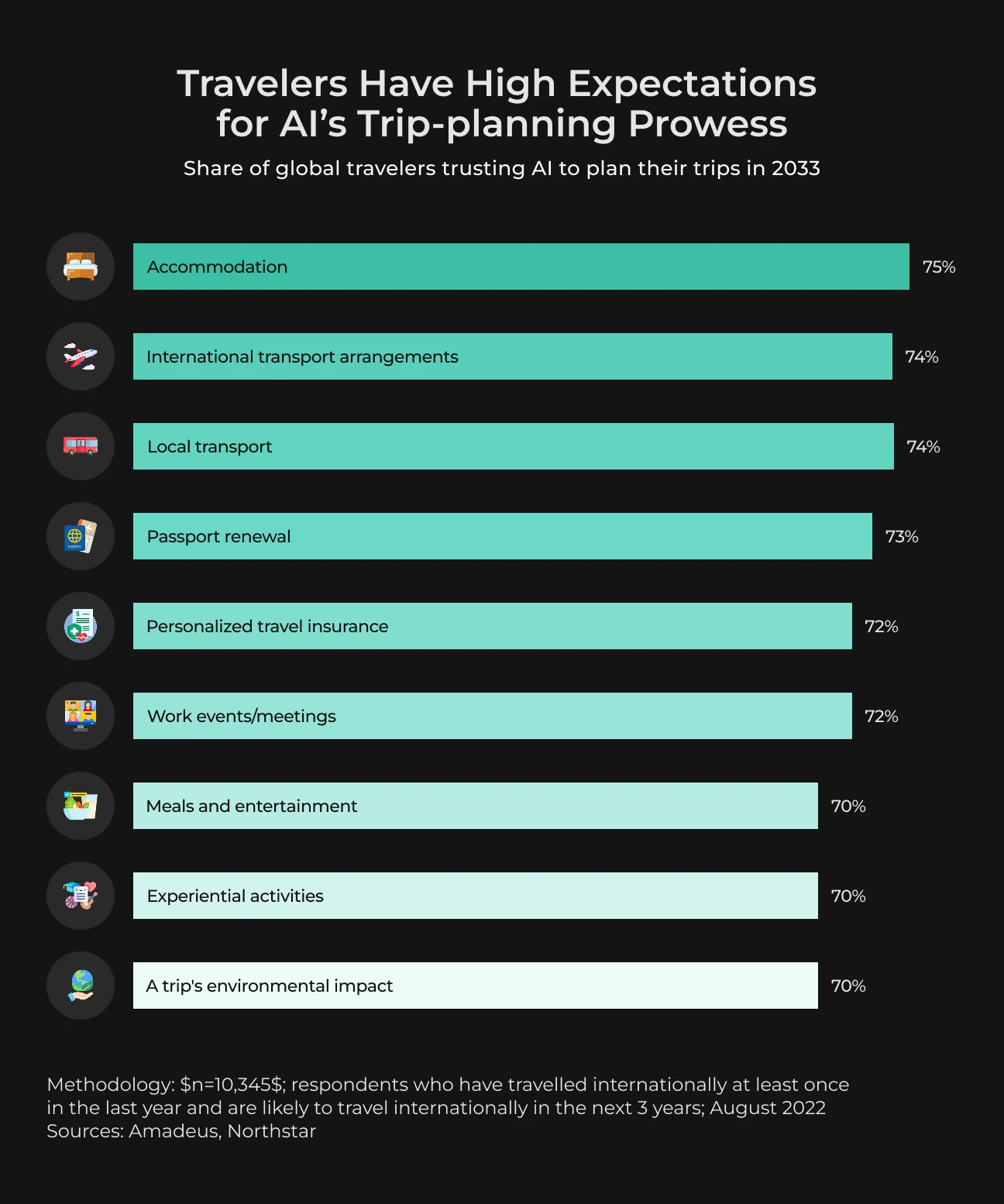
For example, an AI road trip planner may:
- Suggest destinations to visit and things to do based on a traveler's passions and past journeys;
- Find the cheapest flights and hotel rates;
- Construct day-by-day itineraries;
- Constantly update plans in anticipation of changing conditions.
AI for trip planning is like having a personal travel concierge at hand that understands your preferences and plans trips around them.
Core Components of a Modern AI Trip Planner
A smart trip planning app consists of multiple algorithms and technologies combined together. This includes AI selection engines, dynamic price modules, scheduling algorithms, and many others.
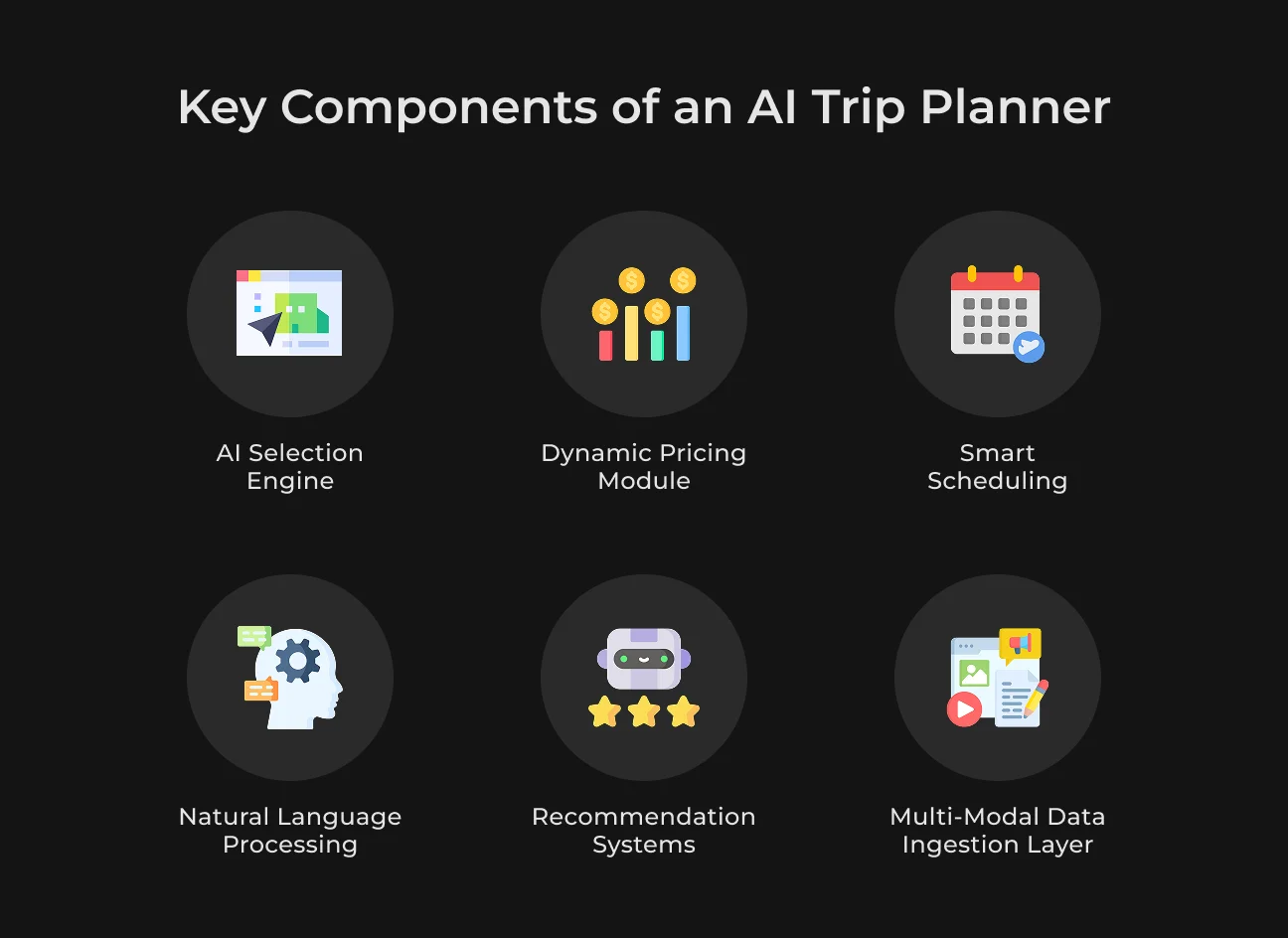
Let’s take a look at the tech stack to build a trip planner app.
AI Selection Engine
The backbone of any modern travel platform is the AI Selection Engine. Unlike traditional software that relies on pre-defined filters, this engine uses large language models like GPT-5 to interpret nuanced user intent.
By analyzing a massive database alongside specific traveler inputs like budget, pacing, and interests, the engine moves beyond simple "matching." It understands context.
For instance, if a user requests an "off-the-beaten-path adventure with cultural immersion," the AI doesn't just filter for "Hot + Adventure."
It creatively identifies emerging destinations or off-peak excursions, like a hidden mountain village in Georgia, offering suggestions the traveler likely wouldn't have discovered through a standard search engine.
Dynamic Pricing Module
Travel costs are notoriously volatile, often fluctuating by the minute. To provide true value, a modern AI trip planner must integrate a dynamic pricing module. This component acts as a financial watchdog, ensuring users book at the optimal moment.
The module uses a two-pronged approach to price management:
- Real-time data integration:
Through API connections with airlines, hotels, and global distribution systems, the engine continuously monitors live inventory. It can instantly alert a user if a flight on their watched route drops by 20% or if hotel availability is tightening.
- Predictive analytics:
Beyond just reading current prices, the module leverages machine learning and historical data to forecast future trends. Much like the predictive power seen in Google Flights, the system analyzes seasonal patterns and booking velocity to advise users whether to "Book Now" or "Wait for a Price Drop."
Rather than checking a single source, the AI scans multiple platforms (including direct airline carriers, OTAs, and car rental aggregators) to consolidate the best available offers into a single view.
By automating the "comparison shopping" phase, the app transforms from a simple itinerary builder into a powerful cost-saving tool.
Smart Scheduling
The smart scheduling component is what transforms a simple list of sights into a logical plan.
While traditional itineraries are often rigid and easily derailed, an AI-driven builder is inherently adaptive.
- Logic-based sequencing:
The system doesn't just list activities; it calculates the most efficient route between them, accounting for opening hours, transit times, and geographic proximity.
- Real-time adaptability:
If a flight is delayed or a local attraction closes unexpectedly, the AI re-optimizes the remaining schedule on the fly. This ensures the user’s day is restructured instantly, removing the stress of manual rescheduling.
- Personalized pacing:
Whether a traveler prefers a packed schedule or a leisurely pace, the AI balances activity duration with necessary downtime.
Natural Language Processing
For a truly intuitive "virtual assistant" experience, natural language processing is non-negotiable.
This technology bridges the gap between complex human desires and structured data.
Instead of forcing users through tedious forms or rigid keyword searches, NLP allows for conversational commerce. Users can provide fluid, unstructured prompts like:
- "Find me a cozy mountain cottage for early December."
- "I’m torn between Paris and Rome for a week—give me an art and local food itinerary for both."
By interpreting intent and sentiment, the NLP engine extracts key variables (destination, duration, and interests) to deliver a response that feels more like a human recommendation than a database query.
Recommendation Systems
The recommendation system is the engine behind hyper-personalization.
While the selection engine handles the initial logic of a trip, the recommendation system analyzes user behavior and historical data to refine those choices over time.
It functions similarly to the advanced algorithms used by Netflix or Amazon, but optimized for the high-stakes world of travel (lodging, dining, and landmarks).
This includes the implementation of a hybrid approach that leverages two core methodologies:
- Collaborative Filtering:
This identifies patterns among user cohorts. By analyzing the behavior of thousands of travelers, the AI can infer: "Users with a travel history similar to yours also highly rated this specific boutique hotel."
- Content-Based Filtering:
This focuses on the DNA of the destination itself. If you have previously enjoyed historic, walkable European cities, the system identifies those specific attributes and finds similar "matches"—such as an underrated medieval town in Portugal.
Blending these models allows the AI to move beyond generic "top-rated" lists. It can proactively suggest a secluded beach town that isn't on the mainstream radar because it understands the intersection of your personal aesthetic and the positive experiences of similar travelers.
This level of nuance ensures that every recommendation feels earned, not just shuffled.
Multi-Modal Data Ingestion Layer
Behind every magic AI recommendation lies a massive stream of information.
The multi-modal data ingestion layer is the foundational architecture responsible for gathering, normalizing, and collating data from hundreds of disparate sources in real time.
For an AI trip planner to be truly effective, it must process three distinct types of data:
1. Structured data: the foundation.
The system continuously pulls "hard facts" through third-party APIs (such as Amadeus, Sabre, or Skyscanner). This includes:
- Real-time inventory: flight schedules, seat availability, and hotel room rates.
- Logistics: train and bus timetables, ferry schedules, and car rental availability.
2. Unstructured data: context & sentiment.
To move beyond a basic search engine, the ingestion layer scrapes and analyzes unstructured soft data. By processing traveler reviews, social media trends, and travel blogs via NLP, the AI gains qualitative context.
For example, while an API says a hotel is available, social media sentiment might reveal that the street in front of it is currently under loud construction, allowing the AI to adjust its recommendation.
3. Real-time environmental signals.
The most advanced planners respond to the world as it changes.
The ingestion layer monitors live streams for:
- Hyper-local weather: using APIs to detect approaching storms or heatwaves;
- Geospatial data: tracking user GPS (with permission) to offer "near-me" suggestions;
- Live events & news: monitoring local festivals, strikes, or public transit disruptions that could impact a traveler’s schedule.
4. Turning raw data into actionable insights.
Once ingested, this rich corpus of information is fed into the selection engine and smart scheduler.
This allows the app to perform complex reasoning, such as: "A major festival was just announced for these dates; availability will drop and prices will spike—recommend booking immediately or suggest an alternative city."
SapientPro's solution for Mastrack covers most of these technologies to make management speed x10 faster.
Essential Features of an AI-Powered Trip Planner
Let’s take a look at the essential features of an AI trip planner and what they offer.
Hyper-Personalized Recommendations
The app suggests destinations, activities, and services tailored to each user’s interests, past behavior, and budget. This increases relevance and user satisfaction by highlighting options they are likely to love.
Smart Itinerary Builder
Automatically generates an optimized daily schedule (what to do, when, and where) for the trip. It adapts to real-time changes like weather or delays to keep plans feasible and efficient, saving users the hassle of manual planning.
Dynamic Pricing & Booking Engine
Fetches live prices for flights and hotels, identifies the best deals, and allows for seamless in-app booking. The AI compares platforms and predicts price fluctuations for optimal booking timing, while managing all reservations, changes, and cancellations in one place.
Voice/Chat-Based Planning Assistant
Users can plan and manage trips through natural text or voice conversations. An AI chatbot answers questions, makes suggestions, and executes booking commands in a conversational flow, providing 24/7 instant support and a human-like experience.
AI-Powered Local Guide
Offers on-trip assistance like a personal guide by answering questions about local sites, providing translation help, and offering cultural tips. It can suggest nearby points of interest and handle emergencies or itinerary changes on the go.
Multi-Modal Transport Planning
Plans comprehensive routes using various modes—flights, trains, public transit, driving, and walking—and integrates their schedules. It optimizes connections and timing for door-to-door navigation, helping users navigate unfamiliar areas without manual effort.
Interactive Maps & Navigation
Includes built-in maps to visualize itineraries and explore surroundings with turn-by-turn navigation. The system provides live traffic updates, route adjustments, and offline access to enhance ground-level navigation within a single interface.
Real-Time Alerts & Updates
Delivers proactive push notifications for flight delays, gate changes, weather alerts, or safety advisories. The app automatically adjusts plans in response to these updates, ensuring users are never caught off guard by unexpected changes.
Social Media Integration
Leverages platforms like Instagram and TikTok to inform recommendations with trending destinations and user-generated content. It also allows users to share their itineraries and travel moments with their network, keeping the experience engaging and trendy.
Global Support (Multilingual & Offline)
Supports international travel with built-in language translation and currency conversion tools. Offline access to itineraries and maps ensures the app remains functional during flights or in remote areas without internet connectivity.
Automated 320 hours each month
See how SapientPro implemented AI for CV processing at scale.

Step-by-Step Guide to Developing Your AI Trip Planner App
To build a route planner app, you need to break it down into several stages.
Here is a step-by-step checklist for trip planner app development.
Phase 1: Strategic Research & Conceptualization
Success begins with a clear vision: what specific problem does your AI trip planner solve?
High-impact development requires validating your concept through deep market research rather than building for everyone. Identify a high-value niche—such as families, business travelers, or luxury seekers—to solve their pain points.
Conduct a rigorous competitive analysis of industry apps like Kayak alongside emerging AI-native startups. Pinpoint gaps in the current user experience to identify where your platform can truly differentiate itself. This allows you to focus on superior personalization or more intuitive UI to capture market share.
Finally, define the scope of your MVP by focusing on core features. Prioritize the itinerary builder and booking integration before expanding into voice assistants or social tools. Most travel-tech leaders adopt a mobile-first strategy to ensure the app is accessible to travelers on the move.
Phase 2: User Experience Design & Feature Definition
With the idea sealed, move on to designing how users will interact with your app. UX/UI design for an AI travel planner is essential as the app handles a lot of data. The challenge is to present complex AI-generated information in a clear and user-friendly manner.
In this phase, you need to:
- Map user journeys.
Sketch the flow for key user tasks. For example, the flow from looking for a trip idea to viewing an itinerary, or from receiving a recommendation to booking it.
- Wireframe the interface.
Create low-fidelity wireframes of your most important screens – i.e., trip input form/chat screen, itinerary view, map view, recommendation feed, booking checkout, etc.
- Add personalization and adaptivity.
Since content will be personalized, think about how the UI can reflect that. A home screen, for instance, that greets the user and shows their upcoming trip or personalized suggestions. Think about responsive design also if you serve different types of devices.
- Design for live updates.
Displaying live updates (e.g., "your flight is delayed" alerts or itinerary changes) presents a unique challenge. Use strong visual cues (color highlights, icons) for alerts.
- Prototype conversation flows.
If you have a chatbot interface, draw the chat screen and consider sample conversations.
- Branding and visual design.
Choose a color palette, typography, and overall aesthetic that is appropriate for your brand (e.g. calming blues and greens for a travel theme, or clean minimal for a tech theme).
Also, finalize the feature list of your MVP versus future versions.
Detail what exactly will be built now. Will you include social media integration in MVP or wait later? Is voice control in scope, or only text chatbot to start with?
A well-defined spec prevents scope creep.
Phase 3: Technical Architecture & Stack Selection
Modern AI travel apps typically favor a microservices architecture for modularity and scalability.
By separating user management, booking, and AI logic into distinct services, you can scale each component independently. While a monolith may work for a quick MVP, designing for future structural decoupling prevents technical debt as you grow.
Given the intense data processing involved, a cloud-native configuration using Docker and Kubernetes is recommended. This allows your recommendation engine to auto-scale during peak travel seasons without affecting the rest of the application.
High-performance backends like Python or Node.js are ideal for managing these complex orchestrations and API calls.
Most developers use a hybrid approach: pre-trained LLMs for conversation and custom ML models for proprietary pricing or recommendation logic.
Abstracting these calls through a dedicated "AI Engine" service layer ensures your architecture remains clean. This central hub orchestrates both internal models and external APIs to deliver a unified response.
Below is your possible tech stack for an AI trip planner app.
Component | Recommended Technologies |
| Frontend | React Native, Flutter (Mobile); React, Vue.js (Web) |
| Backend | Node.js (Nest.js) or Python (FastAPI); REST/GraphQL |
| AI & NLP | GPT-4o/GPT-5 (via OpenAI or Azure); Hugging Face, spaCy |
| Machine Learning | TensorFlow, PyTorch; AWS SageMaker or Google AI Platform |
| Databases | PostgreSQL (Structured); MongoDB (Itineraries); Redis (Caching) |
| Maps & Location | Google Maps SDK, Mapbox, Google Places API |
| Travel APIs | Amadeus, Skyscanner, Expedia, TripAdvisor |
| Payments | Stripe, Braintree, Adyen |
| Cloud & DevOps | AWS/Azure, Docker, Kubernetes, GitHub Actions |
| Security | OAuth 2.0, Auth0, JWT, Firebase Auth |
Phase 4: Critical API Integrations for Real-Time Intelligence
This phase often runs in parallel with route planner app development.
Still, it’s worth highlighting because successful API integration is what allows your app for route planning to offer comprehensive & up-to-date information.
This sheet lists key service categories and examples of APIs to integrate.
Service Category | Purpose | Example API Providers |
| Flight & Hotel Data | Search and book flights, hotels, car rentals. | Amadeus API, Sabre, Skyscanner, Booking.com Partner API, Expedia Rapid API, Skyscanner Travel API. |
| Tours & Activities | Access tours, attractions tickets, experiences. | Viator API, GetYourGuide API, Airbnb Experiences API (if available). |
| Mapping & Places | Maps, geocoding, local search for POIs. | Google Maps & Places API, Mapbox, Here Maps API, OpenStreetMap (for maps data). |
| Directions & Transit | Route planning and transit schedules. | Google Directions API (driving, walking, transit routes), city-specific transit APIs (GTFS feeds), rideshare APIs (Uber, Lyft) for estimates/booking rides. |
| Weather | Weather forecasts and alerts. | OpenWeatherMap (Weather API), Weatherbit, AccuWeather API. |
| Events & Local Info | Local events, reviews, social content. | Eventbrite API (events), Ticketmaster API, Yelp Fusion API (business reviews), Foursquare API, TripAdvisor Content API (attraction ratings). |
| Payments | Secure transactions for bookings or upgrades. | Stripe API, Braintree, PayPal Checkout API (often used for travel bookings). |
| Notifications | User communication (alerts via SMS, email, push). | Twilio (SMS/WhatsApp), SendGrid or Mailgun (email), Firebase Cloud Messaging (push notifications). |
| Calendar & Scheduling | Syncing with user’s calendars or sending invites. | Google Calendar API, Microsoft Graph API for Outlook calendar. |
| Translation & Language | Translate text for multilingual support. | Google Translate API, Microsoft Translator Text API, DeepL API (for high-quality translations). |
| Authentication (Social Login) | Allow users to sign in via social accounts. | OAuth integrations with Google, Facebook, Apple for quick account creation/login. |
Phase 5: Development, Testing & Deployment
This stage is the actual deployment – coding, intensive testing, and the app is live.
It involves several iterative phases:
- Agile development sprints.
Break the feature implementation into sprints that you can implement. You would generally begin with the core elements first (user accounts, basic trip creation, adding a basic recommendation) and build in sophistication iteratively (chatbot, live updates, etc.).
- Backend development.
Create a database schema and API endpoints to support all app functionality. Add data ingestion process for API pulling (event-driven triggers or cron jobs). Create the core logic to produce itineraries (writing routing algorithms, scheduling times from the API data) and combine the AI modules.
- Frontend development.
Develop UI screens and components from the design. This includes forms (e.g. input for trip), list and card view (for recommendations and itineraries), map integration in the UI, chat interface, etc.
- Testing (QA).
This is important, especially with the complexity of AI-generated output and third-party information.
Use a combination of unit tests (each module or function behaves correctly), integration tests (like verify your system correctly calls an API and processes the response), and system tests which test end-to-end user flows.
- Performance & load testing.
Verify the application performs under anticipated load. Test a lot of users searching or creating itineraries at once to determine whether your caching and scaling plans work.
- User acceptance testing (UAT).
Pilot the app with a small group of beta users or internal staff if possible. Feedback from them can identify UX problems or AI oddities that automated checks won't (e.g. "The chatbot's suggestion was irrelevant for my question").
- Iteration.
Expect to iterate a few times between testing and coding. AI aspects in particular may need tweaking.
For example, you may need adjusting a recommendation algorithm's weightings if it's coming up with weird results, or optimizing prompt templates for GPT-5 to get more accurate outputs. Take on an iterative mindset: build -> test -> refine.
- Deployment.
This involves provisioning the servers or cloud, provisioning databases with necessary backups, setting up environment variables (API keys, etc.), and deploying the application. Automate deployment using CI/CD pipelines so that you have an easy way of pushing updates.
- Monitoring.
Closely monitor the usage and performance of the app after deployment. Use analytics to keep tabs on user activity (which features are used, where they drop off), and monitoring libraries to track server health (CPU, memory, API call failures, etc.).
This phase is often iterative and continuous (following a DevOps “continuous integration, continuous deployment” approach). Even after initial launch, you’ll be cycling through route planner app development and testing for updates.
Phase 6: Post-Launch Optimization & Monetization Strategies
Releasing your AI road trip planner is a major milestone, but sustained success lies in continuous optimization and a good business model. Post-launch optimization actions:
- Monitor and improve the AI models.
Once real users start using the app, you’ll gather invaluable data.
- A/B testing.
Try different UI setups, wording, or added features with a subset of users to measure the effect on interaction.
- Performance tuning.
As usage grows, you may reach bottlenecks. Optimize slow processes (maybe cache aggressively or scale the database). Keep third-party API usage and expense in check. Optimize calls (e.g., don't call an API too frequently if not needed).
- User feedback and support.
Add user feedback mechanisms (in-app survey, support email/chat). Listen to your users: they will request features like sharing an itinerary with friends or further developed budgeting tools.
- Keep and update content.
Update your AI's knowledge base as needed. Keep an eye on competing apps as well.
Also important is determining how the application will be profitable and self-sustaining.
There are several ways a route planning app can generate revenue.
Strategy | How It Works | Example |
| Affiliate Commissions | Earn a percentage on bookings facilitated through travel partner integrations. | Earning 5% from Booking.com when a user secures a hotel through your app. |
| Premium AI Features | Charge for high-value, AI-driven functions as one-time or bundled purchases. | A $20 "AI Travel Concierge" upgrade for hyper-detailed guides and offline access. |
| Subscription Plans | Generate recurring revenue by offering a premium tier with exclusive benefits. | $9.99/month for unlimited plans, ad-free browsing, and price-drop alerts. |
| Sponsored Listings | Offer travel brands paid placement within search results or recommendations. | A boutique hotel paying for "Featured" placement in a user’s tailored itinerary. |
| B2B Licensing | Provide white-label solutions or API access to other travel agencies and firms. | Licensing your planning engine to a traditional agency for an enterprise fee. |
See how we reduced rental risks
SapientPro developed a real estate management platform with KYC checks.

How Much Does it Cost to Build an AI Trip Planner
One big question: how much does it cost to create an AI trip planner app?
The answer depends on a multiverse of factors: scope, complexity, the developer team's rates, etc.
Cost can vary wildly, from a minimal app with minimal AI functionalities to a complete platform with bleeding-edge capabilities. Below is an estimate of a typical trip planner application.
Complexity Level | Cost Estimate | What’s Included |
| Basic MVP | $30k – $80k | Core trip creation, static itinerary suggestions, simple UI, and limited third-party API connectivity. Ideal for initial market testing. |
| Moderate | $80k – $200k | Real-time data (flights/weather), route optimization, ML-based personalization, and cross-platform support (iOS/Android) with a scalable backend. |
| Advanced | $200k – $500k+ | Conversational GPT-powered AI, multi-modal transport planning, deep learning recommendations, and a high-availability microservices architecture. |
Final costs in 2026 are heavily influenced by your development team’s location and expertise.
While North American and Western European rates are higher, Eastern Europe remains a top location offering high-tier AI talent at a more balanced cost-to-quality ratio.
Beyond hourly rates, the following factors will dictate your total investment:
- Feature Complexity & AI Scope.
The depth of your AI determines the development timeline. While a basic rule-based assistant is relatively affordable, implementing agentic AI that can autonomously handle multi-leg bookings or real-time re-optimization requires significantly more engineering and rigorous testing.
- AI Model Selection.
Using pre-trained APIs like GPT-5 allows for a faster launch but introduces recurring "token-based" usage fees. Conversely, developing or fine-tuning custom ML models involves higher upfront costs for data preparation and training but offers tighter control over performance and long-term operational expenses.
- Data Ingestion & API Ecosystems.
Each third-party integration—from hotel GDS systems to hyper-local weather feeds—adds specialized engineering hours. Many travel APIs also require licensing fees or security audits, which should be factored into the initial budget to avoid mid-project surprises.
- UX/UI & Platform Parity.
A high-performance travel app must be both visually polished and technically responsive across platforms. Investing in premium UI/UX design and cross-platform frameworks like Flutter or React Native ensures your app remains intuitive while keeping the codebases for iOS and Android unified.
- Infrastructure & Elastic Scaling.
Apps expecting large user volumes require cloud-native architectures with load balancers and auto-scaling capabilities. Modern 2026 infrastructure also demands real-time monitoring and anomaly detection to manage the high computational load of AI inference without sacrificing speed.
- Talent & Strategic Partnerships.
The complexity of AI requires specialized roles like MLOps and data scientists. Partnering with an established development firm often proves more cost-effective than hiring a full in-house team, as it provides immediate access to high-end infrastructure and pre-vetted AI expertise.
In short, building a world-class AI trip planner in 2026 requires balancing a sharp product vision with a scalable technical roadmap. By starting with a focused MVP and a good data strategy, you can manage initial costs while building a foundation for future growth.
Partner with SapientPro to Develop Your AI-Powered Trip Planner
SapientPro is ready to transform your vision into a market-leading reality. With over nine years of experience and more than 200 completed projects, we specialize in high-performance AI development and complex travel-tech architectures.
Our full-cycle approach covers everything from initial strategy to long-term scaling, ensuring your application is both innovative and technically sound. Check out our projects:
- Optimizing Safety Data Sheets with AI Automation
- AI Assistant for Easier Online Shopping
- AI-Powered Sales Expansion Tool
Reach out to SapientPro for a free consultation to launch the development of your app!
Build Your AI Trip Planning App with SapientPro