
All How Is AI Used in Social Media: Impact, Engagement, and Application in 2025
October 7, 202515 min read


Artificial intelligence is transforming all kinds of industries. But perhaps the most overt and direct transformation is taking place in social media. AI-powered algorithms now determine what we read, what ads are most valuable, and even how companies interact with users.
The tech is rewriting the rules of how people interact online.
In 2024, AI-powered content recommendations influence over 70% of the posts users engage with. As platforms embed AI even further, we'll see more customized experiences, more effective ad targeting, and even new ethical dilemmas.
But here's one thing that's certain: AI isn't only improving social media. It's shaping its future. In this article, you’ll learn from SapientPro’s experts about how AI is used in social media and what benefits it brings.
What is AI in Social Media?
Artificial intelligence in social media combines technologies like ML, NLP, data analytics, and many others to improve the user experience. All this uses massive amounts of data to ensure algorithms work properly. Today, AI usually powers:
- Content recommendations;
- Chatbots;
- Image and video recognition;
- Trend analysis.
Facebook, Instagram, TikTok, LinkedIn, Twitter, and other social media use AI to curate feeds, detect harmful content, and improve ad targeting.
Key Applications of AI in Social Media
There are many applications of AI in social media within the modern market, so let’s take a look at the key use cases. These include all options that are applied by most companies.
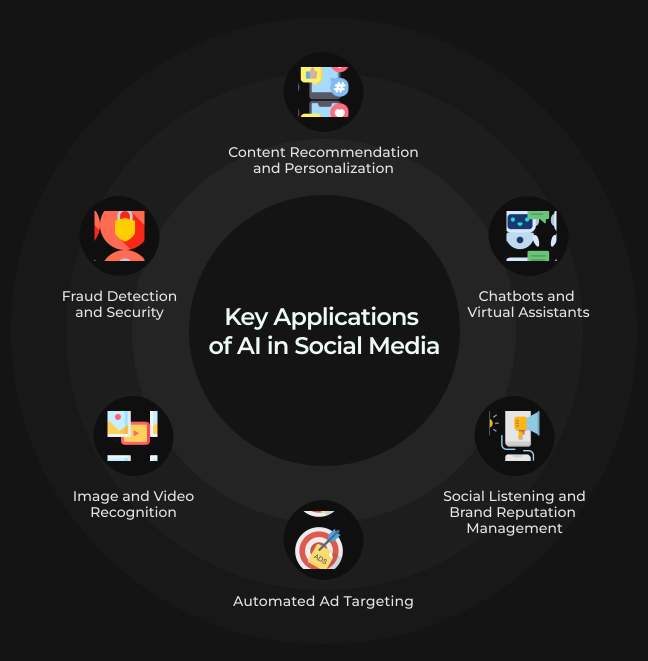
Content Recommendation and Personalization
Computer-algorithm-based methods scan user interests, behavior patterns, and engagement history to generate relevant content. These recommendation technologies engage users for longer periods by displaying posts, videos, and ads tailored to the users' specifications.
YouTube and TikTok use deep learning models to track:
- Watch time;
- Likes;
- Shares;
- Comments.
This allows them to dynamically curate feeds for the highest engagement. For example, if a user continues interacting with exercise videos, the AI prioritizes exercise routines, diet tips, and influencer posts on their feed.
Chatbots and Virtual Assistants
Now is the perfect time to launch an AI assistant for your business. For example, Erica, a fintech virtual assistant, has surpassed over 2 billion interactions and has helped 42 million clients.
The total cost savings from using chatbots reached $11 billion in 2022 and can save businesses up to 30% on customer support costs alone. How? AI-powered virtual assistants and chatbots:
- Handle customer inquiries;
- Automate responses;
- Improve engagement.
Bots employ NLP to create human-like responses and smooth brand interactions.
H&M has an AI-powered social media chatbot that recommends outfits based on customer interests and past purchases. The bot engages in real-time conversation, giving style tips and guiding users to product pages. It improves conversion.
Social Listening and Brand Reputation Management
AI technologies monitor brand mentions, sentiment, and industry trends in real-time on various platforms. Businesses use AI-driven insights to:
- Respond to customer opinion;
- Prevent potential PR crises;
- Optimize message strategies.
Coca-Cola uses AI-driven sentiment analysis to track what people are saying about its brand globally. If a negative trend becomes popular, the AI alerts the marketing team so that they can respond quickly, say, by launching good PR campaigns or addressing complaints directly.
Automated Ad Targeting
AI improves ad targeting by analyzing vast volumes of user information, segmenting audiences, and predicting which ads will perform optimally. Advanced AI models optimize ad positions, bidding strategies, and creative assets. This leads to greater interaction and ROI.
Facebook's ad system uses AI to show highly relevant ads. What does it analyze? Browsing history, buying behavior, and other ads users interact with. It ensures that an ad from a fitness brand is seen by those who've just searched for a gym membership or workout equipment.
Image and Video Recognition
AI-based technologies enable automated tagging, filtering, and moderation of content visuals. They help social networks to:
- Detect undesirable content;
- Facilitate greater accessibility;
- Support functions like AR filters and facial recognition.
Instagram uses AI-powered image recognition to identify and censor objectionable material, such as graphic violence or nudity, from people's feeds before it reaches publication.
Snapchat's AR lenses also use AI-based facial recognition to facilitate interactive and immersive user experiences like turning faces into digital avatars.
AI-Driven Trend Analysis
AI algorithms predict trending content by analyzing:
- Search terms;
- Hashtags;
- Engagement.
This allows brands and creators to tailor their content strategies and catch viral waves in real time. Twitter's trend detection approach using AI analyzes millions of tweets per minute to identify emerging conversations.
Fraud Detection and Security
Social media giants use AI to detect and block:
- Impersonation;
- Bot activity;
- Fake engagement.
AI-powered security solutions maintain platform integrity by identifying suspicious patterns and blocking threats like misinformation and scams.
LinkedIn uses AI to detect impersonating job postings and scam profiles through behavior. When an account is considered to be displaying bot behavior, the system instantly marks the account for review.
What does bot behavior imply? For example, it can be a huge number of connections in bulk or repetitive postings.
Integrate AI in Your Software
SapientPro's engineers will help you get any kind of integration.
Benefits of AI in Social Media
95% of senior leaders report active AI investments within their organizations. The proportion of companies committing $10 million or more is projected to almost double next year, jumping from 16% to 30%. Let's discuss the 4 main benefits of AI in social media.
More Engagement
AI remarkably boosts engagement by creating hyper-personalized experiences. Research by Meta shows that campaigns that use AI-powered tools have an average click-through rate 11% higher and a conversion rate 7.6% higher compared to those not using AI.
TikTok and Instagram use AI to understand user behavior and present users with content that keeps them engaged. AI-driven chatbots and voice assistants further drive engagement by offering instant responses and personalized interactions. This keeps brands fresh in the minds of their viewers.
Data-Driven Decision-Making
AI enables influencers and marketers to make informed decisions based on valuable insights from Big Data. To illustrate, AI optimizes advertisement targeting by evaluating user behavior so that brands find the most engaged audiences.
AI-powered analytics helps influencers determine topics that are in vogue as well as preferred audience interests to create more appealing content. Companies can predict customer needs and modify their strategies appropriately with predictive analytics. This helps boost ROI and conversion rates.
Faster Content Production
AI-powered platforms help creators and brands create great content within a few minutes. Captions, images, and videos generated with the help of AI automate content creation. This saves time and lets marketers devote it to planning instead of manual designing.
A Microsoft case study indicated that content generation aided by AI helps minimize content generation time by up to 70%. This shows that scaling marketing activities is easy in terms of time with AI.
Cost Reduction
By automating time-consuming tasks like customer support, content moderation, and ad targeting, AI enables businesses to reduce operational expenses. AI-powered chatbots eliminate the necessity for big customer support teams, while ad targeting done by machines eliminates ad wastage.
As McKinsey states, the productivity of marketing alone due to gen AI could increase by 5-15% of total marketing spend, worth about $463 billion annually.
Potential Risks of AI in Social Media
Artificial intelligence always comes with certain risks. We already know about hallucinations as the greatest issue with LLM models. However, there are still many other challenges.
AI-Powered Disinformation and Propaganda
AI can be abused to propagate disinformation through:
- Deepfakes;
- Fake media;
- Deceptive news stories.
A deepfake video of President Barack Obama went around on the internet, demonstrating how AI-generated synthetic media can perpetuate false stories. AI-based bots also power deceptive news. It is challenging for users to distinguish reality from fantasy.
According to iProov, only 0.1% of survey participants could accurately distinguish real from fake content across all stimuli, which included images and video. This study shows that AI disinformation remains a robust challenge for businesses, governments, and common people.
AI Propaganda and Political Manipulation
AI-powered bots can generate fake comments and spread some political narratives (AI propaganda). In August 2023, over half of adults in the United States expressed concern about the spread of political AI propaganda. 23% of U.S. adult respondents said they were somewhat concerned.
The 2024 U.S. election is a good example. Kremlin-backed news outlets swarmed social media with divisive content to shape public opinion. The overarching goal was to expand and exploit divisions, attacking the American social fabric where it is most vulnerable, along lines of race, gender, class, and creed. AI manipulation poses a great risk to the national stability of every government.
Privacy and Data Security
Social media AI relies on gigantic amounts of users' information in order to operate effectively. Here, privacy concerns and data safety come into the spotlight. Both TikTok and Facebook have attracted attention for gathering and processing individual information. AI runs the risk of initiating mass surveillance as well as the misuse of information without rules.
Algorithmic Bias
AI systems can inherit bias in the training data they are given, producing discriminatory outputs. In 2020, Twitter's AI-driven image-cropping feature was criticized for cropping white faces instead of black faces. This case study showed how bias in training data influences AI decision-making.
Biased AI censorship tools can censor a specific group disproportionately. At the same time, biased AI tools can allow harmful content from another group to pass through. And this is a huge challenge for AI in social media now that needs extensive improvements.
Use Cases of AI in Social Media Marketing
According to a recent survey by McKinsey, 77% of companies are either using AI or exploring its potential. Yet, despite this high level of adoption, the same report found that fewer than 20% of organizations achieve significant financial returns from their AI initiatives.
Let’s take a look at 3 use cases of AI in social media marketing that yielded great results.
Mercedes-Benz Used Data Drawn Out by AI to Design a Responsive Campaign
Mercedes-Benz launched an off-the-bat, in-market campaign at their office in Poland to promote their new T-Class vehicle. Called “The Moody Colors of Poland,” the campaign was aimed at getting people to listen to their moods. It showed them that they could reflect their mood with the color of the T-Class interior, where they had all eight tones of ambient lighting (happiness in yellow, relaxation in green, etc.).

The company used an AI system to scan and gather Polish social media on Facebook, Instagram, Twitter, and blogs based on emotion-based keywords and hashtags (#joy, #love, #sadness, etc.).
Depending on what mood its Polish fans had been in on social media the previous day, lighting on one of the floors of their headquarters building, billboard, and a special outdoor billboard showing the T-Class would change.
This is a bright example of AI in social media marketing. It is proof that AI insights on social media could be directly used to feed your marketing campaigns so that they become more creative and strategic.
Vanguard Is Experimenting with Messaging on LinkedIn
Vanguard Institutional is an American registered investment adviser. Brands that exist in highly regulated environments, like Vanguard Institutional, need guardrails to ensure that they stay compliant on social media. That is why the brand used AI to experiment with its messaging on LinkedIn.
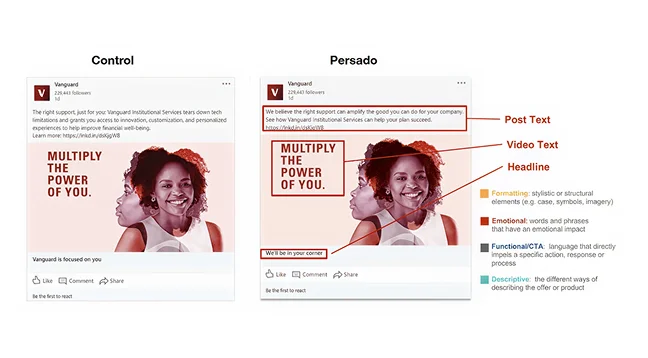
They released different copies of messages and segmented them to identify what performed well with the audience. This enabled the brand to make the most out of the social media messages that they send out on LinkedIn and create customer-specific content, something that their customers will likely react to.
Mastercard Started Jumping on Microtrends by Using AI-Based Data Analysis
Global brands require an early start to respond to social media microtrends. We mean three-day or less conversations that command social platforms.
Mastercard built an engine for digital marketing to monitor social media conversations and identify microtrends before they reach mainstream popularity. AI in social media marketing allows Mastercard to aim at appropriate trends by cross-referencing them with pre-approved subjects.
If it is a well-timed opportunity for MasterCard, AI will send a notice to the marketing team. And if they are willing to engage, the company reaches out with pre-crafted social media posts and focused advertising.
Statistics and Future Trends on AI in Social Media
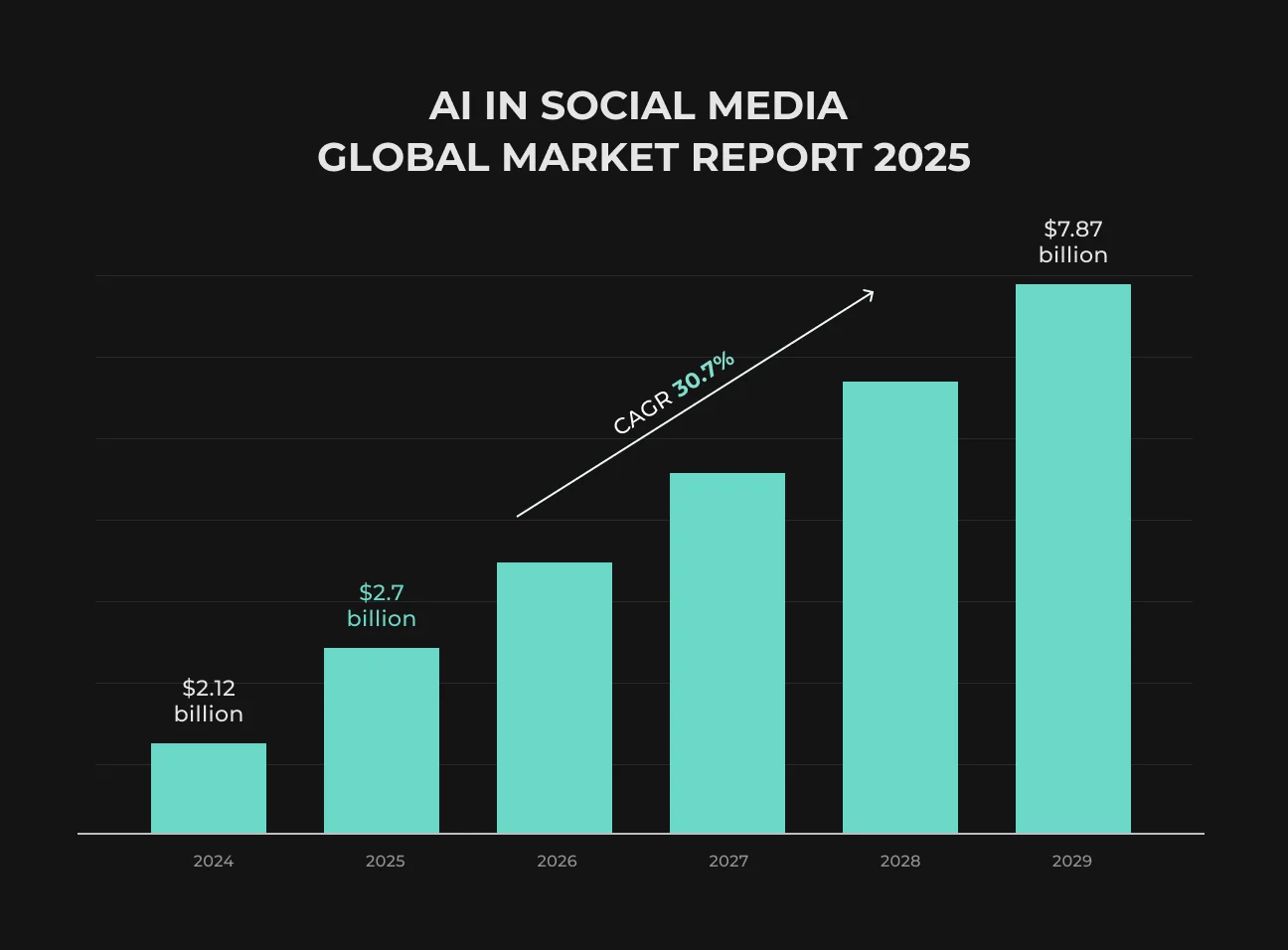
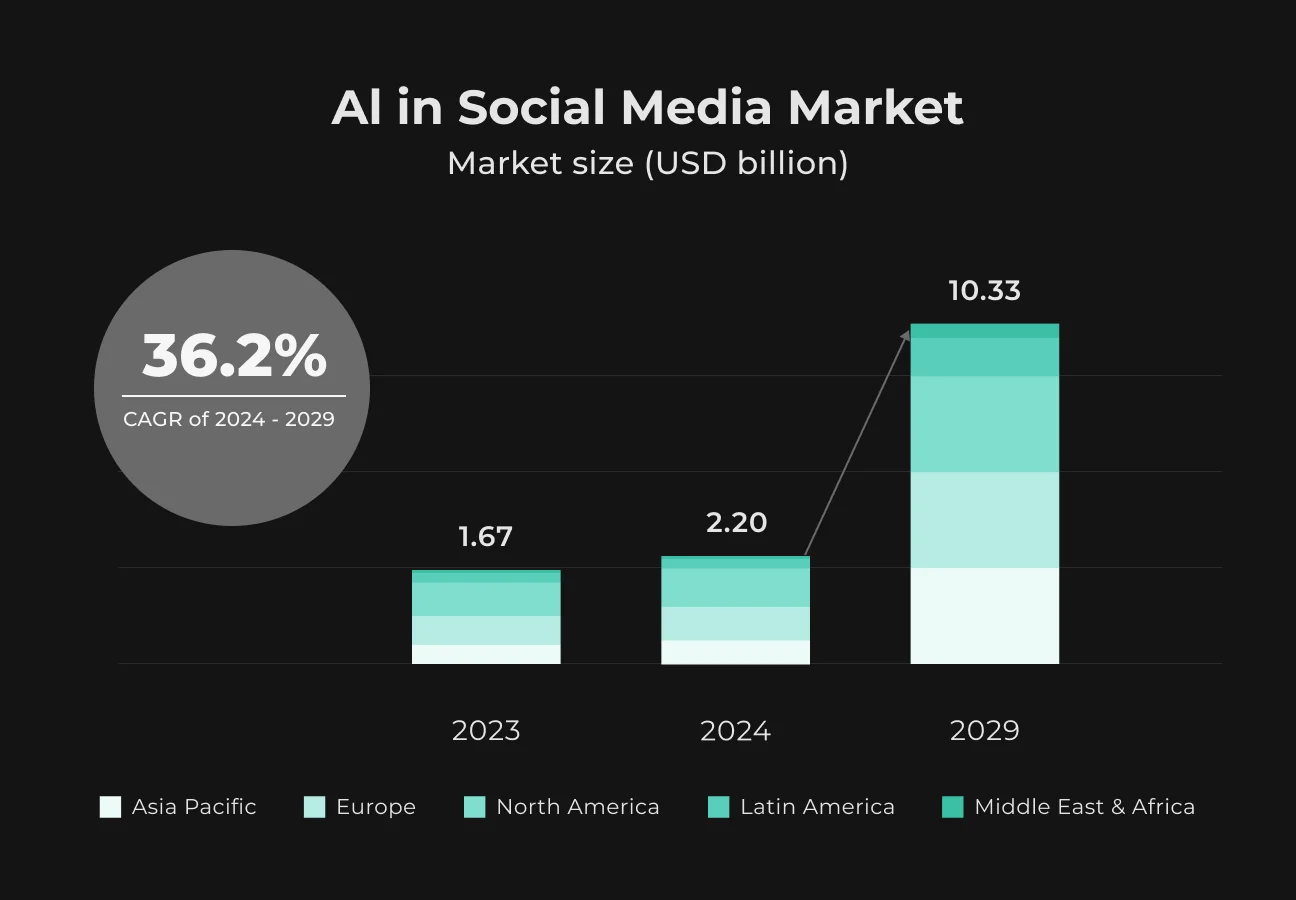
AI continues to change social media, powering tremendous growth and development on platforms. The global AI in social media market is anticipated to rise from $2.2 billion in 2024 to $10.3 billion by 2029 at a CAGR of 36.2%.
Here are a few key statistics highlighting AI's impact:
- Content creation. AI-created content accounted for an estimated 15-20% of all social media posts in 2023, up from less than 5% in 2022. That figure is predicted to be 25-30% in 2024.
- Influencer marketing. AI's role in influencer marketing is growing. AI-driven analytics accounted for 35% of all influencer marketing expenditure in 2024.
- Content recommendations. AI-powered recommendations influenced 70% of content consumption on social media in 2023, compared to 50% in 2022. It was expected to rise to 80-90% in 2024.
- Chatbots and virtual assistants. AI-driven chatbots and virtual assistants on social media rose to over 150 million in 2023 from 80 million in 2022. They were expected to cross 300 million in 2024.
- User engagement. Businesses that used AI for social media saw 15-25% growth in engagement rates. This resulted in higher revenues.
Artificial intelligence is only going to be integrated increasingly in our lives. Companies that leverage this trend first will become the leading bodies in the social media industry.
Partner with SapientPro to Build Your AI-Powered Solution
SapientPro’s engineers are experts in AI development and integration. We’ll help you improve current systems, build new ones, and effectively scale your solutions. Check out our case studies to see how we’ve helped other companies with powerful AI solutions.
Partner with SapientPro today to bring your innovative ideas to life. Let's build the future together!
Leverage AI for Your Business
SapientPro's engineers will help you bring any idea to life.

FAQ
How is AI used in social media?
AI in social media is used to make content more personalized, automate customer service via chatbots, analyze trends, target ads more efficiently, improve content moderation, and improve image/video recognition. These help businesses reach users more efficiently and effectively. How? All thanks to customized experiences and optimized interactions.
What is the advantage of AI in social media?
Social media AI improves interactions by making content more personalized, accelerating decision-making processes, and automating processes. AI allows businesses to create more context-specific ads, monitor posts more quickly, accelerate content creation, reduce operating costs, and more. How does this help? This contributes to a better, more efficient, and responsive user experience.
What are the top AI tools for social media management in 2025?
Some of the best AI social media management platforms of 2025 include Hootsuite AI, Sprinklr, Buffer AI, Lately AI, and Socialbakers AI. They use machine learning and data analytics that are continually improved. Thanks to these AI tools, you can control your social media presence more efficiently, automate tasks, and optimize campaigns.
What are the latest trends in AI for social media marketing?
The latest social media marketing AI trends include the growing use of AI content creation. We mean creating captions, images, and even virtual influencers. Sentiment analysis and social listening platforms powered by AI are also on the rise, as well as personalized ad targeting and automated campaign management. Voice search integration and audio content powered by AI are also increasing.

