All How to Build an MVP for Your Startup: Checklist & Guide
Updated:July 27, 202610 min read


Let's look at some eye-opening stats. Most startups experience challenges, with over two-thirds failing to provide investors with positive returns. Surprisingly, only 10% of startups survive their first year, and almost 123,000 businesses shut down every day.
At the very start, many new companies face a daunting product development process filled with crucial decisions and risks. Startups often fail due to reasons like simply not understanding their customers or poor management of technical debt.
SapientPro’s team knows how launching with an MVP can influence a business’s success and revenue generation. A well-planned MVP allows startups to test ideas, assess their potential, and choose the best direction, reducing the risk of failure and saving time and money.
Read on for our MVP development checklist and see how it can transform your startup.
Key Takeaways
- A minimum viable product (MVP) is the bare-bones version of a product that solves a key issue or offers a great benefit to users;
- High-fidelity MVPs are advanced prototypes, something like detailed mockups. They allow us to deeply analyze user experience and engagement;
- During MVP creation, you can quickly present your product, gather user feedback, and test your core concept with minimal resources;
What is an MVP?
A minimum viable product (MVP) is the initial version of a product that solves a major issue or offers a great perk to users. It's about trying something out with ease first to see how it works.
Take Facebook, for example. It started as a simple setup for Harvard students with just profiles and friend lists. This MVP checked if the idea had promise, setting the stage for growth and new features.
An MVP is not about perfection. It involves offering just enough value to interest users and gather insights. Consider a ride-sharing app MVP. It might only connect drivers with riders, without extras like carpooling or luxury services, to determine market interest before adding features.
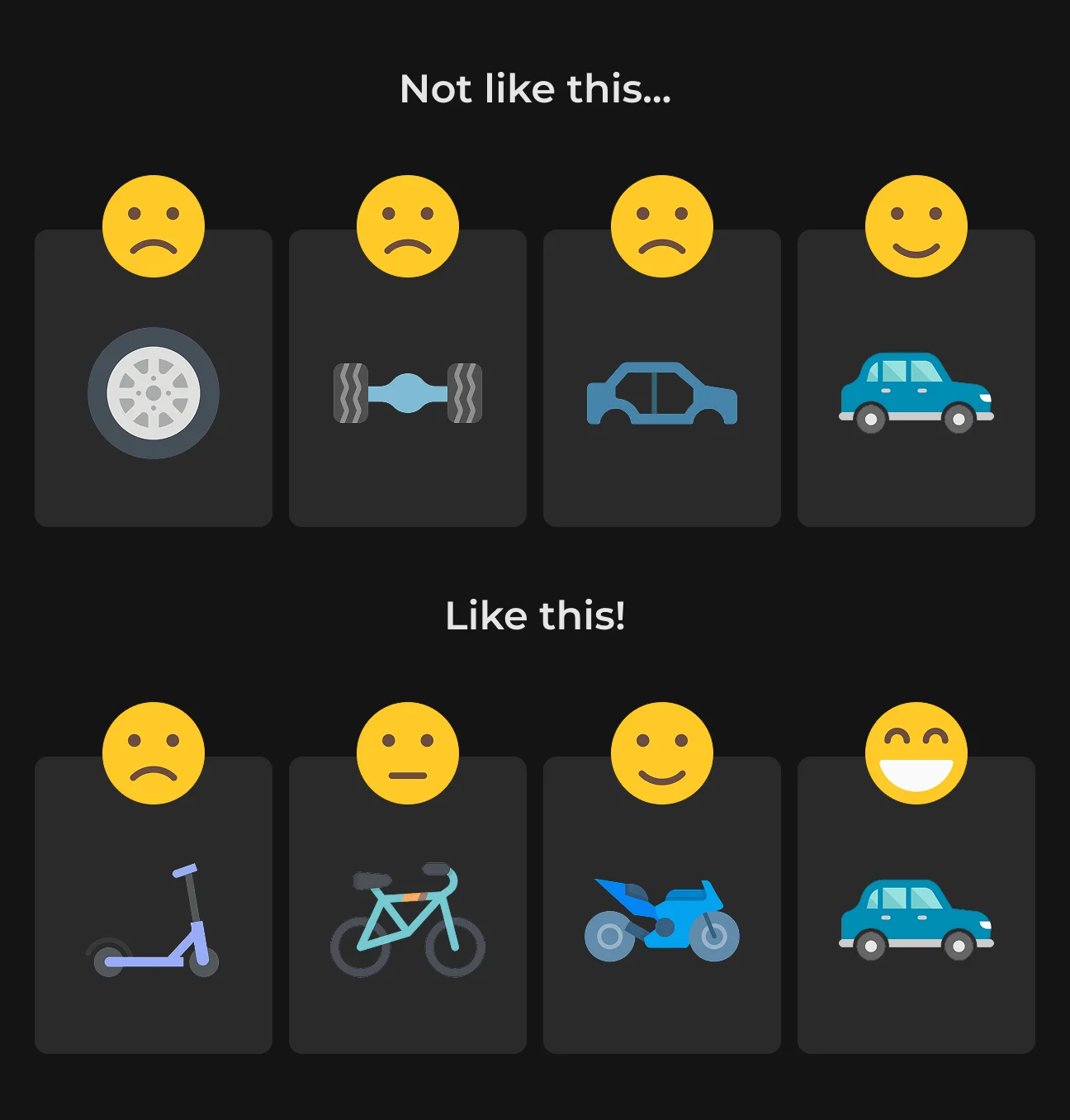
Here’s why an MVP is crucial for startups:
- It prevents wasting money on unnecessary features by identifying what works, saving financial resources;
- It shows what users really want, giving useful insights without a ton of research;
- It proves demand, drawing in investors with real-world validation, making funding easier to get.
MVP Development Statistics
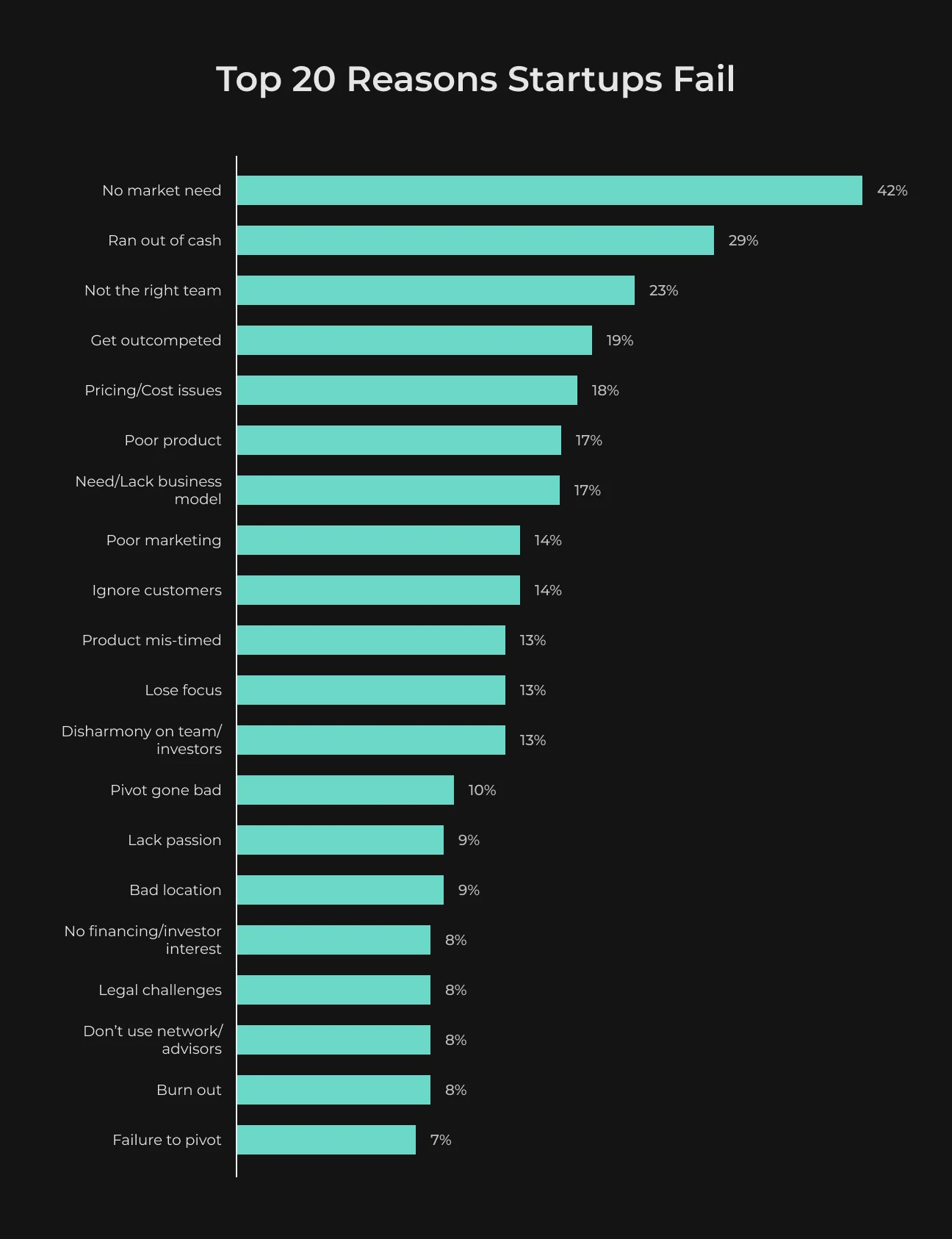
Did you know that 42% of startups fail because they make products no one wants? Another fact is that 68.6% of businesses struggle to understand their customers.
Entrepreneurs might not always recognize how essential an MVP is for startups. MVPs help with product design, clear up communication misunderstandings, and allow for cost-effective development. Exploring the potential of MVPs systematically might be the key to entrepreneurial success.
As startups grow quickly, they might often add features in a hurry. Without a clear MVP startup strategy, they can build up technical debt, much like accumulating a large loan. Engineers may then spend around a third of their time solving complex issues.
Seeking speed, startups might adopt quick fixes without thinking about future problems.
Types of MVP for Startups
Let's now look at two approaches to building MVPs and what the key differences are between them.
High-Fidelity
Let's discuss why high-fidelity solutions are important. We create these products to:
- Detect market demand effectively;
- Attract early adopters and establish a presence in the market;
- Test our value proposition, communication methods, and calls to action;
- Accelerate our design improvements;
- Perfect our product marketing strategies.
High-fidelity MVPs are advanced prototypes, similar to detailed mockups. They allow us to deeply analyze user experience, interface, and engagement. However, be aware that some MVPs can be demanding to maintain once launched.
Let’s now look at four popular high-fidelity MVPs:
- Concierge MVP. In this model, real people step in to do tasks an automated system would usually take. Users get manual assistance to enjoy the app's main functions. It's perfect for projects like recommendation systems or those that use machine learning.
- Wizard of Oz MVP. This approach expands on the concierge model by offering a product that looks fully automated, although humans are running it behind the scenes. Users think the app is powered by smart algorithms, without knowing about human involvement.
- Piecemeal MVP. This method mixes manual efforts with existing services to mimic missing features. You might use different tools for various purposes, like gathering data, automating tasks, or front-end development.
- Single-feature MVP. This approach delivers just one main feature to show users what the product does. More features can be added later, but not in the first version.
For example, SapientPro first launched Contentoo as a high-fidelity MVP with basic features. The platform's foundation showed investors its future potential, securing €6M in funding for further development and promotion.
Low-Fidelity
Building an MVP doesn't always mean creating a fully functional version. Sometimes, less is more. Low-fidelity MVPs allow startups to:
- Assess if the product is valuable;
- Understand customer needs better;
- Discover the most desired solutions;
- Evaluate niche markets to decide if the issue is worth solving.
Some examples of low-fidelity MVPs include:
- Blogs. You can post your product idea on Medium to see if people are interested;
- Forums. Get feedback and check relevance on sites like Reddit;
- Surveys and questionnaires. Use Google Forms to test your product idea;
- Explainer videos. Make short videos for social media and forums to explain your product;
- Advertising campaigns. Launch targeted campaigns to test ideas by analyzing engagement;
- Mockups and presentations. These are useful for sales meetings or pitches.
5 Steps on HOW to Build MVP for Your Startup
During MVP creation, you can quickly introduce a product, gather important user feedback, and test your core concept with minimal resources. Here’s how to make your MVP successful.
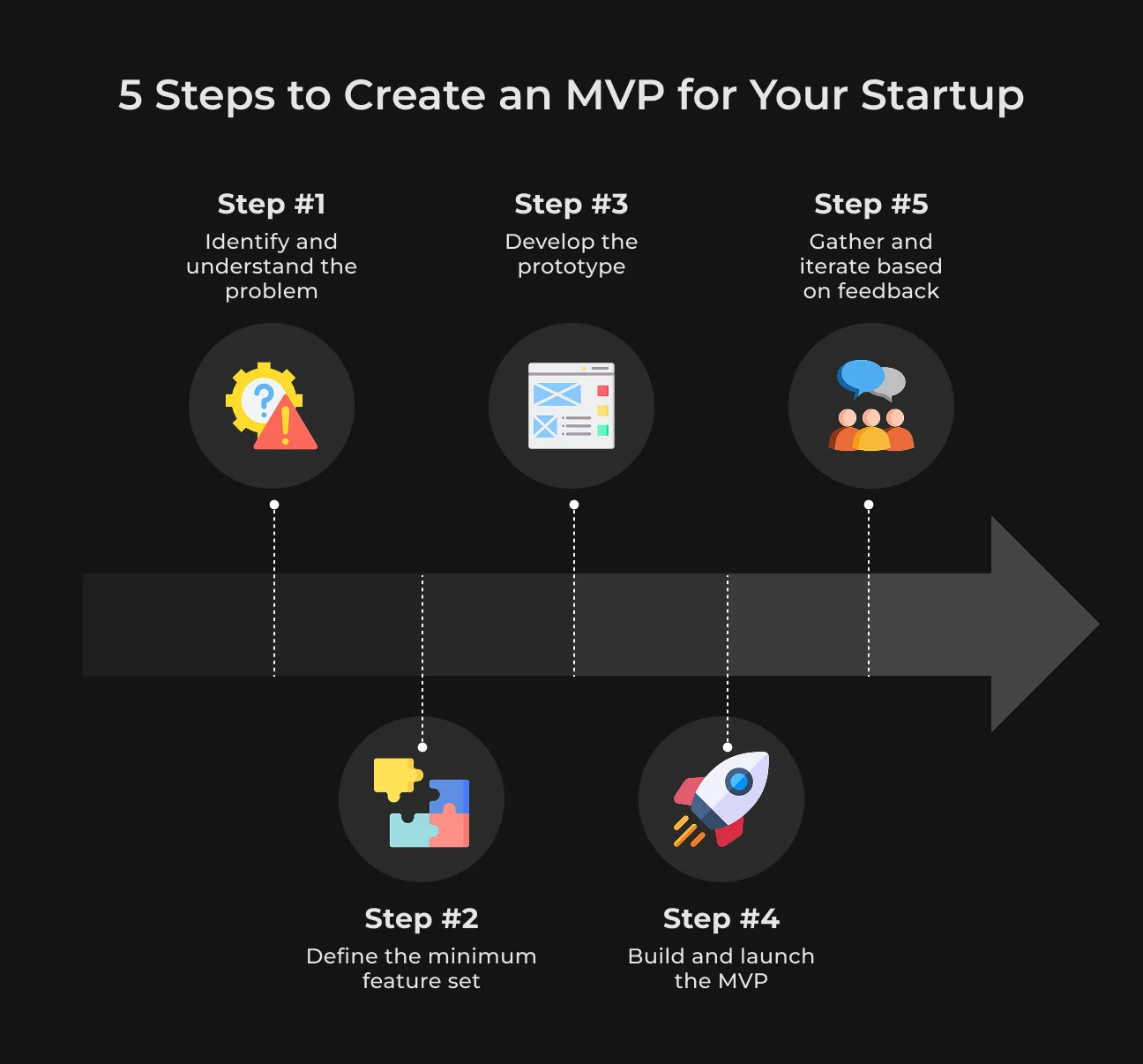
1. Identify and Understand the Problem
Clearly outline the problem your product addresses and confirm there is a true demand for it. You can simplify this by:
- Conducting thorough market research and interacting with potential customers to confirm the issue;
- Using surveys and interviews to collect detailed information and identify pain points.
For example, one key tactic that Dropbox used to become a standout company was creating a minimum viable product. Dropbox started with a simple explainer video that demonstrated the solution without needing any coding.
This clever move proved the demand and resulted in 70,000 signups almost immediately. The video was a simple three-minute demo of the technology, aimed at tech-savvy early adopters.
2. Define MVP Minimum Feature Set
Pinpoint the features required to solve the problem without getting into complexity. Begin with a list and apply the MoSCoW method: Must-have, Should-have, Could-have, and Won't-have, to sort out your priorities. Getting this first cut right is often where founders bring in MVP development services, since a team that has scoped many first releases can tell a must-have from a costly distraction.
This is what Buffer's founders did. They made a simple two-page landing page. Page 1 described the product's benefits, and Page 2 asked for email addresses with a call-to-action, "Sign up to be notified when we launch."
They posted it on Twitter to gather feedback and see if people were willing to share their email addresses.
3. Develop the Prototype
Take your ideas and create something people can test to get feedback. Begin with basic wireframes or interactive prototypes using tools like Figma or Sketch. This way, you’ll understand how users navigate and see any issues.
Focus on customer experience has boosted companies' repeat business by 12%, increased referrals by 17%, and attracted 23% more new customers.
4. Build and Launch the Product Development MVP
Make an app with the main features and release it to a group of users. We recommend using agile methods to keep improving it quickly, with constant integration and delivery. Many first-time founders reach this stage before anyone owns the technical decisions behind the product. Bringing in a fractional CTO covers that gap during the build, which keeps scope and stack choices under senior review.
About 52% of teams use the agile method to launch their MVP faster. Quicker product launches mean greater revenue and the chance to increase it even more. Plus, more than 70% of agile organizations are quite happy with the outcome.
5. Gather and Iterate Based on Feedback
It’s now time to listen to your users. Check out how they're using your product. You can choose Google Analytics to watch their behavior. Use what you find to tweak and upgrade your product and keep the improvements coming.
For example, Instagram started as an app called Burbn for event check-ins and planning meet-ups. However, people preferred to share photos as it turned out. So, the creators focused on that idea and gave us the Instagram we all love today.
5 Common Mistakes During MVP Development
Avoid these five major mistakes that can ruin your MVP and set you back.
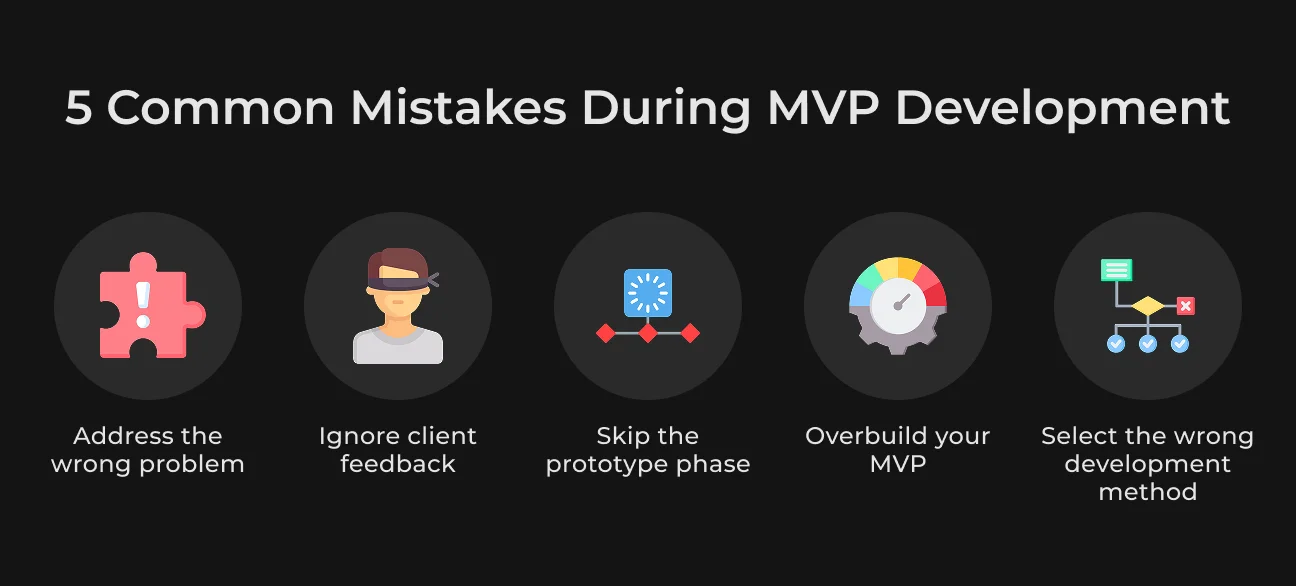
1. Addressing the Wrong Problem
Startups often fail because their products are not something customers really need. This emphasizes the importance of clearly understanding the issue before jumping into developing your MVP. Is the problem truly worth solving? Consider asking yourself these questions:
- Who is this for? Focus on a specific group rather than aiming for everyone;
- What problem does it solve? Concentrate on a real issue that needs fixing;
- Is your idea the best solution? Make it unique compared to what’s already out there.
You need to understand your audience and solve their problems in order to succeed. Your MVP will only work if it's aimed at the right people and fixes something important for them.
2. Ignoring Client Feedback
Your MVP should be all about gathering feedback. If you ignore user opinions, then you risk ending up with a product no one likes. In fact, 91% of people think companies should innovate by listening to their customers, but only 31% think hiring a team of experts is a better approach.
The fix is simple: make feedback a priority. Just create surveys, interviews, and analytics to figure out how to improve your MVP. Create a system that values and prioritizes user feedback.
3. Skipping the Prototype Phase
Starting your MVP without a prototype is a bad idea. A prototype is your handy blueprint, showing how your idea might function in real life. It lets you figure out how things flow, spot any issues with user interactions, and fine-tune your plan.
Plus, a prototype gives everyone (including investors) an understanding of its promise and identifies any issues early on. By trying things out with a prototype first, you can avoid expensive changes in the future.
4. Overbuilding Your MVP
When creating an MVP, don't make everything to its maximum. Stick to solving the core problem and resist the temptation to add extras. Think about essential features only, quickly roll out a basic but practical version, and use real feedback to master it later.
Just stay simple and flexible to launch quickly, reduce risks, and improve your chances of creating something users will truly enjoy.
5. Selecting the Wrong Development Method
Many companies struggle when they dive into development without the right approach. There are actually two main methods for developing an MVP: Agile and Waterfall.
The waterfall method is a straightforward, step-by-step process. It works great for projects with set requirements. Yet, it isn't flexible and doesn't allow for much feedback after development starts.
Agile, on the other hand, excels in iteration and flexibility. This makes it perfect for MVPs and has a 28% higher success rate than traditional projects.
It allows teams to adapt continuously and integrate user feedback into development. This approach enables faster releases and keeps the MVP responsive to real user interactions.
How to Measure MVP Success?
Measuring the success of your MVP is akin to planning a presentation of your product and gauging its impact on the market. Here's how to test its market resilience:
1. Customer satisfaction and feedback. This is what customers actually think about your product or service. It could be divided into:
- Net promoter score (NPS). Are customers raving about your business or saying their critiques? A high score indicates they're eager to share their positive experiences;
- Customer satisfaction (CSAT). How much do users love (or dislike) specific features or your product?
2. User engagement. Are users active participants or passive observers? The following metrics are:
- Activation rate. What percentage of users start to act right after signing up?
- Retention Rate. How many stay long-term?
3. Growth metrics. Does your product really bring something new?:
- User acquisition cost (UAC). What is the cost of acquiring a new client? Lower is better;
- Organic growth. Do clients choose your product or service because everyone’s talking about it and not just because they saw an ad?
4. Financial metrics. Will your product's wallet withstand all the time?
- Revenue. Has your product already started generating revenue for you?
- Burn rate. How quickly is your product consuming its hosting budget?
5. Market fit. Does your product actually fit the market? Let's see the precise metrics below:
- Churn rate. What percentage of users leave? Lower rates indicate that people don't highly desire your product or aren't willing to pay for it;
- Feedback on features. What's working and what isn't? Use this input to refine and better your product.
How Much Does it Cost to Build an MVP
Planning a budget before starting MVP development is a must. Without a clear understanding of the associated costs, you can simply get stuck halfway, while being short on resources and funds. In fact, 38% of startups fail because they either drain their funds or struggle to attract good investors.
Thinking of proper budgeting for a minimum viable product just keeps you on the right track. A basic MVP, for example, might cost around $10,000. For a more complex product, the cost could rise to $50,000. In larger markets, advanced MVPs can reach up to $150,000.
Still, the price for building an MVP for startups is unique for every project. It always depends on factors like your team, how much the developers charge per hour, and their skills.
Activity | Estimated Cost ($) |
| Market research and planning | $3,000 - $6,000 |
| Wireframing, prototyping, and UI/UX design | $5,000 - $10,000 |
| Frontend and backend development (+ API integration) | $20,000 - $50,000 |
| Functionality testing and bug fixing | $2,000 - $5,000 |
| Deployment to live environment | $1,000 - $3,000 |
| Post-Launch support and iterations | $2,000 - $5,000 |
Also, there are some hidden MVP development costs you should be aware of. Here are common expenses that tend to shock first-time founders:
- Cloud hosting and infrastructure. Services like AWS, Google Cloud, or Azure can add $500–$1,000 per month to your bill, even for a simple MVP;
- Project management. Hiring a project manager or agency can cost between $4,000–$6,000;
- Third-party integrations. Expect to spend an additional $200–$500 monthly, depending on the integrations you choose;
- Legal costs. You may need $2,000 to $4,000 upfront to avoid future legal issues;
- Marketing. Plan for an extra $2,000–$10,000 initially for ads, content, and social media marketing;
- Customer support. Setting up support can increase costs by $1,000–$3,000 monthly (depending on the tools and staff required).
All the costs mentioned above are just average estimates. The actual cost to develop an MVP for your unique project will depend on your product's goals and complexity level. For an accurate estimate, just get in touch with SapientPro's team, and our experts will answer all your questions.
SapientPro’s Approach to MVP Business Development
For six years, the team at SapientPro has been turning MVP apps into world-famous products with multi-million dollar backing. Check out how we turned a simple MVP into the MasTrack GPS tracking platform.
MasTrack was designed for businesses and users who need real-time vehicle insights. It offers live tracking, alerts, and reports without any tricky installations. We gave MasTrack a complete makeover with some clever ideas:
- Instead of patching the old system, we rebuilt it from scratch, making updates and future tweaks an easy process;
- Our backend runs GPS signals in real time, so you can instantly see location, speed, and route on any device;
- We created a universal parser to read data from various GPS models;
- The user and admin dashboards got a makeover for easier navigation and management.
Advanced new features included:
- Live vehicle tracking;
- Alerts that pop up just when you need them;
- Device-independent setup;
- Custom reports;
- User roles and subscription management.
Transforming an MVP into a full-fledged product can be challenging, but with the right tech partner the process becomes much easier.
Team up with SapientPro to Build Your Startup

Your Startup’s MVP Development Checklist
Creating an MVP checklist is a necessary part of your preparation process. It's like having a precise script before a presentation, where you want everything to go smoothly. We'll offer you a simple minimum viable product checklist below:
Stage | Requirements |
| 1. Initial market research and planning |
|
| 2. Feature selection |
|
| 3. Design |
|
| 4. Development |
|
| 5. Testing and QA |
|
| 6. Pre-launch preparations |
|
| 7. MVP launch |
|
| 8. Post-launch |
|
| Some extras |
|
Partner with SapientPro to Bring Your Idea to Life
SapientPro is your trusted partner in MVP development and scaling. For over 9 years, we’ve been building solutions, fitting them into existing systems, and revamping old frameworks. Our engineers create innovations to launch your business into the future.
Partnership with SapientPro means you get the latest and greatest practices customized for you.
Contact us for a consultation and let's bring your vision to life.
Discuss your project with SapientPro