
All How to Build a Converting Lead Scoring Model: Step-by-Step Guide for B2B Companies
December 19, 202515 min read


Businesses often find it challenging to handle a large number of leads, especially in the competitive industry of B2B sales. And if you have many leads, not all of them will be matching your requirements. You’ll waste hundreds of hours working through them.
Best-in-class B2B teams usually convert 15-25% of leads into opportunities, 20-30% of demos into proposals, and close 25-40% of proposals into deals. This is a concern sales teams often have. They could be simply wasting effort on prospects who might never become clients. That’s where automation comes into play.
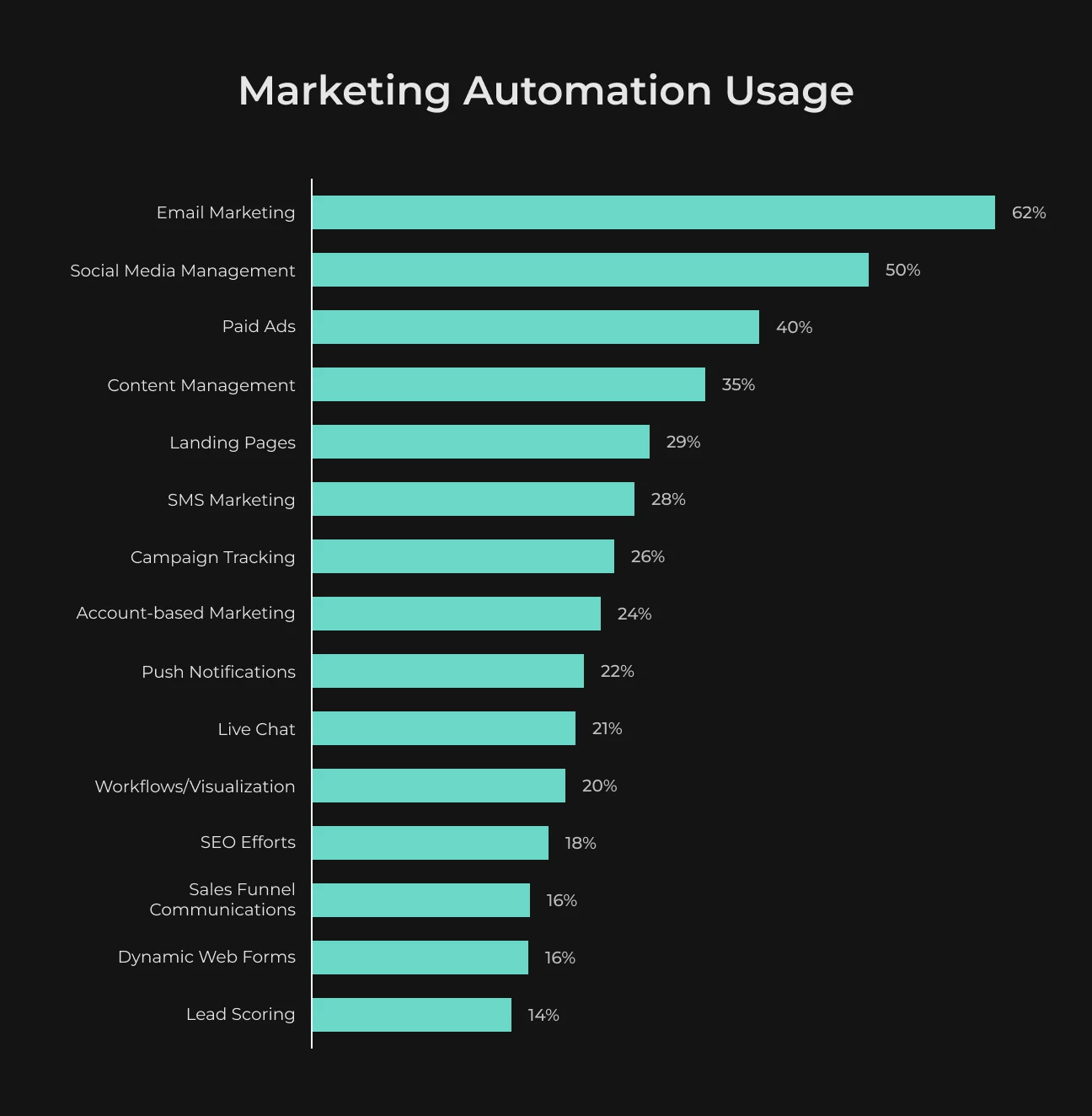
From a sales perspective, lead scoring can give you an idea of which leads are worthy of more attention or what sales strategies simply aren’t working to increase your conversion rates. This strategic model enables brands to leverage their investment and reach their objectives sooner.
This guide from SapientPro will help you learn how to create a lead scoring model that actually works. Let’s lead your B2B or B2C business to reach those leads that have potential.
Key Takeaways
- Leading B2B teams usually convert 15-25% of leads into opportunities;
- Lead scoring helps teams decide what course of action to take and how far a prospect can go in the buying process;
- Predictive lead scoring allows for minimizing human error and prioritizing quality leads with greater accuracy;
- The global lead scoring AI market is predicted to reach $7.8 billion by 2033.
What is Lead Scoring?
Lead scoring is a way of ranking sales leads objectively. It gives teams signals that help them decide what course of action to take and how far a prospect could be in the buying process. Lead scoring basically allows marketing and sales to cooperate.
By allowing both teams to explain what they believe is a good lead, they can quickly respond to each other with useful feedback. This makes it more likely that sales representatives will continue to follow up on the promise.
Marketing specialists tend to have a lot of leads that go over, but sales often deal with long lists. Sales teams may attempt to call a couple of times, but often stop if they think the leads won't be relevant. Lead scoring measures how well the lead matches the ideal customer profile and their level of interest.
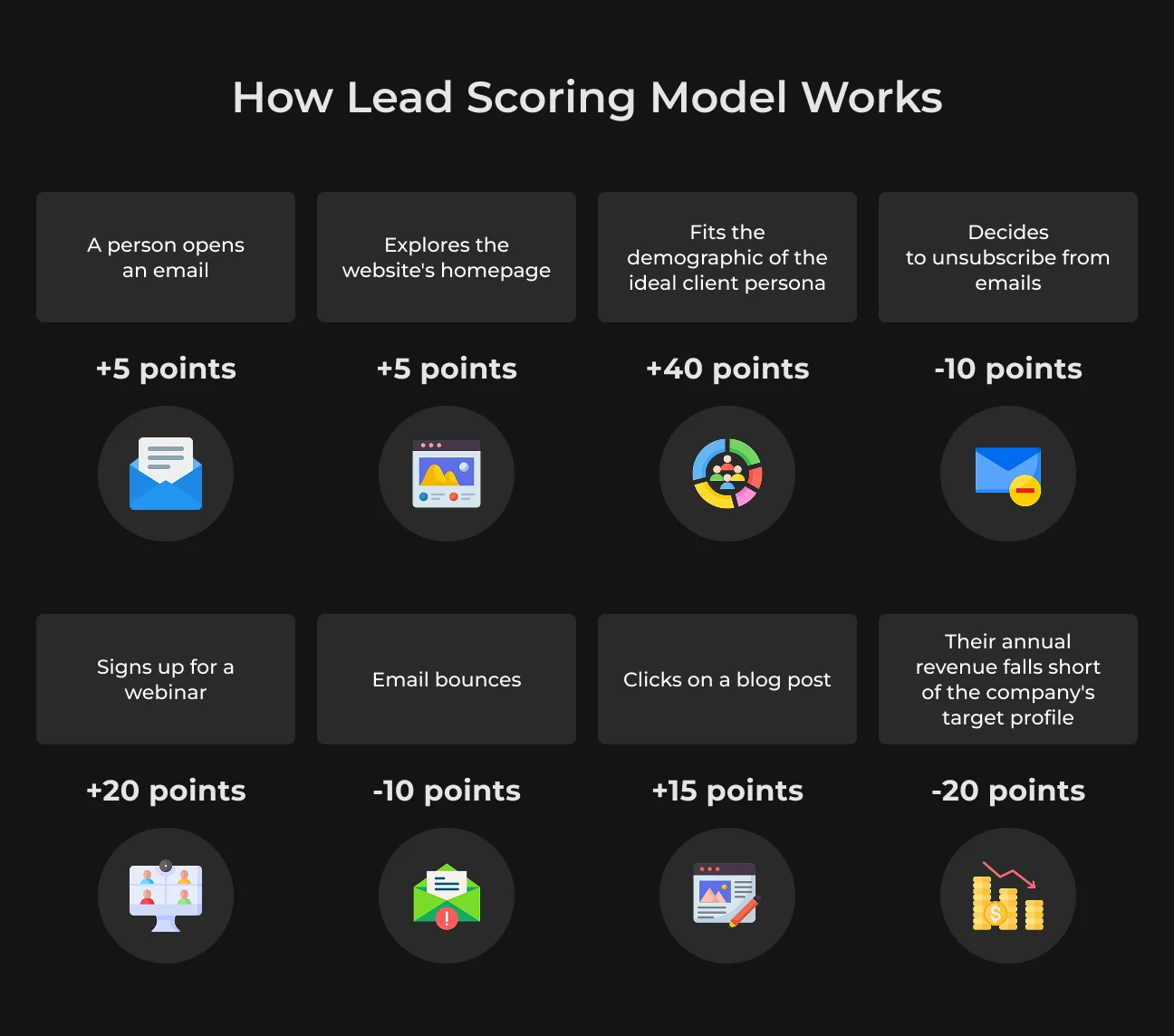
For example, if a potential buyer views just a couple of web pages, it might indicate that they’re merely ready to buy now. Investing much time in nurturing these leads could be a waste of effort. But if prospects request a product demo or fill out a contact form, they're likely to be interested and may need more information from a sales manager.
Lead Scoring Criteria Examples
Every lead scoring implementation framework is different, as it’s based on each company's circumstances and goals. Still, there are some general criteria we suggest you think about when creating your lead-score model.
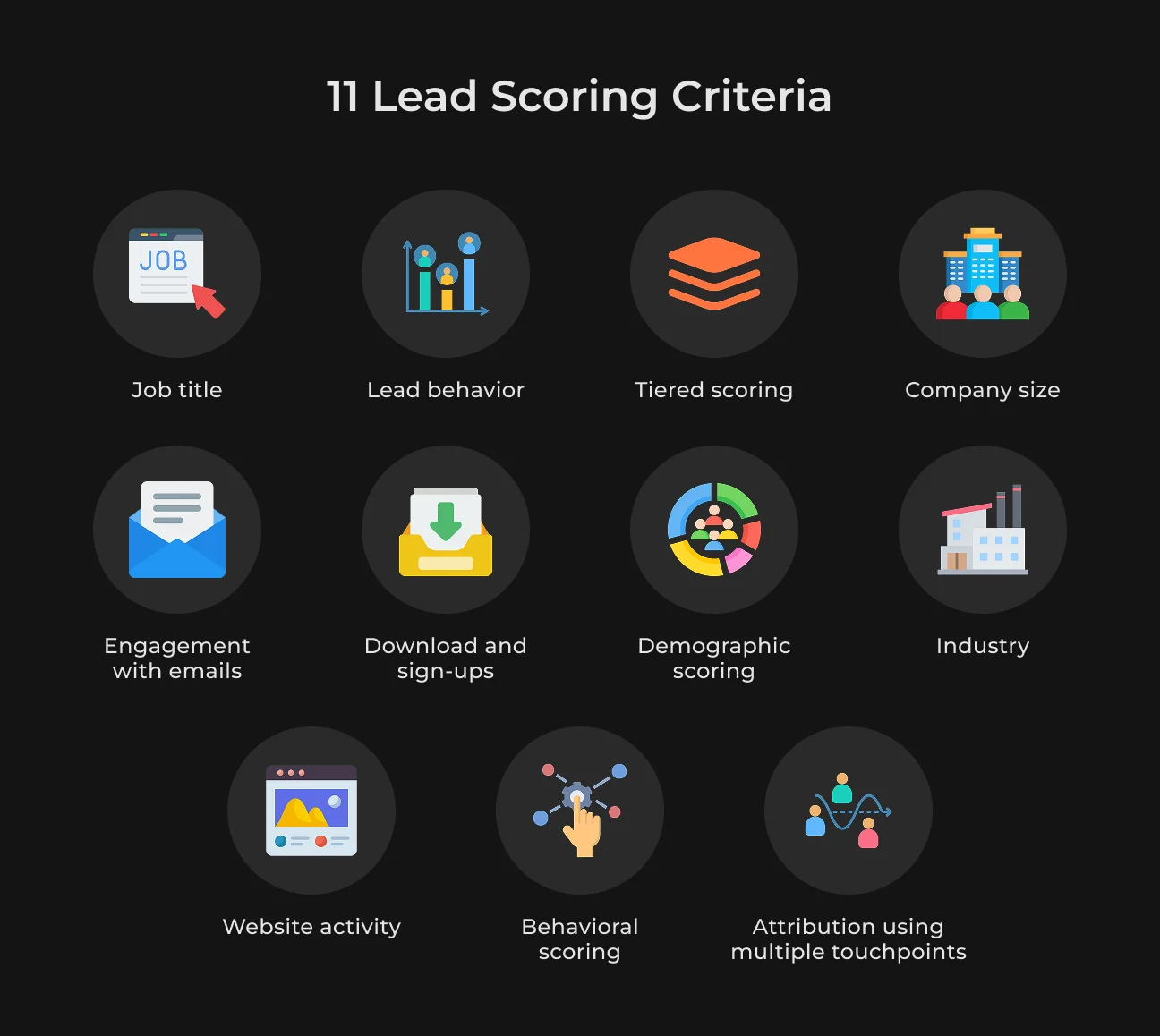
1. Company Size
Think about your targeting customers and just how many of their problems you can solve. Adjust your scoring system to company size and revenue. The more you align with your ideal customer profile, the sharper your approach to engagement.
2. Industry
Describing leads by industry enables you to better position your offers against their unique needs or pains. That means you can provide more relevant communication and offers.
3. Job Title
Questionnaires commonly have a question, like what your job is, when you sign up for a software service. And there’s a reason for that. Job titles show how much power and influence a person has in their company.
By scoring job titles, you make sure you are talking to the right decision makers or influencers who can help move the sales process forward.
4. Engagement with Emails
Your lead’s behavior with your emails is a sign of their interest and responsiveness. If they click and interact with your email content regularly, that shows strong engagement with your business offers.
5. Website Visits
How often and when leads check key pages on your website shows you how interested they are. Tracking visits to product, pricing, or testimonial pages can provide insight into a lead’s level of interest.
6. Lead Behavior
Understanding how a lead shows interest both online and offline can help you better connect with them. By examining web, email, content, or event interactions, you can begin creating a detailed background for lead scoring with minimal extra effort.
7. Downloads and Sign-Ups
Think about what exactly that value proposition is that will make people sign up. Here, lead magnets could be free digital downloads (e-books, checklists, etc.) that are opt-in offers.
Yet, if visitors are interacting with your content, let’s say by signing up for webinars or joining events, this is a signal they are more interested and could be further down the buying journey.
Beyond those basic lead scoring criteria, read on for more advanced methods you can use to refine your lead scoring model.
8. Behavioral Scoring
Behavioral scoring is analyzing how leads interact with your brand. It allows you to score points for activities like opening emails, visiting your website, or engaging on social media.
After, you can take an alternate approach based on how the lead is acting to meet their interest level.
9. Tiered Scoring
The concept of tiered scoring is to create different types of score models based on audience categories. You might, for example, use one scoring model for leads coming from small businesses and another for those coming from large companies.
This approach allows the assessment of leads to become more unique, based on the varying aptitudes and scenarios across segments.
10. Demographic Scoring
Whereas a standard lead scoring model may take into account general demographic criteria, advanced demographic scoring delves deeper. For instance, you could study job titles in a given industry, company size, region, etc., in your scoring model to start improving it.
Early-stage companies might not require this in-depth demographic scoring. But as you grow, gathering additional data about your segments will be critical to providing the most personalized experience for every user.
11. Attribution Using Multiple Touchpoints
Multi-touch attribution is all about assigning credit to every channel and touchpoint a lead engages with. You can see the full journey a lead takes and thus understand which engagements force conversions.
Lead Scoring Model Examples
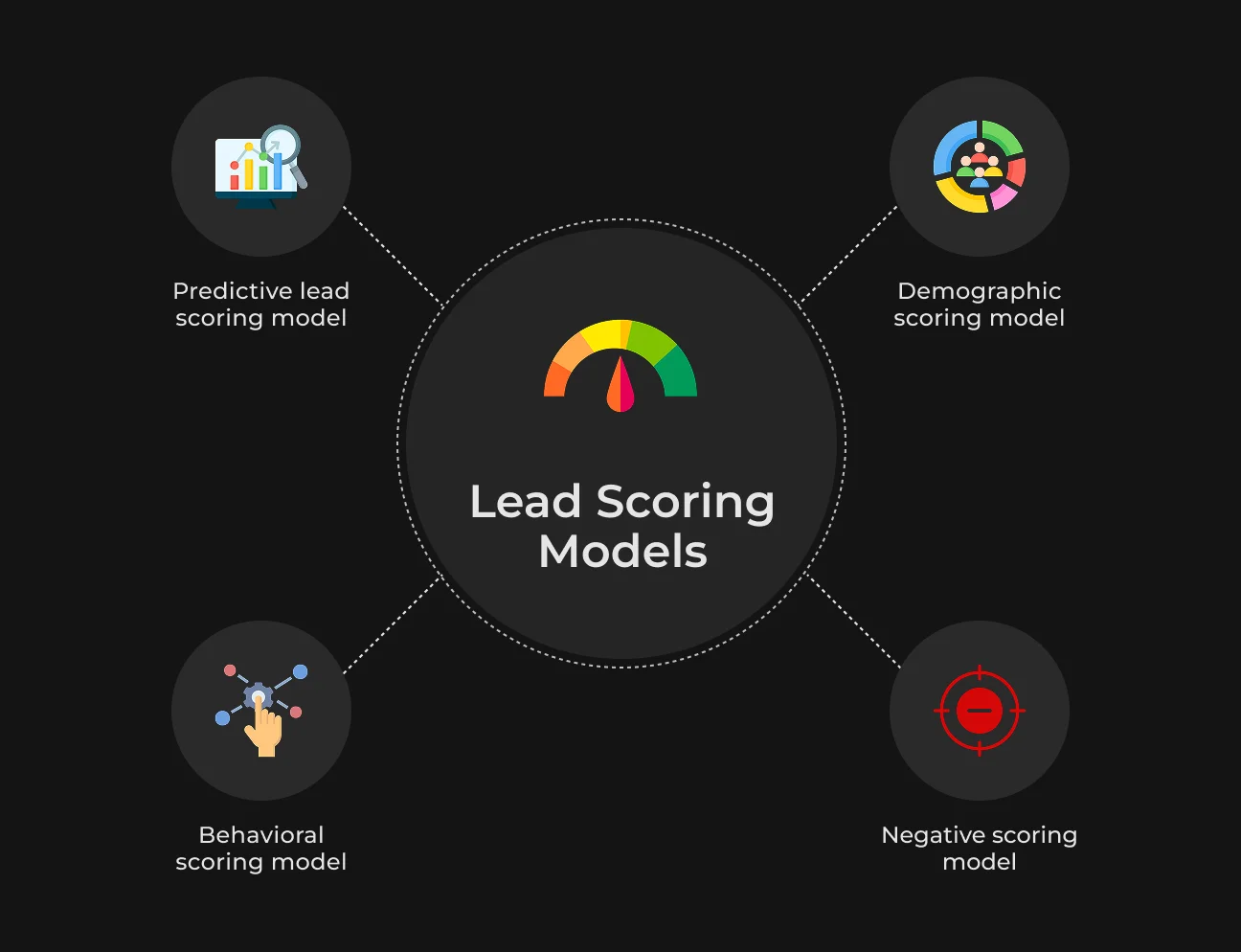
There are different lead scoring models based on your business goals and customer profile. You can also mix or customize them. Here are a few popular types.
Predictive Lead Scoring Model
Predictive lead scoring allows you to reduce human error and prioritize top-quality leads with higher accuracy. It is based on so-called predictive modeling — a statistical method of predicting future behavior based on past behavior.
The predictive model is fueled by data leveraged from integrated CRM and marketing automation tools. It can create the perfect customer profile with clues about who is most likely to buy, based on past demographics and activity. Those are the warm leads, or potential relationships, that show the most interest toward the company.
Behavioral Scoring Model
This model scores the actions of a lead, including visiting your website, downloading content, attending webinars, and opening marketing emails. Higher-scoring leads are those that take more interest in your product or services.
Demographic Scoring Model
This model scores against demographic data like age, location, company size, job title, or industry. It focuses on leads that closely fit the ideal customer profile (ICP).
You just have to check the demographic criteria and identify leads that are less likely to convert. So that you can focus on those with higher potential.
Negative Scoring Model
Negative scoring helps focus on quality leads by giving negative points for red flags (unwanted behavior). These can be invalid contact information or demographic issues. Negative scoring eliminates unqualified prospects more quickly, saves time, and increases sales productivity.
With a combination of negative and positive scoring, your team can automatically zero in on promising leads and dismiss the rest without manual effort.
How to Build a Lead Scoring Model: Example & Best Practices
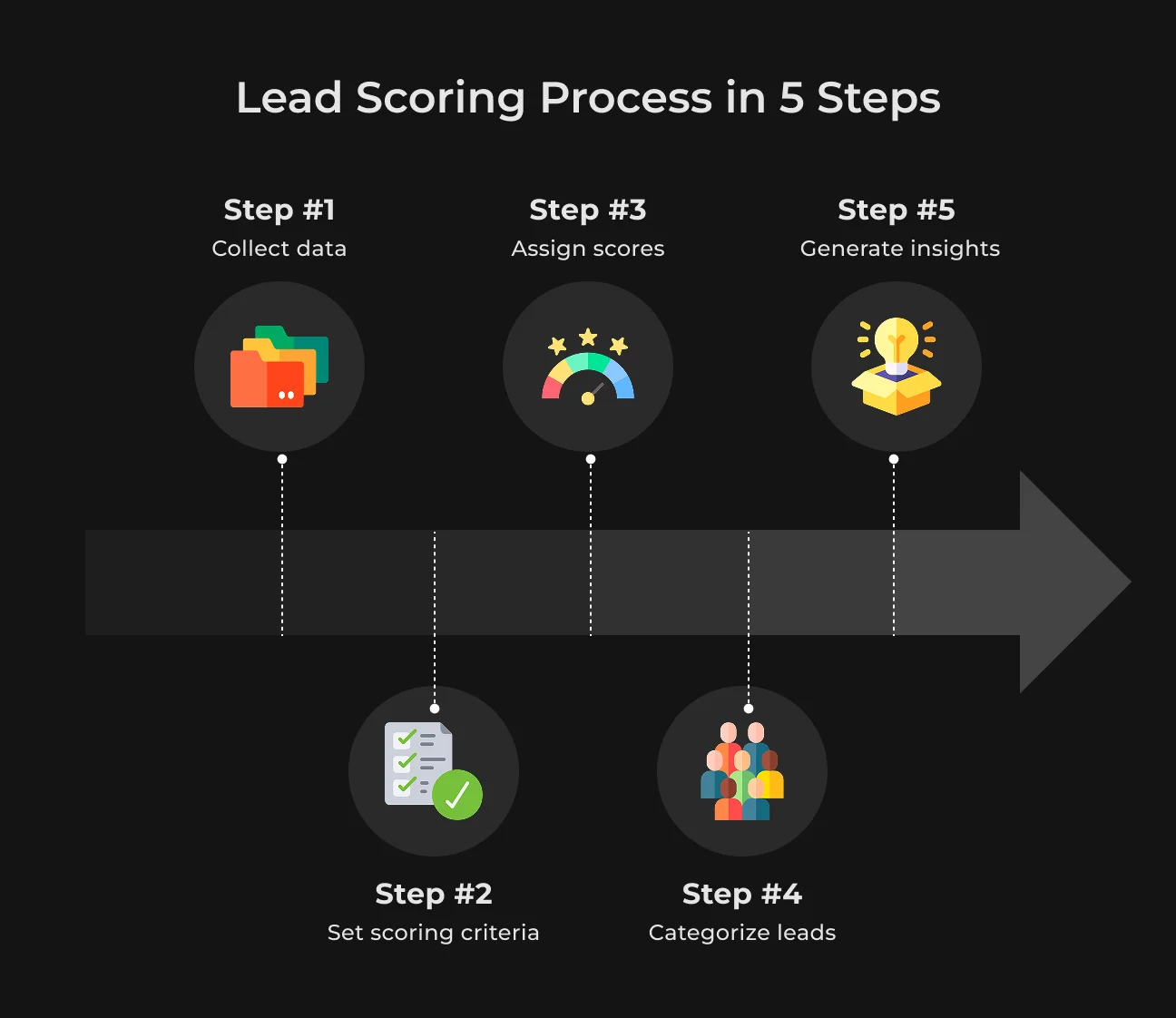
Let us see how you can create a lead-scoring model by following these five steps.
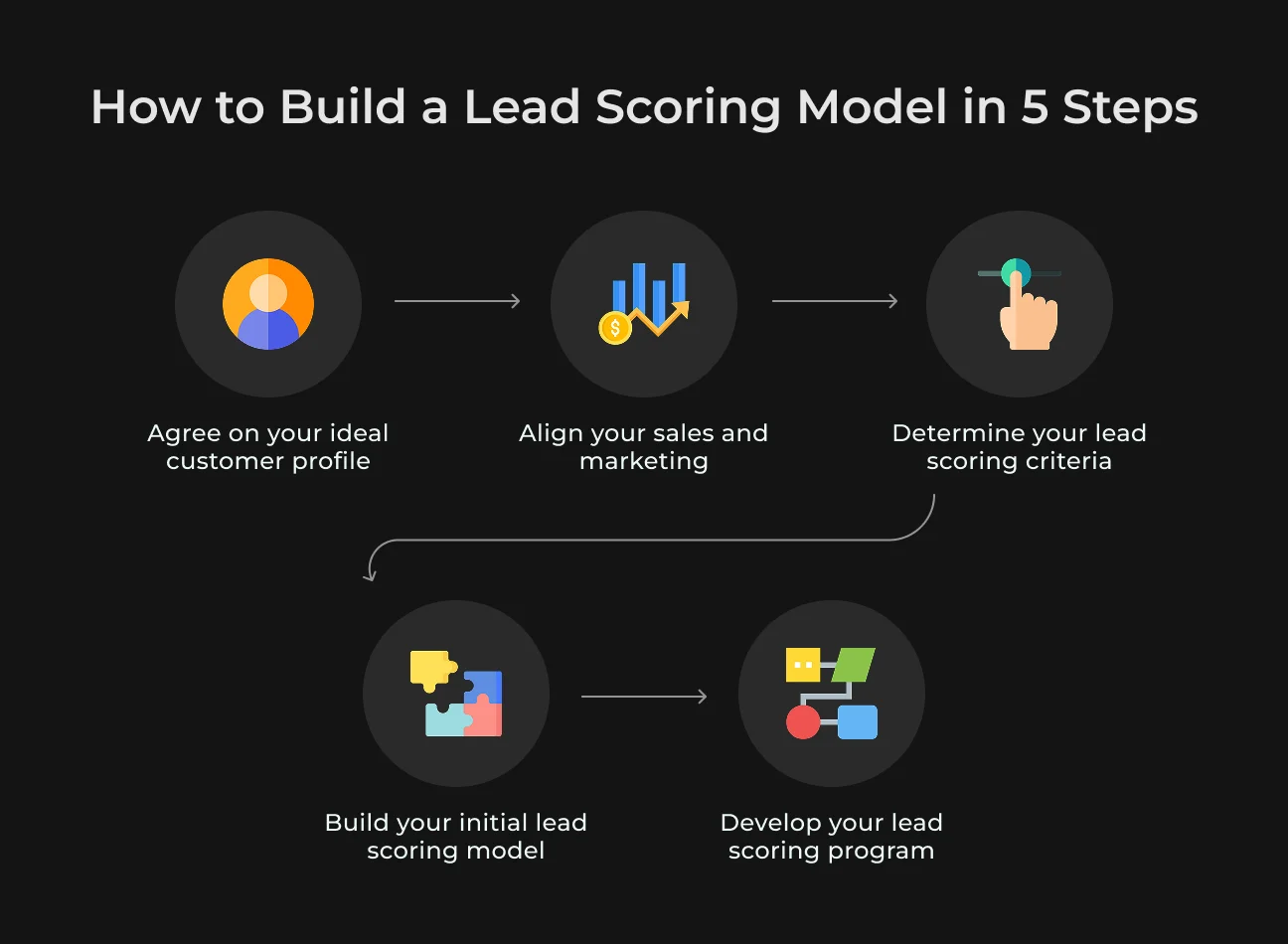
#1 Agree on Your Ideal Customer Profile
Start with a full ICP — not just demographics. In B2B, you’re rarely selling to one person: Gartner notes buying groups can range from 5 to 16 people across up to four functions.
That’s why your ICP should capture both who the company is and what the buying group needs to believe for the deal to move forward.
Define your ICP using real customer evidence (CRM + delivery + CS data), then document:
- Firmographics: industry, company size, geography, revenue band, growth stage;
- Technographics: current stack, integration constraints, data maturity;
- Buying triggers: events that create urgency (new funding, compliance deadlines, platform migration, churn spike);
- Success signals: what “good outcomes” look like (time-to-value, adoption targets, cost reduction, pipeline impact);
- Disqualifiers: clear red flags (no budget owner, low data quality, unsupported tech stack).
Practical tip: build the first draft from your last 20–50 closed-won deals, then review quarterly so the ICP stays aligned with what actually converts.
#2 Get Your Sales and Marketing In Alignment
Misalignment is common — Forrester found 65% of sales and marketing professionals see a lack of alignment between their leaders. The cost is real: Forrester research also reports that highly aligned companies grow 19% faster and are 15% more profitable than less aligned peers.
To fix it, don’t start with “more meetings.”
Start with shared definitions and shared accountability:
- Agree on lead stages: define MQL → SAL → SQL criteria in writing (fit + intent + readiness);
- Set SLAs: response time, follow-up cadence, and what happens when sales rejects a lead;
- Use one scorecard: track the same funnel metrics (lead-to-opportunity, opportunity-to-win, velocity, CAC payback);
- Run a tight cadence: weekly 30-minute pipeline/feedback sync + monthly “what converts” review using actual win/loss data.
This matters even more today because consensus is harder: Gartner reports buying groups that reach consensus are 2.5× more likely to report a high-quality deal. Alignment helps you qualify leads around the real buying conditions — not just form fills.
#3 Determine Your Lead Scoring Criteria
Start by separating criteria into two buckets:
- Fit (who they are): role, company size, industry, region, tech stack, data maturity;
- Engagement/intent (what they do): high-intent page visits (pricing, integration, security), demo requests, webinar attendance, email replies, repeat visits within a short window.
Use historical CRM data to validate what actually predicts outcomes. The MIT/InsideSales lead-response research shows how quickly odds can shift based on behavior and timing.
For example, waiting one hour reduces the odds of contacting a lead by 10×, and the odds of qualifying by 6×.
That same study found the odds of qualifying drop 21× when response time stretches from 5 minutes to 30 minutes. Add negative scoring (disqualifiers) so your model doesn’t over-prioritize the wrong leads.
#4 Build Your Initial Lead Scoring Model
Keep the first version simple and testable. A good baseline is a combined model that scores both fit and engagement (instead of relying on one alone). Your platform should support fit scores, engagement scores, and combined scores for this reason.
Practical build approach:
- Create a 0–100 scale (or 0–200 if you want more granularity);
- Assign weights (example: 50% fit, 50% engagement for most B2B; adjust based on sales cycle);
- Cap low-signal activity so it can’t “game” the score (e.g., unlimited blog views). HubSpot recommends setting group limits and overall score limits to control weighting across event groups;
- Set thresholds with sales (e.g., “send to SDR when score ≥ X”);
- Backtest on the last 6–12 months: do higher scores actually correlate with higher conversion to opportunity and won deals?
#5 Develop Your Lead Scoring Program
You'll need something like a reputable CRM or marketing automation tool (such as Salesforce) to run and automate your lead scoring. Watch closely how the model is performing. And try to have regular meetings with sales teams to ensure you are getting feedback.
Interactive dashboards might let you display your reports. So, sales managers will be able to know what leads are most promising and tailor their approach.
They are 21 times more likely to qualify leads if they return calls within five minutes as compared to 30 minutes.
Build Your Lead Scoring Model Today

Implementation of Artificial Intelligence in Lead Scoring
AI in lead scoring uses a machine learning algorithm to identify patterns within your data (e.g., behavior, demographics, interactions) that can be used to predict who is more likely to convert. The Global Lead Scoring AI market is expected to reach $7.8 billion by 2033.
There are two main criteria by which a lead score is determined for an AI-powered lead scoring method. It first uses the sales team's perfect lead profile to set the initial score. Then, it continuously analyzes new lead data, past customer interactions, conversion trends, market conditions, and more to refine the score.
For example, if visiting a contact page on the company’s website is starting to have a high correlation with higher conversion rates, the AI algorithm will put more weight on this event when calculating a total lead score.
Artificial intelligence, as well as traditional lead scoring, is designed to improve sales productivity by telling your team which leads they should call first. Still, they’re approaching it in very different ways. Traditional lead scoring is based on fixed thresholds and rules. This results in a static model that may be subjective or biased and is usually maintained manually.
AI lead scoring uses machine learning algorithms to train and learn from data. It can easily analyze large datasets without needing human expertise.
Let's look at how these two strategies actually differ.
Aspect | Traditional lead scoring | AI lead scoring |
| Methodology | Manual assignment follows set rules and criteria. | Machine learning algorithms analyze data patterns to predict lead potential |
| Data use | Mainly relies on basic demographic and firmographic data. | Integrates behavioral, transactional, and third-party data. |
| Scalability | Limited scalability. Gets more complicated with larger datasets. | Highly scalable and can process massive datasets. |
| Adaptability | Needs manual updates to scoring criteria. | Learns and adapts to changes in lead behavior and market dynamics. |
| Accuracy | Requires an initial setup and regular manual updates. It might also be subjective. | Offers greater accuracy through data-driven insights and predictive analytics |
| Real-time analytics | Often slower and lacks real-time processing capacities. | Analyzes data in real time. Allows for quick scoring and prioritization. |
| Implementation time | Relatively quick to set up, but requires ongoing management. | The initial setup could take more time, but with lead scoring automation and self-learning, less maintenance is needed later on. |
| Complexity | Simpler apps that might lack complex patterns. | Manages complicated, non-linear connections in the data.
|
| Costs | Lower initial costs, but higher long-term costs because of manual work.
| Requires more upfront investment. But can save more money later because of increased efficiency and conversions. |
| Reporting | Basic reporting that relies on periodic reviews. | Provides advanced analysis and actionable recommendations. |
Benefits of AI Lead Scoring
Let’s take a look at the key benefits of AI lead scoring for your business.
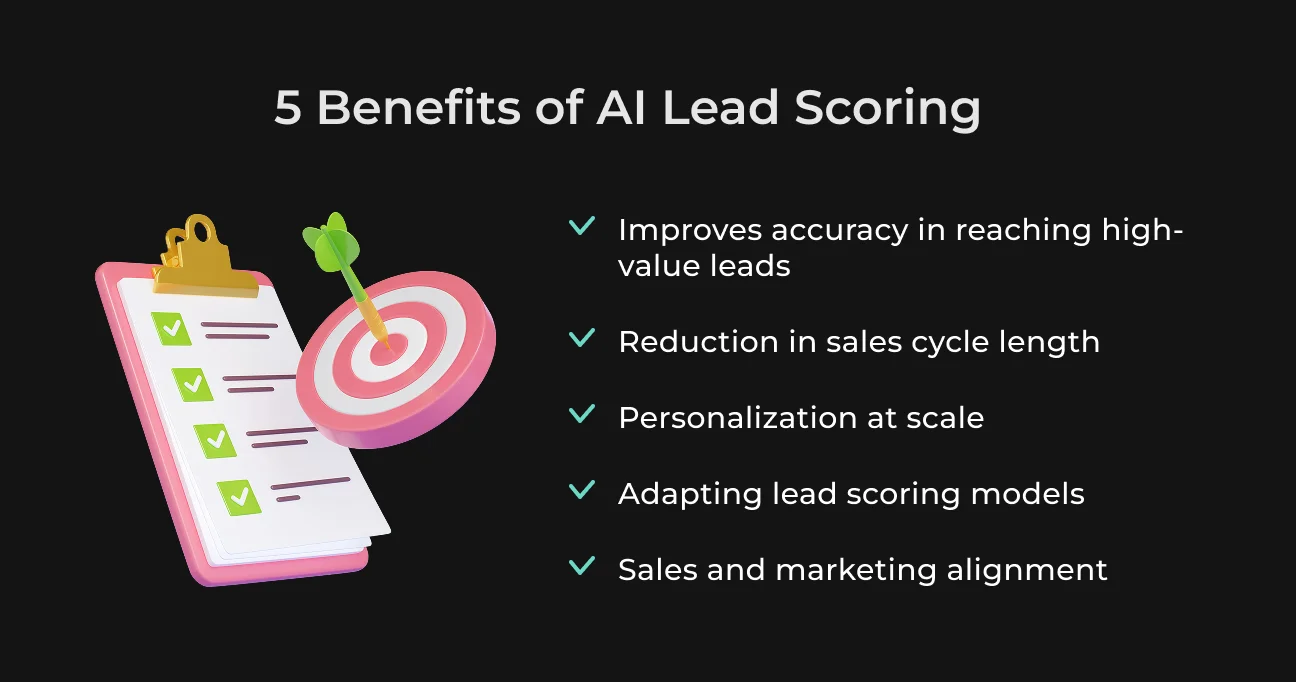
Improved Accuracy in Reaching High-Value Leads
AI lead scoring uses machine learning algorithms to churn through niche data with the explicitness that people couldn’t do on their own. Businesses that use AI for sales get about 50% more leads and appointments.
AI can continuously adapt scoring criteria as patterns change, which helps specify high-value prospects more accurately.
Reduction in Sales Cycle Length
Lead scoring powered by AI can reduce the sales cycle and allow sales teams to identify the most convertible leads in the initial stage. That way, sales representatives can close more deals. The adoption of AI sales tools can increase productivity by 30% and boost revenues by as much as 25%.
Personalization at Scale
AI also helps deliver more personal experiences to prospects by examining past interactions and preferences. According to research, AI-powered best experiences can increase customer satisfaction by 15-20%.
This is because AI can recommend personalized content and offers, increasing the relevance and value of engagement.
Adaptive Lead Scoring Models
AI lead scoring actively adjusts based on market shifts and customer activity. By 2028, over 20% of digital workplace technologies will use AI to customize experiences, using personalization algorithms.
Companies running adaptive AI models have a better chance of getting ahead. They continuously optimize scoring algorithms with the latest trends and customer priorities.
Sales and Marketing Alignment
When it comes to sales and marketing teams, 67% say that AI has improved their ability to focus on more strategic work. While 56% report that their teams get better at learning how to use AI.
AI lead scoring helps hold sales and marketing together. It also means cleaner communication and aligned actions because both will be working off the same information.
Partner with SapientPro to Build Your Lead Scoring Model
SapientPro's tech experts can help transform your lead scoring model into a strategic tool for improving how you identify sales leads. Our deep engagement model for unity in marketing and sales helps align both teams' efforts.
SapientPro will help you get a solution with higher accuracy and faster sales cycles, boosting your conversion rates. Contact our team to help your business gain more qualified leads and provide exceptional service.
Let's Build Your Lead Scoring Model
FAQ
1. What are the lead scoring best practices?
Focus on aligning your sales and marketing. Also, you should use both demographic and behavioral data, consistently analyze and update your scoring criteria. And test your model to ensure it continues to evolve.
2. What is the best lead scoring software?
Lead scoring SaaS may work differently due to the nature of your business. Some common choices remain HubSpot, Salesforce, and Marketo. These platforms provide powerful capabilities to tailor and automate lead scoring models.
3. How to build a lead scoring model?
You need the points for each criterion, decide on a threshold, and identify techniques to be used for precision and recall checking.
To build a lead scoring model, start by defining the ideal customer profile. Then, analyze historical data to identify important characteristics. Decide which criteria to score and assign appropriate values, or choose not to score some at all.

