All How AI in CRM Is Changing the Way Businesses Connect with Customers
August 4, 202515 min read


What if your CRM could do more than store customer data? What if it could think, learn from interactions, and even predict what your customers need before they say a word? That’s exactly what AI in CRM brings to the table, and it’s already happening. By 2025, the CRM industry is projected to hit $97.9 billion, with 91% of businesses already relying on these platforms to handle sales and customer data.
At the same time, AI is taking on a bigger role, with 61% of companies planning to add smart automation and more personalized experiences through AI-powered features. SapientPro's team has been helping startups and established businesses integrate tailored AI solutions for more than 8 years. We’ve seen firsthand how the right tech stack can move the needle, starting with automating sales flows and ending with real-time sentiment tracking.
This guide is based on our real-world experience building AI-powered systems that go beyond expectations. If you're looking to make your CRM do more, this is where to start.
Key Takeaways
- AI in CRM turns customer data into meaningful information, automating tasks and improving decision-making.
- Generative, predictive, and conversational AI each bring unique value to sales, support, and marketing teams.
- Key benefits include better personalization, smarter lead scoring, faster reporting, and sentiment tracking.
- Challenges like data quality, integration, and adoption can be solved with expert support from SapientPro.
- Future trends point to deeper AI integration, privacy-focused design, and smarter automation across platforms.
- Custom CRM solutions offer better flexibility and long-term value for businesses with specific needs.
What is AI in CRM?
The use of AI in CRM means adding artificial intelligence features to customer management software to make it smarter and more helpful. It allows the system to analyze customer data, spot patterns, and make recommendations in real time. Instead of simply storing contact details or logging calls, an AI CRM can predict which leads are likely to convert, send automated follow-ups, or even detect customer sentiment during conversations. It turns your CRM from a tracking tool into an active sales and service assistant.
Types of AI Used in CRM
In our previous article сovering the types of AI, we explored the key categories of artificial intelligence that power all kinds of systems, including recommendation engines, self-driving cars, and so on. Concerning customer relationship management, AI plays a much more focused role. The goal is not to simulate general intelligence, it needs to make CRMs more useful in sales, marketing, and support. Here, we’ll break down three of the most impactful types used in customer management software systems today:
- Generative AI;
- Predictive AI;
- Conversational AI.
Each of these technologies solves a different set of problems inside your customer management workflow. Together, they can help a CRM write personalized emails, predict next quarter’s top clients, handle support chats without human intervention, and do everything in between.
Generative AI
Generative AI in CRM refers to systems that can create new content based on learned data, including text, visuals, responses, and even insights. In practical terms, the addition of this technology means your CRM can write tailored follow-up messages, generate sales summaries, or even recommend the best way to handle objections based on customer history. For example, generative AI can pull data from previous interactions and automatically write a draft email that feels personal, not robotic.
This type of AI uses large language models, such as OpenAI's ChatGPT or IBM’s Watson, to generate human-like outputs. It can help your team move faster without sacrificing quality. Rather than scripting emails manually or summarizing customer feedback, generative AI handles the repetitive part. Your team simply approves or tweaks the result. This approach frees up time and makes interactions feel more authentic at scale.
Predictive AI
While generative AI helps you create, predictive AI helps you plan. It analyzes your customer management software data, such as lead activity, customer lifetime value, or buying patterns, and predicts what’s likely to happen next. For example, it might tell your sales rep which leads are most likely to convert this week or flag a long-time customer who might churn.
Predictive AI shines in:
- Sales forecasting;
- Trend spotting;
- Lead scoring.
It learns from your company’s past interactions and behaviors to guide future decisions. Imagine knowing which of your 1,000 leads to call first, or having an automated heads-up about a customer losing interest. That’s what predictive AI delivers. And when you pair it with SapientPro’s expertise in building custom AI tools, it becomes even more precise and tuned to your business logic.
Conversational AI
Conversational AI is a technology that powers chatbots, virtual assistants, and smart voice systems in CRM software. But we’re not talking about those clunky bots that just throw FAQs at users. Modern conversational AI listens, understands context, and responds like a human would. Think about a bot that helps a customer reset their password, track their shipment, or even recommend a product based on previous orders, all within seconds.
This tech uses natural language processing to interpret messages and generate meaningful replies. It’s often used on websites, mobile apps, or even messaging platforms like WhatsApp or Messenger.
The benefits are clear:
- Faster customer support;
- Less pressure on your team;
- Better user experience.
When implemented well, conversational AI doesn’t replace people, but supports them. Your team can step in when things get complex, while the AI handles the routine. SapientPro has helped several companies integrate custom chat solutions that not only reduce ticket volume but also collect valuable data in the process.
Benefits of AI in CRM
When you add AI to a CRM, it stops being a system that just stores data and becomes an active participant in your business. The real value isn’t in the tech itself, but in what it helps your team do. AI-driven CRMs can reshape how sales and support teams work by sharpening forecasts and rationalizing everyday tasks.
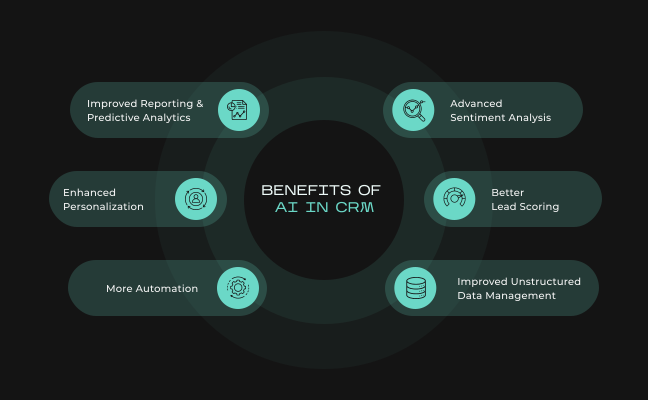
Let's look at some of the most practical ways AI in CRM drives better outcomes, not someday, but right now.
Improved Reporting & Predictive Analytics
Most CRMs already offer reporting dashboards, but they’re often limited to what has already happened. AI takes this a step further and, besides tracking results, it looks ahead. With predictive analytics, your CRM can highlight sales opportunities, detect risk factors in client behavior, and forecast revenue with far greater accuracy.
For example, if a certain type of lead usually converts after three follow-ups, AI will spot that pattern and surface similar prospects to prioritize. Or if a customer has gone quiet, AI can flag them before they churn. Instead of reacting to problems, your team can act early based on data, not hunches.
Our team helped companies build AI dashboards that do more than just visualize numbers. They tell a story and guide decisions in real time.
Enhanced Personalization
Personalized outreach used to mean manually segmenting customers and drafting different email versions. With AI, that process is handled on autopilot, except it’s smarter and more detailed. AI in CRM can analyze a user’s behavior, past purchases, service interactions, and even tone of voice to tailor recommendations or messages with precision.
It’s the difference between “Hi [First Name], here’s a sale” and “Hey Mike, based on your last three purchases, we think you’ll like this.” Personalized experiences lead to higher engagement, longer relationships, and more conversions.
This technology is especially powerful for B2B sales, where buying cycles are longer and trust is everything. With the right AI model built around your business rules, your customer management software starts acting like an assistant who knows each client better than you do.
More Automation
AI doesn’t just make data smarter, it takes over the grunt work. AI in CRM can automate repetitive tasks like data entry, call logging, follow-up scheduling, or lead routing. As a result, your team spends less time clicking buttons and more time actually selling or solving problems.
You can also set up triggers based on AI insights. For instance, when a lead hits a certain score, the system automatically assigns it to your top rep. Or when a customer leaves a bad review, a service ticket is created and escalated right away. These actions happen instantly, without anyone lifting a finger.
With SapientPro’s help, your businesses can implement custom automations that match your unique workflow, not a cookie-cutter process. The result? Faster response times, fewer human errors, and more focus on tasks that actually grow revenue.
Advanced Sentiment Analysis
Customer feedback isn’t always clear-cut. People don’t always say “I’m unhappy”; they might just sound off in a review, leave a slightly colder tone in an email, or use shorter replies than usual. That’s where AI-powered sentiment analysis comes in. Instead of just reading the words, it interprets how things are said.
AI in CRM can scan support chats, social media mentions, or email threads to detect whether a customer is satisfied, frustrated, or ready to switch providers. It reads between the lines, flagging emotional cues and attitude shifts your team might miss.
Sentiment analysis is especially useful in customer service and account management. With early warning signs, your team can jump in before a small problem becomes a churn risk. We can build sentiment layers into your CRM that will alert your team when a conversation needs human escalation, often before the client even realizes they’re dissatisfied.
Better Lead Scoring
Not all leads are created equal. AI in customer management software helps sort the high-potential leads from the ones just browsing so that your sales team doesn’t waste time chasing dead ends. Using historical data, AI can assign scores based on dozens of variables, like click patterns, email engagement, firmographics, or even how fast someone replies to a sales outreach.
Instead of manually assigning scores or relying on gut instinct, the CRM does the heavy lifting. It learns from your sales history and continuously refines how it ranks new prospects. Instead of just a list of names, you get a ranked action plan.
We can help your company by building a tailored scoring model into your sales CRM software to improve deal closure rates and shorten sales cycles. For teams working with limited time and high-pressure targets, better lead scoring means a competitive advantage.
Improved Unstructured Data Management
Every business has piles of unstructured data: emails, chat transcripts, meeting notes, customer reviews, and so on. Traditional CRMs don’t know what to do with it. But AI does.
Using natural language processing, AI and ML in CRM can comb through unstructured content and turn it into relevant information. For example, it might find recurring complaints in support emails, detect emerging product issues, or tag common objections in sales calls.
This approach helps businesses understand their customers in ways spreadsheets never could. More importantly, it connects that knowledge to real outcomes, improving service, tweaking sales messaging, or identifying market gaps in the process.
If your company is sitting on years of untapped data, you can add AI-powered parsing into your CRM system to start seeing patterns that have been hiding in plain sight. That’s the kind of advantage you can’t afford to ignore.
Challenges of AI in CRM
While the benefits of CRM with AI are clear, adopting it doesn’t come without challenges. Businesses often run into such problems as:
- Technical limitations;
- Data issues;
- Team readiness gaps.
The key is not to avoid these problems, but to solve them early with the right approach and technical partner. SapientPro's team has helped companies across different industries tackle these roadblocks head-on. Let's discuss five of the most common challenges we’ve seen and how to move past them.
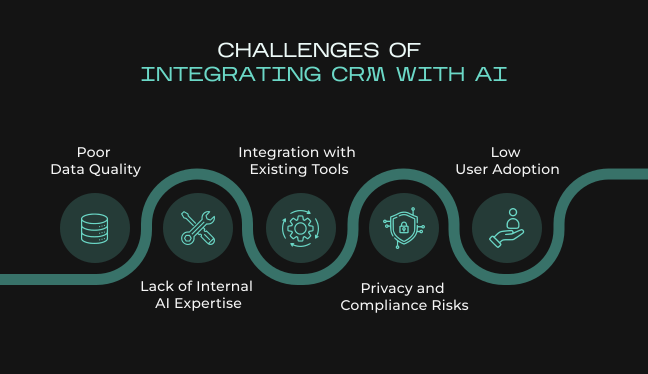
Poor Data Quality
AI systems are only as good as the data they learn from. If your CRM contains outdated contact info, incomplete profiles, or duplicated entries, AI won’t perform well. Bad data can lead to misleading predictions or awkward customer interactions.
Solution:
Start by cleaning and consolidating your existing customer management software data. Then set up rules that ensure incoming data stays consistent, such as:
- Automatic formatting;
- Required fields;
- Real-time validation.
We help businesses design AI CRM systems that include built-in data hygiene tools, so your AI models are always working with clean, reliable input.
Lack of Internal AI Expertise
Many companies want AI but don’t have AI specialists on staff. Without internal expertise, it’s hard to know what’s possible, what’s realistic, and what’s a waste of time (or money). This knowledge gap leads to delays, poor adoption, or features that don’t match real business goals.
Solution:
Rather than hiring a full-time AI team, you can partner with engineers who specialize in CRM and artificial intelligence. Our developers don’t just code; we consult, prototype, and fine-tune AI features that fit your process and customer base. We work as an extension of your team until the system is ready to manage itself.
Integration with Existing Tools
Your CRM likely doesn’t operate in a vacuum – it’s connected to marketing tools, email platforms, support desks, and ERPs. One of the hardest parts of bringing AI into CRM is making sure it works with everything else.
Solution:
Every AI feature should be built with your tech stack in mind. Whether you're using Salesforce, Zoho, HubSpot, or a custom CRM, our team ensures smooth connections through APIs, middleware, or direct integrations. SapientPro experts know how to work with cross-platform systems, so your AI doesn’t get boxed into a silo.
Privacy and Compliance Risks
AI systems often process sensitive customer data, which raises concerns about privacy laws (like GDPR or CCPA), consent, and how data is stored or used. Even well-meaning companies can get caught up in compliance issues if they don’t build AI the right way.
Solution:
Privacy should never be an afterthought. It has to be baked into the AI logic from the start. Our experts follow security-first practices during CRM development and ensure all AI features follow regional and global compliance requirements. This rule includes permission settings, audit trails, encryption, and consent management tools built directly into your CRM.
Low User Adoption
Sometimes, the AI works, but the team doesn’t trust it. Salespeople may ignore AI-generated lead scores. Support reps might skip chatbot suggestions. If your users don’t see the value, the project won’t stick.
Solution:
The key is involving your team from day one. Don’t build AI in a vacuum; build it around real workflows and feedback. We focus on intuitive design and offer user training with every AI CRM project we deliver. When users understand how it helps them, they’re much more likely to use it.
With the right guidance, all these challenges are manageable and temporary. SapientPro is here to help you get it right the first time.
Future Trends in AI CRM Solutions
The AI-powered CRM market has seen explosive growth in recent years, expanding from $8.09 billion in 2024 to a projected $11.04 billion in 2025, anticipating a compound annual growth rate (CAGR) of 20% through 2033. This expansion reflects the increasing demand for intelligent customer management solutions that enhance engagement and optimize operations.
1. Generative AI Enhancing Customer Interactions
Generative AI pushes CRM evolution forward by enabling the creation of personalized content, such as tailored emails and product recommendations. This technology allows decreasing response times by 10% to 30% and accelerating campaign creation by up to 35%. As a result, businesses can deliver more relevant and engaging communications, fostering stronger customer relationships.
2. Predictive Analytics Driving Proactive Strategies
AI-driven predictive analytics are becoming integral to CRM systems, enabling businesses to anticipate customer behaviors and needs. By analyzing historical data, companies can proactively address potential issues, improve customer satisfaction, and optimize sales strategies.
3. Conversational AI Improving Customer Support
The integration of conversational AI, including advanced chatbots and virtual assistants, is enhancing customer support by providing instant, 24/7 assistance. These tools handle routine inquiries efficiently, allowing human agents to focus on more complex tasks.
4. Emphasis on Data Privacy and Compliance
As AI in CRM evolves, there is a growing focus on data privacy and regulatory compliance. Businesses are implementing robust data governance frameworks to ensure customer information is handled responsibly and to stay compliant with regulations such as GDPR and CCPA.
5. Integration of AI Across CRM Platforms
Major customer relationship management software providers are embedding AI capabilities into their platforms, offering features like automated lead scoring, sentiment analysis, and workflow automation. This integration simplifies the adoption of AI for businesses, making advanced tools more accessible.
3 Best AI CRM Solutions in 2025
Here are three top-performing AI CRM platforms in 2025, each offering smart tools for sales, marketing, and customer service. These platforms balance usability with powerful AI features and can serve as a strong base for further customization with SapientPro’s development support.
1. Creatio
Creatio is a low-code online CRM platform with built-in AI tools for lead scoring, next-best-action suggestions, and customer journey automation. Its visual builder makes it easy to customize without coding.
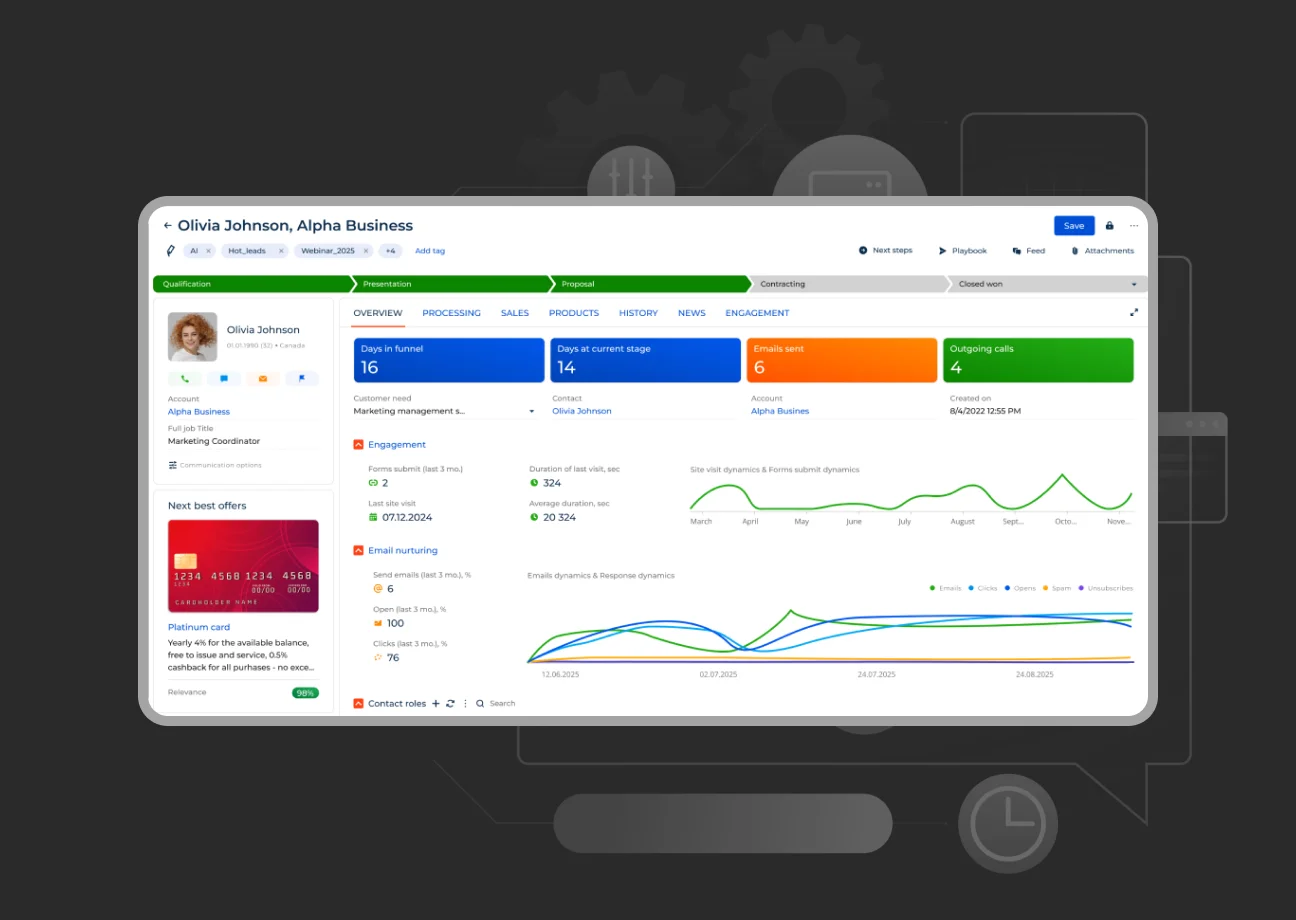
Key features:
- AI scoring;
- Marketing automation;
- Predictive analytics.
Pricing: From $25 to $85 per user/month
2. Hubspot
HubSpot’s customer platform uses AI to improve email personalization, conversation analysis, and pipeline forecasting. It’s ideal for growing teams needing powerful tools without heavy technical overhead.
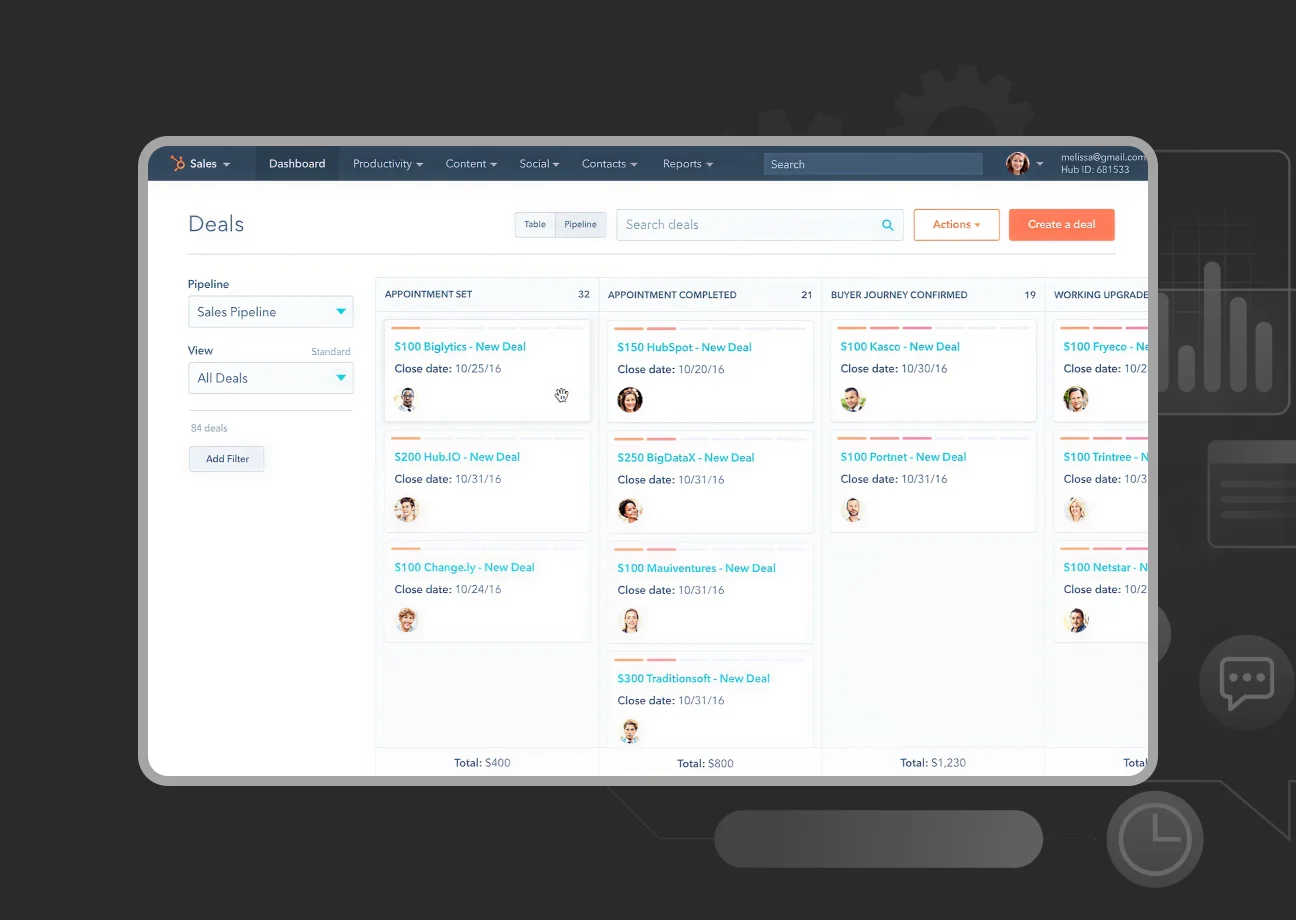
Key features:
- Lead management;
- Conversation intelligence;
- Sales automation;
- Forecasting.
Pricing:
- Free version with all core functionalities;
- $20/month per person for the Starter package;
- $50/month per person for the Professional package;
- $75/month per person for the Enterprise package.
3. Zoho
Zoho CRM brings AI to the table with Zia, its smart assistant. Zia helps with sentiment analysis, anomaly detection, and task suggestions, making sales processes smarter and more responsive.
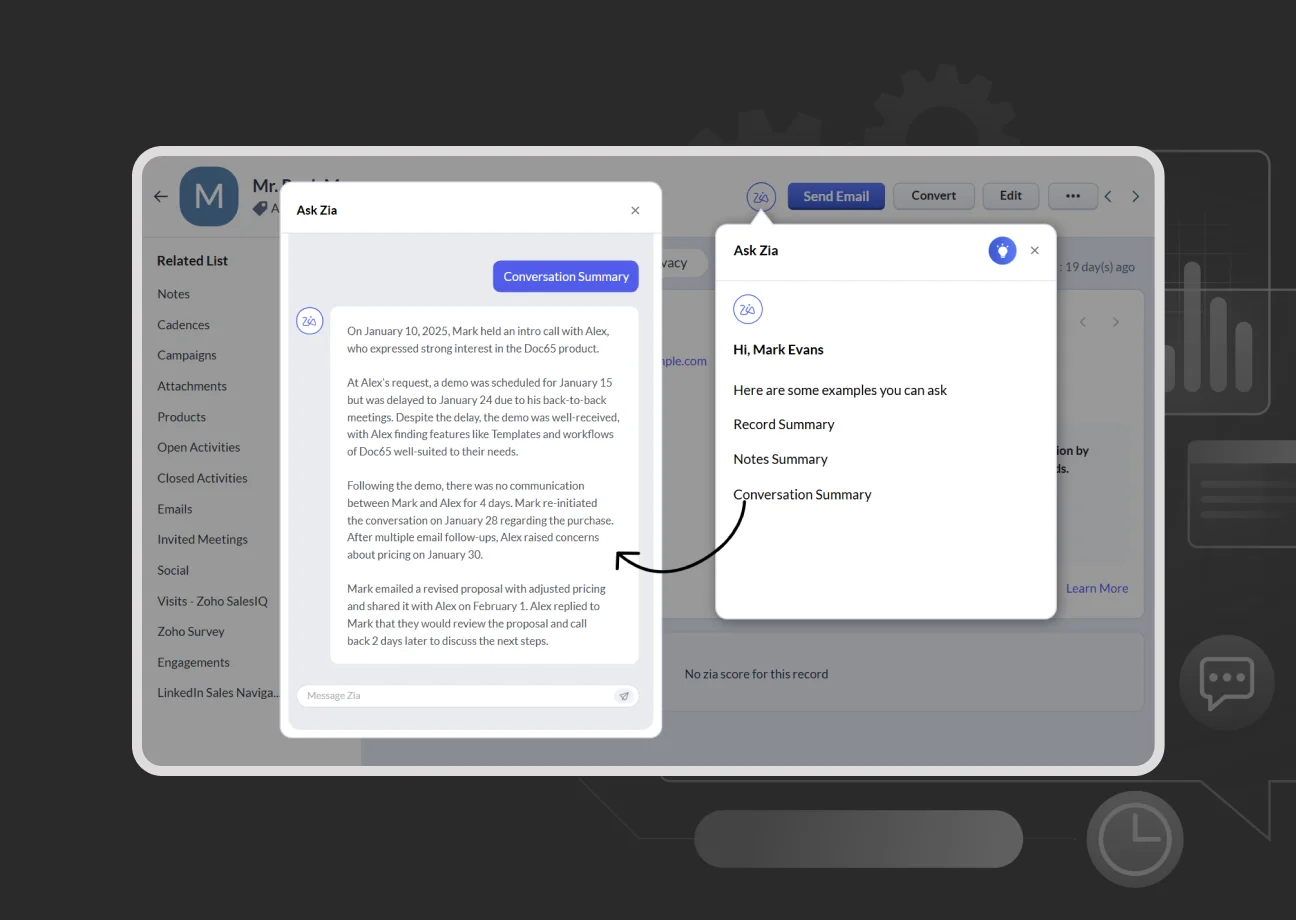
Key features:
- Sentiment tracking;
- Anomaly detection;
- AI recommendations.
Pricing: From $14 to $52 per user/month
Custom CRM vs. Off-the-Shelf: What’s Best for Your Business
Deciding between a custom CRM and a ready-made solution really comes down to your company’s size, processes, and future goals. Off-the-shelf tools like HubSpot or Zoho are quick to set up and user-friendly, but they can fall short when it comes to flexibility. A custom system is specifically designed to meet your exact needs, offering more adaptability and room to scale. Our experts guide clients through both paths: building from the ground up or improving what they already have.
Here’s a side-by-side look at how the two approaches compare:
Feature | Off-the-Shelf CRM | Custom CRM |
|---|---|---|
| Speed of Setup | Immediate or within days | Requires several weeks for development |
| Cost (Initial) | Lower upfront, subscription-based | Higher initial investment |
| Cost (Long-Term) | Requiring monthly fees | One-time build cost with lower long-term fees |
| Scalability | Limited by platform features | Scales with your business exactly as needed |
| Customization | Basic (field tweaks, plug-ins) | Full control over workflows, features, and UI |
| Third-Party Integration | Depends on the available API/connectors | Can integrate with any service or tool you use |
| Ownership of data and code | Controlled by the vendor | Fully owned by your business |
| Security and Compliance | Generalized for all users | Tailored to your specific regulatory needs |
If your workflows are complex or your data requirements are unique, a custom CRM might offer far more value in the long run. SapientPro can guide you through the decision and build exactly what you need.
Start Building Smarter Customer Management Today
Send your project details or book a free consultation to see how AI can boost your CRM’s performance.
FAQ
1. What are the key benefits of AI in CRM?
AI improves CRM systems by adding smart features like predictive analytics, personalized communication, automated workflows, and better lead scoring. It helps teams make faster decisions, save time on manual tasks, and deliver more relevant experiences to each customer.
2. How to implement AI into my CRM?
Start by identifying the areas where AI can bring the most value: sales, support, or data analysis. Then, contact SapientPro for a free consultation. Our team will assess your needs and help you integrate AI tools into your CRM smoothly and effectively.
3. What is the best AI CRM in 2025?
There’s no one-size-fits-all answer. The best AI CRM is the one that fits your exact business goals, workflows, and tech environment. A custom-built solution designed around your needs is often more effective than off-the-shelf tools. SapientPro can help you build one from scratch.