All How to Assess AI Systems for Regulatory Compliance: Data Protection Guide
May 18, 202615 min read


AI systems are powerful. They can sift through vast amounts of data, identify patterns, and solve complicated tasks (sometimes with minimal human guidance). Yet they challenge data protection, ethics, and human rights.
Europe, for instance, has just begun to realize that it’s at risk of losing in an AI-powered revolution. Even with a single market, Europe’s AI approach lacks coordination. Besides, investment in AI research and development is not enough compared to Asia and North America.
In this article, we explain how to break down those AI data security concerns, with a focus on ways to ensure compliance of your AI systems. This lets you not just cut costs but also guarantee strong data protection for your customers.
What Is Data Privacy in AI?
AI systems learn by analyzing big data sets. One notable example is the Common Crawl dataset, which most models use due to its 9.5 petabytes of data. The motivation for working with such large datasets is simple — AI systems trained on more data and using higher computing power perform better.
This approach often improves performance on their tasks, even without changing algorithms. However, a number of AI training datasets could contain sensitive personal information that individuals reveal without realizing it.
Data privacy in AI involves a set of rules and technical measures to protect individuals when their information is processed by AI. It covers the entire data process — from gathering to deleting data — to prevent issues like identity theft, embarrassment, bias, or unwanted tracking.
At its most basic level, AI privacy consists of four categories: what data we hold, why we possess it, who can view it, and how we intend to secure and erase it (if needed). It is about making sure that AI systems respect privacy rights.
Key Data Privacy Risks in AI
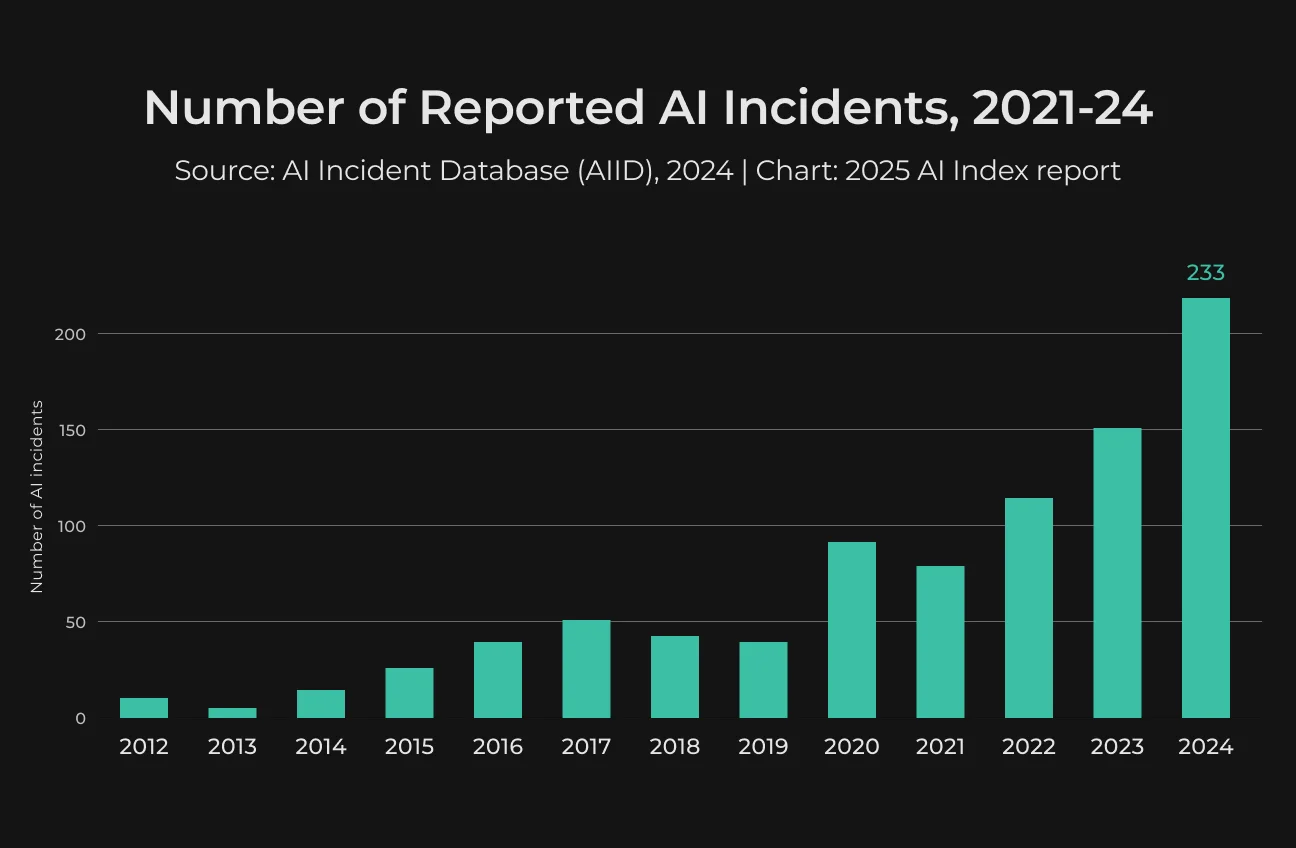
The AI Incidents Database has compiled a total of 233 incidents in 2024 (an increase of 56.4% over 2023). A further 108 new incidents were added between early November 2025 and the end of January 2026. Check out the top data privacy risks associated with AI systems.
Deepfake-Enabled Fraud
The use of deepfakes for fraud has become a routine affair and is frequently employed to impersonate someone for profit. These scams steal the faces of familiar public figures — politicians, media personalities, celebrities or business leaders — to create positive endorsements on products or platforms. The content then goes viral on social networks to deceive people into sending money.
Examples include impersonations of finance ministers or officials from Malta and Cyprus, especially in crypto scams. There are also many cases featuring impersonations of Elon Musk.
Misuse in Institutions
Sometimes, trusted sources like government agencies unintentionally spread wrong information. Their authority can make the misinformation spread more widely and have a bigger impact.
There are also failures with the use of AI in decision-making. For instance, in Argentina, a court allegedly reversed a conviction because a judge used ChatGPT without informing anyone.
In Canada, a national tax chatbot reportedly gave incorrect information to many users. In the US, the acting director of CISA uploaded sensitive material to a public ChatGPT platform.
Chatbots That Interact With Customers Often Make Mistakes
Chatbots often produce risky outputs. For example, they have allegedly encouraged self-harm, given poor financial advice in the UK, and offered harmful medical guidance in India. There were also questions of intellectual property and credit for content.
These concerns demonstrate how AI-powered chatbots can confidently provide so-called answers that may be legally or factually incorrect.
Why Generative AI Creates New Data Risks?
Gen AI can generate new content such as text, code, and images. This ability also creates new opportunities for cyber attackers. GenAI uses patterns similar to human communication, which lets it produce flexible responses and interact in natural language. This makes it accessible to more users, often without needing specialized knowledge.
A worldwide survey of more than 32,000 workers across 47 countries shows that 58% of employees use AI at work on purpose — one-third do it weekly or daily. About 48% have fed sensitive company or customer data into public AI platforms, and 44% report using AI in ways that violate their company’s policies.
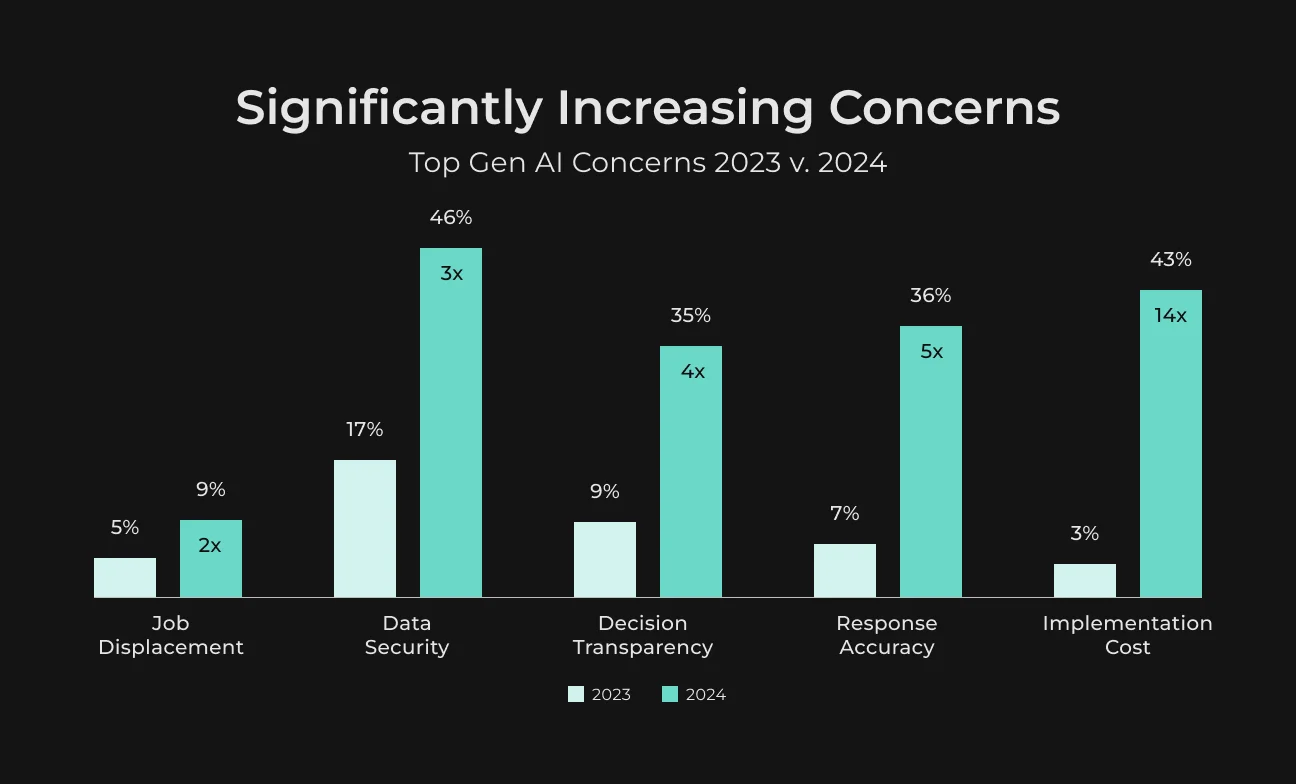
Here's a look at a few key GenAI-related security risks.
Model Memorization Issues
Visual generative AI models, for example, can generate photos based on user inputs (like text prompts).
However, given that they contain billions of parameters, they may inadvertently memorize or reenact portions of the training data. Such memorization brings security challenges — especially the risk of IP violation.
Data Leakage
At times, models may leak pieces of their training dataset, like sensitive customer information or business secrets. This is what happens when the model has memorized and inadvertently regurgitates this content.
This, however, does not prompt file access systems, like antivirus programs that track or prevent data breaches. And there is no apparent audit trail of the leak. Once something is hardwired into memory, it’s not easy to unlearn.
Prompt Injection Attack
This occurs when someone intentionally constructs input prompts that modify a model’s action. For example, they might instruct the model to ignore earlier instructions. That can lead to the model leaking sensitive information or doing things it is not meant to do.
Companies are reluctant to share private data with AI. The danger is that when AI is trained on such data, it may accidentally expose private details about their organization. This risk can be minimized by self-hosted open-source models.

Ihor Hamal
Key AI Data Security Risks You Must Address
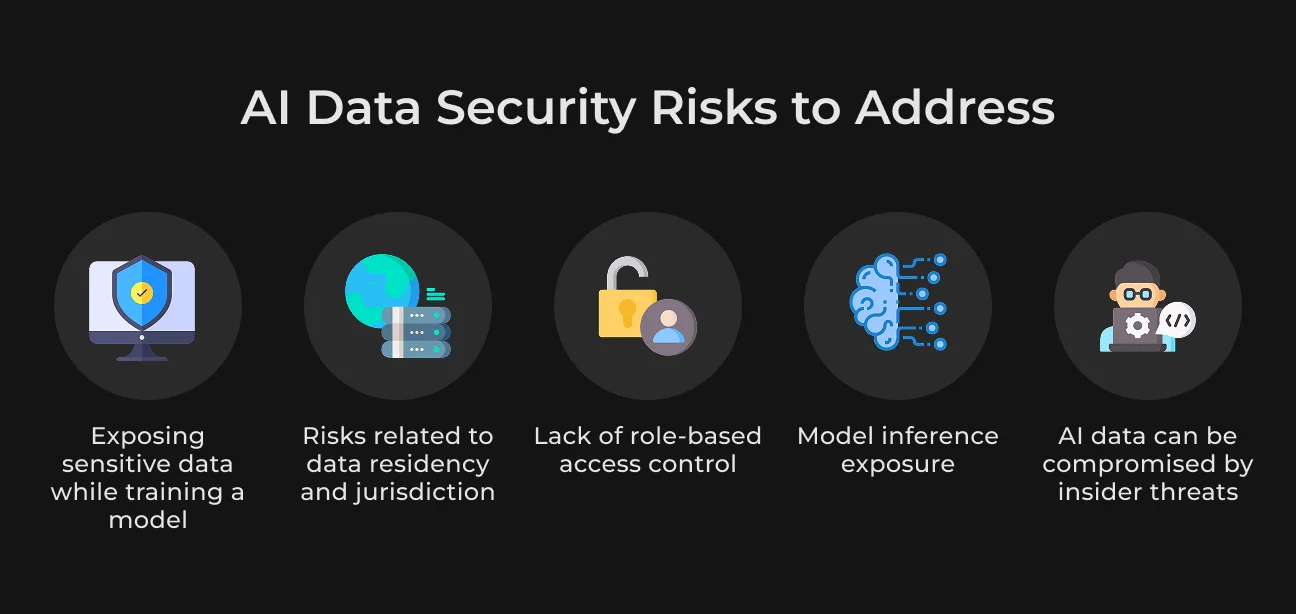
Let’s take a look at the main data security risks posed by AI, and explore some measures you can implement to protect sensitive data.
1. Sensitive Data Exposure During Model Training
There are public records, company databases, IoT devices, support transcripts, and code repositories where AI systems learn from the data. This ensures that the model can run this training, which requires lots of sensitive data from these sources. If not securely protected, personal data can be at risk of exposure or misuse.
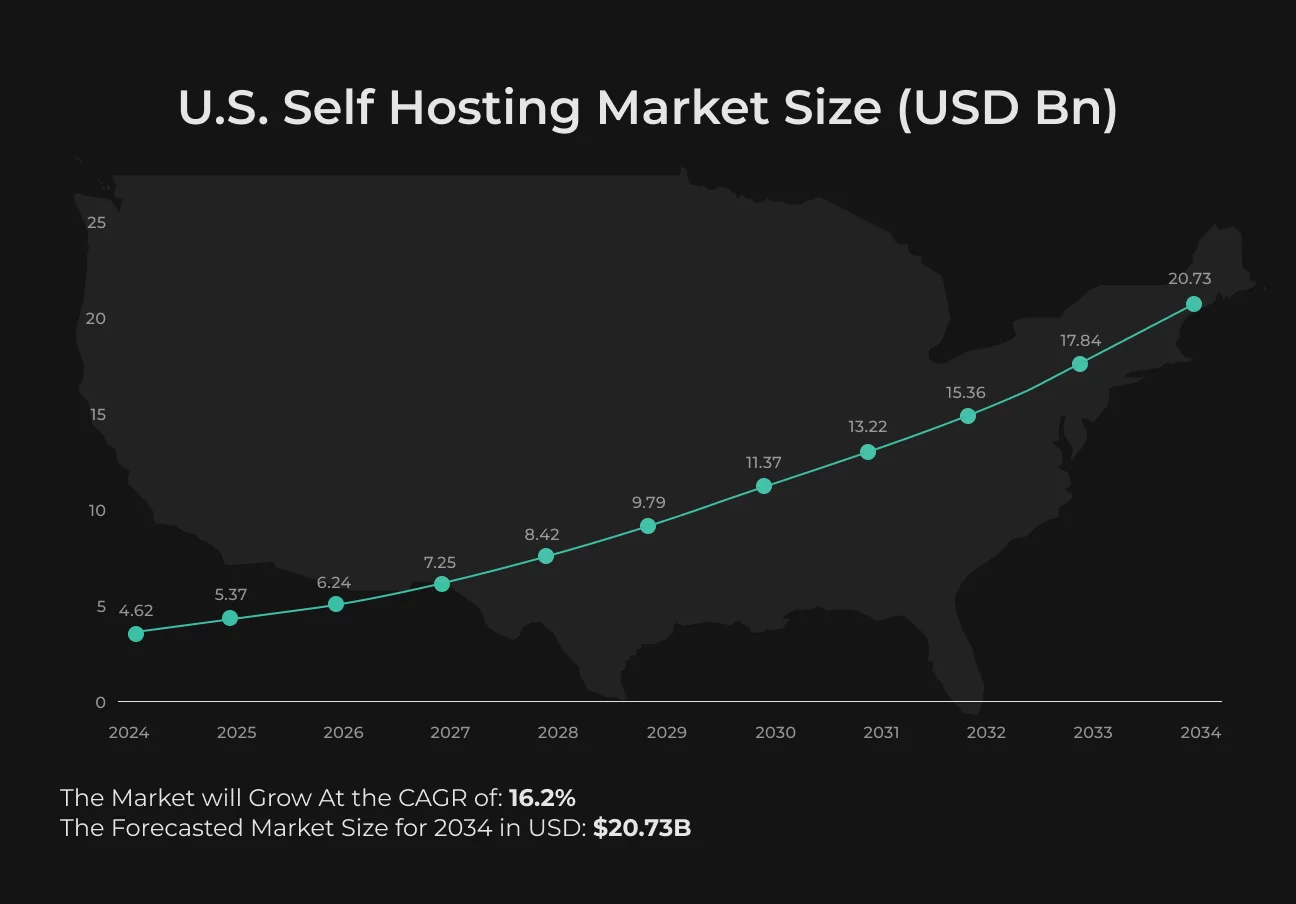
When it comes to this case, self-hosting AI is an advantageous alternative. Companies now need to take back control of their data and technology by using open-source language models locally on their own machines or secure cloud environments.
It allows organizations to maintain the confidentiality and security of data because they do not interact with commercial cloud APIs. You can customize and iterate your AI models relevant to their use case and manage investments.
2. Data Residency and Jurisdiction Risks
AI servers might be in different areas with different laws. Certain laws can even restrict the transfer of private data outside the local geography at all.
Ihor Hamal, COO at SapientPro, suggests that using self-hosted open-source models or AWS/Azure services in a specific region is an excellent way to handle data residency and legal concerns.
Another option is to invest in local AI infrastructure with data centers that follow local laws.
3. Lack of Role-Based Access Visibility
Poor access control is one of the biggest risks to AI data security. Without visibility into who can access what, there is much greater potential for data breaches and misuse.
The issue with a linear perspective in an AI model is that it gives the same view to everyone, no matter their role or rank. This might be problematic as different roles require varying levels of access to internal company information. A potential solution is to implement RAG indices to regulate these access levels.
Ihor Hamal
RAG also helps ensure that AI systems are privacy-preserving: they can return personal data if needed and delete it when possible. It only gives data to a language model during content creation and doesn’t further train the AI.
4. Model Inference Exposure
Generative AI models require user data during inference to produce their predictions, but doing so also makes them vulnerable to security threats. These include model inversion attacks, where the adversary tries to infer sensitive input information.
You can apply differential privacy to introduce noise into the model’s outputs so it doesn’t leak user data while minimally hurting its performance. Secure multi-party computation (SMPC) is another approach in which data can be processed across multiple parties. As a result, no one party can access all the dataset or insights from it.
5. Insider Threats in AI Data Management
Because employees and contractors have access to sensitive information, data breaches (intentional or otherwise) can occur. Classic insider threats usually involve intentional sabotage or theft. The risks caused by AI are paradoxically rarely intentional.
A developer, for example, might use a chatbot to help him debug by entering source code, not realizing the model could save that code.
Tight rules on the usage of data with periodic internal audits can mitigate insider threats. Behavior analytics using advanced technology helps identify abnormal activities.
The culture of security is not all about technical measures and is supported by training and awareness programs. They emphasize how crucial data is in today’s world, and the downsides of not adhering to security practices that protect that data.
Understanding AI for Regulatory Compliance in 2026
In 2026, AI system regulations will be detailed and extensive, so businesses should act with caution. Any organization deploying AI in their operations must follow rules closely.
General Data Protection Regulation (GDPR)
GDPR is a European Union data protection law that calls on organizations to work with personal data responsibly, including consent procedures that respect individual rights.
The laws govern any company that's processing data on EU citizens — wherever they may be. AI systems used by businesses must follow privacy principles, implement anonymization techniques, and handle user consent.
EU AI Act
The AI Act is the first legal framework crafted specifically for artificial intelligence. This law creates rules based on risk levels for developers and users of the AI — but it also doesn’t cover all applications from which AI is made.
This is part of broader AI projects, particularly the European law framework and initiatives such as the AI Innovation Package, or AI Factories. The AI Act will be implemented in stages after becoming law in August 2024.
For instance, AI literacy requirements and bans on certain AI systems went into effect in February 2025. The majority of the rules must be enforced by August 2026.
Health Insurance Portability and Accountability Act (HIPAA)
If your AI systems are in the healthcare space, you will also have to comply with HIPAA. HIPAA rules protect personal health information (PHI), meaning that laws are made to set strict measures around data.
Most importantly, the AI solutions should encrypt PHI, and have appropriate access control measures in place, as well the ability to report any data breach in a timely manner.
ISO 27001
ISO 27001 was a global standard for information security in previous years, established by the International Organization for Standardization. It offers a framework for setting an effective information security management system (ISMS), including specifications on elements like risk assessment, access control, and incident reporting.
Companies that store customer data use this standard to demonstrate to clients and stakeholders that their data is well-protected.
ISO 27001 certification is also granted once an independent third-party auditor has validated your compliance with the requirements.
Let's have a look at some key AI compliance aspects:
- Lawful data use. Companies need to collect, use, and store personal data according to the laws (like GDPR or HIPAA). That means getting people’s permission and using data responsibly. It's also vital to conduct AI data protection impact assessments (DPIAs);
- Explaining AI decisions. In finance, healthcare, or any other sensitive domain, organizations need to know how their AI systems decide. Companies must document the AI models they rely on and make those explanations public;
- Risk monitoring. Regular checks for fairness and reliability will allow organizations to find and fix potential threats and biases in their AI models. Unmonitored risk can make AI systems faulty, which would cause serious issues;
- Human oversight. It is true that AI systems operate in a human context, and so checks on their output by people are required to ensure they are ethical and legal. Companies risk unethical results as well as litigation without human insight.
Ignoring compliance may lead you to lose legal protection, financial advantage, and excellence in your business.
How SapientPro Built a Compliant AI Sales Agent

How to Conduct an AI Risk Assessment
There's no single way to conduct AI security assessment. However, for your AI program’s risk management strategy, you can follow certain steps.
Step 1. Rank AI Risks
Identifying and classifying AI risks as unacceptable, high, limited, or minimal is the first step of this process. Where a risk is unacceptable, the organization must bring that AI activity to a halt, as required by law. An unacceptable risk, for example, is using AI to assess rental applications based on race.
High-risk AI activities might include harming a business's operations, selling personal data, or creating deep fakes.
AI systems that aren't high-risk usually fall into a lower risk category.
Step 2. Identify How Likely They Are to Happen
When an organization has ranked the risks by priority, it's time to evaluate how likely each risk is. The NIST AI Risk Management Framework, as well as the new ISO standard for AI management systems, can help you with this.
Basically, you can classify risk according to its moderate or low severity and likelihood using a risk matrix.
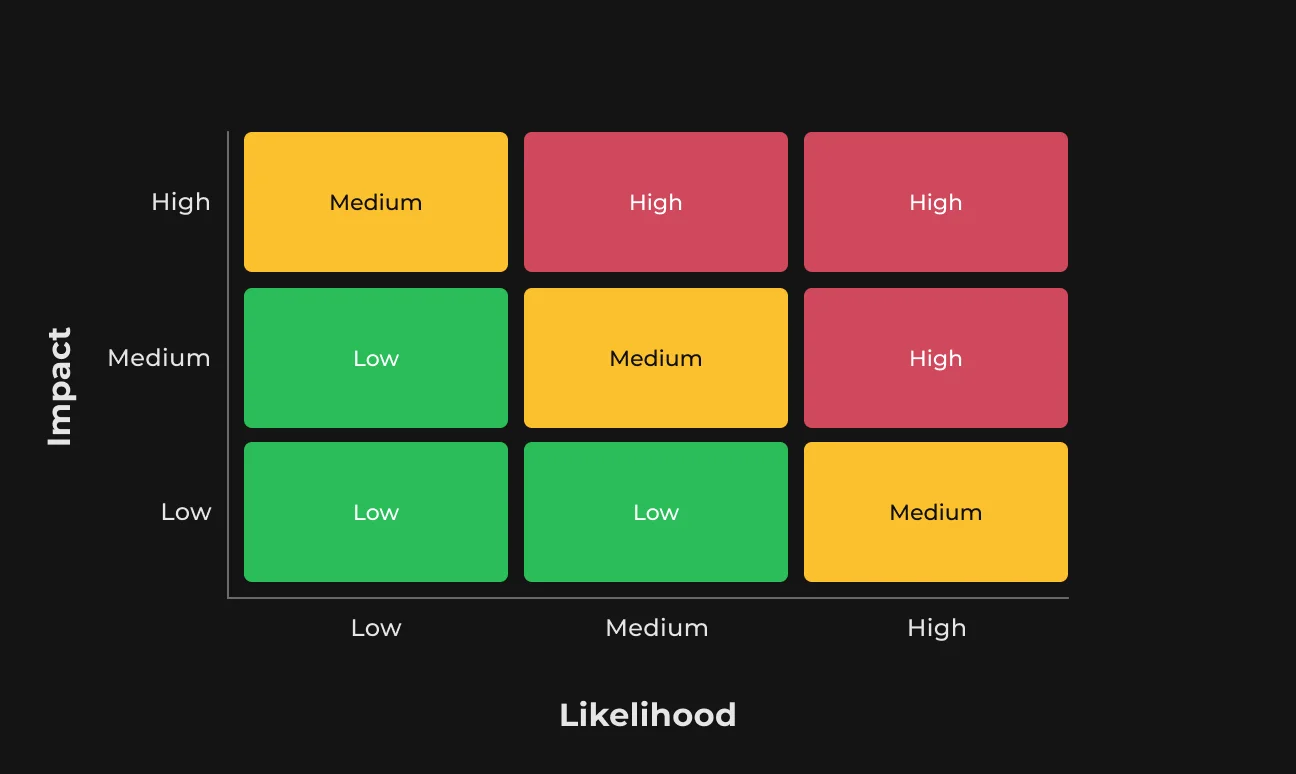
Step. 3. Record the Risk Assessment
You need to maintain records of your AI risk assessments. These records should describe the risks found during the assessment and evaluate if this mitigation is enough for future use of AI.
Privacy legislation, like Europe’s General Data Protection Regulation (GDPR) and several US laws, including the Colorado Privacy and Connecticut Data Privacy Act, requires completing these evaluations.
Step 4. Participate in Ongoing Monitoring
Risk assessment is not a one-time activity, though. You need to build, apply, record, and permanently oversee a risk management system that applies throughout the complete AI lifecycle.
Monitoring potential risks is part of the post-deployment activities of AI systems in a real-world environment.
AI Data Security Solutions for Modern Business
Companies can use specific AI data protection solutions to strengthen their security.
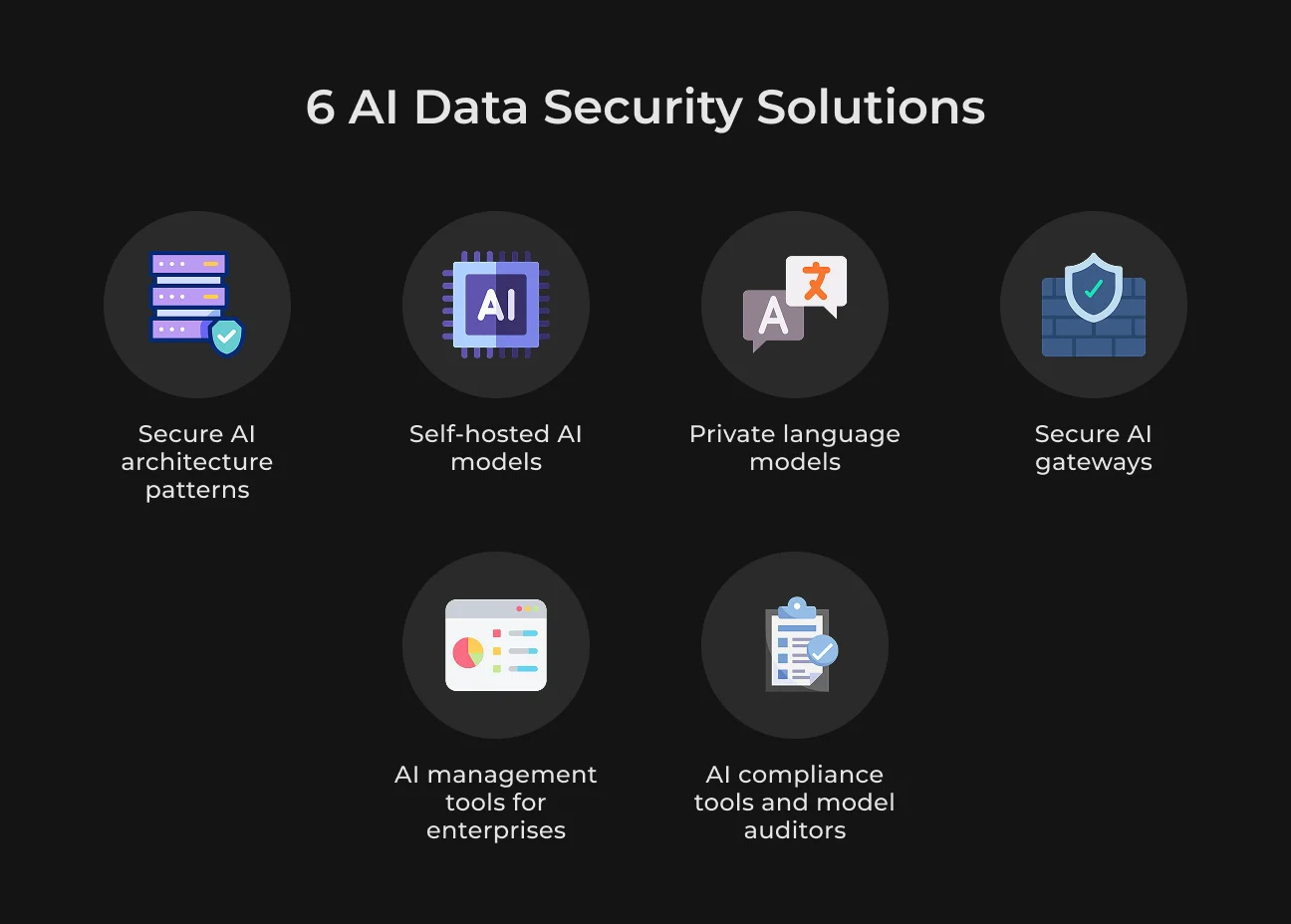
Secure AI Architecture Patterns
We can adopt multiple layers of security and secure AI architecture patterns to build resilient systems.
Frameworks like Microsoft Azure Security Center or AWS Identity and Access Management (IAM) can be useful to manage identity and access, segment networks, and encrypt data while it is stored or in transit.
These would ensure that data is protected and architectures are kept secure through the AI system’s lifecycle (from development through deployment).
Self-Hosted AI Models
Businesses that need greater control over data can indeed self-host AI models. TensorFlow Serving or PyTorch on-premises deployment, for instance, allows businesses to deploy AI models in-house on their own hardware.
The processing performed on-device reduces exposure to external threats, providing better security for the data.
Private LLM Deployment
Running private large language models (LLMs) in-house can keep proprietary information secure.
NVIDIA's NGC Private Registry or the IBM Watson Studio allows for private LLM deployment, locking down all models in protected containerized and virtual environments. Being isolated from external networks reduces the risk of potential data leakage and unauthorized access.
Secure AI Gateways
AI gateways help manage access to AI services. They ensure that only the authorized entities can reach and interact with the system.
AWS’s API Gateway or Google’s Apigee, for example, wraps AI with strong security (authentication, authorization, and encryption) to safeguard against unauthorized external access.
Enterprise AI Governance Tools
Enterprise AI governance tools help ensure that artificial intelligence is used legally and ethically. One example is IBM OpenPages, which provides frameworks to enforce policies, guidelines, and procedures around AI.
Such tools are important for establishing governance needed to secure transparency and accountability in AI systems.
AI Compliance Software and Model Audit Tools
Tools like SAS Compliance Solutions and Fairness360 from the IBM Watson OpenScale can help automate compliance and auditing processes for different reporting sections.
These solutions automate compliance checks and create audit trails so that AI systems comply with industry standards and regulatory benchmarks.
AI Compliance in High-Risk Industries
High-risk industries face more financial, regulatory, and operational challenges. AI systems in these sectors can greatly affect fundamental rights, safety, or human life if there are any security violations or data breaches. Let's take a look at some of these industries.
Healthcare
HIPAA, GDPR, and FDA are a few regulations healthcare organizations must comply with. HIPAA, for example, controls patients' data privacy and security. It basically relates to healthcare providers, health insurance plans, and data processors.
AI developers are not directly regulated by HIPAA, but if their products interact with HIPAA-covered entities, they may share the need to comply.
HIPAA is not the only law affecting agentic AI and machine learning in healthcare. The Federal Food, Drug, and Cosmetic Act (FDCA) is one such law governing this.
And so under this law, AI tech is generally defined as a medical device — especially when it can potentially be used to diagnose or treat health problems.
That means the AI developers need FDA approval to gain market access. The FDA also provides guidance for AI architects and has already approved more than 1,000 AI technologies as medical devices.
Finance
AI can spread errors if not monitored carefully. If there's a weak control point, automation can make a mistake widespread before anyone notices. Studies show that banks investing heavily in AI might take on more operational risks.
To use AI effectively in finance, it's important to incorporate AI risk management right into the core of your products. Especially when it comes to systems that handle data queries, make decisions, or start workflows.
Generally, financial institutions that use AI have to follow rules set by organizations like the SEC, FINRA, and the Federal Reserve. For example, FINRA focuses on having strong transaction monitoring and effective risk management. SEC requires companies to document and validate their AI models and decisions.
Governance & Public Sector
AI in the government and public services market is expected to grow to $109.44 billion by 2035. AI’s potential is something politicians and senior civil servants are increasingly talking about.
One application of generative AI is its large language models (LLMs), which are used to drive multilingual chatbots and provide services. There is a technique known as retrieval-augmented generation (RAG) that enables these models to access information contained in databases. This allows them to produce summaries and rough drafts of laws, regulations, and reports.
But again, while tools like these are available, government staff still need to verify and polish whatever AI produces. Although the private sector is investigating AI systems that can autonomously do tasks, such self-contained AI is not typically employed in government.
This is because governments are responsible not only for results but also for specific procedures and processes.
The Future of AI and Data Protection
No one can say for sure how AI will evolve by 2030, but the trend appears obvious for now. Developers continue plowing billions into building out their data centers.
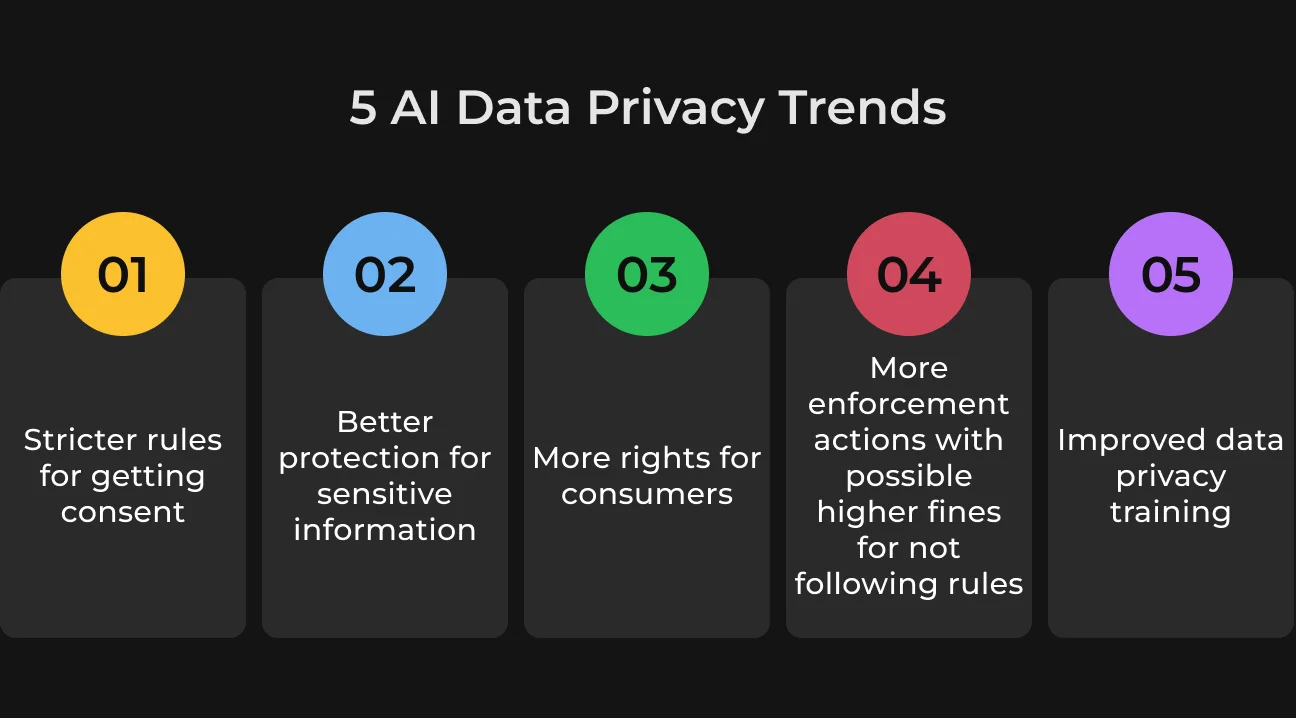
More than 40% of the top businesses will run their core processes on a hybrid computing architecture — up from around 8% today (according to Gartner’s forecast for 2028).
As AI becomes further entrenched in network operations, security teams face a double bind of addressing more threats while also ensuring sensitive data stays under local control.
Approximately 62% of respondents are blocked by data sovereignty and privacy issues in moving ahead with AI. And 80% want to use confidential computing in the next year and beyond to support data control.
So, AI and data protection's path forward will be paved with proactiveness, intersectoral collaboration, and commitment towards data integrity.
How SapientPro Helps Businesses Build Secure and Compliant AI Systems
AI regulations are getting stricter, and the penalties for non-compliance are real. SapientPro's engineers have spent 9+ years building AI systems that hold up to legal scrutiny — across GDPR, HIPAA, the EU AI Act, and ISO 27001.
We work with companies in healthcare, finance, and the public sector, where data protection failures carry the heaviest consequences. Every system we build is designed with compliance requirements in mind, not bolted on afterward.
Get in touch to start your AI compliance assessment today!
Build Compliant AI Systems
Let our experts handle your AI security and compliance for GDPR, HIPPA, and more.