All How to Extract Data from PDFs with AI: Lessons from a 1,400-Hour Build
May 13, 202615 min read


Unstructured information has quietly become the primary asset for competitive differentiation.
Between 80% and 90% of business data generated today is unstructured — locked inside emails, transcripts, and documents. Manual processing creates a structural bottleneck, costing organizations up to $25 per document while stifling advanced analytics adoption.
AI-driven document automation gives companies the framework to convert those static repositories into decision-grade intelligence. This article is written by SapientPro’s engineers based on their recent case study, coversing PDF data extraction software and the practical mechanics of how to extract data from PDF files.
What Is AI Data Extraction from PDFs
Understanding AI-powered data extraction requires a clear distinction between basic character recognition and semantic document intelligence:
- Traditional systems converted image pixels into text strings with no understanding of what those strings meant;
- Modern AI systems use deep learning to interpret a document's intent and structure.
That cognitive layer lets software recognize that a date at the top of a page is an "Invoice Date," while a similar string at the bottom is a "Payment Deadline."
The process maps unstructured text into structured schemas like JSON or XML — a transformation that is essential for feeding document data into automated ERP or CRM workflows.
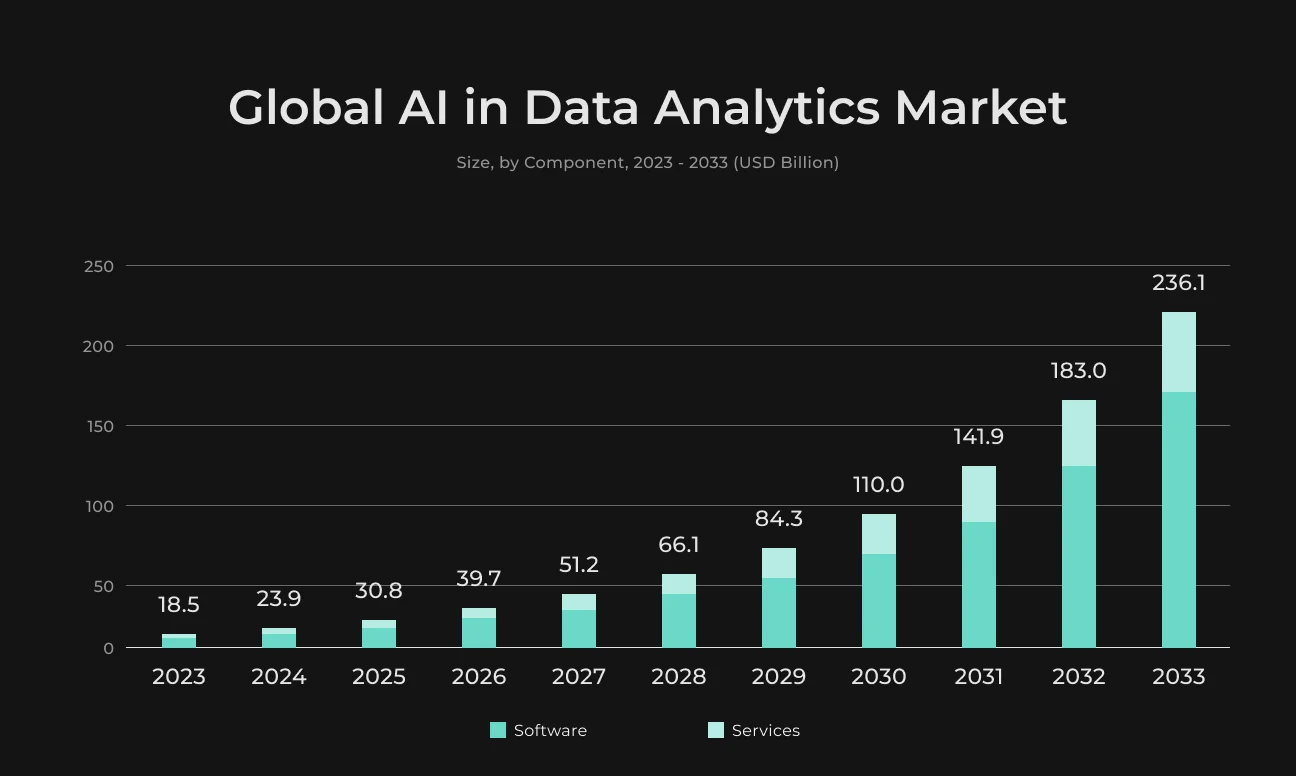
OCR and NLP both play a role here.
While OCR identifies the characters "T-O-T-A-L," NLP identifies that the associated number represents the final financial obligation in that transaction. Machine learning acts as the adaptive layer, refining accuracy as the system encounters more variations in document style.
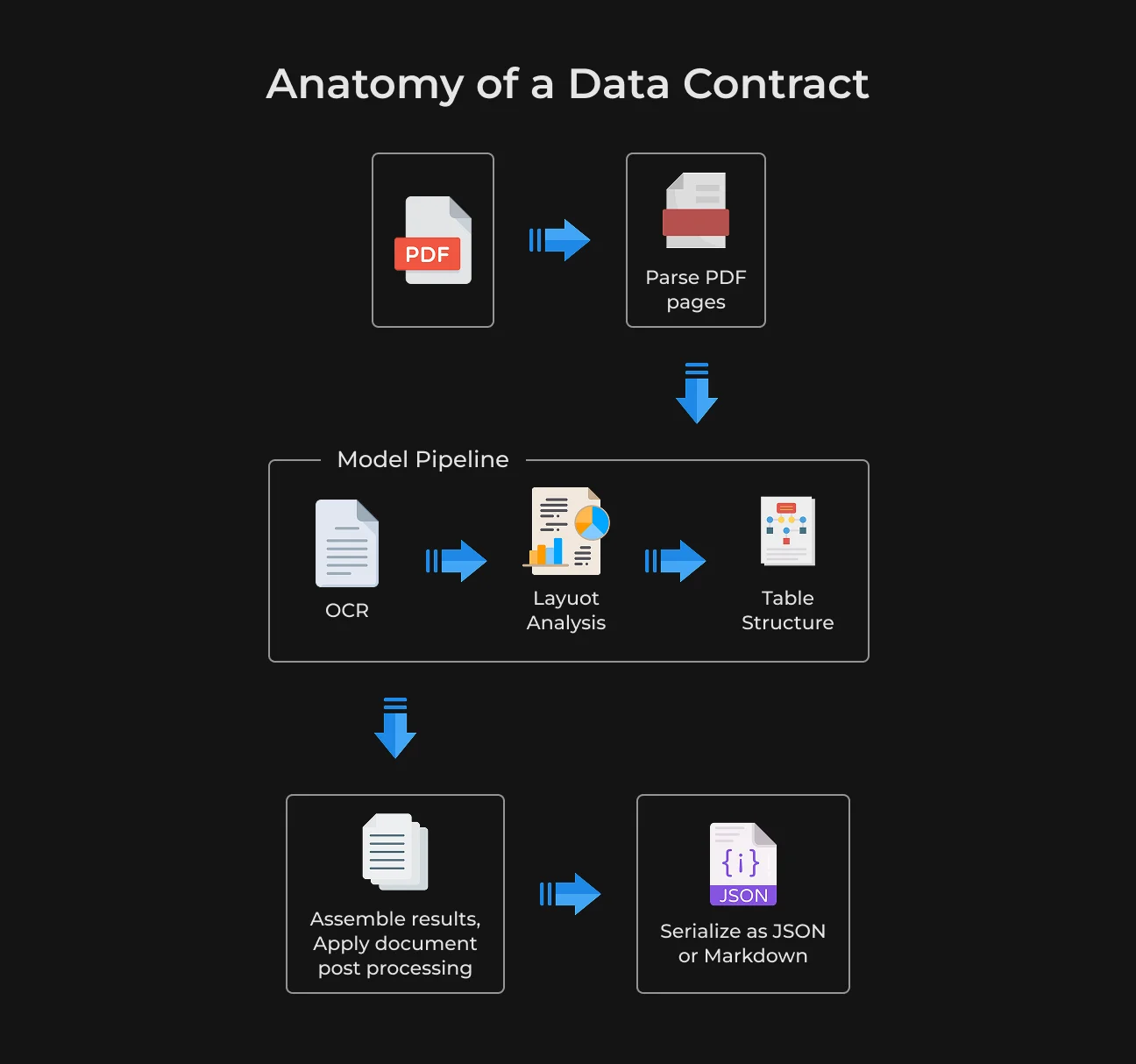
Document classification enables the system to route files to the correct extraction model. An effective system can automatically identify whether an incoming PDF is a contract, an invoice, or a lab report.
The Economic Reality of Unstructured Data
Enterprise data volume is projected to grow from 33 zettabytes in 2018 to 175 zettabytes by 2025.
Of that total, only 10% is currently being stored — and even less is analyzed, creating a vast reservoir of dark data. Unstructured content is growing at three times the rate of structured data, with annual growth rates reaching 65% in many organizations.
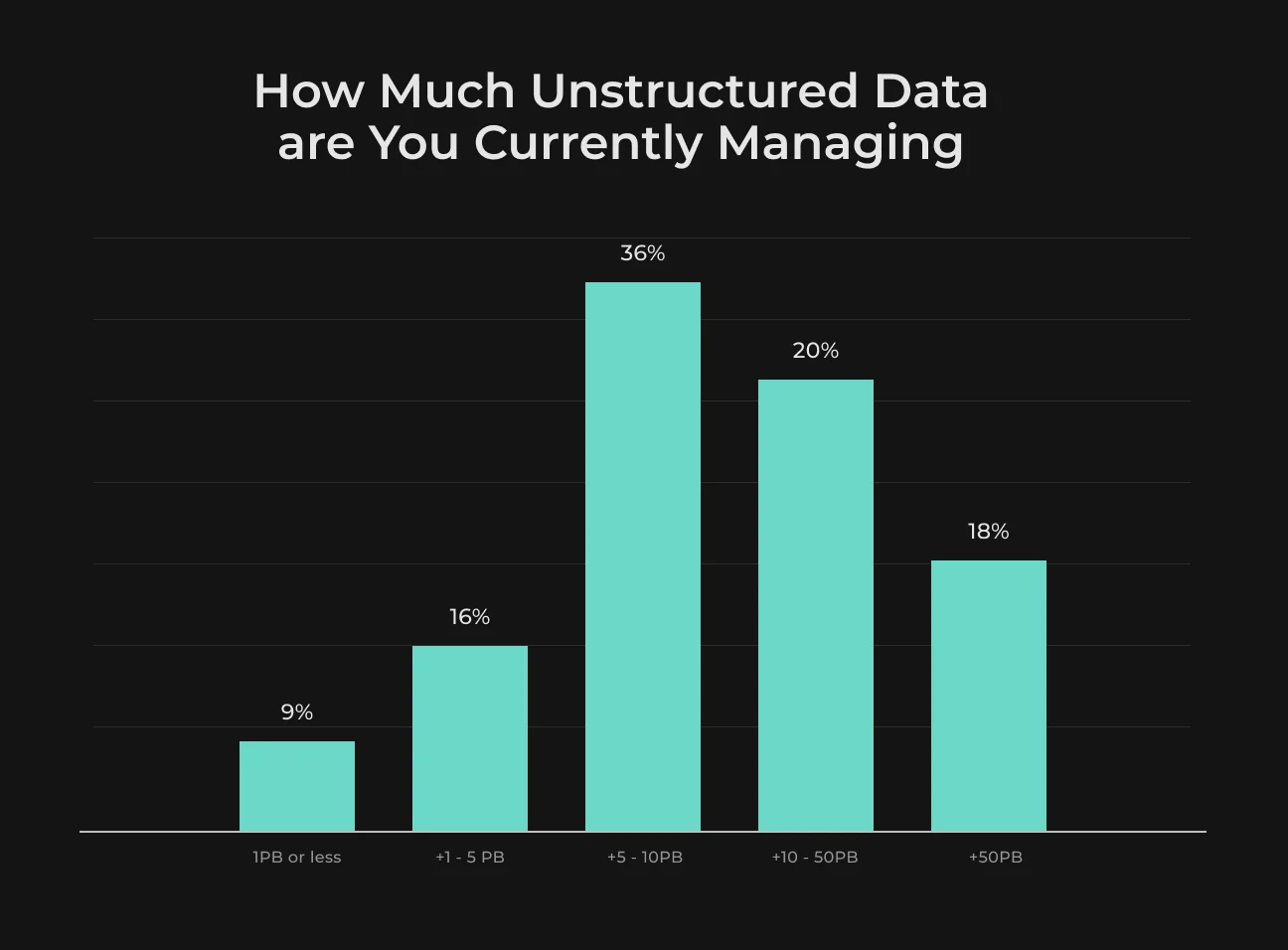
For executives, this data explosion is both a risk and an opportunity. Organizations currently spend more than 30% of their IT budgets solely on managing and storing unstructured files. Without extraction tools, those files remain functionally inaccessible for decision-making or automated workflows.
Metric | Source | Projection / Value |
| Unstructured Data % | Gartner | 80% - 90% of all new data |
| Global Data Volume | IDC | 175 Zettabytes by 2025 |
| Annual Growth Rate | Gartner | 55% - 65% for unstructured data |
| IT Budget Allocation | Komprise | 30% spent on data management |
| ROI of AI Integration | IDC | 3.7x to 10.3x for top performers |
Manual document processing is no longer sustainable at these volumes. Direct labor costs for manual data entry average $15 per hour, but the hidden costs of error remediation and process delays are far more damaging. Industry research suggests that every manual entry error costs an organization between $25 and $150 to identify and correct.
Why Traditional PDF Data Extraction Fails
Traditional PDF data extraction has relied on coordinate-based templates, which are inherently fragile. These systems look for specific data points at exact X and Y coordinates on a digital page. If a vendor adjusts their invoice layout by even a few pixels, the template breaks, and IT has to rebuild it manually.
Challenge | Traditional Method (Gen 1) | AI-Based Method (Gen 3) |
| Template Management | Requires manual update for every layout | Template-free (Zero-shot) |
| Scalability | Limited to a few standardized forms | Scales to thousands of variations |
| Scanned Quality | High failure rate on low-DPI scans | Advanced denoising and vision models |
| Semantic Context | No understanding of text meaning | Full contextual awareness |
| Multilingual Support | Requires separate language models | Native support for 100+ languages |
Rule-based extraction methods
That lack of flexibility makes rule-based systems impossible to scale. Larger organizations often manage thousands of distinct vendors, each with its own document formatting. Creating and maintaining templates for every vendor consumes more resources than it saves.
Challenges with scanned documents
Scanned documents add complexity that legacy systems cannot handle well. Character-level errors that corrupt entire datasets typically trace back to:
- Low-resolution scans;
- Skewed pages;
- Background noise.
Traditional OCR engines struggle to distinguish noise from text, producing high failure rates in industries that still rely on physical paper.
Unstructured data complexity
Handwriting remains a significant barrier for non-AI systems — cursive or messy script often produces garbage outputs. Modern AI extraction tools use specialized models such as Intelligent Character Recognition (ICR) to interpret handwritten annotations.
That capability matters in legal and healthcare contexts, where handwritten clinical notes or contract amendments are common.
How AI Extracts Data from PDF Files
If you consider developing AI data extraction tools, here is how this process works.
Document ingestion and preprocessing
Automated data extraction starts with ingestion and normalization. Inbound files from APIs, emails, or direct uploads are converted into a standardized internal format. This stage includes preprocessing steps like:
- Deskewing;
- Contrast enhancement;
- Noise reduction.
These steps optimize the document before extraction begins.
Optical character recognition (OCR)
Modern AI-based extraction systems use Vision Transformers (ViT) to process documents as image-text hybrids. This preserves the spatial hierarchy of the document — the system understands how headers and sub-headers relate to body text, rather than treating everything as a flat string.
AI-based document understanding
Document understanding is powered by large language models (LLMs) that provide deep semantic insight. Unlike legacy systems, these models can be prompted to extract all risk-related clauses without a predefined field map. That zero-shot learning capability means organizations can deploy the system immediately across new document types.
Table and data structure recognition
Table and structure recognition represent one of the biggest advances in PDF data extraction.
AI models now reconstruct complex grids and nested tables by identifying visual boundaries and logical relationships between cells. This keeps line items in a 50-page invoice associated with their correct subtotals, even when the table spans multiple pages.
Data export and integration
The final step is structuring and delivering data through APIs. The system transforms extracted entities into JSON or CSV files for direct entry into business systems, eliminating the need for human middleware. Data flows from the document to the point of decision in real time.
Key Features of AI PDF Data Extraction Software
AI agents can follow complex multi-step workflows:
- Extract the data
- Verify it against the vendor database
- If the tax ID is missing, send an automated email to the supplier
That level of automation turns document processing from a simple extraction task into a complete business process workflow.
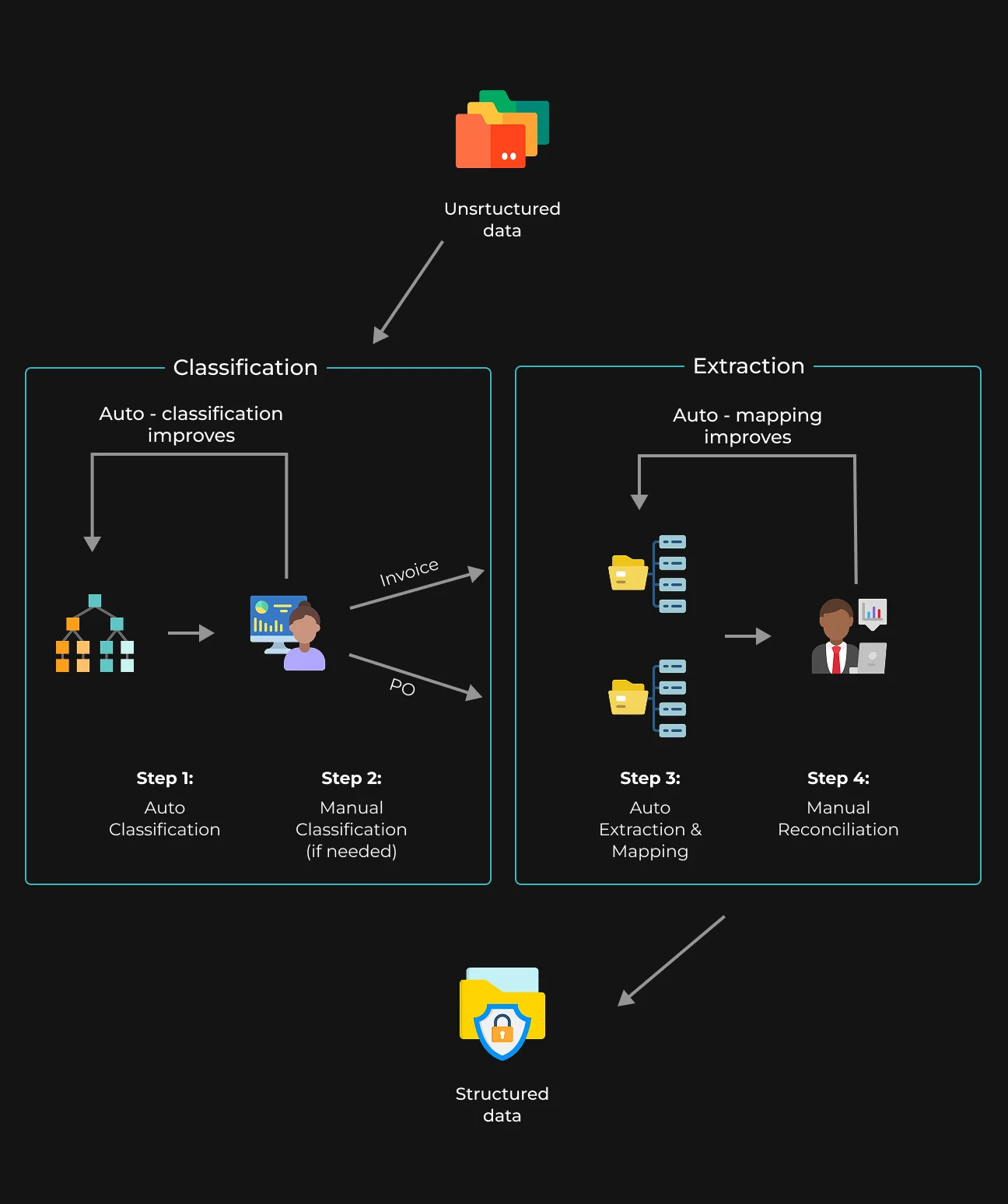
Intelligent document classification
An essential feature of modern PDF data extraction software is the ability to perform intelligent document classification. This is particularly important for compliance-heavy industries that handle diverse document types like:
- Birth certificates;
- Tax forms;
- Utility bills;
- Invoices;
- Contracts;
- Reports;
- Safety documents.
By automatically identifying the document class, the system can apply specialized extraction logic and specific security guardrails.
Automated data extraction from PDFs
Sophisticated AI data extraction software includes built-in validation and confidence scoring.
Every extracted field receives a score. The system flags low-confidence values for human review while auto-approving high-confidence data. This human-in-the-loop model prevents errors from cascading through the organization while keeping automation rates high.
Bulk and batch processing
Modern PDF data extraction tools can process thousands of documents in parallel. That throughput is essential for departments like Accounts Payable or Claims Processing, which often see significant seasonal surges in document volume.
Integration with enterprise systems
Leading AI data extraction tools include pre-built connectors for ERP systems like SAP and Oracle, and CRM platforms like Salesforce and Creatio. An extracted invoice can be automatically matched to a purchase order and routed for approval without any human intervention.
Stop Entering Data Manually
Let's automate the documents your team dreads most.

Technologies Used in AI PDF Data Extraction
The core of AI-based extraction is built on machine learning frameworks like TensorFlow and PyTorch. These libraries let developers train deep neural networks for tasks ranging from object detection (identifying logos and signatures) to text classification.
LLMs have fundamentally changed how data is extracted from PDFs.
Rather than treating a document as a series of pixels, LLMs treat it as a semantic entity — capable of interpreting complex relationships and summarizing long-form text with high accuracy. This enables agentic document workflows where the AI reasons about the content it has just extracted.
Technology Component | Framework / Model | Role in Extraction |
| Deep Learning | TensorFlow / PyTorch | Pattern recognition and classification |
| Semantic Analysis | OpenAI / Mistral | Contextual understanding and reasoning |
| Computer Vision | OpenCV / Vision Transformers | Layout analysis and character recognition |
| Data Engineering | Python / Java | Backend orchestration and API delivery |
| Cloud Infrastructure | AWS / Azure | Scalable processing and model hosting |
Python is the dominant programming language in this stack, given its rich AI-specific library ecosystem — spaCy for NLP, Hugging Face for model deployment. Java is commonly used in the backend to manage high-concurrency data flows and secure database connections.
Autonomous bots and AI agents are increasingly used to orchestrate the entire document lifecycle.
These agents use Retrieval-Augmented Generation (RAG) to cross-reference extracted data with internal knowledge bases or live external APIs, ensuring accuracy and relevance to the specific business transaction being processed.
Business Use Cases of AI Data Extraction
AI-based data extraction has many use cases. Here are 4 of the most vivid.
Invoice and financial document processing
In financial services, artificial intelligence data extraction automates high-volume ingestion of invoices and bank statements. Organizations using these tools report a 70% reduction in invoice processing time, freeing finance teams to focus on forecasting rather than data entry. Automation also reduces the risk of late payment penalties and captures more early-payment discounts.
Contract and legal document analysis
In the legal and compliance sectors, AI-powered data extraction is used to analyze vast repositories of contracts and regulatory filings. AI tools can scan thousands of pages to identify:
- Specific obligations;
- Liability risks;
- Non-standard clauses.
These might be missed during manual review. This is particularly critical in M&A due diligence. As you probably know, the speed of review can determine the success of a deal in M&A due diligence.
Safety data sheet (SDS) extraction
Safety Data Sheet (SDS) management is a critical specialized use case for industrial and healthcare environments. Productroom, SapientPro's product, structures and organizes safety information from any SDS file format, regardless of layout.
It ensures that chemical safety protocols, hazard pictograms, and emergency procedures are instantly accessible and automatically updated, keeping organizations compliant with global safety standards.
Healthcare and insurance documents
Healthcare organizations use AI PDF data extraction to manage the pajama time burden on physicians. AI tools can recover up to 13 hours per week for clinical staff by automating the extraction of data from:
- Clinical notes;
- Lab reports;
- Faxed physician orders.
This reduces burnout. It also ensures that patient data is accurately reflected in EHRs for better care coordination.
Benefits of AI-Powered Data Extraction
Let’s highlight 5 main benefits of AI-powered data extraction.
Massive Operational Cost Reduction
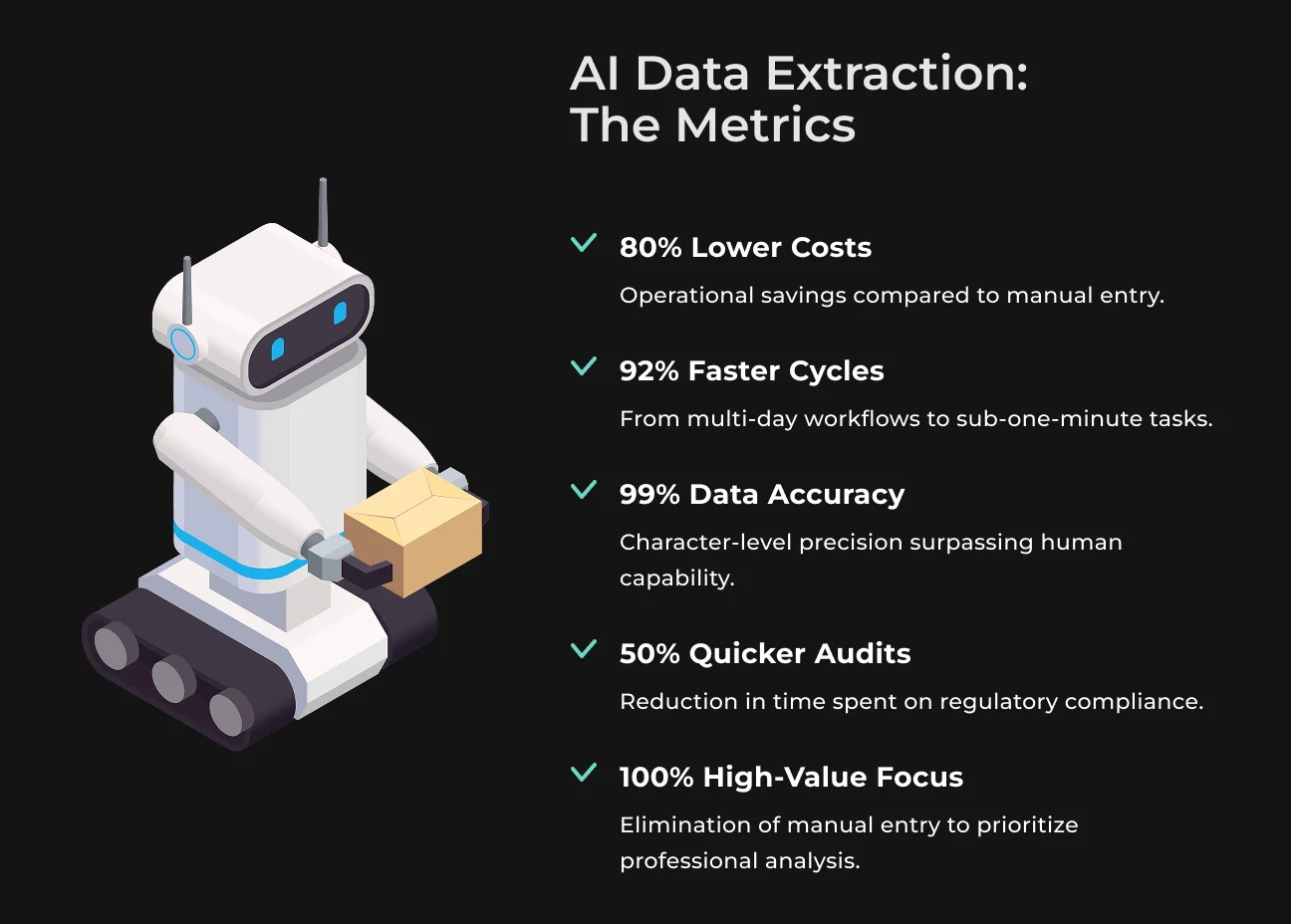
Organizations moving from manual to automated data extraction from PDF typically see cost reductions of 60% to 80%. Manual processing can cost between $10 and $25 per document; AI-driven automation reduces this to as little as $2 per transaction. For a mid-sized organization, that adds up to hundreds of thousands of dollars in annual savings.
Radical Improvements in Cycle Time
Automation reduces document processing time by up to 92%, turning multi-day workflows into sub-minute tasks. In the legal sector, contract cycle times have dropped from 19 days to 3. That speed creates a real competitive advantage.
Higher Precision and Data Integrity
Modern AI systems achieve character-level accuracy of 95% to 99%, far above the reliability of manual data entry. Manual error rates of 1% to 4% often generate downstream costs of $50 per error for remediation. Eliminating human errors at the point of ingestion ensures that business intelligence is built on clean data.
Improved Compliance and Audit Trails
AI-powered systems provide an immutable audit trail for every piece of extracted data, linking directly back to the source document. That transparency is essential for industries subject to HIPAA or GDPR regulations. Automated compliance monitoring can reduce the time required for regulatory audits by as much as 50%.
Employee Empowerment and Talent Retention
By removing data entry, AI lets professional staff focus on high-value analysis.
Legal and medical professionals report lower stress levels and higher job satisfaction when their administrative burden is reduced through automation. Organizations also benefit from better retention of high-performing talent who might otherwise leave due to burnout.
Challenges in AI PDF Data Extraction
If you want to implement artificial intelligence data extraction, you must be prepared for some challenges.
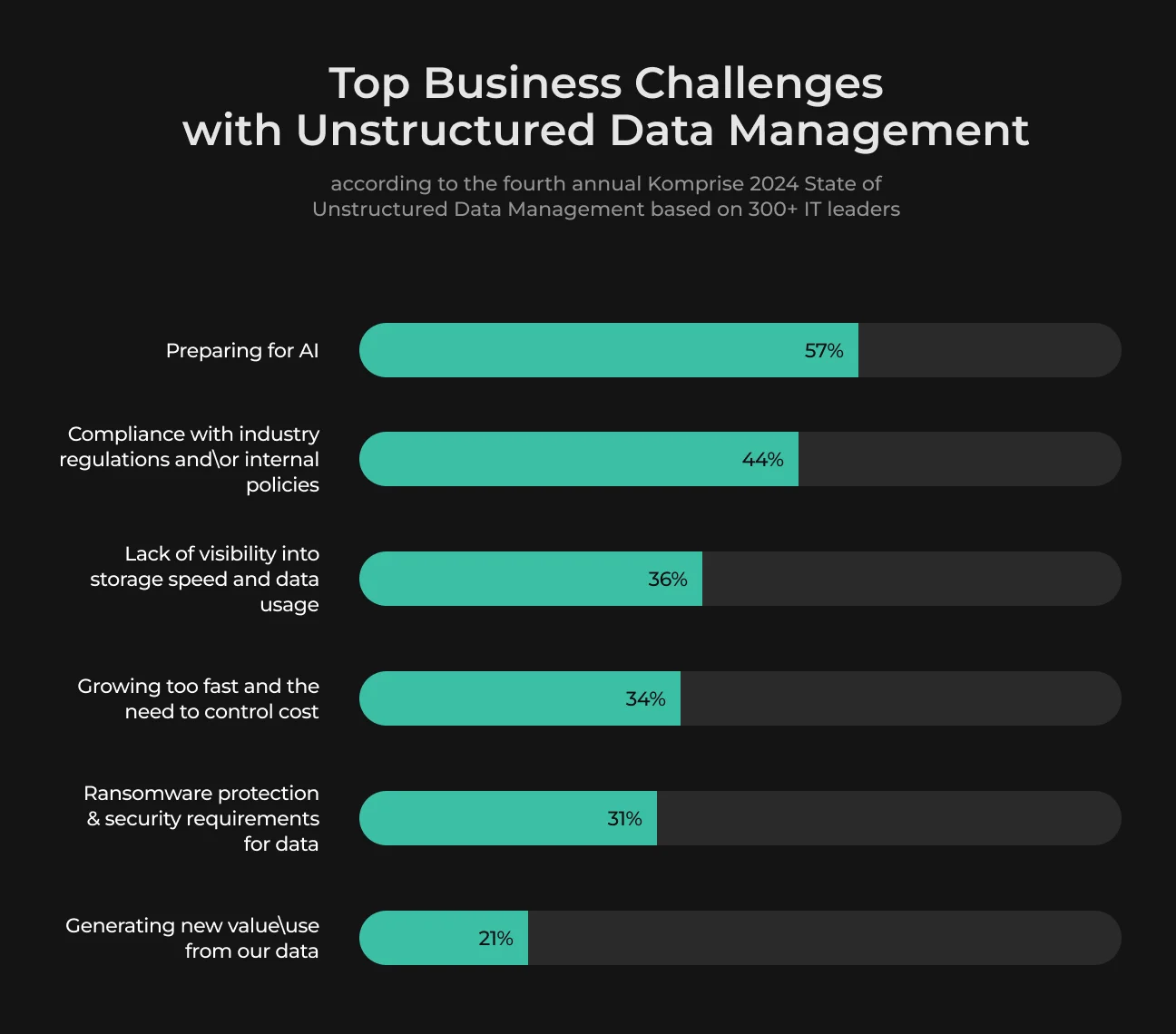
Document Variability
Even with advanced AI, the diversity of document layouts remains a challenge for full automation.
The most effective mitigation is deploying multimodal models that interpret both text and visual layout cues, paired with a human-in-the-loop strategy that flags low-confidence extractions for expert review. This keeps accuracy above established thresholds without slowing down the overall workflow.
Privacy and Data Security
Handling sensitive PII or protected health information requires a privacy-by-design approach from the start. Organizations should implement automated redaction and masking before the AI model processes the data. Hosting models within a private cloud or using on-premises LLMs can prevent confidential data from being exposed to third-party vendors.
AI Hallucinations
Generative AI systems can invent data that is not present in the original document. The most effective guard is rigorous validation — cross-checking subtotals against line items, for instance. Systems should also provide grounded citations, letting users hover over an extracted value and see exactly where it appeared in the source PDF.
Integration and System Complexity
The "Extraction Plateau" occurs when organizations successfully automate extraction but fail to connect it with downstream systems. The solution is to prioritize extraction software with strong REST APIs and pre-built enterprise connectors, and to keep the extraction layer architecturally separate from the business logic layer for easier scaling and maintenance.
Scarcity of High-Quality Training Data
Training specialized models for niche industries requires thousands of labeled document samples, which can be hard to acquire. Zero-shot and few-shot learning techniques help here by drawing on the pre-trained knowledge of large language models. Synthetic data generation can also simulate edge cases and rare document formats, improving model reliability without requiring real-world samples.
How to Implement AI PDF Data Extraction in Your Business
Implementing a production-ready solution requires a step-by-step approach to ensure long-term ROI.
Step | Action | Description | Expected Outcome |
| 1 | Inventory Document Types | Identify which documents require the most manual effort and time to process | Clear view of high-impact automation opportunities |
| 2 | Define Success Metrics | Establish baseline metrics: processing time, cost per document, extraction accuracy | Measurable benchmarks to evaluate AI performance |
| 3 | Evaluate Vendor Security | Verify compliance with GDPR, HIPAA, or SOC 2, and check for local data residency options | Reduced legal and data security risks |
| 4 | Run a Targeted Pilot | Select one high-impact workflow (e.g., Accounts Payable) and process 50–100 real documents | Real-world validation of tool accuracy and efficiency |
| 5 | Design the Validation Workflow | Implement a human-in-the-loop system for handling exceptions and low-confidence outputs | Improved data reliability and controlled automation |
| 6 | Scale and Integrate | Connect the solution to core systems like ERP or CRM via API after a successful pilot | Consistent data flow across business systems |
| 7 | Monitor and Iterate | Use feedback from human reviewers to continuously retrain AI models | Ongoing improvement in accuracy and performance |
How SapientPro Builds AI Data Extraction Solutions
SapientPro develops customized AI document automation systems that convert unstructured data into actionable intelligence. A great example is the SDS automation project completed for a Swiss client.
The challenge: processing thousands of Safety Data Sheets from diverse suppliers — each with a different layout — to maintain compliance with chemical safety regulations.
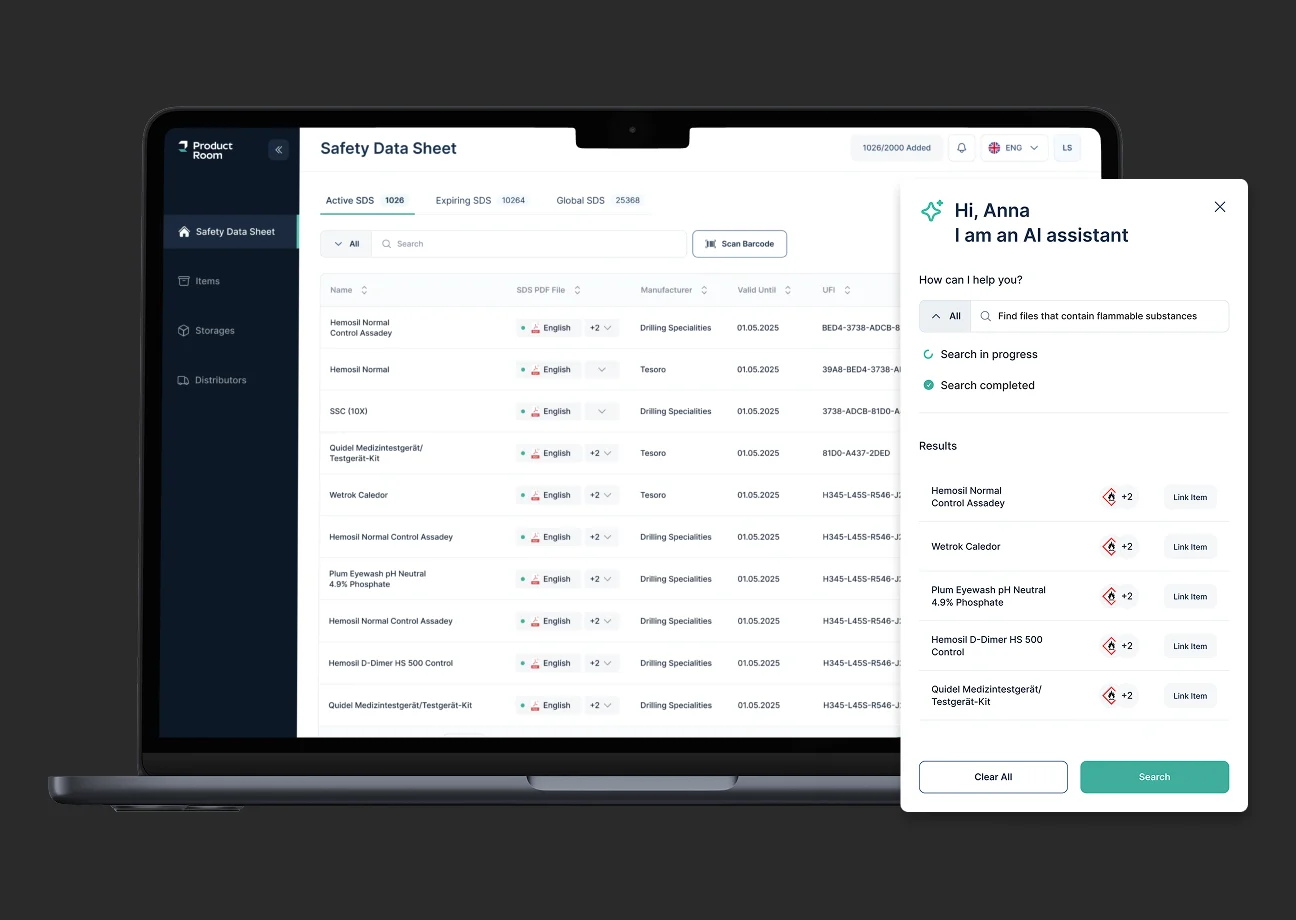
The project ran to 1,400 hours of development and produced an AI-powered platform that automatically extracts chemical compositions, safety protocols, and hazard statements from any SDS format. The solution uses React and NextJS on the frontend with a PHP/MySQL backend, integrating OpenAI and Mistral models for high-precision parsing. It eliminated both manual data entry and reliance on barcodes.
Key technical implementations include:
- Intelligent layout parsing: AI reconstructs tables and data structures from unstructured PDF files;
- Multilingual version matching: automatically identifies and pairs German and English versions of the same product documentation;
- Automated hazard labeling: extracts pictograms and warning statements to generate searchable hazard labels;
- Advanced audit logging: logs every login, upload, and data edit for regulatory oversight.
The ProductRoom platform demonstrates SapientPro's ability to handle complex, industry-specific extraction challenges. By isolating datasets into secure data rooms, the system protects sensitive safety documentation while keeping it accessible to authorized personnel.
Build Your Data Extraction Solution with SapientPro
SapientPro builds custom AI data extraction software for businesses that need measurable results.
Our team specializes in integrating large language models and building scalable document processing systems across the entire document lifecycle — from preprocessing and OCR to semantic interpretation and enterprise system integration.
Here's what you can build with us:
- Contract reviewer that flags risk clauses and non-standard terms before a human ever opens the file;
- Invoice processing pipeline that extracts, validates, and posts to your ERP without manual entry;
- Medical records system that pulls structured data from faxed or scanned clinical documents;
- Compliance dashboard that monitors safety sheets, permits, or regulatory filings across your supplier base;
- Due diligence tool that summarizes and cross-references thousands of pages of deal documents in minutes;
- … and more!
Get in touch with SapientPro to start your AI data extraction project today.
Cut Your Document Processing Costs
Most clients see 60–80% reduction within the first pilot.