All 10 Best Speech-to-Text APIs: Comparison and Use Cases for Your Business
April 29, 202615 min read


As businesses try to capture and process massive volumes of spoken data, choosing the right speech-to-text API becomes a strategic decision. Modern speech recognition systems can transcribe audio at scale, but performance varies significantly depending on latency, accuracy, and domain adaptation.
The gap between generic models and optimized low-latency transcription APIs directly impacts costs and user experience. For example, delays in real-time transcription can break conversational flows in voice assistants, while inaccuracies increase manual review overhead.
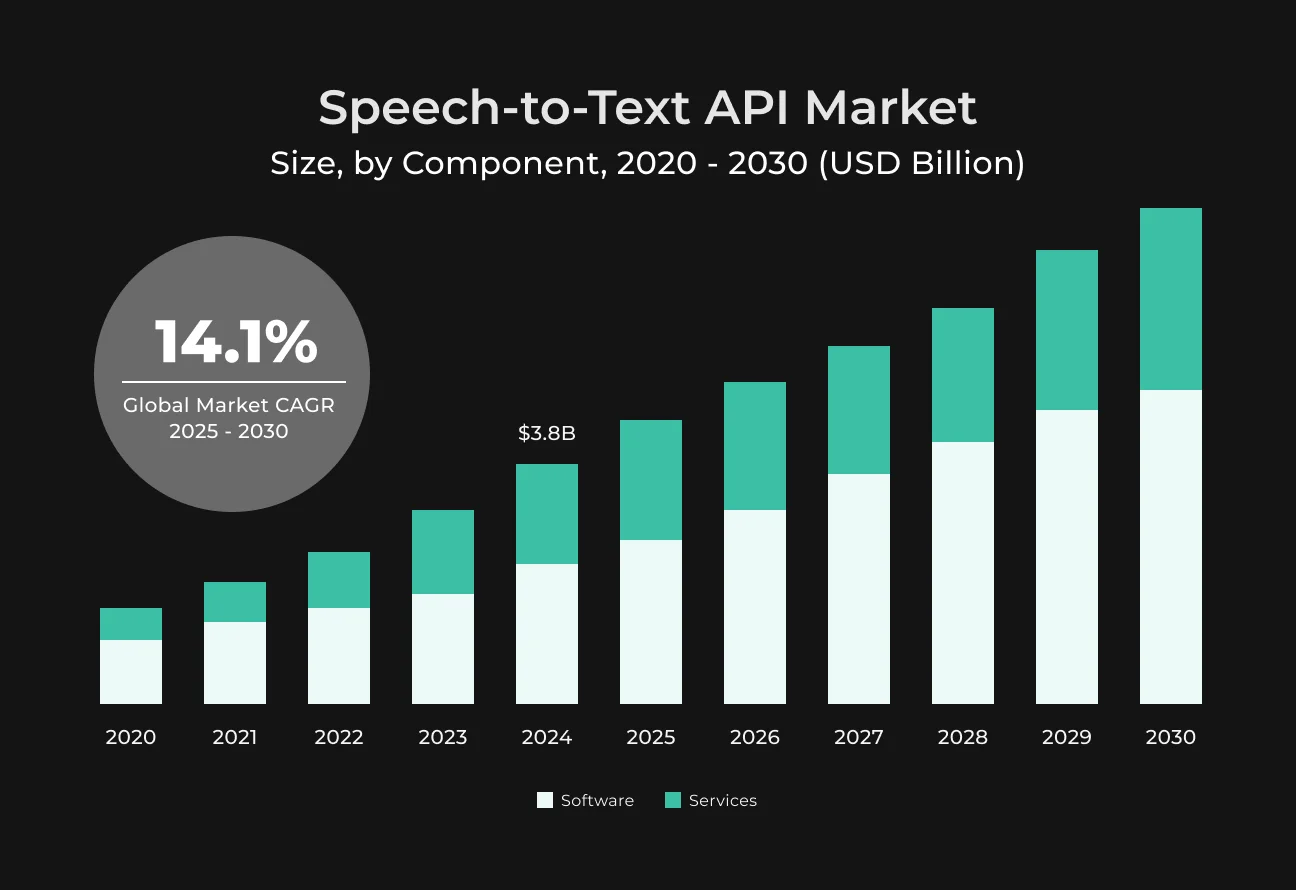
Today’s market is highly segmented. Some APIs focus on minimizing word error rate for offline transcription, while others are built for real-time use cases like AI voice agents, call analytics, or live captions.
In this guide, you will get a comparison of leading speech-to-text APIs, breaking down their strengths, limitations, and best-fit use cases to help you make an informed choice based on SapientPro’s experience.
What Is a Speech-to-Text API?
A speech-to-text API converts spoken language into structured, machine-readable text. It acts as a bridge between raw audio input and downstream systems like analytics platforms, chatbots, or voice assistants.
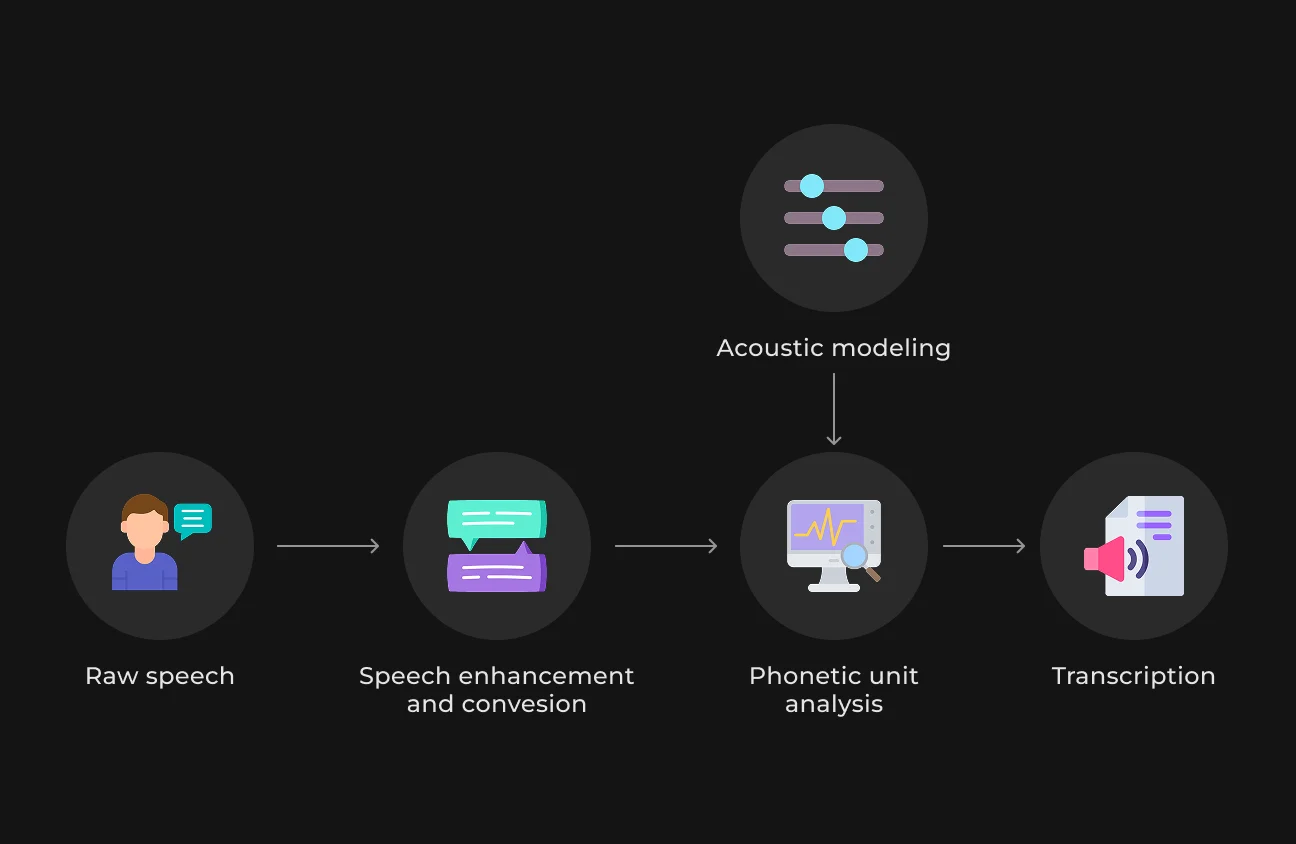
Most modern solutions rely on a three-stage pipeline:
- Audio input.
The system captures raw acoustic signals from sources like microphones or telephony streams and converts them into a digital format (typically PCM). The audio is then preprocessed to normalize volume and reduce background noise;
- Model processing.
This is where most innovation has happened in recent years.
Traditional hidden Markov models have largely been replaced by end-to-end deep learning architectures such as Transformers and Conformers. These models process both acoustic signals (phonemes) and linguistic context (syntax and semantics) to predict the most probable word sequence;
- Text output.
The API returns transcribed text along with metadata such as confidence scores, speaker diarization, and word-level timestamps.
These APIs enable companies to analyze conversations as precisely as any other digital input by turning speech into structured data, whether for product insights, customer support, or compliance.
Key Capabilities of Speech to Text API
Modern speech-to-text APIs are defined by four core capabilities that determine their real-world performance and fit for specific use cases.
Real-time transcription
This capability enables systems to process speech as it happens, which is critical for voice assistants, live captions, and AI agents. It typically relies on streaming protocols like WebSockets or gRPC to maintain continuous communication between client and server.
Performance is measured by:
- Partial latency. Time to generate an initial word hypothesis;
- Final latency. Time to deliver a finalized transcript after a phrase ends;
Leading APIs achieve partial latency below 150 ms, allowing AI systems to handle interruptions and respond in near real time.
Batch transcription
For large-scale processing of recorded audio, batch transcription is more efficient. Audio files are uploaded and processed asynchronously in an ASR API, giving models access to full context from the start.
This allows:
- Lower word error rates due to context-aware corrections;
- Faster throughput, with top providers processing up to 1 hour of audio in under 30 seconds;
Batch mode is widely used in analytics, compliance, and content indexing.
Speaker diarization
Diarization identifies who spoke and when in multi-speaker audio.
It’s essential for meetings, call centers, legal records, and healthcare documentation.
Modern systems rely on neural clustering to separate speakers based on voice characteristics, even in noisy environments or when voices sound similar. Poor diarization quality can break downstream tasks like summarization or sentiment analysis, making it a key differentiator between providers.
Multilingual support
Global applications require more than basic translation. Advanced APIs support automatic language detection and code-switching—handling conversations where speakers switch languages mid-sentence.
Top-tier providers now support 100+ languages with strong accuracy, enabling consistent performance across regions without retraining or manual configuration.
Why Businesses Use Speech Recognition APIs
The main value of speech recognition APIs lies in turning unstructured audio into usable & high-impact data.
Automation of workflows
When combined with LLMs, voice-to-text APIs remove a large share of manual work.
For example, sales or support calls can be automatically:
- Transcribed;
- Summarized into key points;
- Converted into action items and synced with CRM systems;
This reduces administrative overhead and keeps data consistent across systems.
Voice-enabled applications
Speech recognition powers hands-free interfaces across industries.
In automotive, drivers can control navigation or settings without distraction.
In industrial environments, workers can log data without interrupting physical tasks.
The result is higher efficiency and fewer errors in situations where manual input is impractical.
Improved accessibility
Real-time transcription makes digital products more inclusive.
It supports users with hearing impairments and also helps those with ADHD, dyslexia, or auditory processing challenges by making content easier to follow and revisit.
Data extraction from audio
Once conversations are transcribed, they become searchable and analyzable. This unlocks:
- Sentiment analysis across customer interactions;
- Compliance monitoring at scale;
- Trend detection in user feedback.
Instead of treating calls as a cost center, businesses can use them as a continuous source of insight and decision-making data.
Speech to Text Use Cases Across Business
The versatility of the audio transcription API has led to its adoption across every major industrial vertical.
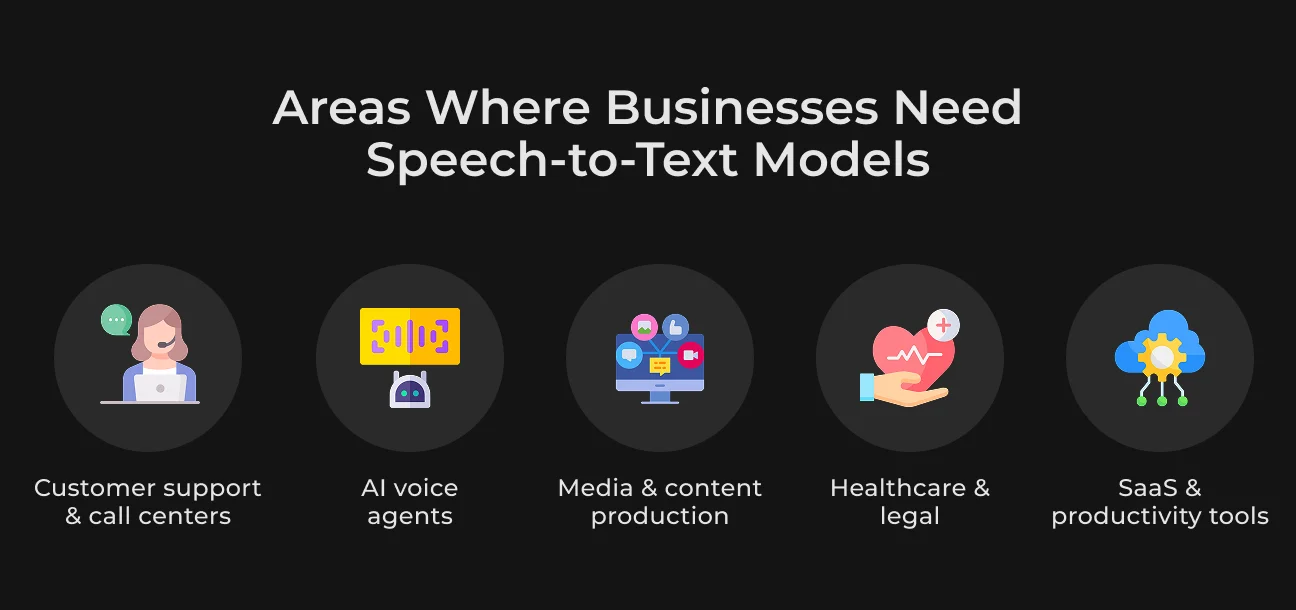
Customer support & call centers
Transcription powers quality assurance and real-time agent support. With live ASR API integration, systems can analyze conversations as they happen and surface relevant responses, scripts, or troubleshooting steps.
For example, when a customer mentions a known issue, the system can instantly suggest solutions—helping reduce average handle time (AHT) and improve resolution rates.
AI voice agents
AI voice agents are one of the fastest-growing speech-to-text use cases.
They rely on low-latency speech-to-text and text-to-speech to handle:
- Lead qualification and outbound calls;
- Appointment scheduling and confirmations;
- Customer support and FAQ handling;
- Order processing and status updates;
In practice, performance depends on latency and accuracy—delays or errors still break conversational flow.
Media & content production
Transcription helps scale content distribution. Video subtitles and podcast transcripts improve SEO, accessibility, and localization. Automating this process reduces production time and enables faster publishing across multiple languages and platforms.
Healthcare & legal
In regulated industries, accuracy is critical. Clinicians use speech recognition to document patient interactions, reducing time spent on manual notes. In legal workflows, transcription enables searchable records of hearings and depositions.
Some providers offer human review layers to meet strict accuracy requirements.
SaaS & productivity tools
Transcription is now a built-in feature in many collaboration tools.
Meeting assistants can:
- Generate summaries and action items;
- Highlight key decisions;
- Provide searchable records of discussions.
This creates a persistent knowledge base and helps teams stay aligned, especially in distributed environments.
Pick the Right Model with SapientPro
Our engineers will help you choose and implement the most suitable STT model for your business.
Key Criteria for Comparing Speech-to-Text APIs
Choosing the right speech-to-text API depends on how it performs across several key dimensions:
Accuracy
Typically measured by Word Error Rate (WER), accuracy is the most visible metric. While vendors report sub-5% WER in controlled conditions, real-world performance in noisy environments (call centers, factories) is what actually matters.
Latency
Latency defines how quickly transcripts are delivered. For real-time use cases, low partial and final latency are critical. For batch processing, it’s measured as processing speed relative to audio length (e.g., 60 minutes of audio in under a minute).
Language Support
Evaluate both the number of supported languages and the quality of dialect recognition. Strong APIs handle accents, regional variations, and code-switching without significant drops in accuracy.
Pricing Models
Pricing varies widely: per-minute billing, credit-based systems, or tiered plans. Some providers also charge extra for advanced features like diarization or sentiment analysis, which can significantly impact total cost.
Developer Experience (DX)
Integration speed matters. Look for clear documentation, stable APIs, SDKs in multiple languages, and support for streaming protocols.
Scalability
Enterprise use cases require handling thousands of concurrent audio streams without performance degradation. Reliability under load is often a key differentiator.
These are the criteria that we used when evaluating the best speech-to-text APIs.
Best Speech to Text APIs in 2026
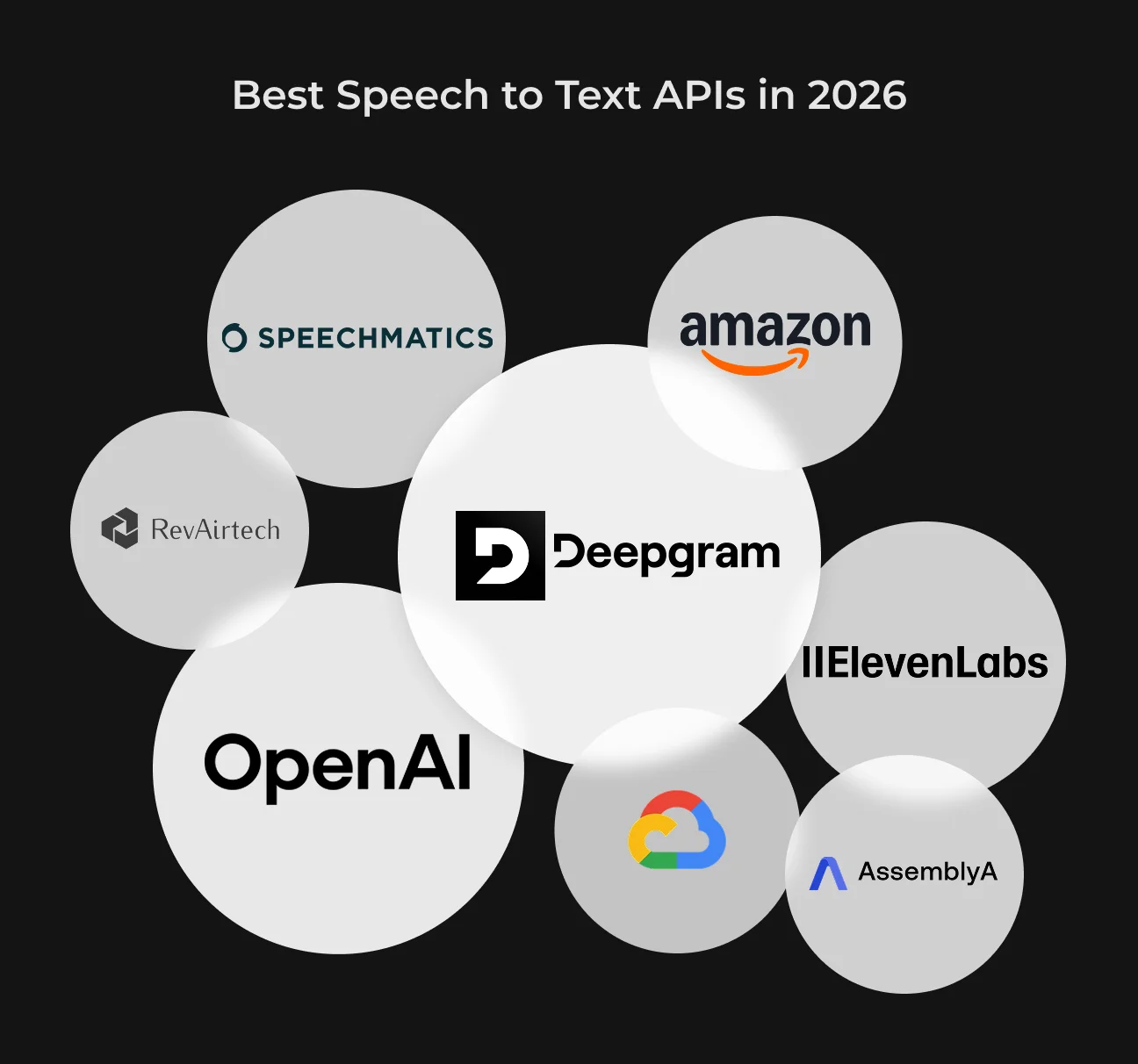
The speech recognition API market in 2026 is highly specialized. No single provider leads across all metrics—performance depends on your use case, data quality, and latency requirements.
The comparison below highlights leading APIs based on real-world accuracy, speed, and deployment strengths. Note that Word Error Rate (WER) can vary significantly depending on audio conditions, domain, and speaker variability.
Provider | Core Model (2026) | Typical WER (Clean English) | Real-time Support | Best For |
| Deepgram | Nova-3 / Flux | ~5.26% | Yes (<300ms) | Voice Agents & Low-Latency Apps |
| OpenAI | Whisper v3 Large | ~4.0 - 8.0% | No (Batch Only) | High-Accuracy Batch Transcription |
| AssemblyAI | Universal-3 Pro | ~5.6% | Yes (~300ms) | LLM-Powered Audio Intelligence |
| Google Cloud | Chirp 3 | ~5.5 - 10% | Yes (~300ms) | Global Scale & GCP Ecosystem |
| Azure | Neural vNext | ~5.5 - 11% | Yes (~300ms) | Microsoft 365 / Enterprise |
| Amazon | Transcribe / Medical | ~6.0 - 12% | Yes (~300ms) | AWS-Native Infrastructure |
| Speechmatics | Ursa | ~5.0 - 9.0% | Yes (<500ms) | Accents & Air-Gapped Deployment |
| IBM Watson | Standard / Neural | ~7.0 - 15% | Yes (~500ms) | Customization & Legacy Enterprise |
| ElevenLabs | Scribe v2 | ~1.7 - 3.9%* | Yes (~150ms) | Unified Voice Stack (STT + TTS) |
| Rev AI | Reverb Turbo | ~5.0 - 9.0% | Yes (~300ms) | Human Fallback & Noisy Audio |
1. Google Speech-to-Text API
Google remains a top choice for enterprises that need масштаб, multilingual coverage, and deep cloud integration. Its flagship Chirp 3 model supports 125+ languages without pre-configuration, thanks to large-scale multilingual training.
It performs well in noisy environments and across accents, making it suitable for global contact centers and regulated industries. Key capabilities of Google Speech-to-Text API:
- Chirp 3 universal model;
- Real-time streaming via gRPC;
- Speaker diarization;
- Domain-specific models (medical, telephony).
The provider stands out as the best speech recognition API for highly regulated sectors. It is one of the only solutions to hold FedRAMP High authorization, making it suitable for government and defense applications.
Integration with the broader Vertex AI suite allows developers to pipe transcripts directly into advanced Google models for summarization or sentiment analysis.
However, for developers who are not already committed to the Google Cloud Platform (GCP), the integration complexity and the requirement for complex authentication layers can be a significant hurdle compared to API-first startups.
Category | Details |
| Model | Standard Recognition (Chirp v3) |
| Base Pricing | $0.016 per minute (first 500,000 minutes/month) |
| Tier 1 | $0.010 per minute (500,001 – 1,000,000 minutes) |
| Tier 2 | $0.008 per minute (1,000,001 – 2,000,000 minutes) |
| Tier 3 | $0.004 per minute (2,000,000+ minutes) |
| Billing Increment | 15-second chunks |
| Rounding Rule | Each request is rounded up to the nearest 15 seconds |
| Cost Impact Note | Short audio (e.g., voice commands) can be disproportionately expensive due to rounding |
2. OpenAI Whisper API
Whisper changed the economics of transcription by offering high accuracy at a low cost. The Whisper v3 model is widely used for batch processing where accuracy matters more than speed.
It handles accents and noisy audio reliably without domain-specific tuning, which makes it a strong default for media and content workflows.
Key capabilities of the OpenAI Whisper API:
- 99+ language support;
- Strong punctuation and formatting;
- Built-in translation;
- Open-source + managed API options.
The primary limitation for OpenAI in 2026 remains the lack of a native real-time streaming endpoint. Yes, developers have created various chunking workarounds to simulate real-time performance.
However, these implementations often suffer from high latency and increased complexity compared to streaming-native providers like Deepgram or AssemblyAI. For organizations that prioritize raw accuracy and cost-efficiency in a non-interactive environment, Whisper is frequently the first choice.
Category | Details |
| Service | Managed Whisper API |
| Primary Use Case | High-accuracy batch transcription |
| Base Pricing | $0.006 per minute |
| Alternative Model | GPT-4o-transcribe — $0.006 per minute |
| Budget Model | gpt-4o-mini-transcribe — $0.003 per minute |
| Diarization Support | Not supported natively |
| Diarization Cost | Additional $0.003 – $0.01 per minute (via external tools/services) |
| Implementation Note | Requires external logic or integrations for speaker separation |
3. Deepgram
Deepgram is optimized for real-time voice AI. Its Nova-3 model focuses on accuracy in noisy environments, while Flux is designed specifically for conversational turn-taking. This makes it one of the best options for building low-latency voice agents.
Key capabilities of Deepgram:
- Sub-300 ms real-time latency;
- Nova-3 (accuracy) + Flux (conversation optimization);
- Built-in audio intelligence (summaries, sentiment);
- Flexible deployment (cloud, VPC, on-prem).
Deepgram is increasingly viewed as a voice stack rather than a single-point solution. Their Aura-2 text-to-speech engine provides sub-200ms generation speeds. It allows developers to build an entire voice loop (STT -> LLM -> TTS) within the same ecosystem.
This integration reduces round-trip latency and simplifies the billing process for high-volume users. Deepgram also offers one of the most flexible deployment models, including cloud, private cloud (VPC), and on-premise options for highly sensitive data.
Category | Details |
| Model | Nova-3 Flagship |
| Batch Pricing | $0.0043 per minute ($0.258/hour) |
| Real-Time Pricing | $0.0077 per minute ($0.462/hour) |
| Billing Type | Pay-as-you-go |
| Alternative Model | Nova-2 |
| Nova-2 Pricing | ~$0.0036 per minute (~$0.22/hour) |
| Add-on Features | Audio intelligence (summarization, sentiment analysis) |
| Add-on Billing | Billed separately per feature or via token-based usage |
| Implementation Note | Additional costs apply for advanced AI features beyond transcription |
4. AssemblyAI
AssemblyAI positions itself as a developer-first audio intelligence platform, not just a transcription API. Its Universal-3 Pro model includes built-in NLP features via the LeMUR framework, allowing you to extract insights without external LLMs.
Key capabilities of AssemblyAI:
- Universal-3 Pro model;
- LeMUR (LLM over audio);
- Built-in sentiment analysis, entity detection, PII redaction;
- Medical-specific optimization.
Their streaming API is highly reliable.
It offers sub-300ms latency and specialized features like immutable transcripts (words that don't change once they are displayed), which is critical for live captioning, where flickering text can be distracting. For teams that value rapid integration and high-level linguistic insights, AssemblyAI is often the top contender.
Category | Details |
| Model | Universal-3 |
| Async Pricing | $0.15 per hour |
| Model Upgrade | Universal-3 Pro |
| Pro Pricing | $0.21 per hour |
| Included Features | Speaker diarization, sentiment analysis, entity detection |
| Feature Packaging | Bundled into base rate (no separate add-on cost) |
| Real-Time Model | Universal-3 Pro Streaming |
| Streaming Pricing | $0.45 per hour |
| Latency | Sub-300ms |
| Implementation Note | Strong value for use cases needing built-in audio intelligence |
5. Amazon Transcribe
Amazon Transcribe is an infrastructure-first choice for teams already operating within AWS. It integrates natively with services like S3 (storage), Lambda (processing), and Connect (contact center automation), making it easy to embed into existing pipelines.
Its biggest advantage lies in vertical specialization. Models for medical transcription and call analytics are trained to detect domain-specific language, sentiment, and conversational signals like customer frustration.
Recent model updates have improved accuracy for non-English languages by up to 20–50%, addressing a historical weakness.
Key capabilities of Amazon Transcribe:
- 100+ language support;
- Medical and call analytics models;
- PII redaction and automatic punctuation.
AWS Transcribe stands out for its vertical specializations.
Its Medical and Call Analytics models are specifically designed to handle the nuances of their respective fields, such as pharmaceutical terminology or the detection of customer frustration.
While its pricing is higher than some specialized providers, the built-in nature of the service for AWS users often results in lower total costs when engineering time and data egress fees are factored in.
Category | Details |
| Tier | Standard Tier |
| Base Pricing | $0.024 per minute ($1.44/hour) — first 250,000 minutes/month |
| Volume Tier 1 | $0.015 per minute (next 250,001 – 1,000,000 minutes) |
| Volume Tier 2 | $0.0078 per minute (5,000,000+ minutes) |
| Max Discount | Up to 67.5% reduction at highest volume tier |
| Specialized Model | Medical Transcription |
| Medical Pricing | $0.075 per minute ($4.50/hour) |
| Analytics Model | Call Analytics (with sentiment analysis) |
| Analytics Pricing | $0.030 per minute ($1.80/hour) |
| Implementation Note | Higher-cost tiers reflect domain-specific accuracy and built-in insights |
6. Azure Speech API
Azure Speech API is one of the most feature-rich and customizable platforms in the market. Supporting over 140 languages and dialects, it’s designed for enterprises that need global coverage with localized performance.
Its main advantage is deep integration with Microsoft Copilot and Azure OpenAI Service, enabling advanced voice-driven workflows that connect directly to internal enterprise data. Azure also stands out for custom model training. Organizations can train speech models on proprietary datasets to recognize internal terminology or create branded voice experiences via Custom Neural Voice.
Key capabilities of Azure Speech API:
- 140+ languages and dialects;
- Custom speech and voice models;
- Real-time translation and avatar viseme generation.
Azure is the best speech recognition API for companies with strict branding requirements. Its Custom Neural Voice and Custom Speech features allow developers to train models on their own proprietary data to recognize unique terminology or create a branded voice identity.
While the platform is powerful, it is also highly complex. Its pricing structure is difficult to predict, while the interface requires a deep familiarity with the Azure ecosystem.
Category | Details |
| Consumption Type | Standard (Pay-as-you-go) |
| Real-Time Pricing | $1.00 per hour |
| Batch Pricing | $0.18 per hour (≈40% cheaper than real-time) |
| Custom Models (RT) | $1.20 per hour |
| Custom Models (Batch) | $0.225 per hour |
| Hosting Cost | $0.0538 per hour per model (endpoint hosting) |
| Commitment Tier 1 | $1,600/month for 2,000 hours ($0.80/hour) |
| Commitment Tier 2 | $25,000/month for 50,000 hours ($0.50/hour) |
| Discount Model | Lower per-hour rates with higher monthly commitments |
| Implementation Note | Best suited for predictable, high-volume workloads |
7. Speechmatics
Speechmatics focuses on a specific but critical problem: accurate transcription across diverse accents and dialects. Its Ursa model is trained on a globally representative dataset, making it more resilient to regional variations that often degrade performance in other APIs.
This makes it particularly valuable in environments where speaker diversity is high—such as international media, legal proceedings, or global customer support.
A major differentiator is its air-gapped deployment option, allowing organizations to run the system entirely isolated from public networks. This is essential for defense, finance, and other high-security environments.
Key capabilities of Speechmatics:
- Strong accent and dialect handling;
- Global language model (no manual switching);
- On-premise and air-gapped deployment.
Crucially, Speechmatics is the only major provider to offer a truly air-gapped deployment option. This makes it the de facto choice for defense, national security, and high-finance organizations that cannot send audio data to a public cloud.
Their Global Language model also simplifies development for international applications by allowing a single model to handle multiple languages without the need for language-switching commands.
Category | Details |
| Tier | Pro Tier |
| Standard Accuracy | $0.24 per hour (batch & real-time) |
| Enhanced Accuracy (Batch) | $0.40 per hour |
| Enhanced Accuracy (RT) | $0.56 per hour |
| Monthly Allowance | 480 free minutes per month |
| Volume Discount | 20% discount for usage exceeding 500 hours/month |
| Pricing Flexibility | Same base rate for batch and real-time at standard accuracy |
| Implementation Note | Clear upgrade path based on accuracy vs cost trade-offs |
8. IBM Watson Speech to Text
IBM Watson remains a stability-first, enterprise-grade solution focused on customization and long-term reliability rather than rapid innovation.
Its core strength is acoustic and language adaptation. Models can be fine-tuned to filter out specific background noise (like machinery) or improve recognition in low-quality audio environments like radio communications.
This makes Watson particularly effective in industrial, government, and regulated sectors where environmental conditions are far from ideal.
Key capabilities of IBM Watson Speech to Text:
- Custom acoustic and language models;
- Noise adaptation and speaker labeling;
- On-premise deployment options.
While Watson may not have the rapid feature-release cycle of smaller AI startups, it offers a level of enterprise-grade security and long-term support that large corporations find comforting.
Its integration with the IBM Cloud Pak for Data allows for a unified approach to AI and data management. Moreover, its on-premises options remain a key selling point for those in highly regulated markets.
Category | Details |
| Plan | Lite Plan |
| Free Allowance | 500 minutes per month (no cost) |
| Standard Plan | $0.02 – $0.06 per minute (depending on model: standard vs neural) |
| Pricing Variability | Depends on model type and performance tier |
| Premium Plan | Custom pricing (enterprise tier) |
| Premium Features | Single-tenant environment, HIPAA compliance |
| Access Model | Requires direct contact / sales inquiry |
| Implementation Note | Flexible entry point with free tier, scalable to enterprise-grade needs |
9. ElevenLabs (speech + voice stack)
ElevenLabs has evolved into a unified voice AI platform, combining transcription, synthesis, and voice generation in a single ecosystem.
Its Scribe v2 model delivers strong accuracy for clean audio (e.g., podcasts, interviews), but the standout feature is its ultra-low real-time latency (~150 ms)—significantly faster than most competitors.
Because transcription and text-to-speech are tightly integrated, developers can build full conversational loops with minimal latency overhead.
Key capabilities of ElevenLabs:
- Scribe v2 (batch + real-time);
- ~150 ms latency;
- Native integration with industry-leading TTS.
Its speed, combined with its world-class voice cloning and synthesis, allows developers to build AI agents that are truly responsive and human-like.
The ElevenLabs pricing model is credit-based. It can be less predictable than per-minute models but offers a unified currency for text-to-speech, transcription, and music generation within the same workspace.
Category | Details |
| Subscription Tiers | Free ($0), Starter ($5/mo), Creator ($22/mo), Pro ($99/mo), Scale ($330/mo), Business ($1,320/mo) |
| Model (Business Tier) | Scribe v2 |
| Batch Transcription | $0.22 per hour |
| Real-time (Ultra-low latency) | $0.39 per hour |
| Billing Model | Subscription-based + usage-based overages |
| Overage Rates (Creator → Scale) | $0.30/min (higher tiers like Creator) down to $0.18/min (Scale) |
| Pricing Structure Note | Lower per-minute cost at higher tiers with improved unit economics |
| Positioning Note | Strong tiered SaaS model combining subscription + consumption pricing |
10. Rev AI
Rev AI combines machine transcription with human validation, offering one of the most flexible accuracy models on the market.
Its AI models are trained on large volumes of human-corrected transcripts, which improves performance on conversational and noisy audio. For critical use cases, developers can enable a human fallback, achieving up to 99% accuracy.
This hybrid approach makes Rev AI especially valuable in domains where errors carry real cost—legal, academic, or media production.
Key capabilities of Rev AI:
- High-accuracy AI models trained on human data;
- Human-in-the-loop fallback;
- Sentiment and topic detection.
The platform’s “secret weapon” is its human fallback option. With a single toggle, a developer can send a difficult audio clip to a human transcriptionist for 99% accuracy at $1.99 per minute. This ensures that for critical business moments, the transcription is guaranteed to be correct.
Rev AI’s entry-level Reverb Turbo pricing is also the lowest in the market for standard English audio, making it an excellent starting point for new projects.
Category | Details |
| AI Model: Reverb Turbo | $0.10 per hour (English only, entry-level option) |
| AI Model: Reverb Standard | $0.20 per hour |
| AI Model: Foreign Language AI | $0.30 per hour |
| Human Transcription | $1.99 per minute ($119.40 per hour) — 99% accuracy via human review |
| Insights Feature | Sentiment analysis + topic extraction |
| Insights Pricing | $0.0008 per 10 words |
| Pricing Structure Note | Hybrid system combining AI, human, and analytics-based add-ons |
| Positioning Note | Strong accuracy ladder: AI → multilingual AI → human verification |
Real-Time vs. Batch Transcription
Choosing between real-time and batch transcription directly impacts system architecture, cost, and user experience.
Real-time APIs
Real-time APIs process audio as it’s spoken, making them essential for interactive applications. In 2026, natural voice interaction requires sub-500 ms total latency across the full pipeline:
- Speech-to-text (ASR);
- LLM response generation;
- Text-to-speech (TTS).
This is accomplished by using protocols like WebSockets or gRPC to stream audio in tiny bursts, usually between 100 and 250 ms.
Best use cases:
- Live customer support bots;
- AI voice agents and sales automation;
- Live captions and event streaming.
Limitations:
- No future context → lower accuracy vs batch;
- Network instability can cause flickering or delayed transcripts;
- More expensive due to always-on processing.
Batch APIs
Batch APIs process complete audio files asynchronously, prioritizing accuracy and efficiency over speed. Since the full recording is available, models can apply multi-pass (or “double-pass”) decoding, using later context to correct earlier errors.
This approach allows providers to run larger, more compute-intensive models, often resulting in better accuracy at a lower cost.
Best use cases:
- Call center analytics and QA;
- Meeting and interview transcription;
- Video subtitling and media processing.
Limitations:
- No real-time feedback;
- Results are only available after processing completes;
- Not suitable for interactive systems.
How to Choose the Best Speech-to-Text API
Choosing the right speech-to-text API comes down to three practical filters: use case, budget, and infrastructure.
Based on the use case
Start with what you’re building.
If you need real-time conversational AI (voice agents, assistants), prioritize low latency and turn-taking performance. APIs like Deepgram (Flux) or ElevenLabs are better suited here.
If your goal is large-scale transcription and analysis, focus on accuracy and language coverage. In this case, OpenAI Whisper or Google Chirp 3 are stronger options.
Based on the budget
Headline pricing rarely reflects the true cost.
Some providers offer low base rates but charge extra for features like diarization, sentiment analysis, or summarization. Others bundle these capabilities into a higher upfront price.
At scale (millions of minutes/month), it may be worth evaluating self-hosted models like Whisper. This removes per-minute costs but introduces infrastructure, maintenance, and scaling overhead.
Based on the infrastructure
Security and compliance often dictate the final choice. For enterprises in the financial or government sectors, the ability to deploy on-premise or in an air-gapped environment (offered by Speechmatics, IBM, or Deepgram) is often a non-negotiable requirement.
For businesses that are already standardized on a specific cloud stack like AWS or Azure, the administrative ease of using native services usually outweighs the minor performance gains of switching to a boutique provider.
Challenges & Limitations of Speech Recognition APIs
Even in 2026, speech recognition systems still struggle with real-world variability. Performance often degrades outside controlled conditions.
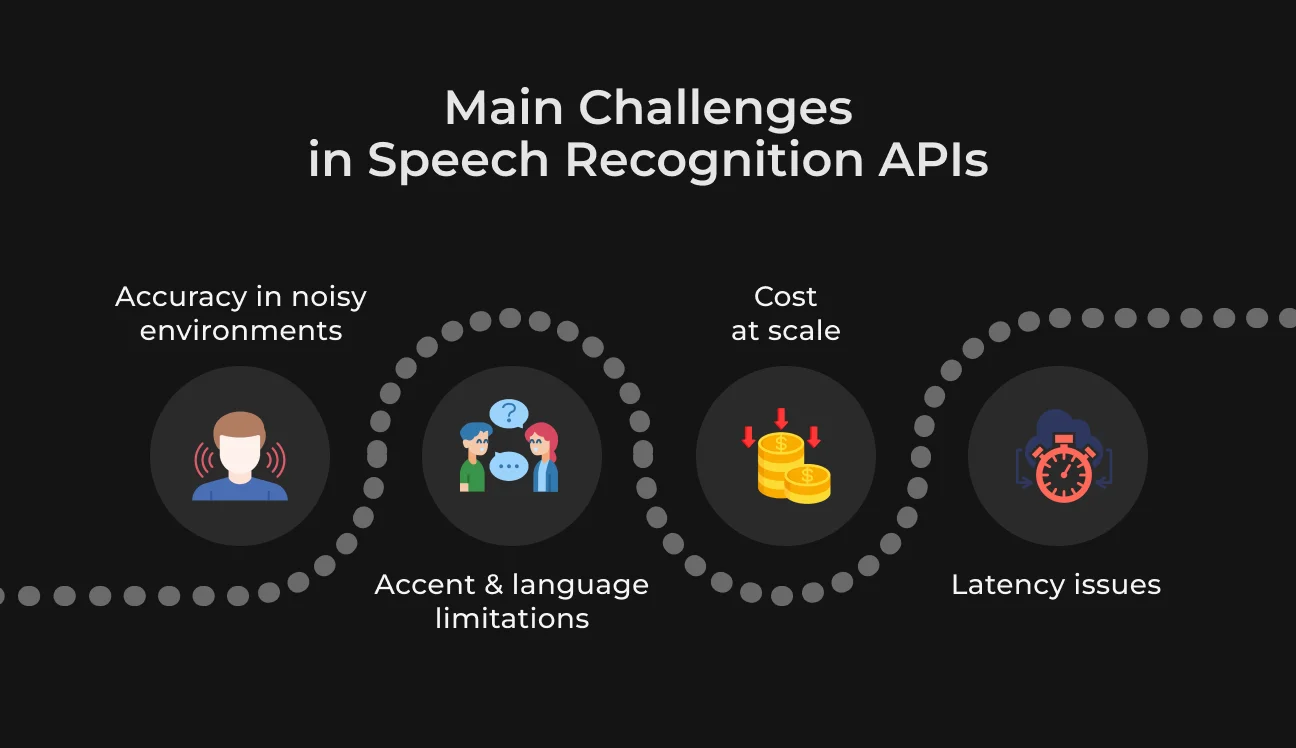
Accuracy in Noisy Environments
Background noise is still one of the main reasons transcription quality drops. Office chatter, traffic, poor microphones, or industrial machinery can all make speech harder to recognize.
To reduce this risk, teams can add noise suppression before sending audio to the API, use better input devices, or choose models known for handling noisy recordings well, such as Whisper or Rev AI.
Accent & Language Limitations
Most leading APIs perform well with widely used languages such as English or Spanish. However, regional accents, dialects, and low-resource languages can still lead to higher error rates. This matters for products used by global or highly diverse audiences.
The safest approach is to test each API on real audio from your actual users. Vendor benchmarks are useful, but they rarely reflect every accent, microphone, and speaking style your product will encounter.
Cost at Scale
Speech-to-text pricing can look low at first, but costs grow quickly when you process thousands or millions of minutes per month. Real-time transcription, diarization, sentiment analysis, and summarization can increase the final bill.
To manage costs, many teams use a tiered strategy. Routine recordings go through cheaper models, while high-value or compliance-sensitive conversations are sent to premium models or human review.
Latency Issues
For voice agents and live assistants, even small delays can make conversations feel unnatural. The total delay includes speech recognition, LLM processing, and text-to-speech generation.
The best way to reduce latency is to use streaming-first APIs, process audio in small chunks, and run parts of the pipeline in parallel where possible. This helps voice systems respond faster and maintain a more natural flow.
Future Trends in Speech Recognition
Over the following years, speech recognition will move beyond simple transcription. The focus is shifting from “turn audio into text” to “understand, react, and assist in real time.”
Real-time AI Agents
Voice AI systems are becoming faster and more context-aware. Instead of waiting for a full sentence, future APIs will process speech as it unfolds, detect interruptions, and manage turn-taking more naturally.
This will make AI agents more useful in sales, support, scheduling, and internal operations.
Multimodal AI
Speech recognition will increasingly work alongside text, vision, and behavioral signals. For example, a support system may analyze both a customer’s voice and on-screen actions to understand frustration or urgency.
This can improve routing, escalation, and personalization, but it also raises serious privacy and consent requirements.
Edge AI Speech Recognition
More transcription will happen directly on devices. Smartphones, cars, wearables, and medical tools can use smaller speech models to process audio locally.
This reduces latency, lowers cloud costs, and keeps sensitive data on the device—especially important for healthcare, finance, and enterprise environments.
How SapientPro Implements Speech-to-Text for Business
SapientPro focuses on turning standalone speech-to-text APIs into production-ready systems—combining ASR, LLMs, and infrastructure into reliable low-latency pipelines.
Case Study #1: Conversational AI Sales Tool with $1/hr Agent Costs
SapientPro built an outbound AI sales assistant designed to handle lead qualification calls at scale. The key challenge was maintaining sub-700 ms response time to keep conversations natural and avoid awkward delays.
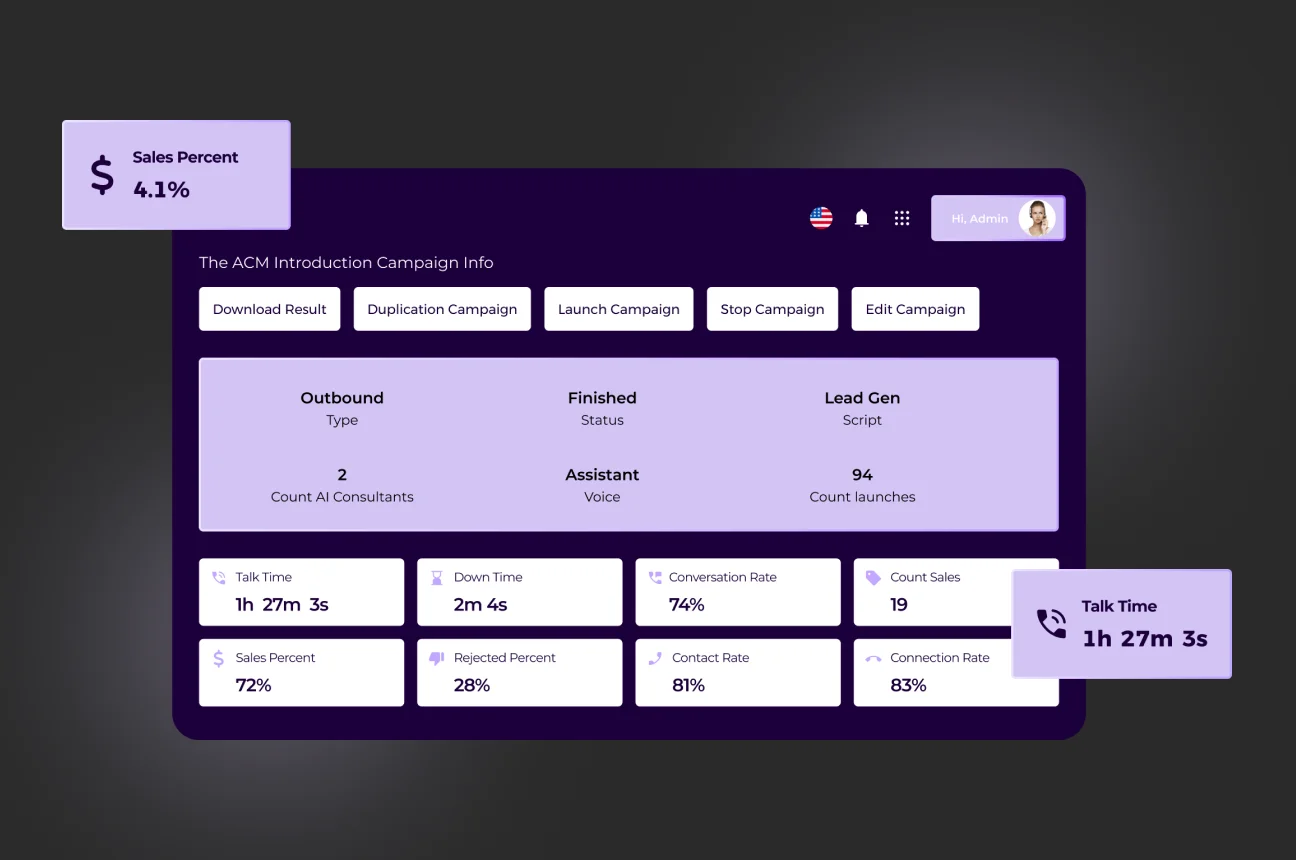
The solution combined a low-latency ASR API, optimized LLM prompts, and custom TTS voices into a tightly orchestrated pipeline. Deployed on Kubernetes, the system scaled automatically during high-demand campaigns.
Result:
- Cost per agent reduced from $15/hour to ~$1/hour;
- Consistent, human-like response times;
- Scalable infrastructure for outbound sales operations.
Case Study #2: Language Learning Assistant Enhanced by AI
In the EdTech sector, SapientPro developed a language learning assistant that goes beyond transcription by analyzing speech at the phoneme level.
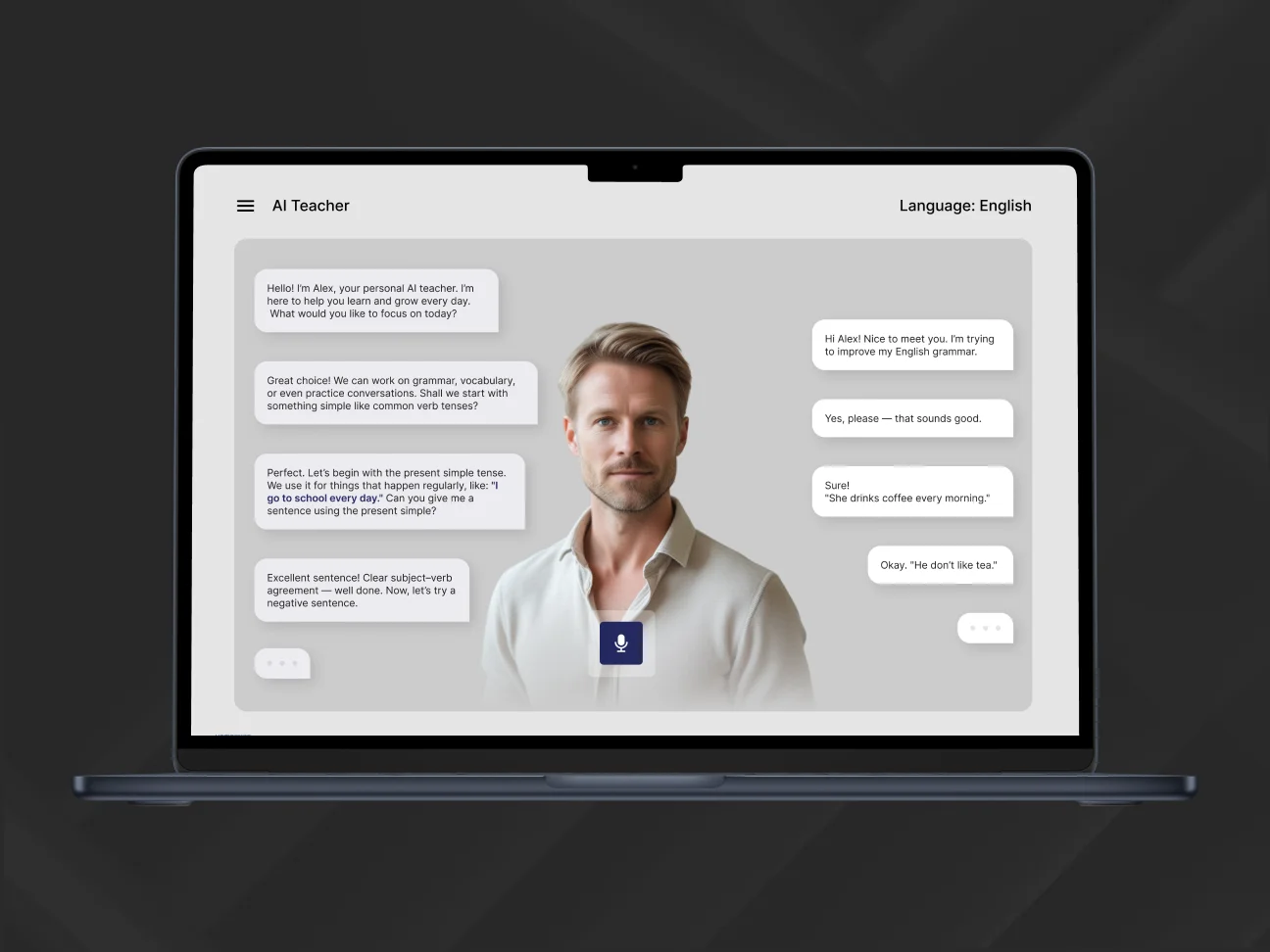
The system processes user speech in real time and provides instant feedback on pronunciation accuracy. Instead of generic corrections, learners receive precise guidance on specific sounds they mispronounce. The experience is enhanced with synchronized avatars, creating a more engaging and immersive learning environment.
Result:
- Real-time pronunciation feedback;
- Improved learner engagement;
- Multi-language support for global audiences.
Case Study #3: AI Produce Inspection App
For a Canadian AgTech company, SapientPro built a voice-driven inspection system tailored for field use. Inspectors often work in remote areas with limited connectivity, so the architecture had to be offline-first.
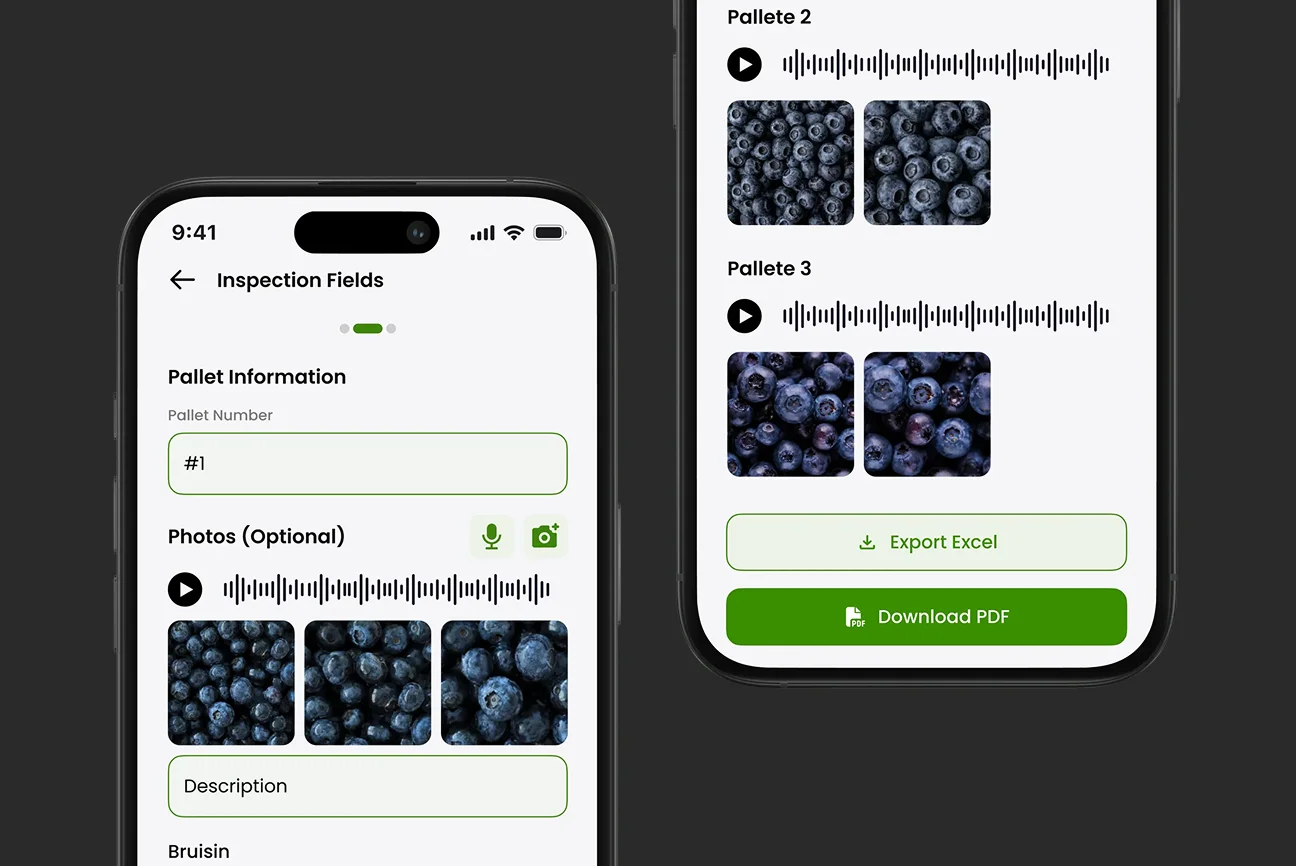
Using speech recognition models optimized for noisy environments, the app captures spoken notes during inspections and converts them into structured digital reports automatically.
Result:
- 87.5% faster inspection workflows;
- Reliable performance in low-connectivity environments;
- Reduced manual data entry for field teams.
Why Choose SapientPro for AI Implementation
Building with speech-to-text APIs is about making the entire system work reliably under real conditions—latency, noise, scaling, and integration all matter.
SapientPro focuses on end-to-end AI implementation, not isolated features.
We design and optimize full pipelines that combine speech recognition, LLMs, and voice generation into production-ready systems. What you get with SapientPro:
- Low-latency voice architectures optimized for real-time interaction;
- Integration of ASR, LLM, and TTS into a single, efficient workflow;
- Handling of edge cases like noisy audio, accents, and unstable networks;
- Scalable infrastructure (cloud, on-prem, or hybrid) tailored to your needs.
With a 5/5 rating on Clutch, SapientPro is your reliable technological partner in implementing speech-to-text and building full voice AI workflows. You’ll get a custom solution that works directly in your industry, considering all the challenges and specifics.
Let’s team up and bring your ideas to life!
Build Software That Works
SapientPro's engineers will help you get a market-winning solution for your business needs.