
All Guide to Developing a Scalable Video Streaming Server for SaaS Products
April 17, 202620 min read


Interactive streaming is expected to increase investments to around $284.18 billion by 2034. This boom serves as a good reminder of how fickle consumer habits and tech trends can be.
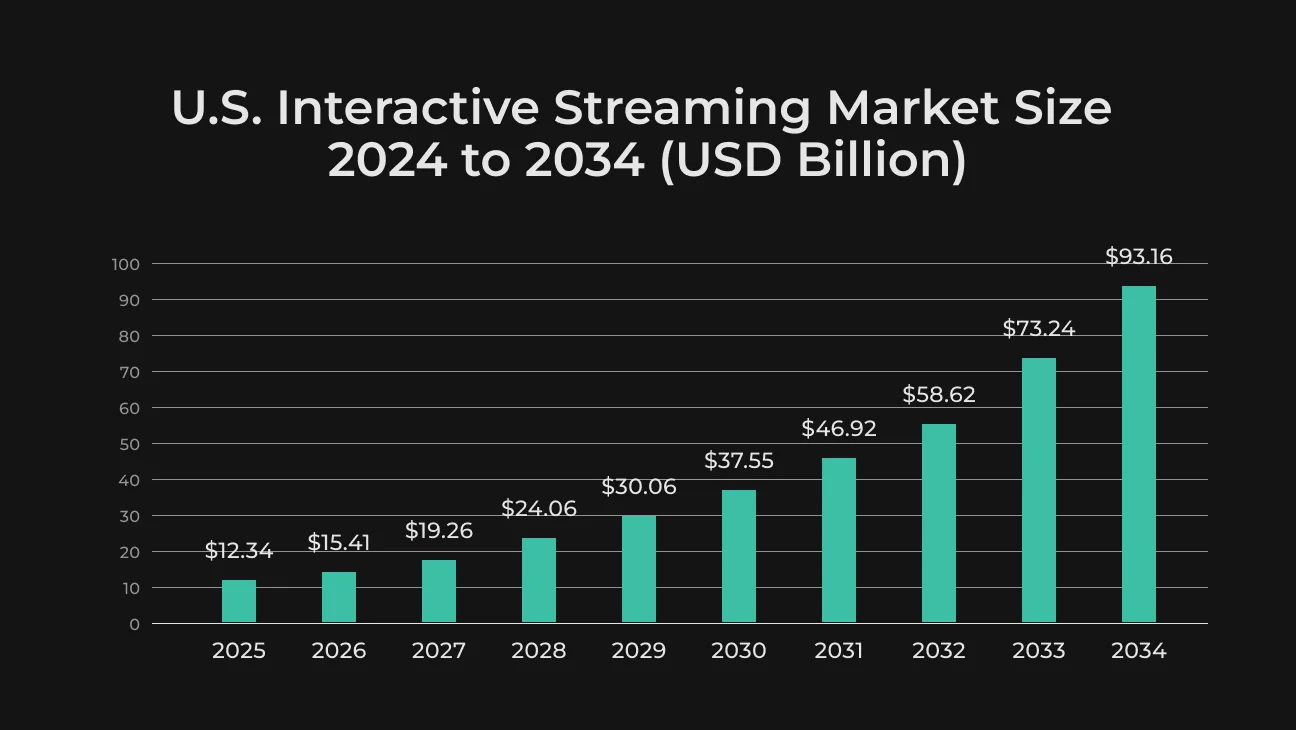
Adding a video streaming server to an existing SaaS product has actually become one of the key trends this year. For example, Disney has introduced exclusive streaming content on its ESPN app, while Fox Corp. recently launched its platform, Fox One.
If you want to have a video streaming solution but are not sure how to make one of the highest quality, this article is for you. We'll guide you in setting up reliable video streaming software based on the latest approaches and technologies.
How Does Video Streaming Work?
Streaming video takes you through the lifecycle of capturing video content, encoding to make your files as small as possible, and delivering it via a CDN with adaptive playback to the user. All of this takes effort, of course. So, let’s examine each phase of that process more closely.
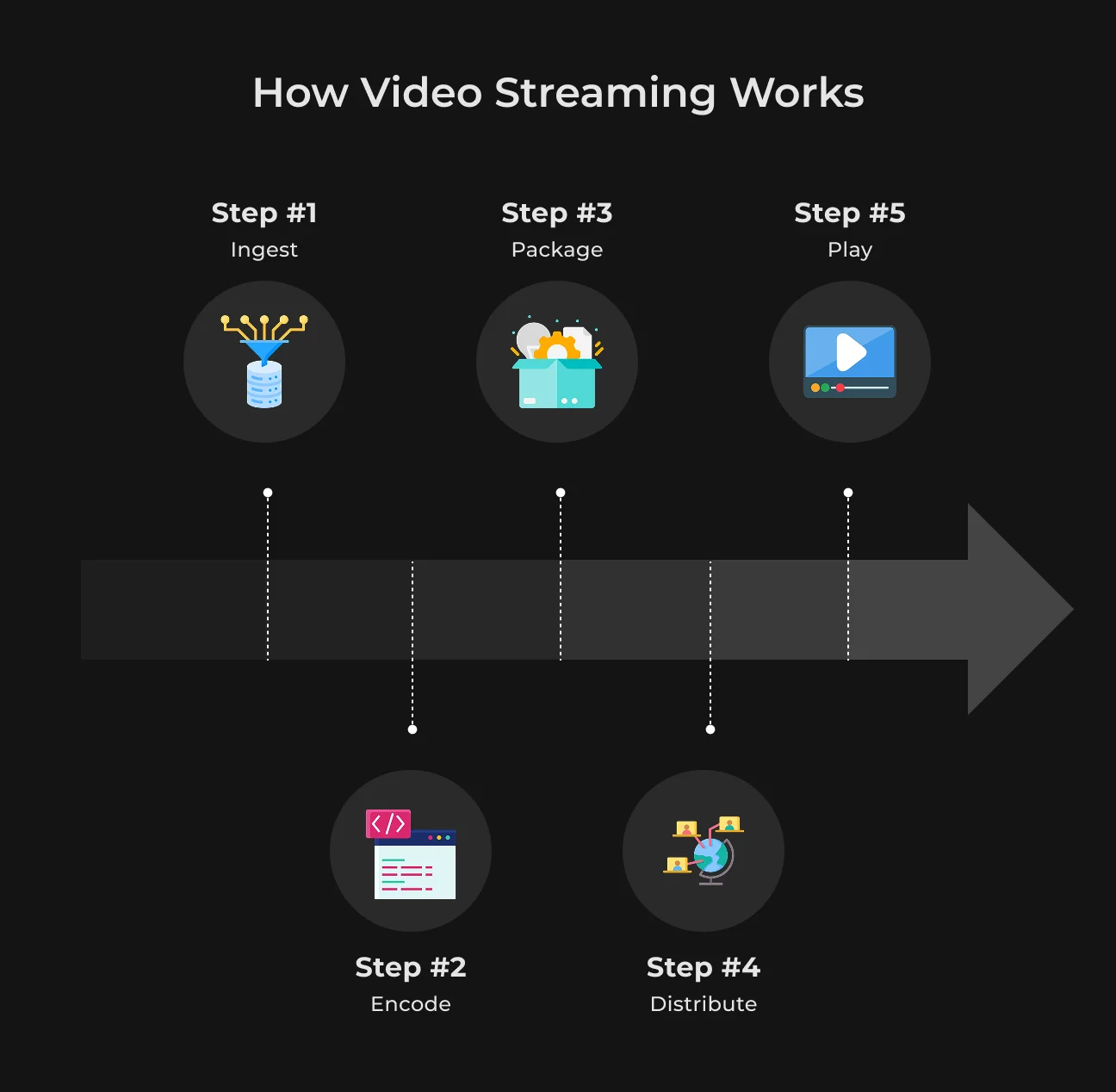
Ingestion
Video ingestion is the process of capturing raw footage and sending it to a processing server.
- Live streams: cameras capture footage and send it via a protocol like RTMP (Real-Time Messaging Protocol) to an encoder;
- Video on demand (VOD): pre-recorded files are uploaded to a storage server;
Modern cameras don't just "pull in stills." They capture a continuous stream of raw data that is far too large to be sent directly over the internet without processing.
Encoding
Raw video files are massive. Encoding uses a codec (like H.264, H.265/HEVC, or AV1) to compress the data by removing redundant information.
Here’s how this works:
- Encoding: compresses the raw source into a digital format.
- Transcoding: a critical sub-step where the video is converted into multiple resolutions( 1080p, 720p, 480p, etc.). This ensures that a user on a 5G connection and a user on a weak Wi-Fi signal can both watch the same video at different quality levels.
Packaging
Once encoded, the video is not sent as one continuous file but is instead “packaged” into small segments that are typically two to ten seconds long.
These segments are organized using delivery protocols like HLS or DASH and are accompanied by a manifest file that acts as a map for the player. The technology enables far more flexible and effective data transmission by segmenting the video.
Content Delivery Network (CDN) Distribution
These video segments are distributed across a content delivery network to prevent lag and buffering. These edge servers cache the video content in locations physically closer to the end-user, which drastically reduces the distance the data must travel.
This infrastructure protects the source server from crashing during high-traffic events and ensures a smooth experience for a global audience.
Playback
The final stage occurs on the user's device, where the player uses the manifest file to fetch segments and decode them back into a visible image.
Modern players utilize adaptive bitrate streaming to monitor the user's internet speed in real time and switch between the various quality levels created during the transcoding phase.
This technology prevents the video from stopping to buffer by automatically lowering the resolution if the connection becomes unstable.
Components of a Scalable Video Streaming Infrastructure
There are multiple key elements that impact the scaling of video streaming infrastructure.
Let’s check them out.
Content Delivery Network (CDN)
A fast CDN reduces latency for video content and makes sure that access is consistent.
CDNs store video in edge locations, closer to users; this results in faster load times and lower bandwidth usage. Some of the best streaming analytics solutions include AWS CloudFront, Azure CDN, and Google Cloud CDN. Cloudflare is also a frequent resource for streaming video.
Cloud Platforms for Video Streaming
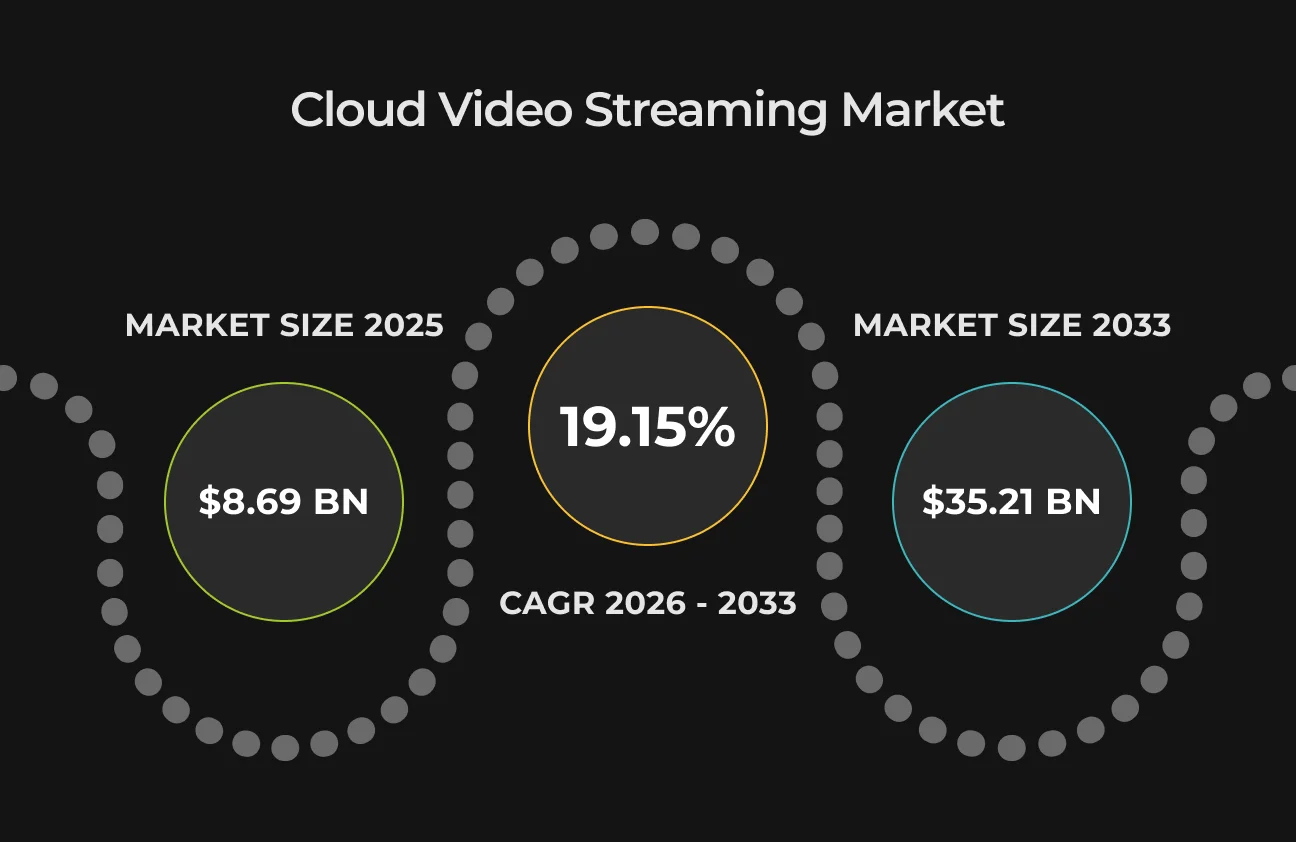
The cloud video streaming market is growing faster than ever due to the increasing demand for on-demand content and OTT platforms in media, education, and business. This segment is expected to increase to over $10.30 billion by 2033 in the United States.
Cloud services such as AWS, Azure, and GCP can use a flexible infrastructure that is capable of being expanded on demand to meet the needs of large video streaming applications.
They are flexible formats with resources to encode and store videos, share them online (it's a base for generating quality video without losing resolution), and playback on different devices.
For example:
- AWS Media provides a series of tools related to live streaming, on-demand video processing, and global content delivery;
- Azure Media Services for encoding, live streaming, and on-demand video delivery with global distribution (via Azure CDN);
- Google Cloud Media Solutions are various cloud services through an extensive network of available APIs (like the Transcoder API for formatting and encoding your media assets or Cloud CDN to deliver content at speed).
Backend Microservices
A video streaming platform comprises several microservices that provide different functionality for your application. This includes:
- Ingestion service manages user uploads and stores raw files on cloud storage;
- Transcoding service transforms videos uploaded into many formats suitable for streaming;
- Packaging service caters to the final steps of the process and formats video files for distribution (HLS, DASH).
Video Processing Pipelines
The conversion and compression of video data are what the whole video stream process is based on. This involves:
- Encoding/transcoding. Adaptive bitrate streaming, for example, involves encoding or transcoding videos into different formats and lower resolutions;
- Packaging. Once encoded, videos are formatted into protocols like HLS or DASH to be streamed across devices;
- Video storage. They safely store raw, encoded, and packaged video files with services like Amazon S3 or Azure Blob Storage.
APIs and Real-Time Interactions
APIs are the backbone of connecting different services in the architecture.
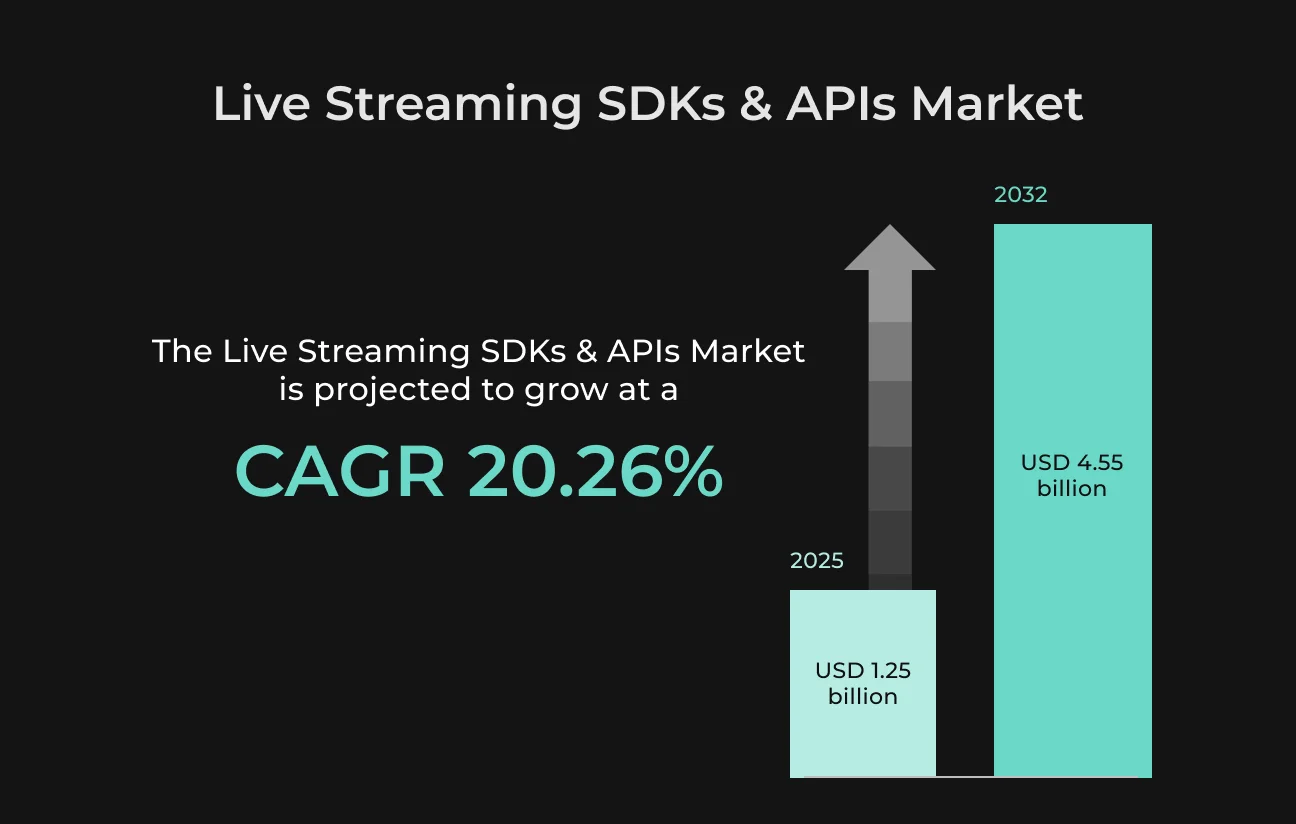
The live streaming SDKs and APIs market is estimated to be about $1.50 billion in 2026 and reach $4.55 billion by 2032. RESTful or GraphQL APIs are most commonly implemented for retrieving video metadata, uploading videos, and playback requests.
However, in such cases, while we have real-time functionality like live styles during a stream, WebSockets can enable two-way communication between the client and backend.
Real-Time Data Processing
Close real-time data processing is needed to collect and analyze user actions like video views, buffer events, availability, or engagement (during live streaming). This data flow often requires constant management with services like AWS Kinesis and Apache Kafka.
AWS Lambda and Azure Functions allow for serverless computing for unique event processing, where operational overhead is close to zero.
Backend Microservices
A video streaming service is typically composed of a set of services that are managed independently and as microservices. For example, the ingestion service controls user uploads by saving raw video files into the cloud storage.
The transcoding service takes the uploaded videos and transcodes them into formats suitable for streaming. While the packing service prepares video files for delivery (with formats like HLS and DASH).
Scalable Storage Solutions
To store the unimaginable amount of video data, storage systems must be scalable and reliable.
- Amazon S3, Azure Blob, and Google Cloud storage are cost-effective and scalable for video files;
- Dynamo, Cosmos, or a NoSQL database is used to store metadata and other video-and-user-related information.
Streaming Protocols
Streaming protocols allow for seamless streaming regardless of device capabilities or network conditions. Let’s take a look at the main protocols.
HLS (HTTP Live Streaming)
Developed by Apple, HLS is the most widely used protocol today because it breaks video into small segments that are delivered over standard HTTP port 80.
This compatibility allows HLS to easily bypass most firewalls and integrate seamlessly with content delivery networks for global scaling.
Because it supports adaptive bitrate streaming (ABR), the player can automatically switch between different quality levels to prevent the video from stopping if your signal weakens.
DASH (Dynamic Adaptive Streaming over HTTP)
MPEG-DASH is an industry-standard, open-source alternative to HLS that offers similar chunk-based delivery and adaptive bitrate capabilities.
Unlike HLS, which was originally tied to the Apple ecosystem, DASH is “codec agnostic,” meaning it can work with a wider variety of compression formats like VP9 or AV1.
This flexibility makes it a powerful choice for streaming high-end 4K and Ultra HD content across a diverse range of smart TVs and Android devices.
WebRTC (Web Real-Time Communication)
While HLS and DASH are designed for high-quality playback with a few seconds of “buffer” delay, WebRTC is built for sub-second latency. It enables direct, peer-to-peer communication between browsers, removing the need for a middleman server to process segments during a call or an interactive broadcast.
This makes WebRTC the gold standard for video conferencing and live auctions, where even a two-second delay would ruin the user experience.
Types of Video Streaming Solutions
Video services can be divided into four categories: live streaming, video on demand, hybrid streaming platforms, and cloud platforms. Here’s a quick overview of what they do and how.
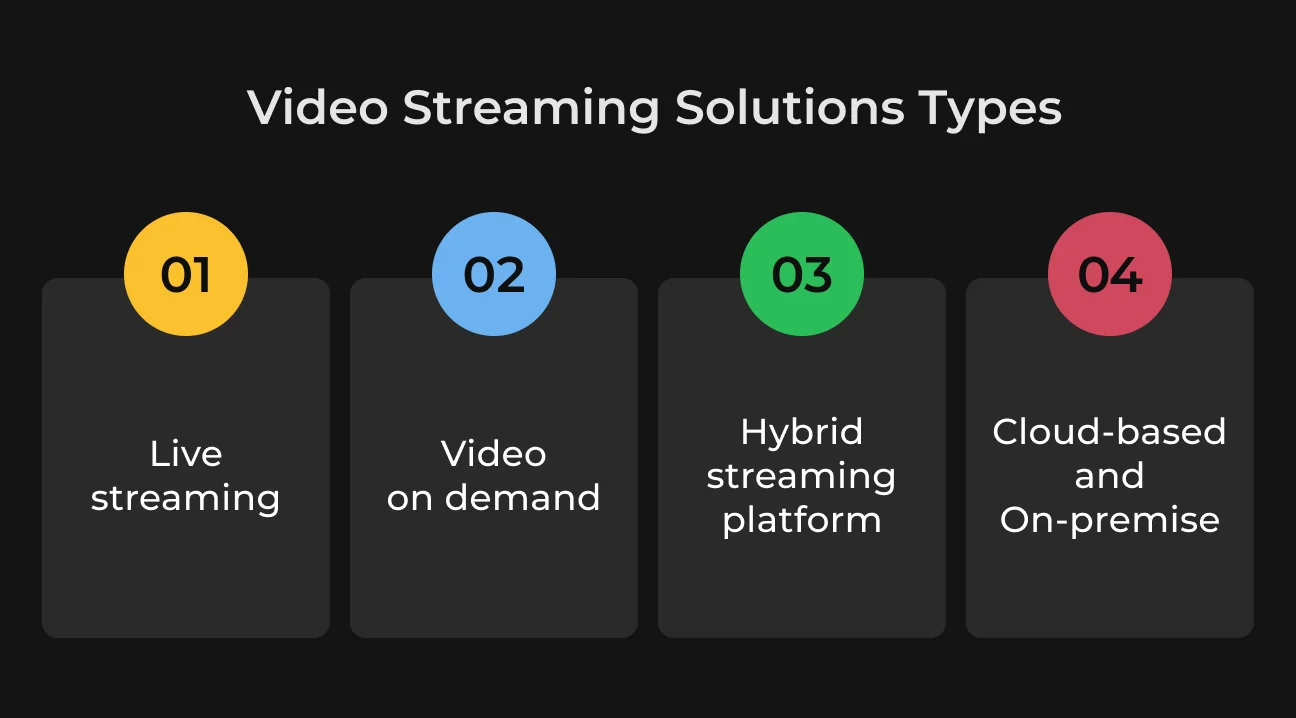
Live Video Streaming Solutions
By 2029, the live streaming market is expected to grow to $4.81 billion. Low latency is a must for live streaming content platforms — like YouTube Live. That means the gap between what a creator does and what viewers are given needs to be as narrow as it can get.
Business owners will have to consider how many viewings they’re hoping for, whether they’ll want to share recordings for a future watch. Or whether they’ll need to restream it or post on sites like Twitter or Facebook.
All of these elements rely on those streaming apps that have the infrastructure in place. Those that can withstand traffic surges, reach real-time performance, and meet low-latency broadcasting.
Video on Demand
Services like Netflix and YouTube enable people to choose and access content at their convenience. Such platforms depend on powerful storage and delivery systems for reliable streaming.
They also have to deal with over a dozen formats of video, and various compression and quality settings — not to mention subtitles in several languages. It is set up on a protected server or in the cloud, making it simple and available for people around the world to see.
Hybrid Streaming Platforms
These hybrid streaming sites mix live and on-demand videos to deliver a fuller viewing session. It does a wonderful job of marrying the live viewing of events as well as access to previously recorded material, all on one platform.
Hybrid models work well for organizations looking to broaden the spectrum of what they can offer. And those who wish to appease viewers who want the immediacy of watching a live stream.
Cloud-Based vs. On-Premise
With cloud-based solutions, video processing, storage, and delivery are handled by remote servers. They provide excellent scalability by coping with spikes in traffic without requiring additional infrastructure upgrades.
And in the cloud, you also get speedy deployment, automatic updates, and less maintenance. But depending on outside providers can raise anxiety over data control and security.
On-premise solutions offer complete control of streaming infrastructure, servers, and software from inside the organization. This is a common option since enterprises are really serious about data security and regulatory compliance.
These systems could be less scalable than cloud solutions and would need to be planned thoroughly to manage growing demand.
Let’s compare cloud-based with on-premise video streaming solutions in terms of price.
Cloud-Based Video Streaming | On-Premise Streaming Solutions | |
| Upfront investment | Minimal upfront investment; usually just a subscription or pay-per-use arrangement. | Hardware, software licenses, and infrastructure all need high initial investments. |
| Recurring expenses | Pay as you go (bandwidth, storage, processing), with a variable scale. Higher usage is associated with higher costs. | Stable but includes maintenance, energy, and human resources. Can be fairly predictable, but you will need to budget for regular upgrades. |
| Scalability | Simple to scale and flexible pricing. However, prices can increase under heavy or expanding use over the years. | Less flexible scaling solution requiring higher capital investment in case of infrastructure scale-up. |
Business Use Cases of Video Streaming in SaaS
Video is everywhere for modern businesses. It is a crucial tool in recruitment, onboarding, sales, support, marketing, and other areas. Here are the 5 top ways in which companies are using video streaming to grow revenue and margins.
Live Classes and Educational Recordings
The worldwide massive open online courses (MOOCs) market is predicted to hit $268.7 billion by 2035. It is dominated by big-name players like Coursera, Udemy, and edX.
For instance, Udemy collaborated with Docker to deliver specialized cloud-native enterprise courses designed to meet the demands of modern IT environments. Similarly, edX partnered with Degreed to integrate micro-credentials directly into HR systems, providing over three million employees with verifiable pathways for professional development.
These collaborations transform digital learning from a solitary activity into an integrated component of corporate workforce planning.
Telemedicine and Secure Consultations
Video streaming in healthcare has given rise to telemedicine, where doctors and patients can interact regardless of their location. This significantly improves accessibility, efficiency, and patient-centricity of medical services.
Two-thirds of psychiatrists (68.2%) said they were doing video or audio telehealth in more than one in five appointments every week. Teladoc and Amwell, for instance, run secure video meetings with HIPAA compliance. They shorten travel time and cost, providing better access to healthcare.
Webinars and Internal Communications
Video streaming in enterprise SaaS platforms enhances team communication and collaboration.
You can stream some videos to conduct remote team meetings, employee training, and knowledge sharing. Cutting unnecessary meetings saves companies approximately $2.5 million a year for every 100 employees.
For companies with 5,000 employees, that can amount to $100 million annually.
Live Analytics Dashboards and Investor Calls
Just look at how platforms like Bloomberg Terminal naturally incorporate streaming data to present the most updated financial information for investors who need to make swift decisions.
Bloomberg’s Real-Time News Feeds rely on automated systems guided by human editors to organize and link news directly to tradable securities.
Furthermore, video conferencing for investor calls provides a secure platform that financial institutions can use to address earnings and market forecasts.
Content Delivery and User Experience
Streaming video services like Netflix, Disney+, and Amazon Prime have changed the nature of video consumption by offering on-demand coverage.
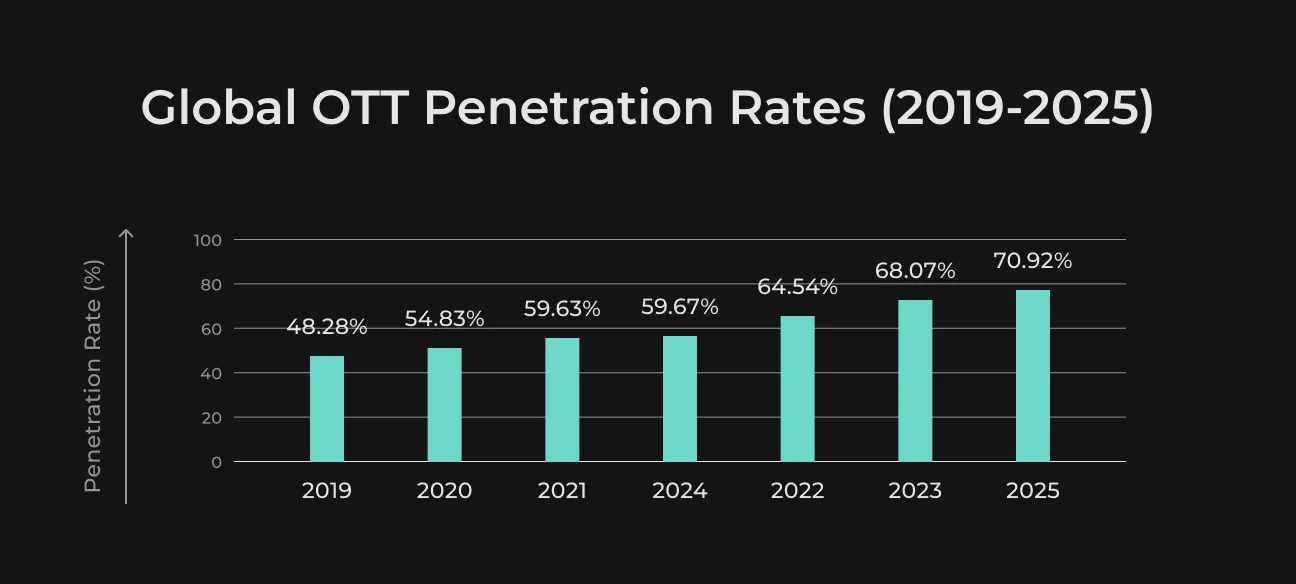
OTT video market revenue worldwide in 2026 can be $352.96 billion, which accounts for as much as 22% of all OTT video revenue this year.
These platforms employ adaptive streaming technologies like HLS and DASH that adjust video quality according to internet speed for seamless user viewing.
Tech Stack for Video Streaming Application Development
Let’s take a look at the common tech stack used to create a video streaming app.
Component | Tech Options |
| Front-end |
|
| Back-end |
|
| Video streaming protocols |
|
| Media servers |
|
| Databases |
|
| Cloud services |
|
| Video processing |
|
| Authentication |
|
| Analytics |
|
| Payment gateways |
|
Build Your Video Solution with SapientPro
We'll help you leverage AI for your video editing solution.

Architecture of a Scalable Video Streaming Solution
Scaling a video-sharing platform comes with many trade-offs and practical limitations that you need to recognize while designing. In this section, we will explore different architectural patterns for building a truly scalable video streaming application.
High-level Architecture
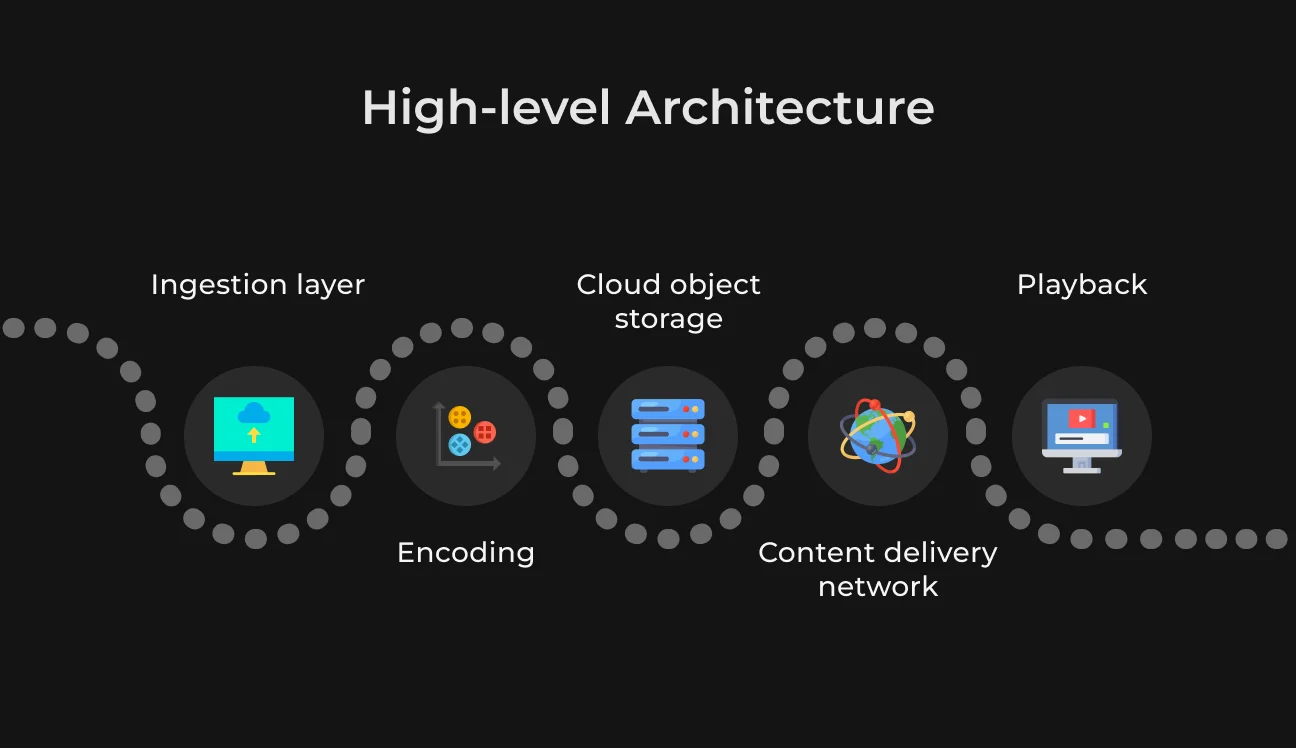
Let’s dissect the core components of high-level architecture:
- Ingestion layer.
This is where videos enter the system. Uploads are completed quickly because they use services like AWS S3 Multipart Upload. This splits large files into chunks, allowing uploads to happen faster;
- Processing layer (encoding/transcoding).
Tools like FFmpeg or AWS Elemental transcode videos into multiple formats, allowing playback on any device. It allows working on high workloads by automatically scaling its resources using something like Kubernetes clusters;
- Cloud object storage.
Processed videos are stored in cloud storage — like an endless, organized library. Amazon S3 and Google Cloud Storage help keep that content secure and accessible;
- Delivery (CDN).
A content delivery network is employed to optimize video streaming and minimize buffering. CDNs (Cloudflare, AWS CloudFront) deploy edge servers across the globe to minimize latency;
- Playback.
Finally, videos enter the playback stage when a user begins to interact with them. It's built on top of HTML5 and Video.js, where audiovisual content improves interaction through elements like playback control, segmentation, and subtitles.
Here are other vital components of a video streaming service.
Microservices Architecture
Using a microservices architecture allows video streaming platforms to function as a coordinated ecosystem of specialized tools.
Engineering teams can make sure that a spike in one area, like millions of people quickly looking for a viral hit, doesn't bring down the entire system by decoupling key functionalities.
That means that each service has its very own, defined role:
- User Authentication
The authentication service is responsible for managing user identities, secure logins, and active session tokens across various devices. The platform can handle large login spikes, such as those that occur during a major live sporting event, and uphold high security standards by isolating this function without compromising the actual video playback.
- Video Processing
This service handles the heavy lifting of encoding and transcoding raw uploads into the various formats and bitrates required for global delivery. Because this is a computationally expensive task, separating it allows the platform to spin up additional processing power only when new content is being uploaded, keeping operational costs efficient.
- Content Management
The content management service acts as the librarian of the platform, managing the video metadata, categories, and search functionality. This separation ensures that users can browse the catalog and view posters or descriptions smoothly, even if the backend video processing systems are under a heavy load.
- Analytics Service
The analytics service silently tracks user interactions, such as watch time, drop-off points, and playback quality, to provide data for personalized recommendations and technical troubleshooting.
Due to its independence, this service is able to continuously consume large volumes of telemetry data without vying for resources with the services that provide the video stream.
The primary advantage of this architectural approach is the ability to scale “horizontally” based on real-time demand.
For example, during a global premiere, the playback service can automatically scale out to thousands of cloud instances to support millions of concurrent viewers, while the video processing service remains at a baseline level if no new content is being uploaded.
This granular control ensures maximum uptime and cost-efficiency by only using the resources necessary for the current task.
CDN Video Streaming
CDNs like Cloudflare and Akamai deliver video data from servers physically closer to users to minimize latency and lag.
For example, an edge server in Tokyo will serve Japanese viewers directly, drastically speeding up access by eliminating the need to fetch data from a distant origin server in the US. Adaptive bitrate streaming utilizes protocols like HLS and DASH to dynamically adjust video quality based on the user's real-time network health.
Under this system, faster connections automatically receive high-definition streams such as 1080p, while slower connections transition to lower resolutions to maintain continuous playback without interruption.
Data and Streaming Analytics
Streaming data analytics monitors user behavior on a very specific level through integrations with partners like Google Analytics and specialized video telemetry tools. These platforms track which content is popular, precisely where viewers drop off, and which devices they use, providing actionable insights for content strategy and targeted advertising.
Beyond performance tracking, analytics maximize monetization by identifying the optimal timestamps for ad insertion based on viewer engagement patterns. Platforms can display more lucrative and relevant advertisements that correspond with the audience's particular interests by utilizing viewer demographics and behavior data.
Step-by-Step Guide: Video Streaming App Development Process Explained
This checklist provides five essential recommendations for the development process, covering everything from the initial planning stages to the final launch and ongoing management of your video streaming platform.
Exploring hidden niches | You probably have other, smaller niches as audiences and areas of content that you might explore. Concentrate on specific micro-genres to win clients who want something new. |
Feature combinations | Blend classic features with creative ideas. For example, you can implement AI for scene recognition. Users will be able to search clips by describing scenes or creating personalized playlists that replace mood instead of viewing history. |
Choosing tech | Rely on new technology, e.g., edge computing, which is helpful for slow internet users. |
Smart recommendations | Create recommendation systems not just to suggest new content but to filter out spoilers, so users can discover content without having unwanted surprises. |
Sustainable streaming | Streamline your consumption to consume less data and decrease server demand. |
Security & Compliance in Video Streaming
Major streaming platforms like Netflix and Spotify handle billions of transactions daily, facing constant threats from hackers who target user accounts and proprietary content.
Because piracy costs the industry over $1 billion annually, cybersecurity must be integrated into the core architecture rather than treated as an afterthought.
Digital Rights Management (DRM)
Modern platforms use holistic multi-DRM systems rather than standalone tools to secure their libraries against unauthorized distribution.
Digital content management majorly uses technologies like Google Widevine, Apple FairPlay, and Microsoft PlayReady that help with:
- License granting. Outline user rights to access content;
- End-to-end protection. Make sure nothing is decrypted and revealed along the way;
- Dynamic watermarking. Unique identifiers are embedded in videos for piracy.
Encrypted and Secure Transmission
Strong encryption engines are the foundation of secure data delivery across the public internet. Platforms typically use AES-128 to encrypt the actual video segments while relying on HTTPS and TLS protocols to verify the server’s identity and secure the exchange of data.
This multi-layered approach ensures that even if a data packet is intercepted, the content remains unreadable to unauthorized parties.
Secure Authentication and Password Protection
Verifying user identity is the first line of defense in preventing account takeovers and credential stuffing attacks.
Most services implement multi-factor authentication to require secondary proof beyond a password, alongside OAuth 2.0 to manage secure API access tokens for third-party integrations.
Additionally, strict password management policies encourage users to adopt complex credentials and update them periodically to maintain account integrity.
Compliance (HIPAA, GDPR)
Privacy regulations like HIPAA and GDPR mandate how streaming platforms collect, store, and protect sensitive user data.
While HIPAA governs strict security measures for health-related data in specialized streaming contexts, GDPR ensures that platforms only collect necessary data and provide transparent consent processes for all users.
These frameworks also require companies to implement rapid-response systems to notify authorities and users immediately in the event of a data breach.
Monetization & Payments Integration
Video streaming platforms use a diverse range of revenue models to balance user accessibility with sustainable profit. These strategies often overlap, allowing services to capture different segments of the market simultaneously.
Subscription Video on Demand (SVOD)
The SVOD model provides users with unlimited access to a library of content in exchange for a recurring monthly or annual fee.
Services like Netflix and Disney+ often offer tiered pricing structures, where higher-cost plans provide additional benefits such as 4K resolution or a higher number of concurrent streams. This model prioritizes long-term user retention and predictable revenue for the platform.
Transactional Video on Demand (TVOD)
In the TVOD model, users pay only for the specific pieces of content they wish to view, either by renting them for a limited window or purchasing them for permanent access.
Platforms like Amazon Prime Video and Apple TV use this for premium new releases that have just left theaters, catering to viewers who prefer “pay-per-view” over a recurring commitment. This approach is highly effective for high-value, exclusive content that commands a premium price.
Ad-Based Video on Demand (AVOD)
AVOD provides viewers with free access to content that is funded entirely by advertising revenue generated during playback.
Platforms like YouTube and the free tier of Peacock utilize this model to reach the widest possible audience, particularly those who are price-sensitive but willing to watch commercials.
Many services now use a hybrid model, offering an “ad-lite” tier at a lower cost than their fully ad-free premium plans.
Donations and Live Monetization
Live streaming platforms like Twitch and YouTube have pioneered direct-to-creator monetization through features like “Bits” or “Super Chats,” which allow fans to pay for highlighted messages during a broadcast.
Outside of the main platform, many creators utilize third-party services like Patreon to offer exclusive perks and “behind-the-scenes” access in exchange for monthly donations.
This creates a specialized micro-economy where the most dedicated fans can directly influence the sustainability of their favorite creators.
Cost of Building a Scalable Video Streaming Platform
Based on the industry’s average costs in video streaming development and the market’s current rates, we made a general estimate for most projects in this niche. Note that the final costs depend on the used technologies, number of features, third-party integrations, and many other issues.
Phase | Description | Estimated Cost (Min) | Estimated Cost (Max) |
| Planning & Concept | Market research, competitive analysis, and project planning. | $10,000 | $50,000 |
| UX Design | Interactive prototyping, visual design, and user testing. | $20,000 | $20,000+ |
| Back-end Development | Server architecture, databases, and APIs. | $100,000 | $300,000 |
| Frontend Development | Building the client-side interface. | $50,000 | $200,000 |
| Video Encoding & DRM | Licensing and transcoding for streaming. | $30,000 | $100,000 |
| QA (Testing) | Load testing and stability performance. | $20,000 | $80,000 |
| Deployment & Launch | Monitoring and user onboarding setup. | $10,000 | $50,000 |
| Maintenance (Monthly) | Updates, security patches, and support. | $5,000 | $30,000 |
You can get a detailed estimate for your project by contacting SapientPro’s team. Our engineers will evaluate your idea and provide the approximate budgets needed to bring your idea to life.
Build Your AI Video Editor with SapientPro
You'll get a detailed estimate of all costs and timelines for your project.
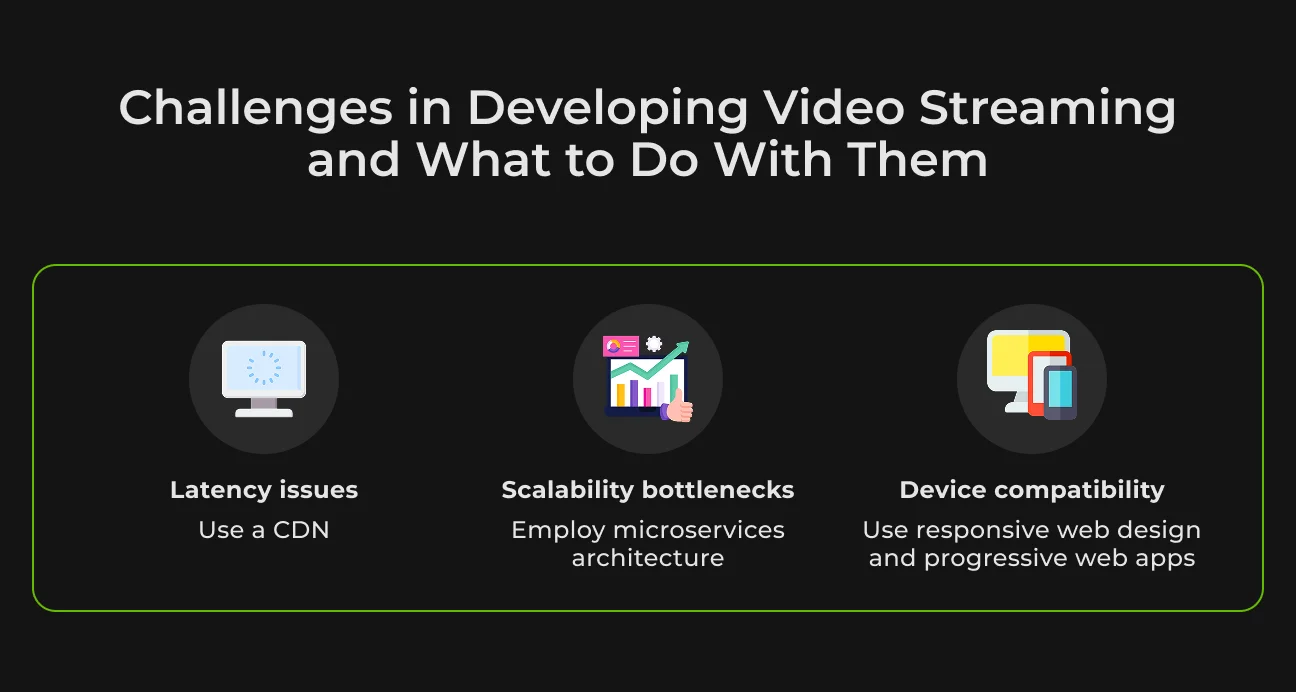
Challenges in Video Streaming Development
Developing a global video streaming platform requires balancing high-speed data delivery with a massive variety of hardware and network conditions.
Addressing these challenges is the difference between a premium user experience and a platform that fails during peak demand.
Latency Issues
Long delays and constant buffering drive viewers away instantly. These issues usually stem from the physical distance between the viewer and the source server. High-quality streams also struggle on unstable mobile networks.
A content delivery network (CDN) solves this by storing video copies on edge servers. These servers are located in cities near the actual users. This shortens the data's travel path and cuts down on loading times.
Newer video codecs like AV1 also help significantly. They shrink file sizes by up to 30% without losing visual detail. Smaller files move faster across the internet and start playing much sooner.
Scalability
Traffic spikes can easily crash a standard server setup.
A sudden viral hit or a live game might bring millions of users at the exact same moment. Platforms must be able to grow their capacity instantly.
Microservices architecture is the best defense against these surges. It breaks the app into small, independent parts like “Login” and “Video Playback.” Developers can scale the playback service alone without touching the rest of the system.
Cloud tools like AWS Auto Scaling automate this entire process. They detect rising traffic and launch new server instances in seconds. This ensures the site stays online during the busiest hours of the year.
Device Compatibility
Viewers watch content on everything from 4K TVs to five-year-old smartphones. Every device has different screen sizes and processing power. This fragmentation makes it difficult to provide a consistent experience for everyone.
Responsive design and progressive web apps (PWAs) create a flexible interface. The layout automatically shifts to fit any screen perfectly. This reduces the need to build separate apps for every single platform.
Cloud transcoding handles the backend side of this problem. It creates multiple versions of every video file during the upload process. The player then picks the specific version that works best for that user's hardware.
How SapientPro Reduced Video Editing Time by Automating Highlight Selection with AI
SapientPro helped a client streamline short-form video production by automating the most time-consuming step — selecting the right moments from raw footage.
The team built an AI-powered pipeline that transforms long videos into ready-to-use segments for fast review. Here are some of the key features:
- Semantic analysis to structure videos into chapters and highlights;
- Frame-level metrics to detect motion, stability, and visual quality;
- Prompt-based relevance scoring to match segments with campaign intent;
- Automated generation of multiple short-form variants from one upload;
This approach reduced manual review by up to 80% and cut shortlist time from hours to minutes, while keeping final editorial control fully in human hands.
Why Choose SapientPro for Video Streaming Development
SapientPro brings hands-on experience in building AI-powered video solutions. Our engineers can create everything from media platforms to advanced content processing pipelines tailored to business goals. Here are some of the solutions you can get with us:
- Custom video streaming platforms (web & mobile);
- Live streaming and real-time video processing;
- AI-powered video analytics and personalization;
- OTT, EdTech, and UGC platform development;
Looking to build or scale your video product?
Let’s talk and turn your idea into a production-ready solution.
Bring Your Idea to Life with Us
SapientPro's team will help you integrate AI into video editing for your business.