All 15 Best Practices for Implementing a Microservices Architecture in 2026
February 19, 202620 min read


By 2032, the global microservices architecture market is set to reach $11.8 billion, growing at a 13.75% CAGR. This growth signals a structural shift in how enterprises build and scale digital products.
The United States holds the largest market share, fueled by large-scale digital transformation initiatives, rapid IoT expansion, and increasing demand for scalable, cloud-native applications. For many businesses, microservices have become the default architectural approach for delivering complex systems.
Yet the market’s evolution has also exposed hard lessons.
Although more than 85% of large enterprises run microservices in production, 42% have consolidated overly fragmented services back into modular monoliths to reduce operational overhead.
The industry has moved past the hype phase into a more pragmatic stage focused on sustainability, governance, and cost control.
Today, successful adoption depends not only on decomposition strategies but also on strong platform engineering practices, AI-assisted architecture optimization, and disciplined FinOps governance.
In this article, we explore:
- What microservices architecture is;
- The key advantages of microservices architecture;
- 15 best practices for implementing microservices effectively and sustainably.
Let’s dive in.
What Are Microservices?
A microservices architecture is an approach to software development where a large application is built as a collection of small, independent services.
Each service:
- Runs in its own process;
- Communicates with other services through lightweight mechanisms, typically HTTP-based APIs;
- Is designed around a specific business capability, such as payments, inventory, or user authentication.
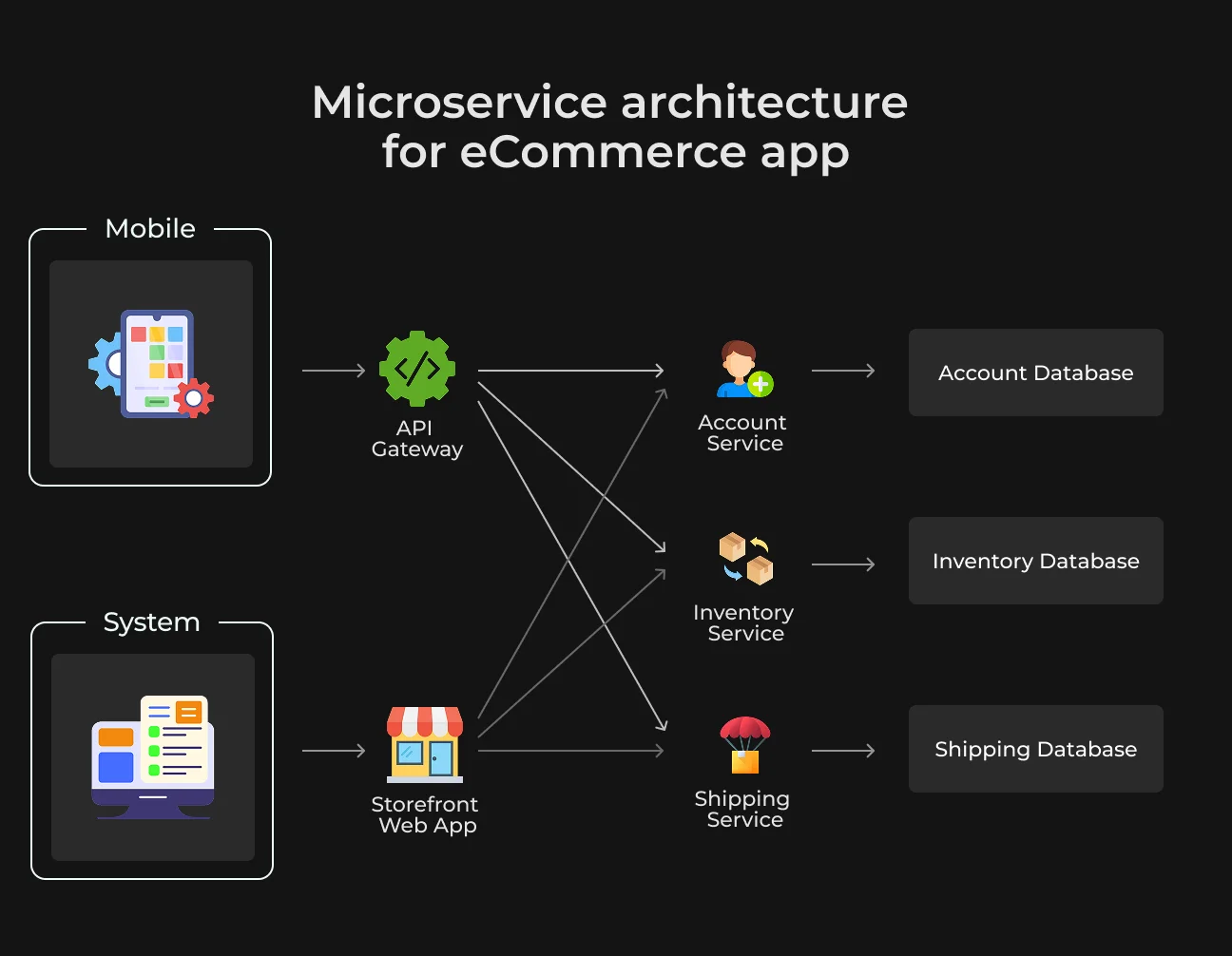
Unlike traditional monolithic systems, where all components are tightly coupled, microservices allow teams to build, deploy, and scale services independently.
Companies that adopt microservices often report measurable performance gains, including up to 60% faster deployment cycles and a 30–40% increase in productivity and release frequency. These improvements stem from smaller codebases, autonomous teams, and reduced interdependencies.
In essence, microservices are the building blocks of a flexible, composable enterprise. Using them is an investment in operational agility, faster innovation, and long-term scalability.
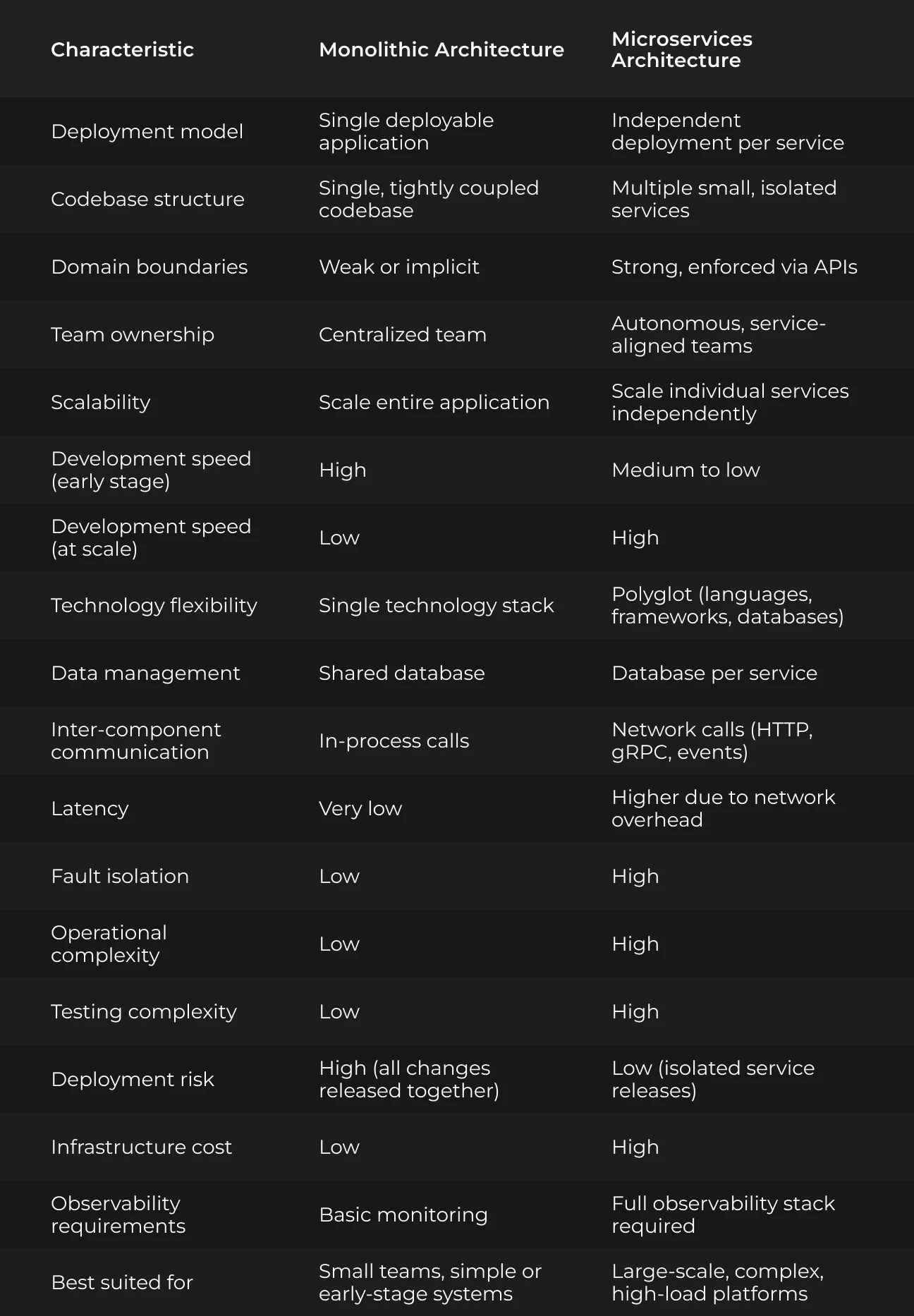
Monolithic vs. Microservices Architecture
Choosing between monolithic and microservices architecture depends largely on your current scale, technical maturity, and long-term business goals.
A monolith is a single unified application where all components like UI, business logic, and data access are tightly integrated into one codebase.
This approach is typically faster to launch and easier to manage in the early stages. For startups or small teams, a monolith offers simplicity, lower operational expenses, and easier deployment.
However, as the system grows, a monolith can become increasingly difficult to update, scale, and modify. Even small changes may require redeploying the entire application, which slows innovation and increases risk. That’s why you might need legacy app modernization services here.
In contrast, microservices architecture distributes functionality across independent services. Each service can be developed, deployed, and scaled separately.
This becomes especially valuable when:
- Multiple teams work on different parts of the system;
- Rapid, frequent releases are required;
- Certain features need to scale independently;
- The product roadmap involves continuous expansion.
In practical terms, team size and organizational complexity often determine the right approach. A team of five developers may benefit from the simplicity of a monolith. A team of fifty working across multiple domains will likely gain efficiency from distributed ownership and independent deployment models.
The real decision is not monolith versus microservices as opposing extremes. It is about aligning architecture with business scale, engineering capacity, and growth trajectory.
Microservices vs. Modular Monolith Architecture
A critical shift in 2026 is the destigmatization of the monolith.
The “Modular Monolith” has emerged as a preferred architecture for startups and specific enterprise domains where the overhead of distributed computing outweighs the benefits of independent deployment.
Architectural divergence:
- Microservices. Preferred for large-scale, complex domains requiring independent scaling and diverse technology stacks.
- Modular monoliths. Preferred for domains with high cohesion, where network latency and distributed transaction complexity introduce unnecessary risk.
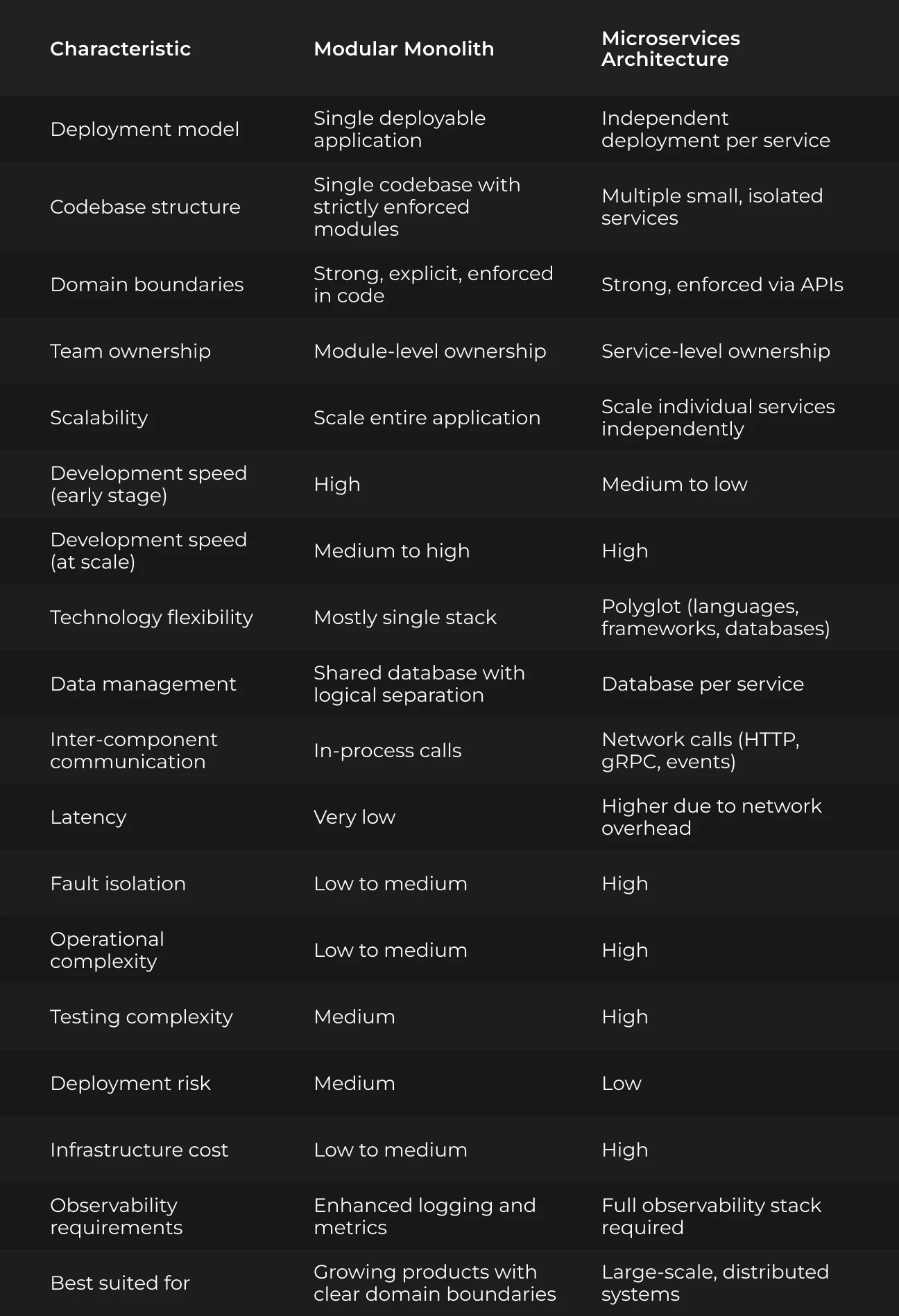
42% of organizations have consolidated selected microservices into modular monoliths.
This is a recalibration. It aligns with the “Start with a Monolith” advice often given to startups, allowing them to stabilize their domain boundaries before paying the “microservices architecture patterns premium” in operational overhead.
When to Choose Microservices?
Moving to a distributed architecture is a strategic decision. It requires investment in DevOps maturity, monitoring, security, and governance. However, in the right conditions, the long-term benefits outweigh the added complexity.
Below are common scenarios where microservices become a logical choice.
Your Application is Massive and Growing
If even minor updates take weeks to test and deploy, your monolithic codebase may have reached its limits. Tight coupling between components slows development and increases the risk of system-wide failures.
In enterprise environments, assigning dedicated teams to specific domains like user authentication, payments, or order management significantly accelerates delivery. Microservices enable parallel development, independent deployments, and clearer ownership boundaries.
You Need to Scale Specific Parts Independently
Not all parts of an application experience equal demand. For example, in an e-commerce system, search, checkout, and inventory services may handle significantly more traffic than static content pages.
With microservices, you can scale only the high-load services in cloud environments such as AWS or Azure.
This targeted scaling provides you with these benefits of microservices:
- Optimizes infrastructure costs;
- Improves performance under peak traffic;
- Prevents overprovisioning of low-traffic components.
You Want to Use a Polyglot Tech Stack
Sometimes the best tool for the job isn't the one your whole app is written in.
Maybe you need Python for a specific machine learning module but want to keep your high-concurrency messaging in Java or Go. A microservices architecture allows these different technologies to coexist. This flexibility is a major facet of why modern startups choose this path.
You are Building for Cloud-Native Resilience
If high availability is a core requirement — for example, targeting 99.999% uptime (five nines) — architectural isolation is a must-have.
In a distributed system, a failure in one component (such as a recommendation engine) does not necessarily disrupt critical flows like checkout or payment processing. This fault isolation reduces the blast radius of incidents and improves overall system reliability.
When Not to Choose Microservices?
It’s easy to get caught up in the hype, but sometimes microservices architecture patterns can be overkill.
Without the right maturity, you risk creating a “distributed monolith” – a system with all the operational overhead of microservices but none of their scalability or agility benefits.
Here are scenarios where a monolithic approach is often the smarter choice.
You’re building an MVP or early-stage product
At the early stage, speed and iteration matter more than architectural elegance. Setting up service communication, monitoring, CI/CD pipelines, and security policies for multiple services can slow development significantly.
If your primary goal is validating product–market fit, a well-structured monolith allows you to:
- Ship features faster;
- Reduce infrastructure overhead;
- Minimize operational risk.
Architecture can evolve later — once traction and scaling needs justify it.
Small Development Teams with Limited Resources
Managing a microservices architecture introduces a DevOps burden:
- Container orchestration (e.g., Kubernetes);
- Distributed logging and monitoring;
- API gateway management;
- Service discovery and fault tolerance mechanisms.
The operational costs of microservices tools are frequently greater than the advantages for teams with fewer than 10 to 15 engineers. Instead of building features, developers may spend a disproportionate amount of time maintaining infrastructure.
Low System Complexity
If your application is primarily a standard CRUD system or an internal tool with limited scalability requirements, microservices architecture patterns add unnecessary network latency and coordination overhead.
In simple systems, the performance cost of inter-service communication can actually make the application slower compared to a clean, modular monolith.
Tight Budget Constraints
Although microservices can optimize costs at scale through selective resource allocation, the initial investment is higher.
Distributed systems typically require:
- More cloud infrastructure;
- Advanced monitoring and security tooling;
- Experienced engineers with distributed systems expertise.
For bootstrapped startups or cost-sensitive projects, a monolith is often the more financially sustainable option. That’s why you should consider the key architectural choices for startups.
Benefits of Using Microservices Architecture
Microservices architecture delivers the scalability and resilience required for modern, high-traffic digital platforms. When implemented correctly, it enables you to innovate faster while maintaining operational stability.
Faster time to market
Independent services allow multiple teams to work in parallel.
Features can be developed, tested, and deployed without waiting for a full system release cycle. This reduces bottlenecks and accelerates product delivery.
Improved resilience
Because services operate independently, a failure in one component does not necessarily bring down the entire system. For example, if a recommendation engine fails, checkout and payment processing can continue functioning. This fault isolation significantly reduces system-wide outages.
Cost efficiency at scale
Microservices support selective scaling. High-traffic components like search or checkout can scale independently in cloud environments like AWS or Azure, while low-demand services remain minimally provisioned. This targeted resource allocation helps optimize infrastructure spending.
Enhanced security controls
Sensitive functionality, such as payment processing or identity management, can be isolated and hardened separately. This makes it easier to enforce strict access controls, apply service-specific security policies, and reduce the attack surface.
Seamless third-party integration
Microservices communicate via APIs, making it easier to integrate external tools, payment providers, analytics platforms, or fraud detection systems. This composability is particularly valuable in e-commerce and FinTech environments, where ecosystems evolve rapidly.
15 Microservices Best Practices for 2026
Let’s take a look at the microservices architecture best practices in 2026.
1. Design Services Around Business Capabilities (DDD & SRP)
The most important decision in microservices architecture is defining clear service boundaries. Poor decomposition leads to tight coupling, excessive inter-service communication, and operational instability.
Two foundational principles guide proper design:
- Single responsibility principle (SRP) — each service should have one clear reason to change and encapsulate a well-defined slice of business logic;
- Domain-driven design (DDD) — services should align with bounded contexts, reflecting real business domains such as Customer, Order, or Inventory;
Architects must explicitly map relationships between domains to understand dependencies and data flow before implementation begins.
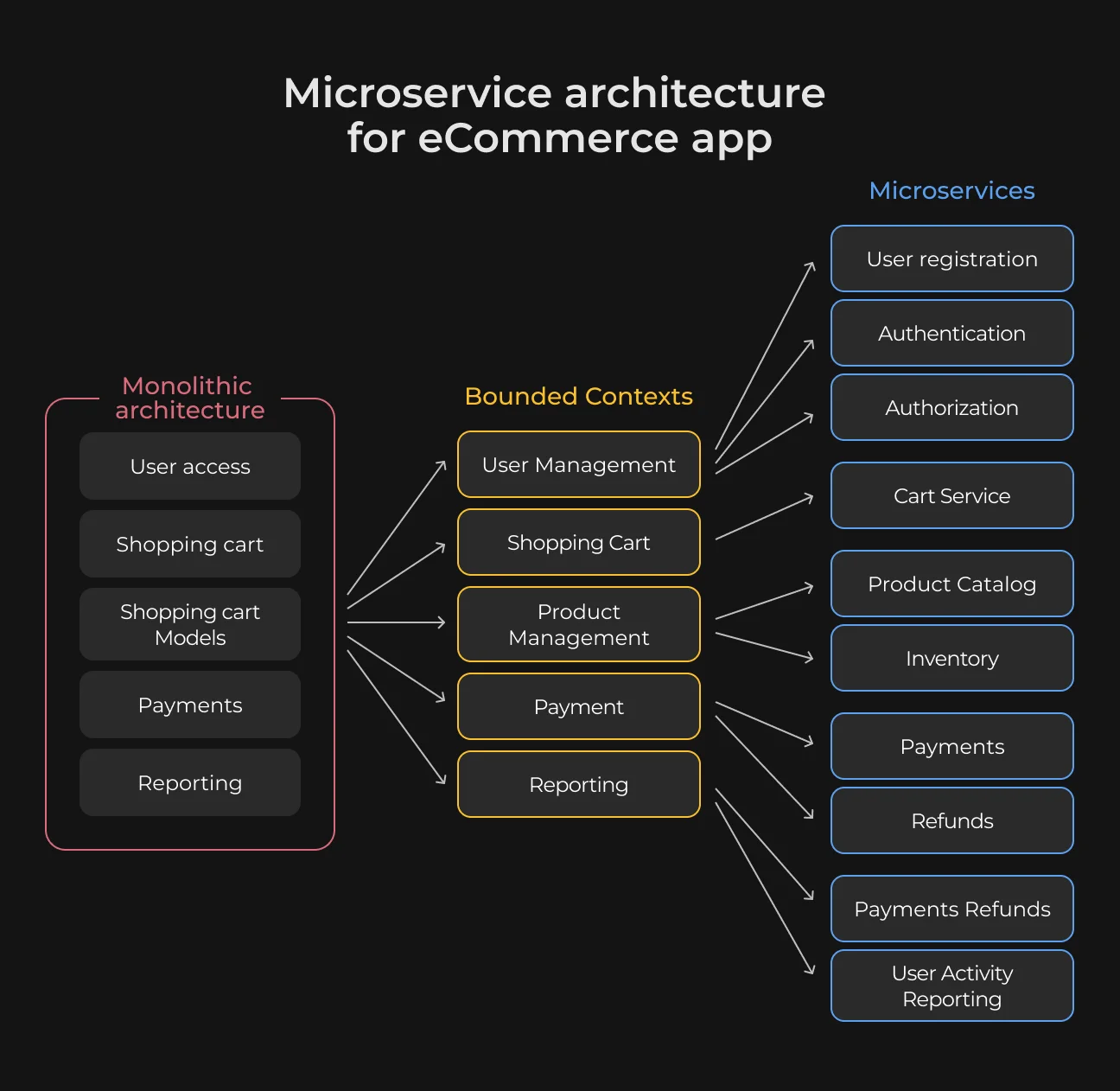
Service size should reflect business volatility and operational needs:
- Macro-services: broader domains (e.g., Billing), typically stable and suitable for coarse-grained boundaries;
- Miniservices: balanced scope, offering independence without excessive fragmentation;
- Microservices: highly granular units focused on specific capabilities (e.g., Tax Calculation);
Current best practice favors a multi-grained architecture, where services of different sizes coexist strategically. For example:
- A volatile domain like Promotions may benefit from fine-grained services to enable rapid iteration;
- A stable domain like General Ledger may remain a larger, cohesive unit.
This flexible approach prevents the “nanoservices” anti-pattern – where excessive fragmentation increases network latency, serialization overhead, and operational complexity beyond the actual business value delivered.
2. Implement Progressive Deployment Strategies
Microservices enable safer release models that reduce production risk and downtime.
Modern deployment strategies include:
Blue-green deployment
Two identical environments run in parallel. The new version is deployed to the inactive environment. After validation, traffic is switched instantly, minimizing rollback complexity.
Canary releases
A new version is released to a small percentage of users (e.g., 5%). System metrics are monitored for errors, latency spikes, or regressions. If stable, rollout gradually increases to full traffic.
Feature flags
New functionality is deployed behind runtime toggles. Features can be enabled or disabled for specific user groups without redeploying code. This supports experimentation, A/B testing, and controlled rollouts.
Progressive delivery is not optional in distributed systems. It is a core reliability practice that protects both revenue and user experience while enabling continuous innovation.
3. Adopt Database-Per-Service and Polyglot Persistence
A core rule of microservices is simple: services should not share a database. A shared database creates tight coupling at the schema level: a “small” table change for one service can break another service that depends on the same tables.
A healthier approach is database-per-service, implemented in stages:
- Logical separation: in early implementations, services may share the same database server, but each service owns its own schema or database, with access restricted via dedicated credentials and permissions;
- Physical separation: at scale, each service gets a dedicated database instance to isolate compute and I/O and to avoid “noisy neighbor” resource contention;
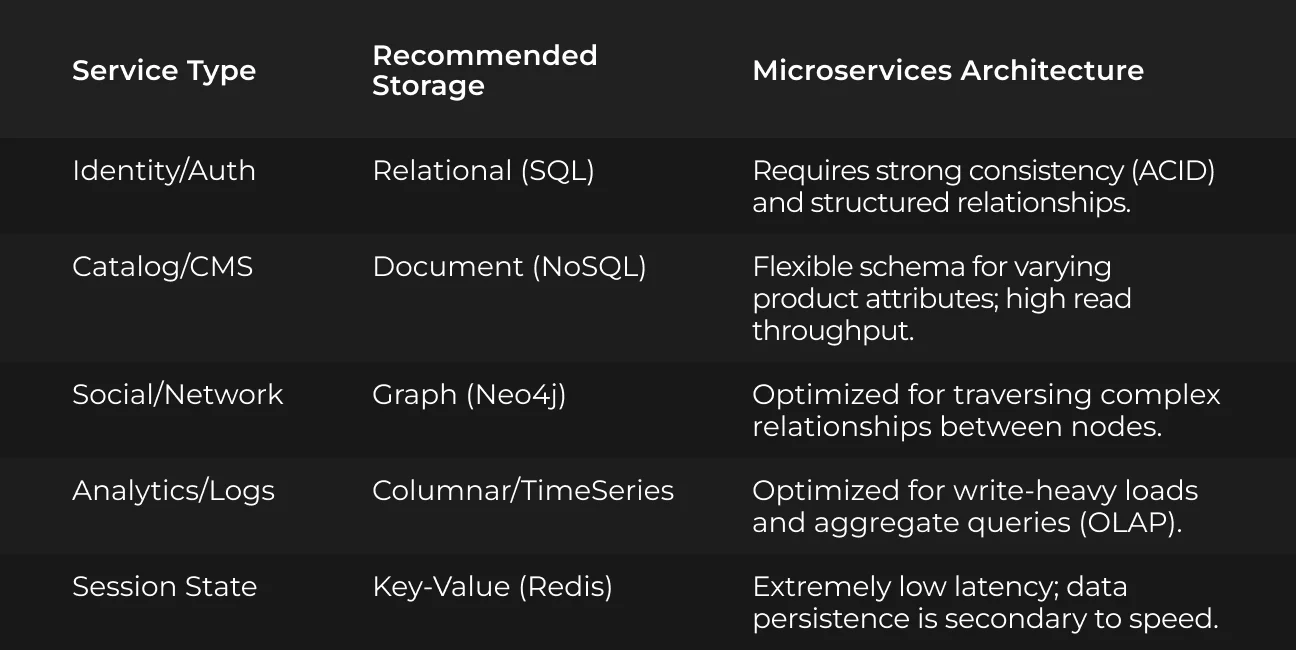
- Polyglot persistence: each service chooses the storage technology that best matches its access patterns, consistency needs, and performance profile.
Below is an example of your database mapping.
4. Align Architecture With Team Topologies
Microservices succeed or fail as much on org design as on code. Conway’s Law is the reason: system boundaries tend to mirror communication boundaries. If you want a decoupled architecture, you need teams that can operate with minimal cross-team coordination.
A common delivery unit remains the "Two-Pizza Team" model — small autonomous teams that can move fast. In mature microservices organizations, these teams are typically structured as:
- Stream-aligned teams:
Cross-functional teams aligned to a single stream of work (for example, a domain like Checkout or Search). They own the service end-to-end – from design and development to deployment and operations (“you build it, you run it”).
- Cognitive load management:
A frequent failure mode is overloading stream-aligned teams with platform complexity. If shipping a feature requires deep expertise in Kubernetes, Terraform, observability stacks, and network policies, delivery speed collapses. This overload is often described as cognitive load.
That’s why aligning architecture with team topology is a core microservices best practice. The goal is clear ownership with manageable responsibilities, so product teams can focus on business value while the platform reduces infrastructure friction.
5. Build Stateless and Idempotent Services
To achieve resilience and horizontal scalability, microservices must be stateless by default.
Any session state should be offloaded to external distributed caches (like Redis) or databases. This ensures that any instance of a service can handle any request from a user, facilitating seamless scaling and failover.
Just as important: operations should be idempotent, especially for write actions. In distributed systems, network timeouts and dropped acknowledgments are normal. A client may retry a request that was successfully processed but never confirmed – for example, a Create Order call.
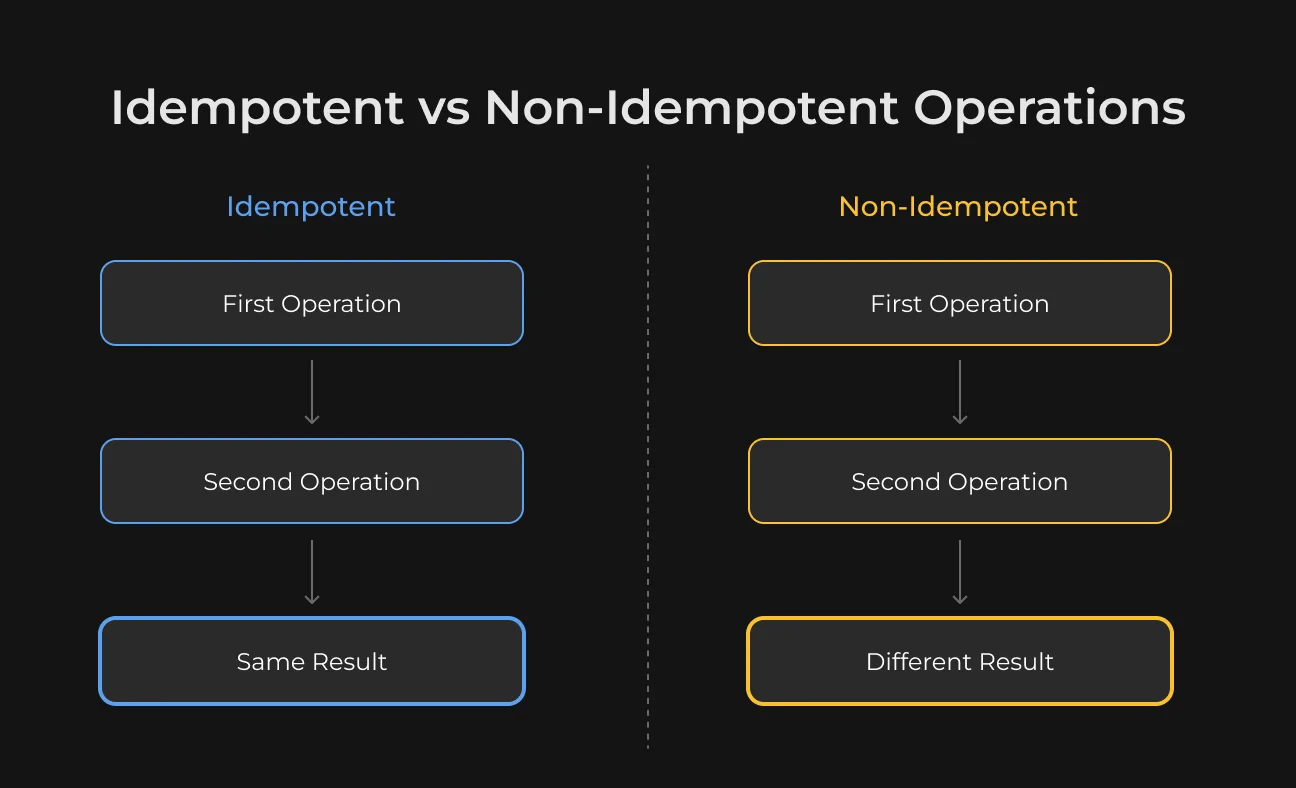
To prevent duplicates, implement idempotency keys for mutating requests:
- The client generates a unique ID for each write operation;
- The service checks a dedicated store (or persistence layer) to see whether that key was already processed;
- If it was, the service returns the previous result without executing the business logic again.
Statelessness makes services scalable. Idempotency makes retries safe. Together, they are foundational for resilient microservices in production.
6. Ensure Loose Coupling via Versioned APIs
Independent deployability depends on strict service boundaries. Microservices must communicate through well-defined and versioned APIs that conceal internal implementation details and protect consumers from breaking changes.
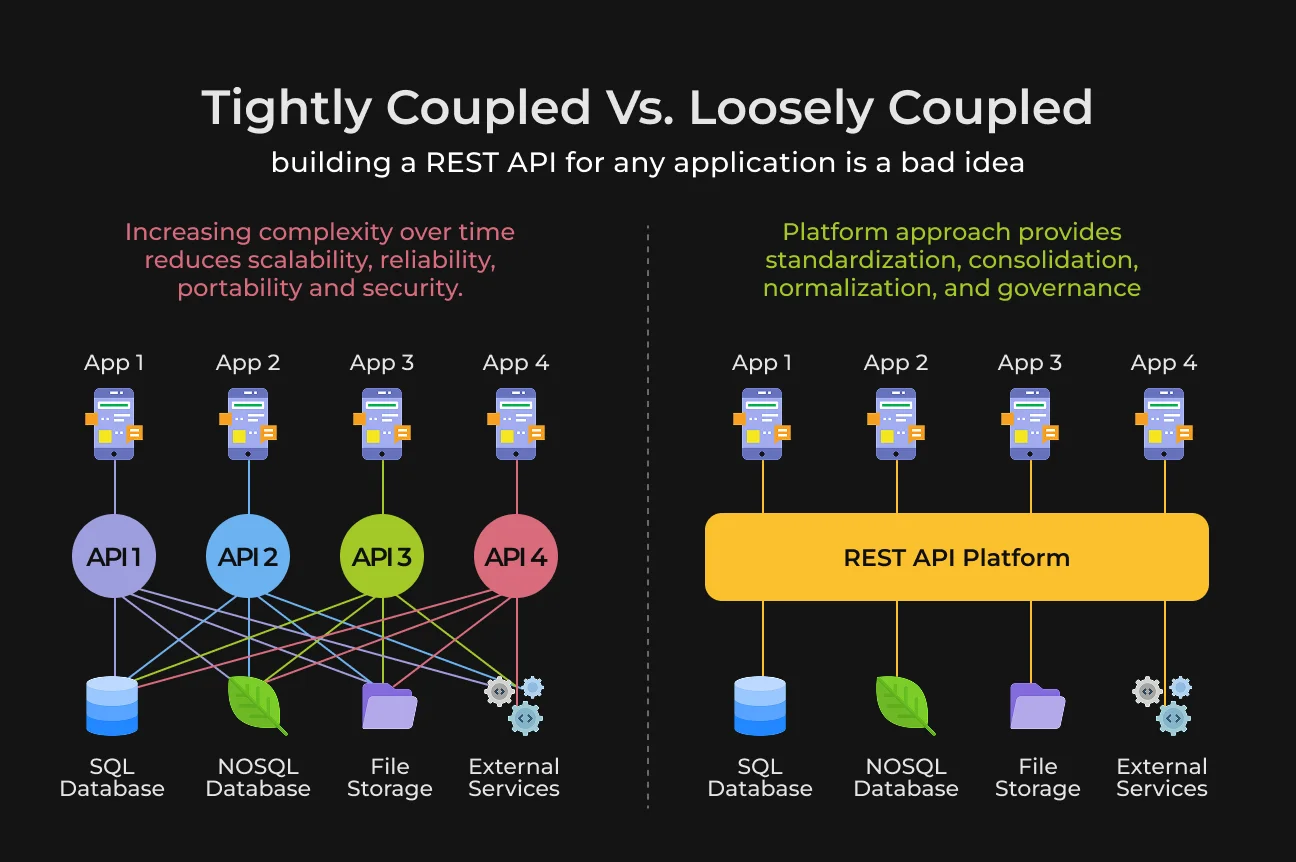
Two core principles make this possible.
Use Data Transfer Objects (DTOs)
Services should never expose internal domain entities — such as database models — directly through their APIs. Instead, they should map internal data structures to DTOs tailored for external consumption.
This abstraction layer allows internal changes without breaking clients. For example, a single Name field in the database can later be split into FirstName and LastName, while the external DTO maintains backward compatibility.
Follow the “smart endpoints, dumb pipes” principle
Business logic must reside inside services, not in the communication layer.
Unlike traditional SOA architectures that relied on complex Enterprise Service Buses (ESBs) for routing and transformation, modern microservices treat communication channels (HTTP, gRPC, or message queues) as simple transport mechanisms. They move data, not logic.
Versioning APIs (e.g., /v1/, /v2/) ensures that services can evolve safely while consumers migrate at their own pace. This approach minimizes cascading failures and protects the autonomy of teams.
In practice, maintaining strict API boundaries is not optional. It is one of the architectural safeguards that preserves independence, scalability, and long-term system stability.
7. Invest in Platform Engineering and Internal Developer Platforms
As microservices ecosystems expand, infrastructure complexity grows exponentially. To control cognitive load and sustain delivery speed, leading organizations are institutionalizing platform engineering — treating internal infrastructure as a product built for developers.
At the center of this model is the Internal Developer Platform (IDP). Built and maintained by a dedicated platform team, the IDP provides standardized, automated workflows — often called “golden paths” or “paved roads” — for building, deploying, and operating services.
Key capabilities include:
Self-service infrastructure
Developers can provision databases, caches, message queues, and other dependencies through automated workflows — without filing tickets or waiting for manual approval from operations teams. This removes bottlenecks and accelerates delivery.
Service catalogs and visibility
Tools such as Backstage or OpsLevel provide a centralized inventory of services. They track ownership, dependencies, health status, SLAs, and metadata. This improves discoverability and reduces operational ambiguity in large organizations.
Embedded standardization
Security policies, logging conventions, CI/CD pipelines, and compliance rules are baked directly into service templates. Instead of enforcing standards reactively, the platform enforces them by design.
SapientPro’s engineers know that neglect platform engineering often accumulate what can be described as organizational debt — rising cognitive load, inconsistent practices, developer frustration, and slower release cycles.
Notably, mature platform teams are shifting their performance metrics. Rather than focusing purely on technical indicators such as uptime, they increasingly measure:
- Revenue enabled by faster feature delivery;
- Infrastructure costs optimized or avoided;
- Developer productivity gains.
Platform engineering is no longer optional at scale. It is the structural layer that allows microservices architecture to remain sustainable rather than chaotic.
8. Use Sagas Instead of Distributed Transactions
Maintaining data consistency across distributed services is one of the hardest challenges in microservices architecture. In monolithic systems, consistency is enforced through ACID transactions.
In distributed systems, that model does not scale. Instead, architectures shift toward BASE principles – prioritizing availability and eventual consistency over strict transactional guarantees.
In a monolithic e-commerce app, placing an order involves inserting a record into the Order table and updating the Inventory table within a single database transaction.
If the inventory update fails, the order is rolled back. In microservices, Order and Inventory are in different databases. So, how does a Saga pattern help here?
A Saga is a sequence of local transactions. Each local transaction updates the database and publishes a message or event to trigger the next local transaction in the saga:
- Forward recovery. If a step fails due to a business rule (e.g., "Credit Limit Exceeded"), the saga executes compensating transactions to undo the changes made by previous steps.
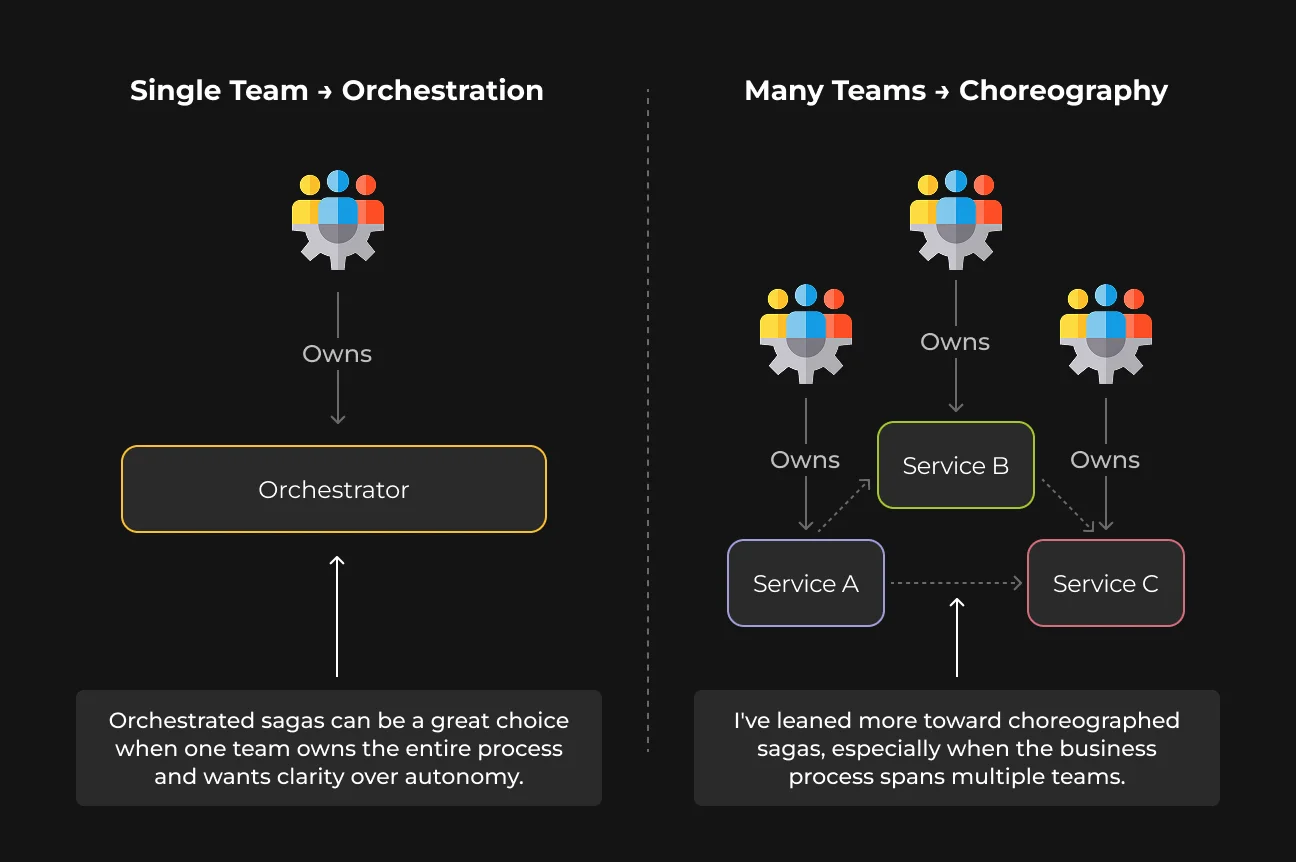
- Choreography. Services exchange events without a central point of control, for example, Order Service emits OrderCreated, Inventory Service listens and emits StockReserved. A great pro here is a simple, loose coupling. Cons also persist: hard to visualize, as well as the risk of cyclic dependencies.
- Orchestration. A central coordinator (AWS Step Functions or Temporal) tells the participants what to do. It delivers a clear process flow and centralized error handling. However, coordinator logic can become complex.
In 2026, we see that orchestration is preferred for complex business workflows to maintain visibility and manageability.
9. Adopt Zero Trust and DevSecOps by Default
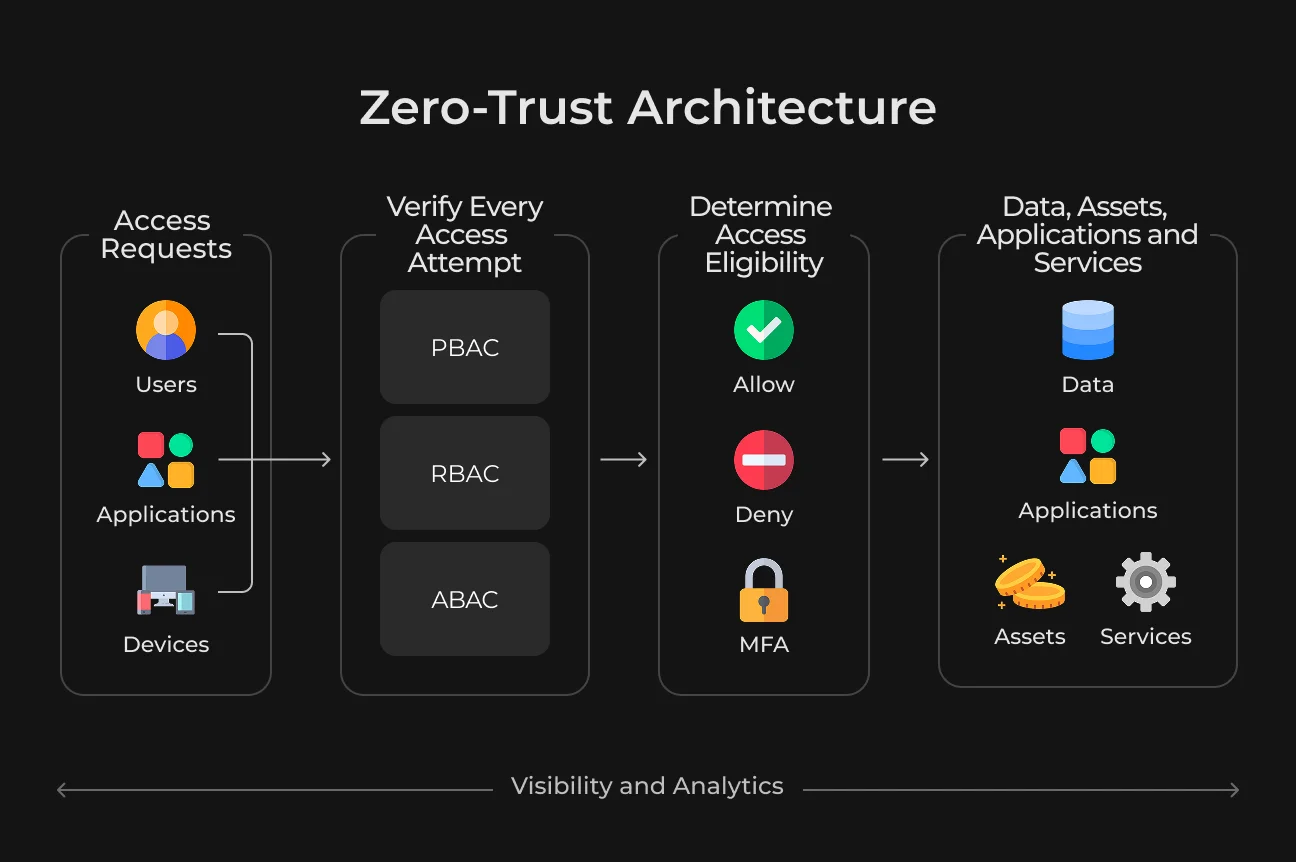
In a microservices architecture, the traditional network perimeter no longer exists. Services communicate across clusters, cloud environments, and third-party integrations. As a result, security must be embedded into every layer of the system — following a Zero Trust model.
The core assumption: the internal network is not inherently safe.
Every request must be verified.
Enforce mutual TLS (mTLS)
Service meshes such as Istio automatically enable Mutual TLS (mTLS) between services. This provides:
- Encryption of all service-to-service traffic in transit;
- Bidirectional identity verification using certificates.
Both the client and the server authenticate each other, significantly reducing the risk of lateral movement inside the network.
Require service-to-service authentication and authorization
Authenticating the end user is not enough. The system must also verify that:
- The calling service is authenticated;
- The calling service is authorized to access the target resource.
This prevents compromised services from freely accessing sensitive internal endpoints.
Strengthen the edge with an API gateway
An API Gateway acts as the single entry point for external traffic and centralizes cross-cutting security concerns. Key responsibilities include:
- Authentication offload: validating tokens from identity providers such as Auth0 or Okta;
- Rate limiting: protecting backend services from DDoS attacks and abusive traffic patterns;
- Token translation: converting external opaque tokens into internal JWTs that carry roles and scopes required by downstream services.
Standardize authorization with policy as code
As systems scale, authorization logic often becomes duplicated and inconsistent across services. To avoid fragmentation, organizations increasingly adopt policy-as-code approaches using tools such as Open Policy Agent (OPA).
With OPA:
- Policies (e.g., “Users can only access documents they own”) are defined centrally in a declarative language such as Rego;
- Enforcement occurs locally within each service, often via a sidecar container.
This model ensures consistent authorization across the entire service fleet without tightly coupling services to a centralized authorization engine.
Zero Trust is a must-have architectural posture. Embedding DevSecOps practices early ensures that security scales alongside your microservices rather than becoming a reactive afterthought.
10. Apply CQRS for Read-Heavy and Composite Views
In distributed systems, assembling a single UI screen from multiple services can create performance bottlenecks. For example, an order history page may require data from Order, Payment, and Shipping services.
If the frontend calls each service separately and aggregates results at runtime, the system suffers from:
- Increased latency due to multiple network hops;
- Tight runtime coupling between services;
- Reduced resilience when one dependency slows down.
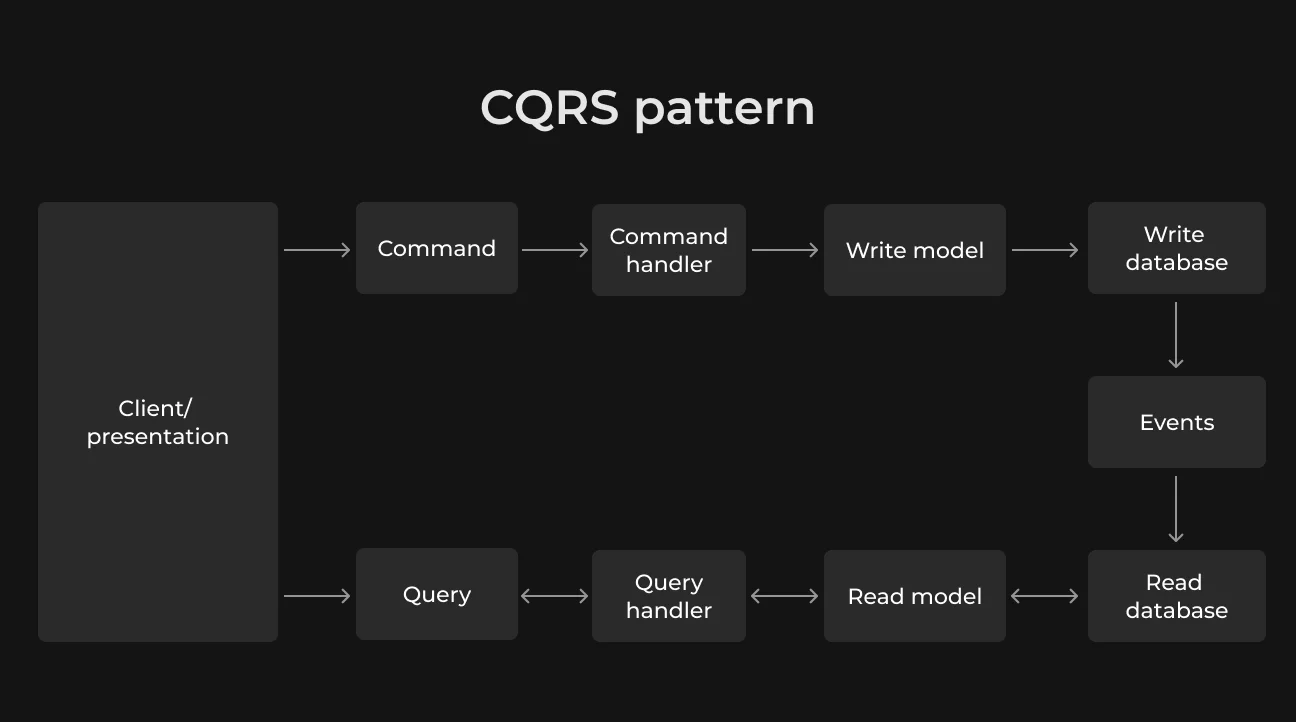
Command Query Responsibility Segregation (CQRS) separates write operations from read operations. Instead of using the same model for both, the system maintains distinct paths:
- Command side (writes): handles state changes and updates authoritative domain data (for example, the Order database);
- Events: after state changes, services emit events describing what happened;
- Query side (reads): consumes these events and updates a dedicated read model, optimized specifically for querying and UI performance.
The read model is often denormalized and purpose-built — such as:
- An Elasticsearch index for fast search and filtering;
- A flattened SQL table containing pre-joined data;
- A document store tailored to frontend display requirements.
CQRS enables:
- Extremely fast read performance;
- Independent scaling of read and write workloads;
- Reduced cross-service API chatter at runtime.
By precomputing composite views, the system avoids expensive real-time joins across services.
In high-traffic and heavy systems (such as e-commerce dashboards, analytics portals, or financial transaction histories) CQRS significantly improves scalability and user experience without increasing write-side complexity.
11. Choose the Right Communication Patterns (Async First)
Choosing the right communication protocol is pivotal for system performance and coupling.
Synchronous communication (HTTP/REST, gRPC)
Typical usage:
- External-facing APIs;
- Simple request/response interactions;
- Real-time queries where an immediate response is required.
Primary drawback:
Synchronous calls create temporal coupling. If Service A depends on Service B and B is slow or unavailable, A must wait. Under load, this can cause cascading latency, thread exhaustion, and even system-wide failures.
Synchronous communication should therefore be limited to cases where real-time consistency is essential.
Asynchronous communication (event-driven architecture)
Typical usage:
- Cross-service workflows;
- Background processing;
- Decoupled business reactions (e.g., OrderPlaced → trigger Shipping, Notification, Analytics).
In this model, Service A emits an event and does not wait for a response. Downstream services consume the event independently when ready.
Common tools:
- Apache Kafka;
- RabbitMQ;
- Amazon SNS/SQS;
- Google Pub/Sub;
- Azure Service Bus;
- NATS;
- Apache Pulsar.
Key benefits:
- Loose coupling between producers and consumers;
- Built-in buffering and backpressure handling;
- Improved resilience: if a consumer is temporarily down, messages remain in the broker until recovery;
- Independent scaling of event producers and consumers.
Event-driven systems reduce direct service dependencies and minimize cascading failures.
Instead of building a chain of synchronous calls across multiple services, asynchronous messaging allows the system to absorb spikes in traffic and recover gracefully from outages.
In 2026, high-scale microservices architectures typically treat synchronous communication as an exception – and event-driven integration as the default pattern for internal workflows.
12. Apply FinOps to Control Microservices Costs
Microservices improve scalability – but they often increase cloud spending, especially in early stages. Multiple services mean more containers, databases, load balancers, and observability tooling. Without discipline, distributed architecture can quietly erode margins.
FinOps brings financial accountability to cloud-native engineering. It aligns architecture decisions with business outcomes rather than raw infrastructure metrics.
Focus on unit economics
Tracking only “total cloud spend” is misleading. Mature teams measure cost efficiency per business unit, such as:
- Cost per order;
- Cost per active user;
- Cost per transaction.
If cloud costs increase by 20% while revenue-driving transactions grow by 50%, the architecture is scaling efficiently. If spending rises without proportional business growth, optimization is required.
Enforce rigorous tagging
Every resource — container, database, message queue, load balancer — should be tagged with:
- Cost center;
- Owning team;
- Application or service name.
Tagging policies are often enforced through policy-as-code frameworks to prevent untracked infrastructure. Without attribution, optimization becomes impossible.
Implement showback or chargeback
Visibility drives accountability. Platform teams should provide cost reports to stream-aligned teams, showing exactly how much their services consume.
When engineers see the financial impact of over-provisioned Kubernetes pods or idle environments, they are more likely to right-size workloads and eliminate waste.
Introduce predictive costing and cost gates
In 2026, advanced organizations integrate cost estimation into CI/CD pipelines.
For example:
- Infrastructure changes (e.g., Terraform updates) generate projected cost impacts before deployment;
- If predicted spend exceeds budget thresholds, deployments are flagged or blocked for review.
This proactive control prevents “bill shock” caused by accidental over-provisioning or misconfigured scaling rules. FinOps is no longer a finance-only function. In microservices environments, cost management becomes an architectural responsibility — embedded directly into engineering workflows.
13. Use Service Meshes and eBPF for Traffic Control
As microservices architectures expand, the network effectively becomes the application backbone. Every request crosses service boundaries, making traffic management, security, and observability significantly more complex.
To handle this complexity, organizations adopt a service mesh – a dedicated infrastructure layer for service-to-service communication.
Service mesh (Istio, Linkerd)
A service mesh abstracts networking concerns away from application code. It typically provides:
- Intelligent load balancing;
- Automatic retries and circuit breaking;
- Mutual TLS (mTLS) encryption;
- Fine-grained traffic routing (e.g., for canary releases);
- Deep observability into latency, error rates, and service dependencies.
Traditionally, service meshes rely on a sidecar proxy model, where a lightweight proxy container runs alongside each service instance. This allows network policies and telemetry to be enforced without modifying application logic.
eBPF and sidecar-less meshes
By 2026, eBPF (Extended Berkeley Packet Filter) has significantly evolved service mesh architectures.
eBPF enables network observability and traffic control directly within the Linux kernel, allowing for sidecar-less service meshes. Instead of running a proxy container next to every service, mesh functionality operates at the kernel level.
Key advantages include:
- Reduced CPU and memory overhead;
- Lower latency compared to sidecar proxies;
- Simplified operational footprint.
This shift addresses one of the major criticisms of early service mesh implementations: excessive resource consumption.
In modern microservices environments, traffic management is not optional. Whether implemented via traditional sidecars or eBPF-powered approaches, a well-designed service mesh provides the reliability, security, and visibility required at scale.
14. Standardize on Containers and Kubernetes (with GitOps)
In modern microservices environments, containers remain the foundational deployment unit.
Docker and other OCI-compliant containers package the application together with its runtime and dependencies, ensuring consistency across development, staging, and production.
This eliminates environment drift and the classic “it works on my machine” problem.
Kubernetes as the cloud operating layer
Kubernetes (K8s) has become the default orchestration platform for containerized workloads. It manages:
- Container scheduling across nodes;
- Self-healing (automatic restarts and rescheduling of failed pods);
- Horizontal auto-scaling based on load;
- Rolling updates and rollbacks.
By 2026, Kubernetes is treated less as a differentiator and more as utility infrastructure.
To reduce operational complexity, many organizations rely on:
- Managed Kubernetes control planes (EKS, AKS, GKE);
- Serverless container platforms (AWS Fargate, Google Cloud Run).
These options offload control-plane maintenance while preserving container portability.
GitOps as the deployment standard
Deployment practices have also matured. GitOps is now a widely adopted model for managing Kubernetes environments using tools such as Argo CD or Flux.
The core principle:
- The desired state of the cluster is declaratively defined in a Git repository;
- Agents running inside the cluster continuously reconcile the live state with the version-controlled configuration;
This approach provides:
- Full auditability of infrastructure changes;
- Version-controlled deployments;
- Simplified rollback to known-good states;
- Strong alignment between DevOps workflows and infrastructure governance.
Together, containers, Kubernetes, and GitOps form the operational backbone of scalable microservices platforms – delivering portability, automation, and controlled change management at scale.
15. Engineer for Failure Using Resilience Patterns
In distributed systems, failure is not an exception – it is a certainty. Networks degrade, containers crash, and dependencies become slow. Microservices must be designed to fail gracefully, not catastrophically.
Circuit breaker pattern
When a downstream service becomes slow or unavailable, continuing to send requests only worsens the situation and can exhaust the caller’s thread pools.
A circuit breaker prevents this cascade:
- If the failure rate exceeds a defined threshold, the breaker opens;
- Subsequent calls fail immediately (fail-fast) without hitting the downstream service;
- After a timeout period, the breaker enters a half-open state and allows a limited number of test requests;
- If those succeed, the breaker closes and normal traffic resumes.
Libraries such as Resilience4j (or built-in service mesh capabilities) provide production-ready implementations.
Bulkhead pattern
Inspired by ship hull compartmentalization, the bulkhead pattern isolates resources to contain failures.
At the application level:
- Allocate separate thread pools for different downstream dependencies;
- If an Image Processing service hangs, it consumes only its assigned resources — leaving critical flows like User Login unaffected;
At the infrastructure level:
- Enforce dedicated CPU and memory quotas for critical services;
- Prevent resource starvation caused by “noisy neighbor” workloads;
Chaos engineering
Resilience patterns must be tested, not assumed.
Organizations practice chaos engineering to validate system behavior under stress. Tools such as Gremlin or Chaos Mesh deliberately inject faults — including:
- Network latency spikes;
- Pod terminations;
- Packet loss;
The objective is not to break the system, but to verify that it:
- Degrades gracefully;
- Contains failure blast radius;
- Recovers automatically;
In mature microservices architectures, resilience is engineered proactively. The goal is not eliminating failure – it is ensuring the system remains stable, predictable, and recoverable when failure inevitably occurs.
Partner with SapientPro to Implement Microservices in Your Product
Moving to a distributed system is a major technical challenge that requires deep expertise.
SapientPro specializes in helping startups and established enterprises convert their legacy systems into high-performance platforms. Our engineers are experts in Python, Java, and cloud-native technologies.
Check out how we helped these startups launch with microservices:
We have deep expertise to help you migrate from a monolith to microservices, create a new AI-integrated system, and more. Let's transform your tech stack together!
Build Your Software with SapientPro