
All What is a Content Delivery Network: Architecture, Use Cases, Benefits for Business
April 1, 202615 min read


How does instant data delivery across the globe shape today’s digital economy?
More than you might expect. In 2024, the content delivery network (CDN) market reached $23.69 billion, driven by 4K streaming, 5G experiences, and real-time AI applications.
What was once a performance add-on is now a core layer of modern infrastructure, with projections exceeding $73 billion by 2033.
In this article, we break down what is a content delivery network, how CDN works, the benefits of CDN, and why it matters for your business. Read on for more!
What Is a Content Delivery Network (CDN)?
A content delivery network, commonly referred to by its acronym CDN, represents a geographically distributed architecture of proxy servers and their supporting data centers.
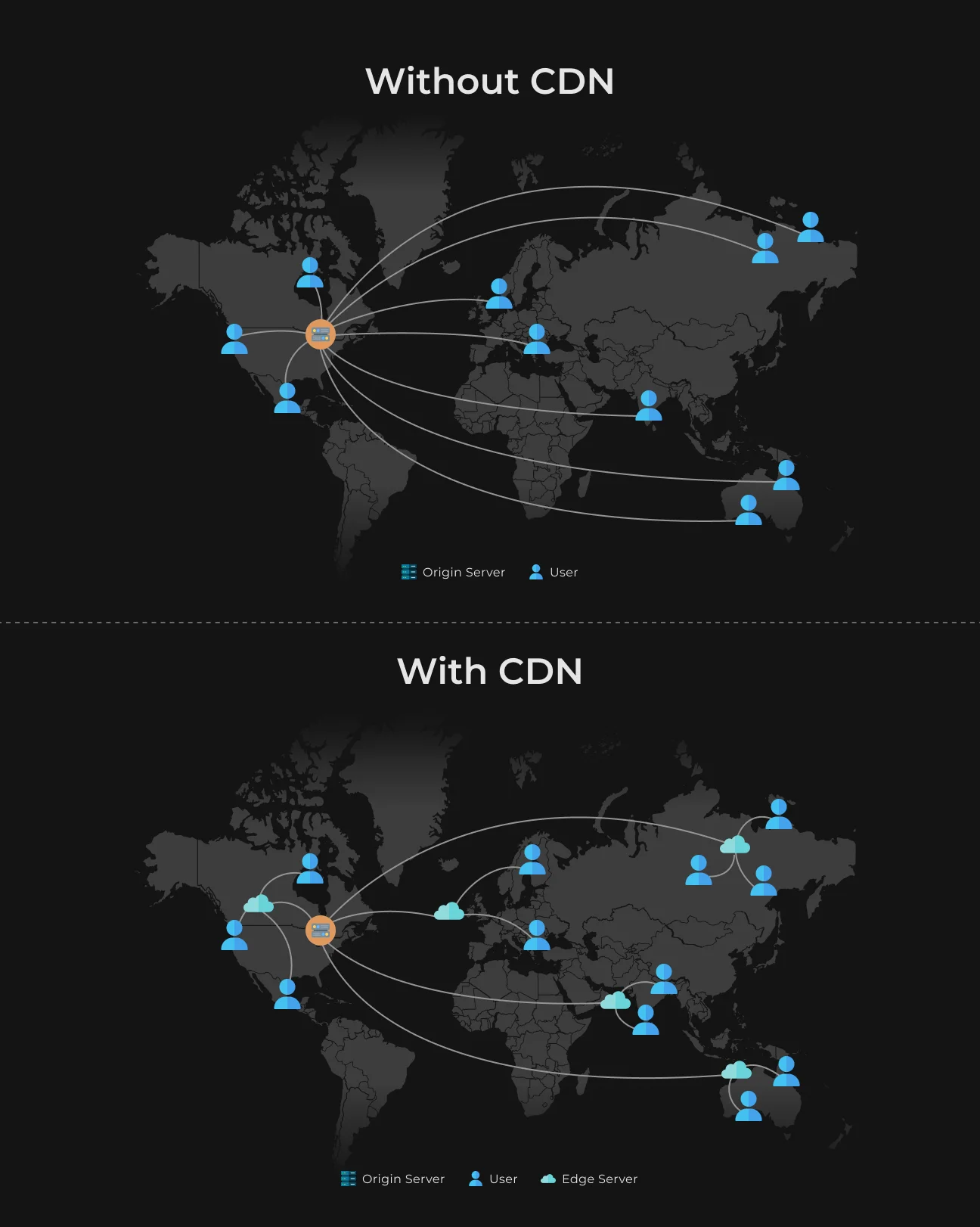
The primary objective of this system is to provide high availability and performance by distributing content based on end-user location. CDN architecture facilitates the efficient delivery of various web resources, including HTML pages, JavaScript files, stylesheets, images, and high-definition video.
How CDN Architecture Works
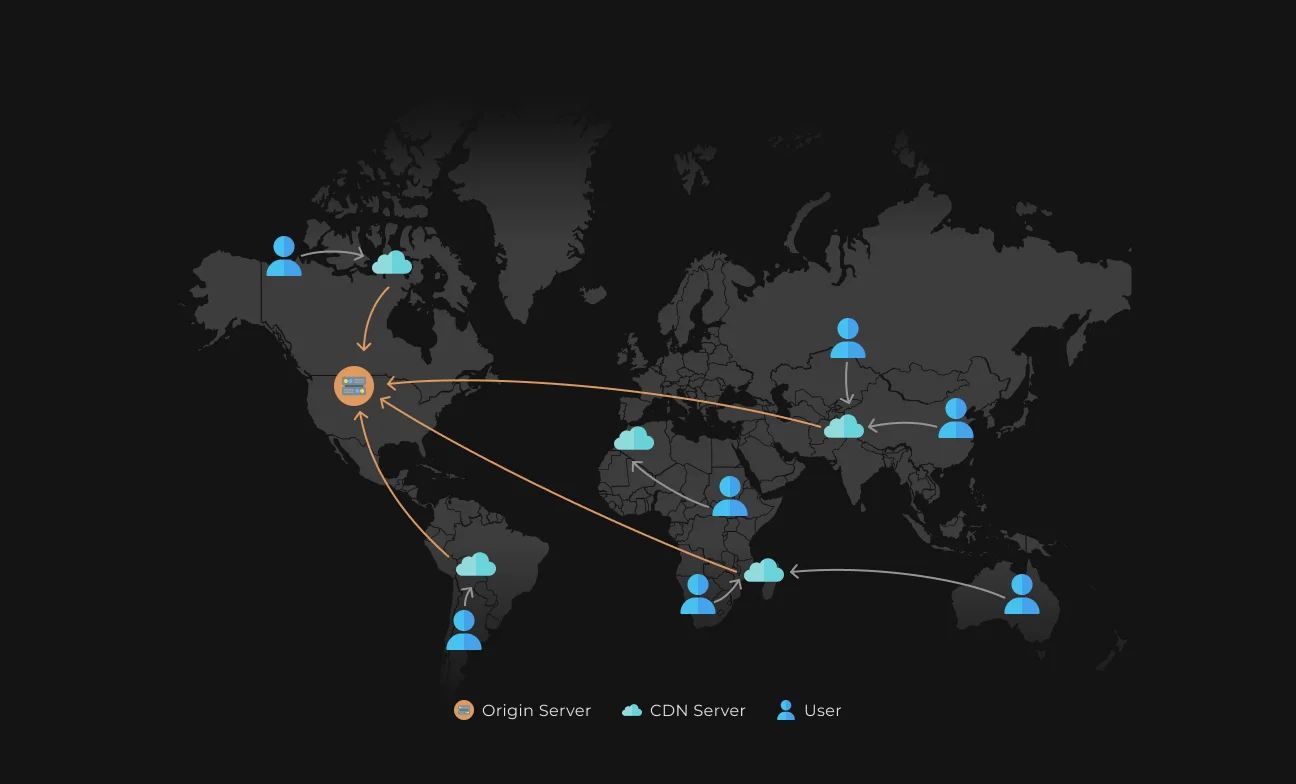
Unlike traditional hosting, which relies on a single source of truth, a CDN architecture uses a hub-and-spoke model. Within this model, the "hub" is the origin server and the "spokes" are the globally dispersed PoPs. This structure allows for intelligent routing and massive parallelism in content delivery.
User
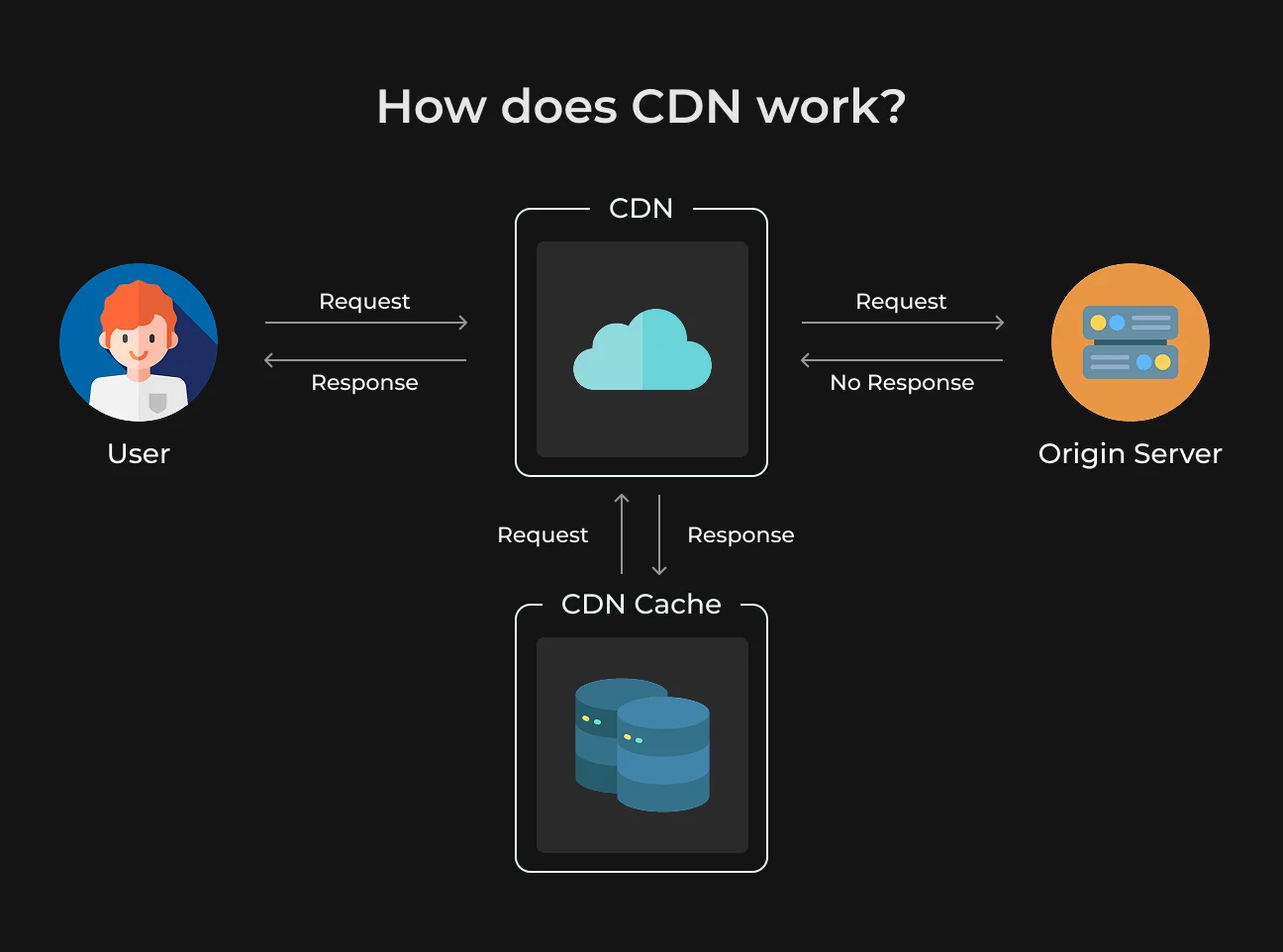
The User represents the end-client or consumer device (such as a web browser or mobile application) that initiates a request for digital content. In a network optimized by a CDN, the user’s request is intercepted at the "network edge" rather than traveling all the way to a distant central server.
In result, faster and more responsive experience is ensured.
CDN
The CDN is a geographically distributed network of proxy servers that act as a high-speed intermediary between the user and the data source.
Its primary function is to intelligently route incoming requests to the nearest Point of Presence (PoP) and deliver cached content locally to minimize latency and reduce physical distance.
CDN Cache
What is a CDN cache? The CDN cache is the specialized storage layer located within edge servers that holds temporary copies of web assets, such as images, scripts, and video files.
As shown in the diagram, when the CDN identifies a cache hit, it retrieves the requested data directly from this local storage and provides an immediate response to the user. This way, it bypasses the need to involve the origin server.
The evolution of caching is now being shaped by the integration of artificial intelligence. AI-driven caching models can analyze historic access patterns to predict which content will become popular in specific regions, pre-fetching those assets before a single user even requests them.
This approach improves cache hit ratios, further driving down egress costs and improving the Quality of Experience (QoE).
To understand how AI relates to broader software architecture, read our article about types of AI.
Origin Server
The Origin Server is the central authoritative host that stores the master version of the website or application’s content. In a typical caching workflow, the origin server is only called upon during a cache miss to fetch fresh data.
However, as illustrated by the "No Response" path in the diagram, a successful CDN integration effectively offloads this server. This protects the server from excessive traffic and preserves its bandwidth for essential processing tasks.
Benefits of CDN Integration for Global Businesses
Integrating a CDN impacts every core business function. Now, let's discuss the 4 main benefits of CDN integration.
1. Improved Website Speed and Performance
Speed is a direct driver of revenue in 2026. Implementing a CDN can improve page load speeds by up to 188%. For every second of delay, e-commerce platforms see a measurable decline in conversion rates and an increase in bounce rates.
Furthermore, search engine algorithms prioritize fast-loading sites. A CDN integration directly improves organic search visibility and customer acquisition costs.
2. Scalability and Global Reach
The CDN provides an elastic infrastructure that allows a business to expand into new markets without investing in physical data centers. Whether the traffic originates from North America or the emerging markets of Asia-Pacific, the CDN ensures a consistent experience for all users.
This scalability is particularly vital for handling flash traffic events, such as product launches or viral social media mentions. WIthout implemented CDN, these flash traffic events can otherwise overwhelm a standalone origin server.
3. Improved Security and DDoS Protection
We see that the CDN security layer has become the primary defense for many of our clients. CDNs absorb massive DDoS attacks that can exceed several terabits per second. They neutralize the threat at the edge before it can saturate the company's bandwidth.
Modern WAFs (Web Application Firewalls) integrated into CDN platforms use behavior analysis to distinguish between legitimate users and malicious bots. This way, they protect proprietary data and user privacy.
4. Cost & Resource Optimization
While CDNs have an associated service cost, they frequently result in a net reduction in total infrastructure spend. By serving content from the edge, a CDN reduces the volume of data that must be fetched from the origin server. It lowers egress fees charged by cloud providers.
Additionally, it offloads the computational work of SSL handshake processing and image optimization. Firms can right-size their origin servers and reduce operational overhead.
Use Cases and Examples of CDN Integration
The versatility of CDN solutions allows them to solve diverse challenges across various industry verticals.
1. Streaming and Media Delivery
The media and entertainment sector accounts for over 41% of CDN revenue. Netflix and YouTube use global CDN caching to minimize buffering and support high-bitrate 4K streaming.
By using adaptive bitrate streaming at the edge, these CDNs ensure that video quality scales up or down based on the user's real-time network conditions. This results in a smooth viewing experience even on congested mobile networks.
2. E-Commerce and SaaS Applications
In e-commerce, high-resolution product images and reviews must load instantly to prevent cart abandonment. SaaS companies use CDNs to accelerate the delivery of their application code (SPA frameworks).
CDNs for SaaS ensure that API responses are fast enough to provide a native feel to web-based tools. Real-time analytics and dynamic edge compression further improve the responsiveness of these platforms.
3. Mobile and Multi-Device Optimization
Modern CDNs detect device type at the edge and automatically serve optimized, smaller image formats (such as WebP or AVIF) to mobile users. CDNs saves them data and improve load times on 4G and 5G connections. Mobile commerce growth is a primary driver for the 32.3% CAGR seen in the mobile-specific CDN segment.
4. Enterprise and Private CDN Deployments
Large corporations often build internal or private CDNs to manage content within their own secure networks. This is particularly common for delivering software updates to thousands of employee devices or for secure internal video training.
Private CDNs offer maximum control and compliance. Thanks to them, sensitive corporate data never touches a public cache.
Securing €6M in Investments
See how SapientPro helped Contentoo get 3,000+ active users.

CDN Analytics, Monitoring, and Performance Optimization
To achieve the best ROI, you must move beyond a set-and-forget mentality. The best approach to CDN analytics is a data-driven approach to maintain peak CDN performance.
Technical teams should focus on the 4 "Golden Signals" of CDN performance to ensure a healthy delivery environment. Monitoring these metrics through real-time dashboards enables immediate responses to regional degradation or configuration errors:
- Cache Hit Ratio (CHR).
This is the most critical metric for cost and origin health. A high CHR (95%+) for static assets indicates an efficient CDN configuration. A dropping CHR suggests that cache keys are too fragmented or that TTLs are too short.
- Latency and TTFB.
It measures how long it takes for a request to reach the CDN and for the user to receive the first byte. Latency should be monitored at the P95 and P99 percentiles to capture the experience of the slowest users.
- Request Rate and Bandwidth Usage.
Sudden spikes in request volume may indicate a bot crawl or a DDoS attack. This is why gradual increases help in capacity planning and budget forecasting.
- Error Rate (4xx/5xx).
A high rate of 5xx errors typically indicates a problem between the CDN and the origin server. 4xx errors might suggest broken links or unauthorized access attempts.
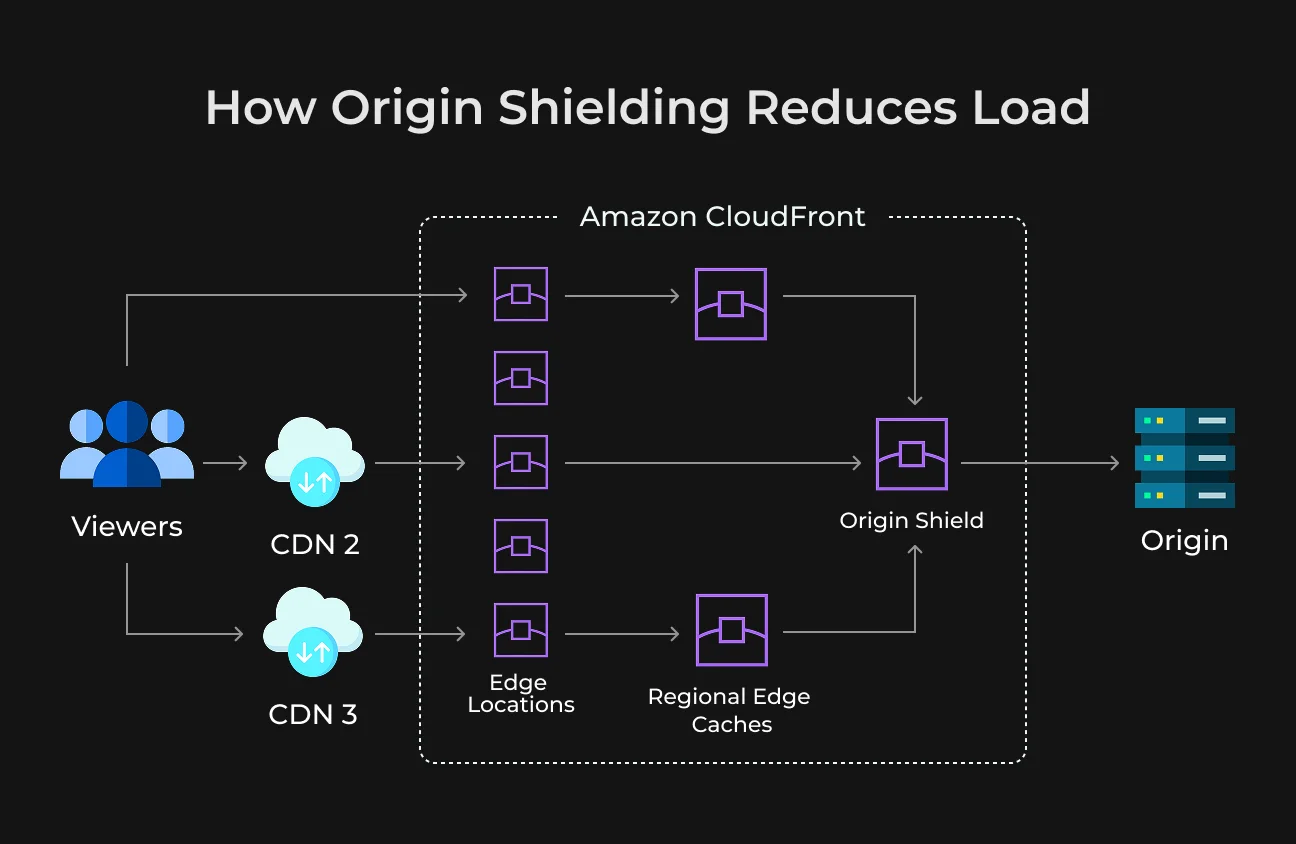
The CDN optimization process is iterative. Analytics data should be used to refine routing paths and cache policies. Suppose data shows that users in Australia are experiencing high latency. In this case, you might enable Origin Shielding at a nearby Singapore PoP to consolidate requests before they return to a US-based origin.
Similarly, suppose you identified frequently requested, but uncacheable API endpoints. In this case, you can implement edge computing logic to generate those responses locally. What is the benefit? You are bypassing the origin entirely.
Challenges in CDN Integration
While the benefits of CDN are significant, CDN integration still presents technical hurdles that can disrupt service if not handled with expertise.
Misconfigured Cache Policies
Establishing the correct rules for what to cache and for how long is a common pain point. If a developer accidentally caches a page containing private user information (for example, Set-Cookie headers), that data could be served to other users. The result? A security breach.
Conversely, overly aggressive caching of time-sensitive data, like stock prices or inventory levels, leads to users seeing outdated information.
Mixed Content Errors
When a website transitions to HTTPS, every asset (images, scripts, and fonts) must be served over a secure connection. If the CDN technology is configured to pull assets via http://, browsers will block those assets and display a "not secure" warning.
This mixed content error can compromise a site's visual integrity and significantly erode brand trust.
SSL Misalignment
The coordination of SSL certificates between the user, the CDN, and the origin is a frequent source of error. SSL misalignment occurs when the CDN's certificate doesn't match the origin's.
Another case is when the CDN is set to "Flexible" mode (encrypting user-to-CDN), but the origin is not configured to accept the resulting traffic. This often results in "526 Invalid SSL" errors or infinite redirect loops that make the site unreachable.
Purge Propagation and Cache Invalidation
Keeping a global network of caches in sync with the origin is a persistent challenge. When an asset is updated, it must be purged from every PoP simultaneously.
However, purge propagation can take anywhere from a few seconds to several minutes, depending on the provider. During this window, users in different parts of the world may see inconsistent versions of the same page. This problem is known as cache incoherence.
Browser-Level Security Blocks
Modern browsers have strict security protocols that can conflict with CDN delivery.
A prime example is Content Security Policy (CSP) headers.
If the CSP is not updated to whitelist the CDN's domain, the browser may block scripts or styles from loading. User interface breaks. Managing these headers at the CDN configuration level requires careful coordination between DevOps and security teams.
Best Practices in CDN Integration
Here are the main industry standards for CDN integration. We recommend that you follow them to get a stable and performant deployment.
Automating HTTPS and Redirects
To avoid mixed content errors, you should enable features like Automatic HTTPS Rewrites and Always Use HTTPS at the CDN technology level. These tools dynamically update insecure links in the HTML on the fly. The entire page remains secure without requiring a massive audit of legacy codebases.
Versioned Caching and Fingerprinting
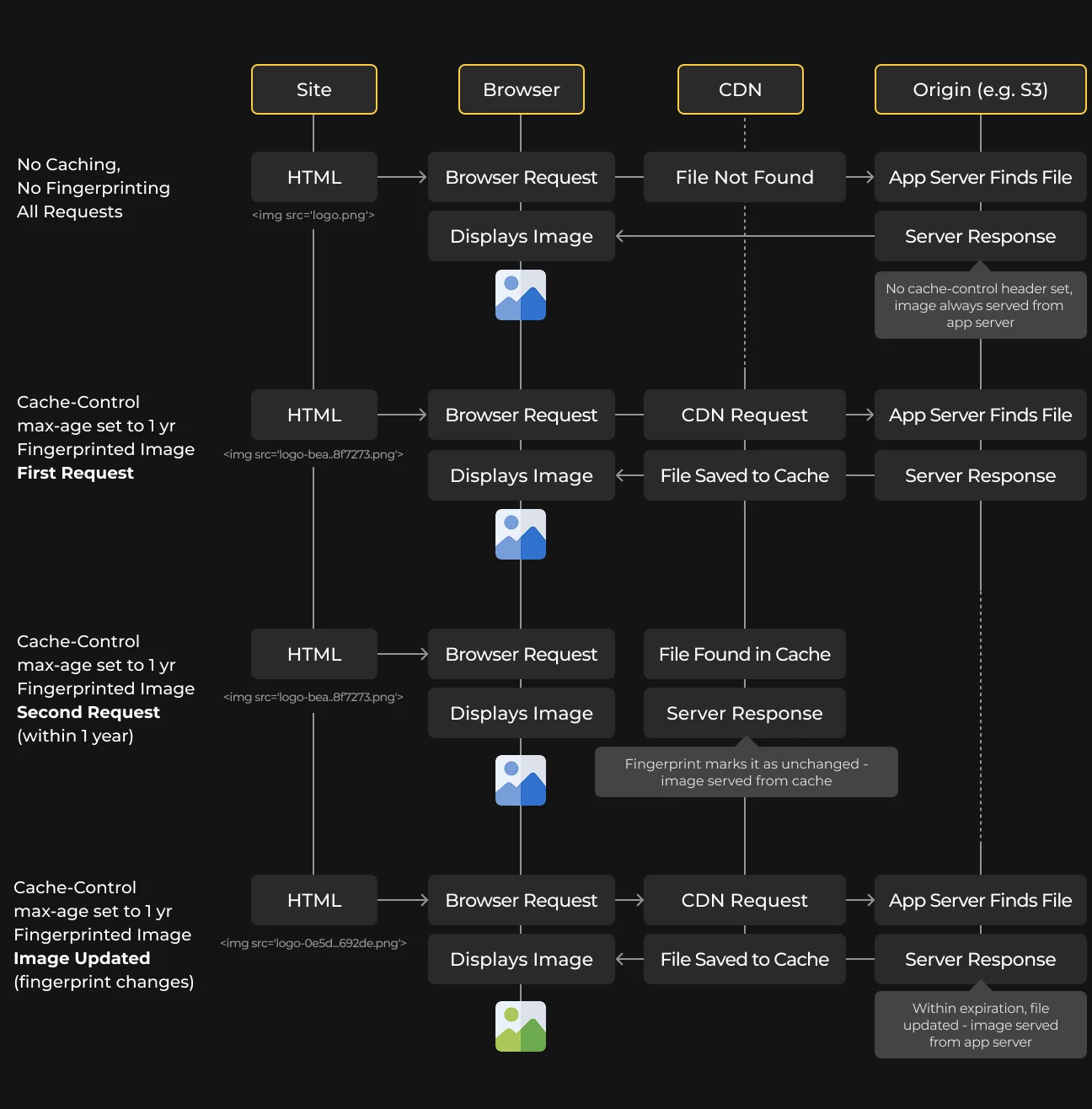
Instead of manually purging the cache every time a file is updated, you should use fingerprinting, for example, main.8f2a1.js.
If you give every file a unique name based on its content, the CDN technology sees it as a brand-new asset. Users always receive the latest version without the risks and delays of manual cache invalidation.
Staging and Canary Environments
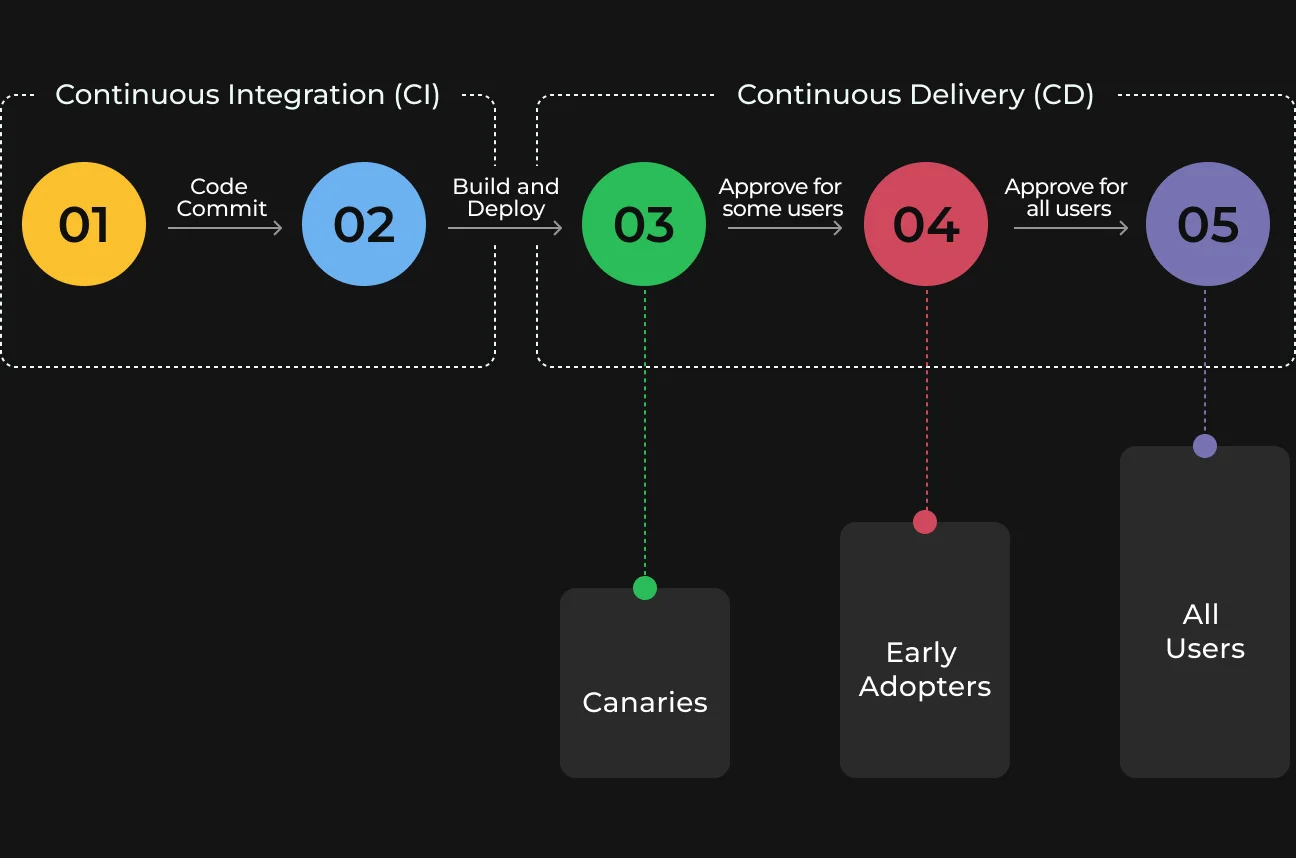
Changes to CDN configuration should never be applied directly to production. Prime examples are new routing rules or WAF policies. Best practices recommend using a staging environment to test configurations.
Advanced teams also use canary rollouts. You need to apply new CDN settings to only 1% of global traffic. This allows you to verify performance before you deploy at scale.
Evaluating Geographic Footprint
CDN technology should be selected based on where the target audience is. Dont select based on the total number of PoPs. You should conduct geographical performance testing to ensure the provider has strong peering with the local ISPs (eyeball networks) used by their customers.
This is especially important for reaching regions with complex network landscapes, such as the Middle East and Southeast Asia.
Origin Shielding and Tiered Caching
For applications with high global traffic, an Origin Shield acts as a parent cache. It sits between the edge PoPs and the origin.
This minimizes the thundering herd problem, where a cache miss in hundreds of global locations results in hundreds of simultaneous requests hitting the origin server.
How to Integrate a CDN into Your Website and Platform
CDN integration requires a systematic approach to ensure that performance gains are realized without introducing CDN security vulnerabilities.
Step | Task | Description |
| 1 | Audit Assets | Identify which resources are static (long TTL) and which are dynamic (short/no TTL). |
| 2 | Select Provider | Match provider footprint to user geography and budget (see Cost Sheet). |
| 3 | Configure DNS | Update CNAME records to point to the CDN’s provided hostname. |
| 4 | Set Cache Rules | Implement Cache-Control and Surrogate-Control headers at the origin. |
| 5 | Enable SSL | Provision certificates on the CDN and ensure the origin supports the chosen encryption mode. |
| 6 | Activate Security | Enable WAF, DDoS protection, and bot mitigation rules. |
| 7 | Test & Purge | Verify delivery in an incognito window and test manual purge functionality. |
How Much Does a Content Delivery Network Cost
CDN pricing is complex and varies by region, volume, and service level. For high-volume users, per-GB rates can drop significantly, but additional fees for requests, security rules, and real-time logs can add up. The numbers below are approximate and can be different for your business case.
Provider | North America/Europe (per GB) | Asia-Pacific (per GB) | Key Philosophy |
| Cloudflare CDN | $0.00 (Unmetered) | $0.00 (Unmetered) | Bundled into monthly plans ($20-$200+). |
| AWS CloudFront | $0.085 | $0.120 - $0.140 | Pay-as-you-go; free egress from AWS. |
| Akamai | $0.035 - $0.049 | Custom/Negotiated | Custom enterprise contracts; annual terms. |
| Azure CDN | $0.081 | $0.129 - $0.233 | Volume-based tiers for Microsoft ecosystem. |
| CDNsun | $0.030 | $0.060 | Pure pay-as-you-go; no monthly minimums. |
| BlazingCDN | $0.001 - $0.005 | $0.001 - $0.005 | Focus on static workloads. |
Integration and implementation costs from developers may vary significantly based on the existing tech stack and complexity. SapientPro can provide a detailed consultation to help forecast these investments.
Future of CDN Technology and Global Distribution
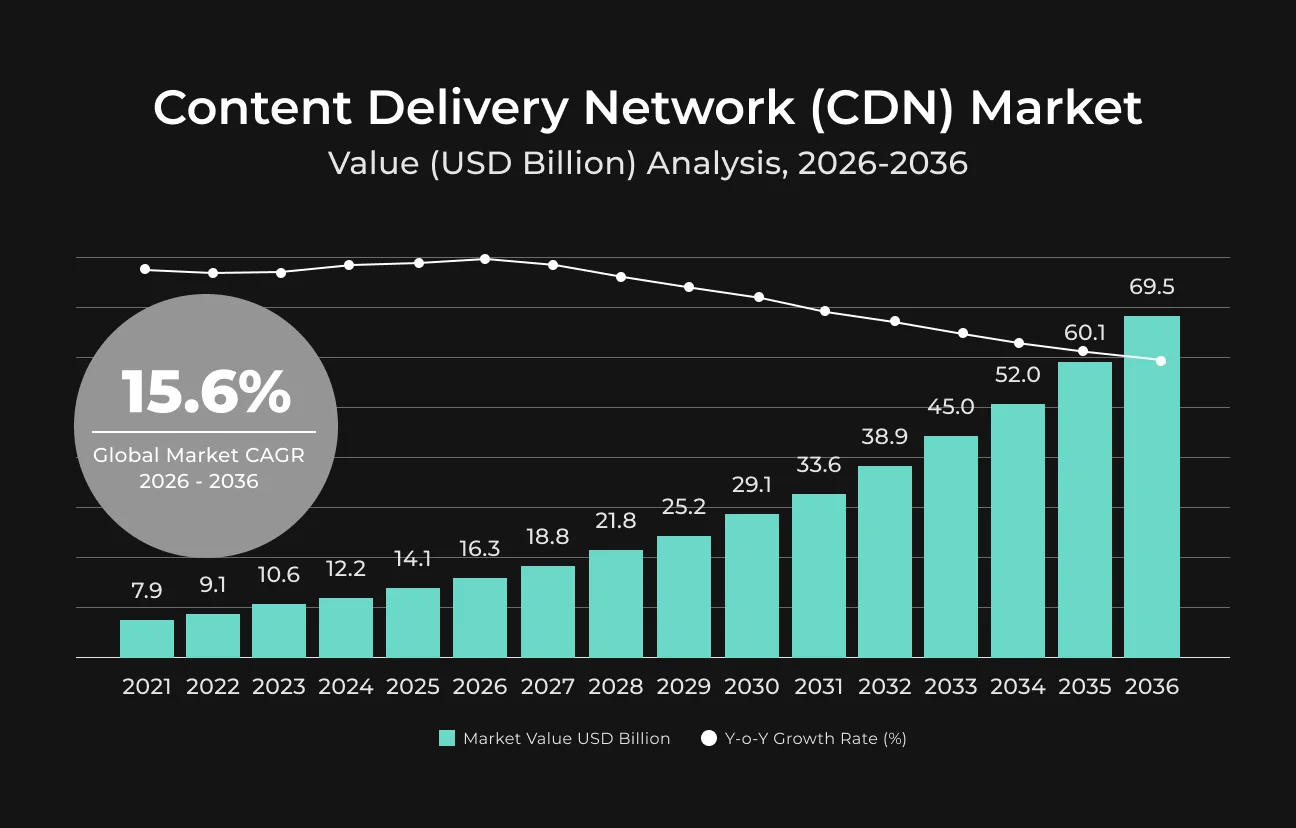
By 2036, the global edge data center market is projected to reach $69.5 billion. It grows at a 15.6% CAGR. We also see the explosion of IoT devices that is projected to reach 40 billion by 2030.
5G greatly impacts this growth and this is why CDNs are evolving into "Edge-as-a-Service" platforms.
Real-time AI inference at the edge will become standard. By 2029, at least 60% of edge computing deployments will use composite AI (both predictive and generative AI), compared to less than 5% in 2023. So, you need to be prepared to all these changes and SapientPro is ready to help you.
How SapientPro Secured €6M Funding for Contentoo
Our partnership with Contentoo, which began in 2018, is a benchmark for how high-performance architecture directly enables financial growth.
The technical foundation allowed for 30% year-over-year profit growth, while the platform’s user base expanded to over 3,000 active users. Key platform benefits included:
- Operational efficiency. Automated financial reporting and payment logic eliminated the need for manual payouts. We reduced administrative overhead as the platform scaled.
- Advanced quality control. A custom-built freelancer evaluation system ensured that only top-tier professionals could join the platform. This maintained high quality as the network grew.
- Interactive collaboration. The development of a lightweight PDF annotation tool allowed for real-time, in-document feedback. We accelerated the production cycle for global clients.
- Investment readiness. We delivered a high-performance MVP with a clear roadmap for scaling. SapientPro provided the technical credibility needed to attract venture capital.
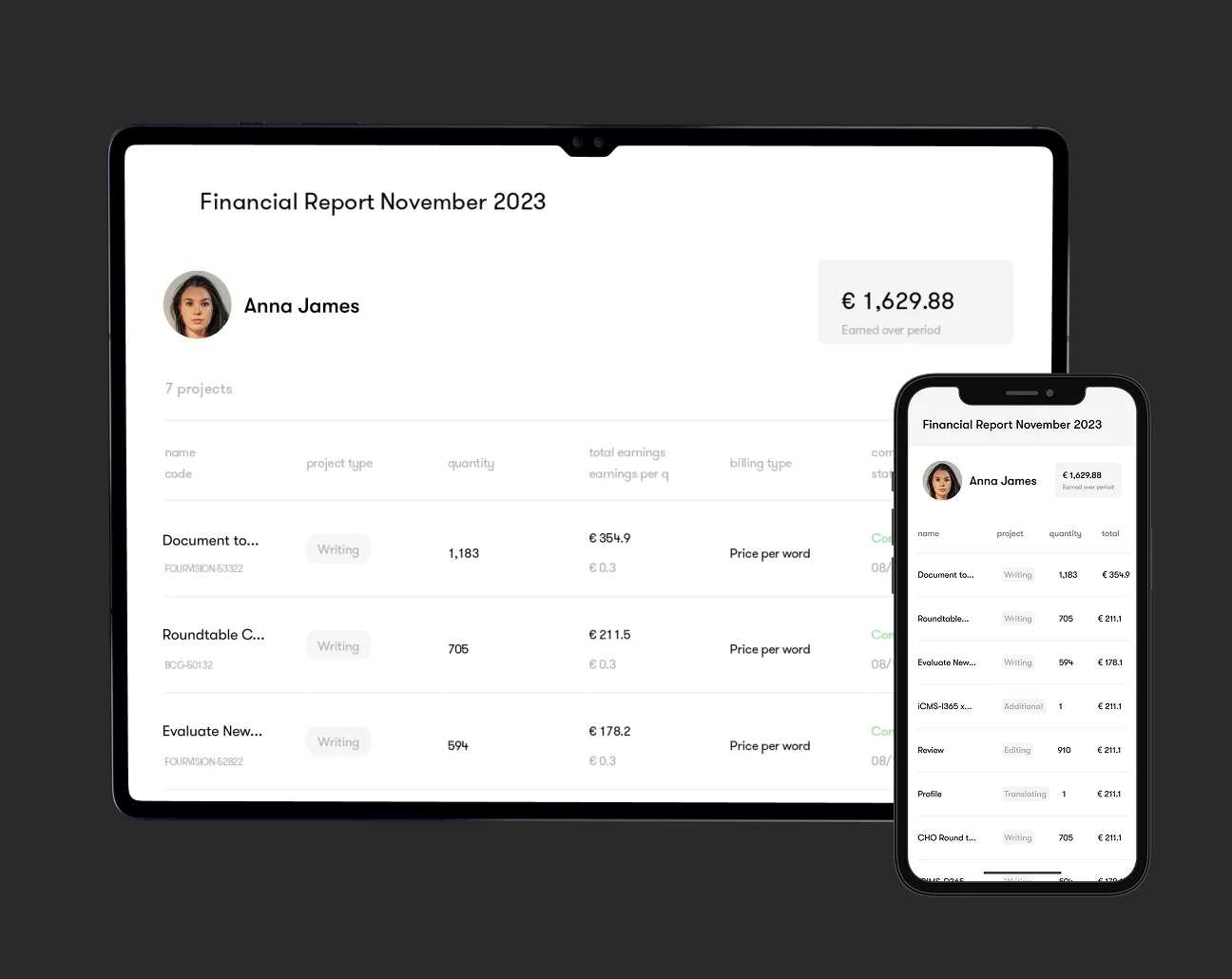
By building a scalable content marketing platform with a modular architecture, SapientPro was instrumental in securing €6M in investment funding for Contentoo.
Partner with SapientPro for CDN Integration Services
SapientPro was founded in 2017, and today our team comprises 70+ seasoned developers and engineers. With a consistent 5/5 rating on Clutch, we have delivered 200+ projects, helping businesses launch innovative products.
We focus on top architecture solutions for high-load and Big Data projects, specializing in building systems that remain stable during business expansion.
Our capabilities span the full AI lifecycle. We help with feasibility analysis, RAG-based data processing, development of custom LLM chains, predictive analytics, and more.
Our strong record of shortening delivery cycles proves our deep expertise in multiple domains. We can reduce PoC timelines from 200–500 hours to just 40–60 hours by using our library of pre-built AI components. Explore our case studies:
- AI-Assisted Service for Produce Quality Automation
- AI Solution for Efficient CV Processing at Scale
- Dialect-Sensitive AI Voice Assistant
Suppose you are looking for a partner to refactor legacy systems for better performance, implement a complex multi-CDN strategy, integrate cutting-edge AI-driven caching, or anything else.
SapientPro is a great partner for strengthening your business.
Get in touch with our team to start your project.
Build Your CDN with SapientPro
Describe your project and get a detailed estimate for your idea.

FAQ
What does a CDN actually do in simple terms?
A Content Delivery Network (CDN) distributes website content across multiple global servers to deliver it from the closest location to the user.
This reduces latency, improves load speed, and ensures higher availability. Instead of relying on a single origin server, CDNs cache and serve assets like images, scripts, and videos from edge locations .
Is a CDN necessary for small or medium-sized businesses?
Yes, even SMBs benefit from CDN integration. It improves website speed, enhances user experience, and supports traffic spikes without infrastructure upgrades.
Faster load times can directly impact conversions and SEO rankings, making CDNs a cost-effective solution for growth-focused businesses operating in competitive digital environments .
How does a CDN improve website security?
A CDN adds a protective layer between users and the origin server. It helps mitigate DDoS attacks by absorbing malicious traffic at the edge and includes built-in tools like Web Application Firewalls (WAF).
These systems analyze behavior patterns to block threats, ensuring data protection and uninterrupted service availability.

