All How AI Data Analytics Transforms Research and Decision-Making
February 20, 202615 min read


AI data analysis boosts research and decision-making. Old-school dashboards are starting to feel so last-century for businesses that are prepared to adopt AI solutions. This ability lets them sort through a large amount of information and make accurate decisions. When talking about data-smart companies, 64% say AI makes them better at innovation.
Moving to AI frees businesses from having to perform the analysis itself, which means there’s more time for strategic work and brainstorming new ideas. Forty-three percent of marketers are already using AI to automate their monotonous and repetitive tasks.
SapientPro's experts provide a comprehensive guide that explores AI data analytics and its impact on industries and businesses of all sizes.
What is Artificial Intelligence Data Analytics?
AI data analytics increases how easily companies evaluate their performance by using machine learning, natural language processing, and data management. Its function is identical to that of conventional analytics — it detects patterns, predicts trends, and delivers insight.
But AI data analysis uses advanced machine learning to quickly sift through tons of data. This makes preparing, analyzing, and visualizing data much simpler. This method automates several things, including the data preparation, cleaning, and modeling (which would otherwise take time).
When the data is ready, the AI system assists in making visual reports of what was found — and can even recommend actions to take.
Since AI can analyze and handle vast amounts of data simultaneously, it can explore numerous combinations influenced by this data and identify relationships among them. So analysts can ask questions about the data without having to deal with complex analysis processes.
How to Use AI in Data Analytics: The Trend for 2026
AI is no longer some far-off dream. It’s already part of the systems, decisions, and strategies that define business today. And still, many leaders undervalue its speed and subtlety.
You just need to keep pace with these rapid changes happening in real time. In 2026, 40% of enterprise applications will include virtual assistants or chatbots designed as custom components over the next four years.
Deloitte estimates that up to 75% of organizations will invest in agentic AI. There could be an explosion of spending on autonomous AI agents across SaaS platforms. We expect SaaS apps to be smarter, more personal, adaptive, and self-sufficient. Agentic AI could gradually displace many of the SaaS tools we use today.

By 2027, for the first time in nearly 35 years, generative AI and AI agents will significantly disrupt mainstream productivity tools, causing a market shift of approximately $58 billion.
AI is what now helps stay ahead of the game and facilitates data analysis. As businesses adopt more AI solutions, they can fully harness data, automate tasks, innovate quickly, and offer more value to customers.
AI Analytics vs. Traditional Analytics
Before AI and machine learning were popular, businesses relied on traditional analytics for their intelligence. That was like the old-school detective work of checking past data with rigid dashboards and KPIs — just reports based on known rules. This process often needed a human to make sense of it all.
Traditional analytics is still great for monitoring data or preventing surprises, but it has its limits. It actually struggles when there's an overwhelming amount of data or rapid market shifts.
To make the most of your data analysis, it's crucial to grasp how it differs from AI analytics.
| Traditional Analytics | AI Analytics | |
| Data processing speed | Takes baby steps with manual processes and basic tools for tasks like collecting and cleaning data. It's often slow and prone to errors with large datasets. | Uses machine learning and advanced computing, automating tasks for quick and insightful results. |
| Predictive capabilities | Relies on basic stats and past data, often missing complex patterns and proactive strategies. | Leverages advanced algorithms to spot intricate data connections. |
| Scalability | Struggles to keep up with growing data, wasting resources and effort. | Effortlessly scalable, managing big data volumes and adjusting to business needs with little human effort. |
Machine learning and generative AI for data analytics supplements it at every stage:
- Data preparation. ML algorithms clean data by fixing errors, inconsistencies, and outliers from the data to make it usable;
- Analysis. These sophisticated algorithms can pinpoint patterns and trends that allow businesses to catch new opportunities;
- Visualization. How you present data is equally important for making complex analytics useful. Unlike conventional means, AI-driven visualization delivers interactive dashboards that evolve with the data.
AI analytics just does a better job of being faster, more accurate, capable of predicting, and scaling up. With its help, businesses can get higher estimates and take the lead in their industries.
Types of AI Tools for Data Analysis
As data analysis changes, AI tools are leading the way. They are powerful and customizable solutions for multiple analytical requirements. Here are some of the latest AI tools being used for data analysis.
Data Platforms with Built-in AI Assistants
Imagine a next-level data platform that’s not merely another storage rack. Today’s data platforms are augmented with AI assistants complete with natural language processing. This allows you to have conversations with them like with humans.
With the help of AI, such systems can illuminate trends and anomalous patterns you might overlook otherwise, and you don’t need to have a scientist’s understanding of them.
Business Intelligence and Reporting Copilots
Static reports and dashboards are a thing of the past. Business Intelligence (BI) copilots, powered by AI, are changing the game. They provide useful recommendations that essentially make the traditional BI tools dynamic and on-the-go.
Users can experiment with different scenarios, forecast results, and decide how to proceed.
ML Platforms and AutoML for Predictive Analytics
Machine learning platforms, especially those including AutoML capabilities, simplify the complex process of selecting and training models as well as validation.
Automated machine learning tools automatically tune models by testing out different algorithms and settings to find the best match without manual effort. This enables organizations to accurately predict and better position themselves for future challenges.
Research and Qualitative Analysis Tools
In qualitative data-driven research environments, AI tools are valuable. They can understand, internally represent, and analyze language on a deep level.
This means they can also think about fine-grained aspects of both human behavior and language. Scientists can reach optimal decisions and adapt tactics according to audience sentiment.
How to Use AI for Data Analysis Across the Research Lifecycle
AI is embedded at each step, from data gathering to decision-making. This empowers developers to make improvements for both accuracy and efficiency at every step.
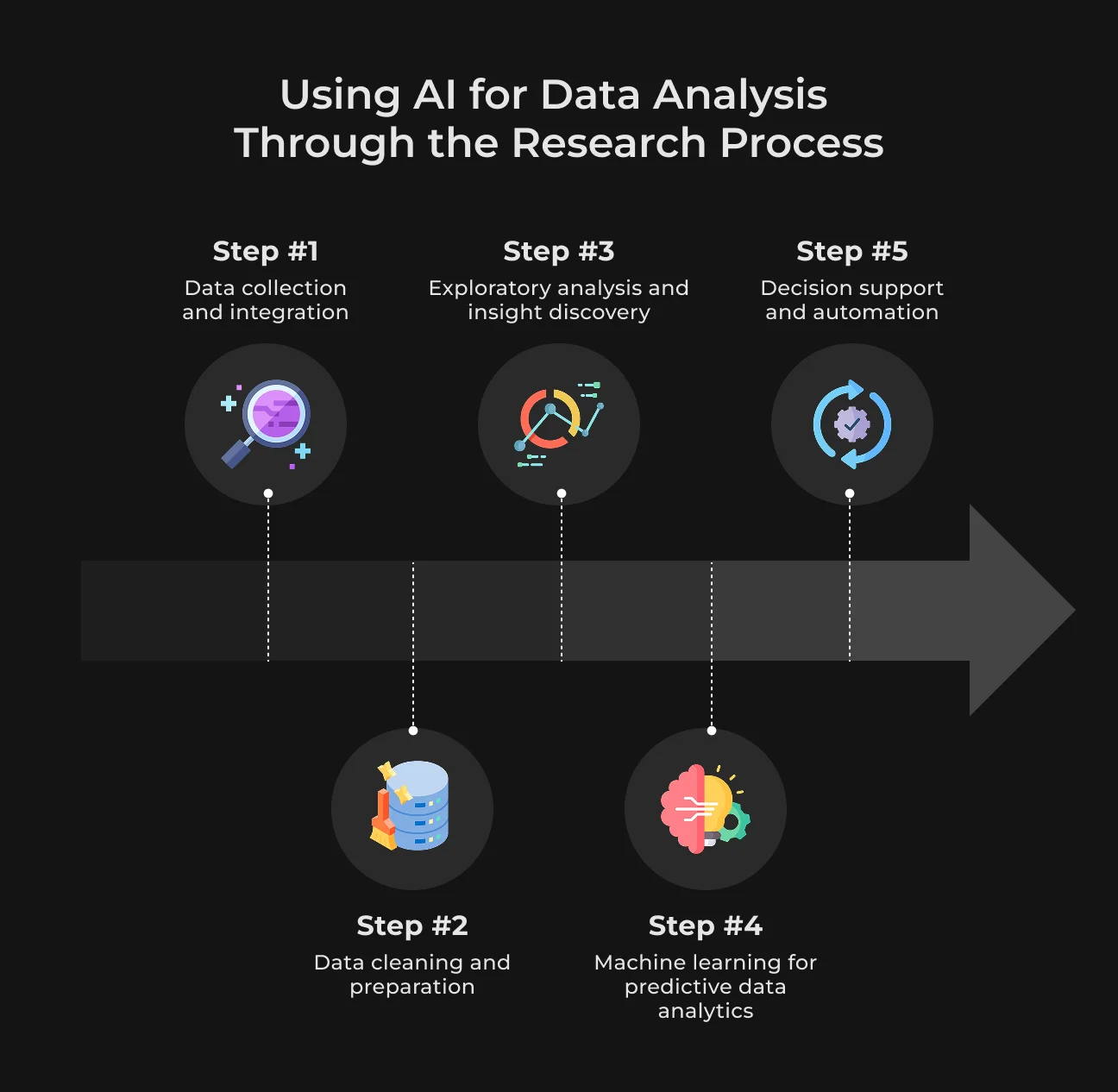
Data Collection and Integration
The beginning of any analysis is collecting data, and this is where AI automates the process. It gathers data from multiple channels and sorts it into the appropriate categories with little manual input.
AI also monitors changes in data structure and alerts users to maintain consistent and accurate data integration.
Data Cleaning and Preparation
Once we have data, it must be prepared for viewing. AI does the work of boring repetition for us. AI tools recommend how to structure the data according to your analysis goals.
These tools can identify outliers that could potentially influence the results, helping you resolve any problems sooner rather than later. What’s more, AI provides smart strategies for dealing with missing data, which helps ensure that your data is reliable and valid.
Exploratory Analysis and Insight Discovery
Exploratory data analysis is raw data analysis that discovers patterns and insights, preferably with AI-based exploratory tools. With natural language questions (NLQ), researchers can ask questions in human language, and easily browse through the data.
AI can produce clear summaries and express key insights, highlighting differences and trends. This leads to faster testing and validation of ideas.
Machine Learning for Predictive Data Analytics
When the analysis goal is to make predictions, AI-based machine learning models are necessary. These algorithms enable analysts to predict demand, anticipate customer churn, evaluate risks, and capacity plan.
AI is effective because it’s fed past data and just gets better. And if you want more on machine learning, take a look at SapientPro's guide on the top programming languages to get started.
Decision Support and Automation
The last is to turn thoughts into actions. AI systems actually help move from analyzing data to acting on it.
For example, an AI system might issue an alert to the sales team about a model’s prediction of increased demand. Or it can suggest operational changes to lower risks after processing its predictions.
These elements lead to rapid, strategy-driven decisions that boost the effectiveness of the analytics.
How AI Supports Research Workflow
Learn about how to leverage AI for your research, from literature reviews to qualitative and quantitative analysis.
Qualitative Research
AI typically won't take long to correct any transcription mistakes, so there's no need for much manual editing. This is known as theme detection, and AI can play a role here by detecting patterns across large datasets.
It also indicates the coding of labels for data segments to enhance the speed and reliability of analysis. AI can generate summary tables that point to the original data, which guarantees interpretability based on evidence.
Quantitative Research
Quantitative research has been essential for years in making intelligent decisions. Its targeted, verified numbers help brands explore markets, vet ideas, and minimize risks. The main challenge in quantitative research, though, is the changing environment, not its effectiveness (despite shrinking timelines and rising expectations).
AI technology helps augment existing approaches but not replace them. By simplifying the process and extending what can be done with data, AI allows brands to derive even more value from the research they rely on.
For example, when researchers test out a hypothesis, AI can advise how to set up the tests based on data and research questions.
Old methods would entail hours of manually sifting databases and cataloguing references. AI tools are making this easier, automatically analyzing research texts, sourcing relevant references, and managing citations.
They come with sophisticated search filters and can sometimes get you free access to academic papers behind paywalls.
AI also compares research on related topics to find differing results or methods. It structures the data, which allows researchers to access the information necessary to generate new knowledge.
Use Cases of AI in Data Analytics
Check out how AI data analysis transforms diverse industries, from retail to healthcare, and the benefits they gain from it.
AI Retail Data Analytics
The overflow of information is causing retailers to drown (as we see this with customer interactions, supply chain events, or digital touchpoints).
This information is drawn from many places, including new digital platforms and various media formats. The issue is that the data is often in silos, so it’s difficult to extract valuable insights and make better demand forecasts.
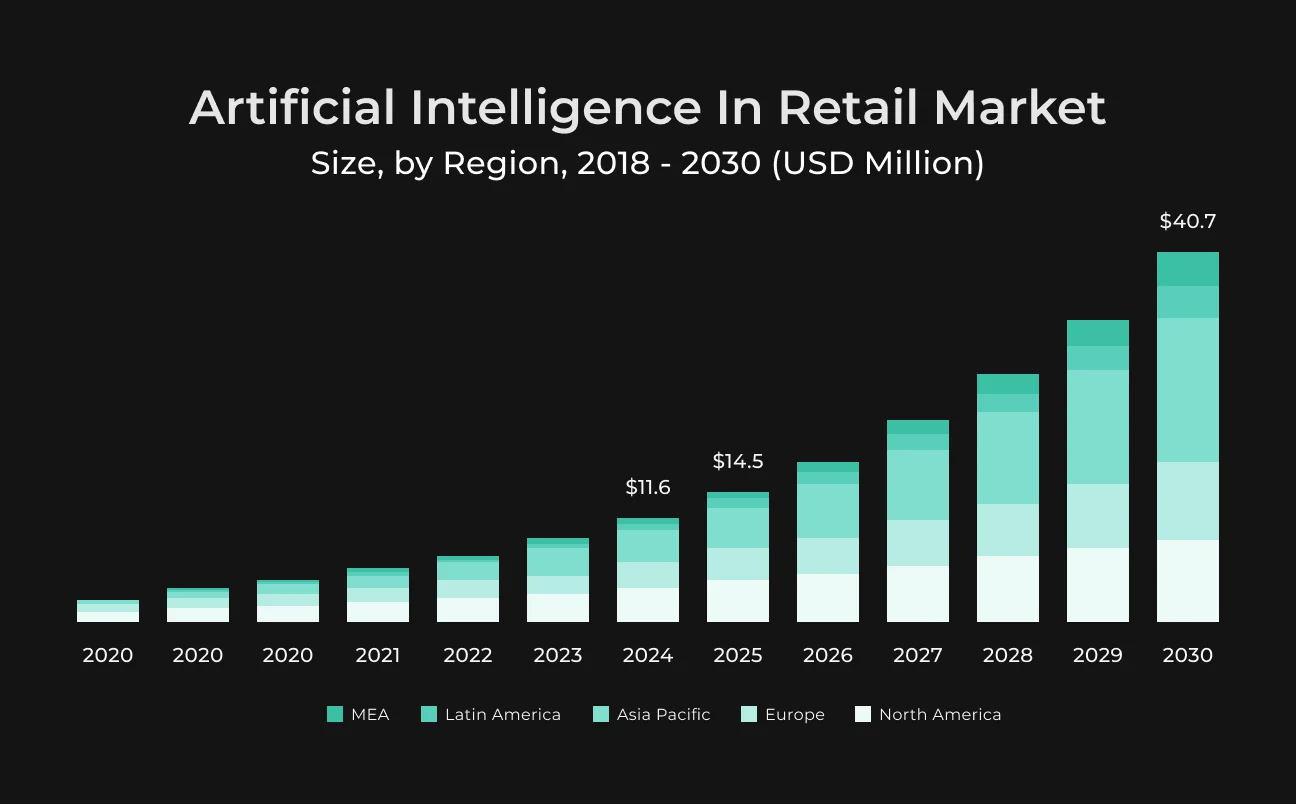
To maintain customer loyalty, there should be quick local assortment planning. Companies that have more than one sales channel can effectively broaden their product offerings with the help of AI retail data analytics. This enables them to give customers more of what they want, driving sales and customer satisfaction.
AI Healthcare and Patient Analytics
AI can build a 360-degree risk profile of each patient by combining their genomic data with the readings from radiology, lab tests, and what are sometimes called social determinants of health. This warns physicians about possible issues, particularly for vulnerable populations. Now they can respond sooner and prevent symptoms from getting worse.
AI’s potential success in healthcare is clear to many nations. For example, Luxembourg is making AI in healthcare a top priority in its digital strategy, along with cybersecurity and regulation for safe use.
AI Finance Analytics
AI is revolutionizing finance, bringing increased fraud detection, risk management, and personalized services. It allows banks to easily spot fraud by analyzing transaction patterns for enhanced security and reduced losses.
Under risk management, AI can forecast market trends and determine credit risks for better decision support.
In the financial sector, AI is held to high standards and therefore must follow strict privacy and integrity regulations. For example, in the United States, the Dodd-Frank Act requires banks to reduce financial risks. In the EU, there is MiFID II, which provides for more transparency along with an increased level of investor protection.
For additional insights, check out SapientPro's guide on AI in finance.
AI Analytics in Travel
AI is not just improving the travel experience. It allows travel businesses (agencies, airlines, and hotels) automate routine operations, predict outcomes, and create personalized marketing.
Smart tourism is also based on big data. Searches, bookings, and social media tell us a lot about how people travel. With such data in hand, tourism businesses can figure out what customers like and predict demand. So they can target their promotions.
AI Analytics in Education
Schools and universities apply AI to analyze student performance, identify at-risk students, monitor learning progress, and enhance curriculum delivery.
Also, many schools have already included AI-generated chatbots. They help students with questions regarding admissions, classes, or student services.
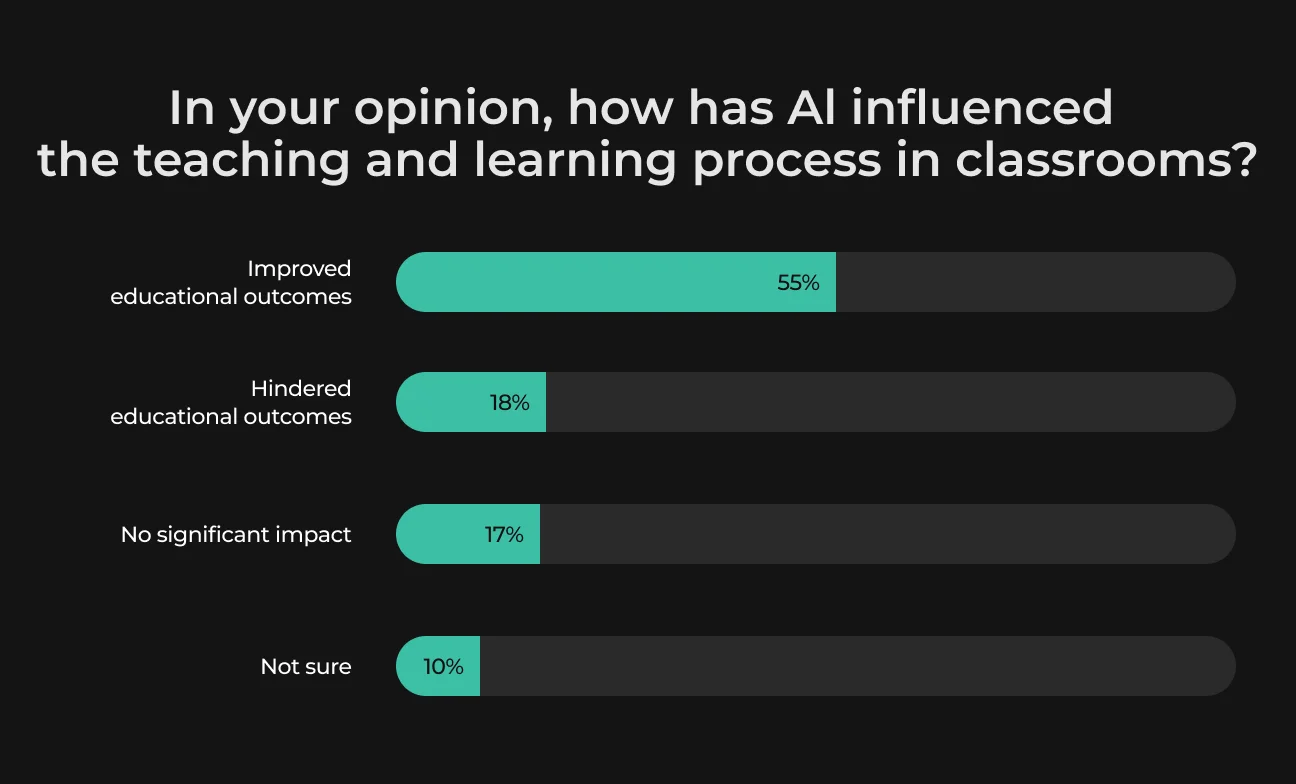
More than half the teachers surveyed said they believe AI analytics positively influences learning, while less than 20% indicated a negative effect.
Challenges and Risks of AI Data Analysis Software
The prospects of AI data analysis have never seemed so promising. But it also poses certain challenges to data analytics. That means if you embrace the technology, you need to do so consciously.
Hallucinations and Unreliable Explanations
AI hallucinations happen when large language models generate incorrect or made-up information and present it as true. Unlike human hallucinations, which involve seeing or hearing things that aren't there, AI hallucinations are about producing false responses.
You can explore how observability prevents AI hallucinations in this article on AI observability.
Data Privacy and Security Threats
Many AI technologies now gather and process personal data without explaining what it will be used for. This can invade people's privacy, with their sensitive information used or circulated without their consent.
Apart from the ethical perspective, companies should beware of legal wildfire, as regulations like GDPR are only getting tighter on data privacy.
Bias, Drift, and Model Decay
Data drift is the term that describes the behavior of input data using a machine learning model. When the data used to train machine learning models changes and no longer reflects the current situation, the model's performance gets worse.
For example, data drift could happen when customer behavior and preferences change because of the underlying economy. When the economy is strong, individuals tend to spend more freely on items for themselves. But when the economy goes down, generally, people cut their spending.
For techniques on how to monitor and address concept drift, see this comprehensive guide.
Governance Essentials to Follow
Knowing how to use AI in a legal, ethical, and effective way is crucial. Here are some key practices:
- Human-in-the-loop. Incorporate human judgment in decisions to approve AI actions;
- Audit trails. Record decision-making and AI processes for transparency and accountability;
- Test suites. Periodically evaluate AI models on different datasets;
- Approval flows. You need rational approval flows with the right people in place before you roll out AI;
- Policy alignment. Make sure that your AI approaches and activities are compliant with both organizational and industry regulations and ethics.
Governance and Risk Management Checklist
This checklist can help you address AI data analysis challenges and build an ethical and effective system.
| ✔️ Apply AI data analytics tools to keep everything on track. |
| ✔️ Safeguard sensitive information with encryption and strict access controls. |
| ✔️ Regularly check for bias, drift, or model deterioration. |
| ✔️ Involve humans in important decisions. |
| ✔️ Record everything for transparency. |
| ✔️ Regularly test models with a variety of data. |
| ✔️ Set up approval processes for AI deployment. |
| ✔️ Make sure AI tasks comply with current policies and laws. |
Will AI Take Over Data Analytics?
The idea of AI replacing data analytics altogether is a complex one. AI actually excels at automating things, like searching rapidly through vast quantities of data and identifying patterns and anomalies.
It is also a very quick and accurate tool to do data cleaning, normalization, and initial exploration. Data-driven machine learning algorithms can be processed much quicker than humans can do that, providing insight in seconds, not days or weeks. AI also automates report building for efficiency.
What Still Needs People?
Although AI is great at processing big data, the nuances and situational analytics are still decided by human intuition and knowledge. It’s in interpreting complex data patterns, advising a strategy, and using domain knowledge where human input remains vital.
Decisions based on context around the data or ethical considerations for using AI systems also require a human perspective.
Benefit From Both
We can achieve an ideal balance between the power of technology and what data analysts can do. It will be AI that churns through both simple and complex work, while analysts can concentrate on working out their strategic plans.
This kind of collaboration enhances productivity, sparks innovation, and solves very difficult situations in ways artificial intelligence or a human specialist alone never could.
Case Study: Front-End Development for a Data Insights Platform
SapientPro created the frontend for Big Data Chef. It's a platform that brings together business data from different sources and shows it through dynamic dashboards, infographics, and reports using Microsoft Power BI.
Our team added these key features to Big Data Chef:
- All-in-one data gathering connects with ERP systems, accounting software, CRMs, and e-commerce platforms to bring all your business data together;
- Unified data reporting mixes and organizes data to create detailed reports that show what's happening across departments and tools;
- Visual dashboards let you use charts and graphs to create infographics and reports.
We also introduced a single sign-on with the Azure Active Directory service, connecting Big Data Chef to Microsoft accounts. This allows Power BI widgets to be embedded using the official API, which provides secure access and identity management.
Partner with SapientPro to Implement AI into Your Workflow
Implement artificial intelligence in your operational strategies easily with SapientPro. With more than 9 years of experience in crafting breakthrough AI applications, we drive smarter business process automation for our clients.
We help turn messy data into neat, organized formats. Our trusty solutions for documents, images, and voice ensure accuracy and can grow with your business.
Discover how SapientPro can empower your company with agile and intelligent AI capabilities.
Implement AI in Your Product Today