All Why Ignoring Unstructured Data is Costing You Millions and How to Fix This
April 9, 202615 min read


Data is a modern enterprise's most valuable strategic asset. Yet for most leaders, it remains frozen. While boards fixate on financial spreadsheets, the exponential growth of unstructured data is overwhelming corporate infrastructure.
SapientPro’s engineers explain the various types of unstructured data and provide a detailed guide on how to manage it. Read on for more!
Key Takeaways
- Unstructured data (emails, videos, and files) has become 80% to 90% of all business data, increasing by an average annual rate of 55% to 65%;
- While structured data speaks of the transactional outcome (SQL, spreadsheets), unstructured data speaks of the "why";
- Using the structured data alone means basing a strategy on 20% of the data;
- An astonishing 95% of enterprise-level AIs flunk the test of returning their investment by simply being unable to tap and make sense out of the “Swamp” data that is needed for context;
- The conventional RDBMS systems are getting integrated with the unstructured data application ecosystems of Object Storage or Data Lakes, Vector Databases for semantic search capabilities, and Intelligent Document Processing for making the unstructured data structured;
- Custom engineering solutions provided by SapientPro have shown immense influence.
What is Unstructured Data: Definition
In the simplest terms, unstructured data is information that lacks a pre-defined data model or schema. It is the "wild west" of the digital ecosystem as it doesn't fit into the orderly rows and columns of traditional relational databases (RDBMS).
While this data often has internal logic (like the grammar of a sentence or the pixels in an image), it is not natively intelligible to SQL-based tools without intermediate processing.
Most business intelligence is trapped in these formats. Use the table below to identify unstructured data examples that may currently be "unqueryable" in your company:
Category | Examples | Key Insights |
| Textual (Communications) | Email bodies, Slack/Teams transcripts, Chat logs. | Sentiment, intent, and negotiation nuance. |
| Business Documents | PDFs, Contracts, Invoices, Whitepapers, PPTX. | The "system of record" for corporate agreements. |
| Social & Web | LinkedIn posts, Tweets, Product reviews, Blog comments. | Brand reputation and volatile market trends. |
| Imagery | Medical X-rays (DICOM), Satellite imagery, QC photos. | Complex visual patterns and logistics data. |
| Audio & Video | Call center recordings, Webinars, Drone footage. | "Voice of the Customer" and training assets. |
| Sensor & Machine | Raw vibration logs, thermal imagery, IoT signal noise. | Industrial health and predictive maintenance. |
This list serves as a checklist for you to identify potential blind spots in your current data architecture.
State of Unstartured Data Problem
Ignoring unstructured data is a growing operational tax.
As the volume of digital noise increases, the gap between companies that can "read" this data and those that can't is becoming a defining competitive divide. Let’s see the key stats in this industry:
- Market intelligence indicates that unstructured data accounts for between 80% and 90% of all data generated by enterprises today;
- Unstructured data is growing at an annual rate of 55% to 65%;
- Already the global datasphere is projected to encompass over 180 zettabytes, the vast majority of which is unstructured;
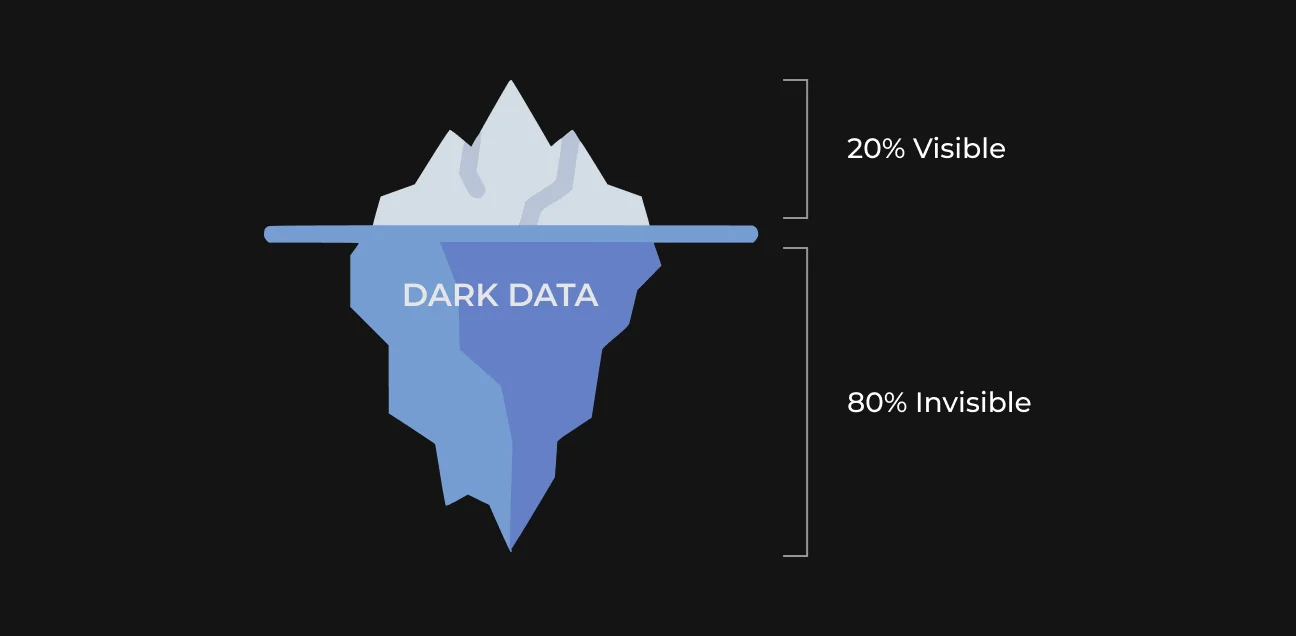
- If decision-making processes are based solely on structured data, leadership is effectively navigating the marketplace using only 10% to 20% of the available intelligence;
- 95% of enterprise AI projects are currently failing to deliver measurable ROI, a failure rate largely attributed to the inability to provide clean, curated unstructured contexts to the models.
In short, most organizations are attempting to run a 21st-century business while looking at only 10% of the map. Without a strategy to use unstructured data, your AI investments are likely to stall and your market visibility will remain dangerously limited.
Structured, Semi-Structured, and Unstructured Data
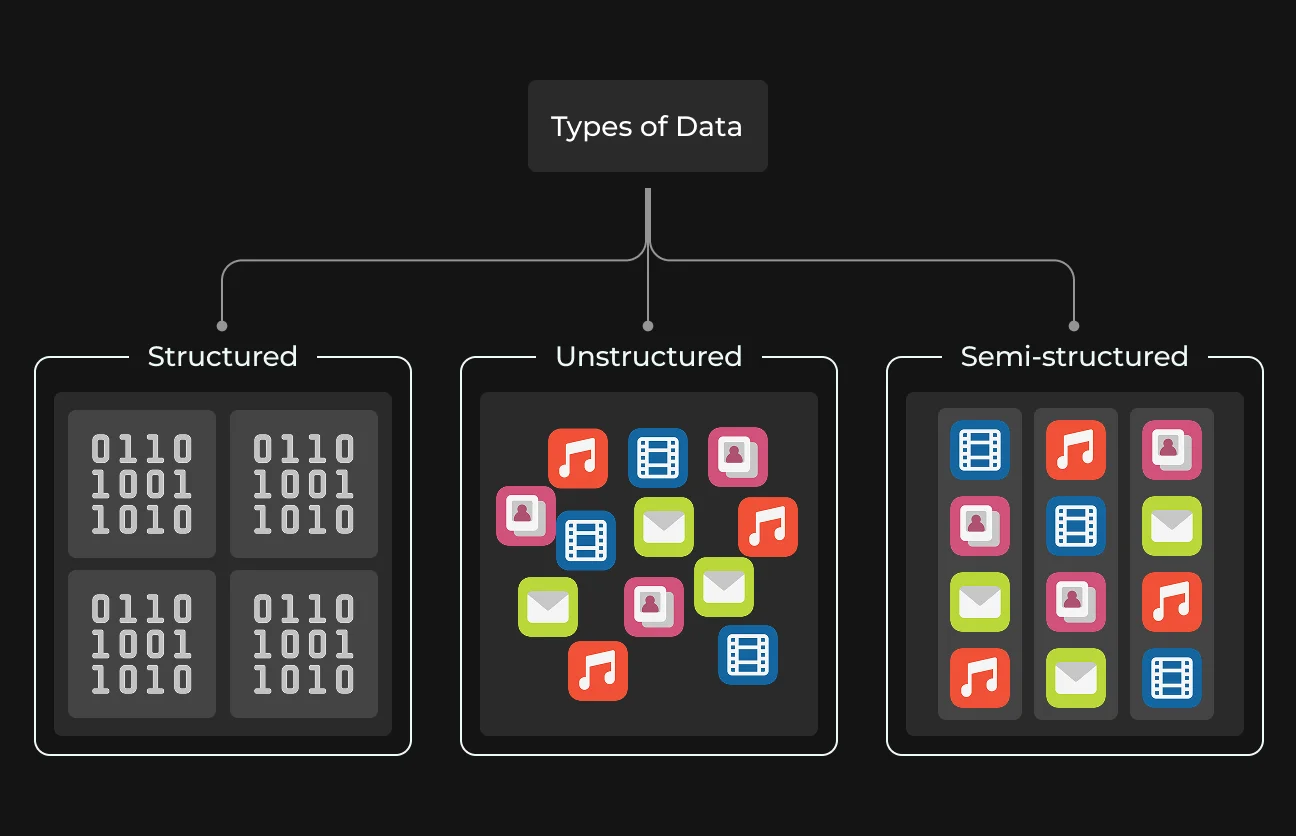
You need to understand the difference between structured and unstructured data. The interplay between these structured, semi-structured, and unstructured data types defines the complexity of the modern data stack.
Structured Data
Structured data is the bedrock of legacy IT. It is highly organized, strictly formatted, and resides in relational databases (RDBMS) like Oracle, SQL Server, or PostgreSQL. Think of it as a perfectly organized spreadsheet where every cell has a purpose.
Pros:
- Extremely fast to query;
- High data integrity (ACID compliance);
- Easy to secure.
Cons:
- Rigid and difficult to change;
- Adding a new attribute requires a schema migration that can take down a system.
Use cases here are financial transactions, inventory counts, airline reservations, etc.
Semi-Structured Data
Semi-structured data doesn't live in a fixed table, but it isn't total chaos. It uses internal tags or markers (like JSON or XML) to separate data elements and enforce hierarchies.
Pros:
- Flexible, evolving data schema;
- Portable web standard formats;
- Supports nested, complex hierarchies.
Cons:
- Queries require specialized tools;
- Inconsistent data quality risks;
- Storage overheads are higher.
Use cases here include web application data exchange, IoT sensor readings, log files, user profiles, etc.
Unstructured Data
Unstructured data has no pre-defined model and is typically stored as "objects" or "blobs" (Binary Large Objects) in a Data Lake. This is where the "silent, chaotic" growth mentioned earlier lives.
Pros:
- Infinite flexibility as it can store anything;
- Fast ingestion as no schema validation is needed.
Cons:
- Difficult to search and analyze without advanced processing.
Use cases here include media storage, document archives, data lakes for machine learning, etc.
Feature | Structured Data | Semi-Structured Data | Unstructured Data |
| Data Model | Pre-defined, rigid Schema (Rows/Columns) | Self-describing, flexible Schema (Tags/Keys) | No pre-defined Schema (Raw files) |
| Storage Technology | RDBMS (SQL, Oracle) | NoSQL (MongoDB), XML DB | Data Lakes, Object Storage (S3, Blob) |
| Scalability | Vertical (Scale Up) - difficult to scale massively. | Horizontal (Scale Out) - moderate scalability. | Horizontal (Scale Out) - massive scalability. |
| Query Language | SQL (Structured Query Language) | JSON Path, XQuery, NoSQL APIs | NLP, Computer Vision, Semantic Search |
| Searchability | High (Exact match) | Moderate (Key-value lookup) | Low (Requires processing/indexing) |
| Volume Share | 10-20% | Variable (often grouped with Unstructured) | 80-90% |
| Human Readability | High (in tables) | Moderate (requires parsing) | Variable (Text is readable; Binary is not) |
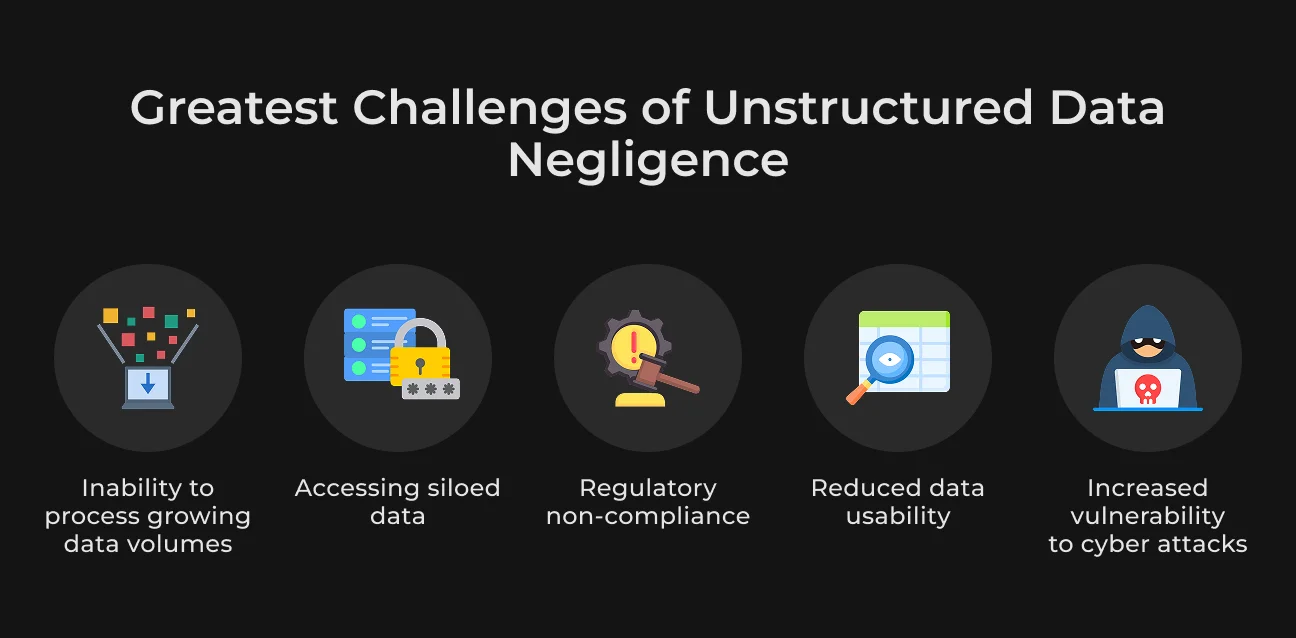
Greatest Challenges of Unstructured Data Negligence
The failure to implement unstructured data software and strategies is a strategic vulnerability. Negligence in processing unstructured data creates a cascade of operational risks that can paralyze your business.
Integration Issues
The primary technical barrier to operating on unstructured data is integration. 43% of organizations cite compatibility issues between legacy systems and modern data tools as their top challenge.
Without a unified strategy, unstructured data accumulates in disconnected silos:
- Marketing holds the social data;
- Legal holds the contracts;
- Sales holds the call logs.
When these streams are dumped into a Data Lake without governance (ETL), the lake becomes a "swamp". It becomes a murky repository where data is irretrievable and unusable.
Generative AI and LLMs require holistic access to enterprise knowledge to function effectively. If data is trapped in silos, the AI cannot "see" the full picture.
It is incapable of answering complex queries like "Correlate the rise in customer complaints in Q3 with the changes in the vendor contracts from Q2". This technical debt makes deploying advanced AI impossible.
Compliance Issues
Unstructured data is the primary vector for compliance breaches. GDPR, CCPA, and HIPAA demand that organizations know exactly what Personally Identifiable Information (PII) they possess and where it is located.
At the same time, we have the search problem. If a customer demands their "Right to be Forgotten", deleting their record from a structured SQL database is trivial.
However, locating every mention of their name across millions of emails, scanned PDF applications, and call transcripts is a monumental challenge without advanced indexing.
The history of data breaches is littered with unstructured data failures. The Yahoo breach (3 billion records) and the exposure of government data in the CBO incident were exacerbated by "Dark Data" contained in unmonitored email archives and file dumps.
But what about using AI in cybersecurity?
Yes, AI-driven security tools are essential for monitoring the vastness of unstructured networks in 2026. Nevertheless, the "black box" nature of these data sets makes them difficult to secure against data poisoning and sophisticated phishing attacks embedded in unstructured communication.
Missed Opportunities
While "Dark Data"—the information you collect but never use—drains your budget through storage costs, the real threat is the opportunity cost.
By failing to integrate unstructured data into your decision-making framework, your enterprise is effectively functioning with one eye closed. You aren't just losing money on storage; you are losing the competitive advantage hidden within 80% of your available intelligence.
The impact of "Dark Data":
- Blind decision making: relying solely on structured data provides a sanitized, incomplete view of market reality;
- Stagnant innovation: missing the "Voice of the Customer" hidden in call logs and reviews prevents proactive product evolution;
- Reactive vs. proactive: without analyzing sensor logs or communications in real-time, you are forced to react to crises rather than predicting them.
Machine Learning Model Degradation
AI models are not static. They degrade.
91% of ML models degrade over time due to "Data Drift" (the input data changes) and "Concept Drift" (the relationship between variables changes).
Unstructured data is particularly volatile because slang evolves, and document formats change. Without a continuous pipeline to ingest and process fresh unstructured data, models lose their predictive power.
Real-Time Decision-Making Errors
Relying strictly on structured dashboards is like looking for lost keys only where the light is good.
This Streetlight Effect creates a dangerous illusion of control.
- The scenario: a retailer sees stable sales figures in their SQL database and assumes all is well;
- The reality: a tidal wave of negative sentiment is exploding on TikTok regarding a product defect;
- The consequence: by the time the structured sales data finally dips, the brand damage is already irreversible.
The fix is using prescriptive analytics to bridge the gap.
By analyzing unstructured social sentiment, call logs, and reviews in real-time, you can predict market shifts and intervene before they impact the bottom line. Structured data tells you what happened; unstructured data tells you why it’s about to happen again.
How to Handle Unstructured Data: Solutions & Examples
The roadmap for how to handle unstructured data involves three distinct phases:
- Digitize & Centralize;
- Analyze & Extract;
- Visualize & Decide.
Let’s take a closer look at all the steps.
1. Digitize & Centralize
The foundational step is to break down silos and aggregate data into a unified, scalable repository:
- Unified data lakes. Modern cloud architectures use Object Storage like Amazon S3, Azure Blob Storage, or Google Cloud Storage. They are used to serve as the "landing zone" for raw, unstructured data. These platforms offer infinite scalability and high durability.
- Ingestion pipelines. Automated connectors are deployed to pull data from disparate sources into the lake. The sources can be email servers, CRM attachments, social media feeds, and IoT gateways.
- Metadata tagging. To prevent the "swamp" scenario, data must be tagged upon ingestion. Automated metadata extraction tools categorize files by author, date, source, and sensitivity level. This ensures that even raw data is searchable.
2. Analyze & Extract
Once the data is centralized, it must be processed to extract value. This is where unstructured data software shines with the help of natural language processing. There are numerous NLP use cases from different domains.
It enables machines to read and understand text:
- Sentiment analysis. Gauging the emotional tone of customer feedback.
- Named Entity Recognition (NER). Automatically extracting proper nouns (people, organizations, locations) from documents.
- RAG (Retrieval Augmented Generation). A cutting-edge architecture where unstructured data is converted into "vector embeddings" (numerical representations of meaning) and stored in a Vector Database. This allows GenAI models to "retrieve" specific facts from the company's knowledge base to answer questions accurately, reducing hallucinations.
Computer vision is also important here. This is critical for digitizing physical workflows, for example, quality control in manufacturing or analyzing security footage for safety violations.
SapientPro specializes in building these extraction layers. We are using tools like IDP (Intelligent Document Processing) to turn scanned PDFs into structured database records. We have developed an AI solution for efficient CV processing at scale that proves that.
320+ Hours Automated Each Month
See how SapientPro automated CV processing by minimizing manual moderation.

3. Visualize & Decide
The final phase involves surfacing the extracted intelligence. This includes:
- Real-time dashboards. You can integrate with BI tools like Power BI, Tableau, or custom frontends. This allows unstructured data metrics ("Customer Sentiment Score") to be displayed alongside traditional financial KPIs.
- Actionable alerts. Systems can be configured to trigger alerts based on unstructured triggers. For example, it can notify the Legal team immediately if a contract with non-standard clauses is uploaded to the lake.
SapientPro’s collaboration with The Big Data Chef is a prime example of a custom frontend that integrates Power BI reports to visualize insights from multiple complex data sources. It gives executives a "single pane of glass" view of their business.
How SapientPro Processes Unstructured Data
Theory is valuable, but execution is vital. SapientPro is a professional AI development partner that engineers custom solutions to tackle the nuances of processing unstructured data.
Intelligent Document Processing
We have developed an AI-powered recruitment tool for one of our clients. One of the most common forms of unstructured data is the Resume (CV). It comes in countless formats (PDF, Word, Image), layouts, and styles.
What was the challenge? A legacy HR agency was paralyzed by the manual effort required to standardize candidate data. Staff spent up to 2 hours per CV manually extracting details. It created a bottleneck that slowed placement and burned out employees.

SapientPro developed a custom unstructured data software solution using Node.js and PostgreSQL. We integrated Azure OpenAI to power the parsing engine.
The tool uses OCR to digitize image-based PDFs. It then applies NLP models to semantic understanding, identifying that a specific date range refers to "Work Experience" rather than "Education".
What was the result? The processing time per CV plummeted from 2 hours to just 5 minutes. The system saves the client over 320 hours of manual labor every month. More importantly, it transforms the unstructured CVs into a structured, indexed, and searchable candidate database.
Custom Data Engineering & ETL
Retail data is notoriously messy, often trapped in legacy Point of Sale (POS) systems and fragmented spreadsheets. This has proved our long-term cooperation with SalesLogs.
What was the challenge? SalesLogs, a retail performance platform, needed to centralize data from 1,100 locations. The data included structured sales figures mixed with unstructured staff notes and shift logs.
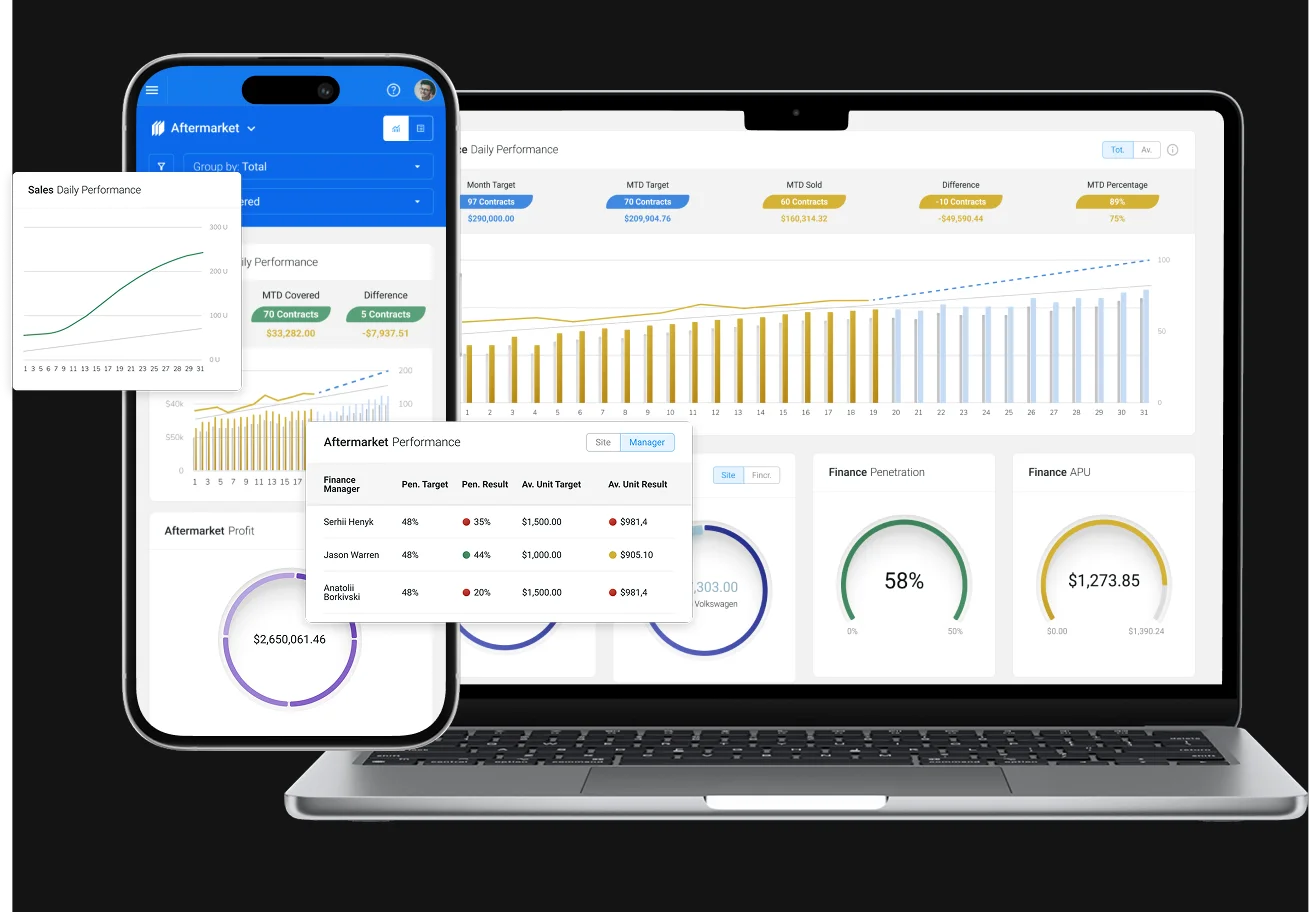
SapientPro engineered a modular ETL (Extract, Transform, Load) pipeline using Angular for the frontend and a robust backend architecture. The custom pipeline ingests high-volume transactional data alongside unstructured inputs.
Here’s what it does:
- Normalizes the data;
- Handles the "cleaning" of inconsistencies (Data Transformation);
- Loads it into a centralized warehouse (Data Warehousing) optimized for real-time querying.
What was the result? Retailers now possess real-time dashboards that correlate sales performance with staff behavior. This enables data-driven management across the entire chain. The solution highlights the critical role of custom data engineering in bridging the gap between structured vs unstructured data.
Computer Vision & Audio AI
In the agricultural sector, data is often captured in the field—offline, visual, and spoken.
A client turned to us to develop an AI app for the AgriTech sector.
What was the challenge? An AgTech company relied on manual fruit inspections. Inspectors wrote notes on paper and took disconnected photos. The data was "dark"—unsearchable, prone to error, and delayed by days.

SapientPro developed a mobile-first solution combining Computer Vision and Audio AI:
- Computer vision. The app uses on-device AI to analyze photos of fruit in real-time. It automatically detects defects, measures size, and determines ripeness levels without manual tagging.
- Audio AI. Inspectors use voice-to-text to dictate notes. The AI transcribes the audio and uses NLP to extract structured data points (e.g., "Batch 45, heavy bruising") directly from the speech stream.
What was the result? Inspection time was reduced by a massive 87.5%. Reports are generated instantly, and the visual/audio data is structured immediately upon capture. This enables long-term trend analysis on crop quality.
Why Partner with SapientPro as Your AI Development Company
SapientPro stands out as a leader in Big Data and scraping services.
We offer a full-scale approach that combines intelligent document processing, computer vision, and custom data engineering. SapientPro’s engineers know how to process unstructured data and build powerful ETL pipelines that help your business grow.
Partnering with SapientPro means engaging experts who bring a competitive advantage to your company. We bridge the gap between structured, semistructured, and unstructured data, ensuring your enterprise is AI-ready, compliant, and data-driven.
Let’s team up today!
Transform Your Data Into Profits
SapientPro will help you turn unstructured data into business benefits.