All How to Scrape Websites with Dynamic Content
April 8, 202615 min read


Organizations increasingly rely on ground-truth data to fuel generative AI models and real-time market intelligence. As a result, the challenge of web scraping dynamic websites became a central infrastructure requirement for global enterprises.
The global web scraping market is estimated at $1.17 billion and is projected to reach $2.23 billion by 2031, representing a CAGR of approximately 13.78%.
This growth is inextricably linked to the dominance of JavaScript-heavy frameworks, with 98.9% of all websites now using client-side programming to facilitate dynamic content updates.
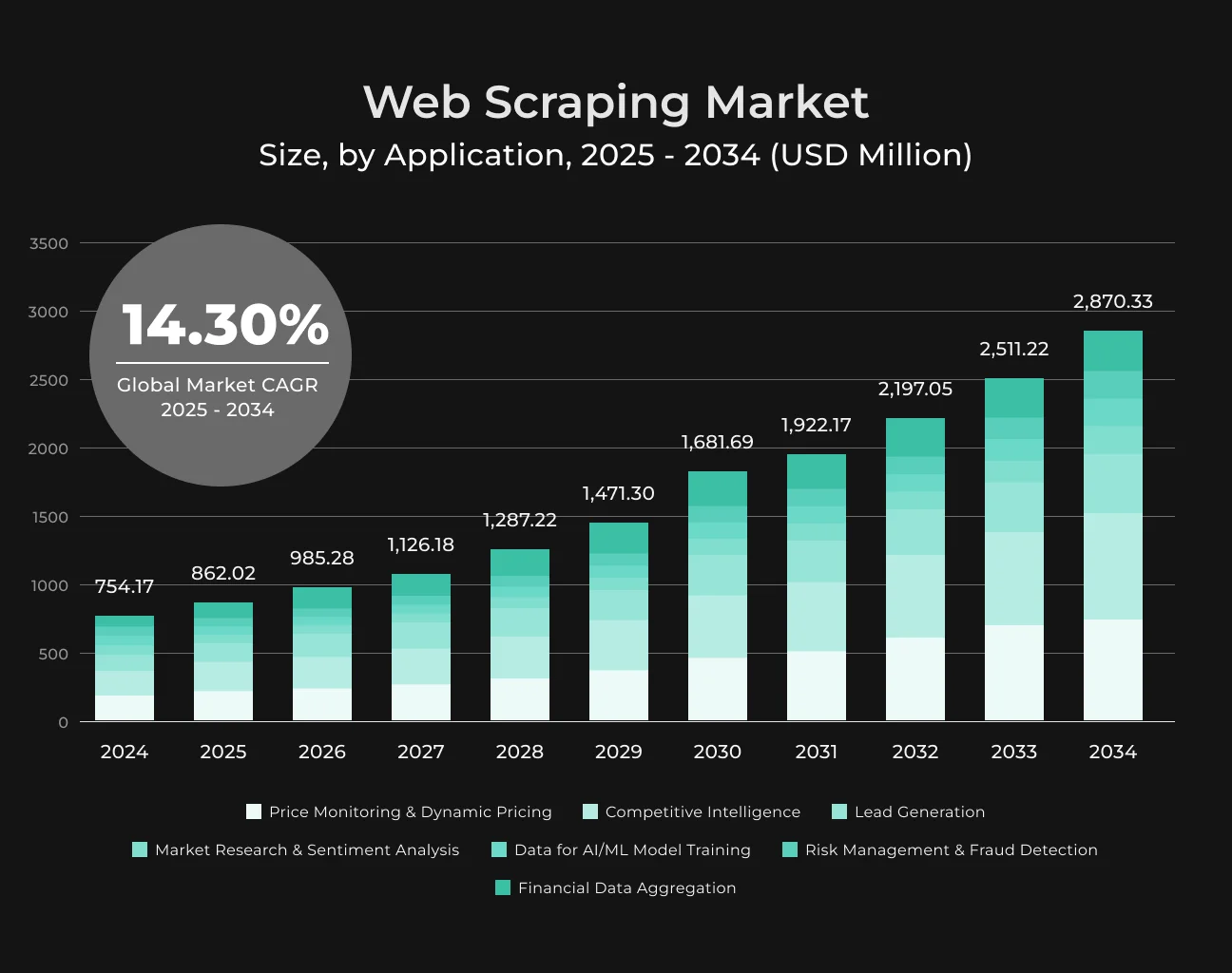
The rise of the "permission economy" in web data has added new layers of complexity. Infrastructure providers like Cloudflare now enforce AI bot restrictions by default, while marketplaces like TollBit facilitate licensed data access. For the modern enterprise, the goal of web scraping dynamic websites is no longer just simple extraction, but sophisticated orchestration.
In this article, SapientPro’s team will explain Python dynamic web scraping and answer the fundamental question: “How to scrape dynamic websites?” Read on for more!
What Is Dynamic Content in Modern Websites?
Traditional web scraping operated under the assumption that a page's content was delivered in its entirety within the initial HTML document. In 2026, this is rarely the case.
Modern web architecture uses a "skeletal" delivery system, where the initial server response is just a hollow container. The actual user interface and data are built in the browser only after JavaScript bundles are executed.
Static vs Dynamic Websites
The fundamental difference between static and dynamic websites resides in the location and timing of content rendering. A static website provides the same content to every visitor, pre-rendered on the server side.
When a scraper requests a static page, the server responds with a complete HTML file that already contains the desired data in the markup. Conversely, a dynamic website uses client-side logic to generate content in real time.
This content often depends on user-specific variables such as:
- Session state;
- Geographic location;
- Interactive triggers.
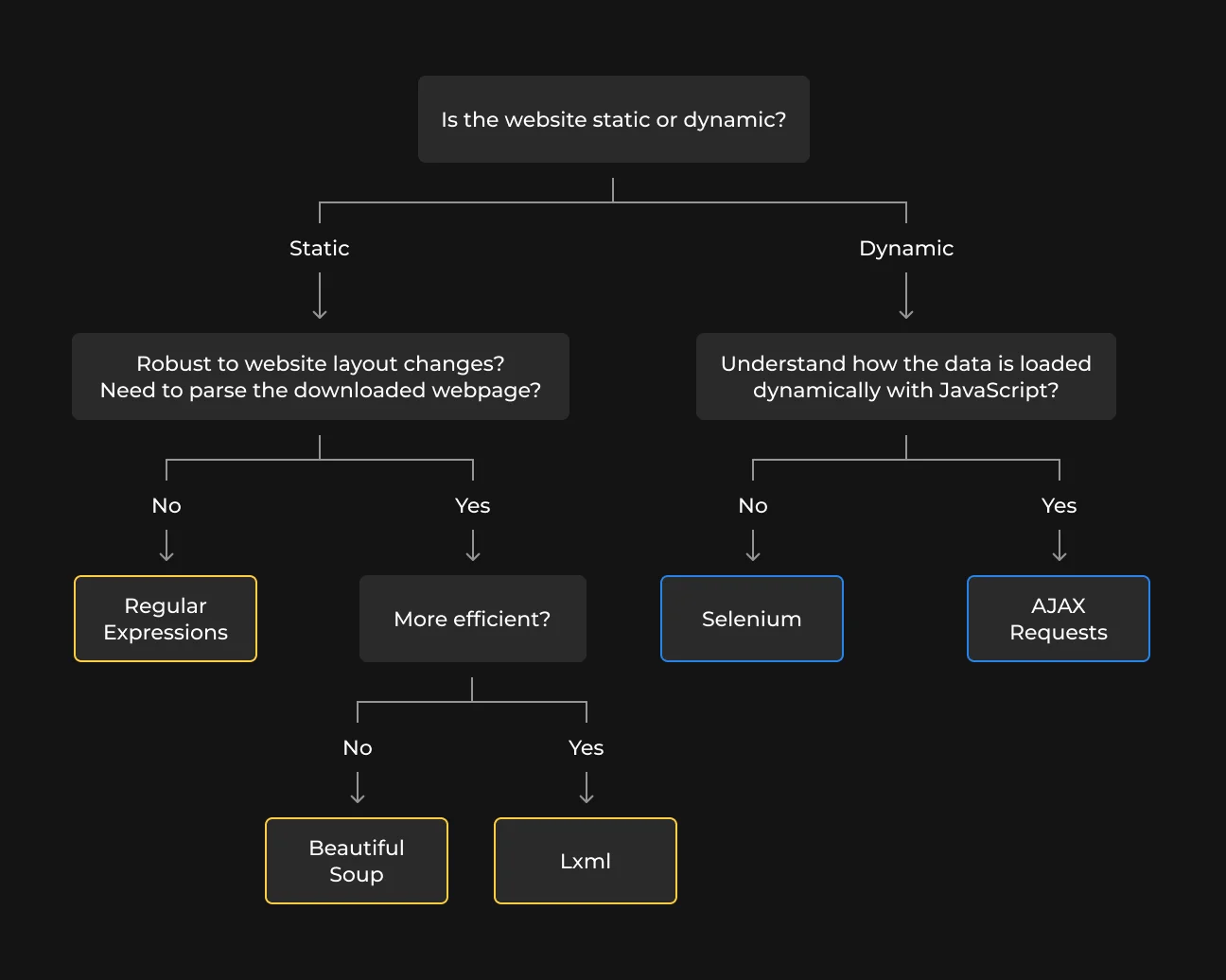
For instance, a retail site may load its product grid only after the browser executes a series of scripts that call an external inventory database. If a scraper fails to run these scripts, it receives an empty page or a loading spinner instead of the actual product data.
Server-Side vs Client-Side Rendering
The evolution toward client-side rendering (CSR) has been driven by the need for high interactivity and reduced server-side processing costs.
In a CSR model, the server sends a minimal HTML shell and a link to a JavaScript file. The browser's engine (such as V8 in Chrome) executes the script, which then fetches data from an API and builds the Document Object Model (DOM). This process is what makes the site interactive.
Server-side rendering (SSR), while still used for SEO purposes and initial page loads, has become increasingly hybrid. Many frameworks, such as Next.js (preferred by 70.2% of backend JavaScript developers), use a combination of SSR for initial page load and CSR for dynamic updates.
For a scraper, this means that while some data might be visible in the initial source code, the "ground truth" of the data is often buried in the post-hydration DOM.
Why Traditional Scraping Fails for Dynamic Pages
Traditional scraping tools like Python’s Requests or PHP’s standard curl functions are essentially HTTP clients. They can fetch raw files but lack the "engine" needed to interpret and execute JavaScript. Because they lack a JavaScript runtime, they cannot trigger the events needed to populate a dynamic page.
Furthermore, these tools struggle with shadow DOM components—encapsulated markup used in modern web components to prevent style bleeding. These components are effectively invisible to standard CSS selectors unless the scraper specifically pierces the shadow root via a browser-level interaction.
Rendering Type | Description | Scraper Requirement |
| Static HTML | Data embedded directly in the markup. | Simple HTTP GET request. |
| Server-Side (SSR) | Content generated on server before delivery. | HTTP request with header management. |
| Client-Side (CSR) | Content generated via browser-side scripts. | Headless browser or API reverse engineering. |
| Hybrid | Mixed delivery (initial frame SSR, details CSR). | Browser automation with wait conditions. |
Why Do You Need Dynamic Web Scraping
The need for dynamic web scraping stems from the fact that the most valuable business data is often the most volatile. Static sites are increasingly rare in the enterprise space.
Here, competitiveness is measured by the ability to capture information that changes by the hour or even the minute. By automating data extraction, you can integrate these volatile feeds directly into your operational logic.
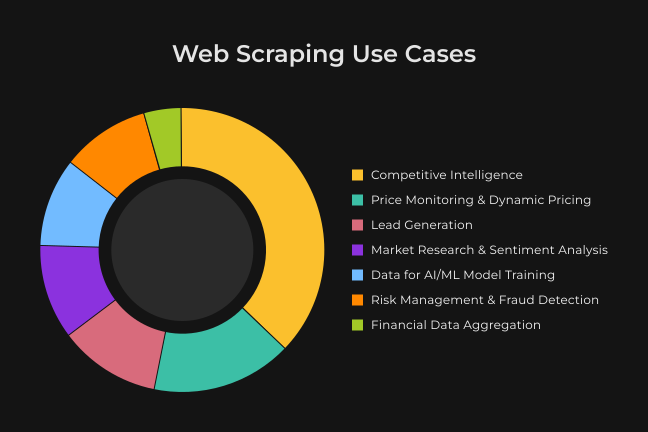
Market Intelligence & Competitive Monitoring
In the retail sector, scraping dynamic content has become a prerequisite for survival. Approximately 81% of US-based retailers now use automated scraping for dynamic repricing, up from 34% in 2020.
This involves monitoring entire product catalogs, stock availability across different regions, competitor prices, and campaign-specific discounts that are only triggered for certain user profiles.
Furthermore, sentiment analysis has evolved from a niche marketing tool into a core risk management function. Agencies and brands now require unified feeds of consumer sentiment harvested from social media platforms and forums, with content loaded dynamically as users scroll.
These feeds allow companies to identify brand-safety signals and campaign performance in near real-time. This way, they pivot strategies before a trend becomes a liability.
Job listing aggregation also relies heavily on web scraping dynamic websites. Many recruitment portals use interactive search filters and asynchronous loading to manage their vast databases.
AI & Machine Learning Data Collection
The sudden boom of generative AI has fundamentally altered the economics of scraping. AI models do not require a few thousand records. The problem is that they require billions of high-quality, labeled tokens.
In 2024, 65% of enterprises used web scraping dynamic websites to feed AI and machine learning projects, a trend that has accelerated into 2026 as organizations seek to build proprietary knowledge bases that cannot be found in static datasets.
Web scraping Python dynamic content provides the freshness these models require, ensuring that an AI system is trained on:
- Current news;
- Evolving technical documentation;
- Real-time social discourse.
This is the shift from simple extraction to full-scale data orchestration. Scrapers act as the continuous supply chain for the AI feedback loop.
Investment & Risk Monitoring
Financial institutions are among the largest consumers of dynamic web data. Currently, 67% of U.S. investment advisers use web-scraped alternative data to feed their credit risk engines and algorithmic trading desks.
This data includes:
- Real-time news feeds;
- Corporate filings that appear on government portals with complex navigation;
- Job market shifts that serve as leading indicators of company health.
In such an environment, regulatory updates can move markets in seconds. This is why the ability to scrape government and news sites that use interactive dashboards is critical for risk monitoring.
Get a Custom Solution for Your Business
SapientPro's engineers will help you build a top-tier web scraping tool for your industry.
Techniques for Scraping Dynamic Content in 2026
How to scrape dynamic web pages?
Capturing data from dynamic environments requires a strategic choice between simulating user behavior and identifying the underlying data streams. In 2026, four primary techniques were refined to balance trade-offs among performance, accuracy, and bypassing advanced defenses.
1. Using Headless Browsers (Selenium, Playwright, Puppeteer)
Headless browsers remain the primary tool for web scraping Python dynamic content.
These are essentially standard web browsers (like Chrome, Firefox, or WebKit) that run without a graphical user interface. Playwright and Selenium allow developers to programmatically control these browsers to simulate human actions, such as clicking buttons, filling out forms, and scrolling through content.
Playwright has emerged as the preferred choice for modern web applications because it communicates directly with browser engines via WebSockets. This results in execution speeds up to 5x faster than the older Selenium WebDriver architecture.
Playwright also offers auto-waiting logic. It ensures that the scraper interacts with elements only when they are stable and visible, reducing the frequency of flaky scripts.
Pros of using headless browsers:
- Handles 100% of JavaScript-heavy content;
- Accurate simulation of user behavior;
- Bypasses simple bot detection by behaving like a real browser.
Cons of using headless browsers:
- Extremely resource-intensive;
- High infrastructure costs at scale;
- Susceptible to advanced fingerprinting detection.
When to use headless browsers for web scraping Python dynamic content? Use for complex, multi-step interactions, or when the target data is deeply integrated into a component-heavy frontend like React or Vue.
2. Intercepting Network Requests (Reverse Engineering APIs)
For large-scale operations, reverse-engineering a website's internal APIs is often the most efficient approach. By inspecting the network tab in browser DevTools, engineers can:
- Identify the XHR (XMLHttpRequest);
- Fetch requests that a site makes to its own backend.
These requests often return clean, structured JSON data that can be requested directly by a lightweight HTTP client.
This method bypasses the need for rendering HTML altogether, dramatically reducing infrastructure costs and increasing speed. For example, a request that takes 4 seconds to render in a headless browser might take only 200 milliseconds when intercepted via the API.
From a business perspective, this technique enables companies to hit daily targets of over 500,000 pages without the massive CPU and RAM overhead required by browser fleets.
3. Handling Infinite Scroll & Lazy Loading
Infinite scroll and lazy loading are performance optimizations that load content only as the user scrolls down the page. Python dynamic web scraping requires the scraper to mimic human scrolling behavior.
The standard logic involves using a loop that triggers a scroll event. It is followed by an "AJAX timeout" or a "wait for element" condition to allow the new content to hydrate in the DOM.
The wait action is crucial. Pages typically take between 100 milliseconds and 3 seconds to fetch and render new batches of data. A common pitfall is using fixed timers (e.g., time.sleep(5)).
Why? They either waste resources or fail when the network is slow.
Modern scrapers use event-driven waits. These proceed only when a new item matching a specific CSS selector appears.
4. Dealing with Anti-Bot Protection
Anti-bot systems have evolved into sophisticated layers that analyze behavioral patterns, device fingerprints, and network reputation. To maintain access, scrapers must use a combination of rotating residential proxies and fingerprint randomization.
Residential proxies route requests through genuine consumer IP addresses. They make it difficult for defenses like Cloudflare to identify automated traffic.
Advanced anti-bot measures also use honeypots—hidden links or elements invisible to humans but visible to bot scripts. If a scraper hits these elements, it is immediately flagged.
Dealing with these requires a "DOM-aware" approach in which the scraper interacts only with elements in the accessibility tree. It must effectively mimic a human user’s focus.
Protection | Mechanism | Counter-Strategy |
| CAPTCHA | Visual/Cognitive challenge. | AI-powered solving or managed unblockers. |
| Fingerprinting | Analysis of OS, GPU, and browser traits. | Randomizing canvas/WebGL fingerprints. |
| Rate Limiting | Restricting requests per IP. | Residential and mobile proxy rotation. |
| Behavioral | Analyzing mouse movements/timing. | Simulating realistic, non-linear interactions. |
How to Use Python for Dynamic Web Scraping
Python is the preeminent language for dynamic web scraping due to its extensive library ecosystem and alignment with data science pipelines that consume extracted information.
If you’re thinking about how to create a web scraper, the Python ecosystem offers tools that can handle everything from simple parsing to enterprise-scale orchestration.
Best Python Libraries for Scraping Dynamic Websites
Here are the best libraries you can use for Python dynamic web scraping.
Selenium
Selenium is a heavyweight champion for browser automation. It supports the widest range of browsers, including legacy versions. This is why it is indispensable for enterprise environments that must maintain compatibility with older systems.
Playwright
Created by Microsoft, Playwright is designed for speed and stability. It uses a WebSocket-based architecture that enables parallel execution within a single browser instance. Playwright is the most efficient choice for modern single-page applications (SPAs).
Requests + BeautifulSoup (with API Interception)
While Requests and BeautifulSoup cannot execute JavaScript, they are the fastest tools for Python dynamic web scraping if the engineer can reverse engineer the site's private APIs. This combination is lightweight, easy to use, and has a very gentle learning curve.
Scrapy + Splash
Scrapy is the Swiss Army knife of Python dynamic web scraping frameworks, designed for large-scale crawling. When integrated with Splash (a lightweight headless browser), it can handle dynamic rendering without the full overhead of a standard browser fleet.
Library | Best For | Scalability | Complexity |
| Playwright | Modern Web Apps / Performance | High | Moderate |
| Scrapy | Large-Scale Crawling | Very High | High |
| Selenium | Legacy Support / Broad Testing | Low | Moderate |
| BeautifulSoup | Simple Parsing / API Interception | Moderate | Low |
How to Scrape Dynamic Web Pages in Python
The first step is to analyze the website's structure using the browser's "Network" and "Elements" tabs.
The engineer must determine whether the target data is present in the initial source code or is populated via an XHR/Fetch request. If the latter is true, the most scalable strategy is to mimic those API calls directly using Requests.
However, if the data is obfuscated or rendered via complex client-side logic, a Playwright-based browser automation strategy is selected.
Implementation requires launching a browser context and navigating to the target URL. The script must incorporate intelligent waits (for example, page.wait_for_selector(".product-price")) to ensure the JavaScript has finished updating the DOM before the scraper attempts to read the data.
If the site uses infinite scroll, the script must enter a loop that scrolls by a specific pixel distance and waits for the DOM to stabilize before repeating.
Once the data is visible, the script:
- Extracts it using CSS selectors or XPath expressions;
- Normalizes it into a structured JSON format;
- Streams it to a persistent database, such as PostgreSQL, or to a data lake, such as S3.
This is how Python scraping dynamic content works.
Scaling Dynamic Web Scraping for Enterprise Use
Scaling scraping dynamic content to millions of pages introduces obstacles that simple scripts cannot overcome. In 2026, enterprise-grade scraping is treated as a supply chain. It requires sophisticated architecture to maintain reliability and manage costs.
Architecture of a Scalable Scraping System
The core of a scalable system is a distributed architecture. Instead of running a single long-loop script, the workload is broken into chunks and distributed across multiple worker nodes. A central master node manages a task queue (using Redis or RabbitMQ).
It ensures that URLs are processed in parallel without overloading any single target server.
Containerization is mandatory in this environment. Wrapping scrapers in Docker containers allows for the instant creation of identical environments. Orchestration tools like Kubernetes can then manage these containers, scaling the infrastructure up or down based on the current load.
This is often coupled with a Dead Letter Queue (DLQ). If a worker node fails to scrape a URL due to a 403 Forbidden or a timeout, the URL is sent to the DLQ to be retried later with a different proxy configuration.
Data Cleaning & Storage Pipelines
Web scraping Python dynamic content generates massive volumes of data that must be cleaned and validated before it reaches the decision-making stage.
This is handled via ETL (Extract, Transform, Load) pipelines that normalize inconsistent formats into a standardized schema. These pipelines work with different date notations, currency symbols, etc.
Storage solutions must be chosen based on the nature of the data. Structured data, such as pricing tables, is typically stored in SQL databases. Unstructured data, such as raw HTML for AI training, is better suited for NoSQL databases or cloud data lakes.
The use of streaming pipelines is also increasing. In this case, data is fed directly into real-time analytics dashboards as soon as it is extracted. This way, the data's freshness is maximized.
Monitoring & Maintenance
A scraper is never finished. Websites change their structure, anti-bot systems update their algorithms, and selectors break. High-scale operations use scraping health dashboards to monitor success rates and latency.
Advanced systems in 2026 incorporate reinforcement learning to detect when a selector has changed and automatically suggest a new one. This reduces the engineering hours lost to manual maintenance.
Challenges in Web Scraping Dynamic Websites
Despite technological advancements, Python scraping dynamic content continues to face persistent challenges that require ongoing innovation and strategic planning.
Frequent Technical Issues
Dynamic selectors that change on every page load and obfuscated HTML are common tactics used by major platforms to deter automated extraction. Furthermore, the shadow DOM presents a significant hurdle, as it encapsulates parts of the page. As a result, they become inaccessible to standard global selectors.
Piercing the shadow DOM requires the scraper to specifically target the shadow host and traverse its root. This process is more resource-intensive and prone to failure if the component library is updated.
Performance & Cost Optimization
Headless browsers are expensive. Running a fleet of 100 Playwright instances requires substantial cloud infrastructure. To optimize costs, you can opt for serverless scraping dynamic content, where functions are triggered only when needed.
Or you can use managed browser pools where the browser execution is outsourced to a specialized provider. This allows your business to pay only for the successfully extracted data rather than the idle time of a server fleet.
Is Web Scraping Legal?
In 2026, the legality of dynamic web scraping is governed by a patchwork of regional laws and landmark court decisions. In the United States, the Ninth Circuit has reaffirmed that scraping publicly available data (data that anyone with a web browser can see) does not violate the Computer Fraud and Abuse Act (CFAA).
However, scraping data behind a login wall is a breach of contract and can lead to civil lawsuits.
The European Union’s GDPR represents a much stricter regulation. There is no exception for public personal data in the EU. Scraping the names, email addresses, or LinkedIn profiles of EU citizens without a specific lawful basis is a violation of their privacy rights.
Furthermore, the EU AI Act, which becomes enforceable in August 2026, requires organizations to maintain a "Traceability Log" for any data used to train high-risk AI models. You must document whether URLs were checked for copyright and personal data issues.
Partner with SapientPro for Machine Learning Services
SapientPro is a premier technology partner with over 70 experienced professionals dedicated to building advanced Big Data and dynamic web scraping solutions. Our expertise lies in creating custom data analysis tools that transform raw web information into actionable business intelligence.
With a 5/5 rating on Clutch.co, SapientPro is recognized for its technical skill in SaaS development, AI-driven solutions, and enterprise-scale data extraction across diverse industries, including e-commerce, finance, and logistics.
Our case studies prove that:
- SapientPro developed a sophisticated data insights platform for The Big Data Chef, consolidating data from ERPs, CRMs, and e-commerce platforms. The solution features interactive Power BI dashboards that use data blending to provide unified reporting across multiple departments and tools simultaneously.
- SapientPro partnered with Zich Solutions to develop a decentralized Web3 scraping infrastructure. The project involved building specialized scraping nodes and automated data pipelines. We designed them to handle complex data extraction across blockchain-backed systems and decentralized DAO governance frameworks.
By working with SapientPro, you gain the technical maturity needed for dynamic web scraping. We can handle complex data extraction and stay fully compliant with evolving legal and ethical standards.
Build Your Web Scraping Tool
SapientPro's engineers will help you get a reliable scraper for your business.