All AI Compliance Automation Guide: Best Practices for Reporting & Compliance
January 29, 202615 min read


Companies are deploying AI systems to an increasing capacity. That speed also makes it difficult for businesses to keep up on regulatory compliance. Many old compliance techniques are simply incapable of addressing some of the AI concerns the team might have.
These could be model drift or an evolving number of features in generative AI.
In order to comply with regulations and reduce risks, there is a need to move toward compliance automation tools. The AI-based compliance automation market is quickly growing.
Currently worth $6.1 billion, it's expected to increase to $18.3 billion by 2033, with an annual growth rate of 14.60%.
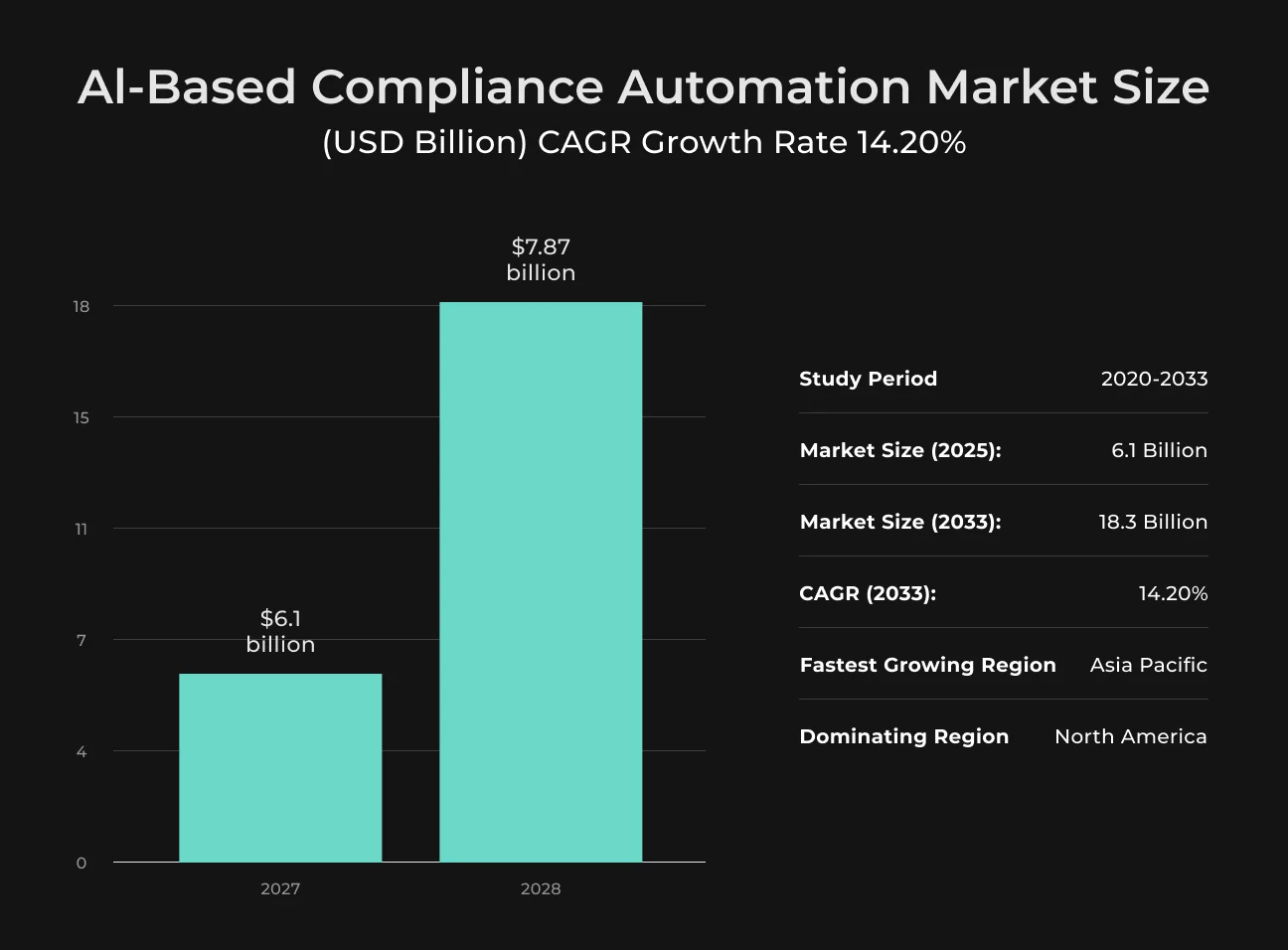
This guide from SapientPro's experts offers a complete approach to compliance process automation. You'll find a detailed plan to help you start integrating AI compliance automation into your business.
Key Takeaways
- An AI compliance automation software can automate and maintain parity with the legal laws and regulations;
- Gen AI can reveal subtle threats in network traffic or system logs that traditional security tools might miss;
- The EU Artificial Intelligence Act could become a global set of rules that affect how AI can benefit or impact a person.
Why Manual Compliance Is No Longer a “Yes”
Manual processes just can't sustain that quick progress in AI updates. This discrepancy can lead to damaging circumstances like expensive fines or negative publicity.
Under the GDPR, companies can face fines of up to tens of millions of euros. The fine can be as much as €20 million. In larger companies, it can be 4% of a company’s global revenue for the prior year.
In a survey that included nearly 1,200 senior cyber decision makers, the firm identified eight risks associated with generative AI. These hazards range from misinformation to social engineering attacks and bad governance of AI strategies. Approximately 77% of survey respondents are worried that this risk will impact their cybersecurity.
Also, 36% of organizations have allocated funds for AI and generative AI in their cybersecurity budgets. Gen AI can uncover subtle threats in network traffic and system logs that may escape the attention of traditional security tools.
What is Regulatory Compliance Automation?
Regulatory compliance automation is a software system that automates and maintains parity with the regulations. This replaces humans and manual reviews of video with automated systems that monitor compliance levels and log processes.
{[a2}}
Here are the key features of the compliance process that can be automated.
- Control enforcement includes:
- Policy-as-code turns compliance policies into code to automatically enforce and execute them within the AI system;
- CI/CD gates automate compliance checks during development and deployment, blocking non-compliant code from going live;
- Approval workflow simplifies and automates approval steps. This ensures models and code that need compliance checks get proper validation.
- Evidence collection consists of:
- Logs automatically capture and store records of AI operations to verify compliance with data processing activities;
- Test automated reports show compliance with safety and ethical standards;
- Access records keep track of who accesses or changes AI models to show compliance with data governance policies;
- Model cards and data protection impact assessments (DPIAs) automate the creation of documentation and assessments for bias, fairness, and data protection.
- Continuous monitoring involves:
- Drift detection that keeps an eye on AI models to ensure they work as expected and stay compliant over time;
- Bias and performance checks automatically review AI systems for any bias and track their performance;
- Incident monitoring records and tracks incidents, while automating alerts to ensure quick resolution and compliance.
- Reporting suggests:
- Audit-ready export that automatically generates compliance for audits;
- Immediate visual status through dashboards to let you see where compliance is at and make decisions fast;
- Traceability guarantees that all automated activities are verifiable.
Automating regulatory compliance will show that your company sticks to the rules.
It also drives operational efficiencies that help your business focus on innovation and growth without the weight of compliance pressing in.
Automating Compliance with AI: Key Regulations and Considerations
Here are some rules and standards to consider as to automated compliance, and why your business should care.
EU AI Act Regulation
AI applications influence the information you see online by guessing what might interest you. They can analyze facial data for law enforcement, customize ads, or help with cancer diagnosis.
The EU Artificial Intelligence Act could become a worldwide set of standards that affect how AI can benefit or impact a person. It creates an entire ecosystem to ensure AI is used safely and responsibly throughout the EU.
Risk-Based Categories
We typically categorize AI applications into four risk levels: minimal, limited, high, and unacceptable. There are different levels of compliance in effect for each level. For engineers, understanding these demands is a prerequisite for building, developing, and using AI systems.
Provider and Deployer Roles
The Act distinguishes between providers (those who develop AI) and deployers (those who apply AI). Each has unique compliance obligations that affect liability, risk, and documentation.
Roles are a key factor in effectively handling these responsibilities. And they can be managed easily through automation.
GDPR
In the EU, the General Data Protection Regulation (GDPR) dictates how personal data must be processed. The following are key GDPR principles that particularly impact the design and implementation of AI systems:
- AI models should process data transparently, in a way that can be explained;
- Only collect data for defined, legitimate purposes and keep it to that use;
- Keep information for no longer than you have to;
- Companies must prove that they comply with every rule in the GDPR.
Check out several relevant GDPR articles AI developers should pay close attention to:
- Article 5. This Act restricts some uses of AI. It prohibits systems that manipulate decisions or that exploit people’s vulnerabilities. It also bans systems that categorize people based on social behavior or physical traits;
- Article 15. The article says that high-risk AI systems must be made so they remain accurate, robust, and secure from beginning to end;
- Article 22. This law restricts automated decision-making/profiling (unless the individual has given their consent). When there’s no explicit consent or a contract, companies need to keep humans in the loop and explain how decisions are made.
Automation offers clear and documented decision processes, helping people understand what affects those decisions.
Other Standards for Trustworthy AI
Businesses can adopt some other standards to make their AI systems trustworthy.
Some examples include the following options.
NIST AI RMF
AI RMF by the National Institute of Standards and Technology helps organizations produce reliable AI systems. It serves as a tool for guiding risk management in AI.
It also provides a flexible tool with four roles to play: govern, map, measure, and manage. These will help search, assess, and mitigate privacy breaches and vulnerabilities.
ISO/IEC 42001
Being the first ever standard on AI systems, ISO/IEC 42001 has tools for managing the evolution of AI and its impact on society. It seeks to answer some of the most complex aspects around AI, including ethics, transparency, and lifelong learning.
Elements to Automate with AI Compliance Solutions
Basically, 85% of companies say compliance has become more complicated over the last three years. The US SEC imposed $8.2 billion in fines during the 2024 fiscal year, while Europe issued €5.65 billion in GDPR fines by early 2025.
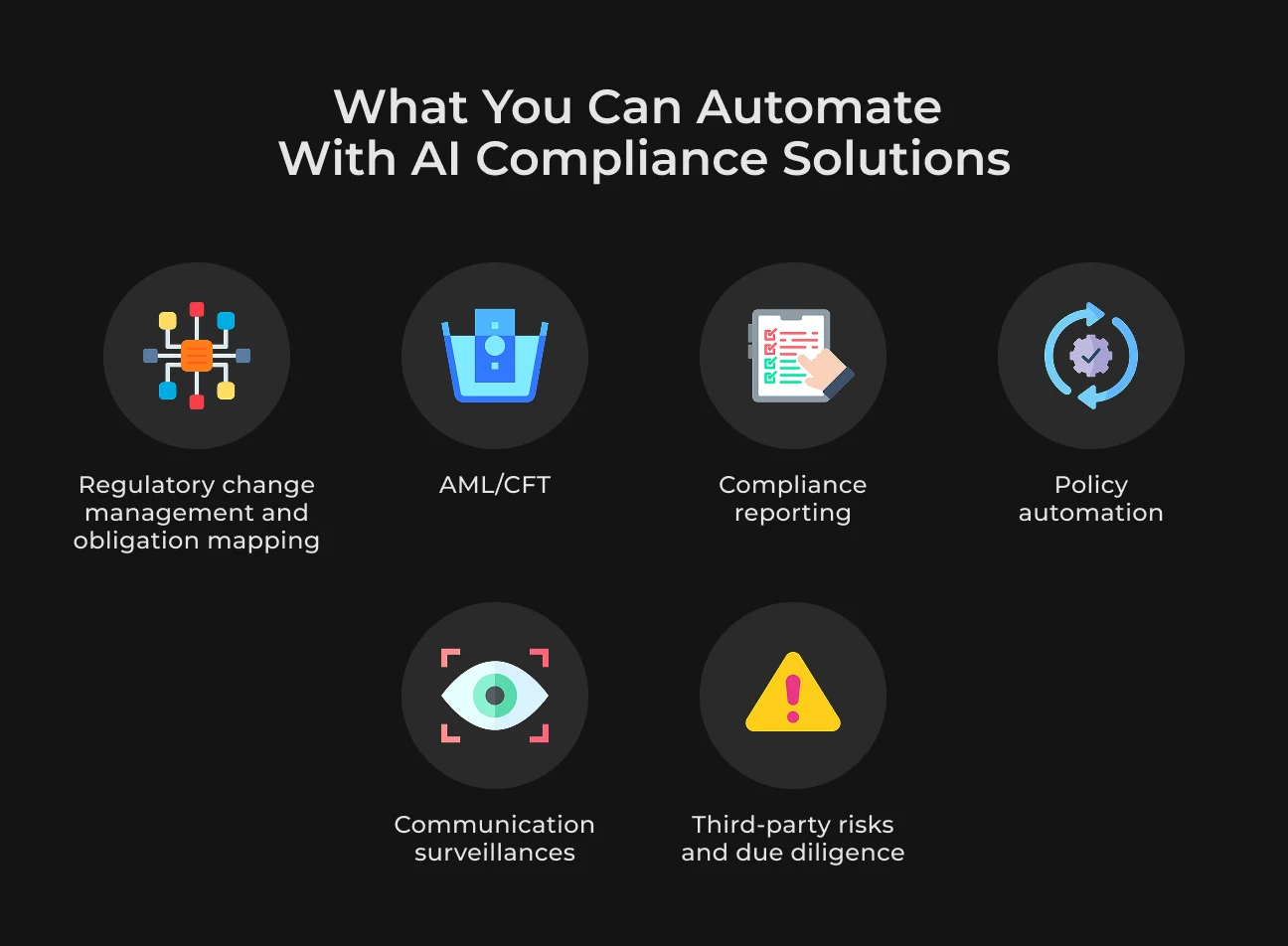
Let's see how applying AI to automating compliance can step-change the way businesses manage regulations.
Regulatory Change Management and Obligation Mapping
The new laws (along with changes to those laws) come fast and sometimes require a quick response. AI-powered compliance technology can automatically track regulatory changes in real time with all their updates.
Through the investigation of millions of legal texts and compliance adjustments, AI-based tools can also map the obligations for relevant laws across various jurisdictions.
Policy and Procedure Automation
Automated AI-driven systems help keep businesses legal and streamline other routine tasks. AI can automatically update and deploy new policies. Your compliance process is always up to date without being time-consuming when regulations change.
By using central policy management systems, companies can consistently apply compliance practices across all areas.
Transaction Monitoring and Financial Crime Operations (AML/CFT)
Lawmakers and regulators know that anti-money laundering (AML) activities can be quite costly for finance institutions because they require a lot of work. AI and ML tools can quickly analyze large amounts of data, identifying suspicious behavior with impressive accuracy.
For example, AI models can compare a customer's behavior to that of their peers.
Rather than relying on fixed rules, these models understand what’s normal for each customer and can rapidly identify anomalies — like atypical kinds of transactions, deviations in how a person normally makes a transaction, or changes in geographic behavior.
Whenever the AI detects a change like this, it automatically re-evaluates and refreshes the customer’s risk rating.
Communications Surveillance and Conduct Risk
Communication is another area where AI helps shed light on previously hidden parts of a company. With natural language processing, AI can understand the context and nuances of language. This means it’s doing more surveillance than only typing keywords.
Compliance Reporting and Audit Evidence Assembly
AI compliance tools automatically collect data from multiple sources and databases. This ensures that all checks can be made with a wide range of current information when reporting on compliance.
Through the use of machine learning algorithms, such tools can pick up anomalies, warning of potential problems before they become major.
AI tools can also automatically generate compliance reports for audits, which helps reduce errors. These reports are accurate, editable, and allow a team to highlight key compliance achievements and important measures.
Third-Party Risk and Due Diligence
AI enables constant third-party monitoring as opposed to random checks in traditional methods. Pharmaceutical companies, for instance, have thousands of suppliers and distributors around the world.
All of them must follow regulations, like the FDA’s Good Manufacturing Practice. If a partner doesn’t follow the rules, it could result in huge fines, product recalls, or harm to public health and the brand.
AI also leverages machine learning technologies to assess and score the risk posed by each supplier. This helps companies focus their due diligence efforts more effectively.
In 2026, over 80% of enterprises might use generative artificial intelligence, or implement GenAI-enabled applications in their production environments.
How to Make AI Compliance Automation Defensible
For your secure AI compliance automation, you should embed certain principles and mechanisms to promote system transparency, accountability, and robustness. Here’s how to do that.
Human-in-the-Loop by Design
The human-in-the-loop approach to AI is valuable since it combines the insight of humans and the precision of machines. This design enables human experts to act at significant moments, making the system more reliable.
For example, in healthcare, a radiologist could use AI to analyze images. Combining their expertise with AI's rapid data processing helps recognize even subtle details that a fully automated system might overlook.
Traceability and Audit Trails
Creating robust traceability and audit for AI is similar to building a digital ledger. For instance, if a bank employs AI to approve or deny loans, an audit trail would record all the inputs (credit score and income level) and every step the algorithm takes. These logs help reveal when something is amiss — like surprise loan denials.
Compliance teams can go back and look at the logs to see why decisions were made.
Model Risk Management and Validation Expectations
Imagine a tech company using AI in self-driving cars. With a safety first principle, it’s crucial to validate AI models. Engineers can check them out on elaborate test setups to ensure that the system detects objects and reasons about diverse driving situations.
A structured risk assessment helps determine where strict controls are necessary, like in comparing urban and rural areas with different risk levels.
GenAI-Specific Guardrails
GenAI guardrails state what an AI system can produce and how it handles sensitive data in business processes.
They are customizable for different use cases — limiting AI inputs or outputs (e.g., some policies might compromise accuracy to preserve privacy), tightening security to prevent data leaks, and complying with industry standards.
Common Challenges with AI in Regulatory Compliance Software Solutions
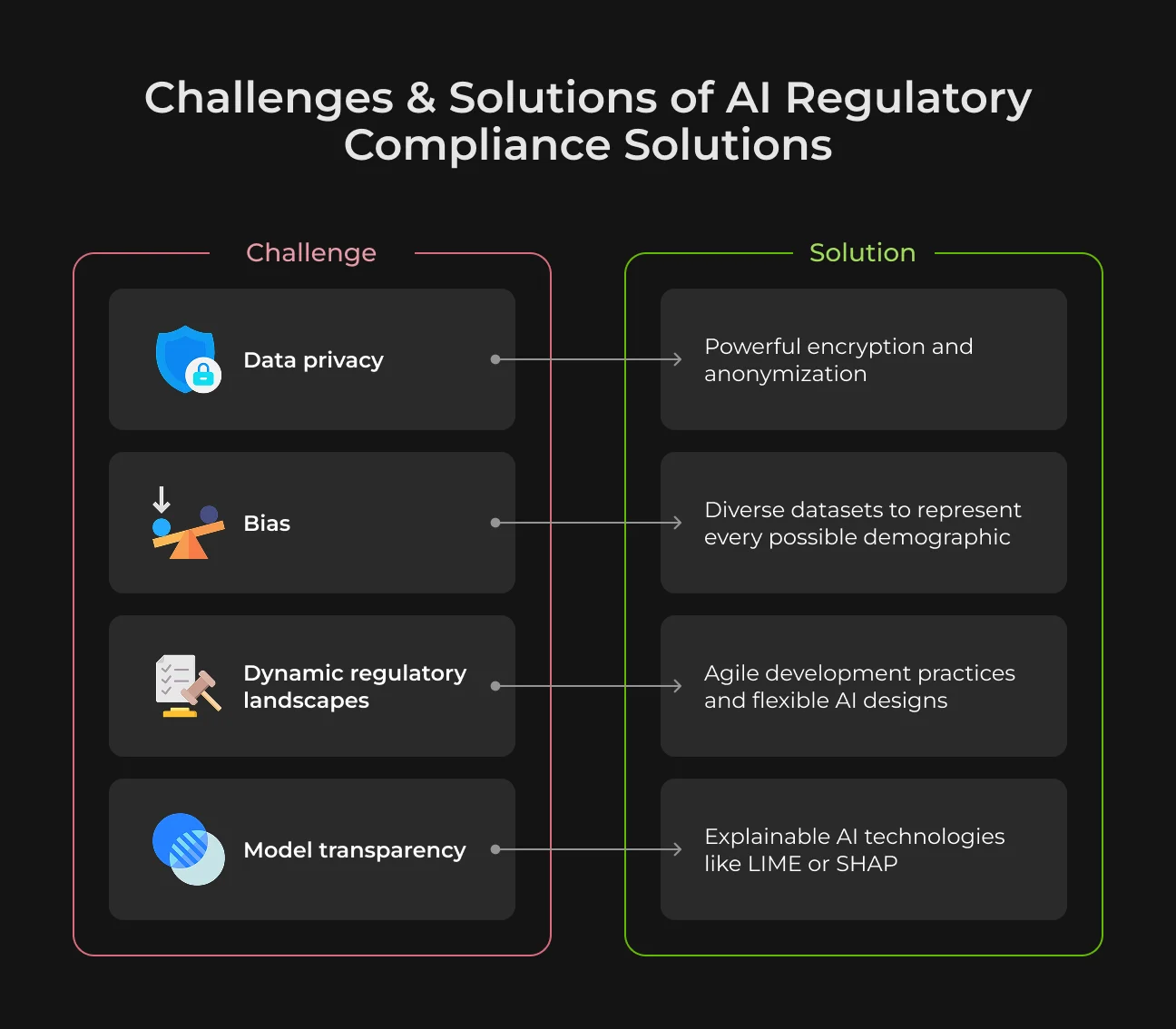
To maximise the opportunities of AI compliance automation, it is essential to be aware of what can go wrong and how best to prevent or limit this. Here are some barriers and tips.
1. Data Privacy
Caring about data privacy in AI systems has always been a challenge, especially under GDPR. AI needs a lot of data that is diverse and often sensitive. But the question is how to use all this data without breaking the law.
Encryption can preserve information by making data unreadable unless you have the keys to decrypt it. Anonymization methods can make personal information anonymous. This allows algorithms to learn while avoiding privacy violations.
2. Bias and Fairness
AI is a disruptive force for industries, but it must be used responsibly to ensure fairness. AI models are trained on historical data, and if that information is flawed, the model can just recite that bias back.
The evaluation of bias needs to be as central to AI as testing. This means using diverse datasets to represent every possible demographic.
3. Model Transparency
People want to understand the choices made by AI. For example, if a self-driving car has an accident and you can’t tell why the AI made its decision, investigations may be harder.
Explainable AI technologies (LIME or SHAP) could open that black box and articulate the reasons. Beyond that, a more user-friendly interface can make AI processes easier to explain.
4. Dynamic Regulatory Landscapes
Laws and policies change constantly, meaning your company needs to be flexible. Cooperating with lawyers and keeping track of legislation can help businesses get ahead of new laws.
Streamlining AI systems to meet new legal standards also demands flexibility in tech setup. For example, an AI analytics logistics platform of a multinational company would need to comply with specific data protection laws in every country.
By following agile development practices and flexible AI designs, they can easily respond to regional needs.
Technical Architecture for AI Compliance Automation Software
Creating an AI compliance automation software is about a harmonious ecosystem that can effectively ingest data, identify anomalies, and automate tasks.
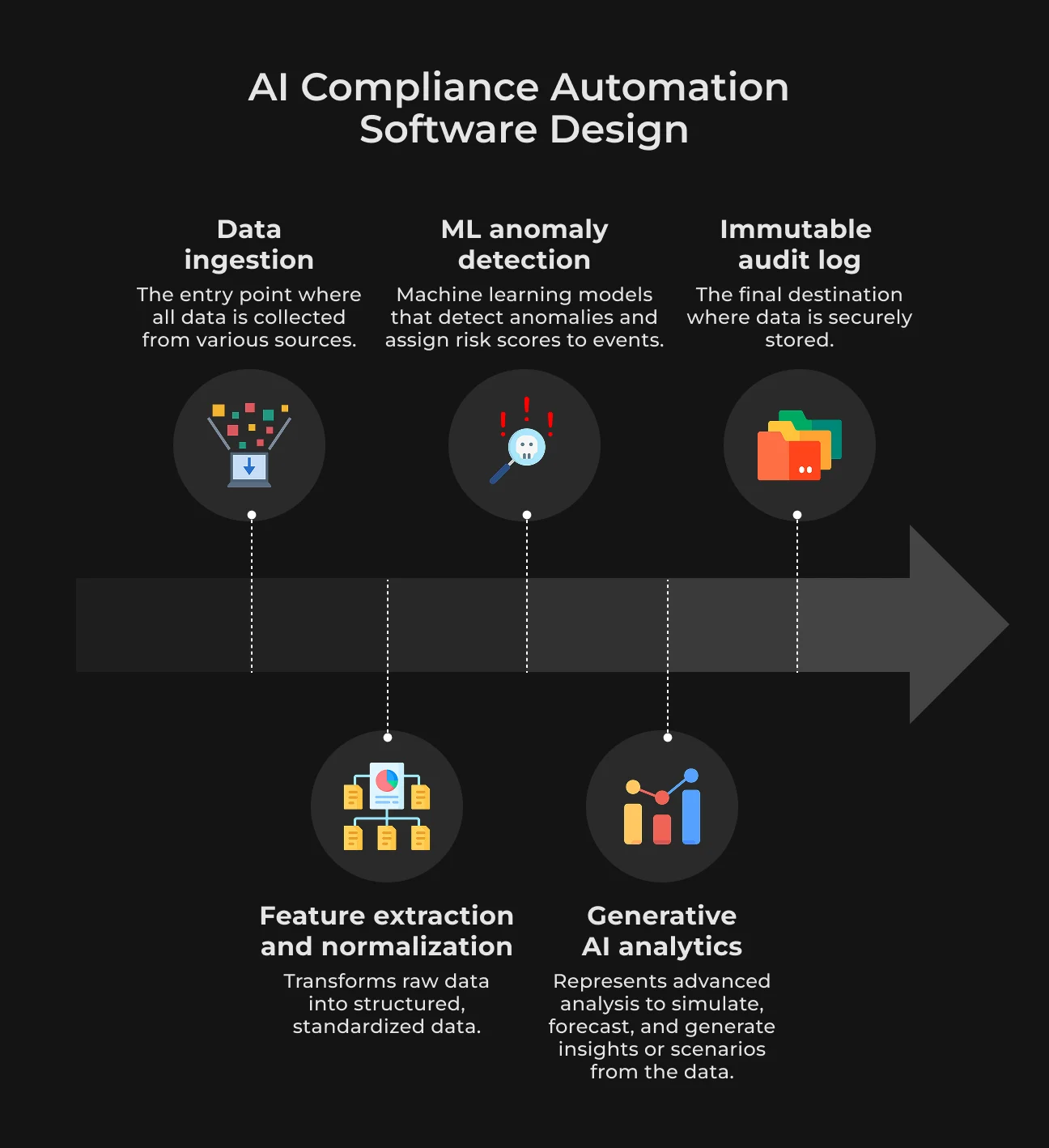
Here is a summary of such an architecture.
1. Data Ingestion
This part of the system manages the automation of compliance by gathering data from many sources, like regulatory rules, transactions, and user activities. This is more complicated because each source has a different format.
Data connectors help establish the system with multiple sources of data, including databases, APIs, or third-party platforms. They must also be flexible enough to handle both structured and unstructured data, while doing so quickly.
2. Feature Layer
This layer turns raw data into useful pieces that the system can easily analyze.
The feature extraction module extracts critical information from the original data for compliance verification. For example, it can structure complex transaction records down to timestamp fields or transaction amounts.
3. Detection Layer
With machine learning capabilities, this layer monitors for anything odd that might indicate non-compliance. Models that are trained on past data note suspicious behavior changes. They are sophisticated enough to differentiate between benign anomalies and potential compliance threats.
The scoring engine applies risk scores to these anomalies. This helps determine which of them require immediate treatment and which could be monitored over time.
4. GenAI Layer
Simulative analysis helps foresee potential compliance results, enabling organizations to test systems for any changes to the legislation.
Natural language processing translates legal language by providing a practical roadmap to compliance from highly complex legal terminology.
5. Evidence Store
This maintains a clear and credible record of compliance measures. The blockchain technology allows for permanently stored data that prevents anyone from changing it.
Implementation Checklist for AI Regulatory Compliance Software
Use this checklist as a starting point for your AI regulatory compliance software.
This approach helps keep applications agile, effective, and prepared for the future as regulations change.
|
|
|
|
|
|
|
|
|
|
|
|
|
|
|
|
How SapientPro Implemented AI for Compliance in the Chemical Industry
SapientPro created a platform focused on chemical safety compliance in Switzerland. The goal was to design a system that would simplify the management of safety data sheets (SDS) for producers, suppliers, and users. The platform had to meet several industry challenges:
- Matching SDS files in different languages with various standards like GHS and OSHA is a real dilemma;
- SDS formats and content aren't consistent, which makes it hard to process products from various suppliers;
- It's tricky to find SDS data for products lacking barcodes (a common issue with older systems or imports).
Our solution offers organized SDS storage, automatic data extraction, multilingual matching, and access control based on roles. The platform also gives hospitals and businesses powerful search tools, email integration, and SDS version tracking.
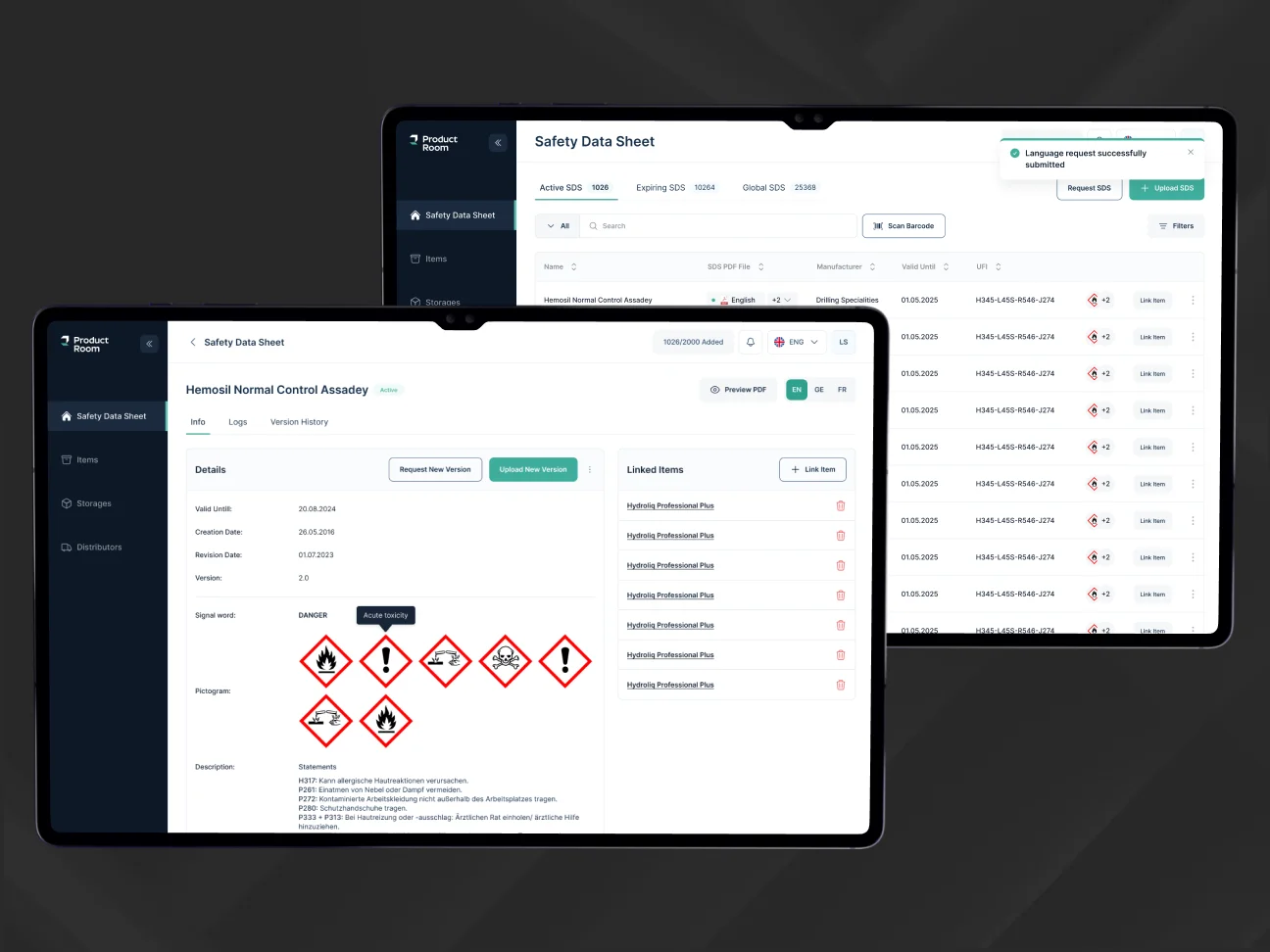
These help stay compliant with GHS and local safety rules.
According to Ihor Hamal, COO at SapientPro, ProductRoom is now the core of a flexible safety-data system.
Partner with SapientPro to Build Your AI Compliance Solution
SapientPro is your reliable partner for building strong AI compliance solutions. With more than 9 years of experience, our tech engineers excel at managing the challenges of AI and regulatory compliance.
Our many successful projects demonstrate how effectively we build unique solutions for various businesses. Just check out a few of them:
- AI-Powered Language Tutor With Live Avatars
- AI Tool for Fast, Scalable CV Data Processing
- Frontend for Power BI–Driven Data Insights Platform
Reach out to us and let's shape the future of AI compliance together.
Automate Compliance with SapientPro