All AI as an E-Commerce Sales Agent: Use Cases and Benefits for Your Business
April 13, 202615 min read


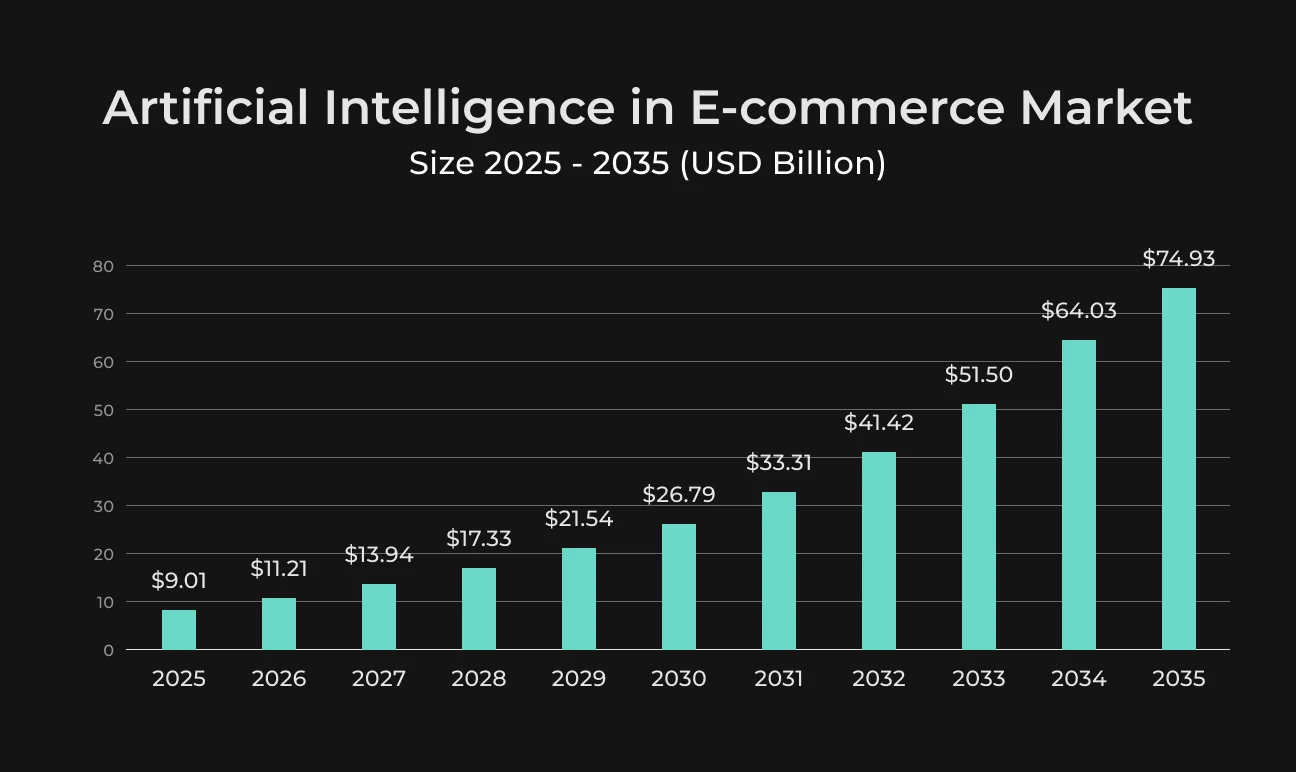
The online shopping industry is shifting rapidly. Experts estimate that the global AI market for e-commerce will reach $74.93 billion by 2035, already being evaluated at $9.01 billion in 2025. This means that AI in e-commerce is a primary driver of revenue growth and competitive differentiation.
Due to the benefits of artificial intelligence in sales, shoppers complete purchases up to 47% faster. That’s a direct win for both businesses and consumers, as a fast purchase flow almost always results in enhanced satisfaction.
In this article, SapientPro’s engineers will explain AI sales agents and their impact on personalization for your business. Read on for more!
What Is an AI Sales Agent and How Does It Work?
To understand the current state of digital commerce, it is essential to distinguish between traditional conversational interfaces and modern AI agent for sales. The difference lies in how these systems "think" and act:
- First-generation chatbots: these operated on rigid decision trees. They followed structured "if/then" pathways and could only respond within very narrow, predefined parameters.
- Modern agentic AI: this represents a leap toward autonomous reasoning. Unlike their predecessors, which waited for direct prompts to perform simple tasks, these agents are context-aware and proactive.
Unlike their predecessors, which remained dependent on direct user prompts to initiate action, these advanced agents can:
- Understand customer intent;
- Adapt to changing contexts;
- Execute complex, multi-stage tasks across disparate business systems.
The foundation of an AI sales agent relies on its ability to move beyond text generation.
It functions as a digital employee capable of reasoning through a high-level goal, decomposing it into discrete subtasks, and using external tools to achieve the result.
Agent Type | Technical Capability | Decision Logic | Operational Role |
| Simple Reflex Agent | Condition-action rules | Reactive; no internal memory | Handles basic FAQs and keyword-based triggers. |
| Model-Based Agent | Tracks internal state/environment | Context-aware; uses historical data | Manages multi-turn dialogues and tracks customer progress. |
| Goal-Based Agent | Plans actions to meet objectives | Proactive; decomposes tasks | Executes complex workflows like returns or custom order configurations. |
| Utility-Based Agent | Optimizes for specific metrics | Evaluates trade-offs for efficiency | Maximizes profitability through dynamic pricing and upselling. |
| Learning Agent | Self-optimizes via feedback | Adapts to user behavior patterns | Continuously improves conversion strategies and sentiment detection. |
| Agentic AI | Goal-oriented autonomy | Long-term planning; tool execution | End-to-end task automation and multi-app coordination. |
Key Tech Stack in Your AI Sales Agent
The effectiveness of an AI sales agent depends on a sophisticated tech stack that blends creative generative models with analytical precision.
The true power of a sales AI agent solution lies in its connection to your internal data. RAG ensures the agent's responses are grounded in real-time, proprietary information—such as product catalogs, shipping policies, and customer history.
By using RAG, you eliminate "hallucinations" (made-up facts) and ensure the AI speaks with your brand's authority.

Serj Molodyk
The integration of model context protocols (MCP) is important for sales AI agent solutions.
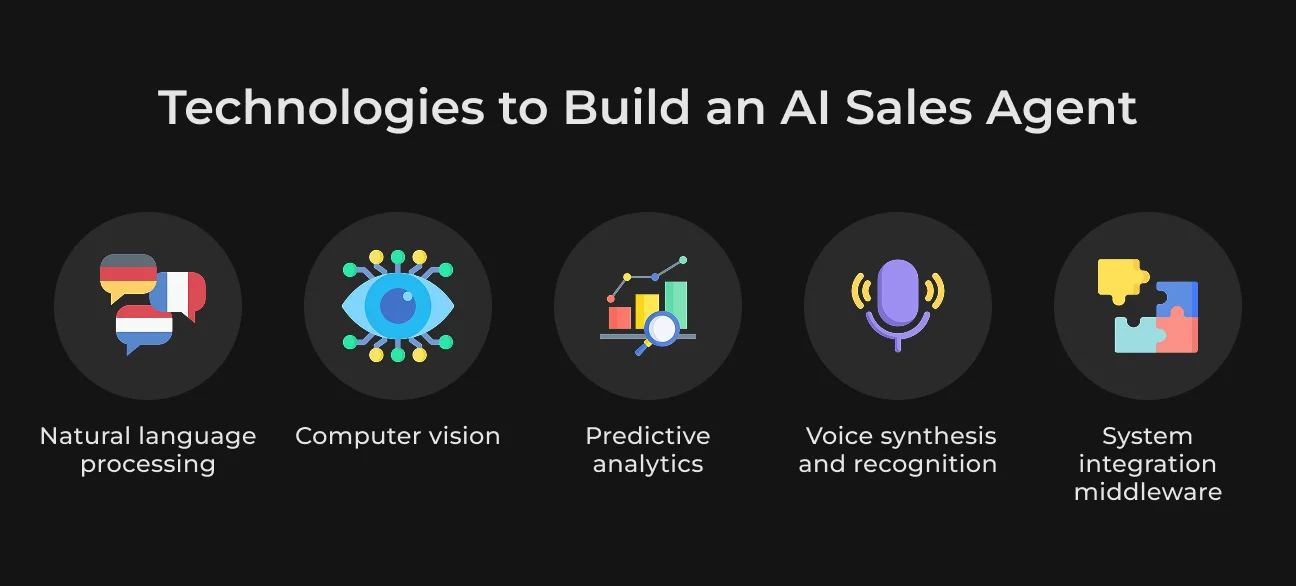
Thanks to this structured blueprint, AI platforms can retrieve and interpret site data more effectively. For a top AI sales agent, the tech stack must also encompass several other critical components:
- Natural language processing (NLP) and understanding (NLU).
These engines decipher literal text, sentiment, urgency, and the underlying intent of the customer. With it, the agent can detect buying signals and objections directly from natural language.
Particularly relevant for high-end retail, vision-enabled agents can analyze uploaded images for virtual try-ons or suggest products based on visual style and skin tone.
These tools perform lead scoring by identifying micro-signals in consumer behavior, which indicate serious purchase intent. For example, these can be dwell time on pricing pages or patterns of sequential content downloads.
Driving the rise of the AI voice sales agent, these systems use vocal biomarkers to assess customer stress or excitement levels during phone-based interactions. These vocal biomarkers can be pitch, intensity, and prosody.
- System integration middleware.
Agents must connect to CRM (e.g., Salesforce, HubSpot), ERP, and payment systems (e.g., Stripe) to pull live data and finalize transactions securely.
These technologies enable seamless integration between the user experience and the back-end.
Types of AI Agents in E-Commerce
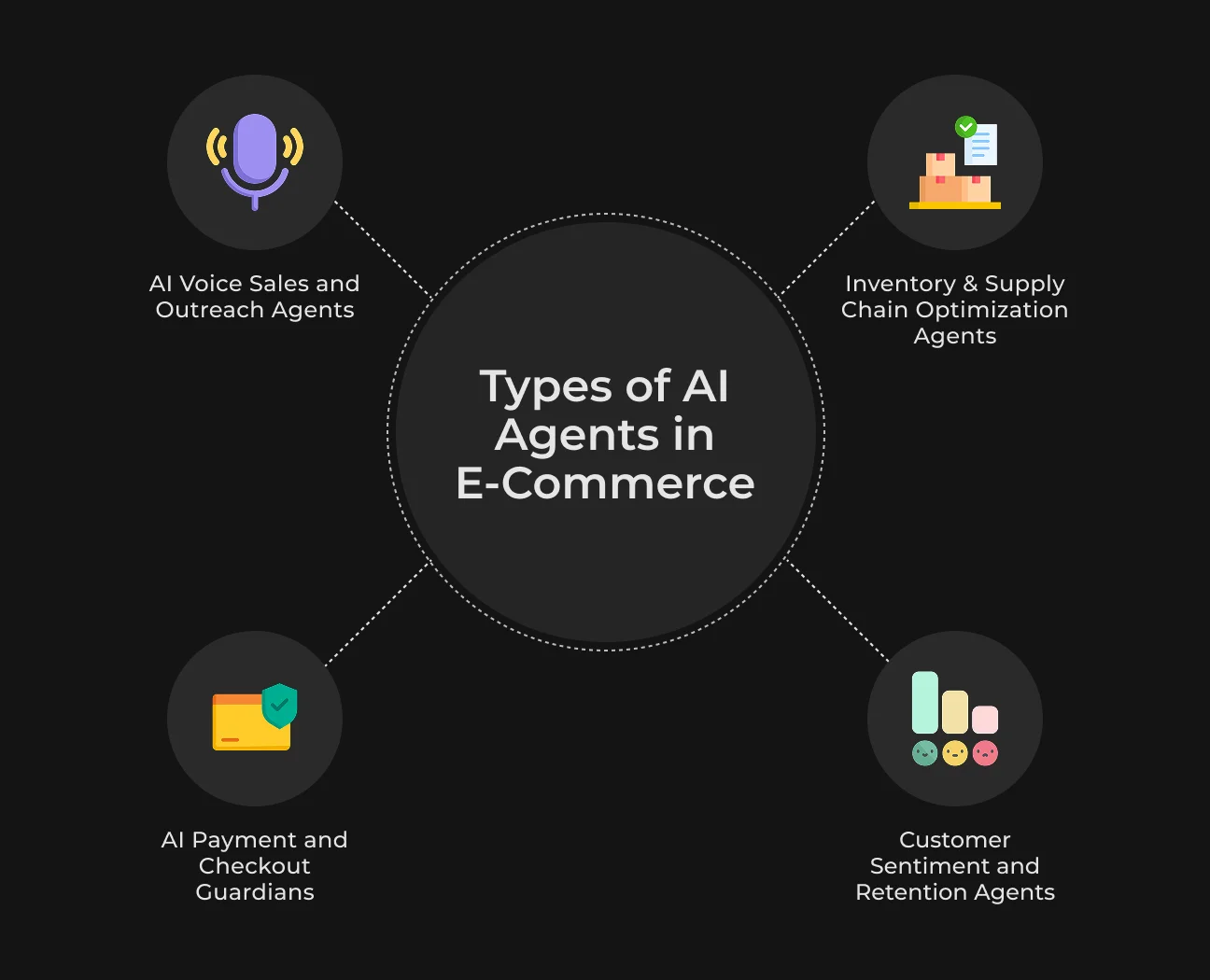
The application of AI in retail has led to the development of specialized agents, each tailored to specific segments of the buyer journey.
Autonomous Shopping Agents and Personal Concierges
Traditional search filters rely on rigid keywords. An AI shopping agent can interpret vague or context-heavy intent. These systems function as virtual stylists or product experts.
For instance, an agent might assist a customer looking for an outfit for a specific event by cross-referencing inventory with external data like weather forecasts or local trends. These agents drive 3-4x higher conversion rates and 30% larger cart sizes than traditional search methods.
Voice-First Sales and Outreach Agents
The AI voice sales agent represents a significant shift in conversational commerce. These agents handle customer phone calls using natural conversation. They also:
- Answer product questions;
- Check inventory;
- Process orders in real-time.
They are particularly effective for outbound lead qualification and cart recovery. They can call customers within minutes of abandonment and recover 3-5x more sales than traditional email campaigns.
Inventory and Supply Chain Optimization Agents
AI agents for e-commerce are transforming back-office logistics. To initiate procurement or optimize warehouse sorting without human intervention, they monitor:
- Stock levels;
- Supplier performance;
- Shifting demand patterns.
Autonomous systems analyze customer shopping patterns and economic shifts to forecast demand. They can even prioritize workloads based on strategic outcomes rather than static rules.
AI Payment and Checkout Guardians
By monitoring transaction data for suspicious activity, they reduce false alarms and ensure a smooth checkout experience. Advanced versions, such as Google's AI Mode, can:
- Automatically add items to a cart;
- Pre-fill checkout information;
- Finalize purchases securely via integrated payment gateways.
These agents simplify the final stage of the purchase funnel by automating payment flows and detecting fraud in real-time.
Customer Sentiment and Retention Agents
Using sentiment analysis, these agents automatically decipher the emotional tone of customer comments and reviews. In a sales context, they can flag churn risks or identify upsell cues within seconds of an interaction.
This allows your business to proactively reach out to at-risk accounts or adjust marketing messaging based on what features are generating the most enthusiastic positive feedback.
Why Your E-Commerce Business Needs an AI Sales Agent
Agentic AI for sales is characterized by several critical business imperatives.
As digital markets become more saturated, the ability to provide a personalized journey becomes the primary competitive lever for e-commerce brands.
1. Automated Repetitive Sales Operations
AI sales agent software eliminates manual repetitive tasks, including:
- Lead discovery;
- Data enrichment;
- Initial screening.
By automating top-of-funnel activities, human representatives focus exclusively on high-value negotiations. Statistics indicate that organizations deploying these agents see a 90% reduction in campaign setup time and a 70% decrease in manual research efforts.
2. Personalized Interactions with Clients
AI e-commerce personalization must be your top priority. 80% of consumers surveyed prefer brands that offer personalized experiences and report spending 50% more with them.
An AI sales agent achieves this by analyzing massive datasets in real-time, including:
- Purchase history;
- Browsing behavior;
- Real-time signals.
AI e-commerce personalization allows you to offer unique contact points and product carousels. This level of tailoring typically yields an average 10-12% increase in revenue and boosts customer satisfaction by over 25%.
3. Optimized Costs and ROI
The economic disparity between human agents and AI systems is profound. While human-led interactions can cost $3.00 to $6.00 per contact, an AI agent reduces this to $0.25 to $0.50 per contact. For high-volume businesses, this represents an 85-90% reduction in customer service and sales support costs.
Furthermore, AI-driven strategies can increase profitability by up to 59% by 2035. Early adopters are already seeing 5-10% improvements in bottom-line margins.
4. Improved Customer Journey
AI eliminates hesitation by offering timely answers and personalized suggestions. It accelerates the product discovery phase. Research shows that shoppers complete purchases 47% faster when assisted by AI tools.
12.3% of shoppers who engage with AI-powered chat make a purchase, compared to just 3.1% of those who do not. Proactive AI is reducing bounce rates and recovering up to 35% of abandoned carts.
5. Scalability Without Human Limits
How many meaningful conversations per day might a top-tier human salesperson manage? Our experience says 50-100. In contrast, an AI sales agent can manage thousands of interactions simultaneously. It can do it without sacrificing quality.
This allows businesses to handle peak traffic periods as opportunities for revenue.
Get an E-Commerce Solution That Sells
SapientPro will help you get a modern web store for your business.
Key Features of the Best AI Sales Agent Software
The best AI sales agent software is defined by its ability to integrate deeply into the sales ecosystem while providing advanced autonomous capabilities that go beyond simple text responses.
Product Discovery and Merchandising Intelligence
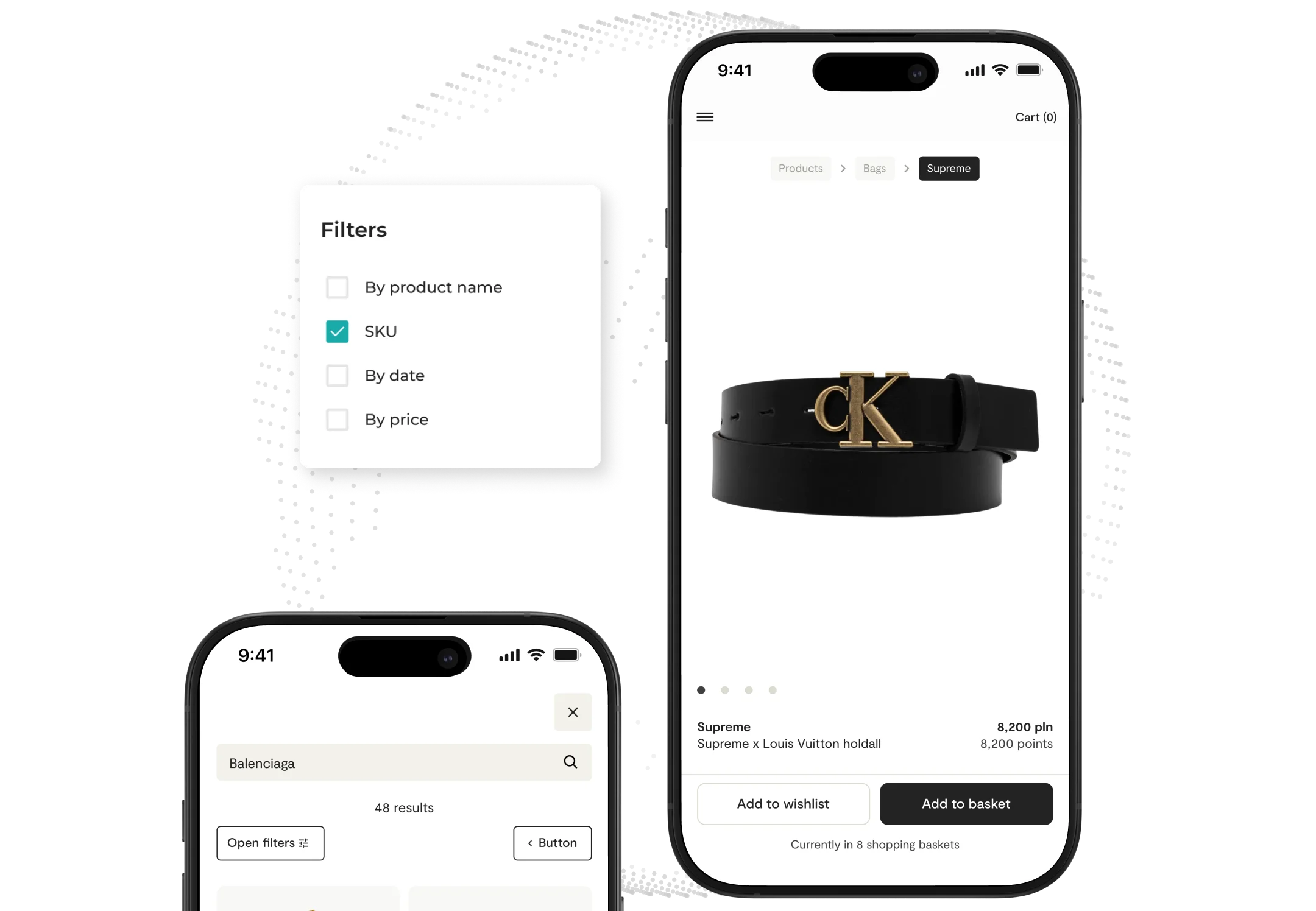
Modern software uses semantic understanding and natural language processing to turn search into a conversion engine. Wizzy.ai and Klevu deliver hyper-relevant results by understanding user intent rather than just matching keywords.
This includes:
- Auto-correction;
- Typo tolerance;
- Visual merchandising tools.
All these boost upselling by presenting products based on real-time behavior and trends.
Pricing Optimization and Elasticity Analysis
Sales AI agent solutions use intelligence to set the optimal price for every deal and customer. These tools adapt instantly to:
- Market shifts;
- Competitor moves;
- Supply chain fluctuations.
For example, AI-driven models like Competera's analyze the impact of pricing factors on sales dynamics. It can recalculate billions of pricing combinations in real time. This way, it delivers optimal prices for each SKU.
With a sales AI agent, you proactively manage margin guards and automate markdowns for stock clearance.
Autonomous Lead Qualification and Triage
The leading AI agent for sales enablement excels at scoring real buying signals. These agents autonomously monitor all customer touchpoints to:
- Identify subtle buying indicators, such as extended sessions on pricing pages;
- Route hot leads to human reps via Slack or CRM alerts.
This ensures reps focus only on winnable opportunities. We see improved qualification accuracy to levels impossible with static rules.
Multi-Modal Sentiment and Emotion Analysis
Top-tier software transcribes both words and vocal tone in real-time to score the emotional undercurrent of a call. By extracting pitch, intensity, and pace, systems like Kixie pinpoint coachable moments for sales teams and identify winning behaviors.
This sentiment analysis identifies themes in customer negativity, such as frustration over shipping. Thanks to this, marketing teams can fix problems faster and double down on what customers love.
Agentic Autonomy in Deal Management
True agentic AI for sales possesses reasoning and planning abilities that allow it to understand context and adjust the customer experience dynamically. If a customer abandons a cart, the agent analyzes why—whether it was price concerns or shipping costs.
How? By evaluating purchase history and competitor pricing in seconds. It then decides autonomously whether to send a discount or wait, executing these actions across channels and learning from the outcomes to self-optimize.
Use Cases and Examples of AI Agents in E-Commerce
The deployment of AI agents is manifesting in various high-impact scenarios.
1. AI Shopping Agents
Modern AI e-commerce brands are deploying shopping agents that act as digital employees using reasoning to execute tasks. Unlike standard filters, these agents interpret vague intent and cross-reference inventory with external data like style guides to suggest tailored bundles. These implementations have shown an 11.4% revenue attribution and a 38% uplift in Average Order Value (AOV).
2. Payment and Checkout Automation
AI simplified payment flows and fraud detection. Systems like Alhena AI bridge the gap between support and sales through agentic checkout. It proactively resolves hesitation by answering last-minute shipping or inventory concerns just before the transaction is finalized.
3. AI in the Automotive and Luxury Goods Sectors
BMW uses AI as a fundamental driver across its entire value chain. The company employs 24/7 virtual assistants to provide verified information on nearly 10 million possible vehicle configurations. Furthermore, AI-supported software in the "Neue Klasse" vehicles allows a driver's intentions to meld intuitively with the vehicle's automated systems, a concept known as "Symbiotic Drive".
4. Real-Time Cart Recovery Calls
AI voice agents call abandoned cart customers within minutes of their departure. Unlike email campaigns with low open rates, these voice agents recover 3-5x more sales.
How? This happens through personalized conversations addressing specific concerns about price or shipping.
5. AI-Powered Size and Fit Guardians
Return rates are a major cost for e-commerce. To reduce them, the best AI sales agent allows shoppers to upload full-body images for virtual try-ons. These fit analyzers receive color palette recommendations based on skin tone and provide accurate sizing suggestions.
This way, they bridge the tactile gap of online shopping.
6. Dynamic Promotional Optimization
AI decides which products to discount, how much, and when. This happens based on customer segmentation intelligence. AI turns promotions from blunt tools into precise strategies that minimize profit erosion while maximizing profitable demand.
7. Lead Discovery and Outbound Sales Ecosystems
Platforms like Jeeva AI combine into a single platform:
- Lead discovery;
- Enrichment;
- Multi-channel outreach.
Companies report up to 6.7x higher reply rates and 40% shorter qualification cycles by allowing agents to autonomously navigate LinkedIn and email outreach.
8. Automated Returns into Re-purchases
Voice agents guide customers through the return process while simultaneously suggesting alternative products. They really can verify eligibility and generate labels. This transforms a potential loss into a re-purchase. Returns are turning into revenue opportunities.
How to Create and Deploy an AI Sales Agent
SapientPro’s engineers have rich experience developing AI agents for e-commerce and sales industries. This requires a structured approach with clear expectations. You can use this checklist below as your roadmap for deployment.
Step | Action Item | Key Deliverable |
| 1. Identification | Select one high-volume workflow (e.g., lead qualification). | Defined KPIs and success metrics. |
| 2. Data Preparation | Consolidate data from CRM, ERP, and catalogs. | Cleaned, labeled knowledge base. |
| 3. Model Selection | Choose between hosted APIs (GPT-4) or open-source (Llama). | Selected AI model architecture. |
| 4. Orchestration | Build tool-use logic via frameworks like LangChain or AutoGen. | Decision-making logic trees. |
| 5. Integration | Sync agent with payment gateways and CRM systems via APIs. | Functioning multi-app ecosystem. |
| 6. Hardening | Implement security audits, RBAC, and PII redaction. | Compliance certifications (GDPR, SOC 2). |
| 7. Testing | Run simulation modes on past tickets and A/B test tone. | Refined agent accuracy & resolution rate. |
| 8. Optimization | Monitor model drift and update prompts quarterly. | Continuous performance improvement. |
E-Commerce AI Agent Development Costs
The cost of developing an AI shopping agent depends on complexity, the degree of autonomy, and the depth of system integration. You can learn about the industry’s average costs in the sheet below. The potential expenses are calculated based on online data from software development companies.
Feature / Intelligence Level | Complexity | Development Cost (Est.) | Timeline |
| Reactive / Simple Reflex | Low | $10,000 – $35,000 | 2–6 Weeks |
| Contextual / Multi-Step | Medium | $40,000 – $80,000 | 4–10 Weeks |
| Autonomous / Agentic | High | $100,000 – $300,000+ | 10–24 Weeks |
| Basic API Integration | Low | $1,000 – $4,300 | 1–2 Weeks |
| Voice Interaction (ASR/TTS) | Medium | $2,600 – $6,900 | 3–5 Weeks |
| Legacy System Integration | High | $4,300 – $10,000+ | 4–8 Weeks |
| Maintenance & Monitoring | Recurring | $500 – $10,000 / Month | Continuous |
Note that these costs are approximate estimates and may vary based on factors such as data quality, real-time requirements, and whether you build in-house or outsource. SapientPro provides detailed estimates for your business after an initial consultation and feasibility research.
How SapientPro Reduced Sales Agent Costs to $1/hour
One of SapientPro’s leading case studies is the development of an AI consultant capable of automating routine and cold calls. The challenge was to maintain a human-like conversation with response times faster than those of competitive offerings.
SapientPro’s team built a system using generative AI models that achieved a latency of 700ms, ensuring responsive interactions.
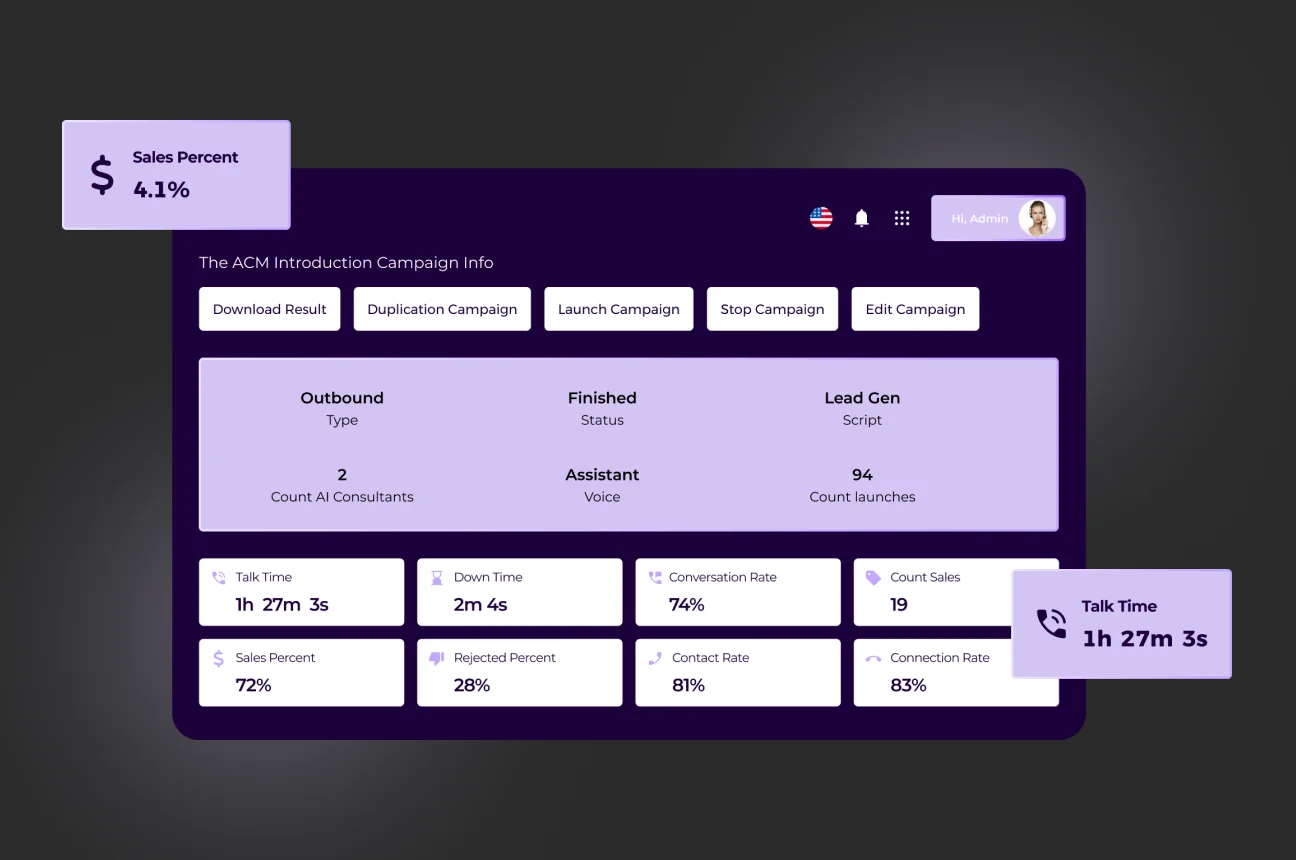
The results of this implementation were transformative:
- Cost efficiency. Human-agent costs of $15 per hour were reduced to $1 per hour for the AI agent.
- Campaign velocity. The time to launch a call campaign was reduced from two weeks to just one day.
- Setup savings. Campaign onboarding costs were slashed from $5,000 to $100.
- Ease of management. Administrators can train the agent on a new topic in just five minutes, and the system supports an unlimited number of agents simultaneously.
We used Kubernetes-powered scalable infrastructure and intelligent speech recognition.
Partner with SapientPro to Build Your AI Agent
SapientPro is a team of 70+ experienced professionals with different industry backgrounds. We provide the know-how necessary to get your product off the ground using top-tier technologies. You’ll get the best solutions for your business based on years of experience and technical expertise.
See our case studies:
- AI-Assisted Service for Produce Quality Automation;
- AI Solution for Efficient CV Processing at Scale;
- Dialect-Sensitive AI Voice Assistant;
If you need to develop an AI shopping agent, SapientPro is your reliable tech partner.
Get in touch with our team to start your project.
Leverage AI for Better Sales
SapientPro's engineers will help you get modern tech for improved conversions.