
All How to Make an AI Voice Chatbot for Customer Support & Interaction
February 21, 202615 min read


Customers are often put on hold to receive answers from customer service on the phone. And that is actually inevitable, because humans simply could not compete with the speed of machines.
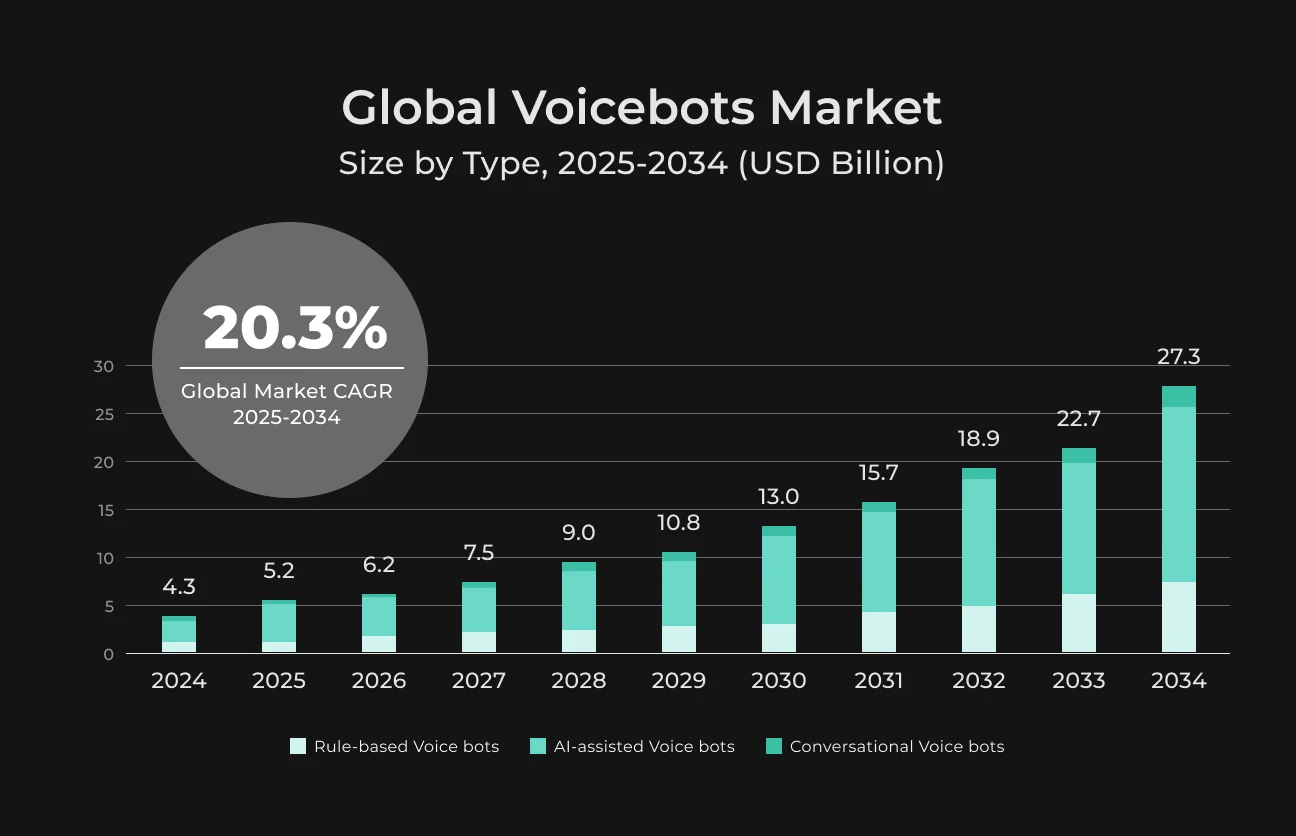
AI voice agent solutions have revolutionized customer support. The global voicebots market can reach $27.3 billion in 2034. Integrating generative AI, these bots can now have organic, human conversations.
But what is a conversational AI voice chatbot exactly?
What it does and how businesses can use one to their benefit?
Find the answers in this new guide from SapientPro’s engineers.
What is an AI Voice Agent?
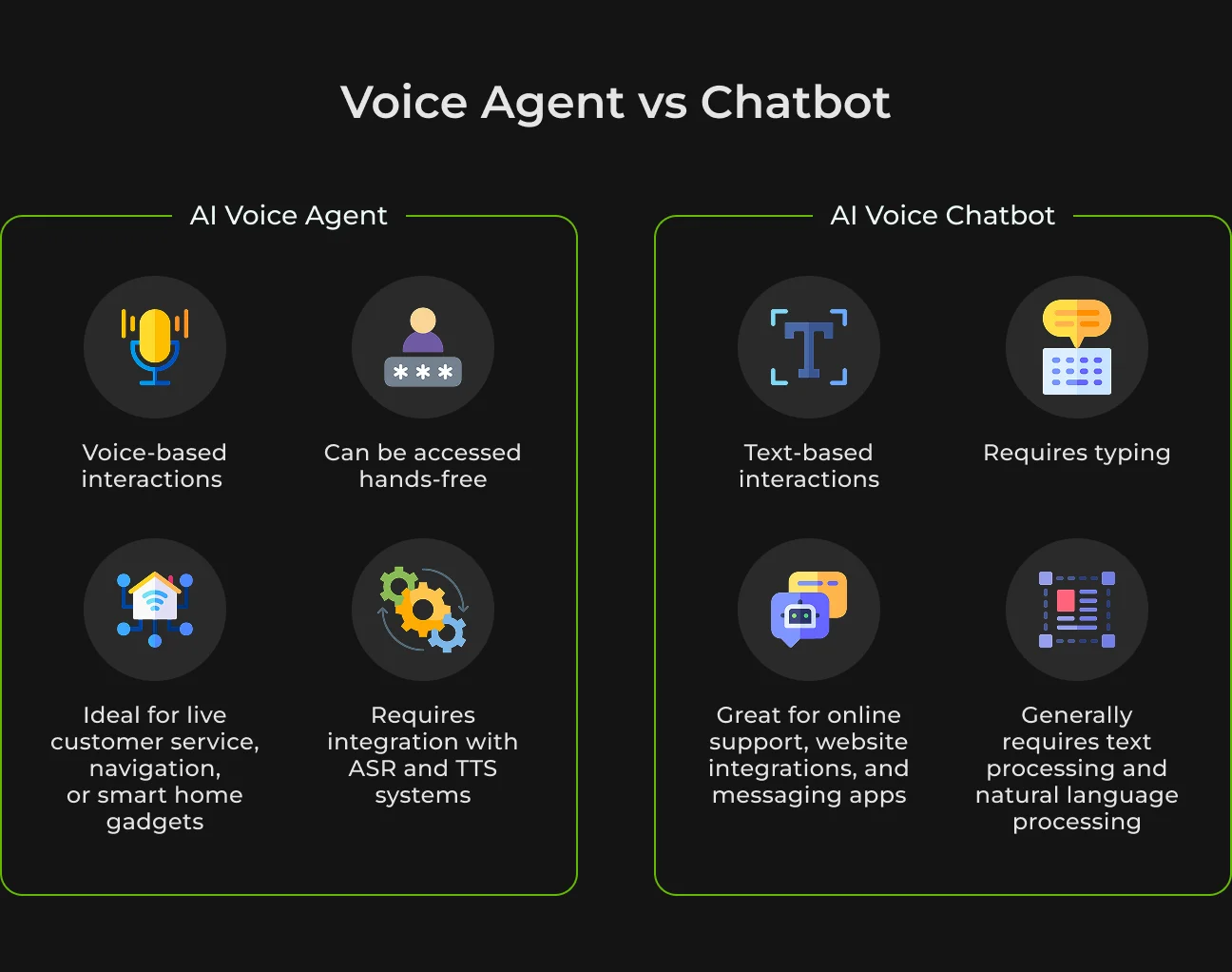
Old-style chatbots only support the textual channel, and do not understand or produce speech. While an AI voice agent is a specialized system designed for use in voice interactions.
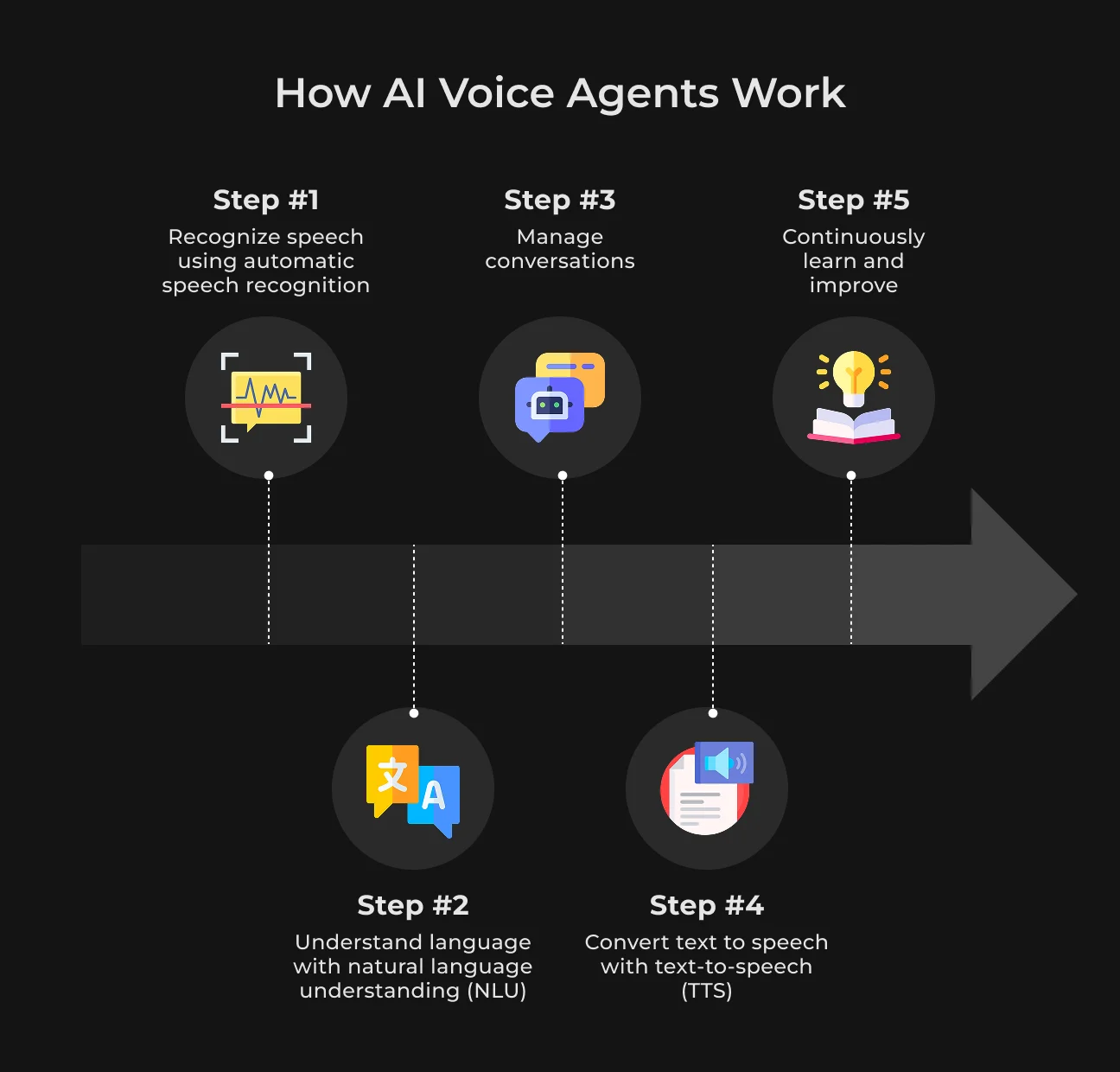
Leveraging natural language processing and machine learning, AI voice solutions understand what an individual is saying, learn from that, and improve. They grasp context to keep the conversation relevant and applicable to a situation.
What is an AI Voice Chatbot?
An AI voice recognition chatbot is similar to an AI voice agent since they both engage in spoken interactions. However, chatbots are a bit narrower. Both leverage NLP and machine learning, but voice chatbots are often deployed for a particular job or localized use cases.
AI voice agents and bots have distinct applications and use cases. Voice bots are virtual assistants within an app or service. They can, for example, set reminders or respond to FAQs.
AI voice agents offer something more comprehensive. This means they can run full customer service interactions, including complex problem-solving or transactions, through multiple channels.
Yet, these categories are becoming less distinct due to technology. Both aim to create easy, natural user experiences with voice-based interfaces.
Where Voice Agents Operate
AI voice agents are quite versatile. They seamlessly integrate into various communication platforms to provide robust support far beyond the possibilities of traditional call centers.
These agents are able to interact with PSTN as well as SIP systems, which allows them to place and handle calls over traditional phone lines.
Reliability and well-established clarity of PSTN are the mainstay for landline communication. And they are still crucial, especially in areas where traditional phone service is prevalent.
These capabilities allow AI voice agents to power and even completely replace contact center operations. They can receive calls, automate responses, and, if necessary, route the call to a human agent.
Whereas VoIP is about sending voice data, Session Initiation Protocol (SIP) is what gives it even more life. It allows for the creation, management, and termination of those voice calls.
SIP phone solutions use machine learning algorithms. These systems analyze call data on the fly to tune audio parameters for optimal performance. As a result, the audio is clearer, and the user is satisfied with improved communication.
Why AI Voice Agents & Chatbots Are the Trend in 2026
We can likely expect AI voice agents and chatbots to become standard parts of customer service and engagement strategies. Several reasons explain this surge.
Advances in Speech and Language Technologies
Newer language models, like GPT-4, have expanded the boundaries of what AI can do with language. These advancements have made AI voice assistants and chatbots much smarter when speaking. They can parse nuances of languages and provide responses with a more human touch.
Developments in speech synthesis and recognition have also enhanced the clarity, naturalness, and accuracy of interactions.
About 30% of consumers—and more than 37% among Gen Z and millennials—choose to quicken service with an AI agent over a human. Plus, 80% of routine customer care questions might be answered by virtual agents by 2029, with 30% cost savings.
24/7 and Multichannel Support Requirement
Today’s consumers demand instant, 24/7 support. While 65% would like businesses to anticipate their needs and make relevant suggestions.
With AI voice and chat, businesses can engage customers over the phone, on mobile applications, and online when it best works for them.
Improved Customer Experience and Efficiency
AI voice agents and chatbots provide faster replies, fewer mistakes, and better service. With the help of AI, satisfaction levels can increase by 15% to 20%, revenue by 5% to 8%, and service costs can potentially decrease by up to 20-30%.
Generative AI Voice Bot Architecture
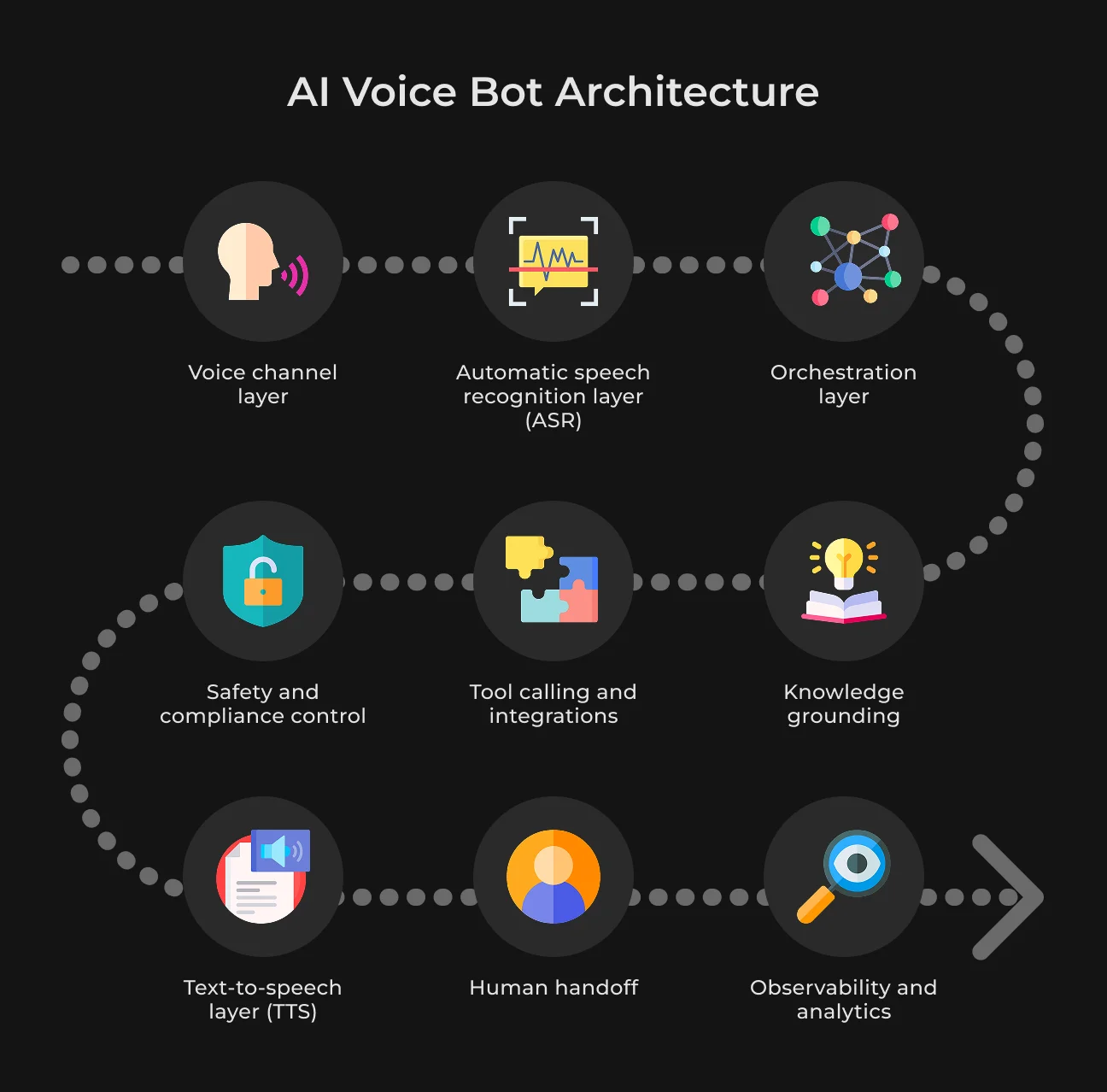
A generative AI voice bot requires a system that controls every detail of the interaction. This way, users will feel no difference in customer experience, while engineers will meet technical requirements for reliability and compliance.
Let’s examine this complex system to understand its basic elements and what each of them does.
Voice Channel Layer
This is the single point of contact for all inbound and outbound calls. It routes calls to the proper destination, whether an automated system or a person.
The voice channel layer also keeps calls connected, handles recordings, and allows for call holds and transfers without losing information.
Automatic Speech Recognition (ASR) Layer
The ASR layer is the part that transcribes (or decodes) your spoken words into text. This process can be further enhanced by recognizing when someone stops speaking (end-pointing) and evaluating how accurate the transcription is (confidence scoring).
Diarization can then provide information about who is speaking. So that the context of interaction becomes more detailed.
Orchestration Layer
The orchestration layer acts as the brain of the voice bot, managing the conversation's direction. It switches between set conversation paths for simple questions and AI-powered thinking for complex interactions.
This layer keeps track of the conversation, allowing the bot to understand context and give consistent responses throughout the dialogue.
Knowledge Grounding
Grounding knowledge is important for reliable and accurate interactions with the AI. It includes obtaining information about trustworthy sources to guide AI responses and avoid errors or disinformation.
Techniques like retrieval-augmented generation (RAG) are used to gather precise data, ensuring policies and information are correct.
Tool Calling and Integrations
For the voice bot to be truly helpful, it needs to call out and integrate with other systems. This enables the bot to take action, like generating support tickets, verifying order status, or user account information.
Safety and Compliance Controls
All these steps are managed through safety and compliance controls. They protect your privacy with PII redaction and encryption tools as necessary.
The system also controls how long data is retained, restricts certain types of processing, and contains defenses against bad inputs to protect the system from abuse.
Text-to-Speech (TTS) Layer
The TTS layer transforms answers into a voice that sounds interesting and trustworthy, and lets the bot communicate in the brand’s tone. It also includes a feature that allows users to interrupt the voice, giving them more control during the interaction.
Human Handoff
When a person needs to take over, the human handoff process starts. It hands the conversation to a human agent, providing them with important details like a transcript, a session summary, key points, and recommended next steps. So, the agent can continue the interaction.
Observability and Analytics
The final part of the architecture involves observability and analytics. It focuses on monitoring system performance, identifying latency problems, assessing outcomes, managing fallbacks, and accurately categorizing errors.
These insights also help continuously optimize the voice bot so that it stays robust and provides great service as circumstances change.
How to Create a Conversational AI Voice Bot in 2026
Understanding the structure of AI bots is one thing. Now, look at how to create a voice bot. The right strategy can vary based on your timeline, budget, and technology. Let’s detail this process.
Step 1. Define the Scope and Guardrails
Decide on the main tasks your bot needs to perform, from simple questions to more complicated jobs.
Set rules for when the bot should hand things over to a human. Also, list what the bot is allowed to do to ensure safety and compliance. This process helps set the limits and abilities that will guide your voice bot development and focus.
Step 2. Prepare Knowledge and Data
After defining the scope, gather and prepare the necessary data. This may involve capturing valuable information like FAQs or past chat interactions.
Put someone in charge of updating that data, and you’ll ensure that the content remains relevant.
Step 3. Select ASR/TTS and Design Voice UX
Choose among the top automatic speech recognition (ASR) and text-to-speech (TTS) systems so your bot can sound better. Also, consider any language needs to serve more people.
Creating a good voice user experience means making interactions easy, responsive, and welcoming for everyone.
Step 4. Build the Orchestration and Dialog Logic
Organizing and managing conversations are central to its architecture. With large language models (LLM) and retrieve-augmented generation (RAG), the bot can answer a wide range of questions.
These models help develop a bot that is consistent, flexible, and can achieve human-level language quality.
Step 5. Integrate with Support Systems
Connecting your bot to existing systems like CRM platforms, helpdesk apps, and order management tools is vital for building a strong setup.
This allows the bot to handle tasks like checking customer details or managing service requests.
Make sure to use secure verification methods to protect data and keep users' trust.
Step 6. Add Safety, Security, and Compliance
Implement PII controls for role-based access control (RBAC), define rules to restrict access, and log the transaction. Set up mechanisms to prevent abuse, so your voice bot remains reliable and trustworthy.
Step 7. Test Like a Contact Center
Before launching your voice bot, testing is integral to ensure success.
Start by running scripted intent tests to make sure everything is working correctly. Then perform adversarial voice tests to better understand how well it can handle background noise, different accents, or interruptions.
And there’s a good reason to load tests. So, you know the system can take more than one transaction without slowing down.
Step 8. Deploy, Monitor, and Iterate
Deploying a bot is only the beginning. Start with Canary editions to gradually move over to full production and reduce downtime. Also, analyze the failure types to locate and fix any weakness in your codebase.
Improve your bot with ongoing monitoring and weekly updates to keep up with current trends.
How Much Does it Cost to Build an AI-Powered Voice Bot
AI voice bot development solutions incur costs at every step of the way. The price is estimated according to the complexity and requirements of your project.
Here’s an approximation of those costs so you know what to look for.
Development Costs
This is what you will need to build a voice bot:
#1 Design and planning. Initial phase that includes requirement gathering and prototyping. | $5,000 - $20,000 |
#2 Programming and integration. System integrations and custom coding. | $20,000 - $80,000 |
#3 Testing and QA. Extensive testing across different environments. | $10,000 - $30,000 |
#4 Custom features & enhancements. Industry-specific functionalities and user interface design. | $15,000 - $70,000 |
Total development costs may be $50,000 to $200,000 or even higher.
Usage Costs
Consider these estimated usage costs.
#1 Telephony minutes. Based on call volume and provider rates. | $0.01 - $0.05 per minute |
#2 ASR/TTS Usage. Depends on service and usage levels. | $0.0025 - $0.015 per use |
#3 LLM Tokens. Model usage charges. | $0.005 - $0.02 per interaction |
#4 Storage and retrieval. Data storage for analytics and compliance. | $200 - $1,000 monthly |
#5 Engineering and maintenance. Regular updates and system improvements. | $800 - $3,000 monthly |
Ongoing costs can be anywhere from $1,000 to $10,000 per month.
SapientPro offers extensive consultations to businesses that want to create an AI-powered voice bot. Experts will make a customized calculation for you based on the features, usage, and size of your generative AI voice bot solution.
Such an individual approach does more than just help with financial and resource planning — it gives support to your strategic goals.
AI Voice Agents Examples Across Industries
Let's share some practical applications created by SapientPro engineers for different businesses. You'll see how effectively these technologies drive growth and innovation.
AI-Powered Language Tutor
SapientPro's voice-activated AI tutor is like a virtual teacher that can be seamlessly incorporated into the school learning plan.
The app provides teachers with the ability to use pre-made lessons, complete real-time attendance monitoring, make handwriting corrections, and use an interactive whiteboard that includes both video and audio functions.
Students can learn languages through short, fun lessons. They can get immediate feedback on pronunciation, submit homework, or change teachers whenever they like.
The result is a flexible & dynamic learning environment that’s ideal for teachers and students.
Dialect-Sensitive AI Voice Assistant for the Arabic Market
SapientPro has developed an AI-based voice assistant that knows Arabic dialects and is aware of cultural issues.
Upon first contact, the assistant can recognize the dialect of the user's Arabic and respond in that dialect, including words, expressions, and accent.
It also takes into account gender, tone, and other local variations. The solution makes conversation more interesting and respectful for users within varied Arabic language-speaking communities.
AI-Powered Sales Expansion Tool for Call Centers
Our team created an AI consultant that can manage routine and cold calls. It makes interactions feel human while keeping things productive, scalable, and accurate.
This AI handles thousands of calls, produces detailed reports, and quickly addresses issues like paraphrasing or mistakes.
It eliminates the need to train human agents, making it easy to scale up without much onboarding hassle.
Plus, by adding a large language model, we've boosted its conversation skills for a more adaptable and engaging chat experience.
Common Challenges in Voice Recognition Bot Development
Voice recognition technology is beneficial for obvious reasons. But developing such an effective algorithm can be a challenge. See what barriers you might face when adopting this technology.
Accent and Dialect Variability
It’s tough to construct a voice recognition bot that could accommodate an array of dialects. Difficult accents remain a major problem despite all the tech innovations.
Research shows speech recognition systems are prejudiced towards particular accents.
They make considerably more mistakes in transcribing non-native (L2) English speech than native (L1) speakers. It also needs more diverse data and better quality models to truly capture different language backgrounds.
Contextual Understanding
Speech recognition apps often have difficulty with context. Half of consumers reported that they frequently find it frustrating to communicate with chatbots. Some 45% reported that chatbots had given them answers or solutions that didn’t match the nature of their question.
It takes extremely advanced NLP techniques and well-designed memory systems to make a bot understand context and maintain it.
Security and Privacy Concerns
Voice recognition technology stores sensitive information, which causes security and privacy issues. About 63% of participants in the study expressed concerns that generative AI could have a privacy-violating tendency to reveal private data.
By using strong encryption, anonymization procedures, and transparent data usage terms, these risks can be minimized. It not only protects the user’s data but also instills trust and increases voice bot adoption.
Scalability Issues
Deploying large-scale online voice conversation systems is challenging because scalability becomes an issue when people worldwide are talking at the same time. Once your business becomes bigger, your voice system has to handle more without slowing things down.
Elastic cloud-based system designs and effective load-balancing schemes are necessary for managing such demands.
Benefits of Interactive Voice Bots for Your Business
Let's explore what positive voice bots can actually do for businesses.
Enhanced Customer Convenience
Interactive voice bots make life easier for customers since they help 24/7. And the results demonstrate that virtual agents are a suitable choice for 61% of consumers. They would rather interact with a chatbot to avoid waiting times.
Improved Scalability
Interactive voice bots help businesses improve customer support without needing to hire more staff, meeting the increasing demand. This scalability is essential for companies that have variations in call volume.
For example, when volume increases, like during peak shopping times or for unforeseen spikes, voice bots help stabilize service levels by managing thousands of interactions on multiple channels.
Streamlined Operations
In a recent survey of IT and engineering leaders, 74% said automation has helped their workforce be more productive. And 59% reported that they lowered costs by as much as 30% with teams that had adopted process automation.
Personalized Customer Interactions
Voice bots are not generic and can respond in a unique way. These bots can offer custom advice and respond to every person. And 71% of consumers have already said they want companies to deliver personalized interaction.
Enhanced Brand Image
Deploying an interactive voice bot to engage in smarter conversations with customers is part of how the business can position itself as more progressive. Firms can upgrade their technology and send a signal to markets about how innovative they are.
Reduced Wait Times
Voice bots help respond to many customer queries and deliver shorter wait times. AI virtual assistants in call centers would take control of more interactions, reducing the number of calls requiring human support by 2%.
Faster servicing means happier and more loyal customers who help grow the company's long-term success.
Partner with SapientPro to Build Your AI Voice Chatbot for Customer Support
Discover the power of advanced customer support with SapientPro's AI voice chatbots. Our engineers are experts in AI, machine learning, and natural language processing who build chatbots that listen to and understand your customers.
Whatever size your business is, collaboration with SapientPro will help augment customer satisfaction rates, reduce support costs, and scale your business.
Contact SapientPro now and start your journey to innovation and excellence in customer engagement.
Build Your AI Chatbot with SapientPro

FAQ
What technology stack is required to deploy a scalable AI voice agent in a call center environment?
A production-ready AI voice agent combines ASR, LLM orchestration, telephony integration (PSTN/SIP/VoIP), CRM connectivity, security controls, and observability tools.
The key priority is reliability, compliance, and cost efficiency at scale. A properly architected solution supports thousands of concurrent calls, protects sensitive data, and integrates seamlessly with existing enterprise systems.
How can ElevenLabs enhance brand experience in enterprise AI voice solutions?
ElevenLabs strengthens the text-to-speech layer by delivering natural, expressive AI voices that align with your brand tone and audience expectations. This translates into higher customer satisfaction, improved engagement, and stronger brand perception.
High-quality voice synthesis reduces friction in phone-based interactions and ensures consistency across languages, regions, and customer support channels.
Why consider OpenAI API when building an AI voice agent for customer support?
OpenAI provides the reasoning layer that enables AI voice agents to handle complex, multi-step customer interactions instead of following rigid scripts. This means faster resolution times, lower support costs, and scalable automation.
Combined with knowledge grounding and integrations, OpenAI-powered systems can securely access company data, generate accurate responses, and continuously improve performance through analytics and monitoring.

