
All How to Build an AI Content Moderation Solution for SaaS
May 30, 202610 min read


People post all kinds of things about themselves online — their personal stories, breaking news, or political opinions. New forms of media technology may have expanded our ability to share more widely than ever before, but with that came the proliferation of problematic posts and misinformation.
For example, when Twitter (now X) came under Elon Musk’s control, he disbanded moderation teams and began reinstating banned accounts. Mark Zuckerberg hinted that Meta would do less partnering with independent fact-checking organizations.
It’s a must now for AI-based content moderation systems to sweep through the that volume of content and moderate by themselves.
This guide will help you build an efficient AI content moderation process. You will be able to establish user trust, fulfill legal consequences, and maintain your brand image despite the competition.
What Is Content Moderation: Definition
Under content moderation outsorcing, we mean the monitoring and control of user-generated content on social media and other digital platforms. This work really matters because moderation is what helps keep online spaces safe for users.
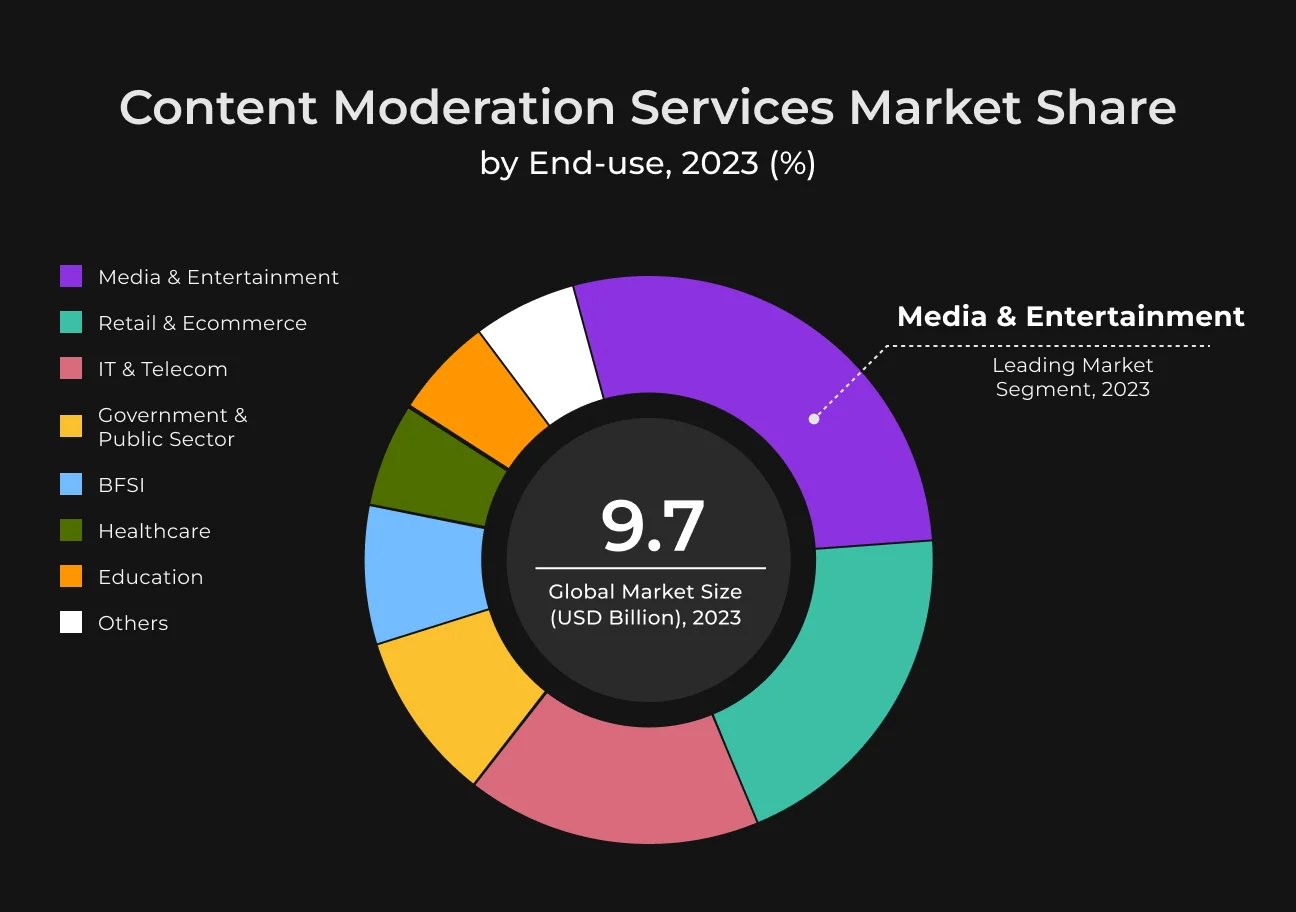
These rules help prevent harmful, offensive, or illegal content from spreading. The market for content moderation services globally is expected to grow as high as $22.78 billion by 2030.
Platforms may involve human moderatorion, software alone, AI, or a combination of these tools. Here are some components of content moderation.
- Text moderation. Text moderation means checking written content for harmful language, such as hate speech or threats, and removing it. This is meant to guarantee that debates are civil and follow the platform’s rules;
- Image moderation. Moderating images refers to reviewing photos for inappropriate or violent content.
Both of those are built on an extensive use of AI, but they’re backed up by humans to quickly detect and remove inappropriate images;
- Video content moderation. Moderating video content is naturally complex. It requires monitoring video and sound to ensure they both meet standards, and deleting any videos that don’t either immediately or shortly after they're posted;
- Audio moderation. Audio moderation reviews spoken content found within audio clips or video soundtracks for offensive language and themes. It uses speech recognition technology to isolate and flag troublesome audio.
Types of Moderation
No platforms look the same, and content moderation strategies must fit the specifics of scale, type of hosted content, and composition of users. The kinds of moderation appropriate for a large network won’t be quite the same as those on a more tightly-focused platform.
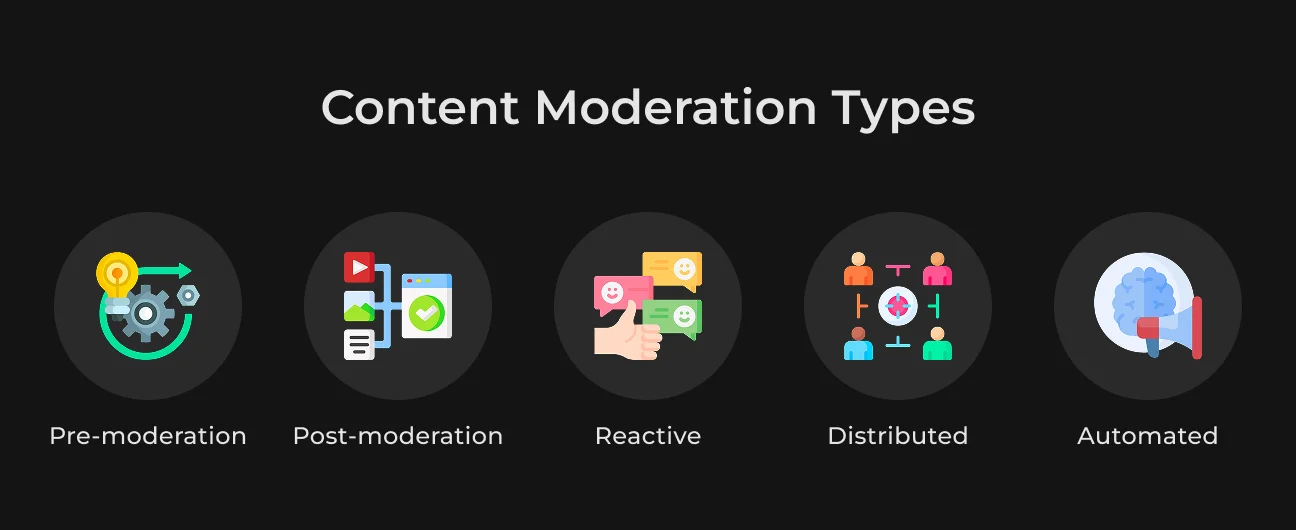
Let's understand these types.
Pre-Moderation
Content is monitored, approved, and only then posted. People will be aware that content is queued until verified by moderators.
It also gives the most control and only lets approved content go live, which makes it ideal for sites where quality and safety are the number one consideration.
These might be children-oriented, corporate communication sites, online education platforms, or health-community-based websites.
Post-Moderation
This moderation happens after content is published. It lets everything go live immediately while still having oversight through user reports, automated systems, or regular checks.
By identifying problematic content instead of all content, this method is effective and low-cost. It’s ideal for systems with large amounts of user traffic that require real-time communication, like social media sites, news comments sections, and well-trafficked forums.
Reactive Moderation
Reactive moderation relies on users to bring content up for review. It is one of the most cost-effective and scalable alternatives for promoting community engagement and collaboration.
It’s useful in some mature communities where users are familiar with and follow etiquette for the platform, like professional or niche forums.
Distributed Moderation
This distributes the task of reviewing content to reputable members of a community or volunteer moderators. It encourages user participation and relies on volunteers for 24/7 coverage.
It’s great for large platforms that contain small, diverse communities within these platforms, like Reddit, or a forum where only hardcore knowledge of its topic will work.
Automated Content Moderation
Automated moderation means the process of using AI and machine learning to perform checks on content and manage it in real time. It uses natural language processing to identify and take down controversial content without human intervention.
It also fosters efficiency and scale, as rules are applied uniformly around the world. It is most effective on high-volume sites, such as social media, streaming, or online marketplaces.
Key Challenges in Digital Content Moderation
While AI moderation offers the advantages of speed and scale, it also creates complications that cannot be ignored by platforms.
Managing Content at Massive Scale
Today, platforms receive millions of user-generated posts a day, and in some cases, billions. The task of moderating such a volume efficiently is enormous.
Automated systems can, of course, lend a hand, but no algorithm is infallible, and increasing human oversight can take time and be costly. The balance between the two (tech and users) has to be great. So that not a piece of content goes unverified.
Meeting Real-Time Moderation Demands
With abuse or sensitive content, users expect quick responses. That in-the-moment moderation is crucial to blocking misinformation, abuse or illegal content from being spread. But assessing posts as they arrive, without also losing accuracy, is quite difficult.
Automated tools also must work in concert with human moderators who can take action on problematic posts in real time.
Understanding Nuance and Context
And the tone of a post can change completely — sarcasm, slang, and memes don't always translate across cultures.
Computers don’t grasp the subtleties of verbal signifiers that guide physical conversation, and even human moderators will occasionally miss the context. They could need a great deal of background information to read through wordy prose.
The purpose is precise moderation requiring tools and teams with the ability to comprehend context at a depth that spans many styles of communication.
Moderating Across Multiple Languages and Cultures
Understanding idioms, local conventions and cultural sensitivities are essential in successful moderation.
As we know, what is completely innocuous in one language may be an affront in another. It is still a heavy technical and operational lift to build systems that are linguistically and culturally aware.
Addressing Bias and Ethical Challenges
There’s bias in algorithms, as well as UGC content moderation. Automated moderation can disproportionately elevate certain groups or topics. There are also access issues, like fairness, transparency, and accountability in the process — which means platforms need to audit frequently and revise moderation policies.
Protecting the Mental Health of Moderators
Human moderators can be exposed to disturbing or violent content too much, which could lead to burnout or make them more annoyed or stressed. Moderators need to be supported.
Businesses should integrate forms of AI help for teams that lessen emotional burden without compromising the quality of moderation.
AI Content Moderation vs Human Moderation
Content moderation today is a hybrid of tech and human judgment.
And while some AI systems can comb through vast amounts of data at lightning speed, human moderators have levels of nuance, empathy and contextual understanding that hardware just doesn’t have. And machines are years from ever replicating.
The best platforms, though, don’t choose one or the other — they integrate both.
AI-Based Content Moderation
AI moderation employs machine learning models to automatically identify and remove offensive or harmful content. These systems are trained on enormous repositories of data and recognize patterns in text, images, video, and audio.
Actually, 45% of organizations that use AI for content moderation keep their projects operational and effective compared to those that rely on a manual approach.
Here are the top benefits of content moderation using AI:
- Speed and scalability. AI can analyze millions of posts in seconds, and machine learning does not get tired. So, it never sleeps and always monitors;
- Cost efficiency. Given their deployment, AI systems are exceptionally effective in reducing the relevance of many moderation teams. This decreases long-term operational costs, particularly for growth platforms;
- Continuous learning. Contemporary AI models are the products of training on data, which is constantly generated and fed into them over time. It enables them to keep up with changing trends, slang, or new forms of harmful content.
The Downside of AI-Based Moderation
Because human communication cannot be reduced to objectivity (much less to calculability), content moderation is most often subjective. This presents a difficulty for automated systems, which cannot fully grasp nuances in tone or minute differences in language.
AI systems may also find it difficult to explain how language and behavior vary by culture, region, or community. Things like liking someone’s posts multiple times or using some form of slang can be perceived as harassment in one context but a completely normal action in another, or even a friendly gesture.
Human Moderation
This work is supported by human moderators, who review content flagged by the AI. Or handle edge cases that the artificial intelligence isn’t ready to deal with. And here’s why they’re vital to fairness and accuracy.
- Context awareness. It is people who read tone, intent and culture. That’s especially important in cases of sarcasm, irony, or sensitive topics;
- Ethical decision-making. Humans can assess moral, social, and legal factors. They can use more than pattern matching to make judgments in complicated situations.
The Downside of Human Moderation
Human moderation, meanwhile, is slower, costlier, and harder to scale.
It also brings up many issues of moderator well-being. Being constantly exposed to damaging content can cause psychological strain.
Aspect | AI Moderation | Human Moderation |
| Speed | Extremely fast, real-time processing | Slower, depends on workload |
| Scalability | Highly scalable | Limited by team size |
| Cost | Lower long-term cost | Higher operational cost |
| Accuracy (context) | Limited understanding | High contextual understanding |
| Handling edge cases | Weak | Strong |
| Adaptability | Learns over time | Learns only with experience |
Core Components of a Content Moderation System
Today’s content moderation systems aren’t just filters — they’re layered architectures capable of capturing, parsing, analyzing, evaluating, and acting on user-generated content.
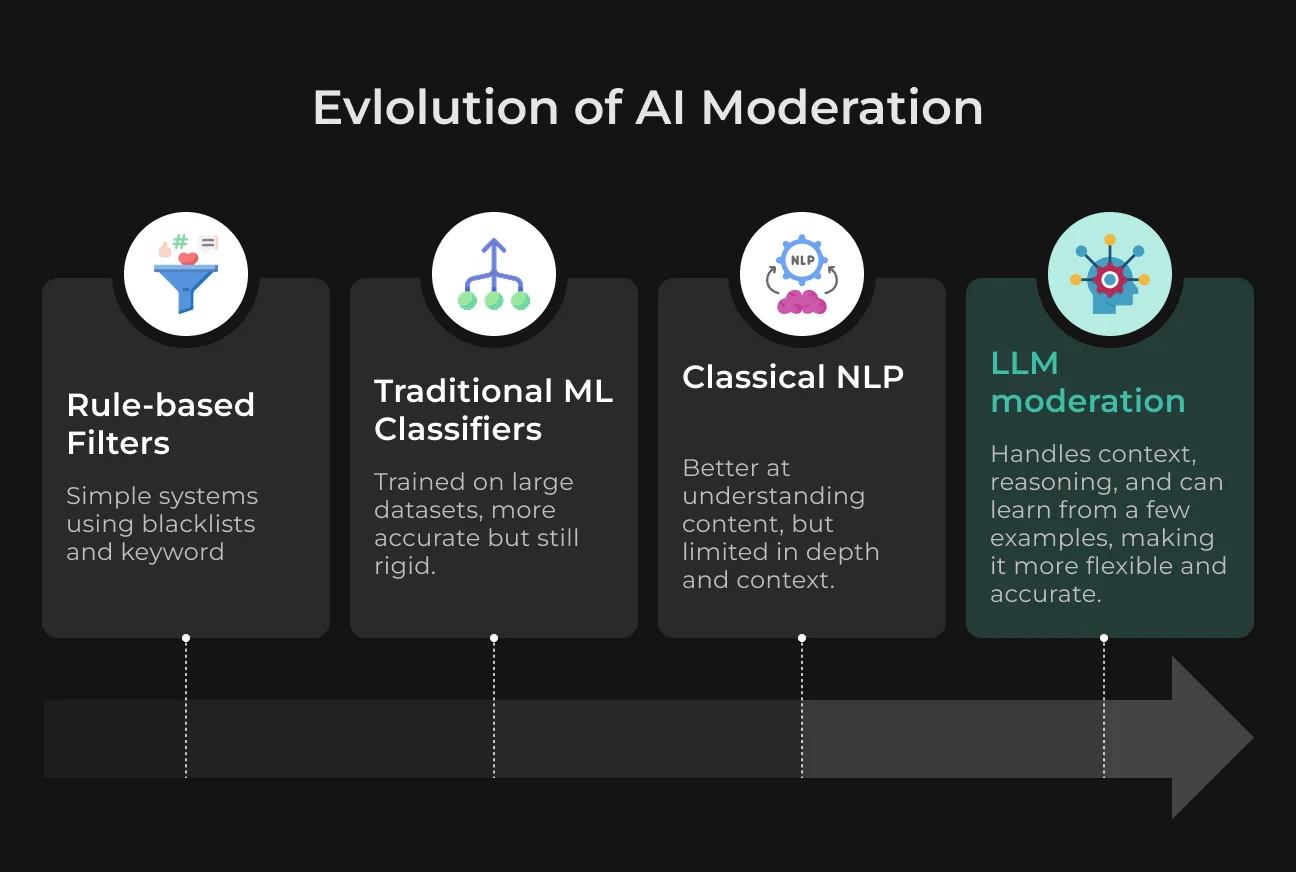
Let’s examine its elements.
Input Layer
Everything starts at ingestion — the point at which content enters the system. This first layer ingests multiple sources of information and compiles them in such a way that some preprocessing can take place. It also prepares input for the next level.
APIs
APIs are the leading integration point that allows platforms to send content (posts, comments, messages) to the moderation system. They allow checks to be performed in real time, which is essential for preventing the dissemination of harmful content.
Streaming Pipelines
Streaming pipelines process content in real time for platforms where activity never stops (social media or live chats). Event streams, for example, ensure that moderation is immediate as users engage.
Batch Ingestion
Not all moderation must also be quick. Batch processing is applied when analyzing large amounts of static content — historical data, reports, period audits, etc.
Processing Layer
After getting content, it goes to the analysis phase. This is the moment where raw data turns into valuable signals.
NLP Models
Natural language processing models detect hate speech, spam, misinformation, or intent to harm in the text. They analyze factors like keywords, tone, and sentence structure for this.
Computer Vision
For images and videos, computer vision models look for explicit content, violence, or dangerous imagery. They can also identify objects, faces, and contextual elements in images.
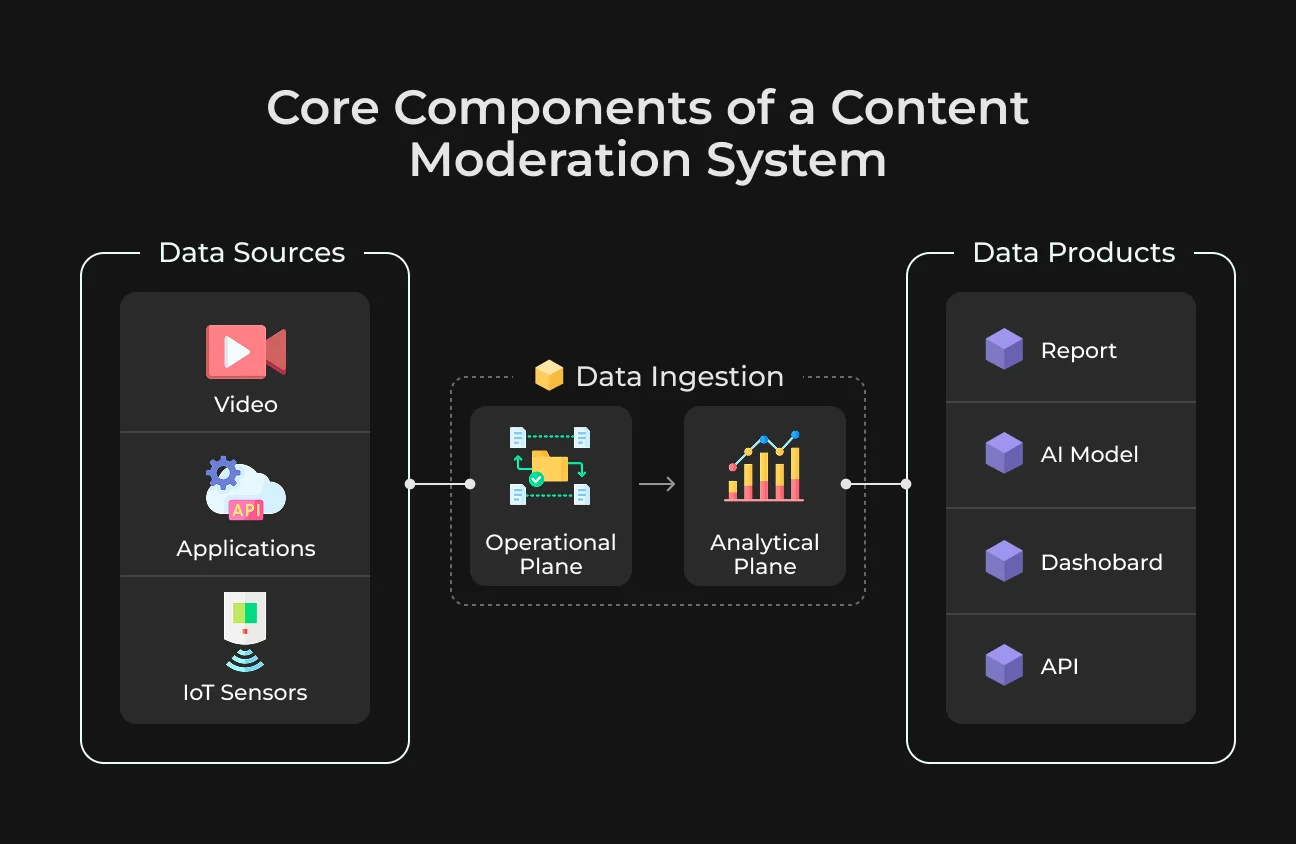
LLM-based Moderation
Traditional models usually identify harmful content based on heuristics or checklists. Consequently, moderation can be more accurate in complicated matters because large language models have a greater ability to understand context and sarcasm as well as subtle patterns in speech.
Decision Engine
This is the system's brain. It’s where all signals converge to decide what should happen next.
Rules + ML outputs
The system uses both manual codes (e.g., banned words or categories) and machine learning predictions. This hybrid strategy ensures both uniformity and adaptability.
Thresholds
Content is evaluated against confidence thresholds. So, for instance, if a model is 90% sure that the content is harmful, it could be automatically removed to satisfy compliance.
Scoring
Content is routinely assigned a risk score within your example. By default, it’s going to be based on language, user behavior, past violations, and so on. That score helps prioritize actions and determine whether the human takes a look at it too.
Action Layer
The system has to act or behave accordingly once a decision is made. The severity and platform policy will dictate actions, like:
Block
Content is immediately deleted or not allowed to get online.
Flag
Content is still visible but flagged for moderation either by humans or bots.
Shadow Ban
The content remains live, but its reach is slowed without the user being informed — a common tactic to reduce spam or malicious spread.
Escalate
Difficult or ambiguous cases are delivered to human moderators.
Feedback Loop
A robust moderation system is not set in stone — it also learns and adapts.
Retraining Models
Models are retrained and improved over time by using new data, including mistakes identified through flagging or emerging trends.
Human Review
Human moderators provide important feedback for edge cases. They are something of a particular frequency and help evolve what the rules are and what’s done by AI around it.
Continuous Improvement
Performance metrics, user reports, and audit results are looped back into the system to ensure it continues to learn from users’ behavior. And what the platform needs in terms of moderation.
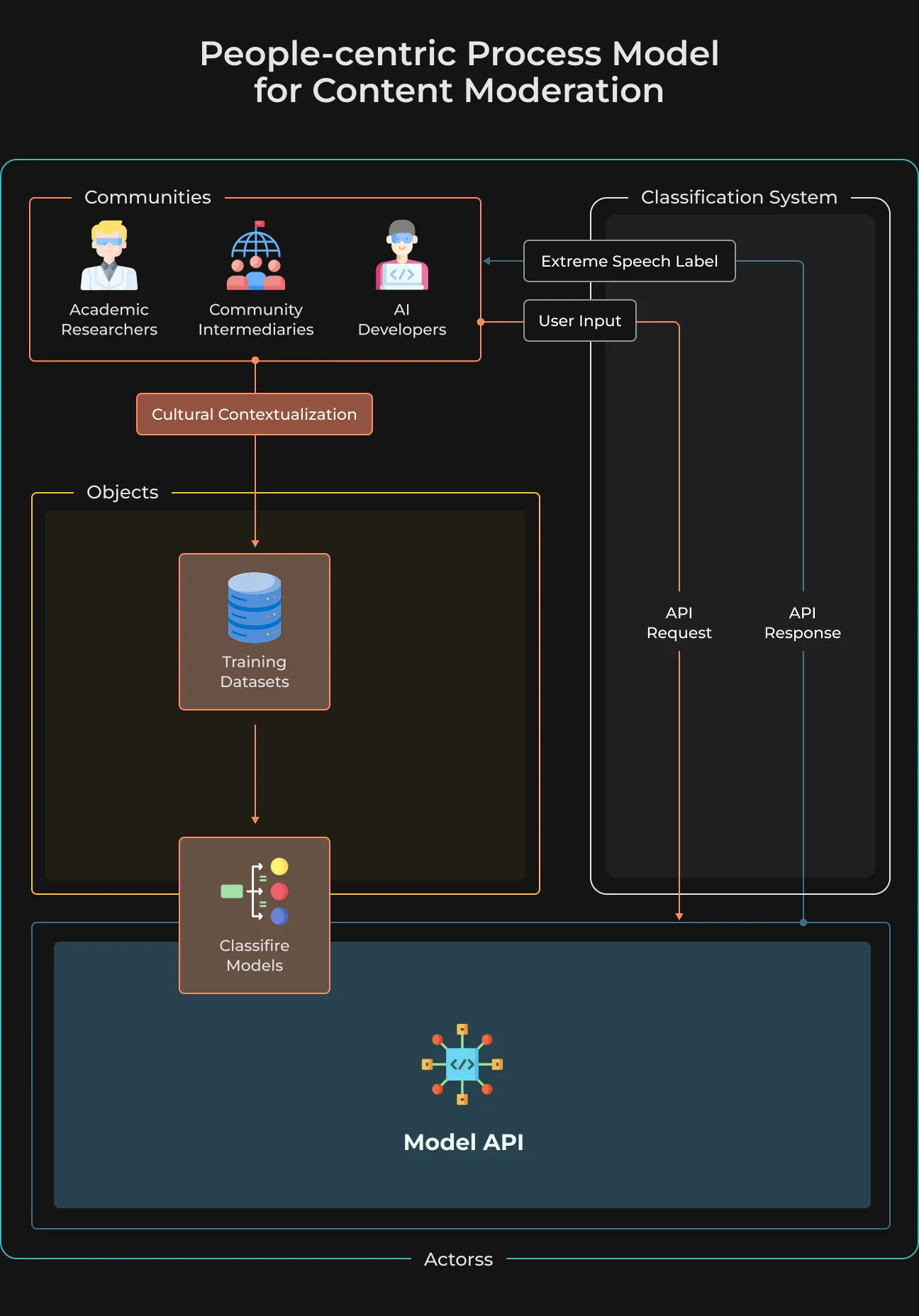
Step-by-Step: How to Build AI Content Moderation Solutions
An AI moderation system would have to be structured, based on clean data, and an iterative process. So, these are the steps from plan to deployment.
Step | Stage | Action | What to do |
1 | Planning | Define moderation goals and risk categories | Decide what your platform needs to detect, such as spam, hate speech, misinformation, explicit content, harassment, or policy violations. |
2 | Planning | Decide what types of content to track | Choose whether the system will moderate text, images, video, audio, or several formats at once. |
3 | Policy setup | Establish clear platform rules | Create moderation policies that explain what content should be allowed, flagged, limited, removed, or escalated. |
4 | Data preparation | Collect and label high-quality data | Prepare clean datasets with accurate labels so the AI system can learn from real examples of acceptable and harmful content. |
5 | Model selection | Select the right models for each moderation task | Use NLP models for text, computer vision for images and video, speech recognition for audio, and LLMs for complex context-based cases. |
6 | Infrastructure | Create a data pipeline | Build a system that can process both real-time content streams and batch content for later review. |
7 | AI implementation | Add AI moderation layers | Integrate NLP, computer vision, LLM-based moderation, or multimodal AI depending on your platform’s needs. |
8 | Decision logic | Define risk scores, thresholds, and decision rules | Set confidence levels that determine when content should be approved, flagged, blocked, or escalated. |
9 | Action setup | Define moderation actions | Decide what happens after analysis, such as block, flag, limit reach, shadow ban, or escalate to human review. |
10 | Human review | Add human review for tricky or sensitive cases | Use human moderators when content requires context, judgment, or ethical decision-making. |
11 | Testing | Test against real-world examples and edge cases | Check how the system performs with actual user-generated content, unusual cases, and platform-specific risks. |
12 | Optimization | Implement a feedback loop for retraining and optimization | Use moderator corrections, user appeals, and model errors to improve the system over time. |
13 | Monitoring | Monitor performance continuously after launch | Track accuracy, false positives, false negatives, time-to-removal, and user reports. |
14 | Maintenance | Update models and policies as threats evolve | Refresh datasets, retrain models, and adjust rules as new slang, risks, and abuse patterns appear. |
Build Safer Platforms with AI
Get expert help with scalable moderation systems.

Tech Stack for AI Content Moderation Systems
The right tech stack gives you the ability to process massive amounts of content in real time, accurately identify risk, and adapt as new forms of misuse develop. Below is a detailed explanation of key technologies used in general.
AI/ML Frameworks
These are tools you can build, train, and deploy moderation models with.
- TensorFlow is the choice for deployment in production systems at scale;
- PyTorch is often used for research and rapid development iterations. Its simplicity is what makes it great for building custom moderation models and experimenting with new techniques;
- Hugging Face ecosystem is a standard way to use NLP pre-trained models.
APIs & Cloud Services
Teams can use moderation tools on the cloud platform instead of building all the work from scratch.
- AWS Rekognition identifies unsafe or inappropriate content in images and videos;
- Google Cloud Vision allows for the analysis of images and use of text-processing data;
- Azure Content Moderator is an integrated filtering and classification solution for text, images, and videos.
Data & Infrastructure
Real-time moderation at scale means you need a powerful backend.
- Kafka's high-throughput real-time stream from the data is meant to process content in real time as it gets produced;
- Elasticsearch comes in handy if you need to switch to queries and searches at a faster pace, especially when you deal with huge datasets;
- Redis is an in-memory data store for fast access and is typically used as a caching layer (to cache moderation results) or the backend of near-real-time workflows.
Moderation Tools
These tools allow for more precise detection of harmful content, usually through a combination of artificial intelligence and written standards.
- Perspective API. Created by Google, it examines the text and assigns scores based on toxicity, so it can be applied to comment curation;
- OpenAI moderation endpoints. These detect harmful or policy-violating content across categories that can help automate moderation workflows.
Types of AI Content Moderation Techniques
Let’s go through the six different AI content moderation techniques and compare them.
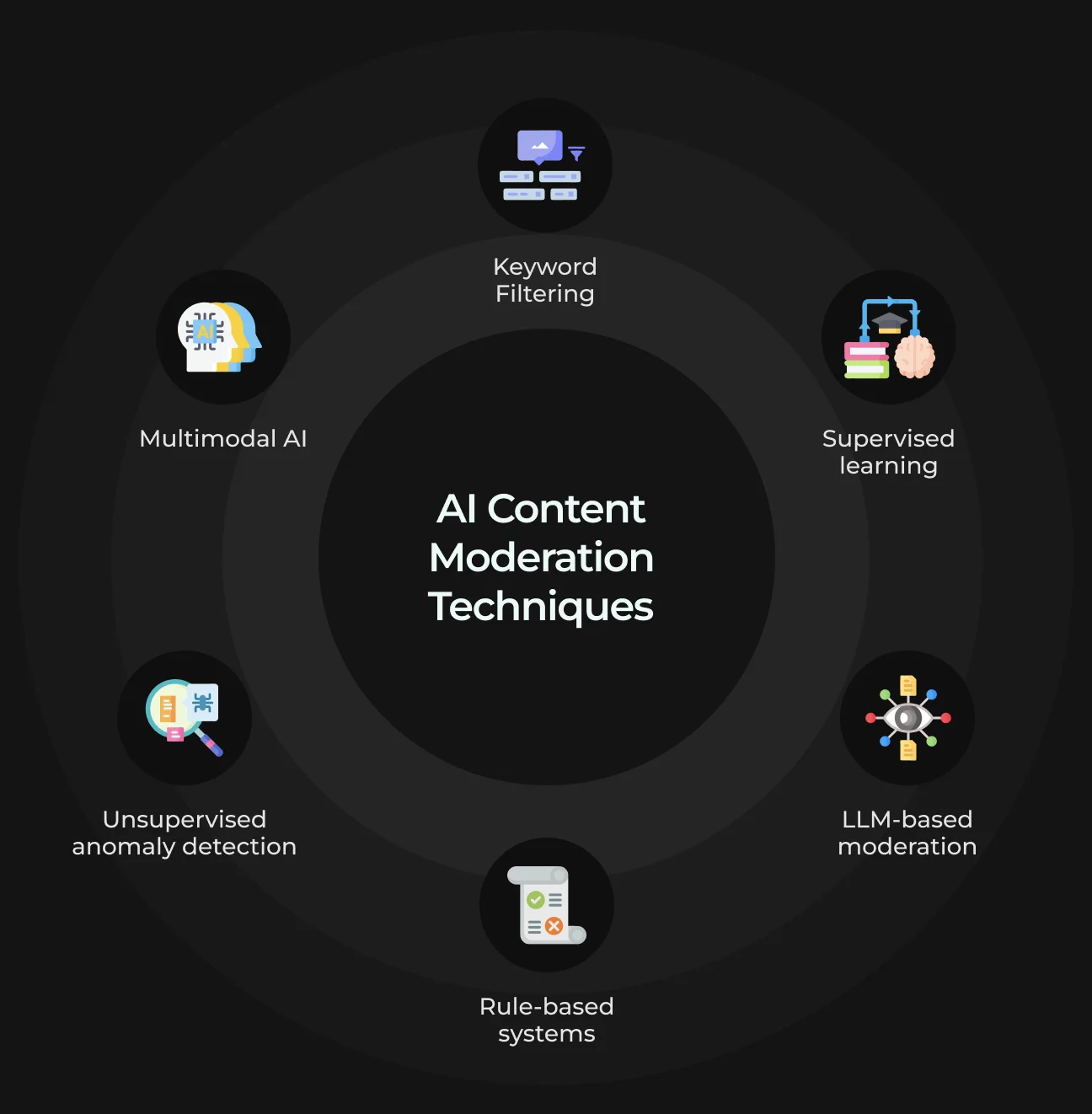
Keyword Filtering
This is the most basic form of a moderation approach, where content is scanned for certain words or phrases that have been linked to policy violations.
Modern moderation systems don’t just remember the words, but understand variations, misspellings, and even the context in which certain patterns appear to reduce false positives while keeping speed.
Rule-based Systems
A second category of moderation is rule-based, which assesses content according to previously laid out guidelines (using clearly written logic).
These systems can choose patterns like repeated characters, unusual links, or odd formatting. They are easy to control (and transparent) but often lack nuanced language and need constant updates.
Supervised Learning
These supervised learning models use labeled datasets containing examples of acceptable and harmful content to learn which is which. By learning from examples, such systems can detect the relatively subtle patterns of tone or wording.
They also rely on high-quality and diverse training data.
Unsupervised Anomaly Detection
Unsupervised methods aim to find anomalies based on outlier detection instead of labels.
By recognizing analytics that deviate from the routine, they can find new forms of abuse or organized spam and unusual content trends that may be missed by traditional systems.
LLM-based Moderation
Large language models introduce a deeper understanding of context to moderation. They can understand intent and switch among more than one language with ease.
LLM-based moderation is effective in complex or ambiguous moderation use cases.
Multimodal AI
Multimodal AI means analyzing two or more contrasting types of content — text, images, audio, video, etc. — in relation.
By cross-referencing these inputs, it streamlines the process of outlining the malicious material.
Content Moderation Best Practices
Here are a few tactics that can help you maintain your content moderation system and ensure it is serving your business.
Create Escalation Levels That Are Context-Specific
The majority of platforms break down when moderation is either on or off (that is to say, allow or remove). In practice, harmful content often exists in gray areas — sarcasm, coded language, or changing slang.
A better model is to layer a graduated response, for example:
- Low-risk — allowed but downrank;
- Medium risk — call for human review;
- High-risk — auto-remove.
Actually, not every problem requires deletion — sometimes lowering amplification is better than removal.
Ongoing Model Retraining on New Harm Modalities
Harm evolves fast. Static datasets become stale after months, particularly for misinformation narratives or political manipulation tactics.
For example, a few better practices would be:
- Retrain models every four to eight weeks on flagged content;
- Add some edge cases from human moderators;
- Incorporate regional slang datasets.
Moderation models should function more like systems in action — not static classifiers.
Don’t Just Measure Accuracy
Too often, the precision that most teams optimize for doesn’t correlate to real-world impact. Instead, try to track:
- Time-to-removal (how quickly harmful content is removed);
- Views (how many people saw it) before removal;
- Recirculation rate (how frequently content that was removed reappears).
Viral posts wrap up most of the views in 24-72 hours. So, a post deleted in 5 minutes leads to less exposure.
Build Specific, Not Generic, Review Teams
Human moderation is vital — but generic moderation teams are often left without context, leading to ad hoc decisions. An improved approach might be:
- Specialized moderator groups (e.g., medical misinformation, regional politics, cultural context);
- In combination with AI tools and trained on specific domains.
Basically, the future is not AI or humans. It’s domain experts working together with AI on complicated topics.
Common Mistakes to Avoid
As with any system — and particularly one that’s driven by AI — things might go wrong. These can occur as a result of having limited experience or just plain misjudgment. What really matters is recognizing these issues early and improving over time.
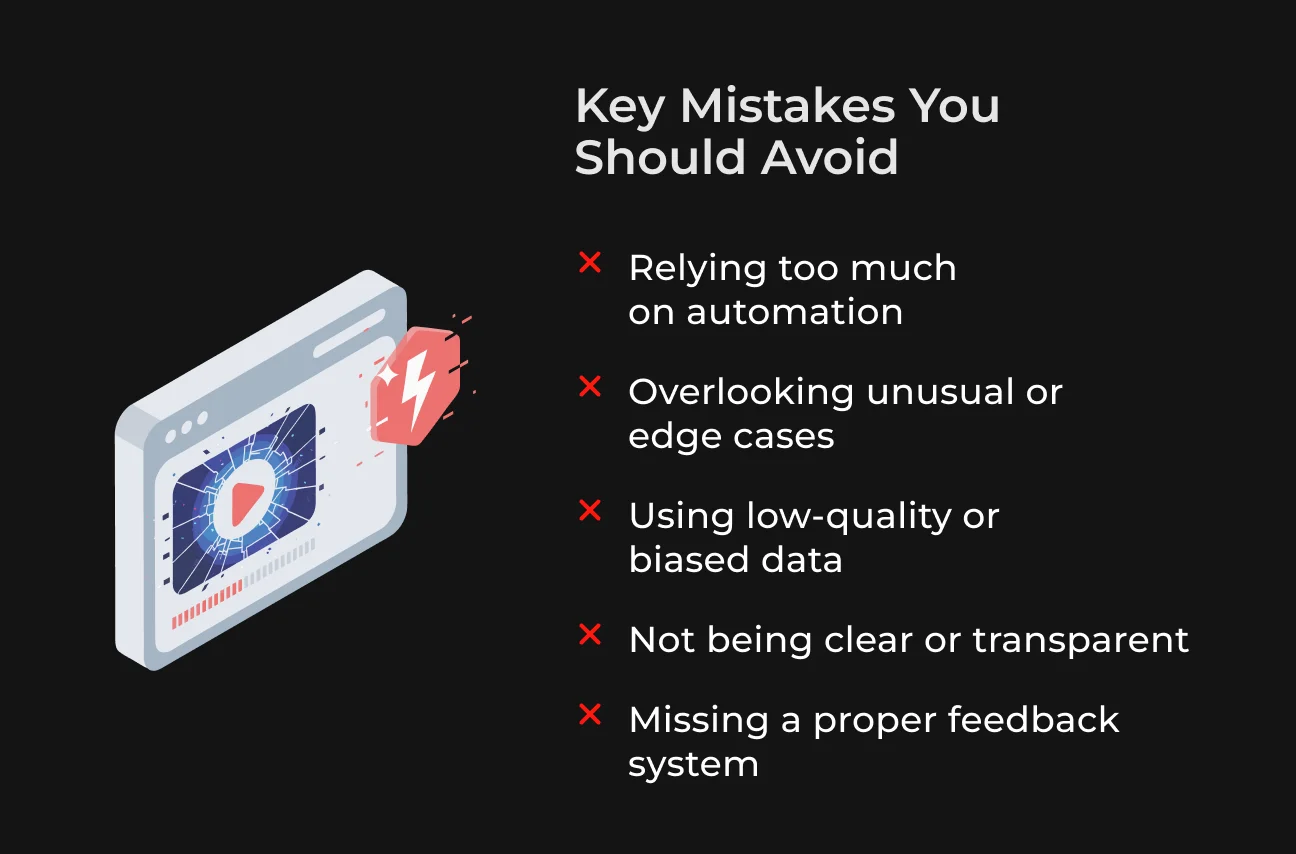
Here are some common mistakes.
Over-reliance on Automation
One might imagine the best scenario is to rely entirely on automated moderation systems — yet this often neglects some blind spots.
An AI system, for instance, might flag a benign joke as harmful content while missing nuanced forms of harassment. Any good system balances automation with human review.
Ignoring Edge Cases
The vast majority of moderation systems are built around typical content, but the real-world platforms they regulate are filled with exceptions.
Edge cases — coded language, memes, or context-dependent phrases — especially make systems fail. Failing to take these scenarios into account leaves holes that bad actors quickly learn how to exploit.
Poor Dataset Quality
A moderation model is only as valuable as the data it learns from. If the training data is old, biased, or focused too narrowly, then those issues will be reflected by the system.
If certain datasets don’t incorporate languages other than English, moderation may inadvertently tend toward an anti-non-English bias.
All of these datasets have to be diverse, current, and accurately annotated from the perspective of how people actually use the platform.
Lack of Transparency
Black box moderation systems breed frustration and can lead to allegations of bias or censorship. When moderation is explained clearly — showing what rule was broken or highlighting the offensive text — it feels more just and accountable.
No Feedback Loop
Moderation systems stagnate without ongoing feedback. They should all feed back into improving the model: user appeals, moderator corrections, new trends, etc.
If, say, people are continually appealing false positives and winning, that’s an indication your system could use some adjustment.
Content Moderation Use Cases in 2026
Look at these top use cases for content moderation to see in 2026.
Social Media Content Moderation Platforms
Instagram actually employs and trains many types of AI to proactively review and identify content that violates its community standards — like hate speech, harassment, nudity, graphic violence, or spam. The platform uses advanced language models to analyze text in captions, comments, and direct messages.
These systems are typically based on transformer architectures and recurrent neural networks that assess content and score it for risk. Since so many posts contain embedded text (like memes, screenshots or images with overlays), Instagram also uses OCR technology to read it.
Meta’s Rosetta system handles this by first detecting text areas within an image using a Faster R-CNN–style model, and then interpreting the extracted words with a ResNet-18–based neural network trained with sequence recognition techniques.
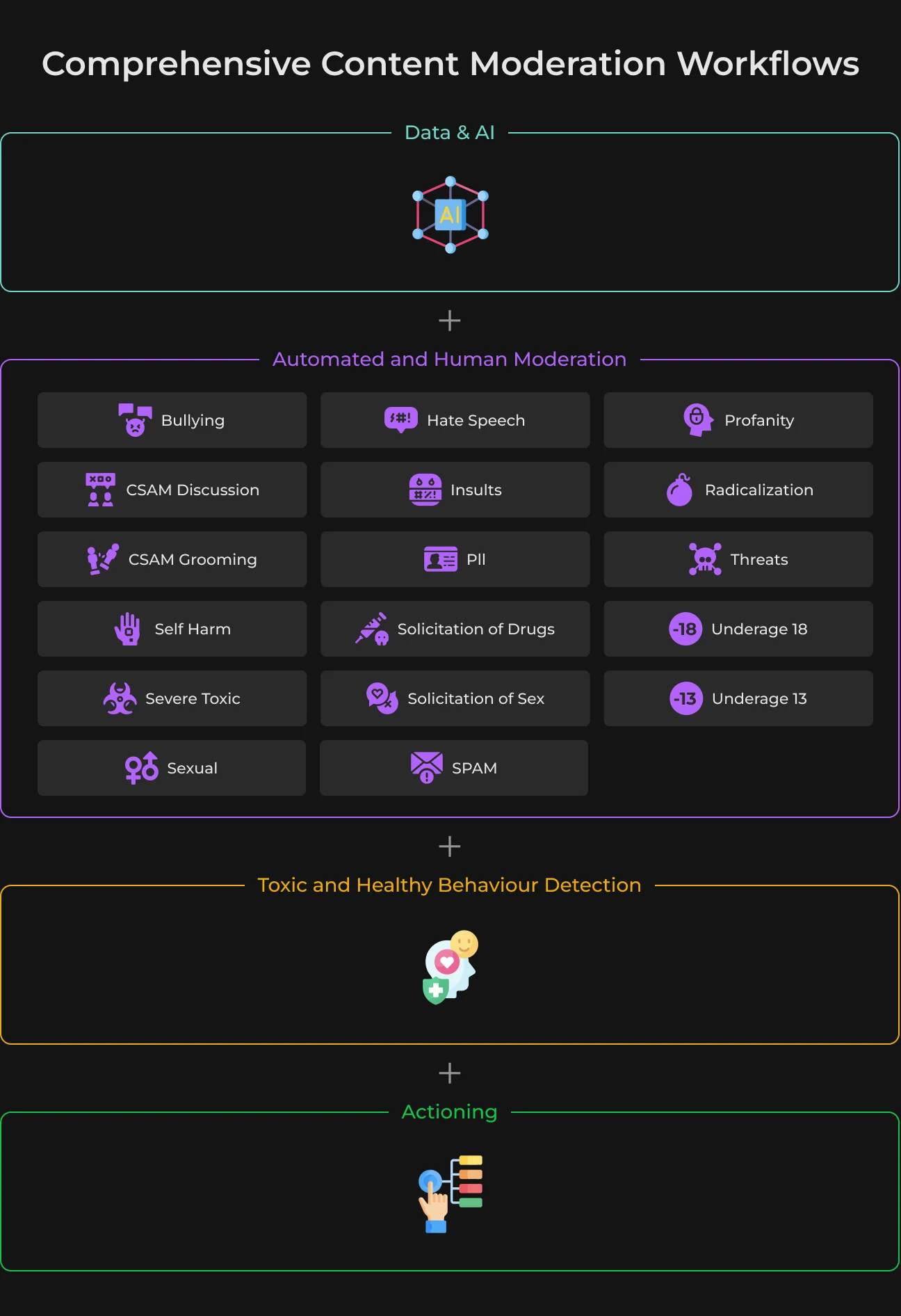
Marketplace Content Moderation
A user on the website searching for something, and instead encountering listings with blurry photos, inaccurate, or deceptive item descriptions, or even banned items, will probably leave.
When the marketplace becomes swamped with listings that contravene the rules, users start to feel it’s a little too unreliable and unsafe.
An AI-based content moderation tool can help marketplaces avoid such consequences. AI detects suspicious patterns (duplicate listings, inconsistent information, or hyper-unusual pricing), keeping customers and sellers safe.
Video Platforms
Platforms like YouTube or TikTok generate an immense quantity of content and serve over 100 million daily active users.
With so many uploads, it’s an actual effort to balance safety and fun. YouTube, for instance, employs a combination of machine and user-generated content moderation.
AI systems comb through natural language processing and inspect video titles, descriptions, and comments. They identify problems like hate speech, harassment, or other violations.
Additionally, videos generate unique fingerprints via perceptual hashing. This technique enables it to automatically identify and block re-uploads of previously removed content.
But even the best algorithms have difficulty with context. This is why human moderators are still back. And trained review teams review flagged videos, comments, and channels under platform policies to make sure decisions are fair.
Future Trends in AI-Based Content Moderation
If you want to know what AI content moderation will look like in 2026 and beyond, we detailed a few key trendds.
Generative AI Moderation
Moderation itself is being redefined by generative AI. We need systems to moderate user-generated content and to regulate AI-generated output. These large language models have begun to be used more frequently to identify potentially harmful patterns in language, generate synthetic training data, or even run simulated edge cases for training the best model.
This matters because of the explosion in AI-generated content — over 57% of web text may already be machine-translated, which is increasing the risk of misinformation and spam.
As a result, moderation is shifting from reactive filtering to AI vs. AI systems, in which models surveil and restrict other models.
Decentralized Moderation
Moderation rules can migrate away from a single point of control and be spread across communities, protocols, or blended with blockchain-based systems.
It also makes sense to have a cautious, localized approach where transparency in governance can reduce the bias of systems. Decentralized moderation is still a nascent movement, but it is growing as users have more demands on what they see.
Regulation-Driven Systems
Regulation will become a defining force behind how content moderation systems are engineered and operated. Governments across the globe are tightening requirements on everything from transparency and reporting to risk assessments.
AI-based moderation isn’t just a product feature anymore, it’s a requirement.
Companies have to explain how their systems work, justify decisions they make, and ensure that none of it runs afoul of what’s legal. The industry for AI content compliance expects a 28.4% CAGR from 2025 to 2033 and will be $16.3 billion by 2033.
Businesses need systems that are scalable and fair by design, so they can move through multiple jurisdictions without losing trust or compliance.
Build Your Content Moderation Solution with SapientPro
SapientPro builds custom content moderation systems for platforms that need fast, accurate, and safe content review at scale.
We develop SaaS solutions that handle large volumes of user-generated content, support real-time checks, and fit into your existing product architecture without slowing it down.
Our engineers can combine automated moderation with human-in-the-loop workflows, so your platform can detect harmful content faster while keeping sensitive or unclear cases under expert review. With SapientPro, you can build:
- Text, image, video, and audio moderation systems;
- Real-time content filtering for high-traffic platforms;
- Human-in-the-loop review dashboards;
- Custom rules, risk scoring, and escalation flows;
- Moderation tools for marketplaces, social platforms, EdTech, media, and SaaS products.
Want to make your platform safer without slowing down growth?
Let’s build a content moderation solution that fits your product, users, and business goals.
Create Your AI Moderation System
Turn moderation challenges into automated workflows.