All AI Audit: What It Is, Why It Matters & How to Do It Right in 2026
February 6, 202615 min read


We see how AI is developing entirely new business models and operations. It’s really making a difference in strategy, operations, talent, and trust. AI is all around us, from powering chatbots to purchase prediction algorithms.
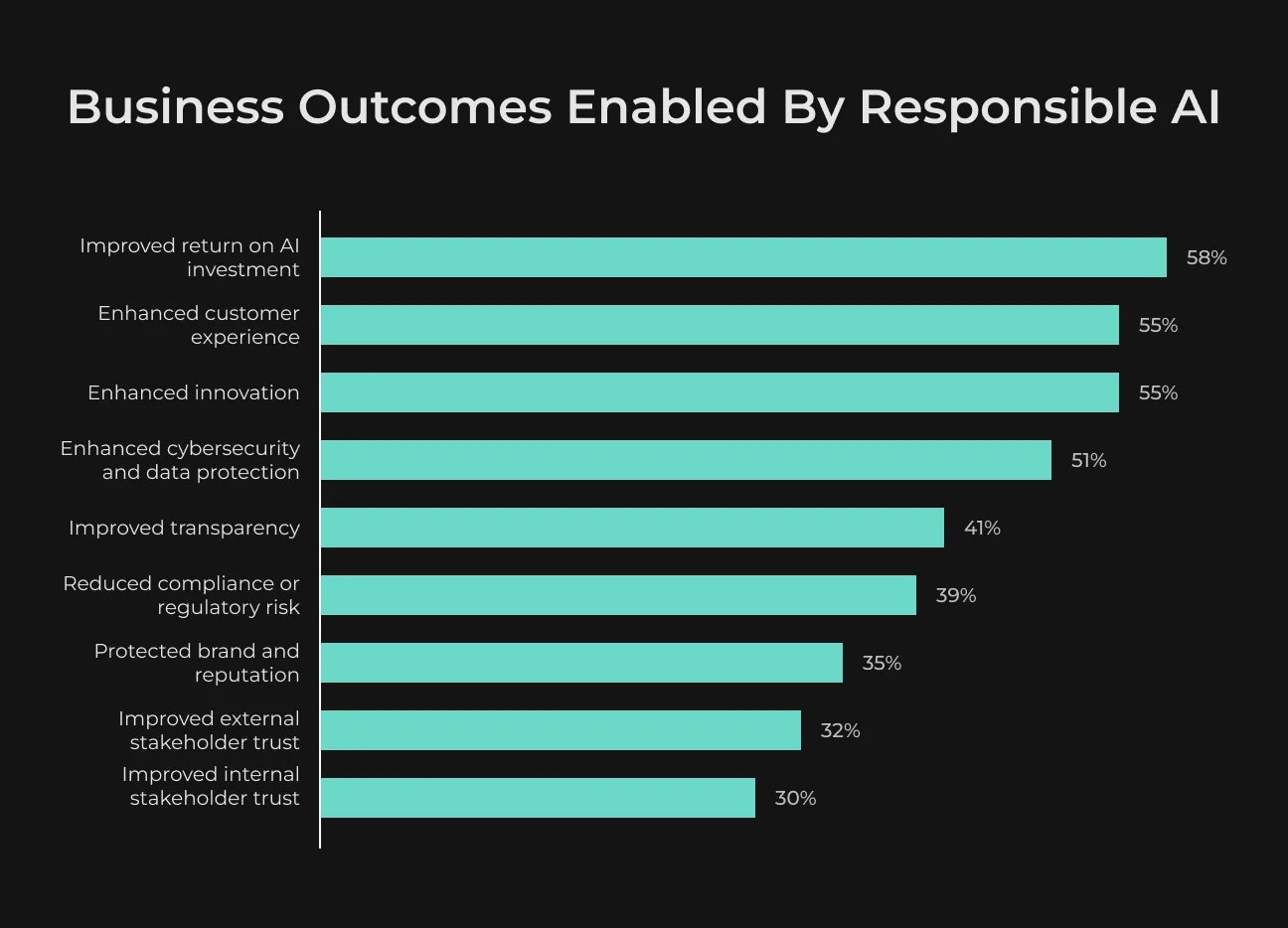
But such great power brings great responsibility. Recent studies suggest nearly 60% of executives believe responsible AI enhances ROI and efficiency. And 55% say it drives better customer experience and innovation.
Yet, how do we make sure AI systems are effective and safe, working for us and safeguarding personal information?
This article explains what an AI audit is and why it matters in 2026. You’ll learn about crucial elements of AI systems, best practices, how to audit AI, and much more.
What is an AI Auditing?
Where typical audits might be good for finances or IT, AI reviews examine every step of an AI system lifecycle. They verify whether a company’s use of AI is consistent with its governance, risk management, and ethical practices.
Here we go over some key questions to ask when preparing an AI audit:
- Is the company’s AI system in compliance with existing rules and ethical principles?
- How is user data privacy secured?
- How do you support the continuous operation of AI models?
- Do AI algorithms have bias?
- Can non-technical stakeholders understand and interpret the AI system’s outputs?
An AI audit can help improve how AI systems function and learn (and spread) across different domains. It guarantees AI is well curated, ethical, and serves the purpose of the organization.
Why AI Audits Are Important in 2026
AI already drives significant advances in applications like mortgage approvals, healthcare, and social media management. These solutions help us work faster and more effectively, but they can also cause problems if we don’t use them in the right way.
For example, bias can emerge from poorly designed AI. Systems like these are exposed to cyberattacks, and might not be trusted. Regions from East Asia and the Pacific to Europe and some American states have been rushing to pass laws to govern AI.
In 2024, the US alone passed 82 bills on AI into law.
The European Union’s Artificial Intelligence Act defines AI risks and demands solid auditing. The National Institute of Standards and Technology (NIST) shared their own approach to making AI systems more trustworthy.
Businesses are forced to be more transparent in declaring the data they use to train AI models.
AI developers need to make clear how their products function, prove that the development of those models was legal, and show they’re safe and accountable if any risks arise.
AI audits are what keep issues from getting worse, simplify data management, ensure legal compliance, and build trust with customers and investors.
Role of AI in Traditional Auditing
AI transforms traditional auditing, and here's how AI does that.
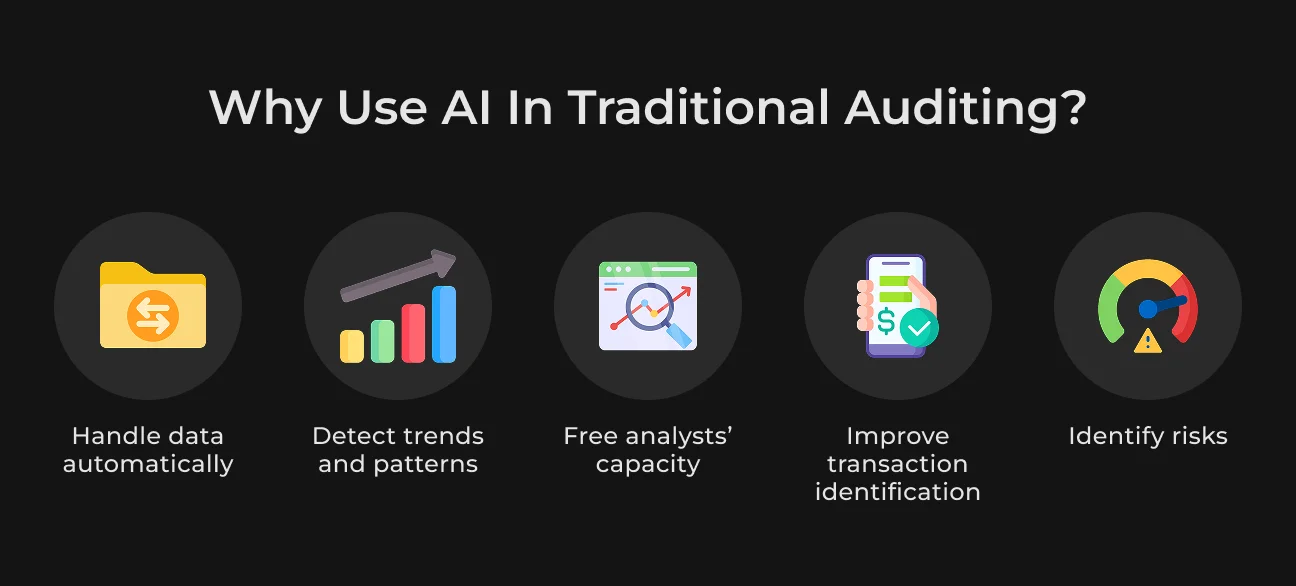
- AI automatically handles data.
It can quickly and accurately extract and verify data from the broadest possible range of sources.
- AI detects patterns.
AI is excellent at finding patterns and anomalies in giant datasets. This is crucial in the context of AI audits to identify unusual behavior or biases. The ability to detect patterns also enables auditors to make sure AI systems comply with regulations and ethics.
- It frees strategic analysts' capacity.
Automation provides the opportunity for audit teams to focus on the more strategic analysis, rather than routine ticking and bashing. Auditors can then concentrate their efforts on decision-making or sustainability aspects related to AI investments.
- AI improves transactional identification.
AI can constantly monitor transactions, making it easier to catch potential risks or anomalies sooner for immediate action. This increases the extent of trust in AI software.
- AI identifies risks.
Auditors can produce fine-grained risk profiles to identify weaknesses and develop a solid basis for risk management.
Key Components of an AI Audit
An AI audit identifies risks, increases accountability, and builds trust with involved parties. It covers the technical side as well as how effectively a system is run within ethical and regulatory frameworks.
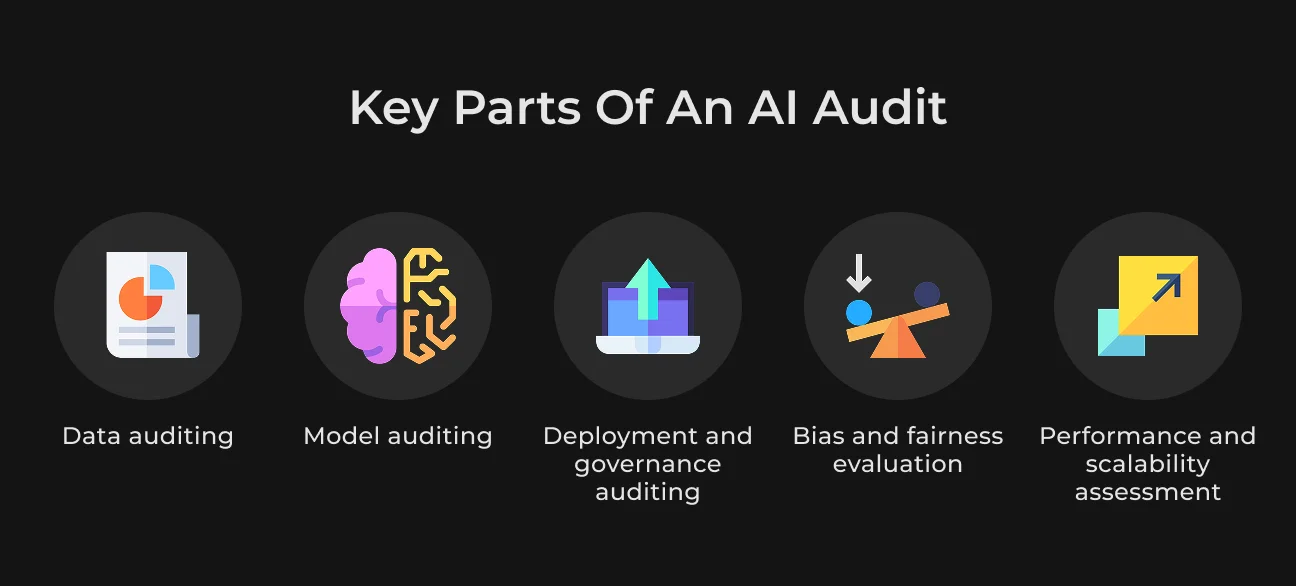
Let’s unpack the core components of an AI audit and look at how they allow for a comprehensive assessment of AI systems.
Data Auditing
Data auditing helps maintain the integrity, quality, and compliance requirements of data that an AI system is trained on. This covers evaluating sources of information for accuracy, completeness, and relevancy.
This component also includes approving data collection practices to ensure they follow legal standards. Plus, it checks data labeling and preparation methods to remove any bias.
Model Auditing
Model auditing evaluates the characteristics of design and performance of AI models.
It basically examines the architecture of the model, as well as the training and testing procedures for prediction validity and trustworthiness.
It's about subjecting models to a variety of scenarios and seeing how they perform in testing for weaknesses or bias.
Deployment and Governance Auditing
This shows how AI models are deployed and governed in a company. This type of auditing checks deployment guides to ensure they follow governance rules and ethical standards.
Bias and Fairness Evaluation
These evaluations identify and mitigate biases that could affect the fairness of AI outcomes.
AI models are tested for their adverse impact on different demographic groups and frameworks to mitigate algorithmic bias. This is to guarantee that there is fairness and the AI system's choices do not create social prejudice.
Performance and Scalability Assessment
Through scalability testing, we verify that the AI system functions correctly and scales effectively as demand grows.
Load testing, for example, helps predict how well a system will handle large demands and how it will scale as capacity grows, all without losing performance quality.
AI Audit Regulations in 2026
Laws and proposed standards are starting to affect AI audits around the globe. Some are already occurring, and many more are coming. Several important regulations include.
EU Artificial Intelligence Act
The aim of the EU Artificial Intelligence Act is nothing less than setting global norms for AI results that impact people. It offers a structure to guarantee AI is applied in a safe and responsible way within the EU.
The Act differentiates between AI providers (developers) and deployers (users), assigning them certain compliance obligations.
AI Risk Management Framework
In 2023, NIST released a voluntary framework designed to assist organizations in the identification of AI risks at every level. Even though the executive order for federal agencies to use it was canceled, the framework still serves as a helpful guide.
ISO/IEC 42001
ISO/IEC 42001 is the world’s first standard for AI systems. It offers a set of tools to monitor the development and societal impact of AI systems. ISO/IEC 42001 also investigates controversial topics like ethics, transparency, or lifelong learning.
ISO/IEC 42006
ISO/IEC 42006 introduces further rules for organizations that audit and certify AI management systems to ISO/IEC 42001. This standard aims to deal with issues like ethics, quality, and integrity of data, risk, and transparency associated with AI.
It provides that auditors have the necessary expertise and criteria by which to make reliable and consistent assessments.
AI Principles
To date, more than 40 members of the Organization for Economic Co-operation and Development (OECD) have endorsed these AI principles on a non-binding basis (since their adoption in 2019).
They basically promote equity, transparency, and robust security as a universal model for national legislations to refer to.
Key AI Auditing Frameworks to Follow
Frameworks are essential for interpreting regulatory requirements and can guide in setting practical auditing standards. There is no such standard audit, and most organizations will mix and match some of the frameworks to develop an audit strategy. Here are some common frameworks.
COBIT
Originally designed for IT governance, COBIT is now an adaptable management tool for AI systems. It gives companies a framework to direct the integration of AI systems from beginning to end, solving issues that are unique to AI.
One of the biggest advantages of COBIT is that it makes it clear who owns AI projects, so every project has a sponsor in place to uphold governance.
COSO Enterprise Risk Management (ERM) Framework
The COSO ERM Framework offers clear guidance on how to address AI risks. It sees AI as a strategic force that's going to transform everything from inside a company.
This model supports the control of AI risks to meet business objectives. It also shields companies from regulatory concerns, particularly regarding data privacy and algorithm transparency.
IIA Artificial Intelligence Auditing Framework
The Institute of Internal Auditors (IIA) has issued an Artificial Intelligence Auditing Framework to assess the governance, risks, and controls over AI systems.
This relies on the three lines model to provide adequate supervision. There is governance, which establishes policies and ethical guidelines; management that has oversight over responsible AI implementation. And an internal audit that offers independent assurance.
GAO AI Accountability Framework
The AI Accountability Framework facilitates responsible use of AI across the federal government and other organizations. This is a model that focuses on practical accountability and ongoing evidence-based evaluation. Businesses must designate individual people or groups to be accountable for each AI system.
Implementing good governance also depends on different perspectives of technical teams, business leaders, and end users. Because even the highly experienced compliance officer has no direct control over every user or system.
UNESCO Ethics of Artificial Intelligence
The UNESCO Recommendation on the Ethics of Artificial Intelligence is an international standard ratified by 193 countries in November 2021. This is a specific and legally backed guide on the entire AI lifecycle focused on human rights, transparency, fairness, and safety.
The Global AI Ethics and Governance Observatory is also a tool for addressing key challenges of AI. This is done, for example, through surveying how prepared (or not) different countries are to use AI without causing harm.
Dialect-Sensitive AI Voice Assistant
See how SapientPro made a solution with 80% dialect accuracy for the Arabic market.
Best Practices in AI Auditing
We have no doubt you want to get the maximum value from your AI systems and see them profitable and beneficial for users.
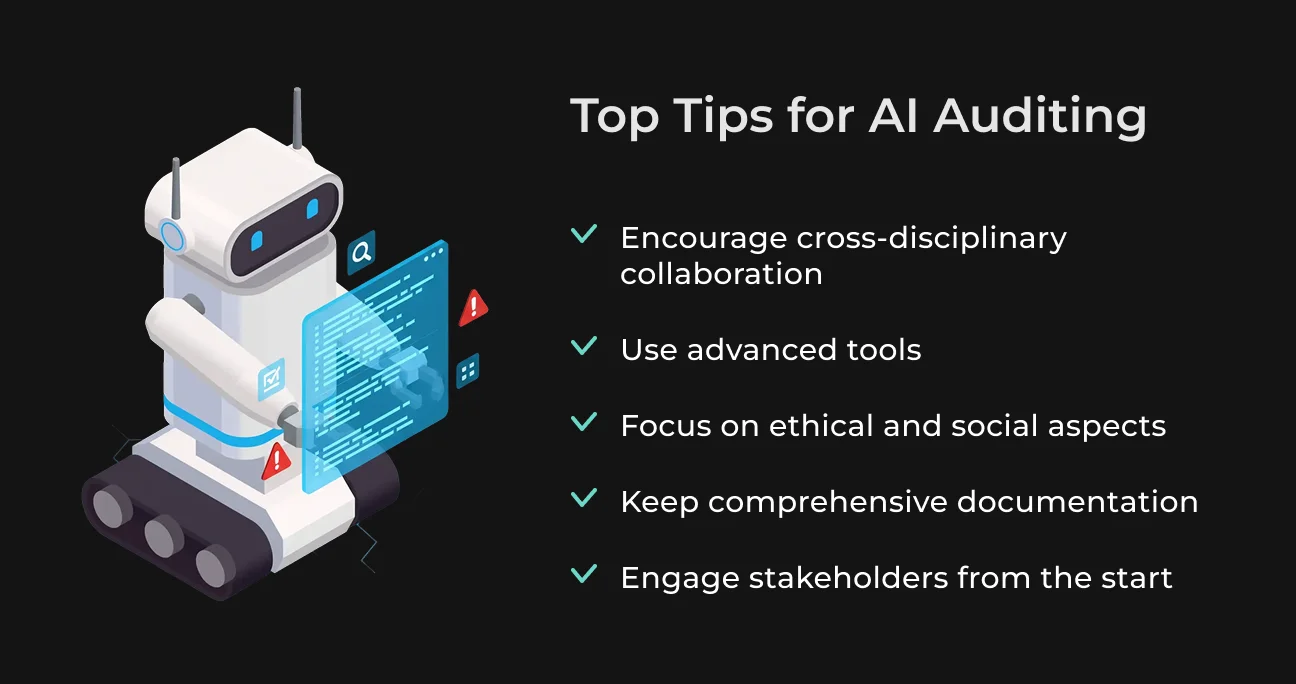
Below are four AI audit best practices that will help your team successfully deploy, audit, and optimize AI.
1. Improve Cross-Disciplinary Collaboration
For an artificial intelligence audit to be launched effectively, it should be conducted by multi-disciplinary competencies (such as data science, ethics, law, and sector-specific experienced practitioners).
It is quite practical to merge technical, organizational, human, and systems views for a holistic picture.
When you have a team of diverse stakeholders, it becomes clear what the hidden sources of risks and opportunities are.
2. Leverage Advanced Tools
Given that everyone’s talking about AI, it can be tempting to just dive in with major changes and automate all the things when it comes to testing. But there’s a more intelligent approach to beginning with AI auditing — focus on quick wins.
AI can be used for tasks like content creation, research organization, and daily searches, both in the initial stages of an audit and for background processes. This will help users ease into the technology.
Later, once you are ready to scale up AI in the reporting stages, you will require more sophisticated tools. This includes establishing clear prompt libraries for everyone on a team to use.
For the best results, it's often key to give AI substantial context about your role and tasks. A prompt library can help bypass this step by providing the most effective and reliable prompts from the start.
3. Ensure Comprehensive Documentation
It’s crucial to document all your work and make it easy for all to follow the trail when auditing AI. It helps figure out why a system made the decision it did.
Different types of data are kept to maintain stellar performance. These include documented methods, reports, findings, and decision rationales. They help create a clear audit trail that future evaluations and audits can use.
It is also beneficial for interested (involved) parties to be familiar with the results of audits.
4. Engage Stakeholders Early in the Process
Any quality AI audit would need to draw in the most significant stakeholders. It would guarantee that all views are considered by involving their input from the outset. So that audit goals match those of the organization and its stakeholders.
Early involvement also helps promote open and clear communication of audit results. And it creates the right atmosphere for implementing changes.
Challenges in AI Auditing
How might we guarantee that an AI engine, unlike the traditional auditing sets, is trustworthy, fair, and accurate? We should uncover any potential concerns about how AI audits actually work and address them on time.
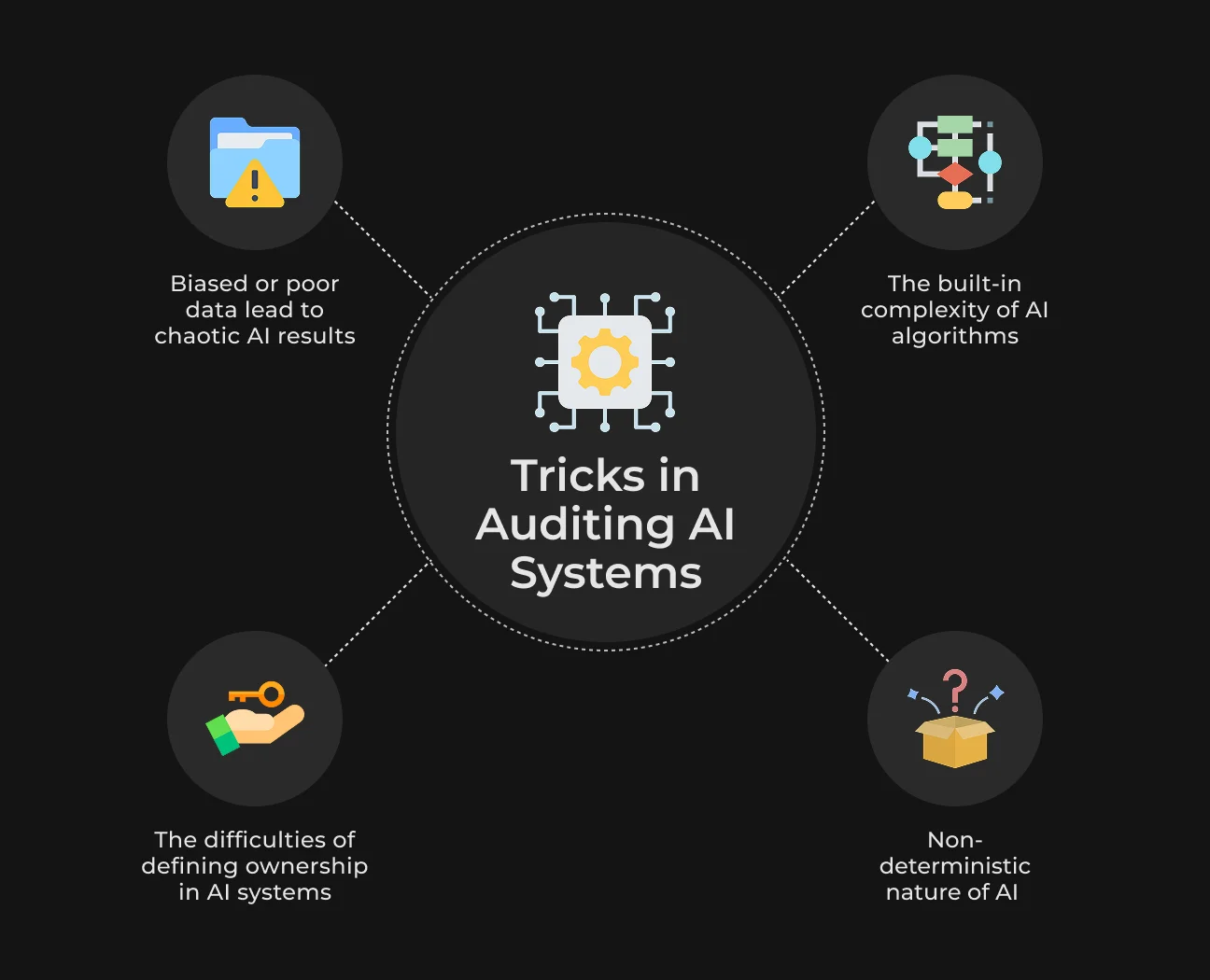
Biased or Poor Data Lead to Chaotic AI Results
AI bias occurs when AI systems based on bad or poor logic make unfair decisions, often prejudiced ones. Because AI learns from data, if data contains societal biases, it can learn and perhaps even exacerbate them.
In auditing, AI bias can screw up results in several ways. It could result in the wrong risk assessments, unfairly marking some areas or populations as high-risk and others as not.
There’s also the chance that AI bias can lead to discriminatory outcomes. For example, an AI system used to detect fraud might erroneously mark the transactions of people belonging to certain racial groups as more fraudulent than others.
The Built-in Complexity of AI Algorithms
AI algorithms, and especially those involving deep learning, tend to operate as “black boxes.” You really can’t know for sure how algorithms are making their decisions. This lack of transparency makes it all but impossible to find out errors or bias in an algorithm.
Auditors can use tools like explainable AI to understand how the processes work together. This enables them to comprehend complex decisions and validate the reasoning for AI-generated selections.
The Difficulties of Defining Ownership in AI Systems
Ownership and responsibility of such systems are hard to establish, as they are typically built through team efforts.
Who should maintain, update, and fix an AI model is a question organizations can’t yet seem to answer. Firms can guide their AI toward more responsible paths by setting clear rules and assigning specific responsibilities.
Non-Deterministic Nature of AI Systems
With deterministic algorithms, every time you provide the same input — you'll get the same output. Non-deterministic AI models, on the other hand, can give different outputs or predictions each time they are used. Lack of confidence makes it hard to check whether they are working properly or not.
AI audit software developers must take a different path when verifying AI or machine learning systems. Instead of the commonly used pass/fail tests, what we want to have are reliable average performance estimates.
It’s also key to track performance once the system is live, because the input data can make a difference in how well or not the system works.
Partner with SapientPro to Audit Your AI Solution
SapientPro develops custom audit plans for artificial intelligence systems aligned with your requirements and industry standards. Our team assesses every aspect from data transparency to testing and validation to ensure your AI solution satisfies all the technical, legal, and ethical needs.
We have extensive experience working with AI products:
- Optimizing Safety Data Sheets with AI Automation
- Language Learning Assistant Enhanced by AI
- AI Assistant for Easier Online Shopping
Based on advanced technology, our approach makes the AI auditing process more robust and precise, detecting risks that traditional methods tend to miss.
Get in touch with us to get the best AI audit plan for your products.
Audit Your AI Solution
SapientPro's experts will ensure your AI is compliant, efficient, and has no vulnerabilities.